Good Morning…… Nina Joyce C. Macay
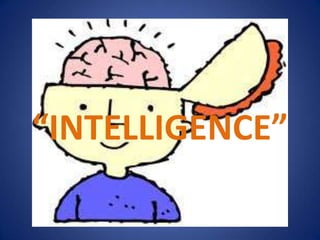
“INTELLIGENCE”
What is INTELLIGENCE?
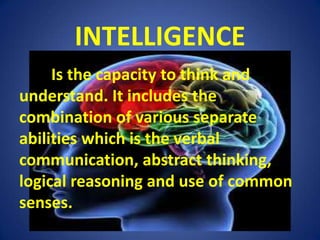
INTELLIGENCE	Is the capacity to think and understand. It includes the combination of various separate abilities which is the verbal communication, abstract thinking, logical reasoning and use of common senses.
Four Different ApproachesPsychometric ApproachFactor Analysis and General IntelligenceCognitive ApproachImplicit Theory Approach
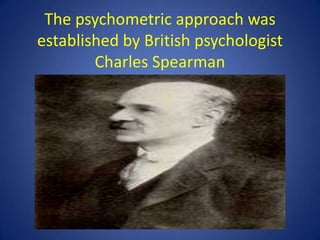
Psychometric Approach Refers to measurement of hidden intelligence or mental characteristics. Through analysis of results of intelligence tests the structure of human intelligence is caused by one factor or a combination factors.The psychometric approach was established by British psychologist Charles Spearman
Factor Analysis and General IntelligenceThis approach is similar to the concept of “factoring” in mathematics where complex algebraic expressions are simplified to arrive at the common multiplier of all terms.
Factor analysis establishes the relation of different measures of intelligence.
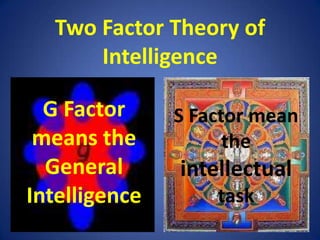
Factor analysis will reveal a different common factor given particular situation.Two Factor Theory of IntelligenceG Factor means the General IntelligenceS Factor mean the intellectual task
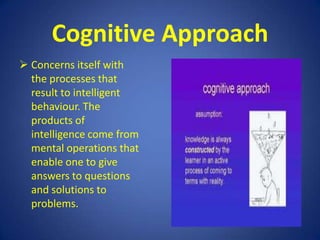
Cognitive ApproachConcerns itself with the processes that result to intelligent behaviour. The products of intelligence come from mental operations that enable one to give answers to questions and solutions to problems.Robert Sternberg has argued that there is a joint operation of COMPONENT and METACOMPONENTS of intelligence.
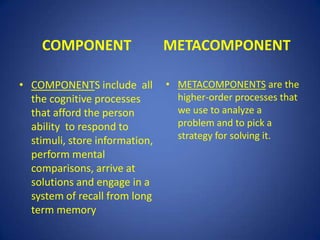
COMPONENTMETACOMPONENTCOMPONENTS include  all the cognitive processes that afford the person ability  to respond to stimuli, store information, perform mental comparisons, arrive at solutions and engage in a system of recall from long term memoryMETACOMPONENTS are the higher-order processes that we use to analyze a problem and to pick a strategy for solving it.
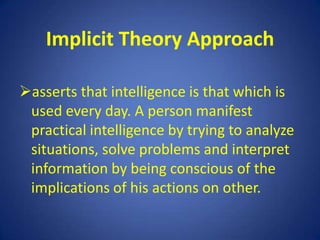
Implicit Theory Approachasserts that intelligence is that which is used every day. A person manifest practical intelligence by trying to analyze situations, solve problems and interpret information by being conscious of the implications of his actions on other.Three Factors which Affect Modern Development, Psychologists point to Age-Related Changes – Universal, Group Specific and Individual
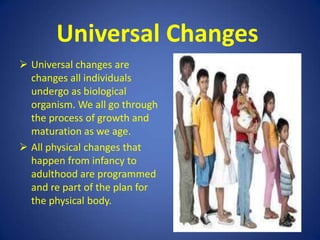
Universal ChangesUniversal changes are changes all individuals undergo as biological organism. We all go through the process of growth and maturation as we age.
All physical changes that happen from infancy to adulthood are programmed and re part of the plan for the physical body.“Right time to live an independent life”
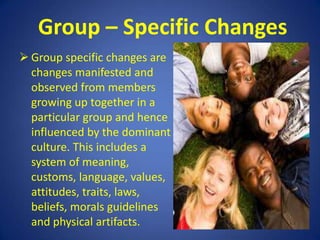
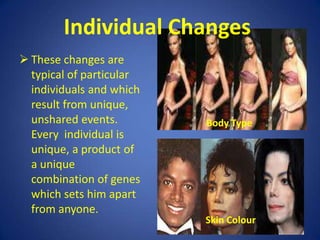
Group – Specific ChangesGroup specific changes are changes manifested and observed from members growing up together in a particular group and hence influenced by the dominant culture. This includes a system of meaning, customs, language, values, attitudes, traits, laws, beliefs, morals guidelines and physical artifacts.Individual ChangesThese changes are typical of particular individuals and which result from unique, unshared events. Every  individual is unique, a product of a unique combination of genes which sets him apart  from anyone.Body TypeSkin Colour
Facial Contours
Other Individual differencesCritical Period – is the stage at which an individual is most sensitive to the presence or absence of some particular experience.Sensitive Period – is the stage at which a child may be particularly responsive to specific forms of experience or particularly influenced by their absence.
Thank You……. 
Report in child and adolescent development

Report in child and adolescent development

  • 1.
  • 2.
  • 3.
  • 4.
    INTELLIGENCE Is the capacityto think and understand. It includes the combination of various separate abilities which is the verbal communication, abstract thinking, logical reasoning and use of common senses.
  • 5.
    Four Different ApproachesPsychometricApproachFactor Analysis and General IntelligenceCognitive ApproachImplicit Theory Approach
  • 6.
    Psychometric Approach Refersto measurement of hidden intelligence or mental characteristics. Through analysis of results of intelligence tests the structure of human intelligence is caused by one factor or a combination factors.The psychometric approach was established by British psychologist Charles Spearman
  • 7.
    Factor Analysis andGeneral IntelligenceThis approach is similar to the concept of “factoring” in mathematics where complex algebraic expressions are simplified to arrive at the common multiplier of all terms.
  • 8.
    Factor analysis establishesthe relation of different measures of intelligence.
  • 9.
    Factor analysis willreveal a different common factor given particular situation.Two Factor Theory of IntelligenceG Factor means the General IntelligenceS Factor mean the intellectual task
  • 10.
    Cognitive ApproachConcerns itselfwith the processes that result to intelligent behaviour. The products of intelligence come from mental operations that enable one to give answers to questions and solutions to problems.Robert Sternberg has argued that there is a joint operation of COMPONENT and METACOMPONENTS of intelligence.
  • 11.
    COMPONENTMETACOMPONENTCOMPONENTS include all the cognitive processes that afford the person ability to respond to stimuli, store information, perform mental comparisons, arrive at solutions and engage in a system of recall from long term memoryMETACOMPONENTS are the higher-order processes that we use to analyze a problem and to pick a strategy for solving it.
  • 12.
    Implicit Theory Approachassertsthat intelligence is that which is used every day. A person manifest practical intelligence by trying to analyze situations, solve problems and interpret information by being conscious of the implications of his actions on other.Three Factors which Affect Modern Development, Psychologists point to Age-Related Changes – Universal, Group Specific and Individual
  • 13.
    Universal ChangesUniversal changesare changes all individuals undergo as biological organism. We all go through the process of growth and maturation as we age.
  • 14.
    All physical changesthat happen from infancy to adulthood are programmed and re part of the plan for the physical body.“Right time to live an independent life”
  • 15.
    Group – SpecificChangesGroup specific changes are changes manifested and observed from members growing up together in a particular group and hence influenced by the dominant culture. This includes a system of meaning, customs, language, values, attitudes, traits, laws, beliefs, morals guidelines and physical artifacts.Individual ChangesThese changes are typical of particular individuals and which result from unique, unshared events. Every individual is unique, a product of a unique combination of genes which sets him apart from anyone.Body TypeSkin Colour
  • 16.
  • 17.
    Other Individual differencesCriticalPeriod – is the stage at which an individual is most sensitive to the presence or absence of some particular experience.Sensitive Period – is the stage at which a child may be particularly responsive to specific forms of experience or particularly influenced by their absence.
  • 18.