Learning Theories


        Piaget, Vygotsky, and
        Bruner
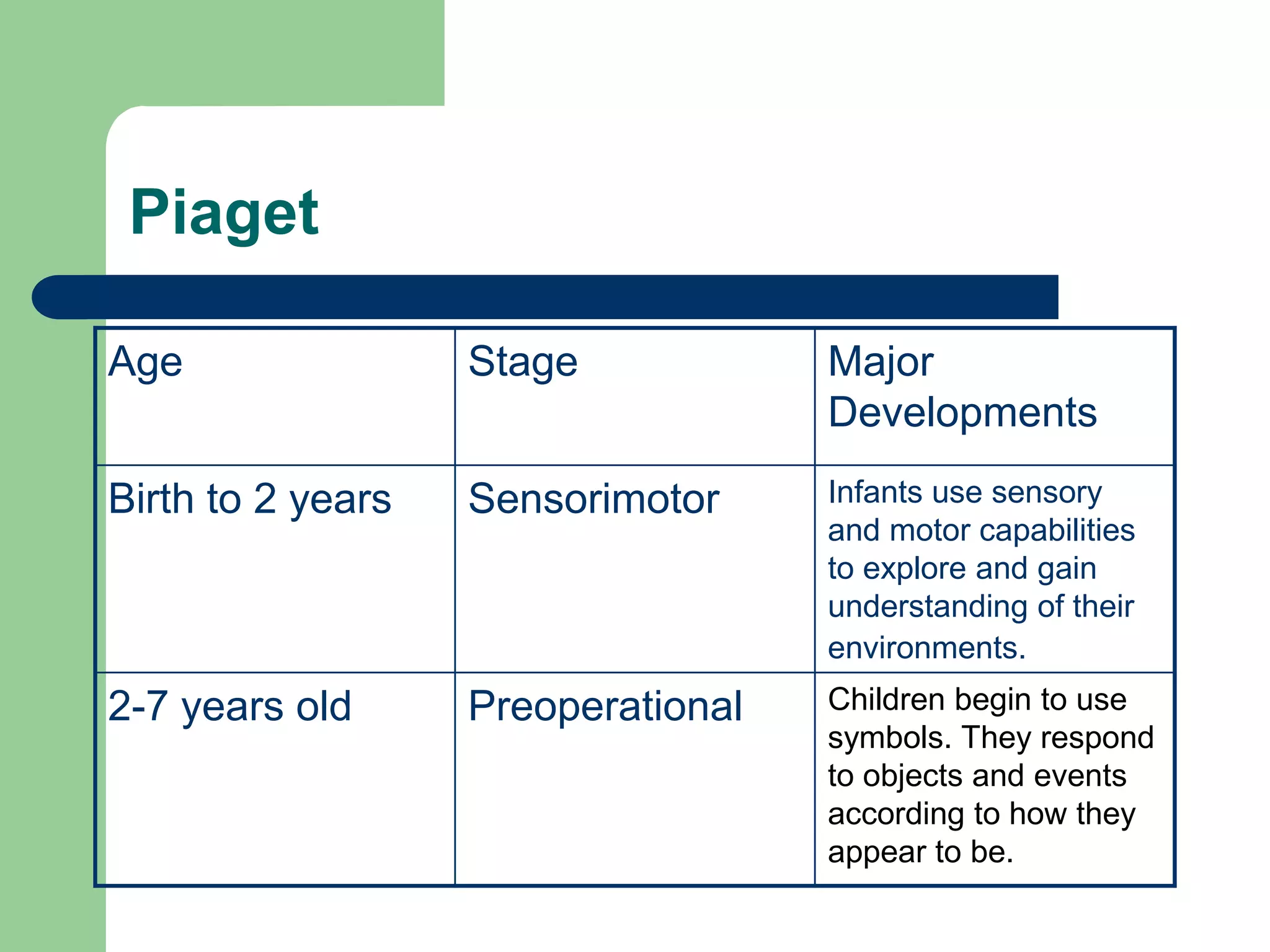
Piaget

Age                Stage            Major
                                    Developments

Birth to 2 years   Sensorimotor     Infants use sensory
                                    and motor capabilities
                                    to explore and gain
                                    understanding of their
                                    environments.
2-7 years old      Preoperational   Children begin to use
                                    symbols. They respond
                                    to objects and events
                                    according to how they
                                    appear to be.
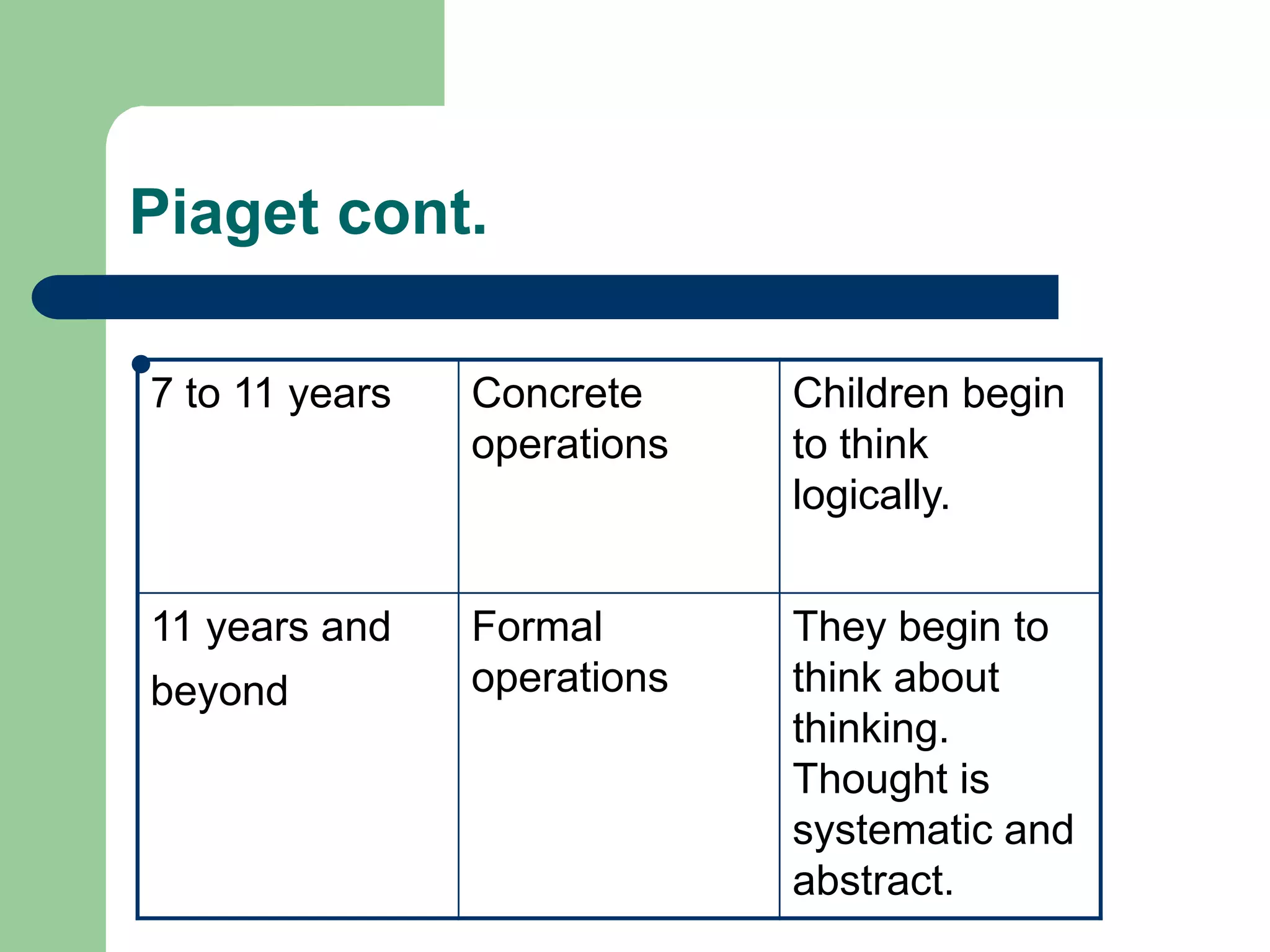
Piaget cont.


7 to 11 years   Concrete     Children begin
                operations   to think
                             logically.


11 years and    Formal       They begin to
beyond          operations   think about
                             thinking.
                             Thought is
                             systematic and
                             abstract.
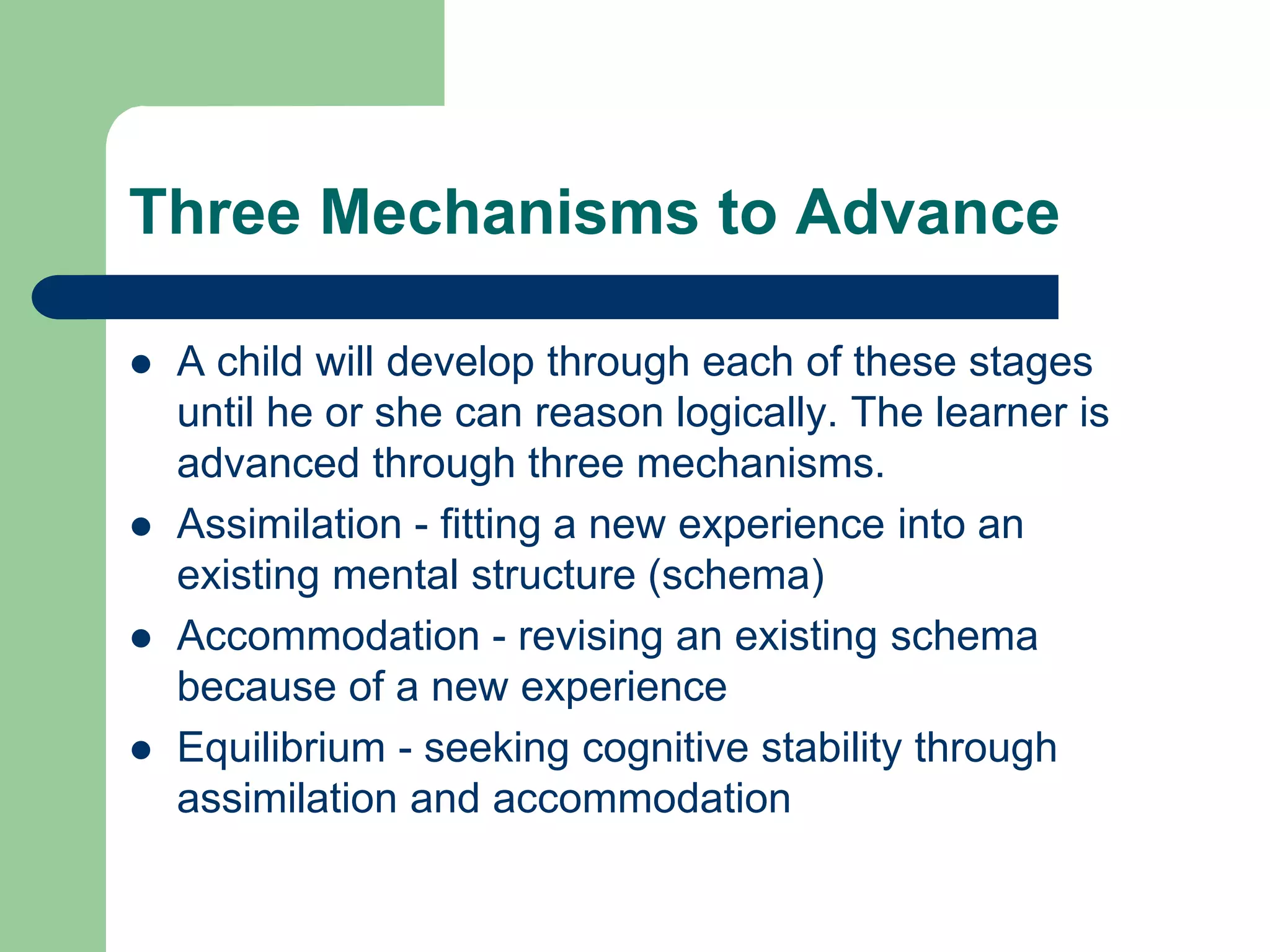
Three Mechanisms to Advance

   A child will develop through each of these stages
    until he or she can reason logically. The learner is
    advanced through three mechanisms.
   Assimilation - fitting a new experience into an
    existing mental structure (schema)
   Accommodation - revising an existing schema
    because of a new experience
   Equilibrium - seeking cognitive stability through
    assimilation and accommodation
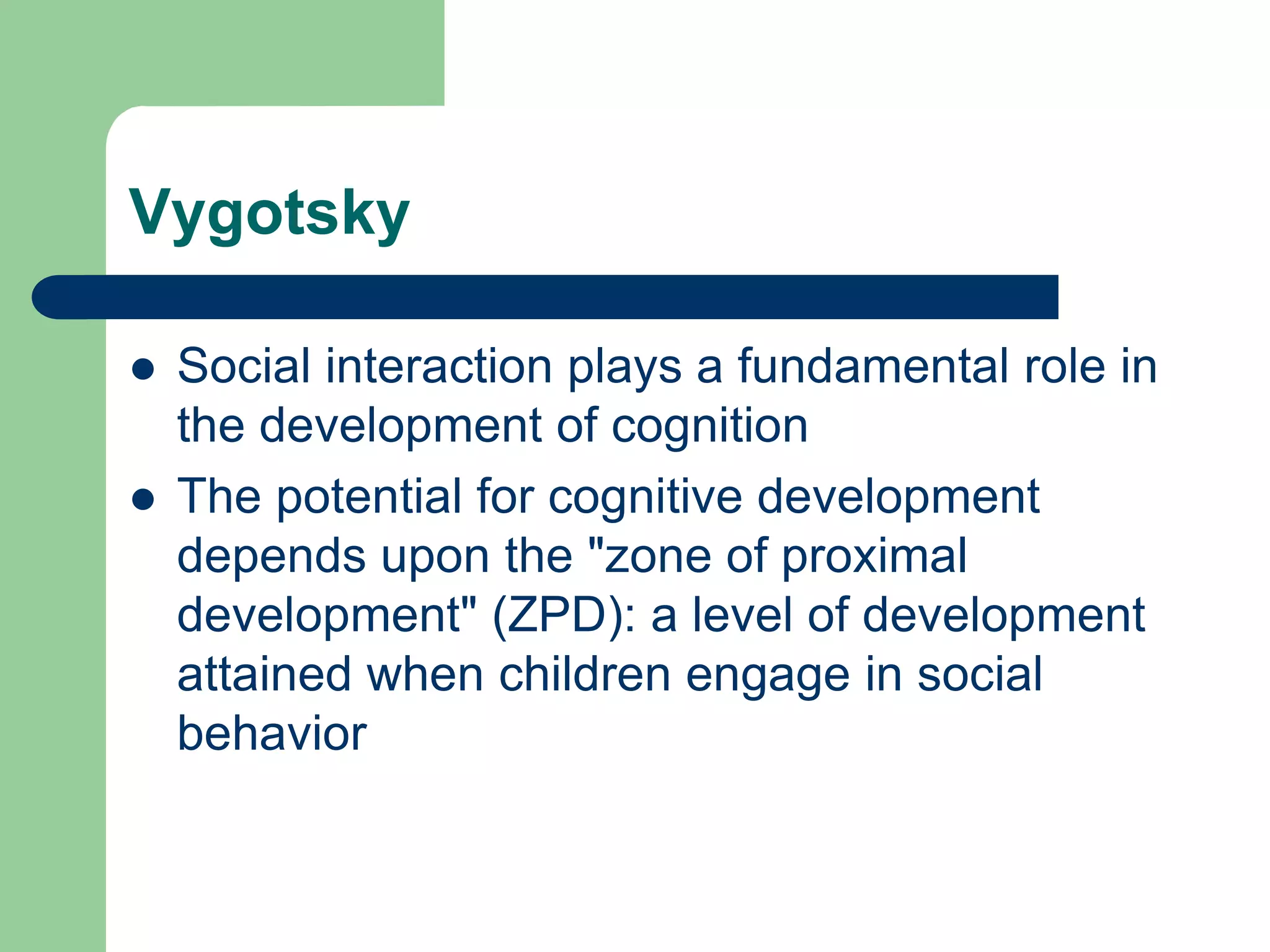
Vygotsky

   Social interaction plays a fundamental role in
    the development of cognition
   The potential for cognitive development
    depends upon the "zone of proximal
    development" (ZPD): a level of development
    attained when children engage in social
    behavior
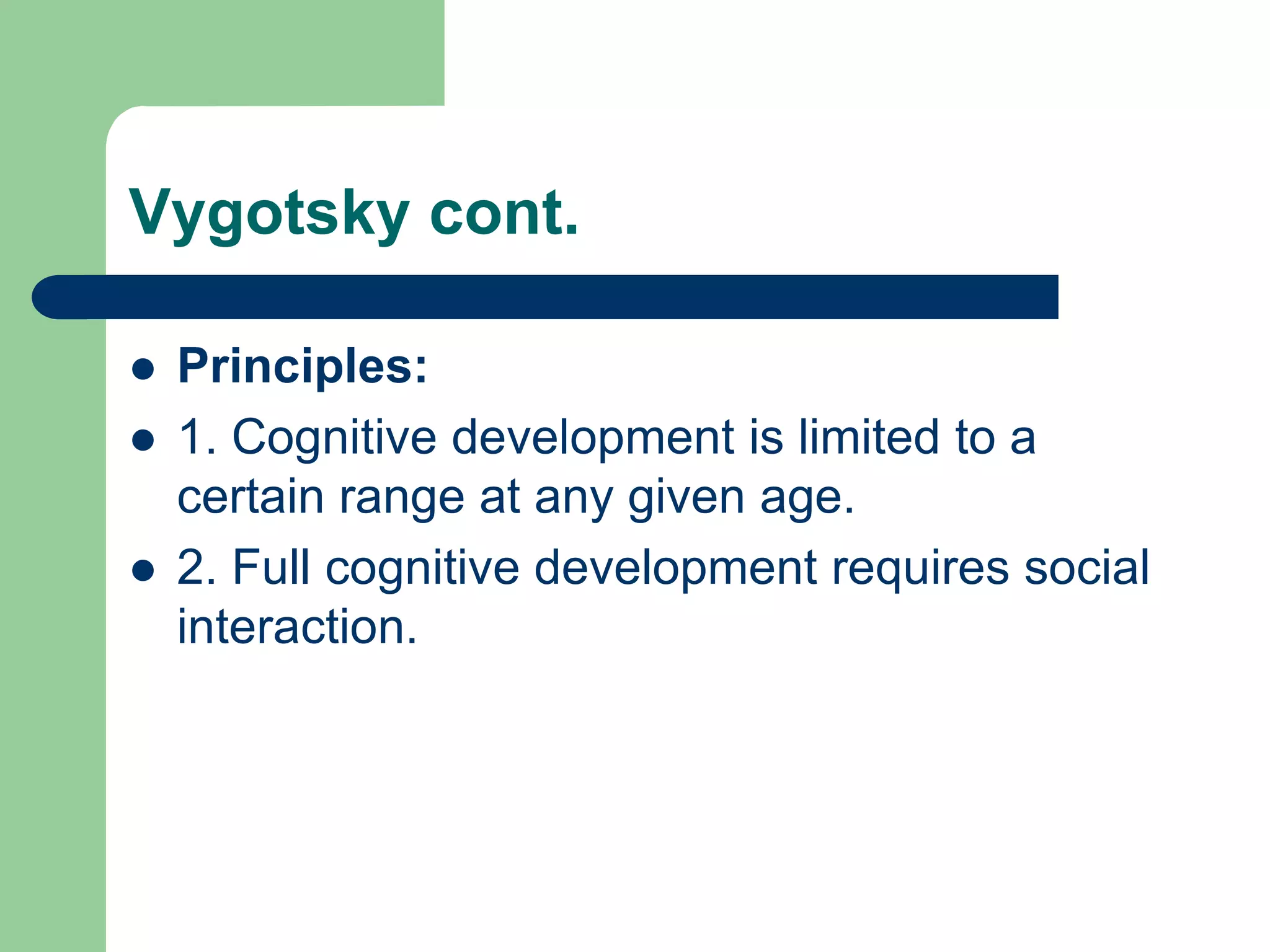
Vygotsky cont.

   Principles:
   1. Cognitive development is limited to a
    certain range at any given age.
   2. Full cognitive development requires social
    interaction.
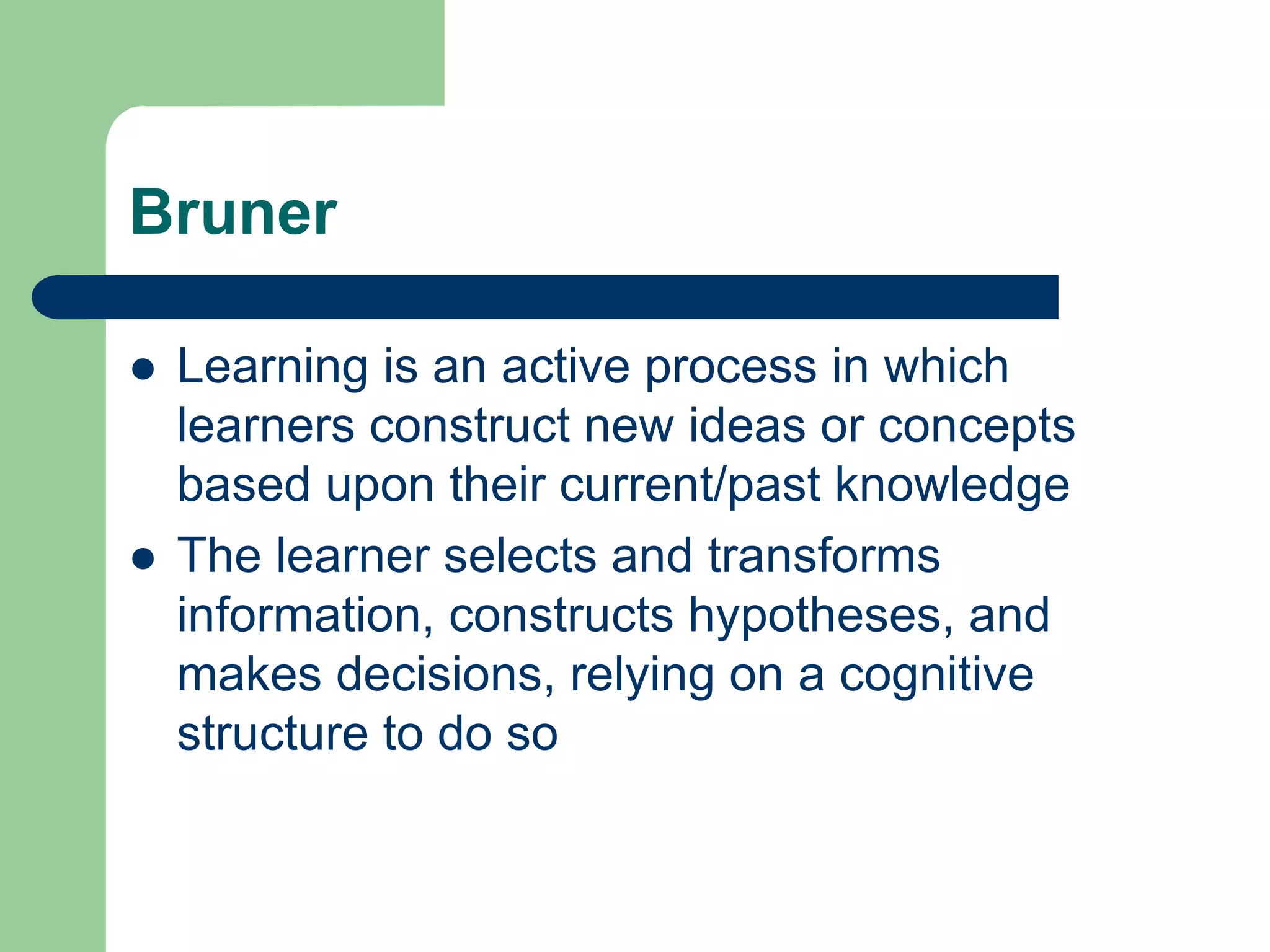
Bruner

   Learning is an active process in which
    learners construct new ideas or concepts
    based upon their current/past knowledge
   The learner selects and transforms
    information, constructs hypotheses, and
    makes decisions, relying on a cognitive
    structure to do so
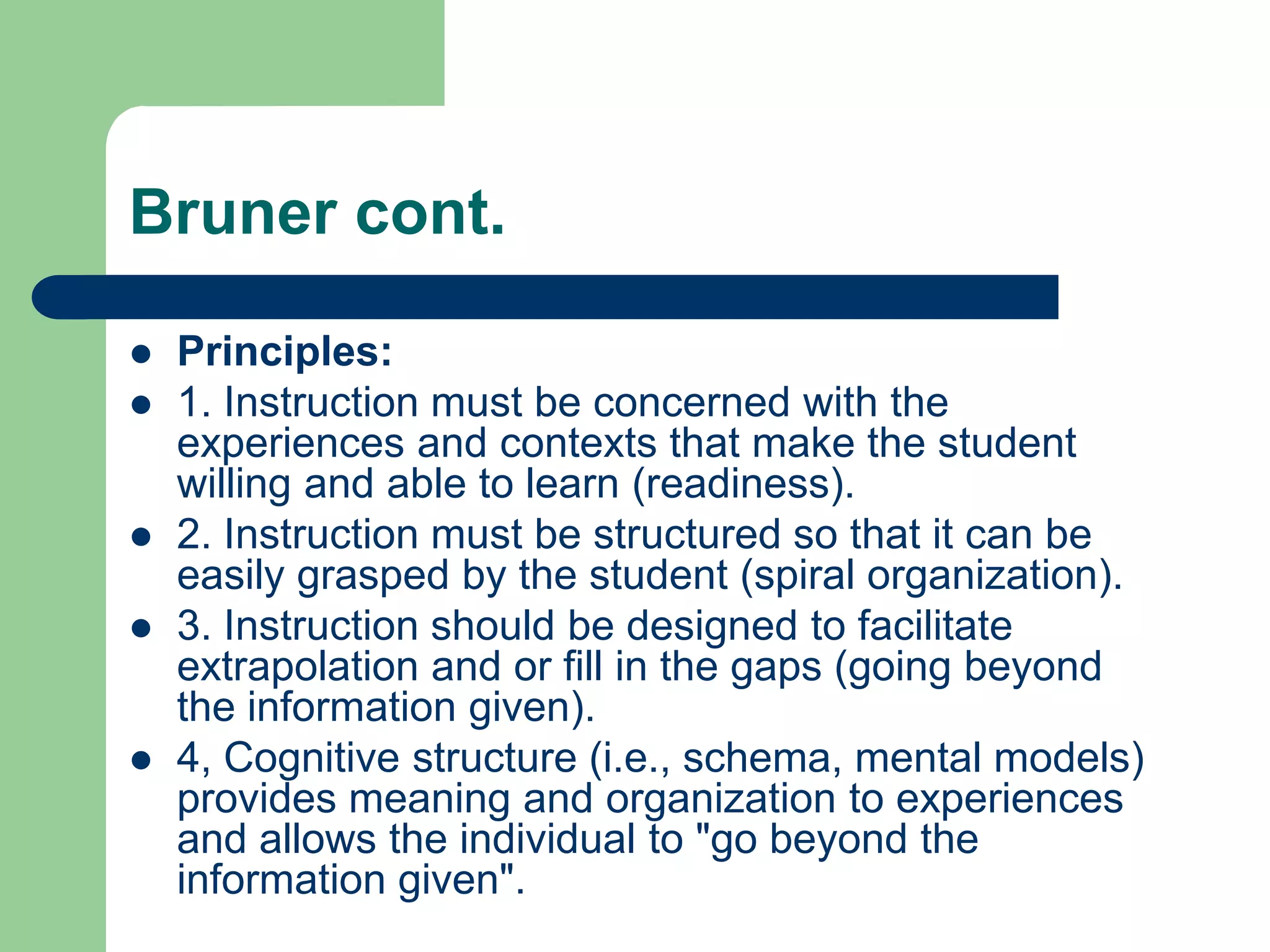
Bruner cont.

   Principles:
   1. Instruction must be concerned with the
    experiences and contexts that make the student
    willing and able to learn (readiness).
   2. Instruction must be structured so that it can be
    easily grasped by the student (spiral organization).
   3. Instruction should be designed to facilitate
    extrapolation and or fill in the gaps (going beyond
    the information given).
   4, Cognitive structure (i.e., schema, mental models)
    provides meaning and organization to experiences
    and allows the individual to "go beyond the
    information given".
Constructivist Teachers…

   1. Encourage and accept student autonomy and
    initiative.
   2. Use raw data and primary sources, along with
    manipulative, interactive, and physical materials.
   3. Use cognitive terminology such "classify,"
    "analyze," "predict," and "create" when framing
    tasks.
   4. Allow student responses to drive lessons, shift
    instructional strategies, and alter content.
   5. Inquire about students' understandings of
    concepts before sharing their own
    understanding of those concepts.
   6. Encourage students to engage in dialogue,
    both with the teacher and with one another.
   7. Encourage student inquiry by asking
    thoughtful, open-ended questions and
    encouraging students to ask questions of each
    other.
   8. Seek elaboration of students' initial responses.
   9. Engage students in experiences that might
    engender contradictions to their initial hypotheses
    and then encourage discussion.
   10. Allow significant wait time after posing
    questions.
   11. Provide time for students to construct
    relationships and create metaphors.
   12. Nurture students' natural curiosity through
    frequent use of the learning cycle model.

Learning Theories

  • 1.
    Learning Theories Piaget, Vygotsky, and Bruner
  • 2.
    Piaget Age Stage Major Developments Birth to 2 years Sensorimotor Infants use sensory and motor capabilities to explore and gain understanding of their environments. 2-7 years old Preoperational Children begin to use symbols. They respond to objects and events according to how they appear to be.
  • 3.
    Piaget cont.  7 to11 years Concrete Children begin operations to think logically. 11 years and Formal They begin to beyond operations think about thinking. Thought is systematic and abstract.
  • 4.
    Three Mechanisms toAdvance  A child will develop through each of these stages until he or she can reason logically. The learner is advanced through three mechanisms.  Assimilation - fitting a new experience into an existing mental structure (schema)  Accommodation - revising an existing schema because of a new experience  Equilibrium - seeking cognitive stability through assimilation and accommodation
  • 5.
    Vygotsky  Social interaction plays a fundamental role in the development of cognition  The potential for cognitive development depends upon the "zone of proximal development" (ZPD): a level of development attained when children engage in social behavior
  • 6.
    Vygotsky cont.  Principles:  1. Cognitive development is limited to a certain range at any given age.  2. Full cognitive development requires social interaction.
  • 7.
    Bruner  Learning is an active process in which learners construct new ideas or concepts based upon their current/past knowledge  The learner selects and transforms information, constructs hypotheses, and makes decisions, relying on a cognitive structure to do so
  • 8.
    Bruner cont.  Principles:  1. Instruction must be concerned with the experiences and contexts that make the student willing and able to learn (readiness).  2. Instruction must be structured so that it can be easily grasped by the student (spiral organization).  3. Instruction should be designed to facilitate extrapolation and or fill in the gaps (going beyond the information given).  4, Cognitive structure (i.e., schema, mental models) provides meaning and organization to experiences and allows the individual to "go beyond the information given".
  • 9.
    Constructivist Teachers…  1. Encourage and accept student autonomy and initiative.  2. Use raw data and primary sources, along with manipulative, interactive, and physical materials.  3. Use cognitive terminology such "classify," "analyze," "predict," and "create" when framing tasks.  4. Allow student responses to drive lessons, shift instructional strategies, and alter content.
  • 10.
    5. Inquire about students' understandings of concepts before sharing their own understanding of those concepts.  6. Encourage students to engage in dialogue, both with the teacher and with one another.  7. Encourage student inquiry by asking thoughtful, open-ended questions and encouraging students to ask questions of each other.  8. Seek elaboration of students' initial responses.
  • 11.
    9. Engage students in experiences that might engender contradictions to their initial hypotheses and then encourage discussion.  10. Allow significant wait time after posing questions.  11. Provide time for students to construct relationships and create metaphors.  12. Nurture students' natural curiosity through frequent use of the learning cycle model.