INSTRUCTION: A MODELS APPROACH CHAPTER 6 PRESENTATION The Concept Development Model FEB. 13, 2008
“ Understandings are built, not acquired.”
Definition Concept Development: A general idea or understanding that is derived from specific instances or occurences A thought or notion
In Other Words … Individuals acquire vocabulary in relationship to concepts If you understand a concept, any unknown words will be given meaning through what is already understood If the concept is not understood, a word’s meaning will be forgotten within a few days
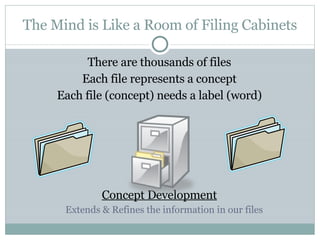
The Mind is Like a Room of Filing Cabinets There are thousands of files Each file represents a concept Each file (concept) needs a label (word) Concept Development Extends & Refines the information in our files
“ To awaken, to encourage,  and to stretch  children’s abilities  to think for themselves  is the highest goal of education.”
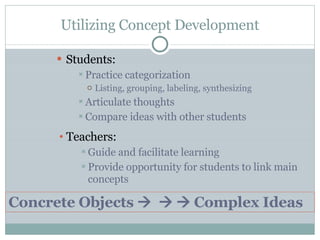
Utilizing Concept Development Students: Practice categorization Listing, grouping, labeling, synthesizing Articulate thoughts Compare ideas with other students Concrete Objects          Complex Ideas Teachers: Guide and facilitate learning Provide opportunity for students to link main concepts
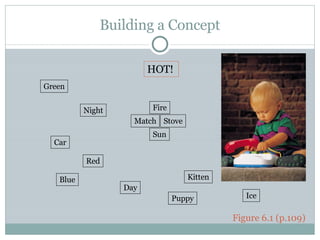
Building a Concept Figure 6.1 (p.109) HOT! Night Red Stove Match Fire Day Sun Puppy Green Ice Blue Car Kitten
Steps in Concept Development List as many items as possible that are associated with the subject Group the items because they are alike in some way Label the groups by defining the reasons for grouping Regroup or subsume individual items or whole groups under other groups Synthesize the information by summarizing the data and forming generalizations Evaluate students’ progress by assessing their ability to generate a wide variety of items and to group those items flexibly
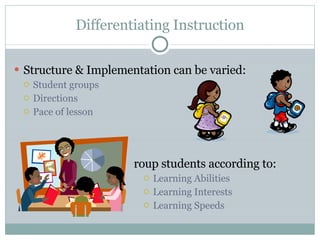
Differentiating Instruction Structure & Implementation can be varied: Student groups Directions Pace of lesson Group students according to: Learning Abilities Learning Interests Learning Speeds
Assessment Quality Number of items generated Self-Assessment Students explain decisions Short essays
Benefits of Concept Development Extending & refining knowledge Gaining additional points of view Generating original ideas 4-5 times in a group, student can perform on own Reading & extracting meaning Understanding a concept increases overall uderstanding Problem solving Learning about others’ experiences can help solve your own problems Writing unified paragraphs and papers A paragraph is a series of sentences developing 1 topic Understanding a concept helps build proper paragraphs
Web Resources Biology Concept Development http://www.csus.edu/indiv/m/mcvicerb/marinebioproject.htm Concept Development:  http://fac-staff.seattleu.edu/kschlnoe/web/TLU/process.html Concept Mapping http://classes.aces.uiuc.edu/ACES100/Mind/CMap.html English Language Development http://coe.sdsu.edu/people/jmora/MoraModules/EDUInstruction.htm The Three Thinking Strategies  – Hilda Taba http://www.mcps.k12.md.us/departments/oipd/mspap/reading/LookingAtConRCL.pdf

Concept Development

  • 1.
    INSTRUCTION: A MODELSAPPROACH CHAPTER 6 PRESENTATION The Concept Development Model FEB. 13, 2008
  • 2.
    “ Understandings arebuilt, not acquired.”
  • 3.
    Definition Concept Development:A general idea or understanding that is derived from specific instances or occurences A thought or notion
  • 4.
    In Other Words… Individuals acquire vocabulary in relationship to concepts If you understand a concept, any unknown words will be given meaning through what is already understood If the concept is not understood, a word’s meaning will be forgotten within a few days
  • 5.
    The Mind isLike a Room of Filing Cabinets There are thousands of files Each file represents a concept Each file (concept) needs a label (word) Concept Development Extends & Refines the information in our files
  • 6.
    “ To awaken,to encourage, and to stretch children’s abilities to think for themselves is the highest goal of education.”
  • 7.
    Utilizing Concept DevelopmentStudents: Practice categorization Listing, grouping, labeling, synthesizing Articulate thoughts Compare ideas with other students Concrete Objects    Complex Ideas Teachers: Guide and facilitate learning Provide opportunity for students to link main concepts
  • 8.
    Building a ConceptFigure 6.1 (p.109) HOT! Night Red Stove Match Fire Day Sun Puppy Green Ice Blue Car Kitten
  • 9.
    Steps in ConceptDevelopment List as many items as possible that are associated with the subject Group the items because they are alike in some way Label the groups by defining the reasons for grouping Regroup or subsume individual items or whole groups under other groups Synthesize the information by summarizing the data and forming generalizations Evaluate students’ progress by assessing their ability to generate a wide variety of items and to group those items flexibly
  • 10.
    Differentiating Instruction Structure& Implementation can be varied: Student groups Directions Pace of lesson Group students according to: Learning Abilities Learning Interests Learning Speeds
  • 11.
    Assessment Quality Numberof items generated Self-Assessment Students explain decisions Short essays
  • 12.
    Benefits of ConceptDevelopment Extending & refining knowledge Gaining additional points of view Generating original ideas 4-5 times in a group, student can perform on own Reading & extracting meaning Understanding a concept increases overall uderstanding Problem solving Learning about others’ experiences can help solve your own problems Writing unified paragraphs and papers A paragraph is a series of sentences developing 1 topic Understanding a concept helps build proper paragraphs
  • 13.
    Web Resources BiologyConcept Development http://www.csus.edu/indiv/m/mcvicerb/marinebioproject.htm Concept Development: http://fac-staff.seattleu.edu/kschlnoe/web/TLU/process.html Concept Mapping http://classes.aces.uiuc.edu/ACES100/Mind/CMap.html English Language Development http://coe.sdsu.edu/people/jmora/MoraModules/EDUInstruction.htm The Three Thinking Strategies – Hilda Taba http://www.mcps.k12.md.us/departments/oipd/mspap/reading/LookingAtConRCL.pdf