THEORIES OF SOCIAL DEVELOPMENT
How Children Develop
Chapter 9
Lawrence Heller, Psy. D.
Child Development Theories
Psychoanalytic Theory
Learning Theory
Theories of Social Cognition
Ecological Theories
Child Development Theories
Why do we study child development?
Developmental theory
 systematic statement of principles and
generalizations that provides a coherent framework
for studying development
What Theories Do
What Does a Theory Do
Theories
 form basis for hypotheses that can be tested by
research studies
 formulating right question is more difficult that finding
right answers
 generate discoveries
 offer insight and guidance by providing coherent
view
Five Key Developmental Issues
1) Nature-nurture issue
 Biological forces or environmental forces
2) Activity-passivity issue
 Are humans active agents in their own development or
passively shaped by forces beyond their control?
4) Continuity-discontinuity issue
 Are changes over the lifespan gradual or abrupt (like stair
steps)?
 Are changes quantitative (a matter of degree) or qualitative
(changes in kind)?
Five Key Developmental Issues, continued
4) Universality-context-specificity issue
 Are developmental changes common to all humans or
different across cultures, subcultures, contexts, and
individuals?
5) Goodness-badness of human nature
 Evidence of biologically-based tendencies for good and bad
Learning Objectives
What are the features of Freud’s psychoanalytic
theory of personality?
What are the features of Freud’s psychoanalytic
theory of psychosexual development?
What are the strengths and weaknesses of
psychoanalytic theory?
Psychoanalytic theory views behavior as motivated by
the need to satisfy basic drives (instinct)
 Such as eating, sleeping, excretion, and sexual desires
Psychoanalytic Theory
Freud’s Psychoanalytic Theory of
Personality
Central notion: humans have instincts that motivate
behavior at an unconscious level
Humans possess psychic energy that is divided
among three components of the personality
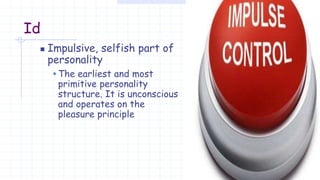
Id
 Impulsive, selfish part of
personality
The earliest and most
primitive personality
structure. It is unconscious
and operates on the
pleasure principle
Ego
Rational aspect that seeks to gratify instincts
Superego
Internalized moral standards
 what we think of as the conscience
Path to the Superego
Oedipus Complex
 The conflict experienced by boys in the
phallic stage (age 3-6) because of their
sexual desire for their mother and their fear
of retaliation by their father
Path to the Superego
Electra Complex
 The conflict experienced by girls in the
phallic stage (age 3-6) because of their
sexual desire for their Father and their fear of
retaliation by their mother
 Freud believed this occurs with less intensity
than the Oedipus complex for boys
Freud’s Theory of Psychosexual
Development
As a child biologically matures, libido seeks to
gratify different biological needs
 Libido – psychic energy of the sex instinct
Child moves through five stages
 Oral – infancy
 Anal – toddlerhood
 Phallic –3 to 6 years of age
 Latent – 6 to 12 years of age
 Genital - adolescence
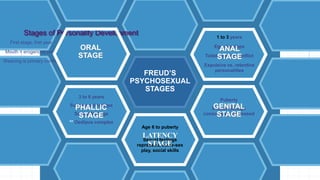
Stages of Personality Development
First stage, first year
Mouth = erogenous zone
Weaning is primary conflict
Age 6 to puberty
Sexual feelings
repressed, same-sex
play, social skills
3 to 6 years
Superego develops
Sexual feelings
** Oedipus complex
1 to 3 years
Ego develops
Toilet training conflict
Expulsive vs. retentive
personalities
Puberty
Sexual feelings
consciously expressed
LATENCY
STAGE
ANAL
STAGE
GENITAL
STAGE
ORAL
STAGE
PHALLIC
STAGE
FREUD’S
PSYCHOSEXUAL
STAGES
Freud’s Theory – Defense Mechanisms
Defense mechanisms
 unconscious coping devices that the
ego adopts to defend itself against
anxiety
Psychoanalytic Theory
Sigmund Freud
Video
 People who don’t resolve the issue of each
stage can get “stuck” in that stage
Strengths and Weaknesses of Freud’s Theory
Weaknesses
 Theory said to be ambiguous, internally
inconsistent, not testable, and therefore not
falsifiable
Strengths
 Many insights have held up and been influential
Called attention to unconscious processes
Emphasized importance of early experience
Emphasized importance of emotions and
emotional conflicts
Learning Objectives
How does Erikson’s psychoanalytic theory compare
to Freud’s theory?
What crisis characterizes each of Erikson’s
psychosocial stages?
Erik Erikson Versus Freud
Most influential neo-Freudian
Some differences with Freud
 Less emphasis on sexual urges
 More emphasis on rational ego
 More positive, adaptive view of human
nature
 Development continues through
adulthood
Erikson’s Stages
of Psychosocial Development
Erik Erikson
 How society or parents respond to the child
in each stage affects if the child succeeds
or fails to resolve the conflict of that
stage
 What do you think would be the result if a
child does not resolve a crisis?
 Erikson’s developmental stages Video
Learning Objectives
What are the distinct features of the learning theories
covered in this chapter: Watson’s classical conditioning,
Skinner’s operant conditioning, and Bandura’s social-
cognitive theory?
What are the strengths and weaknesses of the learning
theories in our understanding of lifespan development?
Learning Theory
Classical Conditioning
 Pavlov
 Watson
Operant Conditioning
 BF Skinner
Social Learning
 Bandura
Classical Conditioning
Pavlov believed behavior is the result of
learning
 1849-1936
 Russian physiologist
 Discovered classical conditioning
 Reflexes, stimuli
& responses
Elements of Classical Conditioning
CONDITIONED
(learned)
UNCONDITIONED
(unlearned)
STIMULUS
RESPONSE
STIMULUS
RESPONSE
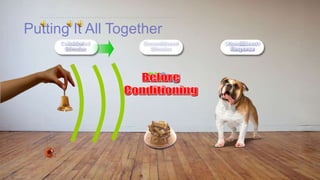
Putting It All Together
Neutral
Stimulus
No
Response
Unconditioned
Stimulus
Unconditioned
Response
Conditioned
Response
Conditioned
Stimulus
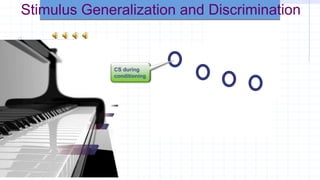
Stimulus Generalization and Discrimination
CS during
conditioning
Extinction and Spontaneous Recovery
Neutral
Stimulus
No
Response
Conditioned
Stimulus
Conditioned
Response
Conditioned
Response
Conditioned
Stimulus
Higher-order conditioning:
Occurs when a strong conditioned
stimulus is paired with a neutral stimulus,
causing the neutral stimulus to become a
second conditioned stimulus
Higher-Order Conditioning
John B. Watson (1878-1958)
Believed that
development is
determined by the child’s
social environment
through learning and
conditioning.
Conditioned emotional response:
Emotional response that has become
classically conditioned to occur to learned
stimuli
 Little Albert
Conditioned Emotional Responses
Mary Cover Jones (1924)
Other Conditioned Responses
Conditioned Taste Aversion: Development of a nausea or
aversive response to a particular taste because that taste was
followed by a nausea reaction, occurring after only one
association
Other Conditioned Responses
Biological
preparedness:
Tendency to learn
certain associations
with only one or few
pairings due to the
survival value of the
learning
Operant Conditioning
BF Skinner (1904-1990)
 Studied observable ,
measurable behavior
 Learning depends on
consequences
Important aspects of
Operant Conditioning
 Reinforcement increases the likelihood of a
desired behavior
 Positive means something is added
 Negative means something is taken away or
avoided
 Punishment Reduce or eliminate behavior
Skinner Box Video
Positive VS Negative Reinforcement
Punishment
Copyright ©
Pearson Education 2012
Modified by Jackie Kroening
Punishment should be:
• Immediate
• Consistent
• Paired with reinforcement
for correct behaviors
Making Punishment More Effective
Punishment Problems
Drawbacks to severe punishment:
 Fear and anxiety
 Lying
 Avoidance
 Modeling of aggression
Social Learning Theory
Albert Bandura
Social Learning Theory
Bandura agued that most human learning is
social in nature and based on observation of the
behavior of others
 “Monkey see, Monkey do”
 Reciprocal determinism- The child influences the
environment and so does the environment influence
the child.
 Bobo Doll Experiment
Ecological Theories of Development
Ethological psychology view
Evolutionary psychology views
These views are concerned with understanding
development and behavior based on an animal’s
evolutionary heritage
Ethological Approach
Konrad Lorenz (1903-1989)
 Often referred to as the father of modern ethology
Konrad Lorenz
Imprinting- a form of learning in which newborns of
some species of birds and mammals become attached
to and follow adult members (mom/dad) and follow
them everywhere.
The purpose is so they baby will stay near for
protection and food
Imprinting video
Bioecological Theory
Uri Bronfenbrenner
This perspective treats child’s environment as a layered
system like the rings of a tree with each layer
representing a different type of system.
 5 interacting systems influence a child’s development
 The child participates in each system
 The quality of each system either enhances or interferes with
the child’s development
Bronfenbrenner’s Bioecological Model
Video-
bioecological
model intro
Bioecological Theory Vocabulary
Microsystem: Closest to the child - family,
school, neighborhood, church
Mesosystem: relationships within the
immediate environment - who lives with child,
who is the teacher, what is the neighborhood
like?
Exosystem: social settings that indirectly
affect the child - parent’s work, neighborhood
safety, services, media
Bioecological Vocabulary (cont.)
Macrosystem: the culture, values, beliefs,
attitudes - a value for family? a work ethic? a
respect for elders? pride in possessions?
ethnic & socioeconomic factors?
Chronosystem: time, the changes over time
in all systems - job change, family change,
death/moving, school change, new sibling,
getting older and having more responsibility
Bioecological System Beliefs:
The quality of the systems and people affect the
child’s development.
AND
The characteristics of the child affect other’s
perceptions of the child, which then affects the
child’s development
The End

Child Development Theories.pptx

  • 1.
    THEORIES OF SOCIALDEVELOPMENT How Children Develop Chapter 9 Lawrence Heller, Psy. D.
  • 2.
    Child Development Theories PsychoanalyticTheory Learning Theory Theories of Social Cognition Ecological Theories
  • 3.
    Child Development Theories Whydo we study child development?
  • 4.
    Developmental theory  systematicstatement of principles and generalizations that provides a coherent framework for studying development What Theories Do
  • 5.
    What Does aTheory Do Theories  form basis for hypotheses that can be tested by research studies  formulating right question is more difficult that finding right answers  generate discoveries  offer insight and guidance by providing coherent view
  • 6.
    Five Key DevelopmentalIssues 1) Nature-nurture issue  Biological forces or environmental forces 2) Activity-passivity issue  Are humans active agents in their own development or passively shaped by forces beyond their control? 4) Continuity-discontinuity issue  Are changes over the lifespan gradual or abrupt (like stair steps)?  Are changes quantitative (a matter of degree) or qualitative (changes in kind)?
  • 7.
    Five Key DevelopmentalIssues, continued 4) Universality-context-specificity issue  Are developmental changes common to all humans or different across cultures, subcultures, contexts, and individuals? 5) Goodness-badness of human nature  Evidence of biologically-based tendencies for good and bad
  • 8.
    Learning Objectives What arethe features of Freud’s psychoanalytic theory of personality? What are the features of Freud’s psychoanalytic theory of psychosexual development? What are the strengths and weaknesses of psychoanalytic theory?
  • 9.
    Psychoanalytic theory viewsbehavior as motivated by the need to satisfy basic drives (instinct)  Such as eating, sleeping, excretion, and sexual desires Psychoanalytic Theory
  • 10.
    Freud’s Psychoanalytic Theoryof Personality Central notion: humans have instincts that motivate behavior at an unconscious level Humans possess psychic energy that is divided among three components of the personality
  • 11.
    Id  Impulsive, selfishpart of personality The earliest and most primitive personality structure. It is unconscious and operates on the pleasure principle
  • 12.
    Ego Rational aspect thatseeks to gratify instincts
  • 13.
    Superego Internalized moral standards what we think of as the conscience
  • 14.
    Path to theSuperego Oedipus Complex  The conflict experienced by boys in the phallic stage (age 3-6) because of their sexual desire for their mother and their fear of retaliation by their father
  • 15.
    Path to theSuperego Electra Complex  The conflict experienced by girls in the phallic stage (age 3-6) because of their sexual desire for their Father and their fear of retaliation by their mother  Freud believed this occurs with less intensity than the Oedipus complex for boys
  • 16.
    Freud’s Theory ofPsychosexual Development As a child biologically matures, libido seeks to gratify different biological needs  Libido – psychic energy of the sex instinct Child moves through five stages  Oral – infancy  Anal – toddlerhood  Phallic –3 to 6 years of age  Latent – 6 to 12 years of age  Genital - adolescence
  • 17.
    Stages of PersonalityDevelopment First stage, first year Mouth = erogenous zone Weaning is primary conflict Age 6 to puberty Sexual feelings repressed, same-sex play, social skills 3 to 6 years Superego develops Sexual feelings ** Oedipus complex 1 to 3 years Ego develops Toilet training conflict Expulsive vs. retentive personalities Puberty Sexual feelings consciously expressed LATENCY STAGE ANAL STAGE GENITAL STAGE ORAL STAGE PHALLIC STAGE FREUD’S PSYCHOSEXUAL STAGES
  • 19.
    Freud’s Theory –Defense Mechanisms Defense mechanisms  unconscious coping devices that the ego adopts to defend itself against anxiety
  • 21.
    Psychoanalytic Theory Sigmund Freud Video People who don’t resolve the issue of each stage can get “stuck” in that stage
  • 22.
    Strengths and Weaknessesof Freud’s Theory Weaknesses  Theory said to be ambiguous, internally inconsistent, not testable, and therefore not falsifiable Strengths  Many insights have held up and been influential Called attention to unconscious processes Emphasized importance of early experience Emphasized importance of emotions and emotional conflicts
  • 23.
    Learning Objectives How doesErikson’s psychoanalytic theory compare to Freud’s theory? What crisis characterizes each of Erikson’s psychosocial stages?
  • 24.
    Erik Erikson VersusFreud Most influential neo-Freudian Some differences with Freud  Less emphasis on sexual urges  More emphasis on rational ego  More positive, adaptive view of human nature  Development continues through adulthood
  • 25.
  • 27.
    Erik Erikson  Howsociety or parents respond to the child in each stage affects if the child succeeds or fails to resolve the conflict of that stage  What do you think would be the result if a child does not resolve a crisis?  Erikson’s developmental stages Video
  • 28.
    Learning Objectives What arethe distinct features of the learning theories covered in this chapter: Watson’s classical conditioning, Skinner’s operant conditioning, and Bandura’s social- cognitive theory? What are the strengths and weaknesses of the learning theories in our understanding of lifespan development?
  • 29.
    Learning Theory Classical Conditioning Pavlov  Watson Operant Conditioning  BF Skinner Social Learning  Bandura
  • 30.
    Classical Conditioning Pavlov believedbehavior is the result of learning  1849-1936  Russian physiologist  Discovered classical conditioning  Reflexes, stimuli & responses
  • 31.
    Elements of ClassicalConditioning CONDITIONED (learned) UNCONDITIONED (unlearned) STIMULUS RESPONSE STIMULUS RESPONSE
  • 32.
    Putting It AllTogether Neutral Stimulus No Response Unconditioned Stimulus Unconditioned Response Conditioned Response Conditioned Stimulus
  • 33.
    Stimulus Generalization andDiscrimination CS during conditioning
  • 34.
  • 35.
    Neutral Stimulus No Response Conditioned Stimulus Conditioned Response Conditioned Response Conditioned Stimulus Higher-order conditioning: Occurs whena strong conditioned stimulus is paired with a neutral stimulus, causing the neutral stimulus to become a second conditioned stimulus Higher-Order Conditioning
  • 36.
    John B. Watson(1878-1958) Believed that development is determined by the child’s social environment through learning and conditioning.
  • 37.
    Conditioned emotional response: Emotionalresponse that has become classically conditioned to occur to learned stimuli  Little Albert Conditioned Emotional Responses
  • 38.
  • 39.
    Other Conditioned Responses ConditionedTaste Aversion: Development of a nausea or aversive response to a particular taste because that taste was followed by a nausea reaction, occurring after only one association
  • 40.
    Other Conditioned Responses Biological preparedness: Tendencyto learn certain associations with only one or few pairings due to the survival value of the learning
  • 41.
    Operant Conditioning BF Skinner(1904-1990)  Studied observable , measurable behavior  Learning depends on consequences
  • 42.
    Important aspects of OperantConditioning  Reinforcement increases the likelihood of a desired behavior  Positive means something is added  Negative means something is taken away or avoided  Punishment Reduce or eliminate behavior
  • 43.
  • 44.
    Positive VS NegativeReinforcement
  • 45.
  • 46.
    Copyright © Pearson Education2012 Modified by Jackie Kroening Punishment should be: • Immediate • Consistent • Paired with reinforcement for correct behaviors Making Punishment More Effective
  • 47.
    Punishment Problems Drawbacks tosevere punishment:  Fear and anxiety  Lying  Avoidance  Modeling of aggression
  • 48.
  • 49.
    Social Learning Theory Banduraagued that most human learning is social in nature and based on observation of the behavior of others  “Monkey see, Monkey do”  Reciprocal determinism- The child influences the environment and so does the environment influence the child.  Bobo Doll Experiment
  • 50.
    Ecological Theories ofDevelopment Ethological psychology view Evolutionary psychology views These views are concerned with understanding development and behavior based on an animal’s evolutionary heritage
  • 51.
    Ethological Approach Konrad Lorenz(1903-1989)  Often referred to as the father of modern ethology
  • 52.
    Konrad Lorenz Imprinting- aform of learning in which newborns of some species of birds and mammals become attached to and follow adult members (mom/dad) and follow them everywhere. The purpose is so they baby will stay near for protection and food Imprinting video
  • 53.
    Bioecological Theory Uri Bronfenbrenner Thisperspective treats child’s environment as a layered system like the rings of a tree with each layer representing a different type of system.  5 interacting systems influence a child’s development  The child participates in each system  The quality of each system either enhances or interferes with the child’s development
  • 54.
  • 55.
    Bioecological Theory Vocabulary Microsystem:Closest to the child - family, school, neighborhood, church Mesosystem: relationships within the immediate environment - who lives with child, who is the teacher, what is the neighborhood like? Exosystem: social settings that indirectly affect the child - parent’s work, neighborhood safety, services, media
  • 56.
    Bioecological Vocabulary (cont.) Macrosystem:the culture, values, beliefs, attitudes - a value for family? a work ethic? a respect for elders? pride in possessions? ethnic & socioeconomic factors? Chronosystem: time, the changes over time in all systems - job change, family change, death/moving, school change, new sibling, getting older and having more responsibility
  • 57.
    Bioecological System Beliefs: Thequality of the systems and people affect the child’s development. AND The characteristics of the child affect other’s perceptions of the child, which then affects the child’s development
  • 58.