Theories of Human Development
A Short Course for Catechists
By
Rev. Cornelius T. McQuillan, C.S.Sp., Psy.D.
Editor: Sharon Piper
Introduction
4 Principle theories of Human Development:
1) Sigmund Freud
2) Jean Piaget
3) Erick Erickson
4) Lawrence Kolberg
Introduction
Jean Piaget´s theory treats Cognitive
Development of Children, while that of Erick
Erickson treats the psycho-sexual
development throughout all the stages of
Human Development.
Introduction
Lawrence Kolberg’s theory treats human
moral development.
Introduction
Not presented here is Freud’s theory of
psycho-sexual development, which does not
offer much insight for the average catechist.
Jean Piaget’s Theory of Cognitive
Development
Piaget’s theory presents his findings with
regard to the Intellectual Development of
children.
Part A
The Cognitive Theory
of
Jean Piaget
Jean Piaget’s Theory
Piaget’s theory is based on careful and
disciplined observation of his own children, as
well as some ingenious experiments he did
with them.
Jean Piaget’s Theory
Piaget describes 4 stages of cognitive
development which have been confirmed by
later studies.
However, later studies indicate that Piaget’s
stages may begin earlier than he theorized.
Jean Piaget’s Theory
Although Piaget is not himself a psychologist,
students of educational psychology and of
pedagogy all study his theory.
Thus his theory should be familiar to catechists
and those responsible for the religious
education of children.
Jean Piaget’s Theory
Jean Piaget’s four stages of development:
1) Sensory-motor
2) Pre-operational
3) Concrete Operations
4) Formal Operations
Jean Piaget’s Stages
1) The Sensory-motor Stage of Development:
(Birth to 2 years)
During the first stage of development the child
makes random movements and only slowly
begins to be able to control his/her own
movements.
Jean Piaget’s Stages
1) First Stage Sensory-motor:
(the first two years)
The child slowly begins to discover the Permanence
of Objects towards the end of the first year.
(That is, it begins to dawn on the child that
objects that are out of sight still exist).
Jean Piaget’s Stages
2) Second Stage is the Pre-operational:
(2 to 7 years)
During this stage the children can begin to
think, but their thought processes are based on the
senses.
They are unable to reason, that is, come to
conclusions based on deduction or induction; nor can
they think abstractly.
Jean Piaget’s Stages
2) The second stage is the Pre-operational:
Children in this stage can’t reason in reverse.
(Operation is any mental activity that is reversible.)
At this stage children do not comprehend that
Objects conserve or retain their physical properties.
Children are Ego-centric during this stage.
Jean Piaget’s Stages
3) The third stage Concrete Operations:
(from around 6 to11 years)
-They develop the capacity to reverse mental
operations.
-They begin to take into account the
conservation of physical properties.
Jean Piaget’s Stages
3) Third Stage Concrete Operations:
(from around 6 to 11 years)
-The nature and quality of their thinking
develops significantly
-They begin to understand the law of “Cause and
Effect.”
-They begin to comprehend the principle of
Conservation
Jean Piaget’s Stages
3) The Third Stage Concrete Operations:
(From about 6 to 11 years)
-Develop the capacity to reverse their
thinking.
- They learn to recognize the essence of things.
-They develop the capacity to order things in a
series.
Jean Piaget’s Stages
4) The fourth stage Formal Operations:
(12 year a adulthood)
Is the capacity to think in abstract terms.
Part B
The Psyco-social Theory
of
Erick Erickson
Erick Erickson’s Theory
Erick Erickson divides his Psycho-social theory
into 8 stages.
Erick Erickson’s Theory
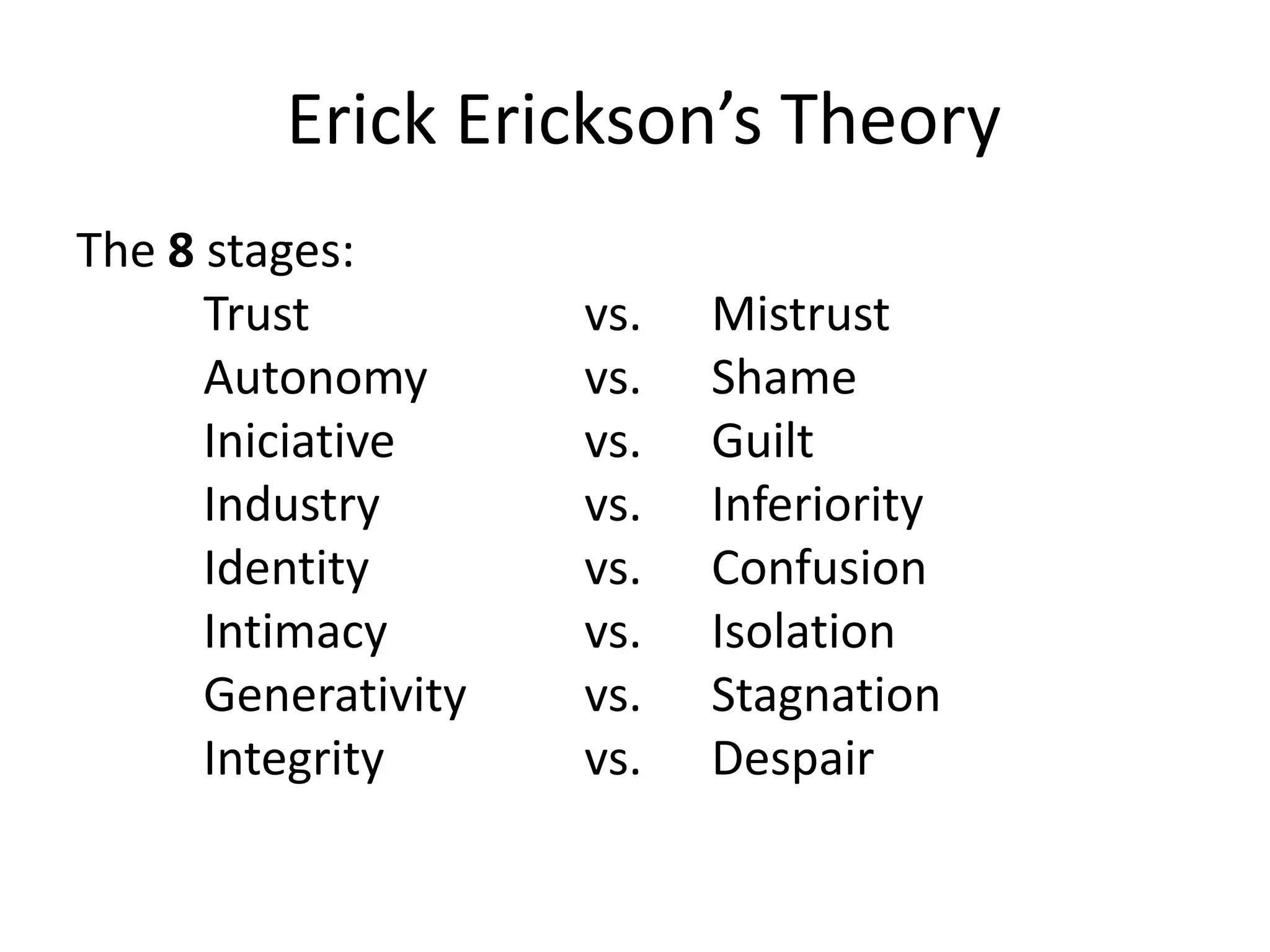
The 8 stages:
Trust vs. Mistrust
Autonomy vs. Shame
Iniciative vs. Guilt
Industry vs. Inferiority
Identity vs. Confusion
Intimacy vs. Isolation
Generativity vs. Stagnation
Integrity vs. Despair
Erick Erickson’s Theory
In each step, the task of each individual is to
strike a balance between two extremes.
The name Erickson gives to each of his stages
are the extreme qualities that each individual
must balance according to their own situation.
Erick Erickson’s Theory
An important principle of Erickson’s theory is
that each succeeding stage depends greatly on
the equilibrium established in each of the
previous stages.
Erick Erickson’s Theory
1) The first stage Trust vs Mistrust
(from 12 to 18 months)
In this first stage a child learns to trust and mistrust
the significant persons in his life.
According to their experience each child combines
these two extremes into a functional or
disfunctional personality.
Erick Erickson’s Theory
2) The second stage Autonomy vs. Shame
(from 12 to 18 months until 3 years)
During this stage the child begins to learn to
do for himself. According to his success and
the reactions of significant others he learns to
balance these two extremes.
Erick Erickson’s Theory
3) The Third stage: Initiative vs. Guilt
(from 3 to 7 years)
During this stage the child begins to explore
the environment within the limits set by the
significant others.
Erick Erickson’s Theory
4) The fourth stage: Industry vs. Inferiority
(7 to 11 years)
In this stage, the child attempts to balance
doing things on his own with his feelings of
inferiority.
Erick Erickson’s Theory
5) The fifth stage: Identity vs. Confusion
(puberty until early adulthood)
From about 11 years of age adolescents begin
discovering their gender role as influenced by
significant others.
( 50% of sexual identity is attributed to genetic
factors while the social environment contributes the
other half).
Erick Erickson’s Theory
6) The sixth stage: Intimacy vs. Isolation
(from about 20 years or early adulthood)
Much of the individual’s capacity for intimacy
depends upon their social skills learned in
earlier stages.
Erick Erickson’s Theory
7) The Seventh Stage: Generativity vs.
Stagnation
(During Intermediate Adulthood, that is from
around 40 to 65 years)
The individual learns to value contributing to the
following generation.
Erick Erickson’s Theory
8) The Eighth Stage: Integrity vs. Despair
(Late Adulthood, that is beginning from around 65
years of age)
The person, realizing their own mortality begins to
evaluate their life. This re-evaluation is more
productive when done together with a significant
other.
Part C
The Theory of Moral Development
of
Lawrence Kolberg
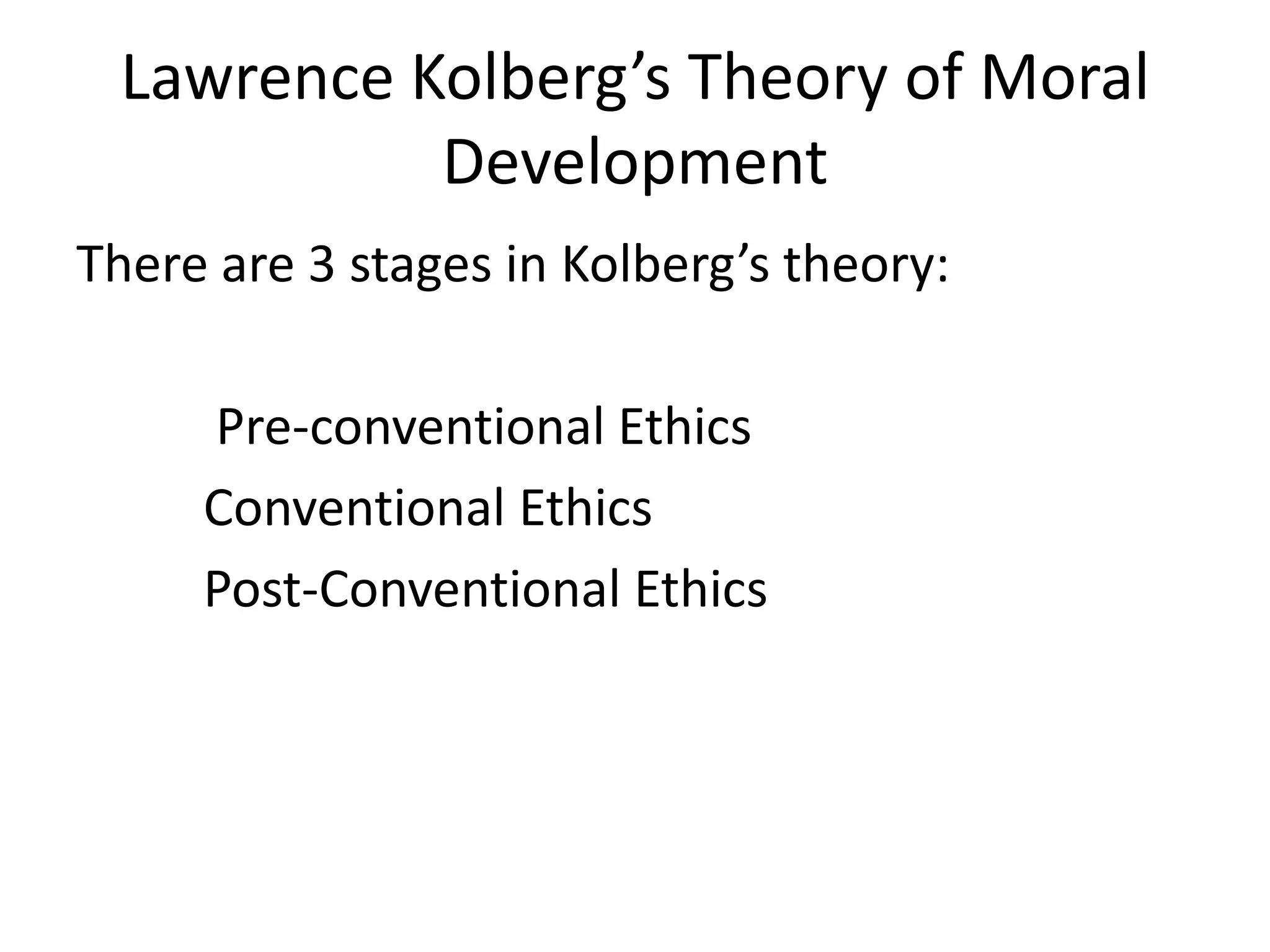
Lawrence Kolberg’s Theory of Moral
Development
There are 3 stages in Kolberg’s theory:
Pre-conventional Ethics
Conventional Ethics
Post-Conventional Ethics
Lawrence Kolberg’s Theory
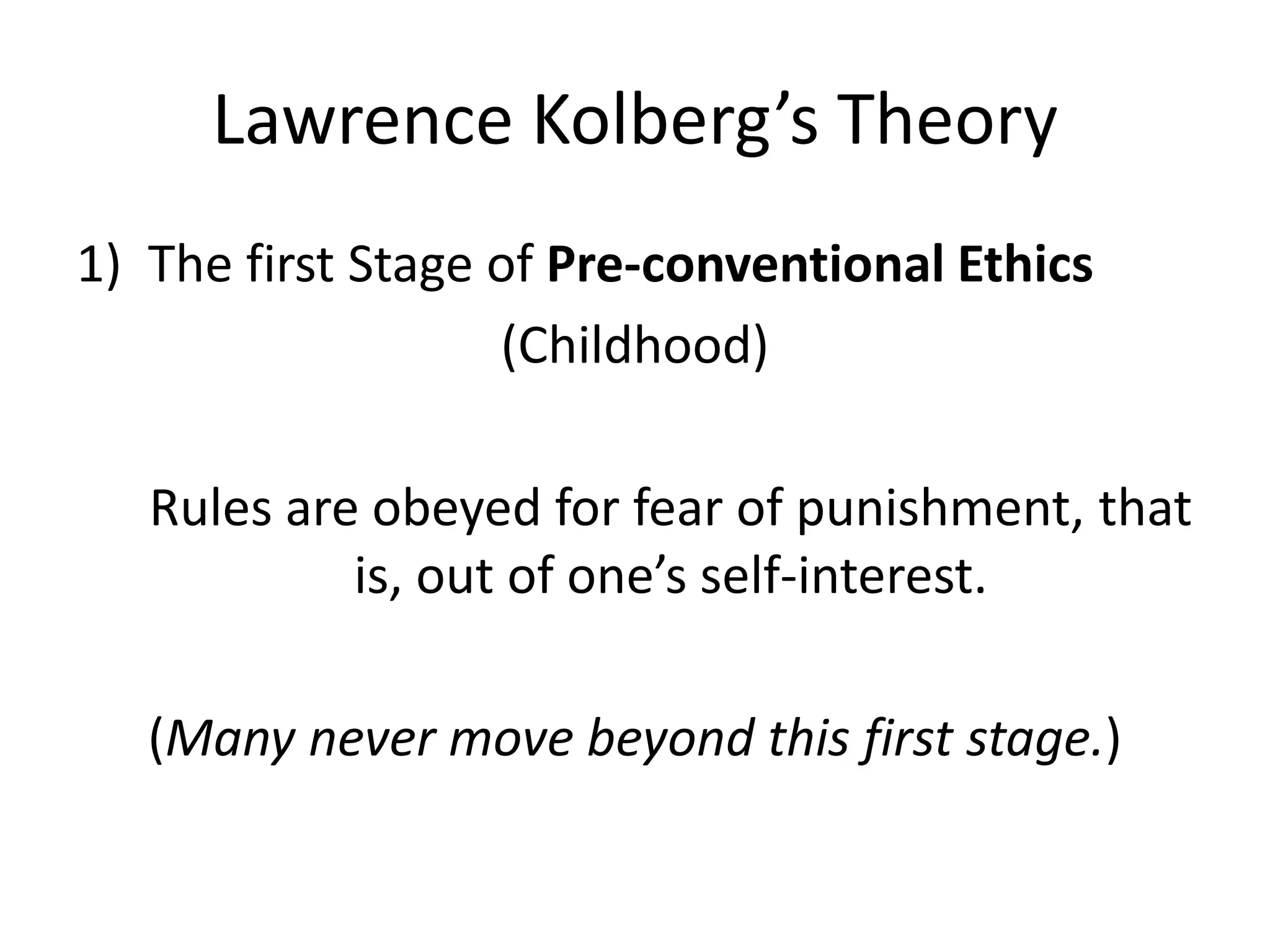
1) The first Stage of Pre-conventional Ethics
(Childhood)
Rules are obeyed for fear of punishment, that
is, out of one’s self-interest.
(Many never move beyond this first stage.)
Lawrence Kolberg’s Theory
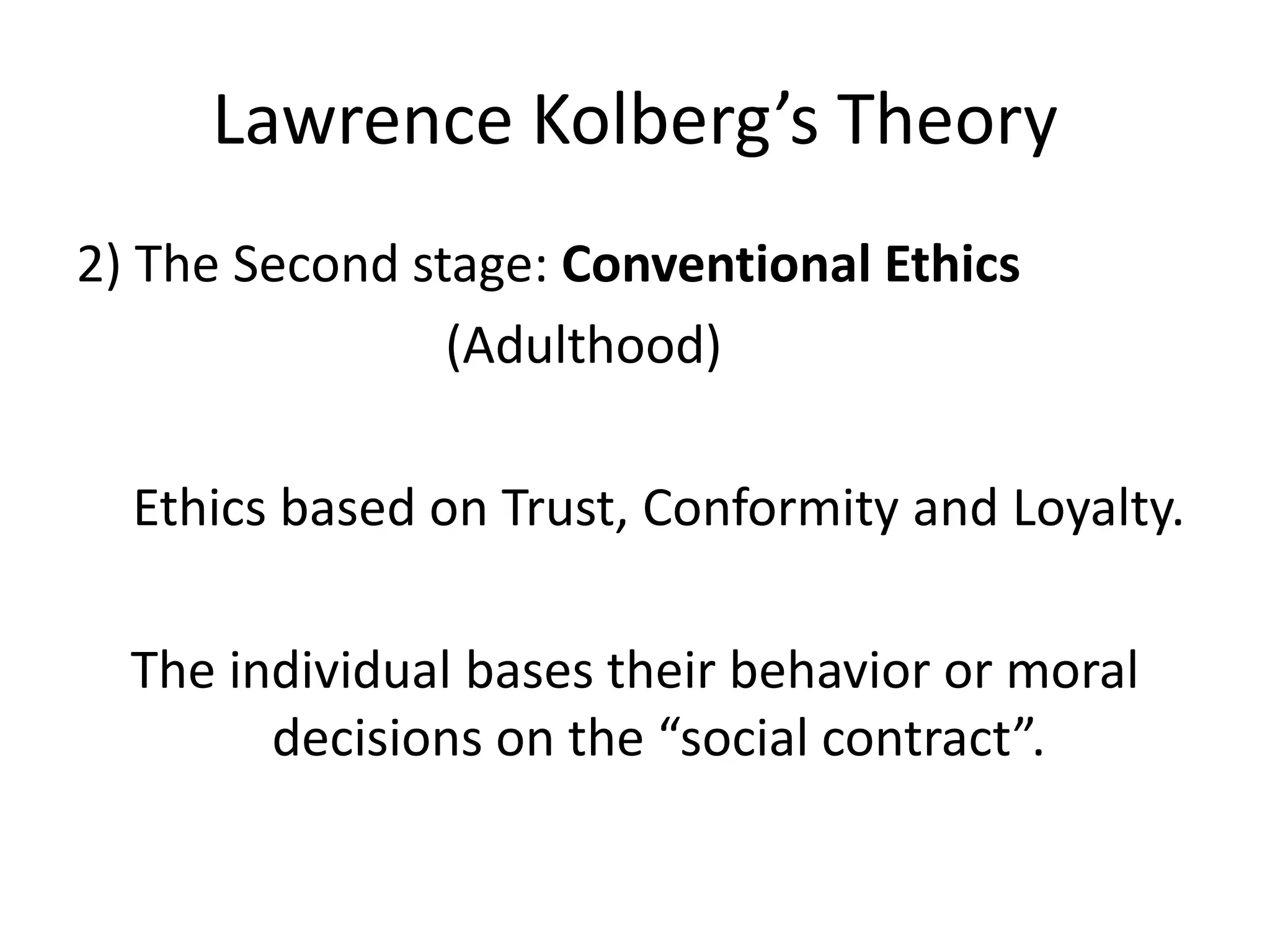
2) The Second stage: Conventional Ethics
(Adulthood)
Ethics based on Trust, Conformity and Loyalty.
The individual bases their behavior or moral
decisions on the “social contract”.
Lawrence Kolberg’s Theory
3) The Third Stage: Post-Conventional
The individual understands laws to be
limited, imperfect and relative.
The individual’s ethics are based on Universal
Moral Principles.
Development Theory Resouces
Aller, Gustavo J. (1984). Métodos Anticonceptivos, (2 ed.)
McGraw-Hill, Caracas.
Billings, John, (1976). Regulación Natural de la Natalidad:
Método de Ovulación, Madrid, Sal Terra Santander.
Burren James E. y Schaie K. Warner (1985). The Psychology of
Aging, 2a ed. Van Nostrand.
Craig, Grace J. (2001). Desarrollo Psicológico, Octava
Ed., Prentice Hall, México.
Dickinson, George E., Leming, Michael R, Mermann, Alan C.
eds. (1997). Dying, Death and Bereavement, 3 ed. Dushkin
McGraw Hill, CT.
Erikson, Erik H. (1963). Childhood and Society, 35to ed., New
York, W.W. Norton & Co.
Hoffman, Lois, Paris, Scott y Hall, Elizabeth (1995). Psicologia
del Desarrollo Hoy, McGraw-Hill, Madrid.
Hurtig Michael y Rondal, Jean Adolphe (1986). Introducción
de la Psicologia del Nino, Herder, Barcelona.
FV Kiibler-Ross, Elizabeth (1972). Sobre la Muerte y los
Moribundos. Ed. Grhalbo, Barcelona.
Lefrancois, Guy R. (1987). The Lifespan, Wadsworth Pub.
Col, Belmont, CA.
Lothrop, H. (1999). La Lactancia Natural, Barcelona, Ediciones
Oniro.
Miller, Patricia H. (1983). Theories of Developmental
Psychology. Freeman & Co. San Francisco, CA.
Martin, M., (1997). Embarazo y Nacimiento: El Libro
Ilustrado, Da Capo Press, New York.
Mock, Gloria y Martinez, Winhed (1995) Sexualidad: Sus
Conceptos Basicos, Ed. Cultural, San Juan, PR.
Papalia, Diane E. y Wendkos Olds, Sally y Duskin Feldman,
Ruth (1999). A Child’s World, Infancy Through
Adolescence, McGraw-Hill, Inc. Boston, MA.
Polan, Elaine U. y Taylor, Daphne (2002). Journey Across
the Lifespan, Davis F.A.
Prohaska, Leopold (1973) El Proceso de la Maduracion del
Hombre, Herder, Barcelona.

Theories of human development an Introductory Course for Catechists

  • 1.
    Theories of HumanDevelopment A Short Course for Catechists By Rev. Cornelius T. McQuillan, C.S.Sp., Psy.D. Editor: Sharon Piper
  • 2.
    Introduction 4 Principle theoriesof Human Development: 1) Sigmund Freud 2) Jean Piaget 3) Erick Erickson 4) Lawrence Kolberg
  • 3.
    Introduction Jean Piaget´s theorytreats Cognitive Development of Children, while that of Erick Erickson treats the psycho-sexual development throughout all the stages of Human Development.
  • 4.
    Introduction Lawrence Kolberg’s theorytreats human moral development.
  • 5.
    Introduction Not presented hereis Freud’s theory of psycho-sexual development, which does not offer much insight for the average catechist.
  • 6.
    Jean Piaget’s Theoryof Cognitive Development Piaget’s theory presents his findings with regard to the Intellectual Development of children.
  • 7.
    Part A The CognitiveTheory of Jean Piaget
  • 8.
    Jean Piaget’s Theory Piaget’stheory is based on careful and disciplined observation of his own children, as well as some ingenious experiments he did with them.
  • 9.
    Jean Piaget’s Theory Piagetdescribes 4 stages of cognitive development which have been confirmed by later studies. However, later studies indicate that Piaget’s stages may begin earlier than he theorized.
  • 10.
    Jean Piaget’s Theory AlthoughPiaget is not himself a psychologist, students of educational psychology and of pedagogy all study his theory. Thus his theory should be familiar to catechists and those responsible for the religious education of children.
  • 11.
    Jean Piaget’s Theory JeanPiaget’s four stages of development: 1) Sensory-motor 2) Pre-operational 3) Concrete Operations 4) Formal Operations
  • 12.
    Jean Piaget’s Stages 1)The Sensory-motor Stage of Development: (Birth to 2 years) During the first stage of development the child makes random movements and only slowly begins to be able to control his/her own movements.
  • 13.
    Jean Piaget’s Stages 1)First Stage Sensory-motor: (the first two years) The child slowly begins to discover the Permanence of Objects towards the end of the first year. (That is, it begins to dawn on the child that objects that are out of sight still exist).
  • 14.
    Jean Piaget’s Stages 2)Second Stage is the Pre-operational: (2 to 7 years) During this stage the children can begin to think, but their thought processes are based on the senses. They are unable to reason, that is, come to conclusions based on deduction or induction; nor can they think abstractly.
  • 15.
    Jean Piaget’s Stages 2)The second stage is the Pre-operational: Children in this stage can’t reason in reverse. (Operation is any mental activity that is reversible.) At this stage children do not comprehend that Objects conserve or retain their physical properties. Children are Ego-centric during this stage.
  • 16.
    Jean Piaget’s Stages 3)The third stage Concrete Operations: (from around 6 to11 years) -They develop the capacity to reverse mental operations. -They begin to take into account the conservation of physical properties.
  • 17.
    Jean Piaget’s Stages 3)Third Stage Concrete Operations: (from around 6 to 11 years) -The nature and quality of their thinking develops significantly -They begin to understand the law of “Cause and Effect.” -They begin to comprehend the principle of Conservation
  • 18.
    Jean Piaget’s Stages 3)The Third Stage Concrete Operations: (From about 6 to 11 years) -Develop the capacity to reverse their thinking. - They learn to recognize the essence of things. -They develop the capacity to order things in a series.
  • 19.
    Jean Piaget’s Stages 4)The fourth stage Formal Operations: (12 year a adulthood) Is the capacity to think in abstract terms.
  • 20.
    Part B The Psyco-socialTheory of Erick Erickson
  • 21.
    Erick Erickson’s Theory ErickErickson divides his Psycho-social theory into 8 stages.
  • 22.
    Erick Erickson’s Theory The8 stages: Trust vs. Mistrust Autonomy vs. Shame Iniciative vs. Guilt Industry vs. Inferiority Identity vs. Confusion Intimacy vs. Isolation Generativity vs. Stagnation Integrity vs. Despair
  • 23.
    Erick Erickson’s Theory Ineach step, the task of each individual is to strike a balance between two extremes. The name Erickson gives to each of his stages are the extreme qualities that each individual must balance according to their own situation.
  • 24.
    Erick Erickson’s Theory Animportant principle of Erickson’s theory is that each succeeding stage depends greatly on the equilibrium established in each of the previous stages.
  • 25.
    Erick Erickson’s Theory 1)The first stage Trust vs Mistrust (from 12 to 18 months) In this first stage a child learns to trust and mistrust the significant persons in his life. According to their experience each child combines these two extremes into a functional or disfunctional personality.
  • 26.
    Erick Erickson’s Theory 2)The second stage Autonomy vs. Shame (from 12 to 18 months until 3 years) During this stage the child begins to learn to do for himself. According to his success and the reactions of significant others he learns to balance these two extremes.
  • 27.
    Erick Erickson’s Theory 3)The Third stage: Initiative vs. Guilt (from 3 to 7 years) During this stage the child begins to explore the environment within the limits set by the significant others.
  • 28.
    Erick Erickson’s Theory 4)The fourth stage: Industry vs. Inferiority (7 to 11 years) In this stage, the child attempts to balance doing things on his own with his feelings of inferiority.
  • 29.
    Erick Erickson’s Theory 5)The fifth stage: Identity vs. Confusion (puberty until early adulthood) From about 11 years of age adolescents begin discovering their gender role as influenced by significant others. ( 50% of sexual identity is attributed to genetic factors while the social environment contributes the other half).
  • 30.
    Erick Erickson’s Theory 6)The sixth stage: Intimacy vs. Isolation (from about 20 years or early adulthood) Much of the individual’s capacity for intimacy depends upon their social skills learned in earlier stages.
  • 31.
    Erick Erickson’s Theory 7)The Seventh Stage: Generativity vs. Stagnation (During Intermediate Adulthood, that is from around 40 to 65 years) The individual learns to value contributing to the following generation.
  • 32.
    Erick Erickson’s Theory 8)The Eighth Stage: Integrity vs. Despair (Late Adulthood, that is beginning from around 65 years of age) The person, realizing their own mortality begins to evaluate their life. This re-evaluation is more productive when done together with a significant other.
  • 33.
    Part C The Theoryof Moral Development of Lawrence Kolberg
  • 34.
    Lawrence Kolberg’s Theoryof Moral Development There are 3 stages in Kolberg’s theory: Pre-conventional Ethics Conventional Ethics Post-Conventional Ethics
  • 35.
    Lawrence Kolberg’s Theory 1)The first Stage of Pre-conventional Ethics (Childhood) Rules are obeyed for fear of punishment, that is, out of one’s self-interest. (Many never move beyond this first stage.)
  • 36.
    Lawrence Kolberg’s Theory 2)The Second stage: Conventional Ethics (Adulthood) Ethics based on Trust, Conformity and Loyalty. The individual bases their behavior or moral decisions on the “social contract”.
  • 37.
    Lawrence Kolberg’s Theory 3)The Third Stage: Post-Conventional The individual understands laws to be limited, imperfect and relative. The individual’s ethics are based on Universal Moral Principles.
  • 38.
    Development Theory Resouces Aller,Gustavo J. (1984). Métodos Anticonceptivos, (2 ed.) McGraw-Hill, Caracas. Billings, John, (1976). Regulación Natural de la Natalidad: Método de Ovulación, Madrid, Sal Terra Santander. Burren James E. y Schaie K. Warner (1985). The Psychology of Aging, 2a ed. Van Nostrand. Craig, Grace J. (2001). Desarrollo Psicológico, Octava Ed., Prentice Hall, México. Dickinson, George E., Leming, Michael R, Mermann, Alan C. eds. (1997). Dying, Death and Bereavement, 3 ed. Dushkin McGraw Hill, CT. Erikson, Erik H. (1963). Childhood and Society, 35to ed., New York, W.W. Norton & Co.
  • 39.
    Hoffman, Lois, Paris,Scott y Hall, Elizabeth (1995). Psicologia del Desarrollo Hoy, McGraw-Hill, Madrid. Hurtig Michael y Rondal, Jean Adolphe (1986). Introducción de la Psicologia del Nino, Herder, Barcelona. FV Kiibler-Ross, Elizabeth (1972). Sobre la Muerte y los Moribundos. Ed. Grhalbo, Barcelona. Lefrancois, Guy R. (1987). The Lifespan, Wadsworth Pub. Col, Belmont, CA. Lothrop, H. (1999). La Lactancia Natural, Barcelona, Ediciones Oniro. Miller, Patricia H. (1983). Theories of Developmental Psychology. Freeman & Co. San Francisco, CA.
  • 40.
    Martin, M., (1997).Embarazo y Nacimiento: El Libro Ilustrado, Da Capo Press, New York. Mock, Gloria y Martinez, Winhed (1995) Sexualidad: Sus Conceptos Basicos, Ed. Cultural, San Juan, PR. Papalia, Diane E. y Wendkos Olds, Sally y Duskin Feldman, Ruth (1999). A Child’s World, Infancy Through Adolescence, McGraw-Hill, Inc. Boston, MA. Polan, Elaine U. y Taylor, Daphne (2002). Journey Across the Lifespan, Davis F.A. Prohaska, Leopold (1973) El Proceso de la Maduracion del Hombre, Herder, Barcelona.