1
Uses of accounting ratios
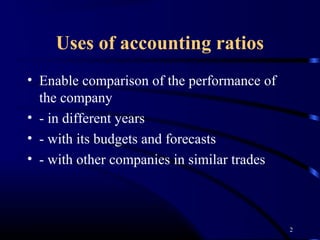
• Enable comparison of the performance of
  the company
• - in different years
• - with its budgets and forecasts
• - with other companies in similar trades


                                             2
Uses of accounting ratios
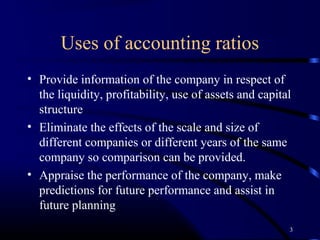
• Provide information of the company in respect of
  the liquidity, profitability, use of assets and capital
  structure
• Eliminate the effects of the scale and size of
  different companies or different years of the same
  company so comparison can be provided.
• Appraise the performance of the company, make
  predictions for future performance and assist in
  future planning
                                                        3
Accounting ratios and
             interpretation
•   Liquidity
•   - current ratio / working capital ratio
•   - acid test ratio / quick ratio / liquid ratio
•   - stock turnover rate
•   - stock turnover period
•   - debtors’ collection period
•   - creditors’ payment period
                                                     4
Liquidity
• Liquidity is a measure of the amount of
  funds a company can quickly use to settle
  its debts.


                                              5
Liquidity – current ratio
• This ratio indicates the ability of a business to
  meet its short-term liabilities from its current
  assets.
• The norm is 2:1.
• If the ratio is too high, the company may be
  holding too many idle short-term assets. (They
  may be used in a more profitable way.)
• If the ratio is too low, the company may not have
  sufficient funds to meet its short-term liabilities.

                                                         6
Liquidity – acid test ratio
• This ratio indicates the ability of the business to
  meet its short-term liabilities from its quick assets.
• The norm is 1:1.
• If the ratio is too high, the company may be
  holding excessive liquid assets.
• If the ratio is too low, the company may have a
  liquidity problem / cash flow problem.


                                                       7
Liquidity – stock turnover rate
• It shows the number of times that a business
  can sell its average stock in a period.
• A high ratio means high sales, fast stock
  turnover and a low stock level.
• A low ratio means low sales, low stock
  turnover and a high stock level. (goods may
  become obsolete, high storage cost)

                                             8
Liquidity – debtors collection
              period
• This ratio measures the debt collection
  period of a business.
• A low ratio means debtors pay back their
  debts in a short period of time. The
  company may have sufficient liquid fund.
• A high ratio indicates a poor credit control
  and a high risk of bad debts.

                                                 9
Liquidity – creditors payment
              period
• This shows the length of time taken to pay
  the creditors.
• A long payment period may indicate that
  the company has a liquidity problem. The
  relationship between the company and the
  suppliers may be affected.


                                               10
Accounting ratio and
            interpretation
• Profitability
• - gross profit ratio / gross margin / profit to
  sales ratio
• - net profit ratio / net profit margin
• - return on capital employed
• - assets turnover


                                                    11
Profitability – gross profit ratio
• It shows the gross profit on sales.
• A low ratio means the stock is being sold at
  lower prices. It may be a policy to stimulate
  sales.
• A high ratio may not result in high gross
  profit figure unless a large volume of sales
  is achieved.

                                              12
Profitability – net profit ratio
• It shows the net profit as a percentage of
  sales.
• It gives some ideas of the company’s
  pricing policy and cost control.
• A low ratio may be the result of lower
  selling prices or higher operating costs.


                                               13
Profitability – return on capital
             employed
• This ratio shows the profitability of a
  business and the management effectiveness
  in terms of the use of capital.
• A higher ratio means a higher profitability
  and a better management efficiency.


                                            14
Capital employed (Sole trader)
• Closing capital
• Average capital
• Capital balance + long term loans


                                      15
Capital employed (Partnership)
• Closing balance on fluctuating capital accounts
• Average of opening and closing balances on the
  fluctuating capital accounts
• Total of fixed capital accounts plus total of current
  accounts
• Average of fixed capital accounts plus total of
  current accounts
• Any of the above plus long term loans to the
  partnership

                                                      16
Capital employed
          (Limited company)
• - total assets
• - long term suppliers of capital (ordinary
  shares + preference shares + reserves +
  long-term loans)
• - shareholders’ capital (ordinary shares +
  preference shares + reserves)
• - shareholders’ equity (ordinary shares +
  reserves)

                                               17
Return
• Net profit after tax and preference share
  dividends (for ordinary shareholders)
• Net profit after tax + any preference share
  dividends + debenture and long-term loan
  interest (for all long-term suppliers of
  capital)


                                                18
Profitability – assets turnover
• This indicates the efficiency of the business
  in using its assets to generate revenues.
• A higher ratio means the company is more
  efficient to use its assets to generate
  revenues. This results in higher
  profitability.


                                              19
Accounting ratios and
            interpretation
•   Management efficiency
•   - stock turnover rate
•   - debtors ratio
•   - creditors ratio
•   - assets turnover


                                 20
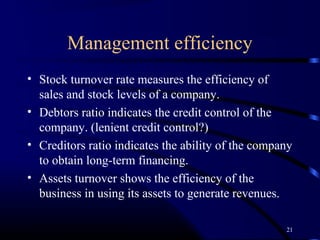
Management efficiency
• Stock turnover rate measures the efficiency of
  sales and stock levels of a company.
• Debtors ratio indicates the credit control of the
  company. (lenient credit control?)
• Creditors ratio indicates the ability of the company
  to obtain long-term financing.
• Assets turnover shows the efficiency of the
  business in using its assets to generate revenues.

                                                    21
Accounting ratios and
          interpretation
• Long-term solvency and stability
• - debt ratio
• - gearing ratio


                                     22
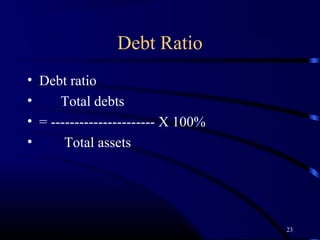
Debt Ratio
• Debt ratio
•     Total debts
• = ---------------------- X 100%
•      Total assets


                                    23
Long-term solvency – debt ratio
• Debt ratio shows the total amount of
  liabilities to total assets.
• If the debt ratio is too high (more than
  50%), it is difficult to obtain further
  financing and it also has a heavy burden of
  interest expense.


                                                24
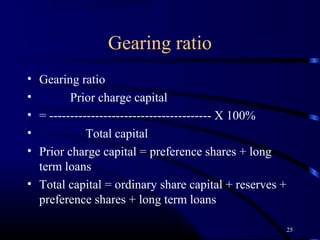
Gearing ratio
• Gearing ratio
•        Prior charge capital
• = --------------------------------------- X 100%
•            Total capital
• Prior charge capital = preference shares + long
  term loans
• Total capital = ordinary share capital + reserves +
  preference shares + long term loans

                                                        25
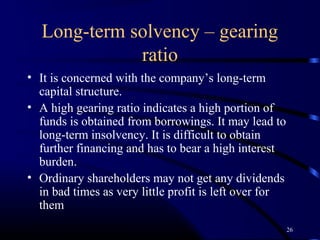
Long-term solvency – gearing
             ratio
• It is concerned with the company’s long-term
  capital structure.
• A high gearing ratio indicates a high portion of
  funds is obtained from borrowings. It may lead to
  long-term insolvency. It is difficult to obtain
  further financing and has to bear a high interest
  burden.
• Ordinary shareholders may not get any dividends
  in bad times as very little profit is left over for

  them
                                                        26
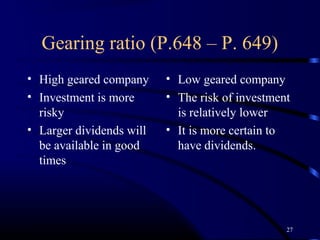
Gearing ratio (P.648 – P. 649)
• High geared company     • Low geared company
• Investment is more      • The risk of investment
  risky                     is relatively lower
• Larger dividends will   • It is more certain to
  be available in good      have dividends.
  times



                                                 27
Changing the gearing
• To reduce gearing      • To increase gearing
• By issuing new         • By issuing debentures
  ordinary shares        • By buying back
• By redeeming             ordinary shares in
  debentures               issue
• By retaining profits   • By issuing new
                           preference shares


                                               28
Accounting ratio and
             interpretation
•   Investment appraisal
•   - earnings per share
•   - price earning ratio
•   - dividend cover
•   - dividend yield


                                 29
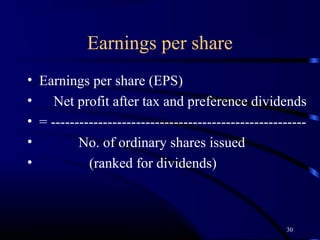
Earnings per share
• Earnings per share (EPS)
•    Net profit after tax and preference dividends
• = ------------------------------------------------------
•         No. of ordinary shares issued
•           (ranked for dividends)


                                                     30
Investment appraisal – earning
            per share
• It shows the profit in dollars associated with
  each ordinary share.
• A higher earnings per share indicates the
  investors may have higher confidence in the
  company. It is more profitable to invest in
  the shares.


                                               31
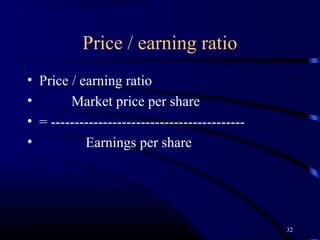
Price / earning ratio
• Price / earning ratio
•       Market price per share
• = -----------------------------------------
•          Earnings per share


                                                32
Investment appraisal – price
          earning ratio
• This ratio indicates the number of years
  required to earn the amount invested in the
  shares.
• A high ratio indicates investors have strong
  confidence in the company.
• An unreasonably high ratio may be the
  result of speculation in the stock market.

                                             33
Dividend cover
• Dividend cover
•    Net profit after tax and preference dividends
• = -------------------------------------------------------
•         Ordinary dividends paid and proposed


                                                     34
Investment appraisal – dividend
             cover
• It shows the amount of profit that has been
  distributed as dividends.
• A low ratio means a large amount of profits has
  been retained as reserves which can help to
  finance the operations of the company.
• A high ratio means a large amount of profits has
  been distributed as dividends. The dividend
  payment is vulnerable unless the company
  becomes more profitable.
                                                     35
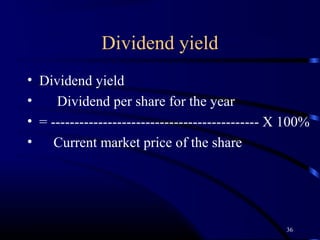
Dividend yield
• Dividend yield
•    Dividend per share for the year
• = -------------------------------------------- X 100%
• Current market price of the share


                                                  36
Investment appraisal – dividend
              yield
• This ratio measures the rate of return

  obtained from dividends on an investment
  in shares.
• A high dividend yield may imply the
  company is more successful and efficient. It
  is more profitable to invest in these shares.


                                              37
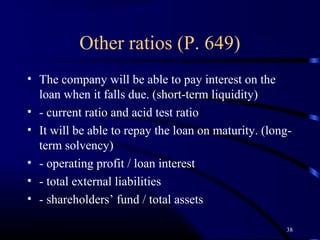
Other ratios (P. 649)
• The company will be able to pay interest on the
  loan when it falls due. (short-term liquidity)
• - current ratio and acid test ratio
• It will be able to repay the loan on maturity. (long-
  term solvency)
• - operating profit / loan interest
• - total external liabilities
• - shareholders’ fund / total assets

                                                     38
Examples of interested group
              (P.641)
•   Profitability
•   - shareholders
•   - management
•   - employees
•   - creditors
•   - competitors
•   - potential investors
                                    39
Examples of interested group
•   Liquidity
•   - shareholders
•   - suppliers
•   - creditors
•   - competitors


                                   40
Examples of interested group
•   Management efficiency
•   - shareholders
•   - potential purchasers
•   - competitors


                                   41
Examples of interested group
• Investment appraisal
• - shareholders
• - potential investors


                                 42
Examples of interested group
•   Capital structure
•   - shareholders
•   - lenders
•   - creditors
•   - potential investors


                                   43
Limitations of ratio analysis
• Different definitions of capital employed
  may cause confusion.
• Changes in price level will affect the
  comparability of the ratios between two
  financial periods.
• Changes in external environment will affect
  the comparison.

                                            44
Limitations of ratio analysis
• Differences in management and background of
  various businesses may affect the comparison.
• Different accounting definitions, methods,
  techniques and policies used by various businesses
  may affect the comparability.
• It is difficult to set up a proper standard for good
  performance.
• Short term fluctuations may not be reflected.

                                                    45

Ppt ratio

  • 1.
  • 2.
    Uses of accountingratios • Enable comparison of the performance of the company • - in different years • - with its budgets and forecasts • - with other companies in similar trades 2
  • 3.
    Uses of accountingratios • Provide information of the company in respect of the liquidity, profitability, use of assets and capital structure • Eliminate the effects of the scale and size of different companies or different years of the same company so comparison can be provided. • Appraise the performance of the company, make predictions for future performance and assist in future planning 3
  • 4.
    Accounting ratios and interpretation • Liquidity • - current ratio / working capital ratio • - acid test ratio / quick ratio / liquid ratio • - stock turnover rate • - stock turnover period • - debtors’ collection period • - creditors’ payment period 4
  • 5.
    Liquidity • Liquidity isa measure of the amount of funds a company can quickly use to settle its debts. 5
  • 6.
    Liquidity – currentratio • This ratio indicates the ability of a business to meet its short-term liabilities from its current assets. • The norm is 2:1. • If the ratio is too high, the company may be holding too many idle short-term assets. (They may be used in a more profitable way.) • If the ratio is too low, the company may not have sufficient funds to meet its short-term liabilities. 6
  • 7.
    Liquidity – acidtest ratio • This ratio indicates the ability of the business to meet its short-term liabilities from its quick assets. • The norm is 1:1. • If the ratio is too high, the company may be holding excessive liquid assets. • If the ratio is too low, the company may have a liquidity problem / cash flow problem. 7
  • 8.
    Liquidity – stockturnover rate • It shows the number of times that a business can sell its average stock in a period. • A high ratio means high sales, fast stock turnover and a low stock level. • A low ratio means low sales, low stock turnover and a high stock level. (goods may become obsolete, high storage cost) 8
  • 9.
    Liquidity – debtorscollection period • This ratio measures the debt collection period of a business. • A low ratio means debtors pay back their debts in a short period of time. The company may have sufficient liquid fund. • A high ratio indicates a poor credit control and a high risk of bad debts. 9
  • 10.
    Liquidity – creditorspayment period • This shows the length of time taken to pay the creditors. • A long payment period may indicate that the company has a liquidity problem. The relationship between the company and the suppliers may be affected. 10
  • 11.
    Accounting ratio and interpretation • Profitability • - gross profit ratio / gross margin / profit to sales ratio • - net profit ratio / net profit margin • - return on capital employed • - assets turnover 11
  • 12.
    Profitability – grossprofit ratio • It shows the gross profit on sales. • A low ratio means the stock is being sold at lower prices. It may be a policy to stimulate sales. • A high ratio may not result in high gross profit figure unless a large volume of sales is achieved. 12
  • 13.
    Profitability – netprofit ratio • It shows the net profit as a percentage of sales. • It gives some ideas of the company’s pricing policy and cost control. • A low ratio may be the result of lower selling prices or higher operating costs. 13
  • 14.
    Profitability – returnon capital employed • This ratio shows the profitability of a business and the management effectiveness in terms of the use of capital. • A higher ratio means a higher profitability and a better management efficiency. 14
  • 15.
    Capital employed (Soletrader) • Closing capital • Average capital • Capital balance + long term loans 15
  • 16.
    Capital employed (Partnership) •Closing balance on fluctuating capital accounts • Average of opening and closing balances on the fluctuating capital accounts • Total of fixed capital accounts plus total of current accounts • Average of fixed capital accounts plus total of current accounts • Any of the above plus long term loans to the partnership 16
  • 17.
    Capital employed (Limited company) • - total assets • - long term suppliers of capital (ordinary shares + preference shares + reserves + long-term loans) • - shareholders’ capital (ordinary shares + preference shares + reserves) • - shareholders’ equity (ordinary shares + reserves) 17
  • 18.
    Return • Net profitafter tax and preference share dividends (for ordinary shareholders) • Net profit after tax + any preference share dividends + debenture and long-term loan interest (for all long-term suppliers of capital) 18
  • 19.
    Profitability – assetsturnover • This indicates the efficiency of the business in using its assets to generate revenues. • A higher ratio means the company is more efficient to use its assets to generate revenues. This results in higher profitability. 19
  • 20.
    Accounting ratios and interpretation • Management efficiency • - stock turnover rate • - debtors ratio • - creditors ratio • - assets turnover 20
  • 21.
    Management efficiency • Stockturnover rate measures the efficiency of sales and stock levels of a company. • Debtors ratio indicates the credit control of the company. (lenient credit control?) • Creditors ratio indicates the ability of the company to obtain long-term financing. • Assets turnover shows the efficiency of the business in using its assets to generate revenues. 21
  • 22.
    Accounting ratios and interpretation • Long-term solvency and stability • - debt ratio • - gearing ratio 22
  • 23.
    Debt Ratio • Debtratio • Total debts • = ---------------------- X 100% • Total assets 23
  • 24.
    Long-term solvency –debt ratio • Debt ratio shows the total amount of liabilities to total assets. • If the debt ratio is too high (more than 50%), it is difficult to obtain further financing and it also has a heavy burden of interest expense. 24
  • 25.
    Gearing ratio • Gearingratio • Prior charge capital • = --------------------------------------- X 100% • Total capital • Prior charge capital = preference shares + long term loans • Total capital = ordinary share capital + reserves + preference shares + long term loans 25
  • 26.
    Long-term solvency –gearing ratio • It is concerned with the company’s long-term capital structure. • A high gearing ratio indicates a high portion of funds is obtained from borrowings. It may lead to long-term insolvency. It is difficult to obtain further financing and has to bear a high interest burden. • Ordinary shareholders may not get any dividends in bad times as very little profit is left over for them 26
  • 27.
    Gearing ratio (P.648– P. 649) • High geared company • Low geared company • Investment is more • The risk of investment risky is relatively lower • Larger dividends will • It is more certain to be available in good have dividends. times 27
  • 28.
    Changing the gearing •To reduce gearing • To increase gearing • By issuing new • By issuing debentures ordinary shares • By buying back • By redeeming ordinary shares in debentures issue • By retaining profits • By issuing new preference shares 28
  • 29.
    Accounting ratio and interpretation • Investment appraisal • - earnings per share • - price earning ratio • - dividend cover • - dividend yield 29
  • 30.
    Earnings per share •Earnings per share (EPS) • Net profit after tax and preference dividends • = ------------------------------------------------------ • No. of ordinary shares issued • (ranked for dividends) 30
  • 31.
    Investment appraisal –earning per share • It shows the profit in dollars associated with each ordinary share. • A higher earnings per share indicates the investors may have higher confidence in the company. It is more profitable to invest in the shares. 31
  • 32.
    Price / earningratio • Price / earning ratio • Market price per share • = ----------------------------------------- • Earnings per share 32
  • 33.
    Investment appraisal –price earning ratio • This ratio indicates the number of years required to earn the amount invested in the shares. • A high ratio indicates investors have strong confidence in the company. • An unreasonably high ratio may be the result of speculation in the stock market. 33
  • 34.
    Dividend cover • Dividendcover • Net profit after tax and preference dividends • = ------------------------------------------------------- • Ordinary dividends paid and proposed 34
  • 35.
    Investment appraisal –dividend cover • It shows the amount of profit that has been distributed as dividends. • A low ratio means a large amount of profits has been retained as reserves which can help to finance the operations of the company. • A high ratio means a large amount of profits has been distributed as dividends. The dividend payment is vulnerable unless the company becomes more profitable. 35
  • 36.
    Dividend yield • Dividendyield • Dividend per share for the year • = -------------------------------------------- X 100% • Current market price of the share 36
  • 37.
    Investment appraisal –dividend yield • This ratio measures the rate of return obtained from dividends on an investment in shares. • A high dividend yield may imply the company is more successful and efficient. It is more profitable to invest in these shares. 37
  • 38.
    Other ratios (P.649) • The company will be able to pay interest on the loan when it falls due. (short-term liquidity) • - current ratio and acid test ratio • It will be able to repay the loan on maturity. (long- term solvency) • - operating profit / loan interest • - total external liabilities • - shareholders’ fund / total assets 38
  • 39.
    Examples of interestedgroup (P.641) • Profitability • - shareholders • - management • - employees • - creditors • - competitors • - potential investors 39
  • 40.
    Examples of interestedgroup • Liquidity • - shareholders • - suppliers • - creditors • - competitors 40
  • 41.
    Examples of interestedgroup • Management efficiency • - shareholders • - potential purchasers • - competitors 41
  • 42.
    Examples of interestedgroup • Investment appraisal • - shareholders • - potential investors 42
  • 43.
    Examples of interestedgroup • Capital structure • - shareholders • - lenders • - creditors • - potential investors 43
  • 44.
    Limitations of ratioanalysis • Different definitions of capital employed may cause confusion. • Changes in price level will affect the comparability of the ratios between two financial periods. • Changes in external environment will affect the comparison. 44
  • 45.
    Limitations of ratioanalysis • Differences in management and background of various businesses may affect the comparison. • Different accounting definitions, methods, techniques and policies used by various businesses may affect the comparability. • It is difficult to set up a proper standard for good performance. • Short term fluctuations may not be reflected. 45