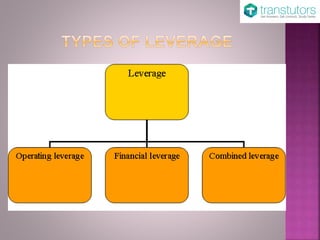
 Leverage is the use of
various financial
instruments making profit
more than the amount
invested in the investment.
 It has to be companies
decision to raise an
investment through debt
or equity.
 Leverage Ratios states the
mixture of debt and equity
in the firm.
 It basically, defines the
capital structure of the firm
to meet the payments
associated.
 Leverage = % change in
dependent variable / %
change in independent
variable
 Operating Leverage shows
the relationship between
the sales revenue and
EBIT.
 The operating leverage is
calculated by dividing the
% change in EBIT by the %
change in sales revenue.
 No fixed cost implies the
EBIT will be direct and
proportionate to the sales.
 The Financial Leverage
measures the relationship
between EBIT and the EPS.
 EPS= [(EBIT – INTEREST)*(1
– t)] / Number of shares
 Financial leverage is
defined as the % change in
EPS divided by the %
change in EBIT.
 This table shows how the
values are calculated from
sales and then move to
EBIT, i.e., Earnings before
interest and tax. By
subtracting Interest from it
gives PBT ,i.e., profit before
tax. Then subtracting tax
gives PAT, i.e., profit after
tax.
 Financial leverage ratios
measure the overall debt
of the company.
 Financial leverage ratios
are also known as debt or
equity ratios.
 Types of financial leverage
ratios: DEBT RATIO and
DEBT TO EQUITY RATIO
 Debt ratio establishes relationship between total debt and
total assets of the company.
 Companies with more liabilities means higher leveraged
and in turn, reduce the lenders.
 DEBT RATIO = Total Debt / Total Assets
 Debt to Equity ratio is computed to assess long-term
financial position of the company.
 DEBT TO EQUITY RATIO = Debt / Equity (Shareholder’s
Funds)
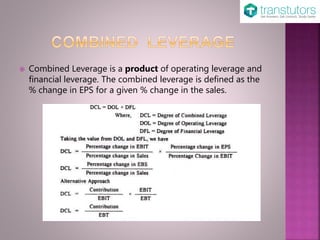
 Combined Leverage is a product of operating leverage and
financial leverage. The combined leverage is defined as the
% change in EPS for a given % change in the sales.
 Activity ratios are those ratios which measure the
effectiveness with which firm use its available resources.
Higher Turnover ratio means better use of resources and
profitability ratio.
 Activity ratios are as follows:
 Inventory Turnover Ratio
 Trade Payables (Creditors) Turnover Ratio
 Trade Receivables (Debtors) Turnover Ratio
 Working Capital Turnover Ratio
 Inventory Turnover Ratio defines the relationship between
cost of goods sold and average inventory during that
period.
 High ratio =>more sales.
 Very high ratio => overtrading and may result in shortage
of working capital.
 Low turnover ratio => inefficient use of inventory.
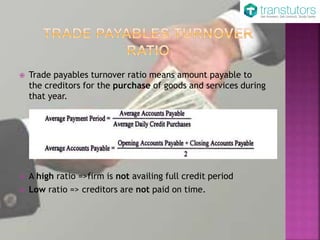
 Trade payables turnover ratio means amount payable to
the creditors for the purchase of goods and services during
that year.
 A high ratio =>firm is not availing full credit period
 Low ratio => creditors are not paid on time.
 Trade receivables turnover ratio means amount receivable
against goods and services sold during that year.
 High ratio =>debts are collected more promptly
 Low ratio =>inefficiency in collection from debtors.
 Working capital turnover ratio shows relationship between
working capital and net sales.
 Higher ratio is better
 Very high ratio =>overtrading, i.e., working capital is not
used effectively.
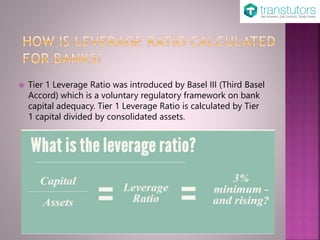
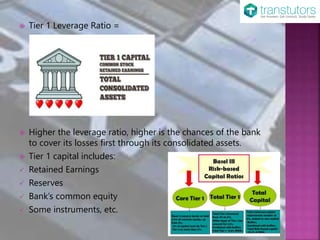
 Tier 1 Leverage Ratio was introduced by Basel III (Third Basel
Accord) which is a voluntary regulatory framework on bank
capital adequacy. Tier 1 Leverage Ratio is calculated by Tier
1 capital divided by consolidated assets.
 Tier 1 Leverage Ratio =
 Higher the leverage ratio, higher is the chances of the bank
to cover its losses first through its consolidated assets.
 Tier 1 capital includes:
 Retained Earnings
 Reserves
 Bank’s common equity
 Some instruments, etc.
 Basel III
established a
minimum
requirement of
3% so that there
should be
enough capital to
cover 3% of its
total assets while
it also allowed
other important
financial
institutions to
make more if
possible.
This was just a summary on Leverage Ratios. For more detailed
information on this topic, please type the link given below or copy it
from the description of this PPT and open it in a new browser window.
www.transtutors.com/homework-help/finance/leverage-ratios.aspx

Leverage Ratios | Finance

  • 2.
     Leverage isthe use of various financial instruments making profit more than the amount invested in the investment.  It has to be companies decision to raise an investment through debt or equity.
  • 3.
     Leverage Ratiosstates the mixture of debt and equity in the firm.  It basically, defines the capital structure of the firm to meet the payments associated.  Leverage = % change in dependent variable / % change in independent variable
  • 5.
     Operating Leverageshows the relationship between the sales revenue and EBIT.  The operating leverage is calculated by dividing the % change in EBIT by the % change in sales revenue.  No fixed cost implies the EBIT will be direct and proportionate to the sales.
  • 6.
     The FinancialLeverage measures the relationship between EBIT and the EPS.  EPS= [(EBIT – INTEREST)*(1 – t)] / Number of shares  Financial leverage is defined as the % change in EPS divided by the % change in EBIT.
  • 7.
     This tableshows how the values are calculated from sales and then move to EBIT, i.e., Earnings before interest and tax. By subtracting Interest from it gives PBT ,i.e., profit before tax. Then subtracting tax gives PAT, i.e., profit after tax.
  • 8.
     Financial leverageratios measure the overall debt of the company.  Financial leverage ratios are also known as debt or equity ratios.  Types of financial leverage ratios: DEBT RATIO and DEBT TO EQUITY RATIO
  • 9.
     Debt ratioestablishes relationship between total debt and total assets of the company.  Companies with more liabilities means higher leveraged and in turn, reduce the lenders.  DEBT RATIO = Total Debt / Total Assets
  • 10.
     Debt toEquity ratio is computed to assess long-term financial position of the company.  DEBT TO EQUITY RATIO = Debt / Equity (Shareholder’s Funds)
  • 11.
     Combined Leverageis a product of operating leverage and financial leverage. The combined leverage is defined as the % change in EPS for a given % change in the sales.
  • 12.
     Activity ratiosare those ratios which measure the effectiveness with which firm use its available resources. Higher Turnover ratio means better use of resources and profitability ratio.  Activity ratios are as follows:  Inventory Turnover Ratio  Trade Payables (Creditors) Turnover Ratio  Trade Receivables (Debtors) Turnover Ratio  Working Capital Turnover Ratio
  • 13.
     Inventory TurnoverRatio defines the relationship between cost of goods sold and average inventory during that period.  High ratio =>more sales.  Very high ratio => overtrading and may result in shortage of working capital.  Low turnover ratio => inefficient use of inventory.
  • 14.
     Trade payablesturnover ratio means amount payable to the creditors for the purchase of goods and services during that year.  A high ratio =>firm is not availing full credit period  Low ratio => creditors are not paid on time.
  • 15.
     Trade receivablesturnover ratio means amount receivable against goods and services sold during that year.  High ratio =>debts are collected more promptly  Low ratio =>inefficiency in collection from debtors.
  • 16.
     Working capitalturnover ratio shows relationship between working capital and net sales.  Higher ratio is better  Very high ratio =>overtrading, i.e., working capital is not used effectively.
  • 17.
     Tier 1Leverage Ratio was introduced by Basel III (Third Basel Accord) which is a voluntary regulatory framework on bank capital adequacy. Tier 1 Leverage Ratio is calculated by Tier 1 capital divided by consolidated assets.
  • 18.
     Tier 1Leverage Ratio =  Higher the leverage ratio, higher is the chances of the bank to cover its losses first through its consolidated assets.  Tier 1 capital includes:  Retained Earnings  Reserves  Bank’s common equity  Some instruments, etc.
  • 19.
     Basel III establisheda minimum requirement of 3% so that there should be enough capital to cover 3% of its total assets while it also allowed other important financial institutions to make more if possible.
  • 20.
    This was justa summary on Leverage Ratios. For more detailed information on this topic, please type the link given below or copy it from the description of this PPT and open it in a new browser window. www.transtutors.com/homework-help/finance/leverage-ratios.aspx