FINANCIAL RATIO
Presenters
• BBSSagar Bajaj
• BBSOsama Rajput
• MBA-72Mohsan Patoli
• MBA-72Muzzamil Shaikh
FINANCIAL RATIO
• A financial ratio (or accounting ratio) is
a relative selected
numerical
magnitude
values
of two
taken from an
enterprise's financial statement.
SOURCES OF DATA FOR
FINANCIAL RATIOS
• Balance Sheet
• Income Statement
• Statement of Cash Flow
• Statement of Retained Earnings
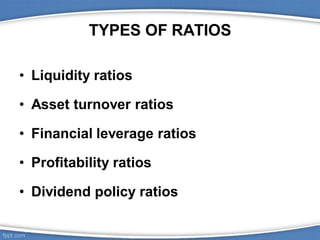
TYPES OF RATIOS
• Liquidity ratios
• Asset turnover ratios
• Financial leverage ratios
• Profitability ratios
• Dividend policy ratios
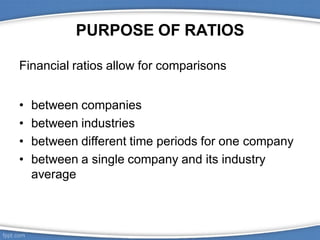
PURPOSE OF RATIOS
Financial ratios allow for comparisons
• between companies
• between industries
• between different time periods for one company
• between a single company and its industry
average
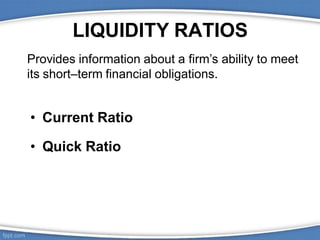
LIQUIDITY RATIOS
Provides information about a firm’s ability to meet
its short–term financial obligations.
• Current Ratio
• Quick Ratio
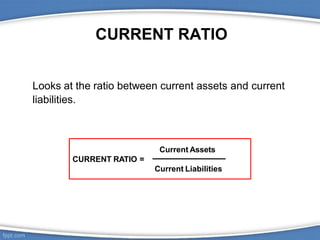
CURRENT RATIO
Current Assets
CURRENT RATIO =
Current Liabilities
Looks at the ratio between current assets and current
liabilities.
QUICK RATIO
Is similar to the current ratio but it excludes inventory
from current assets.
Current Assets - Inventory
QUICK RATIO =
Current Liabilities
LIQUIDITY RATIOS
According to company financial statement they
are in Strong Liquidity position but their liquidity
position is not as good as they stated. Company
liquidity position appear to have remain stable
but below acceptable criteria. Company may
have problem to satisfy its short term obligations
when they come due. But, it is also a fact that
company do not have pay all its short term
obligations at the same time so company should
manage to pay its short liabilities
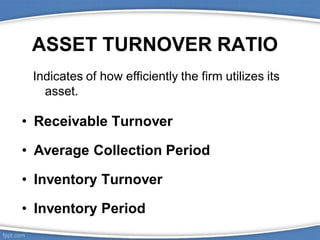
ASSET TURNOVER RATIO
• Receivable Turnover
• Average Collection Period
• Inventory Turnover
• Inventory Period
Indicates of how efficiently the firm utilizes its
asset.
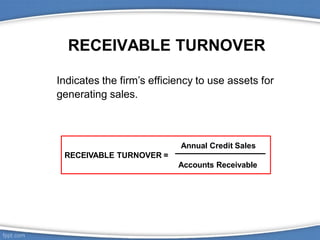
RECEIVABLE TURNOVER
Annual Credit Sales
RECEIVABLE TURNOVER =
Accounts Receivable
Indicates the firm’s efficiency to use assets for
generating sales.
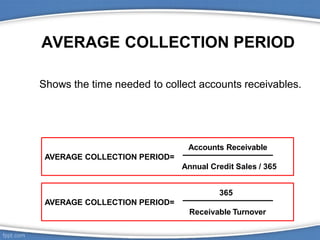
AVERAGE COLLECTION PERIOD
Shows the time needed to collect accounts receivables.
Accounts Receivable
AVERAGE COLLECTION PERIOD=
Annual Credit Sales / 365
365
AVERAGE COLLECTION PERIOD=
Receivable Turnover
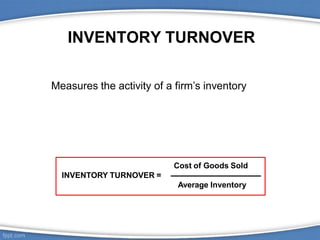
INVENTORY TURNOVER
Cost of Goods Sold
INVENTORY TURNOVER =
Average Inventory
Measures the activity of a firm’s inventory
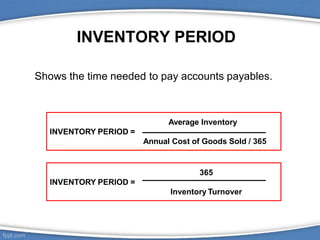
INVENTORY PERIOD
Shows the time needed to pay accounts payables.
Average Inventory
INVENTORY PERIOD =
Annual Cost of Goods Sold / 365
365
INVENTORY PERIOD =
Inventory Turnover
DEBT MANAGEMENT RATIOS
Provide an indication of the long-term
solvency of the firm.
• Debt Ratio
• Debt Equity Ratio
• Interest Coverage
• Book Value
DEBT RATIO
Measures the proportion of total assets financed by
the firm’s creditor
Total Debt
DEBT RATIO =
Total Assets
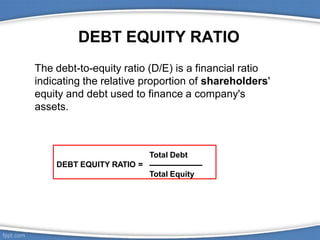
DEBT EQUITY RATIO
The debt-to-equity ratio (D/E) is a financial ratio
indicating the relative proportion of shareholders'
equity and debt used to finance a company's
assets.
Total Debt
DEBT EQUITY RATIO =
Total Equity
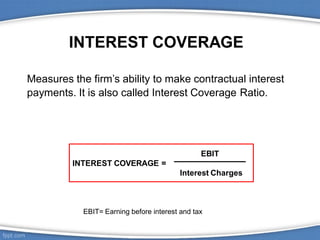
INTEREST COVERAGE
Measures the firm’s ability to make contractual interest
payments. It is also called Interest Coverage Ratio.
EBIT
INTEREST COVERAGE =
Interest Charges
EBIT= Earning before interest and tax
BOOK VALUE
The value of a security or asset as entered in a
firm's books
Total owner’s equity
BOOK VALUE PER SHARE =
No: of share outstanding
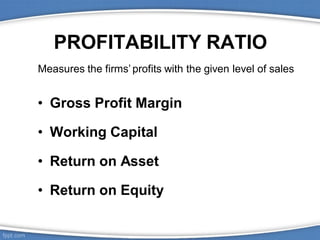
PROFITABILITY RATIO
• Gross Profit Margin
• Working Capital
• Return on Asset
• Return on Equity
Measures the firms’ profits with the given level of sales
GROSS PROFIT MARGIN
It is a measure of the gross profit earned on sales.
Sales – Cost of Goods Sold
GROSS PROFIT MARGIN =
Sales
Net Income
GROSS PROFIT MARGIN =
Sales
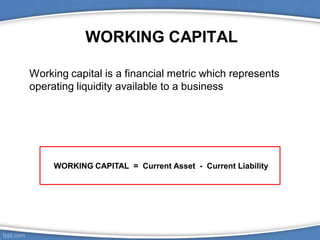
WORKING CAPITAL
Working capital is a financial metric which represents
operating liquidity available to a business
WORKING CAPITAL = Current Asset - Current Liability
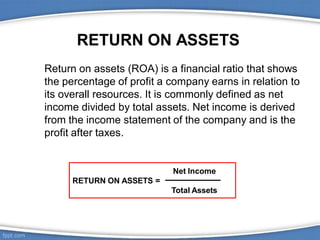
RETURN ON ASSETS
Return on assets (ROA) is a financial ratio that shows
the percentage of profit a company earns in relation to
its overall resources. It is commonly defined as net
income divided by total assets. Net income is derived
from the income statement of the company and is the
profit after taxes.
Net Income
RETURN ON ASSETS =
Total Assets
RETURN ON EQUITY
In corporate finance, the return on equity (ROE) is
a measure of the profitability of a business in relation
to the book value of shareholder equity, also known
as net assets or assets minus liabilities. ROE is a
measure of how well a company uses investments to
generate earnings growth.
Net Income
RETURN ON EQUITY=
Shareholder Equity
DIVIDEND POLICY RATIO
• Dividend Yield Ratio
• Dividend Payout Ratio
DIVIDEND YIELD RATIO
The dividend yield is a financial ratio that measures
the amount of cash dividends distributed to common
shareholders relative to the market value per share.
Dividends Per Share
DIVIDEND YIELD =
Share Price
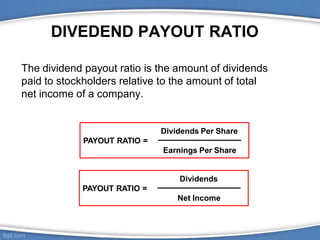
DIVEDEND PAYOUT RATIO
The dividend payout ratio is the amount of dividends
paid to stockholders relative to the amount of total
net income of a company.
Dividends
PAYOUT RATIO =
Net Income
Dividends Per Share
PAYOUT RATIO =
Earnings Per Share
ADVANTAGES OF RATIO
 Forecasting and Planning
 Budgeting
 Measurement of Operating Efficiency
 Communication
 Control of Performance and Cost
 Inter-firm Comparison
ADVANTAGES OF RATIO
 Indication of Liquidity Position
 Indication of Long-term Solvency Position
 Indication of Overall Profitability
 Signal of Corporate Sickness
 Aid to Decision-making
 Simplification of Financial Statements
LIMITATIONS OF RATIO
 Historical Information
 Different Accounting Policies
 Lack of Standard of Comparison
 Changes in Price Level
 Seasonal Factors Affect Financial Data
 A reference point is needed
Financial Ratio
Financial Ratio

Financial Ratio

  • 2.
  • 3.
    Presenters • BBSSagar Bajaj •BBSOsama Rajput • MBA-72Mohsan Patoli • MBA-72Muzzamil Shaikh
  • 5.
    FINANCIAL RATIO • Afinancial ratio (or accounting ratio) is a relative selected numerical magnitude values of two taken from an enterprise's financial statement.
  • 6.
    SOURCES OF DATAFOR FINANCIAL RATIOS • Balance Sheet • Income Statement • Statement of Cash Flow • Statement of Retained Earnings
  • 7.
    TYPES OF RATIOS •Liquidity ratios • Asset turnover ratios • Financial leverage ratios • Profitability ratios • Dividend policy ratios
  • 8.
    PURPOSE OF RATIOS Financialratios allow for comparisons • between companies • between industries • between different time periods for one company • between a single company and its industry average
  • 9.
    LIQUIDITY RATIOS Provides informationabout a firm’s ability to meet its short–term financial obligations. • Current Ratio • Quick Ratio
  • 10.
    CURRENT RATIO Current Assets CURRENTRATIO = Current Liabilities Looks at the ratio between current assets and current liabilities.
  • 11.
    QUICK RATIO Is similarto the current ratio but it excludes inventory from current assets. Current Assets - Inventory QUICK RATIO = Current Liabilities
  • 12.
    LIQUIDITY RATIOS According tocompany financial statement they are in Strong Liquidity position but their liquidity position is not as good as they stated. Company liquidity position appear to have remain stable but below acceptable criteria. Company may have problem to satisfy its short term obligations when they come due. But, it is also a fact that company do not have pay all its short term obligations at the same time so company should manage to pay its short liabilities
  • 14.
    ASSET TURNOVER RATIO •Receivable Turnover • Average Collection Period • Inventory Turnover • Inventory Period Indicates of how efficiently the firm utilizes its asset.
  • 15.
    RECEIVABLE TURNOVER Annual CreditSales RECEIVABLE TURNOVER = Accounts Receivable Indicates the firm’s efficiency to use assets for generating sales.
  • 16.
    AVERAGE COLLECTION PERIOD Showsthe time needed to collect accounts receivables. Accounts Receivable AVERAGE COLLECTION PERIOD= Annual Credit Sales / 365 365 AVERAGE COLLECTION PERIOD= Receivable Turnover
  • 17.
    INVENTORY TURNOVER Cost ofGoods Sold INVENTORY TURNOVER = Average Inventory Measures the activity of a firm’s inventory
  • 18.
    INVENTORY PERIOD Shows thetime needed to pay accounts payables. Average Inventory INVENTORY PERIOD = Annual Cost of Goods Sold / 365 365 INVENTORY PERIOD = Inventory Turnover
  • 20.
    DEBT MANAGEMENT RATIOS Providean indication of the long-term solvency of the firm. • Debt Ratio • Debt Equity Ratio • Interest Coverage • Book Value
  • 21.
    DEBT RATIO Measures theproportion of total assets financed by the firm’s creditor Total Debt DEBT RATIO = Total Assets
  • 22.
    DEBT EQUITY RATIO Thedebt-to-equity ratio (D/E) is a financial ratio indicating the relative proportion of shareholders' equity and debt used to finance a company's assets. Total Debt DEBT EQUITY RATIO = Total Equity
  • 23.
    INTEREST COVERAGE Measures thefirm’s ability to make contractual interest payments. It is also called Interest Coverage Ratio. EBIT INTEREST COVERAGE = Interest Charges EBIT= Earning before interest and tax
  • 24.
    BOOK VALUE The valueof a security or asset as entered in a firm's books Total owner’s equity BOOK VALUE PER SHARE = No: of share outstanding
  • 26.
    PROFITABILITY RATIO • GrossProfit Margin • Working Capital • Return on Asset • Return on Equity Measures the firms’ profits with the given level of sales
  • 27.
    GROSS PROFIT MARGIN Itis a measure of the gross profit earned on sales. Sales – Cost of Goods Sold GROSS PROFIT MARGIN = Sales Net Income GROSS PROFIT MARGIN = Sales
  • 28.
    WORKING CAPITAL Working capitalis a financial metric which represents operating liquidity available to a business WORKING CAPITAL = Current Asset - Current Liability
  • 29.
    RETURN ON ASSETS Returnon assets (ROA) is a financial ratio that shows the percentage of profit a company earns in relation to its overall resources. It is commonly defined as net income divided by total assets. Net income is derived from the income statement of the company and is the profit after taxes. Net Income RETURN ON ASSETS = Total Assets
  • 30.
    RETURN ON EQUITY Incorporate finance, the return on equity (ROE) is a measure of the profitability of a business in relation to the book value of shareholder equity, also known as net assets or assets minus liabilities. ROE is a measure of how well a company uses investments to generate earnings growth. Net Income RETURN ON EQUITY= Shareholder Equity
  • 31.
    DIVIDEND POLICY RATIO •Dividend Yield Ratio • Dividend Payout Ratio
  • 32.
    DIVIDEND YIELD RATIO Thedividend yield is a financial ratio that measures the amount of cash dividends distributed to common shareholders relative to the market value per share. Dividends Per Share DIVIDEND YIELD = Share Price
  • 33.
    DIVEDEND PAYOUT RATIO Thedividend payout ratio is the amount of dividends paid to stockholders relative to the amount of total net income of a company. Dividends PAYOUT RATIO = Net Income Dividends Per Share PAYOUT RATIO = Earnings Per Share
  • 34.
    ADVANTAGES OF RATIO Forecasting and Planning  Budgeting  Measurement of Operating Efficiency  Communication  Control of Performance and Cost  Inter-firm Comparison
  • 35.
    ADVANTAGES OF RATIO Indication of Liquidity Position  Indication of Long-term Solvency Position  Indication of Overall Profitability  Signal of Corporate Sickness  Aid to Decision-making  Simplification of Financial Statements
  • 36.
    LIMITATIONS OF RATIO Historical Information  Different Accounting Policies  Lack of Standard of Comparison  Changes in Price Level  Seasonal Factors Affect Financial Data  A reference point is needed