LEVERGE
BY RUPA YADAV
Flowsofthepresentation
o MeaningofLeverage
o MattersassociatedwiththeconceptofLeverage
o TypesofLeverage
o OperatingLeverage
o FinancialLeverage
o CombinedLeverage
 In general ,leverage refers to accomplish certain things which are otherwise not possible
i.e. lifting of heavy objects with the help of lever. This concept of leverage is valid in
businessalso.
 In finance ,the term ‘leverage’ is used to describe the firm’s ability to use fixed cost assets
or funds to increase the return to its owners; i.e. equity shareholders. In other words, the
fixed cost funds i.e. debentures & preference share capital act as the fulcrum , which assist
the lever i.e. the firm to lift i.e. to increase the earnings of its owner i.e. the equity
shareholders.
 If earnings less the variable costs exceed the fixed costs i.e. preference dividend & interest
on debenture, or earnings before interest and taxes exceed the fixed return requirement,
the leverageiscalled favourable . when they do not ,the result isunfavourable leverage.
 Leverageisalsothe influence which anindependent variable hasover a dependent/related
variablei.e. rainfall overproduction. In financial context, sales & fixedcostoverprofit
MEANING OF LEVERAGE
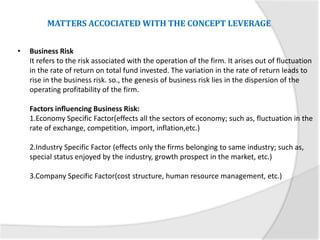
• Business Risk
It refers to the risk associated with the operation of the firm. It arises out of fluctuation
in the rate of return on total fund invested. The variation in the rate of return leads to
rise in the business risk. so., the genesis of business risk lies in the dispersion of the
operating profitability of the firm.
Factors influencing Business Risk:
1.Economy Specific Factor(effects all the sectors of economy; such as, fluctuation in the
rate of exchange, competition, import, inflation,etc.)
2.Industry Specific Factor (effects only the firms belonging to same industry; such as,
special status enjoyed by the industry, growth prospect in the market, etc.)
3.Company Specific Factor(cost structure, human resource management, etc.)
MATTERS ACCOCIATED WITH THE CONCEPT LEVERAGE
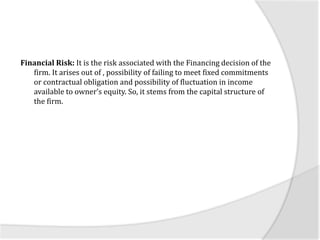
Financial Risk: It is the risk associated with the Financing decision of the
firm. It arises out of , possibility of failing to meet fixed commitments
or contractual obligation and possibility of fluctuation in income
available to owner’s equity. So, it stems from the capital structure of
the firm.
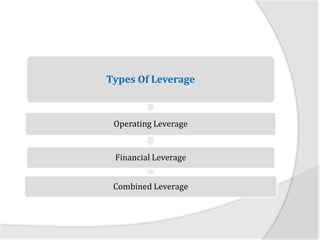
Types Of Leverage
Operating Leverage
Financial Leverage
Combined Leverage
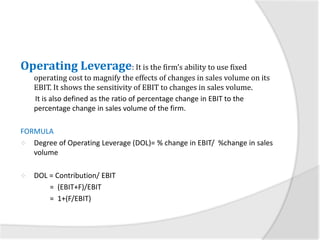
Operating Leverage: It is the firm’s ability to use fixed
operating cost to magnify the effects of changes in sales volume on its
EBIT. It shows the sensitivity of EBIT to changes in sales volume.
It is also defined as the ratio of percentage change in EBIT to the
percentage change in sales volume of the firm.
FORMULA
 Degree of Operating Leverage (DOL)= % change in EBIT/ %change in sales
volume
 DOL = Contribution/ EBIT
= (EBIT+F)/EBIT
= 1+(F/EBIT)
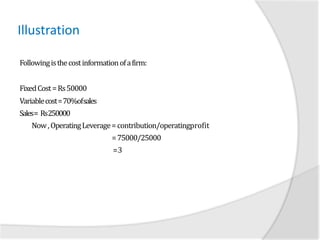
Illustration
Followingisthecostinformationofafirm:
FixedCost=Rs50000
Variablecost=70%ofsales
Sales= Rs250000
 Now,OperatingLeverage=contribution/operatingprofit
 =75000/25000
 =3
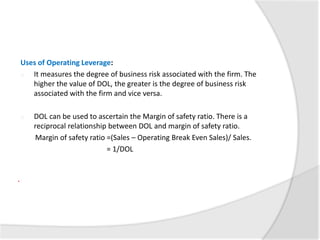
Uses of Operating Leverage:
o It measures the degree of business risk associated with the firm. The
higher the value of DOL, the greater is the degree of business risk
associated with the firm and vice versa.
o DOL can be used to ascertain the Margin of safety ratio. There is a
reciprocal relationship between DOL and margin of safety ratio.
Margin of safety ratio =(Sales – Operating Break Even Sales)/ Sales.
= 1/DOL
.
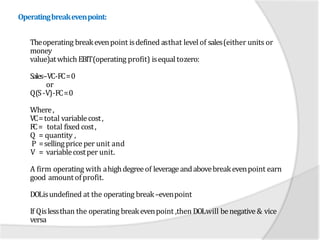
Operatingbreakevenpoint:
Theoperating breakevenpoint isdefined asthat levelof sales(either units or
money
value)atwhich EBIT(operating profit) isequaltozero:
Sales–VC-FC=0
or
Q(S-V)-FC=0
Where,
VC=total variablecost,
FC= total fixed cost,
Q = quantity ,
P =sellingprice per unit and
V = variablecostper unit.
A firm operating with ahighdegreeof leverageandabovebreakevenpoint earn
good amount ofprofit.
DOLisundefined at the operating break–evenpoint
If Qislessthan the operating breakevenpoint ,then DOLwill benegative& vice
versa
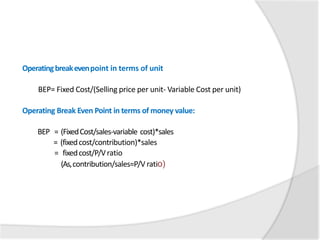
Operatingbreakevenpoint in terms of unit
BEP= Fixed Cost/(Selling price per unit- Variable Cost per unit)
Operating Break Even Point in terms of money value:
BEP = (FixedCost/sales-variable cost)*sales
= (fixedcost/contribution)*sales
= fixedcost/P/Vratio
(As,contribution/sales=P/V ratio)
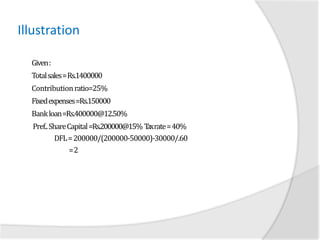
Illustration
 Given:
 Totalsales=Rs.1400000
 Contributionratio=25%
 Fixedexpenses=Rs.150000
 Bankloan=Rs.400000@12.50%
 Pref..ShareCapital=Rs.200000@15% Taxrate=40%
DFL=200000/(200000-50000)-30000/.60
=2
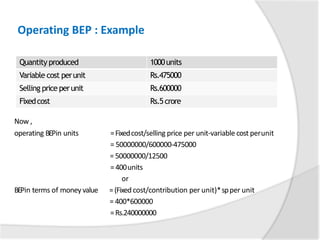
Operating BEP : Example
Quantity produced 1000units
Variable cost perunit Rs.475000
Selling price perunit Rs.600000
Fixedcost Rs.5crore
Now ,
operating BEPin units =Fixedcost/selling price per unit-variable cost perunit
= 50000000/600000-475000
= 50000000/12500
=400units
or
BEPin terms of moneyvalue =(Fixedcost/contribution per unit)*spper unit
= 400*600000
=Rs.240000000
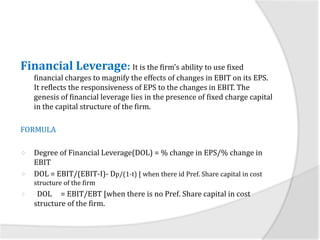
Financial Leverage: It is the firm’s ability to use fixed
financial charges to magnify the effects of changes in EBIT on its EPS.
It reflects the responsiveness of EPS to the changes in EBIT. The
genesis of financial leverage lies in the presence of fixed charge capital
in the capital structure of the firm.
FORMULA
 Degree of Financial Leverage(DOL) = % change in EPS/% change in
EBIT
 DOL = EBIT/(EBIT-I)- Dp/(1-t) [ when there id Pref. Share capital in cost
structure of the firm
 DOL = EBIT/EBT [when there is no Pref. Share capital in cost
structure of the firm.
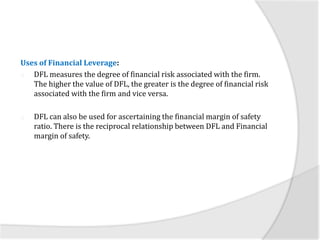
Uses of Financial Leverage:
o DFL measures the degree of financial risk associated with the firm.
The higher the value of DFL, the greater is the degree of financial risk
associated with the firm and vice versa.
o DFL can also be used for ascertaining the financial margin of safety
ratio. There is the reciprocal relationship between DFL and Financial
margin of safety.
Terms associated with financial leverage
 Financial Break Even Point: It is that level of EBIT at which EPS is equal
to Zero. In other words , it represents that level of EBIT at which the firm
can satisfy its fixed financial charges . Any level of EBIT below Financial
break even point will yield negative EPS.
Financial BEP = I + Dp/(1-t)
 Financial Margin of Safety: The excess of actual level of EBIT over the
financial break even point is called financial margin of safety. At this point
the EPS is equal to zero.
Financial MSR=( Actual EBIT- FBEP )/ Actual EBIT.
It is reciprocal of DFL
FMS ratio= 1/DFL.
Hence the higher the value of DFL the lower will be the FMS ratio and vice
versa.
Combined Leverage: The product of Operating Leverage and
Financial Leverage is called Combined Leverage. It shows the
responsiveness of EPS to the changes in sales volume of the firm.
FORMULA
DTL= DOL*DFL
DTL= % change in EPS/% change in sales volume.
DTL = [1+(I+F)/ EBT]
Use
It measures the total risk associated with the firm i.e; it provides a
risk profile of the firm.
Conclusion:
We may now conclude that as in general sense lever is used to achieve
certain object which is otherwise not possible. Similarly, in corporate
finance it helps in providing the total risk profile of the firm and in
achieving the magnified result of a very less effort or change.
THANKYOU

Leverage

  • 1.
  • 2.
    Flowsofthepresentation o MeaningofLeverage o MattersassociatedwiththeconceptofLeverage oTypesofLeverage o OperatingLeverage o FinancialLeverage o CombinedLeverage
  • 3.
     In general,leverage refers to accomplish certain things which are otherwise not possible i.e. lifting of heavy objects with the help of lever. This concept of leverage is valid in businessalso.  In finance ,the term ‘leverage’ is used to describe the firm’s ability to use fixed cost assets or funds to increase the return to its owners; i.e. equity shareholders. In other words, the fixed cost funds i.e. debentures & preference share capital act as the fulcrum , which assist the lever i.e. the firm to lift i.e. to increase the earnings of its owner i.e. the equity shareholders.  If earnings less the variable costs exceed the fixed costs i.e. preference dividend & interest on debenture, or earnings before interest and taxes exceed the fixed return requirement, the leverageiscalled favourable . when they do not ,the result isunfavourable leverage.  Leverageisalsothe influence which anindependent variable hasover a dependent/related variablei.e. rainfall overproduction. In financial context, sales & fixedcostoverprofit MEANING OF LEVERAGE
  • 4.
    • Business Risk Itrefers to the risk associated with the operation of the firm. It arises out of fluctuation in the rate of return on total fund invested. The variation in the rate of return leads to rise in the business risk. so., the genesis of business risk lies in the dispersion of the operating profitability of the firm. Factors influencing Business Risk: 1.Economy Specific Factor(effects all the sectors of economy; such as, fluctuation in the rate of exchange, competition, import, inflation,etc.) 2.Industry Specific Factor (effects only the firms belonging to same industry; such as, special status enjoyed by the industry, growth prospect in the market, etc.) 3.Company Specific Factor(cost structure, human resource management, etc.) MATTERS ACCOCIATED WITH THE CONCEPT LEVERAGE
  • 5.
    Financial Risk: Itis the risk associated with the Financing decision of the firm. It arises out of , possibility of failing to meet fixed commitments or contractual obligation and possibility of fluctuation in income available to owner’s equity. So, it stems from the capital structure of the firm.
  • 6.
    Types Of Leverage OperatingLeverage Financial Leverage Combined Leverage
  • 7.
    Operating Leverage: Itis the firm’s ability to use fixed operating cost to magnify the effects of changes in sales volume on its EBIT. It shows the sensitivity of EBIT to changes in sales volume. It is also defined as the ratio of percentage change in EBIT to the percentage change in sales volume of the firm. FORMULA  Degree of Operating Leverage (DOL)= % change in EBIT/ %change in sales volume  DOL = Contribution/ EBIT = (EBIT+F)/EBIT = 1+(F/EBIT)
  • 8.
  • 9.
    Uses of OperatingLeverage: o It measures the degree of business risk associated with the firm. The higher the value of DOL, the greater is the degree of business risk associated with the firm and vice versa. o DOL can be used to ascertain the Margin of safety ratio. There is a reciprocal relationship between DOL and margin of safety ratio. Margin of safety ratio =(Sales – Operating Break Even Sales)/ Sales. = 1/DOL .
  • 10.
    Operatingbreakevenpoint: Theoperating breakevenpoint isdefinedasthat levelof sales(either units or money value)atwhich EBIT(operating profit) isequaltozero: Sales–VC-FC=0 or Q(S-V)-FC=0 Where, VC=total variablecost, FC= total fixed cost, Q = quantity , P =sellingprice per unit and V = variablecostper unit. A firm operating with ahighdegreeof leverageandabovebreakevenpoint earn good amount ofprofit. DOLisundefined at the operating break–evenpoint If Qislessthan the operating breakevenpoint ,then DOLwill benegative& vice versa
  • 11.
    Operatingbreakevenpoint in termsof unit BEP= Fixed Cost/(Selling price per unit- Variable Cost per unit) Operating Break Even Point in terms of money value: BEP = (FixedCost/sales-variable cost)*sales = (fixedcost/contribution)*sales = fixedcost/P/Vratio (As,contribution/sales=P/V ratio)
  • 12.
    Illustration  Given:  Totalsales=Rs.1400000 Contributionratio=25%  Fixedexpenses=Rs.150000  Bankloan=Rs.400000@12.50%  Pref..ShareCapital=Rs.200000@15% Taxrate=40% DFL=200000/(200000-50000)-30000/.60 =2
  • 13.
    Operating BEP :Example Quantity produced 1000units Variable cost perunit Rs.475000 Selling price perunit Rs.600000 Fixedcost Rs.5crore Now , operating BEPin units =Fixedcost/selling price per unit-variable cost perunit = 50000000/600000-475000 = 50000000/12500 =400units or BEPin terms of moneyvalue =(Fixedcost/contribution per unit)*spper unit = 400*600000 =Rs.240000000
  • 14.
    Financial Leverage: Itis the firm’s ability to use fixed financial charges to magnify the effects of changes in EBIT on its EPS. It reflects the responsiveness of EPS to the changes in EBIT. The genesis of financial leverage lies in the presence of fixed charge capital in the capital structure of the firm. FORMULA  Degree of Financial Leverage(DOL) = % change in EPS/% change in EBIT  DOL = EBIT/(EBIT-I)- Dp/(1-t) [ when there id Pref. Share capital in cost structure of the firm  DOL = EBIT/EBT [when there is no Pref. Share capital in cost structure of the firm.
  • 15.
    Uses of FinancialLeverage: o DFL measures the degree of financial risk associated with the firm. The higher the value of DFL, the greater is the degree of financial risk associated with the firm and vice versa. o DFL can also be used for ascertaining the financial margin of safety ratio. There is the reciprocal relationship between DFL and Financial margin of safety.
  • 16.
    Terms associated withfinancial leverage  Financial Break Even Point: It is that level of EBIT at which EPS is equal to Zero. In other words , it represents that level of EBIT at which the firm can satisfy its fixed financial charges . Any level of EBIT below Financial break even point will yield negative EPS. Financial BEP = I + Dp/(1-t)  Financial Margin of Safety: The excess of actual level of EBIT over the financial break even point is called financial margin of safety. At this point the EPS is equal to zero. Financial MSR=( Actual EBIT- FBEP )/ Actual EBIT. It is reciprocal of DFL FMS ratio= 1/DFL. Hence the higher the value of DFL the lower will be the FMS ratio and vice versa.
  • 17.
    Combined Leverage: Theproduct of Operating Leverage and Financial Leverage is called Combined Leverage. It shows the responsiveness of EPS to the changes in sales volume of the firm. FORMULA DTL= DOL*DFL DTL= % change in EPS/% change in sales volume. DTL = [1+(I+F)/ EBT] Use It measures the total risk associated with the firm i.e; it provides a risk profile of the firm.
  • 18.
    Conclusion: We may nowconclude that as in general sense lever is used to achieve certain object which is otherwise not possible. Similarly, in corporate finance it helps in providing the total risk profile of the firm and in achieving the magnified result of a very less effort or change.
  • 19.