Presented By:
Introduction
History of IFRS
IFRS originated in the European Union, with
the intention of making business affairs and
accounts accessible across the continent.
The idea quickly spread globally, as a
common language allowed greater
communication worldwide.
Various Accounting Standard
Bodies and Their Roles.
INTERNATIONAL
 The International Accounting Standards Board
 is the independent standard-setting body of the
IFRS Foundation. It's mission is to develop
enforceable, globally accepted International
Financial Reporting Standards (IFRS).
 The International Federation of Accountants
 It supports the IASB with respect
to setting accounting standards.
 The IFRS Foundation
 Oversees the work of the IASB, made structure and
strategy, and has fund raising responsibility.
INDIA
 National Financial Reporting Authority (NFRA)
(Previously it was National Advisory Committee
on Accounting Standards (NACAS)) with the
aide and advice of Institute of Chartered
Accountants of India (ICAI)
 Accounting Standard Board (ASB)
 formulate Accounting Standards
The Accounting Standards are issued under the
authority of the Council of the ICAI.
IFRS covers a wide range of accounting
activities. There are certain aspects of
business practice for which IFRS set
mandatory rules.
 Statement of Financial Position
 Statement of Comprehensive Income
 Statement of Changes in Equity
 Statement of Cash Flow
 summary of its accounting policies.
Standard IFRS Requirements
 Providing information to management.
 Providing information to investors, promoters,
debt provider and creditors.
 Providing information to shareholders & public.
 Providing information about the economic
resources of an organization.
 Providing information as to how an organization
is procuring & using various resources.
 Providing information to various stakeholders
regarding performance management.
 Providing information to the statutory auditors
which in turn facilitates audit.
 Enhancing social welfare by looking into the
interest of employees, trade union &
Government.
Objectives of IFRS
Structure of IFRS
The IFRS Foundation has a three-
tier governance structure,
 based on an independent
standard-setting Board of
experts International
Accounting Standards Board
(IASB)
 governed and overseen by
Trustees from around the world
(IFRS Foundation Trustees)
 who in turn are accountable
to a monitoring board of
public authorities (IFRS
Foundation Monitoring Board).
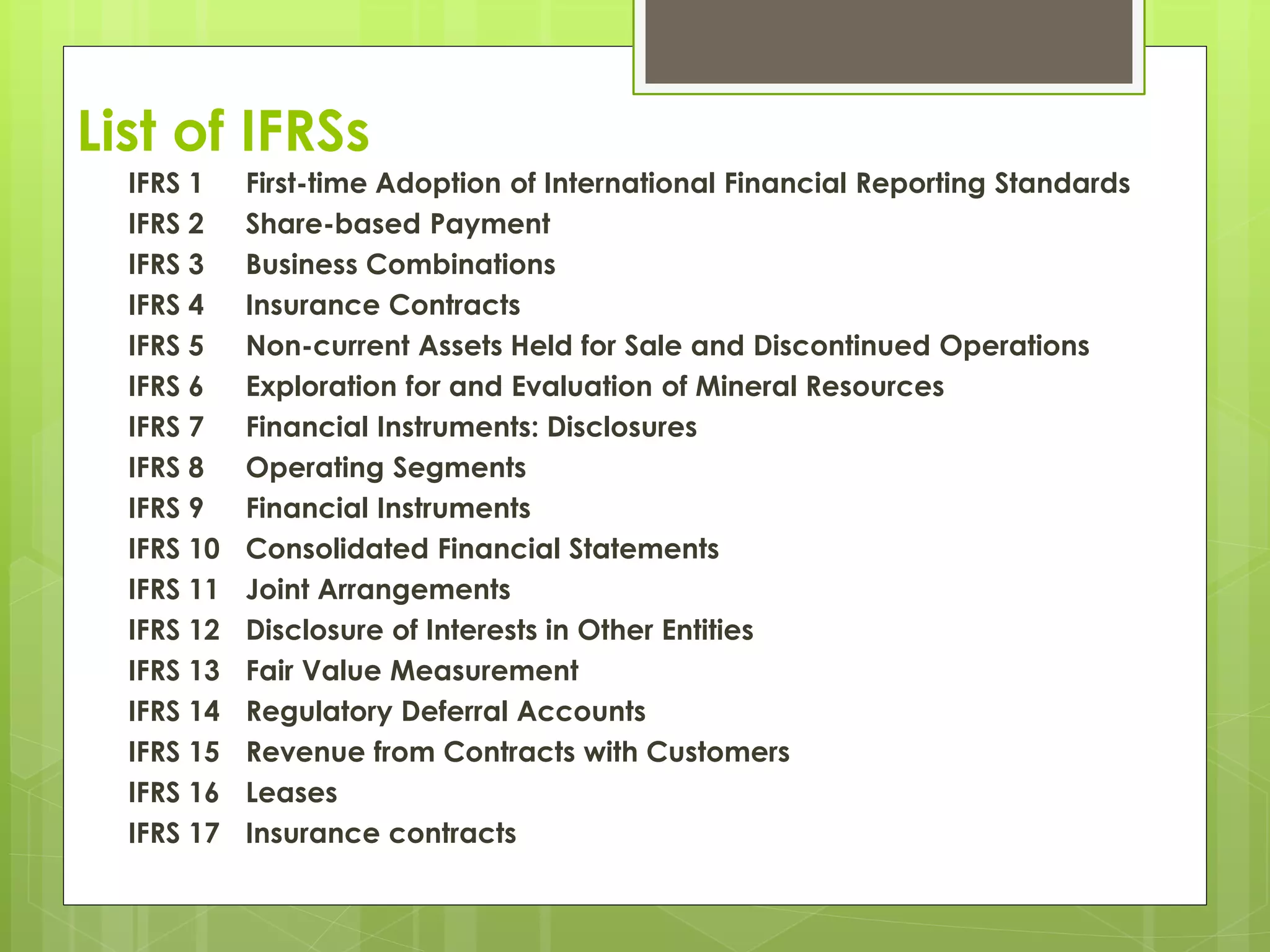
List of IFRSs
IFRS 1 First-time Adoption of International Financial Reporting Standards
IFRS 2 Share-based Payment
IFRS 3 Business Combinations
IFRS 4 Insurance Contracts
IFRS 5 Non-current Assets Held for Sale and Discontinued Operations
IFRS 6 Exploration for and Evaluation of Mineral Resources
IFRS 7 Financial Instruments: Disclosures
IFRS 8 Operating Segments
IFRS 9 Financial Instruments
IFRS 10 Consolidated Financial Statements
IFRS 11 Joint Arrangements
IFRS 12 Disclosure of Interests in Other Entities
IFRS 13 Fair Value Measurement
IFRS 14 Regulatory Deferral Accounts
IFRS 15 Revenue from Contracts with Customers
IFRS 16 Leases
IFRS 17 Insurance contracts
Adoption of IFRS
IFRS are used in at least 166 countries, as of March
2019, including those in the European Unions (EU) and
many in Asia and South America,
History of Accounting Standard.
 The International Accounting Standards
Committee (IASC) was founded in June 1973 in London.
 On April 21, 1977 ICAI constituted the Accounting
Standard Board (ASB) for formulation of Accounting
Standards in India.
 The Institute of Chartered Accountants of India (ICAI)
became an associate member in 1974 and joined the
board in 1993.
 In 2001, IASC was dissolved and IASB was established,
who was responsible for developing the International
Accounting Standards and promoting the use and
application of these standards.
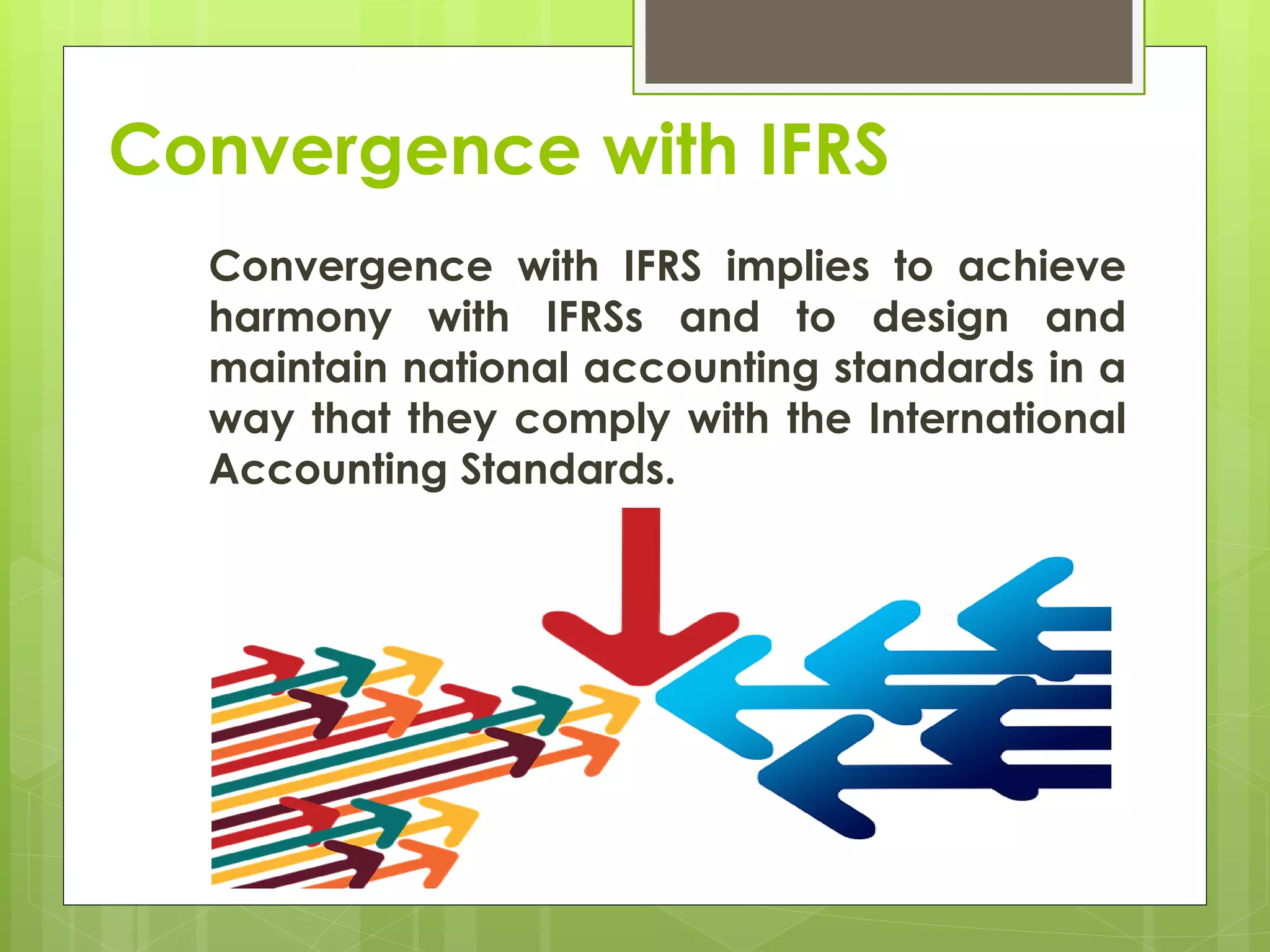
Convergence with IFRS
Convergence with IFRS implies to achieve
harmony with IFRSs and to design and
maintain national accounting standards in a
way that they comply with the International
Accounting Standards.
Convergence Process
GAAP ???
 Accounting Rules used to prepare and
standardize the reporting statements.
 Guidelines Helps the accountants in preparing
the accounting standards in such in a way that
“Uniformity and Comparability” in the accounts.
 It is implemented through measurement
principles and disclosure principles.
 Institute of Chartered Accountants of India (ICAI)
is the Body in India.
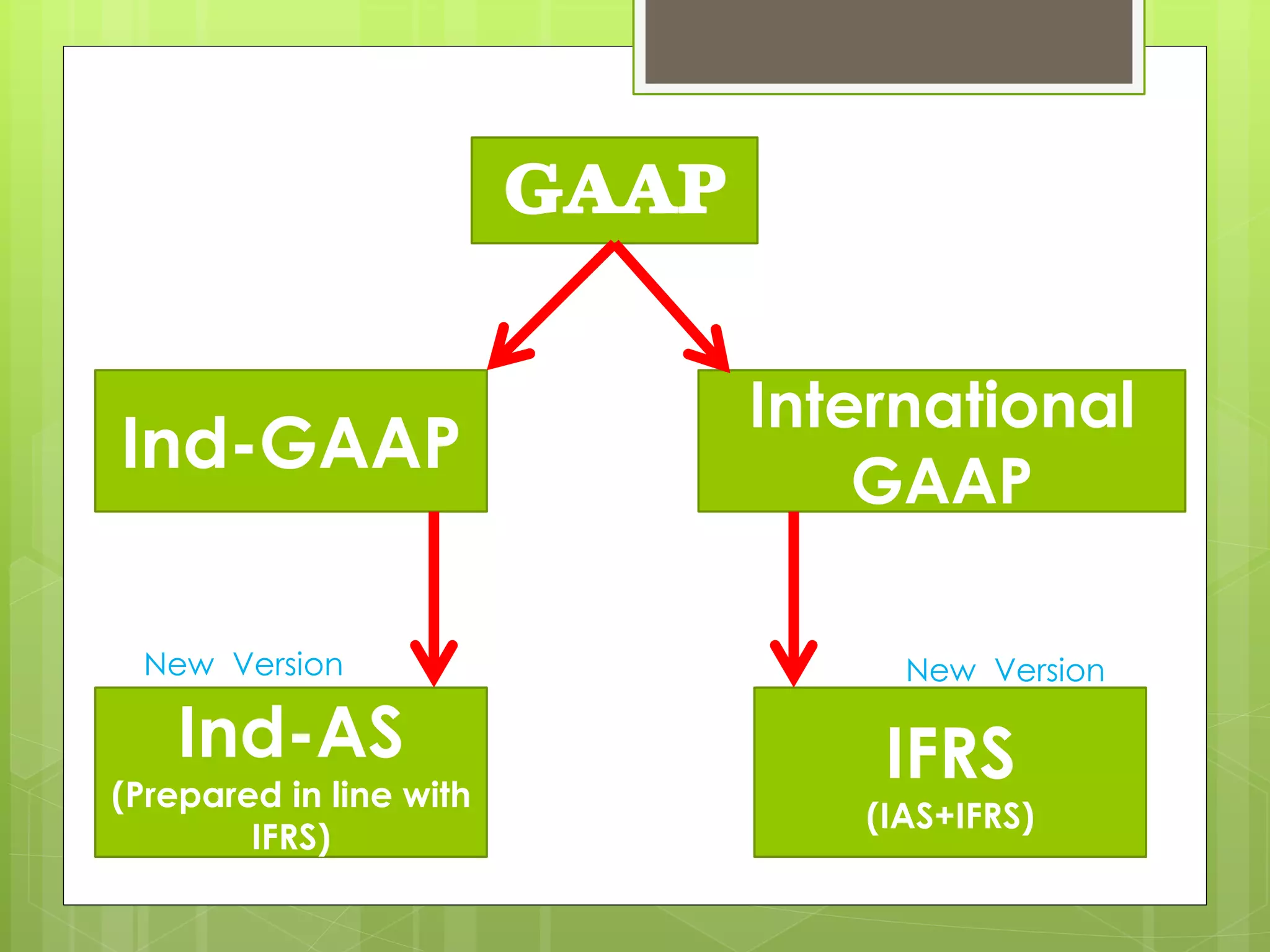
GAAP
Ind-GAAP
International
GAAP
Ind-AS
(Prepared in line with
IFRS)
IFRS
(IAS+IFRS)
New Version New Version
Benefits of Convergence
Beneficial to Economy
Beneficial to Investors
Beneficial to the Industry
Beneficial to Professionals
More Transparency
Cost Saving
 IFRS increases comparability
 IFRS enables Indian companies to access
Global Capital Markets
 Encourage more foreign capital flow to the
country.
 Uniformity in Accounting Standard.
 True & Fair valuation.
 Opportunities for Indian professionals in
abroad.
 Avoidance of multiple reporting such as
Indian GAAP, US GAAP, IFRS
Time Schedule for IFRSs
Implementation in India
For companies other than Insurance, Banking and NBFCs
Phase Applicable to Applicable
from
I • Companies which are part of NSE-Nifty 50
• Companies which are part of BSE-Sensex 30
• Companies whose shares or other securities
are listed on the stock exchange outside India
• Companies, whether listed or not which
have a net worth in excess of Rs. 1,000 crores.
April 01, 2011
II Companies, whether listed or not having a net
woth exceeding Rs. 500 crores but not
exceeding Rs. 1,000 crores.
April 01, 2013
III Listed companies which have a net worth of
Rs. 500 crores or less.
April 01, 2014
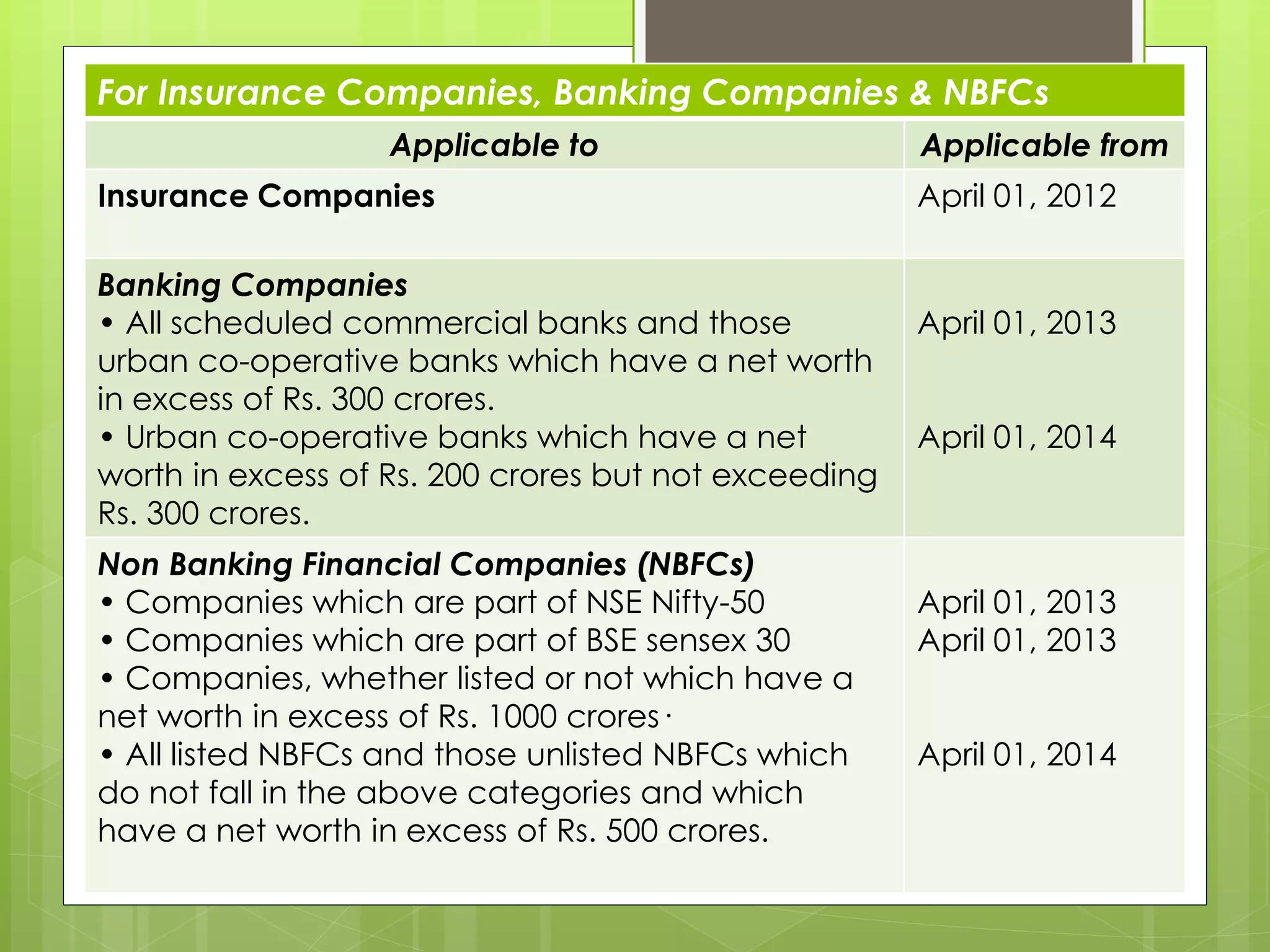
For Insurance Companies, Banking Companies & NBFCs
Applicable to Applicable from
Insurance Companies April 01, 2012
Banking Companies
• All scheduled commercial banks and those
urban co-operative banks which have a net worth
in excess of Rs. 300 crores.
• Urban co-operative banks which have a net
worth in excess of Rs. 200 crores but not exceeding
Rs. 300 crores.
April 01, 2013
April 01, 2014
Non Banking Financial Companies (NBFCs)
• Companies which are part of NSE Nifty-50
• Companies which are part of BSE sensex 30
• Companies, whether listed or not which have a
net worth in excess of Rs. 1000 crores·
• All listed NBFCs and those unlisted NBFCs which
do not fall in the above categories and which
have a net worth in excess of Rs. 500 crores.
April 01, 2013
April 01, 2013
April 01, 2014
CHALLENGES
Difference in GAAP and IFRS
Training and Development
Legal and Regulatory Considerations
Fair value measurement
Financial reporting system
Taxation
Case Study
Effects Of Convergence To IFRS On Financial
Statements of WIPRO Limited.
 Wipro had voluntarily prepared its annual
report on the basis of Indian GAAP and IFRS
for the year ended 31st March 2010,
 Wherein reconciliation of equity based on
Indian GAAP and IFRS is presented for the
opening Balance Sheet as at 1st April 2008
and for Balance Sheet ended 31st March
2009.
INFERENCES
Analyzing the opening financial statement of Wipro for the
year 1.4.2008 it is observed that
 1.37% increase in the Total assets value as per IFRS.
 23% increase in the value of Net tax asset including
deferred taxes in IFRS.
 10% increase in Other assets in IFRS reporting
 The total equity has increased by nearly 7%.
 The total liability has decreased by 6%.
Analyzing the closing financial statement of Wipro for the
year 31.3.2009 it is observed that
 1.94% increase in the Total assets value as per IFRS
 115.53% increase in the value of Net tax asset including
deferred taxes in IFRS
 10.57% increase in Other assets in IFRS
 Total equity has increased by nearly 8.13% in IFRS
 Total liability has decreased by 4.28% in IFRS
Conclusion
 All these observations make us conclude that
IFRS is fair value oriented and Balance Sheet
oriented accounting where there are more
transparent disclosures and Indian GAAP is
conservative approach.
 Further to resolve the issues, it is required to
employ adequate IFRS skills professionals by
investing training processes for Indian
accounting professionals to manage the
conversion projects for Indian corporate.
2nd Sem., Dept. of Commerce,
FM University, Balasore

Ifrs & convergence of ind gaap with ifrs

  • 1.
  • 3.
  • 4.
    History of IFRS IFRSoriginated in the European Union, with the intention of making business affairs and accounts accessible across the continent. The idea quickly spread globally, as a common language allowed greater communication worldwide.
  • 5.
    Various Accounting Standard Bodiesand Their Roles. INTERNATIONAL  The International Accounting Standards Board  is the independent standard-setting body of the IFRS Foundation. It's mission is to develop enforceable, globally accepted International Financial Reporting Standards (IFRS).  The International Federation of Accountants  It supports the IASB with respect to setting accounting standards.  The IFRS Foundation  Oversees the work of the IASB, made structure and strategy, and has fund raising responsibility.
  • 6.
    INDIA  National FinancialReporting Authority (NFRA) (Previously it was National Advisory Committee on Accounting Standards (NACAS)) with the aide and advice of Institute of Chartered Accountants of India (ICAI)  Accounting Standard Board (ASB)  formulate Accounting Standards The Accounting Standards are issued under the authority of the Council of the ICAI.
  • 7.
    IFRS covers awide range of accounting activities. There are certain aspects of business practice for which IFRS set mandatory rules.  Statement of Financial Position  Statement of Comprehensive Income  Statement of Changes in Equity  Statement of Cash Flow  summary of its accounting policies. Standard IFRS Requirements
  • 8.
     Providing informationto management.  Providing information to investors, promoters, debt provider and creditors.  Providing information to shareholders & public.  Providing information about the economic resources of an organization.  Providing information as to how an organization is procuring & using various resources.  Providing information to various stakeholders regarding performance management.  Providing information to the statutory auditors which in turn facilitates audit.  Enhancing social welfare by looking into the interest of employees, trade union & Government. Objectives of IFRS
  • 9.
    Structure of IFRS TheIFRS Foundation has a three- tier governance structure,  based on an independent standard-setting Board of experts International Accounting Standards Board (IASB)  governed and overseen by Trustees from around the world (IFRS Foundation Trustees)  who in turn are accountable to a monitoring board of public authorities (IFRS Foundation Monitoring Board).
  • 10.
    List of IFRSs IFRS1 First-time Adoption of International Financial Reporting Standards IFRS 2 Share-based Payment IFRS 3 Business Combinations IFRS 4 Insurance Contracts IFRS 5 Non-current Assets Held for Sale and Discontinued Operations IFRS 6 Exploration for and Evaluation of Mineral Resources IFRS 7 Financial Instruments: Disclosures IFRS 8 Operating Segments IFRS 9 Financial Instruments IFRS 10 Consolidated Financial Statements IFRS 11 Joint Arrangements IFRS 12 Disclosure of Interests in Other Entities IFRS 13 Fair Value Measurement IFRS 14 Regulatory Deferral Accounts IFRS 15 Revenue from Contracts with Customers IFRS 16 Leases IFRS 17 Insurance contracts
  • 11.
    Adoption of IFRS IFRSare used in at least 166 countries, as of March 2019, including those in the European Unions (EU) and many in Asia and South America,
  • 12.
    History of AccountingStandard.  The International Accounting Standards Committee (IASC) was founded in June 1973 in London.  On April 21, 1977 ICAI constituted the Accounting Standard Board (ASB) for formulation of Accounting Standards in India.  The Institute of Chartered Accountants of India (ICAI) became an associate member in 1974 and joined the board in 1993.  In 2001, IASC was dissolved and IASB was established, who was responsible for developing the International Accounting Standards and promoting the use and application of these standards.
  • 13.
    Convergence with IFRS Convergencewith IFRS implies to achieve harmony with IFRSs and to design and maintain national accounting standards in a way that they comply with the International Accounting Standards.
  • 14.
  • 15.
  • 17.
     Accounting Rulesused to prepare and standardize the reporting statements.  Guidelines Helps the accountants in preparing the accounting standards in such in a way that “Uniformity and Comparability” in the accounts.  It is implemented through measurement principles and disclosure principles.  Institute of Chartered Accountants of India (ICAI) is the Body in India.
  • 18.
    GAAP Ind-GAAP International GAAP Ind-AS (Prepared in linewith IFRS) IFRS (IAS+IFRS) New Version New Version
  • 19.
    Benefits of Convergence Beneficialto Economy Beneficial to Investors Beneficial to the Industry Beneficial to Professionals More Transparency Cost Saving
  • 21.
     IFRS increasescomparability  IFRS enables Indian companies to access Global Capital Markets  Encourage more foreign capital flow to the country.  Uniformity in Accounting Standard.  True & Fair valuation.  Opportunities for Indian professionals in abroad.  Avoidance of multiple reporting such as Indian GAAP, US GAAP, IFRS
  • 22.
    Time Schedule forIFRSs Implementation in India For companies other than Insurance, Banking and NBFCs Phase Applicable to Applicable from I • Companies which are part of NSE-Nifty 50 • Companies which are part of BSE-Sensex 30 • Companies whose shares or other securities are listed on the stock exchange outside India • Companies, whether listed or not which have a net worth in excess of Rs. 1,000 crores. April 01, 2011 II Companies, whether listed or not having a net woth exceeding Rs. 500 crores but not exceeding Rs. 1,000 crores. April 01, 2013 III Listed companies which have a net worth of Rs. 500 crores or less. April 01, 2014
  • 23.
    For Insurance Companies,Banking Companies & NBFCs Applicable to Applicable from Insurance Companies April 01, 2012 Banking Companies • All scheduled commercial banks and those urban co-operative banks which have a net worth in excess of Rs. 300 crores. • Urban co-operative banks which have a net worth in excess of Rs. 200 crores but not exceeding Rs. 300 crores. April 01, 2013 April 01, 2014 Non Banking Financial Companies (NBFCs) • Companies which are part of NSE Nifty-50 • Companies which are part of BSE sensex 30 • Companies, whether listed or not which have a net worth in excess of Rs. 1000 crores· • All listed NBFCs and those unlisted NBFCs which do not fall in the above categories and which have a net worth in excess of Rs. 500 crores. April 01, 2013 April 01, 2013 April 01, 2014
  • 25.
    CHALLENGES Difference in GAAPand IFRS Training and Development Legal and Regulatory Considerations Fair value measurement Financial reporting system Taxation
  • 26.
    Case Study Effects OfConvergence To IFRS On Financial Statements of WIPRO Limited.  Wipro had voluntarily prepared its annual report on the basis of Indian GAAP and IFRS for the year ended 31st March 2010,  Wherein reconciliation of equity based on Indian GAAP and IFRS is presented for the opening Balance Sheet as at 1st April 2008 and for Balance Sheet ended 31st March 2009.
  • 29.
    INFERENCES Analyzing the openingfinancial statement of Wipro for the year 1.4.2008 it is observed that  1.37% increase in the Total assets value as per IFRS.  23% increase in the value of Net tax asset including deferred taxes in IFRS.  10% increase in Other assets in IFRS reporting  The total equity has increased by nearly 7%.  The total liability has decreased by 6%. Analyzing the closing financial statement of Wipro for the year 31.3.2009 it is observed that  1.94% increase in the Total assets value as per IFRS  115.53% increase in the value of Net tax asset including deferred taxes in IFRS  10.57% increase in Other assets in IFRS  Total equity has increased by nearly 8.13% in IFRS  Total liability has decreased by 4.28% in IFRS
  • 30.
    Conclusion  All theseobservations make us conclude that IFRS is fair value oriented and Balance Sheet oriented accounting where there are more transparent disclosures and Indian GAAP is conservative approach.  Further to resolve the issues, it is required to employ adequate IFRS skills professionals by investing training processes for Indian accounting professionals to manage the conversion projects for Indian corporate.
  • 31.
    2nd Sem., Dept.of Commerce, FM University, Balasore