Page 1
Lesson 2:
COMPONENTS
OF A
COMPUTER SYSTEM
Page 2
Computer SystemComputer System
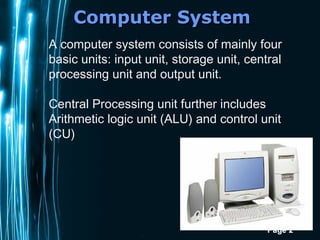
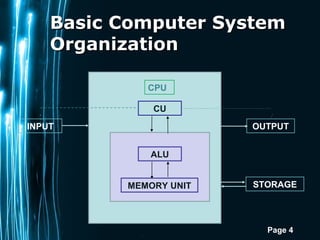
A computer system consists of mainly four
basic units: input unit, storage unit, central
processing unit and output unit.
Central Processing unit further includes
Arithmetic logic unit (ALU) and control unit
(CU)
Page 3
A computer performs five major
operations or functions:
• it accepts data or instructions as input,
• it stores data and instruction
• it processes data as per the
instructions,
• it controls all operations inside a
computer
• it gives results in the form of output.
Computer System.. contComputer System.. cont
Page 4
Basic Computer SystemBasic Computer System
OrganizationOrganization
CPU
ALU
MEMORY UNIT
CU
INPUT OUTPUT
STORAGE
Page 5
Functional Units:
1.Input Unit. This unit is used for entering
data and programs into the computer system by
the user for processing.
2. Storage Unit. The storage unit is used for
storing data and instructions before and after
processing.
3.Output Unit. The output unit is used for
storing the result as output produced by the
computer after processing.
Page 6
4. Processing. The task of performing
operations like arithmetic and logical operations
is called processing.
The Central Processing Unit (CPU)
takes data and instructions from the storage unit
and makes all sorts of calculations based on the
instructions given and the type of data provided.
It is then sent back to the storage unit. CPU
includes Arithmetic logic unit (ALU) and control
unit (CU)
Page 7
Functional Units… cont.
• Control Unit - controls all operations
like input, processing and output.
-It takes care of step by step processing of all
operations in side the computer.
•Arithmetic Logic Unit- all calculations and
comparisons, based on the instructions provided,
are carried out.
- it performs arithmetic functions like addition,
subtraction, multiplication, division and also
logical operations like greater than, less than
equal to, and etc.
Page 8
The Central Processing Unit (CPU)
takes data and instructions from the
storage unit and makes all sorts of
calculations based on the instructions
given and the type of data provided.
It is then sent back to the storage
unit. CPU includes Arithmetic logic
unit (ALU) and control unit (CU)
Page 9
Functional Units… cont.
5. Primary and
Secondary Storage
a. primary storage
a.1 RAM
a.2 ROM
b. secondary storage
b.1. magnetic disk
b.2. magnetic tape
b.3. optical disk
b.4. punched card
.
Page 10
Functional Units… cont.
a. Primary Storage
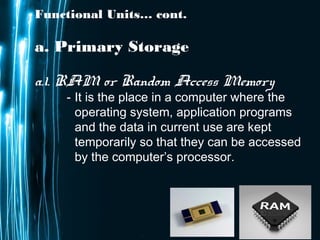
a.1. RAM or Random Access Memory
- It is the place in a computer where the
operating system, application programs
and the data in current use are kept
temporarily so that they can be accessed
by the computer’s processor.
Page 11
Functional Units… cont.
a. Primary Storage
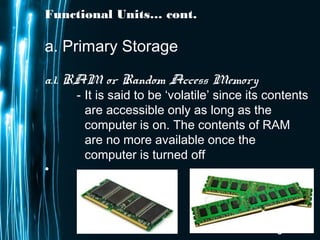
a.1. RAM or Random Access Memory
- It is said to be ‘volatile’ since its contents
are accessible only as long as the
computer is on. The contents of RAM
are no more available once the
computer is turned off
•
Page 12
Functional Units… cont.
a. Primary Storage
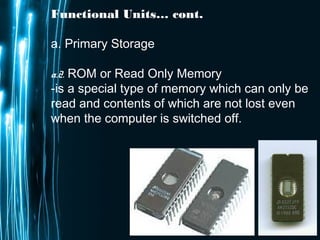
a.2. ROM or Read Only Memory
-is a special type of memory which can only be
read and contents of which are not lost even
when the computer is switched off.
Page 13
Functional Units… cont.
a. Primary Storage
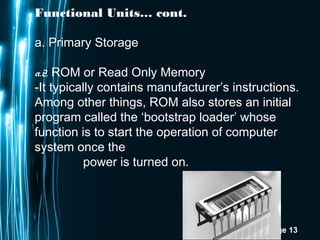
a.2. ROM or Read Only Memory
-It typically contains manufacturer’s instructions.
Among other things, ROM also stores an initial
program called the ‘bootstrap loader’ whose
function is to start the operation of computer
system once the
power is turned on.
Page 14
Functional Units… cont.
b. Secondary Storage
- devices and peripherals that are
connected and controlled by the computer to
enable permanent storage of programs and
data.
e.g. Magnetic disks and optical disks
Page 15
Functional Units… cont.
b. Secondary Storage
b.1. Magnetic disks
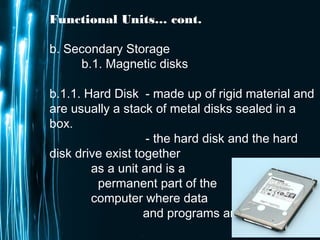
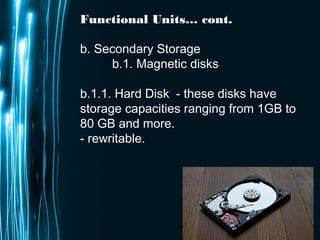
b.1.1. Hard Disk - made up of rigid material and
are usually a stack of metal disks sealed in a
box.
- the hard disk and the hard
disk drive exist together
as a unit and is a
permanent part of the
computer where data
and programs are saved.
Page 16
Functional Units… cont.
b. Secondary Storage
b.1. Magnetic disks
b.1.1. Hard Disk - these disks have
storage capacities ranging from 1GB to
80 GB and more.
- rewritable.
Page 17
Functional Units… cont.
b. Secondary Storage
b.1. Magnetic disks
b.1.3. Floppy disk - a disk
storage medium composed of a disk of thin
and flexible magnetic storage medium,
sealed in a rectangular plastic carrier lined
with fabric that removes dust particles.
Page 18
Functional Units… cont.
b. Secondary Storage
b.1. Magnetic disks
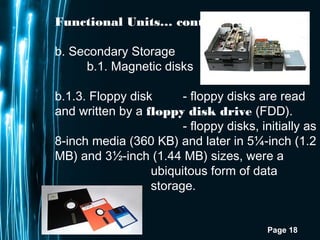
b.1.3. Floppy disk - floppy disks are read
and written by a floppy disk drive (FDD).
- floppy disks, initially as
8-inch media (360 KB) and later in 5¼-inch (1.2
MB) and 3½-inch (1.44 MB) sizes, were a
ubiquitous form of data
storage.
Page 19
Functional Units… cont.
b. Secondary Storage
b.2. Optical disks
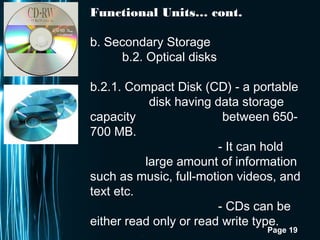
b.2.1. Compact Disk (CD) - a portable
disk having data storage
capacity between 650-
700 MB.
- It can hold
large amount of information
such as music, full-motion videos, and
text etc.
- CDs can be
either read only or read write type.
Page 20
Functional Units… cont.
b. Secondary Storage
b.2. Optical disks
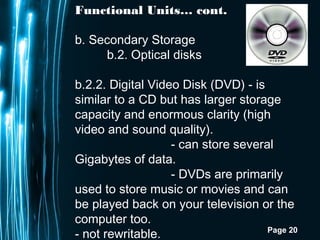
b.2.2. Digital Video Disk (DVD) - is
similar to a CD but has larger storage
capacity and enormous clarity (high
video and sound quality).
- can store several
Gigabytes of data.
- DVDs are primarily
used to store music or movies and can
be played back on your television or the
computer too.
- not rewritable.
Page 21
Functional Units… cont.
b. Secondary Storage
b.2. Optical disks
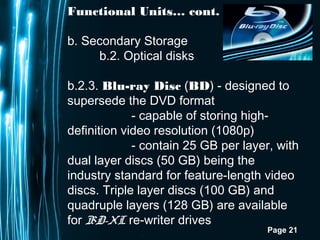
b.2.3. Blu-ray Disc (BD) - designed to
supersede the DVD format
- capable of storing high-
definition video resolution (1080p)
- contain 25 GB per layer, with
dual layer discs (50 GB) being the
industry standard for feature-length video
discs. Triple layer discs (100 GB) and
quadruple layers (128 GB) are available
for BD-XL re-writer drives
Page 22
Functional Units… cont.
b. Secondary Storage
b.2. Optical disks
b.2.3. Blu-ray Disc (BD)
- the name Blu-ray Disc refers
to the blue laser used to read the disc,
which allows information to be stored at a
greater density than is possible with the
longer-wavelength red laser used
for DVDs.
Page 23
Functional Units… cont.
b. Secondary Storage
b.2. Optical disks
b.2.3. Blu-ray Disc (BD)
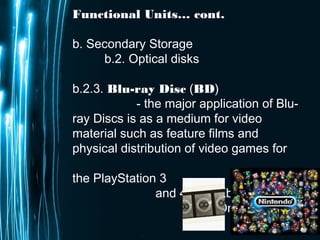
- the major application of Blu-
ray Discs is as a medium for video
material such as feature films and
physical distribution of video games for
the PlayStation 3
and 4, and Xbox
One.
Page 24
Functional Units… cont.
b. Secondary Storage
b.2. Optical disks
b.2.3. Blu-ray Disc (BD)
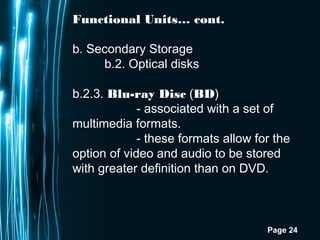
- associated with a set of
multimedia formats.
- these formats allow for the
option of video and audio to be stored
with greater definition than on DVD.
Page 25
Functional Units… cont.
b. Secondary Storage
b.3. Magnetic tapes
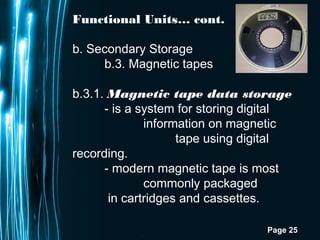
b.3.1. Magnetic tape data storage 
- is a system for storing digital
information on magnetic
tape using digital
recording.
- modern magnetic tape is most
commonly packaged
in cartridges and cassettes.
Page 26
Functional Units… cont.
6. Other Storage Devices
6.1. Secondary Storage
b.3. Paper Medium
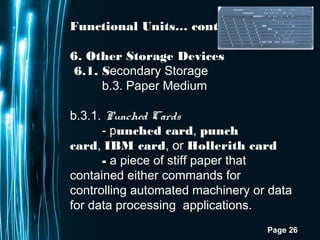
b.3.1. Punched Cards  
- punched card, punch
card, IBM card, or Hollerith card
- a piece of stiff paper that
contained either commands for
controlling automated machinery or data
for data processing  applications.
Page 27
Functional Units… cont.
6. Other Storage Devices
6.1. Secondary Storage
b.3. Paper Medium
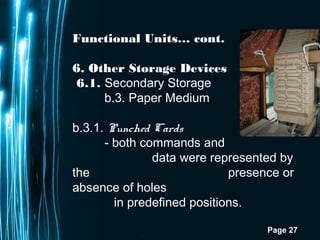
b.3.1. Punched Cards  
- both commands and
data were represented by
the presence or
absence of holes
in predefined positions.
Page 28
Functional Units… cont.
6. Other Storage Devices
6.1. Secondary Storage
6.1.1. Pen drive -  flash memory with an
integrated Universal Serial Bus (USB)
interface.
- flash drives are typically removable and
rewritable, and physically much smaller
than any secondary storage.
 - faster, have thousands of times more
capacity, and are more durable and
reliable because they have no moving
parts.
- immune to magnetic interference (unlike
floppy disks), and unharmed by surface
Page 29
- faster, have thousands of times more
capacity, and are more durable and
reliable because they have no
moving parts.
- immune to magnetic interference
(unlike floppy disks), and unharmed
by surface scratches (unlike CDs).
Page 30
Functional Units… cont.
6. Other Storage Devices
6.1. Secondary Storage
6.1.2. Pen drive - smaller, faster, have
thousands of times more capacity, and are
more durable and reliable because they
have no moving parts.
- immune to magnetic interference
(unlike floppy disks), and unharmed by
surface scratches (unlike CDs).

Lesson2.1 computer components rev2

  • 1.
  • 2.
    Page 2 Computer SystemComputerSystem A computer system consists of mainly four basic units: input unit, storage unit, central processing unit and output unit. Central Processing unit further includes Arithmetic logic unit (ALU) and control unit (CU)
  • 3.
    Page 3 A computerperforms five major operations or functions: • it accepts data or instructions as input, • it stores data and instruction • it processes data as per the instructions, • it controls all operations inside a computer • it gives results in the form of output. Computer System.. contComputer System.. cont
  • 4.
    Page 4 Basic ComputerSystemBasic Computer System OrganizationOrganization CPU ALU MEMORY UNIT CU INPUT OUTPUT STORAGE
  • 5.
    Page 5 Functional Units: 1.InputUnit. This unit is used for entering data and programs into the computer system by the user for processing. 2. Storage Unit. The storage unit is used for storing data and instructions before and after processing. 3.Output Unit. The output unit is used for storing the result as output produced by the computer after processing.
  • 6.
    Page 6 4. Processing.The task of performing operations like arithmetic and logical operations is called processing. The Central Processing Unit (CPU) takes data and instructions from the storage unit and makes all sorts of calculations based on the instructions given and the type of data provided. It is then sent back to the storage unit. CPU includes Arithmetic logic unit (ALU) and control unit (CU)
  • 7.
    Page 7 Functional Units…cont. • Control Unit - controls all operations like input, processing and output. -It takes care of step by step processing of all operations in side the computer. •Arithmetic Logic Unit- all calculations and comparisons, based on the instructions provided, are carried out. - it performs arithmetic functions like addition, subtraction, multiplication, division and also logical operations like greater than, less than equal to, and etc.
  • 8.
    Page 8 The CentralProcessing Unit (CPU) takes data and instructions from the storage unit and makes all sorts of calculations based on the instructions given and the type of data provided. It is then sent back to the storage unit. CPU includes Arithmetic logic unit (ALU) and control unit (CU)
  • 9.
    Page 9 Functional Units…cont. 5. Primary and Secondary Storage a. primary storage a.1 RAM a.2 ROM b. secondary storage b.1. magnetic disk b.2. magnetic tape b.3. optical disk b.4. punched card .
  • 10.
    Page 10 Functional Units…cont. a. Primary Storage a.1. RAM or Random Access Memory - It is the place in a computer where the operating system, application programs and the data in current use are kept temporarily so that they can be accessed by the computer’s processor.
  • 11.
    Page 11 Functional Units…cont. a. Primary Storage a.1. RAM or Random Access Memory - It is said to be ‘volatile’ since its contents are accessible only as long as the computer is on. The contents of RAM are no more available once the computer is turned off •
  • 12.
    Page 12 Functional Units…cont. a. Primary Storage a.2. ROM or Read Only Memory -is a special type of memory which can only be read and contents of which are not lost even when the computer is switched off.
  • 13.
    Page 13 Functional Units…cont. a. Primary Storage a.2. ROM or Read Only Memory -It typically contains manufacturer’s instructions. Among other things, ROM also stores an initial program called the ‘bootstrap loader’ whose function is to start the operation of computer system once the power is turned on.
  • 14.
    Page 14 Functional Units…cont. b. Secondary Storage - devices and peripherals that are connected and controlled by the computer to enable permanent storage of programs and data. e.g. Magnetic disks and optical disks
  • 15.
    Page 15 Functional Units…cont. b. Secondary Storage b.1. Magnetic disks b.1.1. Hard Disk - made up of rigid material and are usually a stack of metal disks sealed in a box. - the hard disk and the hard disk drive exist together as a unit and is a permanent part of the computer where data and programs are saved.
  • 16.
    Page 16 Functional Units…cont. b. Secondary Storage b.1. Magnetic disks b.1.1. Hard Disk - these disks have storage capacities ranging from 1GB to 80 GB and more. - rewritable.
  • 17.
    Page 17 Functional Units…cont. b. Secondary Storage b.1. Magnetic disks b.1.3. Floppy disk - a disk storage medium composed of a disk of thin and flexible magnetic storage medium, sealed in a rectangular plastic carrier lined with fabric that removes dust particles.
  • 18.
    Page 18 Functional Units…cont. b. Secondary Storage b.1. Magnetic disks b.1.3. Floppy disk - floppy disks are read and written by a floppy disk drive (FDD). - floppy disks, initially as 8-inch media (360 KB) and later in 5¼-inch (1.2 MB) and 3½-inch (1.44 MB) sizes, were a ubiquitous form of data storage.
  • 19.
    Page 19 Functional Units…cont. b. Secondary Storage b.2. Optical disks b.2.1. Compact Disk (CD) - a portable disk having data storage capacity between 650- 700 MB. - It can hold large amount of information such as music, full-motion videos, and text etc. - CDs can be either read only or read write type.
  • 20.
    Page 20 Functional Units…cont. b. Secondary Storage b.2. Optical disks b.2.2. Digital Video Disk (DVD) - is similar to a CD but has larger storage capacity and enormous clarity (high video and sound quality). - can store several Gigabytes of data. - DVDs are primarily used to store music or movies and can be played back on your television or the computer too. - not rewritable.
  • 21.
    Page 21 Functional Units…cont. b. Secondary Storage b.2. Optical disks b.2.3. Blu-ray Disc (BD) - designed to supersede the DVD format - capable of storing high- definition video resolution (1080p) - contain 25 GB per layer, with dual layer discs (50 GB) being the industry standard for feature-length video discs. Triple layer discs (100 GB) and quadruple layers (128 GB) are available for BD-XL re-writer drives
  • 22.
    Page 22 Functional Units…cont. b. Secondary Storage b.2. Optical disks b.2.3. Blu-ray Disc (BD) - the name Blu-ray Disc refers to the blue laser used to read the disc, which allows information to be stored at a greater density than is possible with the longer-wavelength red laser used for DVDs.
  • 23.
    Page 23 Functional Units…cont. b. Secondary Storage b.2. Optical disks b.2.3. Blu-ray Disc (BD) - the major application of Blu- ray Discs is as a medium for video material such as feature films and physical distribution of video games for the PlayStation 3 and 4, and Xbox One.
  • 24.
    Page 24 Functional Units…cont. b. Secondary Storage b.2. Optical disks b.2.3. Blu-ray Disc (BD) - associated with a set of multimedia formats. - these formats allow for the option of video and audio to be stored with greater definition than on DVD.
  • 25.
    Page 25 Functional Units…cont. b. Secondary Storage b.3. Magnetic tapes b.3.1. Magnetic tape data storage  - is a system for storing digital information on magnetic tape using digital recording. - modern magnetic tape is most commonly packaged in cartridges and cassettes.
  • 26.
    Page 26 Functional Units…cont. 6. Other Storage Devices 6.1. Secondary Storage b.3. Paper Medium b.3.1. Punched Cards   - punched card, punch card, IBM card, or Hollerith card - a piece of stiff paper that contained either commands for controlling automated machinery or data for data processing  applications.
  • 27.
    Page 27 Functional Units…cont. 6. Other Storage Devices 6.1. Secondary Storage b.3. Paper Medium b.3.1. Punched Cards   - both commands and data were represented by the presence or absence of holes in predefined positions.
  • 28.
    Page 28 Functional Units…cont. 6. Other Storage Devices 6.1. Secondary Storage 6.1.1. Pen drive -  flash memory with an integrated Universal Serial Bus (USB) interface. - flash drives are typically removable and rewritable, and physically much smaller than any secondary storage.  - faster, have thousands of times more capacity, and are more durable and reliable because they have no moving parts. - immune to magnetic interference (unlike floppy disks), and unharmed by surface
  • 29.
    Page 29 - faster,have thousands of times more capacity, and are more durable and reliable because they have no moving parts. - immune to magnetic interference (unlike floppy disks), and unharmed by surface scratches (unlike CDs).
  • 30.
    Page 30 Functional Units…cont. 6. Other Storage Devices 6.1. Secondary Storage 6.1.2. Pen drive - smaller, faster, have thousands of times more capacity, and are more durable and reliable because they have no moving parts. - immune to magnetic interference (unlike floppy disks), and unharmed by surface scratches (unlike CDs).

Editor's Notes

  • #27 An 80-column punched card of the type most widely used in the 20th century. The size of the card was 7 3⁄8 in × 3 1⁄4 in (187 mm × 83 mm). This example displays the 1964 EBCDICcharacter set, which added more special characters to earlier encodings.
  • #28 Punched cards in use in a Jacquard loom.