PRESENTEDBY
Mrs. Khushbu
Assit. Professor
SGT University
Gurugram
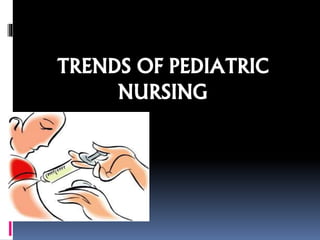
TRENDS OF PEDIATRIC
NURSING
CURRENT ATRENDS IN PEDIATRIC
AND PEDIATRIC NURSING
 FAMILY CENTERED CARE
 HIGHTECHNOLOGY CARE AND IMPROVEMENT
IN DIAGNOSISANTTREATMENT
 EVIDENCE BASED PRACTICE
 PRIMARY NURSING
 PREVENTIVE CARE
 CONTINUUM OF CARE
 ATRAUMATIC CENTRE
 COST CONTAINMENT
 CASE MANAGEMENT
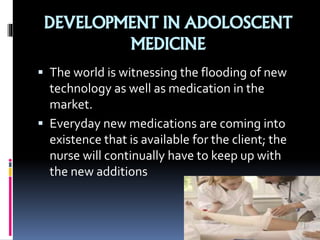
 DEVELOPEMNT IN ADOLESCENT MEDICINE
FAMILY CENTERED CARE
 FAMILY CENTERED CARE is to recognize the
family as the constant in a child’s life ,while
the service systems and personnel within
those systems fluctuate.
 It covers 2 concepts-
1. Enabling
2. empowerment
 ENABLING:
In this process of all the family members are
helped by the professionals to create the
opportunities and means to utilize their
present abilities and acquire new skills that
are necessary to provide care to their ailing
children
 EMPOWERING
It helps to foster the strengths of family
members to cope up and withstand stress
related to sickness of their children.
FAMILY CENTERED CARE
 The goal of care is to minimize the
manifestations of the illness and maximize
the child’s cognitive, physical, and
psychosocial potential
NURSES RESPONSIBILITIES
 The nurse recognize family as an essential
part of child’s care and illness experience and
acknowledge and respect the family feelings
in caring for both within and outside the
hospital
 The nurse may suggest parenting classes to
increase their knowledge base and promote
empowerment
 In the absence of child’s family she is
supposed to maintain daily routine of child as
established by family
ATRAUMATIC CARE
 It is provision of therapeutic care in settings ,
by personnel, and through the interventions
that eliminate or minimize the psychologic
and physical distress experienced by children
and their families in the health care system .
PURPOSES
 Prevent or minimize the child’s separation
from the family
 Promote a sense of control
 Prevent or minimize the bodily injury and
pain
CASE MANAGEMENT
 Case management has developed as an
approach to coordinated care and control costs.
 Nurses as Case managers have responsibility and
accountability for a particular group of patients
and use a system of critical paths derived from
standard of care.
BENEFITS
 Improved patient and family satisfaction
 Decreased fragmentation of care
 Ability to describe and measure outcomes for
a homogenous group of patient became
apparent
PRIMARY NURSING
 It is system for the distribution of nursing care
in which care of one child is managed for the
entire 24-hour day by one nurse who directs
and coordinates nurses and other personnel;
schedules all tests, procedures, and daily
activities for that patient; and cares for that
patient personally when on duty
PREVENTIVE CARE
 Efforts to improve the health and to reduce
the costs have led to an increased emphasis
on preventive care.
 Anticipatory guidance is vital during each
health contact with children and their
families; education of family includes
everything from keeping their home safe to
prevent illness.

CONTINUUM OF CARE
 In order to provide care more efficiently,
nursing care of children now encompasses a
continuum of care that extends from acute
care setting such as hospitals to outpatient
setting such as rehabilitative units,
community care settings, homes and schools.
For example: after an acute hospital stay, a
child may be able to complete
therapy at home.
HIGH TECHNOLOGY CARE AND
IMPROVEMENT IN DIAGNOSIS
AND TREATMENT
 Advancement in the medical field has created
the care of children technologically versatile.
The nurse also needs to be technologically
competent enough to meet the nursing care
needs of children
 The advancement in the diagnosis
technology has made detection of many
disorders even in the fetal period
 Surfactant therapy
 Continuous positive airway
pressure ( CPAP)
 Integrated management of
childhood illnesses(IMCI)
SURFACTANT THERAPY
 The surfactant therapy is the most important
clinical advance in neonatal intensive care. It is
useful both for prevention and treatment of
RDS.
 Surfactant: it is a lipoprotein which decreases
the surface tension of distal airways
maintaining adequate functional residual
capacity during expiration.

 For example-
Survanta,Infasurf,Corosurf,Exosurf
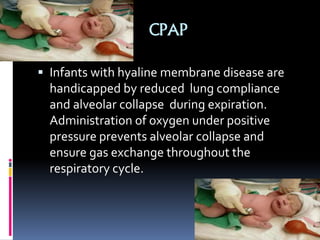
CPAP
 Infants with hyaline membrane disease are
handicapped by reduced lung compliance
and alveolar collapse during expiration.
Administration of oxygen under positive
pressure prevents alveolar collapse and
ensure gas exchange throughout the
respiratory cycle.
IMCI
 TheWHO strategy of IMCI has been adapted.
The Indian version of the program, integrated
management of neonatal and childhood
illnesses, incorporates additional elements of
new born care.
 The implementation strategy incorporates
home visiting to provide health preventive and
promotive care to newborn babies and infants.
 Goals of IMNCI-
a) Focus on most common causes of mortality.
b) Nutritional assessment of all sick infants and
children.
c) Homecare for newborns like exclusive breast
feeding, preventing hypothermia etc.
d) The implementation of various preventive
health care services to newborn and infants
 COLOR CODEDAMNAGEMENT:
 PINK classification-child needs in patient
care.
 YELLOW classification-child needs specific
treatment provide it at home(antibiotics).
 GREEN classification-child needs no
medicine ,advise home care.
EVIDENCE BASED PRACTICE
 STEPS IN EVIDENCE BASED PRACTICE-
a) FRAME QUESTIONS
b) SEARCH FOR EVIDENCES
c) ASSESS EVIDENCES
d) MAKE DECISIONS
e) EVALUATE PERFORMANCES
 It provides a systematic approach to enable nurses
to effectively use the best solutions related to
nursing practice
 Nursing focuses is on illness aspect of care the
human response during disease and therapy
 Quality improvements measures and throwing
outdated management tools are essential to
improve nursing practice.This is possible with
the help of EBP
DEVELOPMENT IN ADOLOSCENT
MEDICINE
 The world is witnessing the flooding of new
technology as well as medication in the
market.
 Everyday new medications are coming into
existence that is available for the client; the
nurse will continually have to keep up with
the new additions
COST CONTAINMENT
 With passage of time there is a continuous
trend of hike in price of drugs due to inflation
and other global factors.
 The nurses face a challenge of cost
containment without to sacrificing quality
care
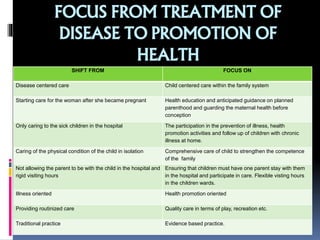
FOCUS FROM TREATMENT OF
DISEASE TO PROMOTION OF
HEALTH
SHIFT FROM FOCUS ON
Disease centered care Child centered care within the family system
Starting care for the woman after she became pregnant Health education and anticipated guidance on planned
parenthood and guarding the maternal health before
conception
Only caring to the sick children in the hospital The participation in the prevention of illness, health
promotion activities and follow up of children with chronic
illness at home.
Caring of the physical condition of the child in isolation Comprehensive care of child to strengthen the competence
of the family
Not allowing the parent to be with the child in the hospital and
rigid visiting hours
Ensuring that children must have one parent stay with them
in the hospital and participate in care. Flexible visting hours
in the children wards.
Illness oriented Health promotion oriented
Providing routinized care Quality care in terms of play, recreation etc.
Traditional practice Evidence based practice.
CHANGING ROLE OF PEDIATRIC
NURSE
 Primary role
 Secondary role
PRIMARY ROLE
1. CAREGIVER
2. ADVOCATE
3. EDUCATOR
4. RESEARCHER
5. MANAGER
6. LEADER
SECONDARY ROLE
1. COLLABORATOR
2. COORDINATOR
3. COMMUNICATOR
4. CONSULTANT
Questions?
QUESTIONS?
Trends in pediatric nursing

Trends in pediatric nursing

  • 1.
  • 2.
  • 3.
    CURRENT ATRENDS INPEDIATRIC AND PEDIATRIC NURSING  FAMILY CENTERED CARE  HIGHTECHNOLOGY CARE AND IMPROVEMENT IN DIAGNOSISANTTREATMENT  EVIDENCE BASED PRACTICE  PRIMARY NURSING  PREVENTIVE CARE  CONTINUUM OF CARE  ATRAUMATIC CENTRE  COST CONTAINMENT  CASE MANAGEMENT  DEVELOPEMNT IN ADOLESCENT MEDICINE
  • 4.
    FAMILY CENTERED CARE FAMILY CENTERED CARE is to recognize the family as the constant in a child’s life ,while the service systems and personnel within those systems fluctuate.  It covers 2 concepts- 1. Enabling 2. empowerment
  • 5.
     ENABLING: In thisprocess of all the family members are helped by the professionals to create the opportunities and means to utilize their present abilities and acquire new skills that are necessary to provide care to their ailing children
  • 6.
     EMPOWERING It helpsto foster the strengths of family members to cope up and withstand stress related to sickness of their children.
  • 7.
    FAMILY CENTERED CARE The goal of care is to minimize the manifestations of the illness and maximize the child’s cognitive, physical, and psychosocial potential
  • 8.
    NURSES RESPONSIBILITIES  Thenurse recognize family as an essential part of child’s care and illness experience and acknowledge and respect the family feelings in caring for both within and outside the hospital  The nurse may suggest parenting classes to increase their knowledge base and promote empowerment  In the absence of child’s family she is supposed to maintain daily routine of child as established by family
  • 9.
    ATRAUMATIC CARE  Itis provision of therapeutic care in settings , by personnel, and through the interventions that eliminate or minimize the psychologic and physical distress experienced by children and their families in the health care system .
  • 10.
    PURPOSES  Prevent orminimize the child’s separation from the family  Promote a sense of control  Prevent or minimize the bodily injury and pain
  • 11.
    CASE MANAGEMENT  Casemanagement has developed as an approach to coordinated care and control costs.  Nurses as Case managers have responsibility and accountability for a particular group of patients and use a system of critical paths derived from standard of care.
  • 12.
    BENEFITS  Improved patientand family satisfaction  Decreased fragmentation of care  Ability to describe and measure outcomes for a homogenous group of patient became apparent
  • 13.
    PRIMARY NURSING  Itis system for the distribution of nursing care in which care of one child is managed for the entire 24-hour day by one nurse who directs and coordinates nurses and other personnel; schedules all tests, procedures, and daily activities for that patient; and cares for that patient personally when on duty
  • 14.
    PREVENTIVE CARE  Effortsto improve the health and to reduce the costs have led to an increased emphasis on preventive care.  Anticipatory guidance is vital during each health contact with children and their families; education of family includes everything from keeping their home safe to prevent illness. 
  • 15.
    CONTINUUM OF CARE In order to provide care more efficiently, nursing care of children now encompasses a continuum of care that extends from acute care setting such as hospitals to outpatient setting such as rehabilitative units, community care settings, homes and schools. For example: after an acute hospital stay, a child may be able to complete therapy at home.
  • 16.
    HIGH TECHNOLOGY CAREAND IMPROVEMENT IN DIAGNOSIS AND TREATMENT  Advancement in the medical field has created the care of children technologically versatile. The nurse also needs to be technologically competent enough to meet the nursing care needs of children  The advancement in the diagnosis technology has made detection of many disorders even in the fetal period
  • 17.
     Surfactant therapy Continuous positive airway pressure ( CPAP)  Integrated management of childhood illnesses(IMCI)
  • 18.
    SURFACTANT THERAPY  Thesurfactant therapy is the most important clinical advance in neonatal intensive care. It is useful both for prevention and treatment of RDS.  Surfactant: it is a lipoprotein which decreases the surface tension of distal airways maintaining adequate functional residual capacity during expiration.  For example- Survanta,Infasurf,Corosurf,Exosurf
  • 19.
    CPAP  Infants withhyaline membrane disease are handicapped by reduced lung compliance and alveolar collapse during expiration. Administration of oxygen under positive pressure prevents alveolar collapse and ensure gas exchange throughout the respiratory cycle.
  • 20.
    IMCI  TheWHO strategyof IMCI has been adapted. The Indian version of the program, integrated management of neonatal and childhood illnesses, incorporates additional elements of new born care.  The implementation strategy incorporates home visiting to provide health preventive and promotive care to newborn babies and infants.
  • 21.
     Goals ofIMNCI- a) Focus on most common causes of mortality. b) Nutritional assessment of all sick infants and children. c) Homecare for newborns like exclusive breast feeding, preventing hypothermia etc. d) The implementation of various preventive health care services to newborn and infants
  • 22.
     COLOR CODEDAMNAGEMENT: PINK classification-child needs in patient care.  YELLOW classification-child needs specific treatment provide it at home(antibiotics).  GREEN classification-child needs no medicine ,advise home care.
  • 23.
    EVIDENCE BASED PRACTICE STEPS IN EVIDENCE BASED PRACTICE- a) FRAME QUESTIONS b) SEARCH FOR EVIDENCES c) ASSESS EVIDENCES d) MAKE DECISIONS e) EVALUATE PERFORMANCES
  • 24.
     It providesa systematic approach to enable nurses to effectively use the best solutions related to nursing practice  Nursing focuses is on illness aspect of care the human response during disease and therapy  Quality improvements measures and throwing outdated management tools are essential to improve nursing practice.This is possible with the help of EBP
  • 25.
    DEVELOPMENT IN ADOLOSCENT MEDICINE The world is witnessing the flooding of new technology as well as medication in the market.  Everyday new medications are coming into existence that is available for the client; the nurse will continually have to keep up with the new additions
  • 26.
    COST CONTAINMENT  Withpassage of time there is a continuous trend of hike in price of drugs due to inflation and other global factors.  The nurses face a challenge of cost containment without to sacrificing quality care
  • 27.
    FOCUS FROM TREATMENTOF DISEASE TO PROMOTION OF HEALTH SHIFT FROM FOCUS ON Disease centered care Child centered care within the family system Starting care for the woman after she became pregnant Health education and anticipated guidance on planned parenthood and guarding the maternal health before conception Only caring to the sick children in the hospital The participation in the prevention of illness, health promotion activities and follow up of children with chronic illness at home. Caring of the physical condition of the child in isolation Comprehensive care of child to strengthen the competence of the family Not allowing the parent to be with the child in the hospital and rigid visiting hours Ensuring that children must have one parent stay with them in the hospital and participate in care. Flexible visting hours in the children wards. Illness oriented Health promotion oriented Providing routinized care Quality care in terms of play, recreation etc. Traditional practice Evidence based practice.
  • 28.
    CHANGING ROLE OFPEDIATRIC NURSE  Primary role  Secondary role
  • 29.
    PRIMARY ROLE 1. CAREGIVER 2.ADVOCATE 3. EDUCATOR 4. RESEARCHER 5. MANAGER 6. LEADER
  • 30.
    SECONDARY ROLE 1. COLLABORATOR 2.COORDINATOR 3. COMMUNICATOR 4. CONSULTANT
  • 31.