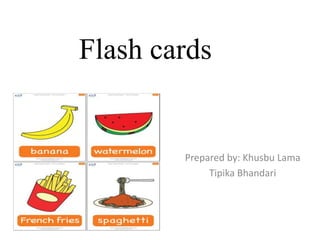
Flash cards
Prepared by: Khusbu Lama
Tipika Bhandari
Content
• Introduction
• Uses
• Types
• Articles
• Preparation
• Techniques
• Advantages
• Disadvantages
• Set of visual aids
• Simple message in steps by consecutive pictures
• Used in group discussion
• Verbal explanation
• Commonly used for 5-15 members
• Use 10-12 cards for one talk
Introduction
“A small compact card, which flashes before the class to bring
any idea.”
-K.P. Neeraja
Definition
Uses of flashcards
I. Exercise mental process
II. As a drill
III. For reviewing
IV.For small groups (not over 30)
V. Provides variety and activity
Types (based on materials used)
I. Plain flashcards
II. Laminated flashcards
III. Synthetic flashcards
IV.Flashcards prepared from old tins or metal cans
V. Flashcards made of heavy cloth
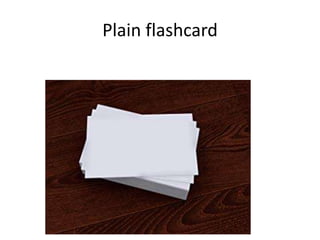
Plain flashcard
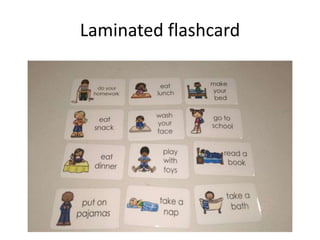
Laminated flashcard
Flashcard made from old tins
Flash card made of cloth
Articles needed
 Card boards/ drawing paper
 Illustrations
 Colors
 Letterings
 Sketches
 Pencil
 Scale
Preparation of flashcards
• Collect information
• Select the essential points
• Logical sequence
• Visualize one idea on one cards
TECHNIQUES OF MAKING FLASH
CARDS
I. Cut chart paper
II. Paste pictures
 Size usually (12cmX10 cm)
 Size according to number of audience and distance
 Cut and paste the picture
 Keep sequentially
Coloring
 Write number on back of card
Writing
• Few or no words
• Use capital letters
• Five or six words
• Write talking words on right hand side of back
• For first card, write on last one and for second on
the back of first and repeat
Points to Remember
• For each card make a rough layout on an ordinary
sheet of paper of the same size of the card
• Remember that everyone who sees the card must be
able to understand the illustrations quickly and
easily. So do not use complicated drawings
• The idea on the flash card should be brief
• It should be large enough for everyone to see
• Be adapted to local condition
• Each card presents only one idea
Techniques to use flash card:-
Orient in such a way that showing a card the interest
of the audience is aroused and maintained.
Rehearse the presentation several times before
trying them on the audience.
Do not allow anyone to sit more than 20 feet away
from the teacher.
Keep the cards together in a sequential order with
the picture face up, so when the card is removed
after its use, the next one is seen.
When using the flash card, hold the set of flashcards at
appropriate height(normally chest level). So, that it will be
visible to all audience.
Turn to different angles so that everyone can see clearly.
Show the title page and introduce the topic,put it on the
back and show first card. Explain the picture by looking at
the caption written on the back of title page.Again keep
first card in the back and show second card by looking its
caption on the back of the first card. Continue using cards in
this way until all are explained.
Be a good showman.Do not be clumsy while showing the
cards.
When using the flash card, hold the set of flashcards at
appropriate height(normally chest level). So, that it will be
visible to all audience.
Turn to different angles so that everyone can see clearly.
Show the title page and introduce the topic,put it on the
back and show first card. Explain the picture by looking at
the caption written on the back of title page.Again keep
first card in the back and show second card by looking its
caption on the back of the first card. Continue using cards in
this way until all are explained.
Be a good showman.Do not be clumsy while showing the
cards.
Don't hesitate to repeat the card when doubt arises
on the particular card.If necessary present it again.
Summarize the main points at the end of the talk.
Audience can ask question on the spot if any
confusion.
Store the flash cards set properly for future use.
Advantages:-
It is attractive with pictures so draw attention of the
audience.It is more useful with illiterate audience.
It is easy to prepare, simple drawing or cutting and tracing
can be done.
It is cheap and requires few resources to prepare and can
be home made.
It is easy to carry and use in different places such as school,
community,etc.
Can be used to review a topic.
It can be stored and used later.
It doesn't require electricity.
Disadvantages:-
Deteriorate with constant use.
Some artistic ability is required if making home
made flashcards.
Limited to small groups.
Easy to get out of sequence.
Difficult to produce if large amount needed.
Sometime it may be difficult and time consuming to
prepare pictures manually each of them by looking
at the caption one by one.
Reference
• T.Shrestha, (2017).A Textbook of Educational Science for
Nurses(6th edition). Bhotahity,Kathmandu: Heritage
Publishers and Distributors PVT.LTD.
• R.Shrestha, (2015).A Textbook of Educational Science in
Nursing(5th edition). Bhotahity,Kathmandu:Vidhyarthi
Pustak Bhandar
• Jared Luwis.2015.“Flash cards.” Retrived from
https://classroom.synonym.com/advantages-flash-cards-
7427604.html
• Herlina Rahmi Dewi.July 17,1017. “Flashcard
Media.”Retrived from
http://journal.unj.ac.id/unj/index.php/ijer/article/downloa
d/4367/3283/

Flash cards 1581380713 final

  • 1.
    Flash cards Prepared by:Khusbu Lama Tipika Bhandari
  • 2.
    Content • Introduction • Uses •Types • Articles • Preparation • Techniques • Advantages • Disadvantages
  • 3.
    • Set ofvisual aids • Simple message in steps by consecutive pictures • Used in group discussion • Verbal explanation • Commonly used for 5-15 members • Use 10-12 cards for one talk Introduction
  • 4.
    “A small compactcard, which flashes before the class to bring any idea.” -K.P. Neeraja Definition
  • 5.
    Uses of flashcards I.Exercise mental process II. As a drill III. For reviewing IV.For small groups (not over 30) V. Provides variety and activity
  • 6.
    Types (based onmaterials used) I. Plain flashcards II. Laminated flashcards III. Synthetic flashcards IV.Flashcards prepared from old tins or metal cans V. Flashcards made of heavy cloth
  • 7.
  • 8.
  • 9.
  • 10.
  • 11.
    Articles needed  Cardboards/ drawing paper  Illustrations  Colors  Letterings  Sketches  Pencil  Scale
  • 12.
    Preparation of flashcards •Collect information • Select the essential points • Logical sequence • Visualize one idea on one cards
  • 13.
    TECHNIQUES OF MAKINGFLASH CARDS I. Cut chart paper II. Paste pictures  Size usually (12cmX10 cm)  Size according to number of audience and distance
  • 15.
     Cut andpaste the picture  Keep sequentially Coloring  Write number on back of card Writing • Few or no words • Use capital letters • Five or six words • Write talking words on right hand side of back • For first card, write on last one and for second on the back of first and repeat
  • 16.
    Points to Remember •For each card make a rough layout on an ordinary sheet of paper of the same size of the card • Remember that everyone who sees the card must be able to understand the illustrations quickly and easily. So do not use complicated drawings • The idea on the flash card should be brief • It should be large enough for everyone to see • Be adapted to local condition • Each card presents only one idea
  • 17.
    Techniques to useflash card:- Orient in such a way that showing a card the interest of the audience is aroused and maintained. Rehearse the presentation several times before trying them on the audience. Do not allow anyone to sit more than 20 feet away from the teacher. Keep the cards together in a sequential order with the picture face up, so when the card is removed after its use, the next one is seen.
  • 18.
    When using theflash card, hold the set of flashcards at appropriate height(normally chest level). So, that it will be visible to all audience. Turn to different angles so that everyone can see clearly. Show the title page and introduce the topic,put it on the back and show first card. Explain the picture by looking at the caption written on the back of title page.Again keep first card in the back and show second card by looking its caption on the back of the first card. Continue using cards in this way until all are explained. Be a good showman.Do not be clumsy while showing the cards.
  • 19.
    When using theflash card, hold the set of flashcards at appropriate height(normally chest level). So, that it will be visible to all audience. Turn to different angles so that everyone can see clearly. Show the title page and introduce the topic,put it on the back and show first card. Explain the picture by looking at the caption written on the back of title page.Again keep first card in the back and show second card by looking its caption on the back of the first card. Continue using cards in this way until all are explained. Be a good showman.Do not be clumsy while showing the cards.
  • 20.
    Don't hesitate torepeat the card when doubt arises on the particular card.If necessary present it again. Summarize the main points at the end of the talk. Audience can ask question on the spot if any confusion. Store the flash cards set properly for future use.
  • 21.
    Advantages:- It is attractivewith pictures so draw attention of the audience.It is more useful with illiterate audience. It is easy to prepare, simple drawing or cutting and tracing can be done. It is cheap and requires few resources to prepare and can be home made. It is easy to carry and use in different places such as school, community,etc. Can be used to review a topic. It can be stored and used later. It doesn't require electricity.
  • 22.
    Disadvantages:- Deteriorate with constantuse. Some artistic ability is required if making home made flashcards. Limited to small groups. Easy to get out of sequence. Difficult to produce if large amount needed. Sometime it may be difficult and time consuming to prepare pictures manually each of them by looking at the caption one by one.
  • 23.
    Reference • T.Shrestha, (2017).ATextbook of Educational Science for Nurses(6th edition). Bhotahity,Kathmandu: Heritage Publishers and Distributors PVT.LTD. • R.Shrestha, (2015).A Textbook of Educational Science in Nursing(5th edition). Bhotahity,Kathmandu:Vidhyarthi Pustak Bhandar • Jared Luwis.2015.“Flash cards.” Retrived from https://classroom.synonym.com/advantages-flash-cards- 7427604.html • Herlina Rahmi Dewi.July 17,1017. “Flashcard Media.”Retrived from http://journal.unj.ac.id/unj/index.php/ijer/article/downloa d/4367/3283/