Practice
teaching
on
Glomerulonephritis
Presented by:
Ms. Hari singh nagar
M. Sc Nursing 1st year
Objectives
After completion of the class students will be able to
• Introduce the glomerulonephritis.
• Define glomerulonephritis
• Enlist the types of glomerulonephritis
• Explain the Causes of glomerulonephritis
• Explain the Pathophysiology of glomerulonephritis
• Enumerate the Clinical manifestations
glomerulonephritis.
Objectives
• Enlist the diagnostic evaluation of
glomerulonephritis.
• Explain the management of glomerulonephritis.
• Enlist the complication of glomerulonephritis.
• Explain the nursing management of the
glomerulonephritis.
Introduction
It is a term used to refers to several kidney
disease (both kidney) characterized by
inflammation either of the glomeruli or of the
small blood vessels in the kidney. But not all the
disease necessarily have an inflammatory
component.
It occurs due to repeated episodes of acute
nephrotic syndrome, nephrosclerosis and
hyperlipidemia.
Definition
• Glomerulonephritis is a
kidney condition that
involves damage
/inflammation to the
glomeruli.
Incidence
Incidence rates of primary GN vary between
0.2/100,000/year and 2.5/100,000/ year. this
disease can exist sub clinically and is therefore
only detected by chance in some patients. In
addition, referral policies for diagnostic biopsy
vary between countries. This will affect the
incidence rates found.
Anatomy and physiology of
Nephron
The nephron consist of a tubule closed at one
end, to form the cup-shaped glomerular capsule
(bowman’s capsule), which almost completely
enclose a network of tinny arterial capillaries,
the glomerulus. Continuing from the glomerulus
capsule, the remainder of the nephron is about
3cm long & is described in three parts-
• The proximal convoluted tubule
• loop of henle ( medullary loop )
• distal convoluted tubule lead them to
collecting duct.
Etiology & risk factor
• Streptococcal infection of the throat ( strep throat)
or skin ( impetigo)
• Hereditary diseases
• Immune diseases, such as SLE
• diabetes
• High blood pressure
• Vasculitis (inflammation of the blood vessels)
• Viruses ( HIV, hepatitis B virus, and hepatitis C
virus)
• Endocarditis (infection of the valves of the heart)
Types of glomerulonephritis
 Acute glomerulonephritis
- begins suddenly.
It occurs after 5-21
days of streptococcal
Infection.
 Chronic glomerulonephritis
-develops gradually over
several years. It occurs
after the acute phase.
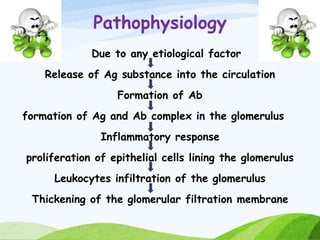
Pathophysiology
Due to any etiological factor
Release of Ag substance into the circulation
Formation of Ab
formation of Ag and Ab complex in the glomerulus
Inflammatory response
proliferation of epithelial cells lining the glomerulus
Leukocytes infiltration of the glomerulus
Thickening of the glomerular filtration membrane
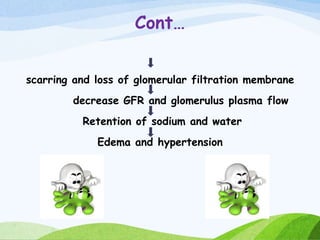
Cont…
scarring and loss of glomerular filtration membrane
decrease GFR and glomerulus plasma flow
Retention of sodium and water
Edema and hypertension
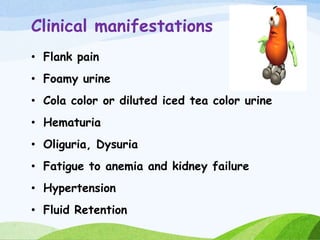
Clinical manifestations
• Flank pain
• Foamy urine
• Cola color or diluted iced tea color urine
• Hematuria
• Oliguria, Dysuria
• Fatigue to anemia and kidney failure
• Hypertension
• Fluid Retention
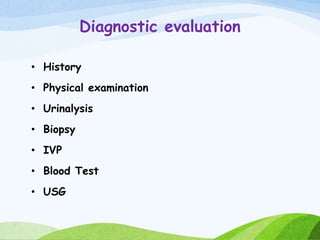
Diagnostic evaluation
• History
• Physical examination
• Urinalysis
• Biopsy
• IVP
• Blood Test
• USG
Management
Management
• Treatment depend on the cause of the disorder, type
and severity of the symptoms.
• High B.P. may be hard to control. Controlling the
B.P. usually the most important part of the
treatment.
• Dialysis
• Medication
 Diuretics
 Immuno-suppressants
 Anti-hypertensive
Cont…
• Life style changes
 Sodium and water restriction
 Potassium, phosphorus, magnesium restriction.
 Limit intake of protein in the diet.
 Take calcium supplements.
 Maintain a healthy weight through diet and exercise.
• Physiotherapy treatment
Cont…
• Patient education
 Lymphatic message to reduce the edema.
 Breathing exercise – pursed lip and diaphragmatic
breathing.
 Endurance exercise such as walking, swimming,
bicycling, aerobic dancing, circulatory exercise.
This exercise improve your blood circulation, accelerate
kidney to discharge waste and toxins.
Complication
• Acute and chronic renal failure
• Nephrotic syndrome
• Hypertension
• Electrolyte imbalances
• Pulmonary edema
• CHF due to fluid overload
Nursing
Management
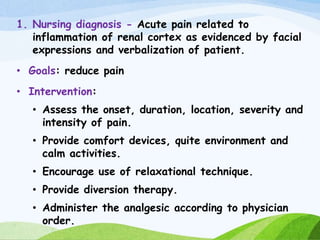
1. Nursing diagnosis - Acute pain related to
inflammation of renal cortex as evidenced by facial
expressions and verbalization of patient.
• Goals: reduce pain
• Intervention:
• Assess the onset, duration, location, severity and
intensity of pain.
• Provide comfort devices, quite environment and
calm activities.
• Encourage use of relaxational technique.
• Provide diversion therapy.
• Administer the analgesic according to physician
order.
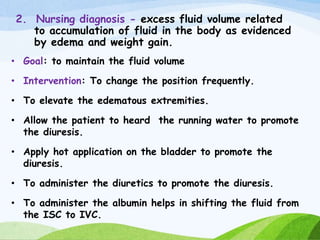
2. Nursing diagnosis - excess fluid volume related
to accumulation of fluid in the body as evidenced
by edema and weight gain.
• Goal: to maintain the fluid volume
• Intervention: To change the position frequently.
• To elevate the edematous extremities.
• Allow the patient to heard the running water to promote
the diuresis.
• Apply hot application on the bladder to promote the
diuresis.
• To administer the diuretics to promote the diuresis.
• To administer the albumin helps in shifting the fluid from
the ISC to IVC.
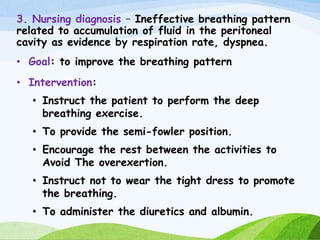
3. Nursing diagnosis – Ineffective breathing pattern
related to accumulation of fluid in the peritoneal
cavity as evidence by respiration rate, dyspnea.
• Goal: to improve the breathing pattern
• Intervention:
• Instruct the patient to perform the deep
breathing exercise.
• To provide the semi-fowler position.
• Encourage the rest between the activities to
Avoid The overexertion.
• Instruct not to wear the tight dress to promote
the breathing.
• To administer the diuretics and albumin.
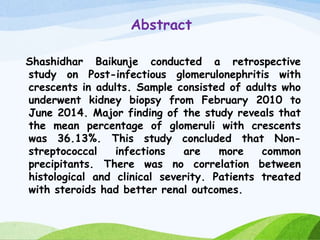
Abstract
Shashidhar Baikunje conducted a retrospective
study on Post-infectious glomerulonephritis with
crescents in adults. Sample consisted of adults who
underwent kidney biopsy from February 2010 to
June 2014. Major finding of the study reveals that
the mean percentage of glomeruli with crescents
was 36.13%. This study concluded that Non-
streptococcal infections are more common
precipitants. There was no correlation between
histological and clinical severity. Patients treated
with steroids had better renal outcomes.
Summary
References
• “Burnner and Suddarth’s” text book of medical
surgical nursing, twelth edition,Wolters
publication, Page no. 1316-1317
• “Saunders” comprehensive review for the NCLEX
RN examination, fifth edition, Elsevier
publication, page no. 494-495
• Shashidhar Baikunje, Post-infectious
glomerulonephritis with crescents in adults; a
retrospective study, [Internet]. India:[cited
2017march,1]. Available form -
https://www.ncbi.nlm.nih.gov/pmc/articles/PMC47
92622/

glomerulonephritis-170709131935.pdf

  • 1.
  • 2.
    Objectives After completion ofthe class students will be able to • Introduce the glomerulonephritis. • Define glomerulonephritis • Enlist the types of glomerulonephritis • Explain the Causes of glomerulonephritis • Explain the Pathophysiology of glomerulonephritis • Enumerate the Clinical manifestations glomerulonephritis.
  • 3.
    Objectives • Enlist thediagnostic evaluation of glomerulonephritis. • Explain the management of glomerulonephritis. • Enlist the complication of glomerulonephritis. • Explain the nursing management of the glomerulonephritis.
  • 4.
    Introduction It is aterm used to refers to several kidney disease (both kidney) characterized by inflammation either of the glomeruli or of the small blood vessels in the kidney. But not all the disease necessarily have an inflammatory component. It occurs due to repeated episodes of acute nephrotic syndrome, nephrosclerosis and hyperlipidemia.
  • 5.
    Definition • Glomerulonephritis isa kidney condition that involves damage /inflammation to the glomeruli.
  • 6.
    Incidence Incidence rates ofprimary GN vary between 0.2/100,000/year and 2.5/100,000/ year. this disease can exist sub clinically and is therefore only detected by chance in some patients. In addition, referral policies for diagnostic biopsy vary between countries. This will affect the incidence rates found.
  • 7.
    Anatomy and physiologyof Nephron The nephron consist of a tubule closed at one end, to form the cup-shaped glomerular capsule (bowman’s capsule), which almost completely enclose a network of tinny arterial capillaries, the glomerulus. Continuing from the glomerulus capsule, the remainder of the nephron is about 3cm long & is described in three parts- • The proximal convoluted tubule • loop of henle ( medullary loop ) • distal convoluted tubule lead them to collecting duct.
  • 9.
    Etiology & riskfactor • Streptococcal infection of the throat ( strep throat) or skin ( impetigo) • Hereditary diseases • Immune diseases, such as SLE • diabetes • High blood pressure • Vasculitis (inflammation of the blood vessels) • Viruses ( HIV, hepatitis B virus, and hepatitis C virus) • Endocarditis (infection of the valves of the heart)
  • 10.
    Types of glomerulonephritis Acute glomerulonephritis - begins suddenly. It occurs after 5-21 days of streptococcal Infection.  Chronic glomerulonephritis -develops gradually over several years. It occurs after the acute phase.
  • 11.
    Pathophysiology Due to anyetiological factor Release of Ag substance into the circulation Formation of Ab formation of Ag and Ab complex in the glomerulus Inflammatory response proliferation of epithelial cells lining the glomerulus Leukocytes infiltration of the glomerulus Thickening of the glomerular filtration membrane
  • 12.
    Cont… scarring and lossof glomerular filtration membrane decrease GFR and glomerulus plasma flow Retention of sodium and water Edema and hypertension
  • 13.
    Clinical manifestations • Flankpain • Foamy urine • Cola color or diluted iced tea color urine • Hematuria • Oliguria, Dysuria • Fatigue to anemia and kidney failure • Hypertension • Fluid Retention
  • 14.
    Diagnostic evaluation • History •Physical examination • Urinalysis • Biopsy • IVP • Blood Test • USG
  • 15.
  • 16.
    Management • Treatment dependon the cause of the disorder, type and severity of the symptoms. • High B.P. may be hard to control. Controlling the B.P. usually the most important part of the treatment. • Dialysis • Medication  Diuretics  Immuno-suppressants  Anti-hypertensive
  • 17.
    Cont… • Life stylechanges  Sodium and water restriction  Potassium, phosphorus, magnesium restriction.  Limit intake of protein in the diet.  Take calcium supplements.  Maintain a healthy weight through diet and exercise. • Physiotherapy treatment
  • 18.
    Cont… • Patient education Lymphatic message to reduce the edema.  Breathing exercise – pursed lip and diaphragmatic breathing.  Endurance exercise such as walking, swimming, bicycling, aerobic dancing, circulatory exercise. This exercise improve your blood circulation, accelerate kidney to discharge waste and toxins.
  • 19.
    Complication • Acute andchronic renal failure • Nephrotic syndrome • Hypertension • Electrolyte imbalances • Pulmonary edema • CHF due to fluid overload
  • 20.
  • 21.
    1. Nursing diagnosis- Acute pain related to inflammation of renal cortex as evidenced by facial expressions and verbalization of patient. • Goals: reduce pain • Intervention: • Assess the onset, duration, location, severity and intensity of pain. • Provide comfort devices, quite environment and calm activities. • Encourage use of relaxational technique. • Provide diversion therapy. • Administer the analgesic according to physician order.
  • 22.
    2. Nursing diagnosis- excess fluid volume related to accumulation of fluid in the body as evidenced by edema and weight gain. • Goal: to maintain the fluid volume • Intervention: To change the position frequently. • To elevate the edematous extremities. • Allow the patient to heard the running water to promote the diuresis. • Apply hot application on the bladder to promote the diuresis. • To administer the diuretics to promote the diuresis. • To administer the albumin helps in shifting the fluid from the ISC to IVC.
  • 23.
    3. Nursing diagnosis– Ineffective breathing pattern related to accumulation of fluid in the peritoneal cavity as evidence by respiration rate, dyspnea. • Goal: to improve the breathing pattern • Intervention: • Instruct the patient to perform the deep breathing exercise. • To provide the semi-fowler position. • Encourage the rest between the activities to Avoid The overexertion. • Instruct not to wear the tight dress to promote the breathing. • To administer the diuretics and albumin.
  • 24.
    Abstract Shashidhar Baikunje conducteda retrospective study on Post-infectious glomerulonephritis with crescents in adults. Sample consisted of adults who underwent kidney biopsy from February 2010 to June 2014. Major finding of the study reveals that the mean percentage of glomeruli with crescents was 36.13%. This study concluded that Non- streptococcal infections are more common precipitants. There was no correlation between histological and clinical severity. Patients treated with steroids had better renal outcomes.
  • 25.
  • 26.
    References • “Burnner andSuddarth’s” text book of medical surgical nursing, twelth edition,Wolters publication, Page no. 1316-1317 • “Saunders” comprehensive review for the NCLEX RN examination, fifth edition, Elsevier publication, page no. 494-495 • Shashidhar Baikunje, Post-infectious glomerulonephritis with crescents in adults; a retrospective study, [Internet]. India:[cited 2017march,1]. Available form - https://www.ncbi.nlm.nih.gov/pmc/articles/PMC47 92622/