Expected Topics:
•Mean
- Ungrouped Data
- Grouped Data
•Median
- Ungrouped Data
- Grouped Data
•Mode
- Ungrouped Data
- Grouped Data
Measures of Central Tendency
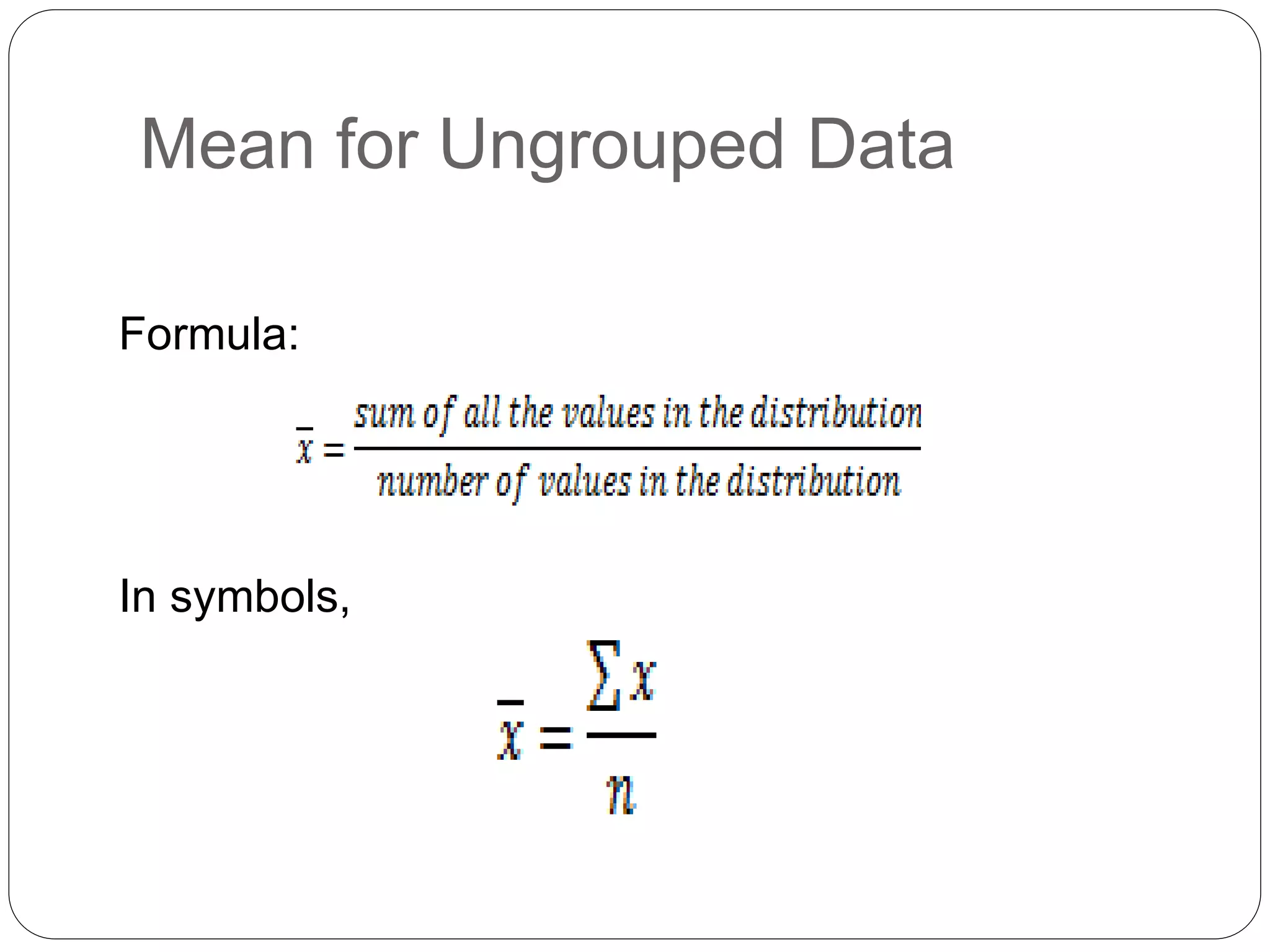
Mean for Ungrouped Data
Formula:
In symbols,
Example: Compute the mean of the following values.
21 10 36 42 39 52 30 25 26
Solution:
Weighted Mean
Example: Suppose we are interested in computing
the weighted mean grade of the student in the
following subjects.
Subjects No. of Units (w) Grade (x)
Math 3 3 1.75
English 3 3 2.00
Accounting 3 5 1.75
Computer 3 3 1.50
Filipino 3 3 1.50
P.E. 3 2 1.00
Solution:
Subjects No. of Units
(w)
Grade (x) wx
Math 3 3 1.75 5.25
English 3 3 2.00 6.00
Accounting 3 5 1.75 6.25
Computer 3 3 1.50 4.50
Filipino 3 3 1.50 4.50
P.E. 3 2 1.00 2.00
∑w = 19 ∑wx = 28.50
Mean for Grouped Data
Two Methods in Computing the Mean Value for
Grouped Data
1. Midpoint Method
2. Unit Deviation Method
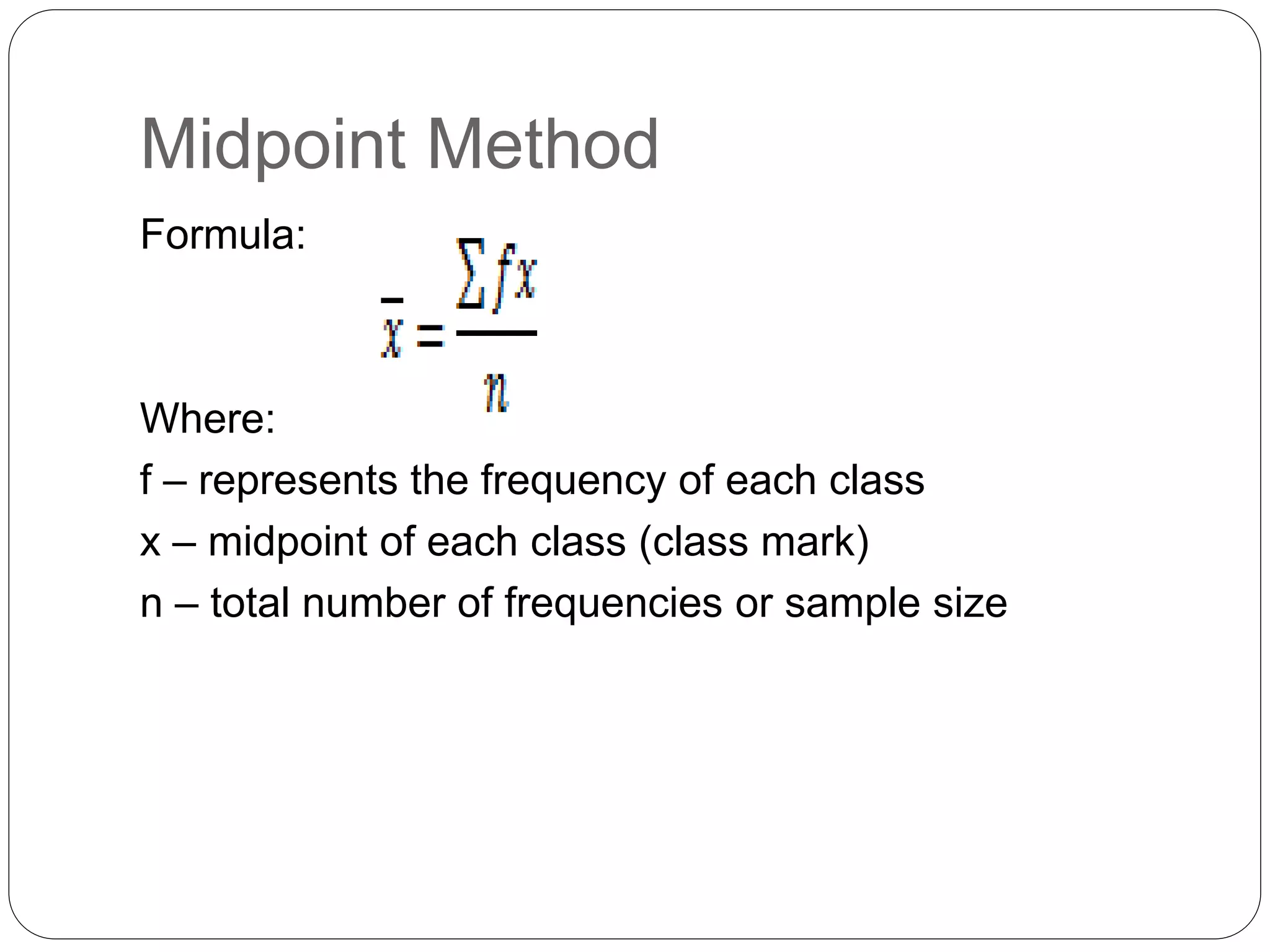
Midpoint Method
Formula:
Where:
f – represents the frequency of each class
x – midpoint of each class (class mark)
n – total number of frequencies or sample size
Steps in using the Midpoint Method
1. Get the midpoint of each class (x)
2. Multiply each midpoint by its corresponding
frequency (fx)
3. Get the sum of the products in step 2 (∑fx)
4. Divide the sum obtained in step 3 by the total
number of frequencies. The result shall be rounded
off to two decimal places (∑fx/n)
Class Interval f x fx
LL UL
11 22 3 16.5 49.5
23 34 5 28.5 142.5
35 46 11 40.5 445.5
47 58 19 52.5 997.5
59 70 14 64.5 903.0
71 82 6 76.5 459.0
83 94 2 88.5 177.0
n = 60 ∑fx = 3,174
Unit Deviation Method
Formula:
Where:
= assumed mean (usually the midpoint of the class
interval having the highest frequency)
f = frequency of each class
d = deviation of the values from the assumed mean or
unit deviation
n = total number of items or sample size
Steps in using the Deviation Method
Steps:
1. Choose an assumed mean by getting the midpoint of
any interval.
2. Construct the unit deviation column.
3. Multiply the frequencies by their corresponding unit
deviations. Add the products.
4. Divide the sum in step 3 by the sample size.
5. Multiply the result in step 4 by the size of the class
interval.
6. Add the value obtained in step 5 to the assumed mean.
The obtained result which is the mean should be
rounded off to 2 decimal places.
Example:
Class Interval f x d fd
LL UL
11 22 3 16.5 -3 -9
23 34 5 28.5 -2 -10
35 46 11 40.5 -1 -11
47 58 19 52.5 0 0
59 70 14 64.5 1 14
71 82 6 76.5 2 12
83 94 2 88.5 3 6
n 60 ∑fd = 2
Median for Ungrouped Data
Median for Odd Sample
 The median is the middle number when the data
are arranged in order.
Formula:
Median for Even Sample
 When there are even samples , the median is the
mean of the two middle numbers.
Examples:
1. Find the median of the following values.
21 10 36 42 39 52 30 25 26
Solution:
10 21 25 26 30 36 39 42 52
5 refers to the 5th value
2. The following are sample scores of four students
obtained from a 10 – item quiz in Statistics: 5
7 9 3
Solution: 3 5 7 9
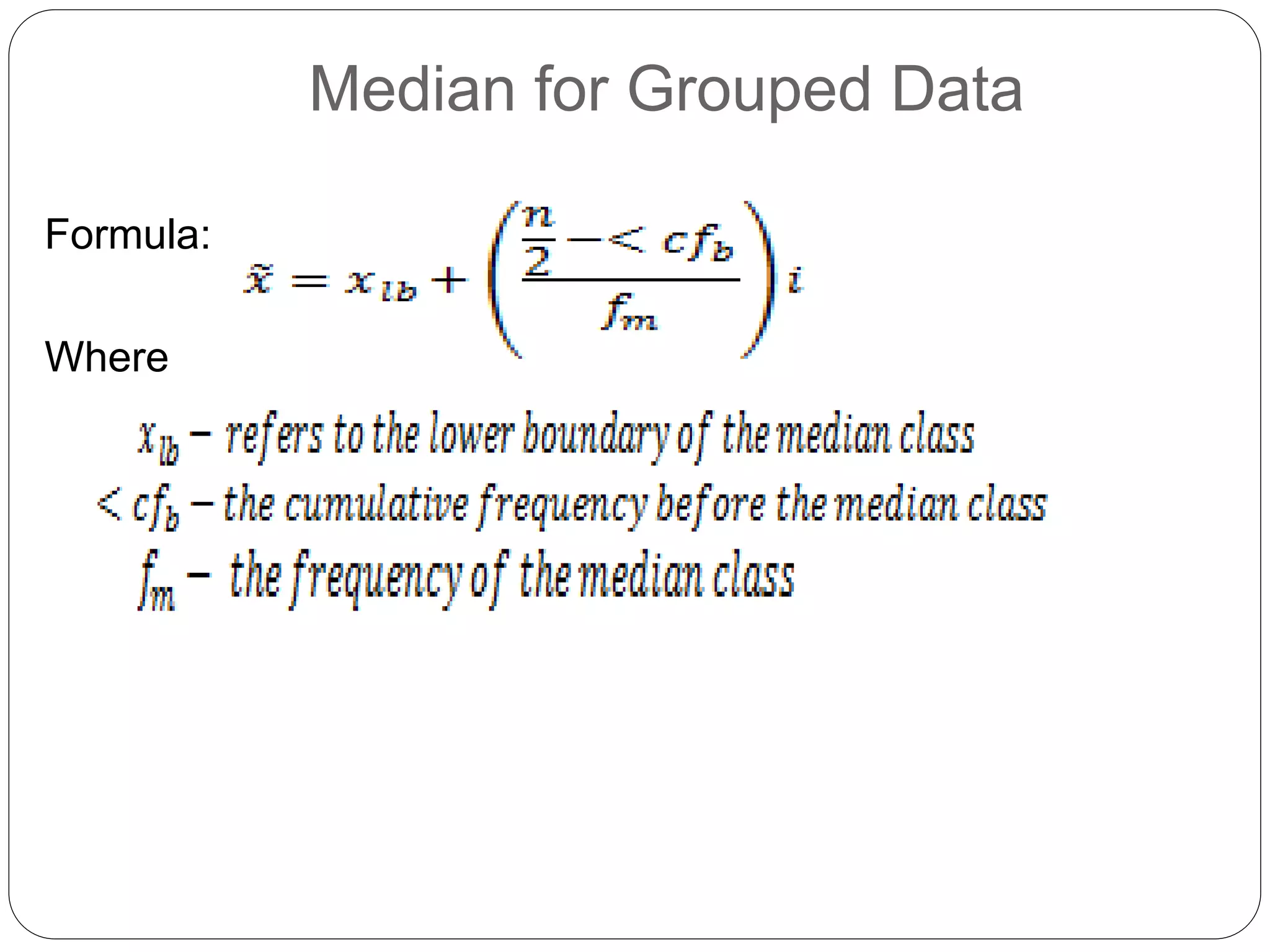
Median for Grouped Data
Formula:
Where
Steps in Computing the Median for Grouped Data
1. Determine the median class.
Divide n by 2 (n/2).
2. Locate n/2 in the cumulative frequency to determine the
median class.
3. Get the lower boundary of the median class.
4. From the computed n/2, subtract the <cf.
5. Divide the difference by the frequency of the median
class, then multiply the quotient by the class size (i).
6. Add the obtained value in #5 to the lower boundary of the
median class. Round off the final result to two decimal
places.
Class
Interval f <cf
LL UL
11 22 3 3
23 34 5 8
35 46 11 19
47 58 19 38
59 70 14 52
71 82 6 58
83 94 2 60
60
Mode for Grouped Data
Formula:
Steps in Computing the Mode for Grouped Data
1. Determine the modal class.
2. Get the value of ∆1.
3. Get the value of ∆2.
4. Get the lower boundary of the modal class.
5. Apply the formula by substituting the values obtained
in the preceding steps.
Class
Interval f
LL UL
11 22 3
23 34 5
35 46 11
47 58 19
59 70 14
71 82 6
83 94 2
60

lesson 4 measures of central tendency copy

  • 1.
    Expected Topics: •Mean - UngroupedData - Grouped Data •Median - Ungrouped Data - Grouped Data •Mode - Ungrouped Data - Grouped Data Measures of Central Tendency
  • 2.
    Mean for UngroupedData Formula: In symbols,
  • 3.
    Example: Compute themean of the following values. 21 10 36 42 39 52 30 25 26 Solution:
  • 4.
    Weighted Mean Example: Supposewe are interested in computing the weighted mean grade of the student in the following subjects. Subjects No. of Units (w) Grade (x) Math 3 3 1.75 English 3 3 2.00 Accounting 3 5 1.75 Computer 3 3 1.50 Filipino 3 3 1.50 P.E. 3 2 1.00
  • 5.
    Solution: Subjects No. ofUnits (w) Grade (x) wx Math 3 3 1.75 5.25 English 3 3 2.00 6.00 Accounting 3 5 1.75 6.25 Computer 3 3 1.50 4.50 Filipino 3 3 1.50 4.50 P.E. 3 2 1.00 2.00 ∑w = 19 ∑wx = 28.50
  • 6.
    Mean for GroupedData Two Methods in Computing the Mean Value for Grouped Data 1. Midpoint Method 2. Unit Deviation Method
  • 7.
    Midpoint Method Formula: Where: f –represents the frequency of each class x – midpoint of each class (class mark) n – total number of frequencies or sample size
  • 8.
    Steps in usingthe Midpoint Method 1. Get the midpoint of each class (x) 2. Multiply each midpoint by its corresponding frequency (fx) 3. Get the sum of the products in step 2 (∑fx) 4. Divide the sum obtained in step 3 by the total number of frequencies. The result shall be rounded off to two decimal places (∑fx/n)
  • 9.
    Class Interval fx fx LL UL 11 22 3 16.5 49.5 23 34 5 28.5 142.5 35 46 11 40.5 445.5 47 58 19 52.5 997.5 59 70 14 64.5 903.0 71 82 6 76.5 459.0 83 94 2 88.5 177.0 n = 60 ∑fx = 3,174
  • 10.
    Unit Deviation Method Formula: Where: =assumed mean (usually the midpoint of the class interval having the highest frequency) f = frequency of each class d = deviation of the values from the assumed mean or unit deviation n = total number of items or sample size
  • 11.
    Steps in usingthe Deviation Method Steps: 1. Choose an assumed mean by getting the midpoint of any interval. 2. Construct the unit deviation column. 3. Multiply the frequencies by their corresponding unit deviations. Add the products. 4. Divide the sum in step 3 by the sample size. 5. Multiply the result in step 4 by the size of the class interval. 6. Add the value obtained in step 5 to the assumed mean. The obtained result which is the mean should be rounded off to 2 decimal places.
  • 12.
    Example: Class Interval fx d fd LL UL 11 22 3 16.5 -3 -9 23 34 5 28.5 -2 -10 35 46 11 40.5 -1 -11 47 58 19 52.5 0 0 59 70 14 64.5 1 14 71 82 6 76.5 2 12 83 94 2 88.5 3 6 n 60 ∑fd = 2
  • 13.
    Median for UngroupedData Median for Odd Sample  The median is the middle number when the data are arranged in order. Formula: Median for Even Sample  When there are even samples , the median is the mean of the two middle numbers.
  • 14.
    Examples: 1. Find themedian of the following values. 21 10 36 42 39 52 30 25 26 Solution: 10 21 25 26 30 36 39 42 52 5 refers to the 5th value
  • 15.
    2. The followingare sample scores of four students obtained from a 10 – item quiz in Statistics: 5 7 9 3 Solution: 3 5 7 9
  • 16.
    Median for GroupedData Formula: Where
  • 17.
    Steps in Computingthe Median for Grouped Data 1. Determine the median class. Divide n by 2 (n/2). 2. Locate n/2 in the cumulative frequency to determine the median class. 3. Get the lower boundary of the median class. 4. From the computed n/2, subtract the <cf. 5. Divide the difference by the frequency of the median class, then multiply the quotient by the class size (i). 6. Add the obtained value in #5 to the lower boundary of the median class. Round off the final result to two decimal places.
  • 18.
    Class Interval f <cf LLUL 11 22 3 3 23 34 5 8 35 46 11 19 47 58 19 38 59 70 14 52 71 82 6 58 83 94 2 60 60
  • 19.
    Mode for GroupedData Formula: Steps in Computing the Mode for Grouped Data 1. Determine the modal class. 2. Get the value of ∆1. 3. Get the value of ∆2. 4. Get the lower boundary of the modal class. 5. Apply the formula by substituting the values obtained in the preceding steps.
  • 20.
    Class Interval f LL UL 1122 3 23 34 5 35 46 11 47 58 19 59 70 14 71 82 6 83 94 2 60