MANAGEMENT OF
CHANGE AND
DIVERSITY IN
ORGANIZATIONS
Lesson 5
2
Management of change and organizational
diversity are two related activities/functions of
management because trying to bring change
in organizations is dependent on the kind and
the behavior of the people within them.
Bringing about organizational innovations or
changes in order to respond to future
competitors may threaten the firm’s members
and, thus, cause resistance. Understanding
and managing diversity in the workplace may,
therefore, be necessary to help manage
change in organizations.
Definition of Terms
Organizational Change- any
alteration of people, structure, or
technology in organizations
brought by external or internal
forces which they encounter
Organizational Diversity- the
host of individual differences that
make people in organizations
different from and similar to each
other.
TYPES OF CHANGE
Changes in people. People’s attitudes, values, wants and needs, expectations,
perceptions, and behaviors change as time goes by, but changing them for the better in
not easy to do. In order to address this need for change, organizational development (OD)
techniques are used. OD is used to describe organizational change methods related to
people, their nature, and the quality of their interpersonal relationship as they work and
collaborate with one another. Team building, sensitivity training, intergroup development,
process consultation, and survey feedback are popular OD techniques. Managers,
however, must use techniques that are suitable to the prevailing organizational culture in
their respective companies.
An organization and its members must undergo constant improvement
along with its achievement of growth. Changes may be implemented to
bring development in an organization.
Among the changes that typically occur or are implemented in an
organization are the following:
3
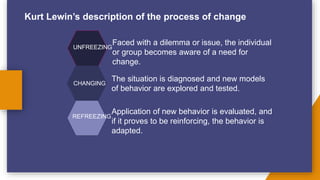
Kurt Lewin’s description of the process of change
UNFREEZING
CHANGING
REFREEZING
Faced with a dilemma or issue, the individual
or group becomes aware of a need for
change.
The situation is diagnosed and new models
of behavior are explored and tested.
Application of new behavior is evaluated, and
if it proves to be reinforcing, the behavior is
adapted.
5
Changes in Structures. Due to changing conditions/situations and changing
strategies used, organizational structures may also change according to work
specialization, departmentalization, change of command, span of control,
centralization, formalization, and job redesign, among others. Managers are
advised to alter one or more of these structural components, depending on the
needs of their organization.
Changes in Technology. Technology changes usually refer to changes in work
processes and methods used, introduction of new equipment and work tools,
automation, or computerization. Competitive factors or innovations in industries
require administrators of companies to consider such technological changes.
Computerization is most popular example of technological change. With the use
of computer networks, large amounts of data can be stored, retrieve, utilized in
many different ways-from the simple keeping of employees records to controlling
complex equipment. Both large and small companies now use the Internet to
transact business, hence the rise of e-commerce as standard practice in many
firms. It has also created a new group of workers called “virtual workers” who work
MANAGING
RESISTANCE TO
CHANGE
6
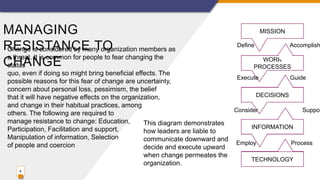
Change is considered by many organization members as
a threat. It is common for people to fear changing the
status
quo, even if doing so might bring beneficial effects. The
possible reasons for this fear of change are uncertainty,
concern about personal loss, pessimism, the belief
that it will have negative effects on the organization,
and change in their habitual practices, among
others. The following are required to
manage resistance to change: Education,
Participation, Facilitation and support,
Manipulation of information, Selection
of people and coercion
MISSION
WORK
PROCESSES
DECISIONS
INFORMATION
TECHNOLOGY
Define Accomplish
Execute Guide
Consider Suppor
Employ Process
This diagram demonstrates
how leaders are liable to
communicate downward and
decide and execute upward
when change permeates the
organization.
7
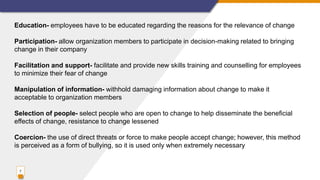
Education- employees have to be educated regarding the reasons for the relevance of change
Participation- allow organization members to participate in decision-making related to bringing
change in their company
Facilitation and support- facilitate and provide new skills training and counselling for employees
to minimize their fear of change
Manipulation of information- withhold damaging information about change to make it
acceptable to organization members
Selection of people- select people who are open to change to help disseminate the beneficial
effects of change, resistance to change lessened
Coercion- the use of direct threats or force to make people accept change; however, this method
is perceived as a form of bullying, so it is used only when extremely necessary
8
Understanding Situational Factors
Waiting for the appropriate time and situation is suggested when bringing change in
organizations. For example, the induction of new administrators/leaders is a good time to
introduce changes in the organization’s strategies, policies, and core values. Employees may
show less resistance to change because they may perceive their new leaders as more
capable of responding to their needs and the organization’s need. Another example is when a
crisis situation has just occurred. A big financial crisis in the organization could trigger a clamor
for change. In this situation, there would be less resistance to the acceptance of new
investment, marketing, and human resource policies.
Making Changes in Organizational Culture
Change in organizational culture cannot be done easily because it is highly valued and ingrained
among the firm’s members. Thus, this must be done slowly to avoid violent resistance. Robbins
and Coulter (2009) suggested the following steps:
New Issues in Change Management
9
• Set the tone through management behavior-top managers,
particularly, need to be positive role models.
• Create new stories, symbols, and rituals to replace those
currently in use.
• Select and promote employees who adapt the new values.
• Redesign socialization processes to align with the new
values.
• Change the rewards system to encourage acceptance of new
values.
• Replace unwritten norms with clearly specified expectations.
• Shake up current subcultures through job transfers, job
rotation, and/or termination.
• Work to get consensus through employee participation and
create a climate with a high level of trust.
10
Managing Workplace Diversity
Workforce diversity in organizations in inevitable. It is a fact that organization
members may differ in age, gender, physical ability, ethnicity/race, culture, values,
attitudes, beliefs, and personality. Since workgroup diversity is associated with
positive and negative outcomes, managers must try to reduce the potential negative
effects of diversity through:
a.) encouraging employees to accept the organization’s culture or its dominant
values and
b.) encouraging employees to accept differences in the workplace
These, in turn, may be accomplished by training in order to improve the inherent
negative relationship regarding a workgroup’s diversity or between its deep level
values an the organization’s culture and dominant values. Training can also be used
to help employees understand demography differences. Other ways to handle
workplace diversity is by creating support groups that can help employees ease the
tensions of working in diverse groups and reducing unconscious stereotyping
THANK
YOU!

Management-of-Change-and-Diversity-in-Organizations.pptx

  • 1.
    MANAGEMENT OF CHANGE AND DIVERSITYIN ORGANIZATIONS Lesson 5
  • 2.
    2 Management of changeand organizational diversity are two related activities/functions of management because trying to bring change in organizations is dependent on the kind and the behavior of the people within them. Bringing about organizational innovations or changes in order to respond to future competitors may threaten the firm’s members and, thus, cause resistance. Understanding and managing diversity in the workplace may, therefore, be necessary to help manage change in organizations. Definition of Terms Organizational Change- any alteration of people, structure, or technology in organizations brought by external or internal forces which they encounter Organizational Diversity- the host of individual differences that make people in organizations different from and similar to each other.
  • 3.
    TYPES OF CHANGE Changesin people. People’s attitudes, values, wants and needs, expectations, perceptions, and behaviors change as time goes by, but changing them for the better in not easy to do. In order to address this need for change, organizational development (OD) techniques are used. OD is used to describe organizational change methods related to people, their nature, and the quality of their interpersonal relationship as they work and collaborate with one another. Team building, sensitivity training, intergroup development, process consultation, and survey feedback are popular OD techniques. Managers, however, must use techniques that are suitable to the prevailing organizational culture in their respective companies. An organization and its members must undergo constant improvement along with its achievement of growth. Changes may be implemented to bring development in an organization. Among the changes that typically occur or are implemented in an organization are the following: 3
  • 4.
    Kurt Lewin’s descriptionof the process of change UNFREEZING CHANGING REFREEZING Faced with a dilemma or issue, the individual or group becomes aware of a need for change. The situation is diagnosed and new models of behavior are explored and tested. Application of new behavior is evaluated, and if it proves to be reinforcing, the behavior is adapted.
  • 5.
    5 Changes in Structures.Due to changing conditions/situations and changing strategies used, organizational structures may also change according to work specialization, departmentalization, change of command, span of control, centralization, formalization, and job redesign, among others. Managers are advised to alter one or more of these structural components, depending on the needs of their organization. Changes in Technology. Technology changes usually refer to changes in work processes and methods used, introduction of new equipment and work tools, automation, or computerization. Competitive factors or innovations in industries require administrators of companies to consider such technological changes. Computerization is most popular example of technological change. With the use of computer networks, large amounts of data can be stored, retrieve, utilized in many different ways-from the simple keeping of employees records to controlling complex equipment. Both large and small companies now use the Internet to transact business, hence the rise of e-commerce as standard practice in many firms. It has also created a new group of workers called “virtual workers” who work
  • 6.
    MANAGING RESISTANCE TO CHANGE 6 Change isconsidered by many organization members as a threat. It is common for people to fear changing the status quo, even if doing so might bring beneficial effects. The possible reasons for this fear of change are uncertainty, concern about personal loss, pessimism, the belief that it will have negative effects on the organization, and change in their habitual practices, among others. The following are required to manage resistance to change: Education, Participation, Facilitation and support, Manipulation of information, Selection of people and coercion MISSION WORK PROCESSES DECISIONS INFORMATION TECHNOLOGY Define Accomplish Execute Guide Consider Suppor Employ Process This diagram demonstrates how leaders are liable to communicate downward and decide and execute upward when change permeates the organization.
  • 7.
    7 Education- employees haveto be educated regarding the reasons for the relevance of change Participation- allow organization members to participate in decision-making related to bringing change in their company Facilitation and support- facilitate and provide new skills training and counselling for employees to minimize their fear of change Manipulation of information- withhold damaging information about change to make it acceptable to organization members Selection of people- select people who are open to change to help disseminate the beneficial effects of change, resistance to change lessened Coercion- the use of direct threats or force to make people accept change; however, this method is perceived as a form of bullying, so it is used only when extremely necessary
  • 8.
    8 Understanding Situational Factors Waitingfor the appropriate time and situation is suggested when bringing change in organizations. For example, the induction of new administrators/leaders is a good time to introduce changes in the organization’s strategies, policies, and core values. Employees may show less resistance to change because they may perceive their new leaders as more capable of responding to their needs and the organization’s need. Another example is when a crisis situation has just occurred. A big financial crisis in the organization could trigger a clamor for change. In this situation, there would be less resistance to the acceptance of new investment, marketing, and human resource policies. Making Changes in Organizational Culture Change in organizational culture cannot be done easily because it is highly valued and ingrained among the firm’s members. Thus, this must be done slowly to avoid violent resistance. Robbins and Coulter (2009) suggested the following steps: New Issues in Change Management
  • 9.
    9 • Set thetone through management behavior-top managers, particularly, need to be positive role models. • Create new stories, symbols, and rituals to replace those currently in use. • Select and promote employees who adapt the new values. • Redesign socialization processes to align with the new values. • Change the rewards system to encourage acceptance of new values. • Replace unwritten norms with clearly specified expectations. • Shake up current subcultures through job transfers, job rotation, and/or termination. • Work to get consensus through employee participation and create a climate with a high level of trust.
  • 10.
    10 Managing Workplace Diversity Workforcediversity in organizations in inevitable. It is a fact that organization members may differ in age, gender, physical ability, ethnicity/race, culture, values, attitudes, beliefs, and personality. Since workgroup diversity is associated with positive and negative outcomes, managers must try to reduce the potential negative effects of diversity through: a.) encouraging employees to accept the organization’s culture or its dominant values and b.) encouraging employees to accept differences in the workplace These, in turn, may be accomplished by training in order to improve the inherent negative relationship regarding a workgroup’s diversity or between its deep level values an the organization’s culture and dominant values. Training can also be used to help employees understand demography differences. Other ways to handle workplace diversity is by creating support groups that can help employees ease the tensions of working in diverse groups and reducing unconscious stereotyping
  • 11.