Individual Behaviour
By
Dr. H.S. ABZAL BASHA, M.B.A., Ph.D., L.L.B.
Assistant Professor,
Department of Management Studies,
G. Pullaiah College of Engineering & Technology,
Kurnool.
What isbehaviour?
• Most people use the word
‘behaviour’ to mean conduct.
• Behaviour is anything that a
person does.
• In psychology, behaviour is
regarded as any observable
activity by human being.
• In other words actions/
reactions/ response/ reflection
to the environment.
• Most human behaviour results
from a combination of factors such
as culture, attitudes, emotions,
values, ethics, authority, rapport,
persuasion, coercion and
genetics.
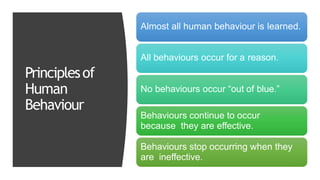
Principlesof
Human
Behaviour
Almost all human behaviour is learned.
All behaviours occur for a reason.
No behaviours occur “out of blue.”
Behaviours continue to occur
because they are effective.
Behaviours stop occurring when they
are ineffective.
A – B – C Model of Behaviour
A
Antecedent
Trigger
1 2
B
Behaviour
Action
3
C
Consequence
Response
Behaviour
• Behaviour is the manner in
which a person behaves,
whether they can conform to
the accepted social standards
or not.
HUMAN BEHAVIOUR
Economic Man
Social Man
Organisation Man
Self Actualisation Man
Complex Man
Impulsive Man
Compulsive Man
15% 15%
35%
35%
Sir Francis Galton Study on Similarities in 1896
Attributes
Extreme +Ve Average -Ve Extreme -Ve
Average +Ve
Introduction
8
• An organization is basically the association of human beings
and a major problem of today’s organization is how to get
maximum possible efforts and contributions of the human
beings determining these efforts and contributions, those
responsible for managing the organization must understand
the way human beings behave.
• It is to be noted that the world of human work consists of
individual performing jobs in some setting, usually in some
organization
• The fact that there are tremendous differences among
individuals and among jobs is the basis of the frequently
expressed notion of “matching” people and jobs and of the
expression “round pegs in square holes” when the “match” is
not a good one. Mismatches can occur in any setting.
Variables influencing Individual Behavior
The Person
Skills & abilities
Personality
Perceptions
Attitudes
Values
Ethics
The
Environment
Organization
Work group
Job
Personal life
Behavior
9
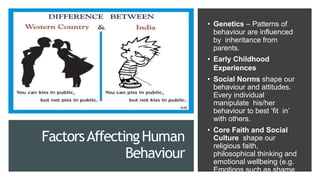
FactorsAffectingHuman
Behaviour
• Genetics – Patterns of
behaviour are influenced
by inheritance from
parents.
• Early Childhood
Experiences
• Social Norms shape our
behaviour and attitudes.
Every individual
manipulate his/her
behaviour to best ‘fit in’
with others.
• Core Faith and Social
Culture shape our
religious faith,
philosophical thinking and
emotional wellbeing (e.g.
Emotions such as shame
and guilt connected to
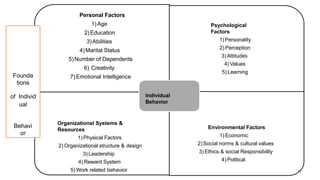
Personal Factors
1)Age
2)Education
3)Abilities
4)Marital Status
5)Number of Dependents
6) Creativity
7)Emotional Intelligence
Psychological
Factors
1) Personality
2) Perception
3) Attitudes
4) Values
5) Learning
Organizational Systems &
Resources
1) Physical Factors
2) Organizational structure & design
3) Leadership
4) Reward System
5) Work related behavior
Environmental Factors
1) Economic
2) Social norms & cultural values
3) Ethics & social Responsibility
4) Political
Individual
Behavior
12
Founda
tions
of Individ
ual
Behavi
or
Personal Factors
13
• Age: Age has impact on performance, turnover, absenteeism, productivity
and Satisfaction level
• Education: Increased levels of education serve to increase an individual’s
expectation about positive outcomes (general and specialized)
• Ability: Ability refers to an individuals capacity to perform various tasks in
a given job (intellectual and physical). Employee performance is enhanced
when there is ability-fit job
• Marital Status: it has impact on absenteeism, turnover & satisfaction
• Number of Dependents: There is a correlation between number of
dependents and absenteeism and satisfaction
• Creativity : Creativity refers to the cognitive activity that results in a new or novel way
of viewing or solving a problem. They have three attributes of background experience,
personal traits and cognitive abilities (analytical skills)
14
• Emotional Intelligence: Emotions are an effective state of
consciousness in which joy, sorrow, fear, hate, love, surprise, and anger is expressed.
Emotions have impact on Mood, performance, Features are: Emotions are highly focused,
expressions of emotions is universal and Culture determines expression of feelings.
Emotional Intelligence helps us to monitor our emotions
Environmental Factors
15
• Economic Factors: All work is performed within economic framework, that
both directly and indirectly, impinges on an organizational environment. Various factors
like employment opportunities, wage rates, economic outlook and Technological change
• Cultural Environment: Cultural environment is made up of institutions and
other forces that affect society’s basic values, perceptions, work ethics, achievement
needs and effort- reward expectations, values preferences and behavior
• Ethics and Social Responsibility: Ethics refers to a system of moral
principles; a sense of right and wrong and goodness and badness of actions and the motives
and the consequences of these actions. Social Responsibility or Corporate social
Responsibility is understood as the obligation of decision makers to take actions that protect
and improve the welfare of the society as a whole, along with their own interest
• Political Factors: The stability of Government tends to have impact on employment
opportunities and these, in turn, impact employee behavior. The political ideology of a country
affects individual behavior primarily through the relative freedom available to the citizens
16
Organizational Systems & Resources
17
• Facilities: Like lighting, ventilation, air-conditioning, décor, space for
employees, secretarial support
• Organizational structure & Design: The behavior & performance of an
individual is influenced by where that person fits into the overall structure &
design of the organization.
• Leadership: A leader provides direction, assistance, advice and coaching to
individuals, due to which a system of leadership and supervision is necessary
as it is a potential source of influence.
• Reward System: The behavior and performance of an individual is
influenced by the reward system of his or her organization
• Work related behavior: The five stages of the individual’s stay in the
organization may be distinguished by joining in the organization, remaining
with the organization, maintaining work attendance, performing required
tasks & exhibiting organizational citizenship
18
Psychological Factors
1. Tribalistic: This category people prefer directive, strong leadership
from their boss.
2. Ego-centric: Desire to work alone.
3. Socio-centric: Seek social relationship.
4. Existential: Strives for satisfying growth and self fulfilment.
Implications
Individual behaviour

Individual behaviour

  • 1.
    Individual Behaviour By Dr. H.S.ABZAL BASHA, M.B.A., Ph.D., L.L.B. Assistant Professor, Department of Management Studies, G. Pullaiah College of Engineering & Technology, Kurnool.
  • 2.
    What isbehaviour? • Mostpeople use the word ‘behaviour’ to mean conduct. • Behaviour is anything that a person does. • In psychology, behaviour is regarded as any observable activity by human being. • In other words actions/ reactions/ response/ reflection to the environment. • Most human behaviour results from a combination of factors such as culture, attitudes, emotions, values, ethics, authority, rapport, persuasion, coercion and genetics.
  • 3.
    Principlesof Human Behaviour Almost all humanbehaviour is learned. All behaviours occur for a reason. No behaviours occur “out of blue.” Behaviours continue to occur because they are effective. Behaviours stop occurring when they are ineffective.
  • 4.
    A – B– C Model of Behaviour A Antecedent Trigger 1 2 B Behaviour Action 3 C Consequence Response
  • 5.
    Behaviour • Behaviour isthe manner in which a person behaves, whether they can conform to the accepted social standards or not.
  • 6.
    HUMAN BEHAVIOUR Economic Man SocialMan Organisation Man Self Actualisation Man Complex Man Impulsive Man Compulsive Man
  • 7.
    15% 15% 35% 35% Sir FrancisGalton Study on Similarities in 1896 Attributes Extreme +Ve Average -Ve Extreme -Ve Average +Ve
  • 8.
    Introduction 8 • An organizationis basically the association of human beings and a major problem of today’s organization is how to get maximum possible efforts and contributions of the human beings determining these efforts and contributions, those responsible for managing the organization must understand the way human beings behave. • It is to be noted that the world of human work consists of individual performing jobs in some setting, usually in some organization • The fact that there are tremendous differences among individuals and among jobs is the basis of the frequently expressed notion of “matching” people and jobs and of the expression “round pegs in square holes” when the “match” is not a good one. Mismatches can occur in any setting.
  • 9.
    Variables influencing IndividualBehavior The Person Skills & abilities Personality Perceptions Attitudes Values Ethics The Environment Organization Work group Job Personal life Behavior 9
  • 10.
    FactorsAffectingHuman Behaviour • Genetics –Patterns of behaviour are influenced by inheritance from parents. • Early Childhood Experiences • Social Norms shape our behaviour and attitudes. Every individual manipulate his/her behaviour to best ‘fit in’ with others. • Core Faith and Social Culture shape our religious faith, philosophical thinking and emotional wellbeing (e.g. Emotions such as shame and guilt connected to
  • 12.
    Personal Factors 1)Age 2)Education 3)Abilities 4)Marital Status 5)Numberof Dependents 6) Creativity 7)Emotional Intelligence Psychological Factors 1) Personality 2) Perception 3) Attitudes 4) Values 5) Learning Organizational Systems & Resources 1) Physical Factors 2) Organizational structure & design 3) Leadership 4) Reward System 5) Work related behavior Environmental Factors 1) Economic 2) Social norms & cultural values 3) Ethics & social Responsibility 4) Political Individual Behavior 12 Founda tions of Individ ual Behavi or
  • 13.
    Personal Factors 13 • Age:Age has impact on performance, turnover, absenteeism, productivity and Satisfaction level • Education: Increased levels of education serve to increase an individual’s expectation about positive outcomes (general and specialized) • Ability: Ability refers to an individuals capacity to perform various tasks in a given job (intellectual and physical). Employee performance is enhanced when there is ability-fit job • Marital Status: it has impact on absenteeism, turnover & satisfaction
  • 14.
    • Number ofDependents: There is a correlation between number of dependents and absenteeism and satisfaction • Creativity : Creativity refers to the cognitive activity that results in a new or novel way of viewing or solving a problem. They have three attributes of background experience, personal traits and cognitive abilities (analytical skills) 14 • Emotional Intelligence: Emotions are an effective state of consciousness in which joy, sorrow, fear, hate, love, surprise, and anger is expressed. Emotions have impact on Mood, performance, Features are: Emotions are highly focused, expressions of emotions is universal and Culture determines expression of feelings. Emotional Intelligence helps us to monitor our emotions
  • 15.
    Environmental Factors 15 • EconomicFactors: All work is performed within economic framework, that both directly and indirectly, impinges on an organizational environment. Various factors like employment opportunities, wage rates, economic outlook and Technological change • Cultural Environment: Cultural environment is made up of institutions and other forces that affect society’s basic values, perceptions, work ethics, achievement needs and effort- reward expectations, values preferences and behavior
  • 16.
    • Ethics andSocial Responsibility: Ethics refers to a system of moral principles; a sense of right and wrong and goodness and badness of actions and the motives and the consequences of these actions. Social Responsibility or Corporate social Responsibility is understood as the obligation of decision makers to take actions that protect and improve the welfare of the society as a whole, along with their own interest • Political Factors: The stability of Government tends to have impact on employment opportunities and these, in turn, impact employee behavior. The political ideology of a country affects individual behavior primarily through the relative freedom available to the citizens 16
  • 17.
    Organizational Systems &Resources 17 • Facilities: Like lighting, ventilation, air-conditioning, décor, space for employees, secretarial support • Organizational structure & Design: The behavior & performance of an individual is influenced by where that person fits into the overall structure & design of the organization. • Leadership: A leader provides direction, assistance, advice and coaching to individuals, due to which a system of leadership and supervision is necessary as it is a potential source of influence.
  • 18.
    • Reward System:The behavior and performance of an individual is influenced by the reward system of his or her organization • Work related behavior: The five stages of the individual’s stay in the organization may be distinguished by joining in the organization, remaining with the organization, maintaining work attendance, performing required tasks & exhibiting organizational citizenship 18
  • 19.
    Psychological Factors 1. Tribalistic:This category people prefer directive, strong leadership from their boss. 2. Ego-centric: Desire to work alone. 3. Socio-centric: Seek social relationship. 4. Existential: Strives for satisfying growth and self fulfilment. Implications