Sections	1.1–1.2
                   Functions

                   V63.0121, Calculus	I


                     September	10, 2009


Announcements
   Syllabus	is	on	the	common	Blackboard
   Office	Hours	TBA

                                          .   .   .   .   .   .
Outline
  What	is	a	function?
  Modeling
  Examples	of	functions
     Functions	expressed	by	formulas
     Functions	described	numerically
     Functions	described	graphically
     Functions	described	verbally
  Properties	of	functions
     Monotonicity
  Classes	of	Functions
     Linear	functions
     Other	Polynomial	functions
     Other	power	functions
     Rational	functions
     Trigonometric	Functions
     Exponential	and	Logarithmic	functions
                                             .   .   .   .   .   .
Definition
A function f is	a	relation	which	assigns	to	to	every	element x in	a
set D a	single	element f(x) in	a	set E.
    The	set D is	called	the domain of f.
    The	set E is	called	the target of f.
    The	set { f(x) | x ∈ D } is	called	the range of f.


                                               .    .    .   .   .    .
Outline
  What	is	a	function?
  Modeling
  Examples	of	functions
     Functions	expressed	by	formulas
     Functions	described	numerically
     Functions	described	graphically
     Functions	described	verbally
  Properties	of	functions
     Monotonicity
  Classes	of	Functions
     Linear	functions
     Other	Polynomial	functions
     Other	power	functions
     Rational	functions
     Trigonometric	Functions
     Exponential	and	Logarithmic	functions
                                             .   .   .   .   .   .
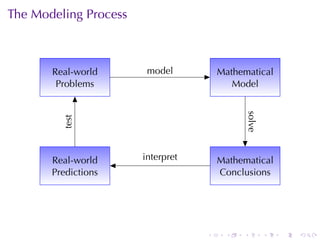
The	Modeling	Process


     .                                 .
         Real-world
              .
              .         m
                        . odel             Mathematical
                                                .
          Problems                            Model


                                                    s
                                                    . olve
           .est
           t


     .                 i
                       .nterpret       .
         Real-world
              .                            Mathematical
                                                .
         Predictions                       Conclusions


                                   .        .   .            .   .   .
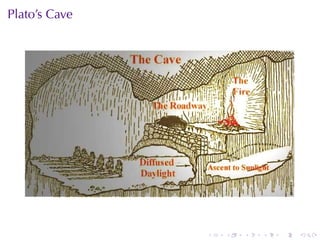
Plato’s	Cave


               .   .   .   .   .   .
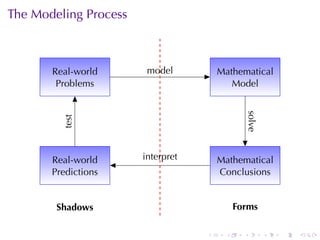
The	Modeling	Process


     .                                 .
         Real-world
              .
              .         m
                        . odel             Mathematical
                                                .
          Problems                            Model


                                                      s
                                                      . olve
           .est
           t


     .                 i
                       .nterpret       .
         Real-world
              .                            Mathematical
                                                .
         Predictions                       Conclusions


          S
          . hadows                              F
                                                . orms

                                   .        .     .            .   .   .
Outline
  What	is	a	function?
  Modeling
  Examples	of	functions
     Functions	expressed	by	formulas
     Functions	described	numerically
     Functions	described	graphically
     Functions	described	verbally
  Properties	of	functions
     Monotonicity
  Classes	of	Functions
     Linear	functions
     Other	Polynomial	functions
     Other	power	functions
     Rational	functions
     Trigonometric	Functions
     Exponential	and	Logarithmic	functions
                                             .   .   .   .   .   .
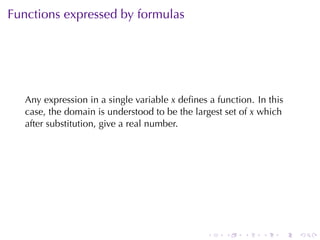
Functions	expressed	by	formulas


   Any	expression	in	a	single	variable x defines	a	function. In	this
   case, the	domain	is	understood	to	be	the	largest	set	of x which
   after	substitution, give	a	real	number.


                                                .   .    .   .    .   .
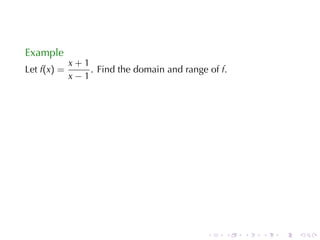
Example
             x+1
Let f(x) =       . Find	the	domain	and	range	of f.
             x−1


                                             .   .   .   .   .   .
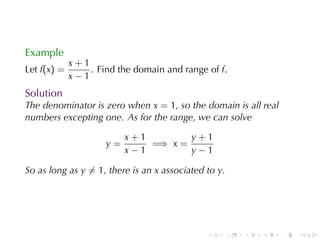
Example
             x+1
Let f(x) =       . Find	the	domain	and	range	of f.
             x−1
Solution
The	denominator	is	zero	when x = 1, so	the	domain	is	all	real
numbers	excepting	one. As	for	the	range, we	can	solve

                          x+1        y+1
                     y=       =⇒ x =
                          x−1        y−1

So	as	long	as y ̸= 1, there	is	an x associated	to y.


                                               .       .   .   .   .   .
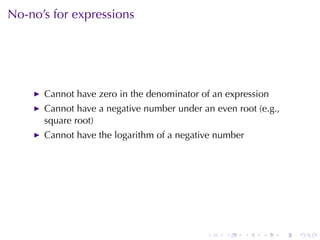
No-no’s	for	expressions


      Cannot	have	zero	in	the	denominator	of	an	expression
      Cannot	have	a	negative	number	under	an	even	root	(e.g.,
      square	root)
      Cannot	have	the	logarithm	of	a	negative	number


                                            .   .      .   .    .   .
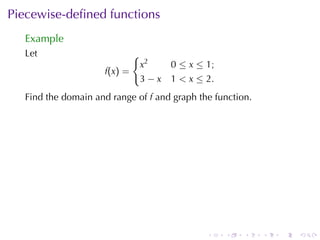
Piecewise-defined	functions
  Example
  Let                      {
                            x2      0 ≤ x ≤ 1;
                    f(x) =
                            3−x     1 < x ≤ 2.
  Find	the	domain	and	range	of f and	graph	the	function.


                                             .   .    .    .   .   .
Piecewise-defined	functions
  Example
  Let                        {
                              x2         0 ≤ x ≤ 1;
                      f(x) =
                              3−x        1 < x ≤ 2.
  Find	the	domain	and	range	of f and	graph	the	function.

  Solution
  The	domain	is [0, 2]. The	range	is [0, 2). The	graph	is	piecewise.

                            . .
                            2       .

                            . .
                            1       .        .

                               .     .        .
                             0
                             .     1
                                   .        2
                                            .

                                                  .   .   .   .   .    .
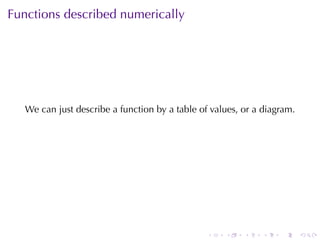
Functions	described	numerically


   We	can	just	describe	a	function	by	a	table	of	values, or	a	diagram.


                                                .   .    .    .   .      .
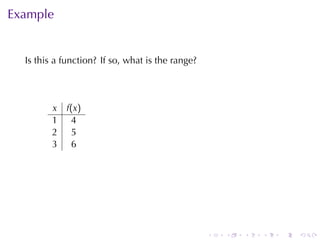
Example


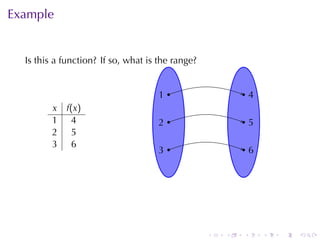
  Is	this	a	function? If	so, what	is	the	range?


         x f(x)
         1 4
         2 5
         3 6


                                                  .   .   .   .   .   .
Example


  Is	this	a	function? If	so, what	is	the	range?


                                     . .
                                     1                    ..
                                                           4
         x f(x)
         1 4                         . ..
                                     2                    .. .
                                                             5
         2 5
         3 6
                                     . .
                                     3                    ..
                                                           6


                                                  .   .   .      .   .   .
Example


  Is	this	a	function? If	so, what	is	the	range?


                                     . .
                                     1                    ..
                                                           4
         x f(x)
         1 4                         . ..
                                     2                    .. .
                                                             5
         2 5
         3 6
                                     . .
                                     3                    ..
                                                           6


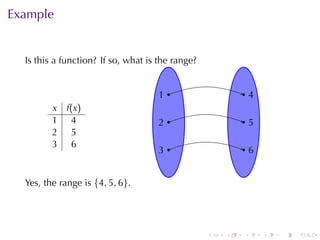
  Yes, the	range	is {4, 5, 6}.


                                                  .   .   .      .   .   .
Example


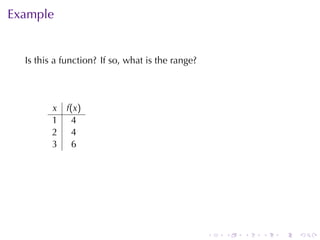
  Is	this	a	function? If	so, what	is	the	range?


         x f(x)
         1 4
         2 4
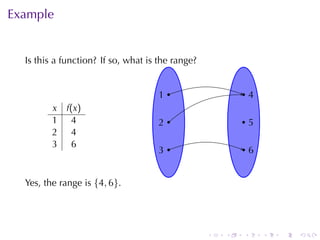
         3 6


                                                  .   .   .   .   .   .
Example


  Is	this	a	function? If	so, what	is	the	range?


                                     . .
                                     1                    ..
                                                           4
         x f(x)
         1 4                         . ..
                                     2                    .. .
                                                             5
         2 4
         3 6
                                     . .
                                     3                    ..
                                                           6


                                                  .   .   .      .   .   .
Example


  Is	this	a	function? If	so, what	is	the	range?


                                     . .
                                     1                    ..
                                                           4
         x f(x)
         1 4                         . ..
                                     2                    .. .
                                                             5
         2 4
         3 6
                                     . .
                                     3                    ..
                                                           6


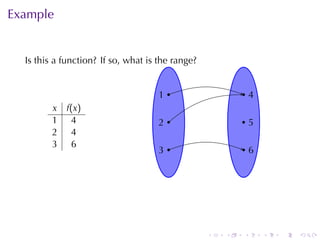
  Yes, the	range	is {4, 6}.


                                                  .   .   .      .   .   .
Example


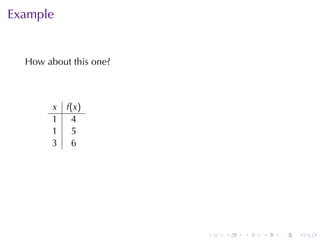
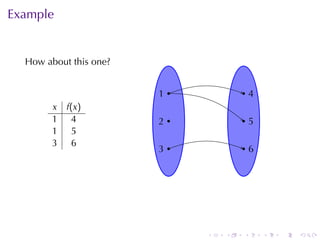
  How	about	this	one?


        x f(x)
        1 4
        1 5
        3 6


                        .   .   .   .   .   .
Example


  How	about	this	one?


                        . .
                        1              ..
                                        4
        x f(x)
        1 4             . ..
                        2              .. .
                                          5
        1 5
        3 6
                        . .
                        3              ..
                                        6


                               .   .   .      .   .   .
Example


  How	about	this	one?


                                   . .
                                   1              ..
                                                   4
        x f(x)
        1 4                        . ..
                                   2              .. .
                                                     5
        1 5
        3 6
                                   . .
                                   3              ..
                                                   6


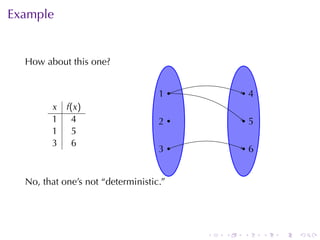
  No, that	one’s	not	“deterministic.”


                                          .   .   .      .   .   .
In	science, functions	are	often	defined	by	data. Or, we	observe
data	and	assume	that	it’s	close	to	some	nice	continuous	function.


                                            .   .    .   .    .     .
Example
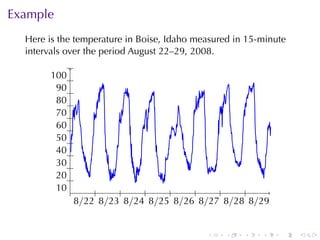
  Here	is	the	temperature	in	Boise, Idaho	measured	in	15-minute
  intervals	over	the	period	August	22–29, 2008.
              .
        1
        . 00 .
          9
          .0.
          8
          .0.
          7
          .0.
          6
          .0.
          5
          .0.
          4
          .0.
          3
          .0.
          2
          .0.
          1
          .0.        .     .     .     .     .     .     .
                8
                . /22 . /23 . /24 . /25 . /26 . /27 . /28 . /29
                       8     8     8     8     8     8     8


                                            .   .    .   .   .    .
Functions	described	graphically
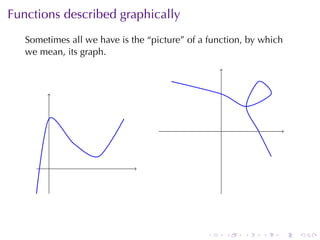
   Sometimes	all	we	have	is	the	“picture”	of	a	function, by	which
   we	mean, its	graph.


                                                  .


        .


                                              .       .   .   .   .   .
Functions	described	graphically
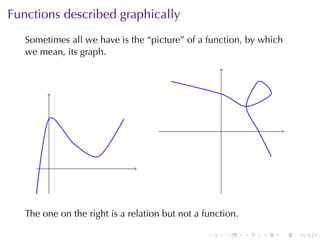
   Sometimes	all	we	have	is	the	“picture”	of	a	function, by	which
   we	mean, its	graph.


                                                     .


         .


   The	one	on	the	right	is	a	relation	but	not	a	function.

                                                 .       .   .   .   .   .
Functions	described	verbally


   Oftentimes	our	functions	come	out	of	nature	and	have	verbal
   descriptions:
       The	temperature T(t) in	this	room	at	time t.
       The	elevation h(θ) of	the	point	on	the	equation	at	longitude
       θ.
       The	utility u(x) I derive	by	consuming x burritos.


                                               .      .     .   .   .   .
Outline
  What	is	a	function?
  Modeling
  Examples	of	functions
     Functions	expressed	by	formulas
     Functions	described	numerically
     Functions	described	graphically
     Functions	described	verbally
  Properties	of	functions
     Monotonicity
  Classes	of	Functions
     Linear	functions
     Other	Polynomial	functions
     Other	power	functions
     Rational	functions
     Trigonometric	Functions
     Exponential	and	Logarithmic	functions
                                             .   .   .   .   .   .
Monotonicity


  Example
  Let P(x) be	the	probability	that	my	income	was	at	least	$x last
  year. What	might	a	graph	of P(x) look	like?


                                               .   .    .   .       .   .
Monotonicity


  Example
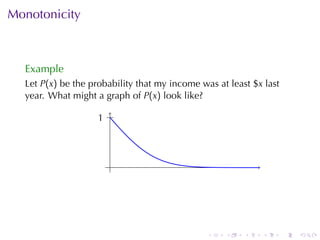
  Let P(x) be	the	probability	that	my	income	was	at	least	$x last
  year. What	might	a	graph	of P(x) look	like?

                    . .
                    1


                       .


                                               .   .    .   .       .   .
Monotonicity


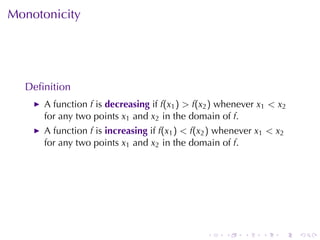
  Definition
      A function f is decreasing if f(x1 ) > f(x2 ) whenever x1 < x2
      for	any	two	points x1 and x2 in	the	domain	of f.
      A function f is increasing if f(x1 ) < f(x2 ) whenever x1 < x2
      for	any	two	points x1 and x2 in	the	domain	of f.


                                                .   .    .    .    .   .
Examples


  Example
  Going	back	to	the	burrito	function, would	you	call	it	increasing?


                                              .    .   .    .   .     .
Examples


  Example
  Going	back	to	the	burrito	function, would	you	call	it	increasing?

  Example
  Obviously, the	temperature	in	Boise	is	neither	increasing	nor
  decreasing.


                                              .    .   .    .     .   .
Outline
  What	is	a	function?
  Modeling
  Examples	of	functions
     Functions	expressed	by	formulas
     Functions	described	numerically
     Functions	described	graphically
     Functions	described	verbally
  Properties	of	functions
     Monotonicity
  Classes	of	Functions
     Linear	functions
     Other	Polynomial	functions
     Other	power	functions
     Rational	functions
     Trigonometric	Functions
     Exponential	and	Logarithmic	functions
                                             .   .   .   .   .   .
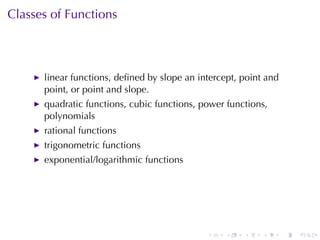
Classes	of	Functions


      linear	functions, defined	by	slope	an	intercept, point	and
      point, or	point	and	slope.
      quadratic	functions, cubic	functions, power	functions,
      polynomials
      rational	functions
      trigonometric	functions
      exponential/logarithmic	functions


                                             .    .   .    .      .   .
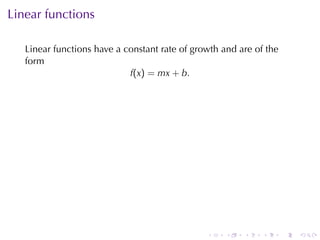
Linear	functions

   Linear	functions	have	a	constant	rate	of	growth	and	are	of	the
   form
                            f(x) = mx + b.


                                               .    .   .    .      .   .
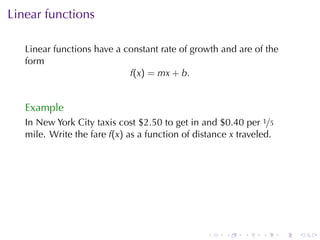
Linear	functions

   Linear	functions	have	a	constant	rate	of	growth	and	are	of	the
   form
                            f(x) = mx + b.


   Example
   In	New	York	City	taxis	cost	$2.50	to	get	in	and	$0.40	per 1/5
   mile. Write	the	fare f(x) as	a	function	of	distance x traveled.


                                                 .   .    .    .     .   .
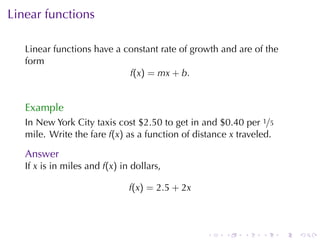
Linear	functions

   Linear	functions	have	a	constant	rate	of	growth	and	are	of	the
   form
                            f(x) = mx + b.


   Example
   In	New	York	City	taxis	cost	$2.50	to	get	in	and	$0.40	per 1/5
   mile. Write	the	fare f(x) as	a	function	of	distance x traveled.

   Answer
   If x is	in	miles	and f(x) in	dollars,

                               f(x) = 2.5 + 2x


                                                 .   .    .    .     .   .
Other	Polynomial	functions


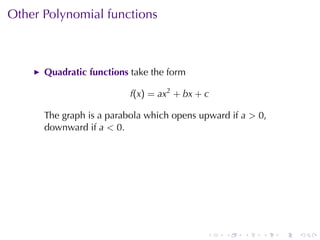
      Quadratic	functions take	the	form

                          f(x) = ax2 + bx + c

      The	graph	is	a	parabola	which	opens	upward	if a > 0,
      downward	if a < 0.


                                            .   .   .    .   .   .
Other	Polynomial	functions


      Quadratic	functions take	the	form

                          f(x) = ax2 + bx + c

      The	graph	is	a	parabola	which	opens	upward	if a > 0,
      downward	if a < 0.
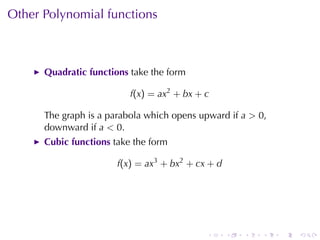
      Cubic	functions take	the	form

                       f(x) = ax3 + bx2 + cx + d


                                            .      .   .   .   .   .
Other	power	functions


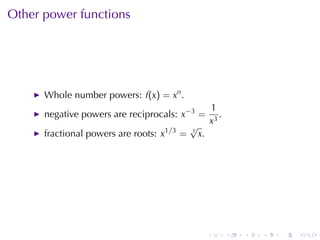
      Whole	number	powers: f(x) = xn .
                                               1
      negative	powers	are	reciprocals: x−3 = 3 .
                                               x
                                          √
      fractional	powers	are	roots: x1/3 = 3 x.


                                            .      .   .   .   .   .
Rational	functions


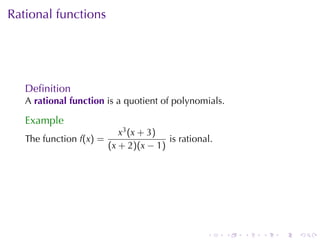
   Definition
   A rational	function is	a	quotient	of	polynomials.

   Example
                            x 3 (x + 3 )
   The	function f(x) =                   is	rational.
                         (x + 2)(x − 1)


                                                   .    .   .   .   .   .
Trigonometric	Functions


      Sine	and	cosine
      Tangent	and	cotangent
      Secant	and	cosecant


                              .   .   .   .   .   .
Exponential	and	Logarithmic	functions


      exponential	functions	(for	example f(x) = 2x )
      logarithmic	functions	are	their	inverses	(for	example
      f(x) = log2 (x))


                                              .    .   .      .   .   .

Lesson 1: Functions

  • 1.
    Sections 1.1–1.2 Functions V63.0121, Calculus I September 10, 2009 Announcements Syllabus is on the common Blackboard Office Hours TBA . . . . . .
  • 2.
    Outline What is a function? Modeling Examples of functions Functions expressed by formulas Functions described numerically Functions described graphically Functions described verbally Properties of functions Monotonicity Classes of Functions Linear functions Other Polynomial functions Other power functions Rational functions Trigonometric Functions Exponential and Logarithmic functions . . . . . .
  • 3.
    Definition A function fis a relation which assigns to to every element x in a set D a single element f(x) in a set E. The set D is called the domain of f. The set E is called the target of f. The set { f(x) | x ∈ D } is called the range of f. . . . . . .
  • 4.
    Outline What is a function? Modeling Examples of functions Functions expressed by formulas Functions described numerically Functions described graphically Functions described verbally Properties of functions Monotonicity Classes of Functions Linear functions Other Polynomial functions Other power functions Rational functions Trigonometric Functions Exponential and Logarithmic functions . . . . . .
  • 5.
    The Modeling Process . . Real-world . . m . odel Mathematical . Problems Model s . olve .est t . i .nterpret . Real-world . Mathematical . Predictions Conclusions . . . . . .
  • 6.
    Plato’s Cave . . . . . .
  • 7.
    The Modeling Process . . Real-world . . m . odel Mathematical . Problems Model s . olve .est t . i .nterpret . Real-world . Mathematical . Predictions Conclusions S . hadows F . orms . . . . . .
  • 8.
    Outline What is a function? Modeling Examples of functions Functions expressed by formulas Functions described numerically Functions described graphically Functions described verbally Properties of functions Monotonicity Classes of Functions Linear functions Other Polynomial functions Other power functions Rational functions Trigonometric Functions Exponential and Logarithmic functions . . . . . .
  • 9.
    Functions expressed by formulas Any expression in a single variable x defines a function. In this case, the domain is understood to be the largest set of x which after substitution, give a real number. . . . . . .
  • 10.
    Example x+1 Let f(x) = . Find the domain and range of f. x−1 . . . . . .
  • 11.
    Example x+1 Let f(x) = . Find the domain and range of f. x−1 Solution The denominator is zero when x = 1, so the domain is all real numbers excepting one. As for the range, we can solve x+1 y+1 y= =⇒ x = x−1 y−1 So as long as y ̸= 1, there is an x associated to y. . . . . . .
  • 12.
    No-no’s for expressions Cannot have zero in the denominator of an expression Cannot have a negative number under an even root (e.g., square root) Cannot have the logarithm of a negative number . . . . . .
  • 13.
    Piecewise-defined functions Example Let { x2 0 ≤ x ≤ 1; f(x) = 3−x 1 < x ≤ 2. Find the domain and range of f and graph the function. . . . . . .
  • 14.
    Piecewise-defined functions Example Let { x2 0 ≤ x ≤ 1; f(x) = 3−x 1 < x ≤ 2. Find the domain and range of f and graph the function. Solution The domain is [0, 2]. The range is [0, 2). The graph is piecewise. . . 2 . . . 1 . . . . . 0 . 1 . 2 . . . . . . .
  • 15.
    Functions described numerically We can just describe a function by a table of values, or a diagram. . . . . . .
  • 16.
    Example Is this a function?If so, what is the range? x f(x) 1 4 2 5 3 6 . . . . . .
  • 17.
    Example Is this a function?If so, what is the range? . . 1 .. 4 x f(x) 1 4 . .. 2 .. . 5 2 5 3 6 . . 3 .. 6 . . . . . .
  • 18.
    Example Is this a function?If so, what is the range? . . 1 .. 4 x f(x) 1 4 . .. 2 .. . 5 2 5 3 6 . . 3 .. 6 Yes, the range is {4, 5, 6}. . . . . . .
  • 19.
    Example Is this a function?If so, what is the range? x f(x) 1 4 2 4 3 6 . . . . . .
  • 20.
    Example Is this a function?If so, what is the range? . . 1 .. 4 x f(x) 1 4 . .. 2 .. . 5 2 4 3 6 . . 3 .. 6 . . . . . .
  • 21.
    Example Is this a function?If so, what is the range? . . 1 .. 4 x f(x) 1 4 . .. 2 .. . 5 2 4 3 6 . . 3 .. 6 Yes, the range is {4, 6}. . . . . . .
  • 22.
    Example How about this one? x f(x) 1 4 1 5 3 6 . . . . . .
  • 23.
    Example How about this one? . . 1 .. 4 x f(x) 1 4 . .. 2 .. . 5 1 5 3 6 . . 3 .. 6 . . . . . .
  • 24.
    Example How about this one? . . 1 .. 4 x f(x) 1 4 . .. 2 .. . 5 1 5 3 6 . . 3 .. 6 No, that one’s not “deterministic.” . . . . . .
  • 25.
    In science, functions are often defined by data. Or,we observe data and assume that it’s close to some nice continuous function. . . . . . .
  • 26.
    Example Here is the temperature in Boise,Idaho measured in 15-minute intervals over the period August 22–29, 2008. . 1 . 00 . 9 .0. 8 .0. 7 .0. 6 .0. 5 .0. 4 .0. 3 .0. 2 .0. 1 .0. . . . . . . . 8 . /22 . /23 . /24 . /25 . /26 . /27 . /28 . /29 8 8 8 8 8 8 8 . . . . . .
  • 27.
    Functions described graphically Sometimes all we have is the “picture” of a function, by which we mean, its graph. . . . . . . . .
  • 28.
    Functions described graphically Sometimes all we have is the “picture” of a function, by which we mean, its graph. . . The one on the right is a relation but not a function. . . . . . .
  • 29.
    Functions described verbally Oftentimes our functions come out of nature and have verbal descriptions: The temperature T(t) in this room at time t. The elevation h(θ) of the point on the equation at longitude θ. The utility u(x) I derive by consuming x burritos. . . . . . .
  • 30.
    Outline What is a function? Modeling Examples of functions Functions expressed by formulas Functions described numerically Functions described graphically Functions described verbally Properties of functions Monotonicity Classes of Functions Linear functions Other Polynomial functions Other power functions Rational functions Trigonometric Functions Exponential and Logarithmic functions . . . . . .
  • 31.
    Monotonicity Example Let P(x) be the probability that my income was at least $x last year. What might a graph of P(x) look like? . . . . . .
  • 32.
    Monotonicity Example Let P(x) be the probability that my income was at least $x last year. What might a graph of P(x) look like? . . 1 . . . . . . .
  • 33.
    Monotonicity Definition A function f is decreasing if f(x1 ) > f(x2 ) whenever x1 < x2 for any two points x1 and x2 in the domain of f. A function f is increasing if f(x1 ) < f(x2 ) whenever x1 < x2 for any two points x1 and x2 in the domain of f. . . . . . .
  • 34.
    Examples Example Going back to the burrito function, would you call it increasing? . . . . . .
  • 35.
    Examples Example Going back to the burrito function, would you call it increasing? Example Obviously, the temperature in Boise is neither increasing nor decreasing. . . . . . .
  • 36.
    Outline What is a function? Modeling Examples of functions Functions expressed by formulas Functions described numerically Functions described graphically Functions described verbally Properties of functions Monotonicity Classes of Functions Linear functions Other Polynomial functions Other power functions Rational functions Trigonometric Functions Exponential and Logarithmic functions . . . . . .
  • 37.
    Classes of Functions linear functions, defined by slope an intercept, point and point, or point and slope. quadratic functions, cubic functions, power functions, polynomials rational functions trigonometric functions exponential/logarithmic functions . . . . . .
  • 38.
    Linear functions Linear functions have a constant rate of growth and are of the form f(x) = mx + b. . . . . . .
  • 39.
    Linear functions Linear functions have a constant rate of growth and are of the form f(x) = mx + b. Example In New York City taxis cost $2.50 to get in and $0.40 per 1/5 mile. Write the fare f(x) as a function of distance x traveled. . . . . . .
  • 40.
    Linear functions Linear functions have a constant rate of growth and are of the form f(x) = mx + b. Example In New York City taxis cost $2.50 to get in and $0.40 per 1/5 mile. Write the fare f(x) as a function of distance x traveled. Answer If x is in miles and f(x) in dollars, f(x) = 2.5 + 2x . . . . . .
  • 41.
    Other Polynomial functions Quadratic functions take the form f(x) = ax2 + bx + c The graph is a parabola which opens upward if a > 0, downward if a < 0. . . . . . .
  • 42.
    Other Polynomial functions Quadratic functions take the form f(x) = ax2 + bx + c The graph is a parabola which opens upward if a > 0, downward if a < 0. Cubic functions take the form f(x) = ax3 + bx2 + cx + d . . . . . .
  • 43.
    Other power functions Whole number powers: f(x) = xn . 1 negative powers are reciprocals: x−3 = 3 . x √ fractional powers are roots: x1/3 = 3 x. . . . . . .
  • 44.
    Rational functions Definition A rational function is a quotient of polynomials. Example x 3 (x + 3 ) The function f(x) = is rational. (x + 2)(x − 1) . . . . . .
  • 45.
    Trigonometric Functions Sine and cosine Tangent and cotangent Secant and cosecant . . . . . .
  • 46.
    Exponential and Logarithmic functions exponential functions (for example f(x) = 2x ) logarithmic functions are their inverses (for example f(x) = log2 (x)) . . . . . .