Chapter
Chi-Square Tests and
the F-Distribution
1 of 91
10
© 2012 Pearson Education, Inc.
All rights reserved.
Chapter Outline
• 10.1 Goodness of Fit
• 10.2 Independence
• 10.3 Comparing Two Variances
• 10.4 Analysis of Variance
© 2012 Pearson Education, Inc. All rights reserved. 2 of 91
Section 10.1
Goodness of Fit
© 2012 Pearson Education, Inc. All rights reserved. 3 of 91
Section 10.1 Objectives
• Use the chi-square distribution to test whether a
frequency distribution fits a claimed distribution
© 2012 Pearson Education, Inc. All rights reserved. 4 of 91
Multinomial Experiments
Multinomial experiment
• A probability experiment consisting of a fixed
number of independent trials in which there are more
than two possible outcomes for each trial.
• The probability for each outcome is fixed and each
outcome is classified into categories.
• Recall that a binomial experiment had only two
possible outcomes.
© 2012 Pearson Education, Inc. All rights reserved. 5 of 91
Multinomial Experiments
• A tax preparation company wants to determine the
proportions of people who used different methods to
prepare their taxes.
• The company can perform a multinomial experiment.
• It wants to test a previous survey’s claim concerning
the distribution of proportions of people who use
different methods to prepare their taxes.
• It can compare the distribution of proportions
obtained in the multinomial experiment with the
previous survey’s specified distribution.
• It can perform a chi-square goodness-of-fit test.
© 2012 Pearson Education, Inc. All rights reserved. 6 of 91
Chi-Square Goodness-of-Fit Test
• Used to test whether a frequency distribution fits an
expected distribution.
• The null hypothesis states that the frequency
distribution fits the specified distribution.
• The alternative hypothesis states that the frequency
distribution does not fit the specified distribution.
© 2012 Pearson Education, Inc. All rights reserved. 7 of 91
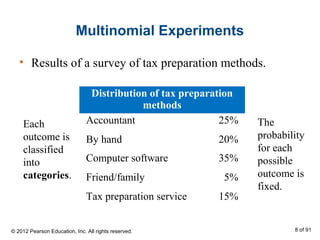
Multinomial Experiments
• Results of a survey of tax preparation methods.
Distribution of tax preparation
methods
Accountant 25%
By hand 20%
Computer software 35%
Friend/family 5%
Tax preparation service 15%
Each
outcome is
classified
into
categories.
The
probability
for each
possible
outcome is
fixed.
© 2012 Pearson Education, Inc. All rights reserved. 8 of 91
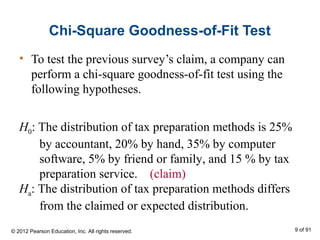
Chi-Square Goodness-of-Fit Test
• To test the previous survey’s claim, a company can
perform a chi-square goodness-of-fit test using the
following hypotheses.
H0: The distribution of tax preparation methods is 25%
by accountant, 20% by hand, 35% by computer
software, 5% by friend or family, and 15 % by tax
preparation service. (claim)
Ha: The distribution of tax preparation methods differs
from the claimed or expected distribution.
© 2012 Pearson Education, Inc. All rights reserved. 9 of 91
Chi-Square Goodness-of-Fit Test
• To calculate the test statistic for the chi-square
goodness-of-fit test, the observed frequencies and the
expected frequencies are used.
• The observed frequency O of a category is the
frequency for the category observed in the sample
data.
© 2012 Pearson Education, Inc. All rights reserved. 10 of 91
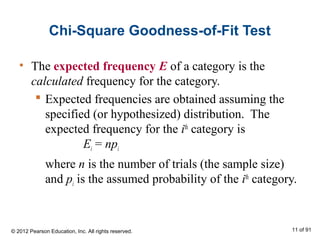
Chi-Square Goodness-of-Fit Test
• The expected frequency E of a category is the
calculated frequency for the category.
 Expected frequencies are obtained assuming the
specified (or hypothesized) distribution. The
expected frequency for the ith
category is
Ei = npi
where n is the number of trials (the sample size)
and pi is the assumed probability of the ith
category.
© 2012 Pearson Education, Inc. All rights reserved. 11 of 91
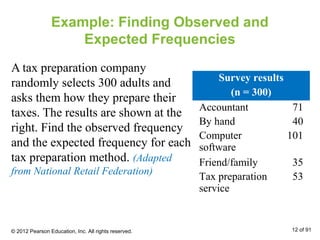
Example: Finding Observed and
Expected Frequencies
A tax preparation company
randomly selects 300 adults and
asks them how they prepare their
taxes. The results are shown at the
right. Find the observed frequency
and the expected frequency for each
tax preparation method. (Adapted
from National Retail Federation)
Survey results
(n = 300)
Accountant 71
By hand 40
Computer
software
101
Friend/family 35
Tax preparation
service
53
© 2012 Pearson Education, Inc. All rights reserved. 12 of 91
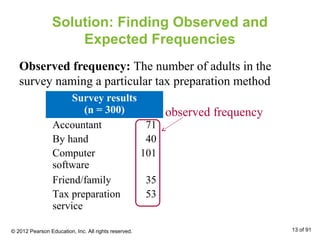
Solution: Finding Observed and
Expected Frequencies
Observed frequency: The number of adults in the
survey naming a particular tax preparation method
Survey results
(n = 300)
Accountant 71
By hand 40
Computer
software
101
Friend/family 35
Tax preparation
service
53
observed frequency
© 2012 Pearson Education, Inc. All rights reserved. 13 of 91
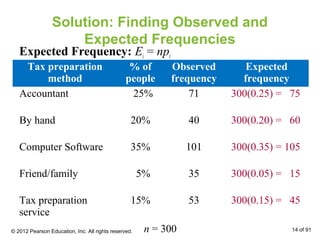
Solution: Finding Observed and
Expected Frequencies
Expected Frequency: Ei = npi
Tax preparation
method
% of
people
Observed
frequency
Expected
frequency
Accountant 25% 71 300(0.25) = 75
By hand 20% 40 300(0.20) = 60
Computer Software 35% 101 300(0.35) = 105
Friend/family 5% 35 300(0.05) = 15
Tax preparation
service
15% 53 300(0.15) = 45
n = 300© 2012 Pearson Education, Inc. All rights reserved. 14 of 91
Chi-Square Goodness-of-Fit Test
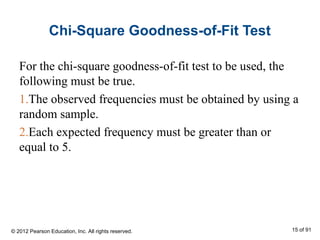
For the chi-square goodness-of-fit test to be used, the
following must be true.
1.The observed frequencies must be obtained by using a
random sample.
2.Each expected frequency must be greater than or
equal to 5.
© 2012 Pearson Education, Inc. All rights reserved. 15 of 91
Chi-Square Goodness-of-Fit Test
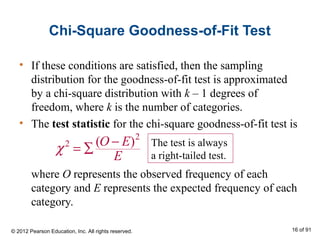
• If these conditions are satisfied, then the sampling
distribution for the goodness-of-fit test is approximated
by a chi-square distribution with k – 1 degrees of
freedom, where k is the number of categories.
• The test statistic for the chi-square goodness-of-fit test is
where O represents the observed frequency of each
category and E represents the expected frequency of each
category.
2
2 ( )O E
E
χ −
= ∑ The test is always
a right-tailed test.
© 2012 Pearson Education, Inc. All rights reserved. 16 of 91
Chi-Square Goodness-of-Fit Test
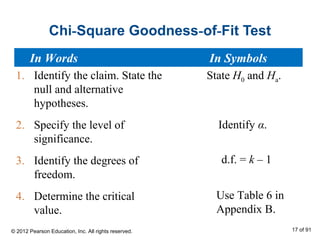
1. Identify the claim. State the
null and alternative
hypotheses.
2. Specify the level of
significance.
3. Identify the degrees of
freedom.
4. Determine the critical
value.
State H0 and Ha.
Identify α.
Use Table 6 in
Appendix B.
d.f. = k – 1
In Words In Symbols
© 2012 Pearson Education, Inc. All rights reserved. 17 of 91
Chi-Square Goodness-of-Fit Test
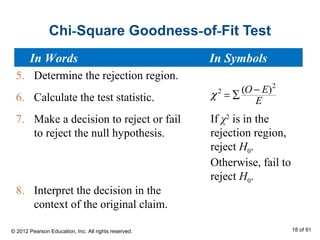
If χ2
is in the
rejection region,
reject H0.
Otherwise, fail to
reject H0.
5. Determine the rejection region.
6. Calculate the test statistic.
7. Make a decision to reject or fail
to reject the null hypothesis.
8. Interpret the decision in the
context of the original claim.
2
2 ( )O E
E
χ −
= ∑
In Words In Symbols
© 2012 Pearson Education, Inc. All rights reserved. 18 of 91
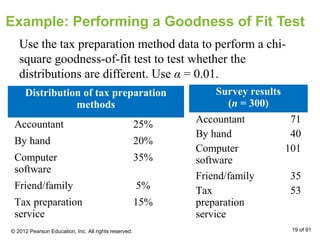
Example: Performing a Goodness of Fit Test
Use the tax preparation method data to perform a chi-
square goodness-of-fit test to test whether the
distributions are different. Use α = 0.01.
Survey results
(n = 300)
Accountant 71
By hand 40
Computer
software
101
Friend/family 35
Tax
preparation
service
53
Distribution of tax preparation
methods
Accountant 25%
By hand 20%
Computer
software
35%
Friend/family 5%
Tax preparation
service
15%
© 2012 Pearson Education, Inc. All rights reserved. 19 of 91
Solution: Performing a Goodness of Fit
Test
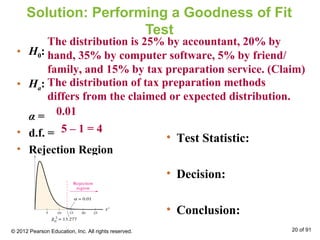
• H0:
• Ha:
α =
• d.f. =
• Rejection Region
• Test Statistic:
• Decision:
• Conclusion:
0.01
5 – 1 = 4
The distribution is 25% by accountant, 20% by
hand, 35% by computer software, 5% by friend/
family, and 15% by tax preparation service. (Claim)
The distribution of tax preparation methods
differs from the claimed or expected distribution.
© 2012 Pearson Education, Inc. All rights reserved. 20 of 91
Solution: Performing a Goodness of Fit
Test
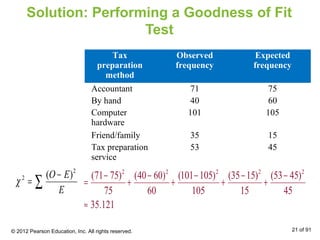
2
2 ( )O E
E
χ
−
= ∑
Tax
preparation
method
Observed
frequency
Expected
frequency
Accountant 71 75
By hand 40 60
Computer
hardware
101 105
Friend/family 35 15
Tax preparation
service
53 45
2 2 2 2 2
(71 75) (40 60) (101 105) (35 15) (53 45)
75 60 105 15 45
35.121
− − − − −
= + + + +
≈
© 2012 Pearson Education, Inc. All rights reserved. 21 of 91
Solution: Performing a Goodness of Fit
Test
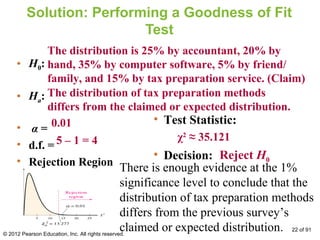
• H0:
• Ha:
• α =
• d.f. =
• Rejection Region
• Test Statistic:
• Decision:
0.01
5 – 1 = 4
The distribution is 25% by accountant, 20% by
hand, 35% by computer software, 5% by friend/
family, and 15% by tax preparation service. (Claim)
The distribution of tax preparation methods
differs from the claimed or expected distribution.
χ2
≈ 35.121
There is enough evidence at the 1%
significance level to conclude that the
distribution of tax preparation methods
differs from the previous survey’s
claimed or expected distribution.
Reject H0
© 2012 Pearson Education, Inc. All rights reserved.
22 of 91
Example: Performing a Goodness of Fit Test
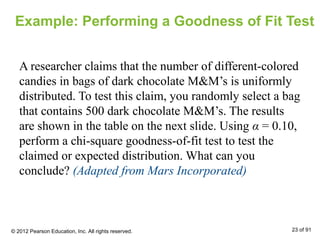
A researcher claims that the number of different-colored
candies in bags of dark chocolate M&M’s is uniformly
distributed. To test this claim, you randomly select a bag
that contains 500 dark chocolate M&M’s. The results
are shown in the table on the next slide. Using α = 0.10,
perform a chi-square goodness-of-fit test to test the
claimed or expected distribution. What can you
conclude? (Adapted from Mars Incorporated)
© 2012 Pearson Education, Inc. All rights reserved. 23 of 91
Example: Performing a Goodness of Fit Test
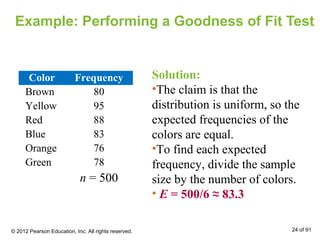
Color Frequency
Brown 80
Yellow 95
Red 88
Blue 83
Orange 76
Green 78
Solution:
•The claim is that the
distribution is uniform, so the
expected frequencies of the
colors are equal.
•To find each expected
frequency, divide the sample
size by the number of colors.
• E = 500/6 ≈ 83.3
n = 500
© 2012 Pearson Education, Inc. All rights reserved. 24 of 91
Solution: Performing a Goodness of Fit
Test
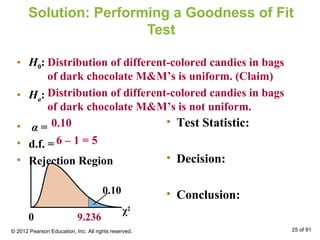
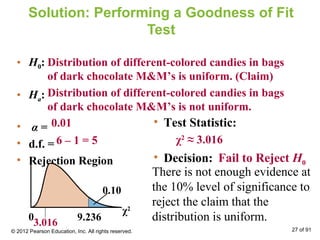
• H0:
• Ha:
• α =
• d.f. =
• Rejection Region
• Test Statistic:
• Decision:
• Conclusion:
0.10
6 – 1 = 5
0.10
χ2
0 9.236
Distribution of different-colored candies in bags
of dark chocolate M&M’s is uniform. (Claim)
Distribution of different-colored candies in bags
of dark chocolate M&M’s is not uniform.
© 2012 Pearson Education, Inc. All rights reserved. 25 of 91
Solution: Performing a Goodness of Fit
Test
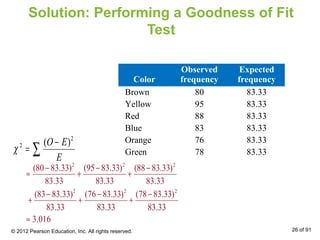
2 2 2
2 2 2
(80 83.33) (95 83.33) (88 83.33)
83.33 83.33 83.33
(83 83.33) (76 83.33) (78 83.33)
83.33 83.33 83.33
3.016
− − −
≈ + +
− − −
+ + +
≈
Color
Observed
frequency
Expected
frequency
Brown 80 83.33
Yellow 95 83.33
Red 88 83.33
Blue 83 83.33
Orange 76 83.33
Green 78 83.33
2
2 ( )O E
E
χ
−
= ∑
© 2012 Pearson Education, Inc. All rights reserved. 26 of 91
Solution: Performing a Goodness of Fit
Test
• H0:
• Ha:
• α =
• d.f. =
• Rejection Region
• Test Statistic:
• Decision:
0.01
6 – 1 = 5
0.10
χ2
0 9.236
χ2
≈ 3.016
3.016
There is not enough evidence at
the 10% level of significance to
reject the claim that the
distribution is uniform.
Distribution of different-colored candies in bags
of dark chocolate M&M’s is uniform. (Claim)
Distribution of different-colored candies in bags
of dark chocolate M&M’s is not uniform.
Fail to Reject H0
© 2012 Pearson Education, Inc. All rights reserved. 27 of 91
Section 10.1 Summary
• Used the chi-square distribution to test whether a
frequency distribution fits a claimed distribution
© 2012 Pearson Education, Inc. All rights reserved. 28 of 91
Section 10.2
Independence
© 2012 Pearson Education, Inc. All rights reserved. 29 of 91
Section 10.2 Objectives
• Use a contingency table to find expected frequencies
• Use a chi-square distribution to test whether two
variables are independent
© 2012 Pearson Education, Inc. All rights reserved. 30 of 91
Contingency Tables
r × c contingency table
• Shows the observed frequencies for two variables.
• The observed frequencies are arranged in r rows and
c columns.
• The intersection of a row and a column is called a
cell.
© 2012 Pearson Education, Inc. All rights reserved. 31 of 91
Contingency Tables
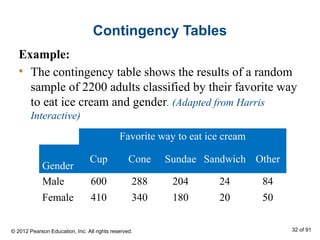
Example:
• The contingency table shows the results of a random
sample of 2200 adults classified by their favorite way
to eat ice cream and gender. (Adapted from Harris
Interactive)
© 2012 Pearson Education, Inc. All rights reserved. 32 of 91
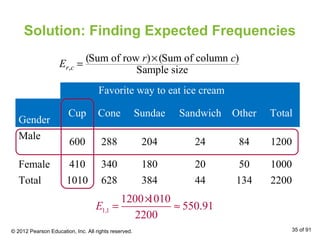
Favorite way to eat ice cream
Gender
Cup Cone Sundae Sandwich Other
Male 600 288 204 24 84
Female 410 340 180 20 50
Finding the Expected Frequency
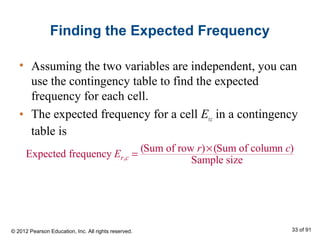
• Assuming the two variables are independent, you can
use the contingency table to find the expected
frequency for each cell.
• The expected frequency for a cell Er,c in a contingency
table is
,
(Sum of row ) (Sum of column )
Expected frequency
Sample sizer c
r c
E
×
=
© 2012 Pearson Education, Inc. All rights reserved. 33 of 91
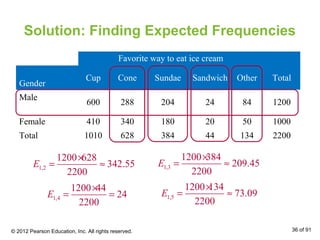
Example: Finding Expected Frequencies
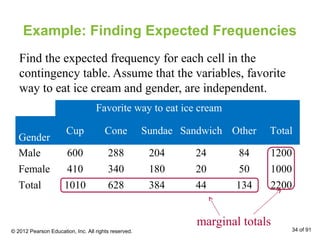
Find the expected frequency for each cell in the
contingency table. Assume that the variables, favorite
way to eat ice cream and gender, are independent.
Favorite way to eat ice cream
Gender
Cup Cone Sundae Sandwich Other Total
Male 600 288 204 24 84 1200
Female 410 340 180 20 50 1000
Total 1010 628 384 44 134 2200
marginal totals
© 2012 Pearson Education, Inc. All rights reserved. 34 of 91
Solution: Finding Expected Frequencies
Favorite way to eat ice cream
Gender
Cup Cone Sundae Sandwich Other Total
Male
600 288 204 24 84 1200
Female 410 340 180 20 50 1000
Total 1010 628 384 44 134 2200
,
(Sum of row ) (Sum of column )
Sample sizer c
r c
E
×
=
1,1
1200 1010
550.91
2200
E
×
= ≈
© 2012 Pearson Education, Inc. All rights reserved. 35 of 91
Solution: Finding Expected Frequencies
Favorite way to eat ice cream
Gender
Cup Cone Sundae Sandwich Other Total
Male
600 288 204 24 84 1200
Female 410 340 180 20 50 1000
Total 1010 628 384 44 134 2200
1,2
1200 628
342.55
2200
E
×
= ≈ 1,3
1200 384
209.45
2200
E
×
= ≈
1,4
1200 44
24
2200
E
×
= = 1,5
1200 134
73.09
2200
E
×
= ≈
© 2012 Pearson Education, Inc. All rights reserved. 36 of 91
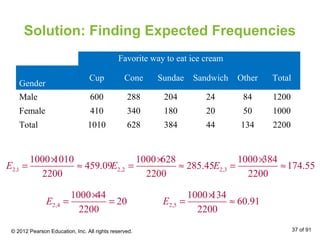
Solution: Finding Expected Frequencies
Favorite way to eat ice cream
Gender
Cup Cone Sundae Sandwich Other Total
Male 600 288 204 24 84 1200
Female 410 340 180 20 50 1000
Total 1010 628 384 44 134 2200
2,2
1000 628
285.45
2200
E
×
= ≈
2,4
1000 44
20
2200
E
×
= = 2,5
1000 134
60.91
2200
E
×
= ≈
2,1
1000 1010
459.09
2200
E
×
= ≈ 2,3
1000 384
174.55
2200
E
×
= ≈
© 2012 Pearson Education, Inc. All rights reserved. 37 of 91
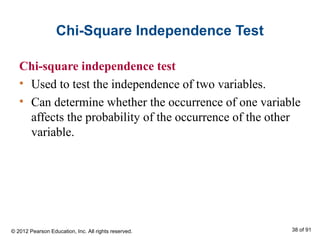
Chi-Square Independence Test
Chi-square independence test
• Used to test the independence of two variables.
• Can determine whether the occurrence of one variable
affects the probability of the occurrence of the other
variable.
© 2012 Pearson Education, Inc. All rights reserved. 38 of 91
Chi-Square Independence Test
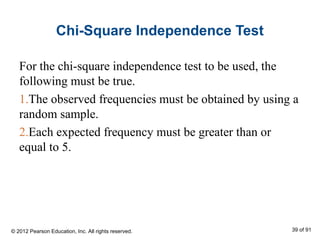
For the chi-square independence test to be used, the
following must be true.
1.The observed frequencies must be obtained by using a
random sample.
2.Each expected frequency must be greater than or
equal to 5.
© 2012 Pearson Education, Inc. All rights reserved. 39 of 91
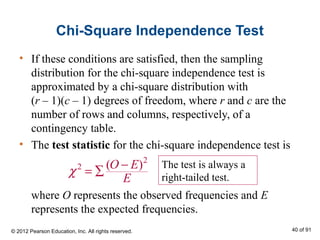
Chi-Square Independence Test
• If these conditions are satisfied, then the sampling
distribution for the chi-square independence test is
approximated by a chi-square distribution with
(r – 1)(c – 1) degrees of freedom, where r and c are the
number of rows and columns, respectively, of a
contingency table.
• The test statistic for the chi-square independence test is
where O represents the observed frequencies and E
represents the expected frequencies.
2
2 ( )O E
E
χ −
= ∑
The test is always a
right-tailed test.
© 2012 Pearson Education, Inc. All rights reserved. 40 of 91
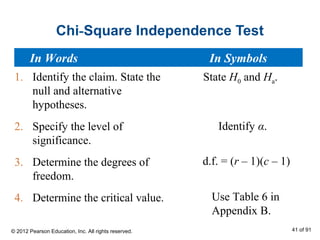
Chi-Square Independence Test
1. Identify the claim. State the
null and alternative
hypotheses.
2. Specify the level of
significance.
3. Determine the degrees of
freedom.
4. Determine the critical value.
State H0 and Ha.
Identify α.
Use Table 6 in
Appendix B.
d.f. = (r – 1)(c – 1)
In Words In Symbols
© 2012 Pearson Education, Inc. All rights reserved. 41 of 91
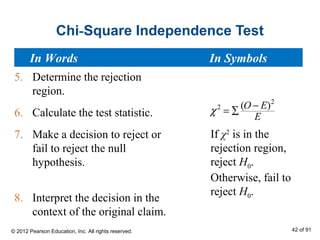
Chi-Square Independence Test
If χ2
is in the
rejection region,
reject H0.
Otherwise, fail to
reject H0.
5. Determine the rejection
region.
6. Calculate the test statistic.
7. Make a decision to reject or
fail to reject the null
hypothesis.
8. Interpret the decision in the
context of the original claim.
2
2 ( )O E
E
χ −
= ∑
In Words In Symbols
© 2012 Pearson Education, Inc. All rights reserved. 42 of 91
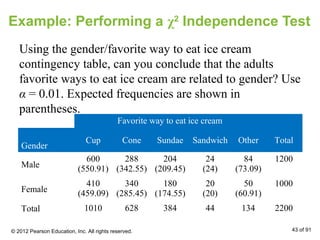
Example: Performing a χ2
Independence Test
Using the gender/favorite way to eat ice cream
contingency table, can you conclude that the adults
favorite ways to eat ice cream are related to gender? Use
α = 0.01. Expected frequencies are shown in
parentheses.
Favorite way to eat ice cream
Gender
Cup Cone Sundae Sandwich Other Total
Male
600
(550.91)
288
(342.55)
204
(209.45)
24
(24)
84
(73.09)
1200
Female
410
(459.09)
340
(285.45)
180
(174.55)
20
(20)
50
(60.91)
1000
Total 1010 628 384 44 134 2200
© 2012 Pearson Education, Inc. All rights reserved. 43 of 91
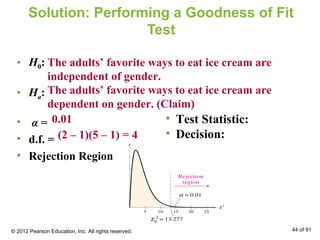
Solution: Performing a Goodness of Fit
Test
• H0:
• Ha:
• α =
• d.f. =
• Rejection Region
• Test Statistic:
• Decision:
0.01
(2 – 1)(5 – 1) = 4
The adults’ favorite ways to eat ice cream are
independent of gender.
The adults’ favorite ways to eat ice cream are
dependent on gender. (Claim)
© 2012 Pearson Education, Inc. All rights reserved. 44 of 91
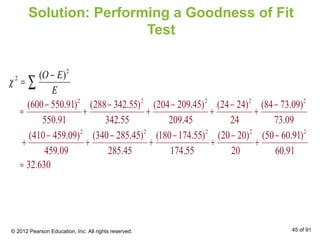
Solution: Performing a Goodness of Fit
Test
2 2 2 2 2
2 2 2 2 2
(600 550.91) (288 342.55) (204 209.45) (24 24) (84 73.09)
550.91 342.55 209.45 24 73.09
(410 459.09) (340 285.45) (180 174.55) (20 20) (50 60.91)
459.09 285.45 174.55 20 60.91
32.630
− − − − −
≈ + + + +
− − − − −
+ + + + +
≈
2
2 ( )O E
E
χ
−
= ∑
© 2012 Pearson Education, Inc. All rights reserved. 45 of 91
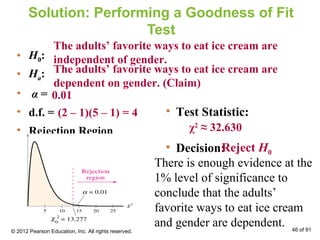
Solution: Performing a Goodness of Fit
Test
• H0:
• Ha:
• α =
• d.f. =
• Rejection Region
• Test Statistic:
• Decision:
0.01
(2 – 1)(5 – 1) = 4
The adults’ favorite ways to eat ice cream are
independent of gender.
The adults’ favorite ways to eat ice cream are
dependent on gender. (Claim)
χ2
≈ 32.630
There is enough evidence at the
1% level of significance to
conclude that the adults’
favorite ways to eat ice cream
and gender are dependent.
Reject H0
© 2012 Pearson Education, Inc. All rights reserved. 46 of 91
Section 10.2 Summary
• Used a contingency table to find expected frequencies
• Used a chi-square distribution to test whether two
variables are independent
© 2012 Pearson Education, Inc. All rights reserved. 47 of 91
Section 10.3
Comparing Two Variances
© 2012 Pearson Education, Inc. All rights reserved. 48 of 91
Section 10.3 Objectives
• Interpret the F-distribution and use an F-table to find
critical values
• Perform a two-sample F-test to compare two
variances
© 2012 Pearson Education, Inc. All rights reserved. 49 of 91
F-Distribution
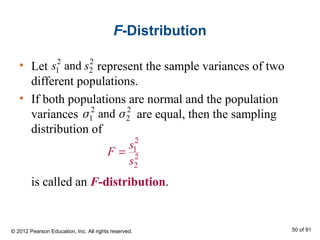
• Let represent the sample variances of two
different populations.
• If both populations are normal and the population
variances are equal, then the sampling
distribution of
is called an F-distribution.
2 2
1 2ands s
2 2
1 2andσ σ
2
1
2
2
s
F
s
=
© 2012 Pearson Education, Inc. All rights reserved. 50 of 91
Properties of the F-Distribution
1. The F-distribution is a family of curves each of
which is determined by two types of degrees of
freedom:
 The degrees of freedom corresponding to the
variance in the numerator, denoted d.f.N
 The degrees of freedom corresponding to the
variance in the denominator, denoted d.f.D
1. F-distributions are positively skewed.
2. The total area under each curve of an F-distribution
is equal to 1.
© 2012 Pearson Education, Inc. All rights reserved. 51 of 91
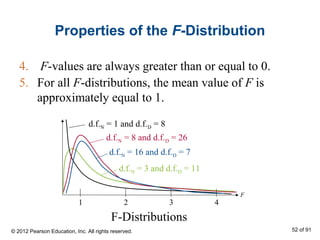
Properties of the F-Distribution
4. F-values are always greater than or equal to 0.
5. For all F-distributions, the mean value of F is
approximately equal to 1.
d.f.N = 1 and d.f.D = 8
d.f.N = 8 and d.f.D = 26
d.f.N = 16 and d.f.D = 7
d.f.N = 3 and d.f.D = 11
F
1 2 3 4
© 2012 Pearson Education, Inc. All rights reserved. 52 of 91
F-Distributions
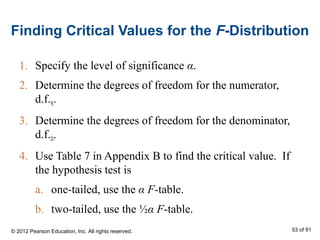
Finding Critical Values for the F-Distribution
1. Specify the level of significance α.
2. Determine the degrees of freedom for the numerator,
d.f.N.
3. Determine the degrees of freedom for the denominator,
d.f.D.
4. Use Table 7 in Appendix B to find the critical value. If
the hypothesis test is
a. one-tailed, use the α F-table.
b. two-tailed, use the ½α F-table.
© 2012 Pearson Education, Inc. All rights reserved. 53 of 91
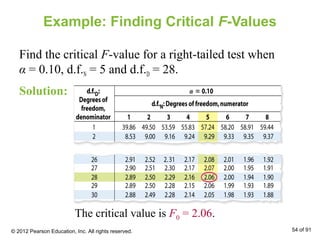
Example: Finding Critical F-Values
Find the critical F-value for a right-tailed test when
α = 0.10, d.f.N = 5 and d.f.D = 28.
The critical value is F0 = 2.06.
Solution:
© 2012 Pearson Education, Inc. All rights reserved. 54 of 91
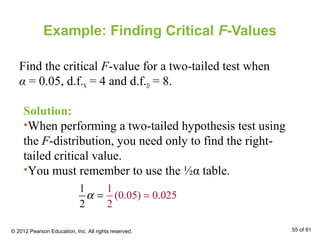
Example: Finding Critical F-Values
Find the critical F-value for a two-tailed test when
α = 0.05, d.f.N = 4 and d.f.D = 8.
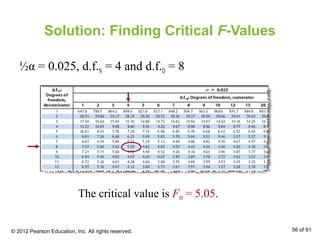
Solution:
•When performing a two-tailed hypothesis test using
the F-distribution, you need only to find the right-
tailed critical value.
•You must remember to use the ½α table.
1
(0.05) 0.025
2
1
2
α ==
© 2012 Pearson Education, Inc. All rights reserved. 55 of 91
Solution: Finding Critical F-Values
½α = 0.025, d.f.N = 4 and d.f.D = 8
The critical value is F0 = 5.05.
© 2012 Pearson Education, Inc. All rights reserved. 56 of 91
Two-Sample F-Test for Variances
To use the two-sample F-test for comparing two
population variances, the following must be true.
1.The samples must be randomly selected.
2.The samples must be independent.
3.Each population must have a normal distribution.
© 2012 Pearson Education, Inc. All rights reserved. 57 of 91
Two-Sample F-Test for Variances
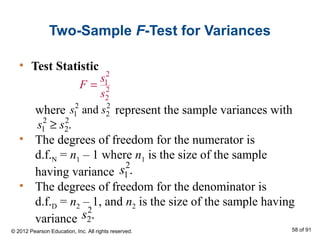
• Test Statistic
2
1
2
2
s
F
s
=
where represent the sample variances with
• The degrees of freedom for the numerator is
d.f.N = n1 – 1 where n1 is the size of the sample
having variance
• The degrees of freedom for the denominator is
d.f.D = n2 – 1, and n2 is the size of the sample having
variance
2 2
1 2ands s
2 2
1 2.s s≥
2
1.s
2
2.s
© 2012 Pearson Education, Inc. All rights reserved. 58 of 91
Two-Sample F-Test for Variances
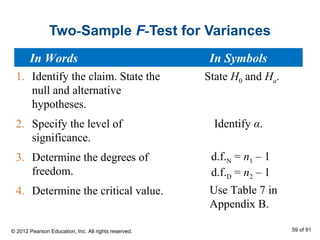
1. Identify the claim. State the
null and alternative
hypotheses.
2. Specify the level of
significance.
3. Determine the degrees of
freedom.
4. Determine the critical value.
State H0 and Ha.
Identify α.
Use Table 7 in
Appendix B.
d.f.N = n1 – 1
d.f.D = n2 – 1
In Words In Symbols
© 2012 Pearson Education, Inc. All rights reserved. 59 of 91
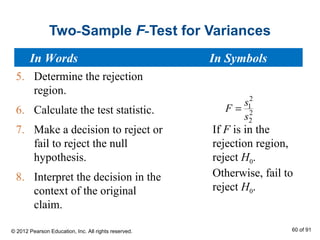
Two-Sample F-Test for Variances
If F is in the
rejection region,
reject H0.
Otherwise, fail to
reject H0.
5. Determine the rejection
region.
6. Calculate the test statistic.
7. Make a decision to reject or
fail to reject the null
hypothesis.
8. Interpret the decision in the
context of the original
claim.
2
1
2
2
s
F
s
=
In Words In Symbols
© 2012 Pearson Education, Inc. All rights reserved. 60 of 91
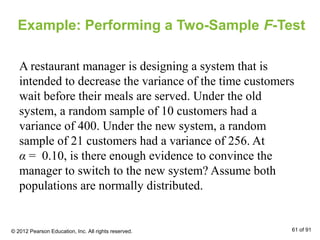
Example: Performing a Two-Sample F-Test
A restaurant manager is designing a system that is
intended to decrease the variance of the time customers
wait before their meals are served. Under the old
system, a random sample of 10 customers had a
variance of 400. Under the new system, a random
sample of 21 customers had a variance of 256. At
α = 0.10, is there enough evidence to convince the
manager to switch to the new system? Assume both
populations are normally distributed.
© 2012 Pearson Education, Inc. All rights reserved. 61 of 91
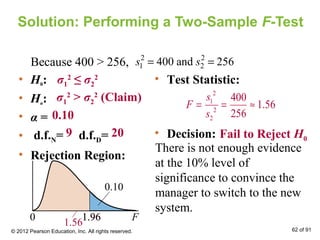
Solution: Performing a Two-Sample F-Test
• H0:
• Ha:
• α =
• d.f.N= d.f.D=
• Rejection Region:
• Test Statistic:
• Decision:
σ1
2
≤ σ2
2
σ1
2
> σ2
2
(Claim)
0.10
9 20
0 F1.96
0.10
Because 400 > 256, 2 2
1 2400 and 256s s= =
2
1
2
2
400
1.56
256
s
F
s
= = ≈
There is not enough evidence
at the 10% level of
significance to convince the
manager to switch to the new
system.
1.96
1.56
Fail to Reject H0
© 2012 Pearson Education, Inc. All rights reserved. 62 of 91
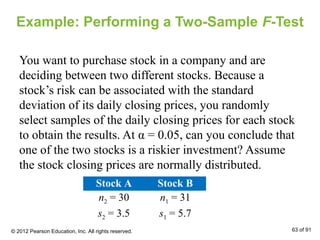
Example: Performing a Two-Sample F-Test
You want to purchase stock in a company and are
deciding between two different stocks. Because a
stock’s risk can be associated with the standard
deviation of its daily closing prices, you randomly
select samples of the daily closing prices for each stock
to obtain the results. At α = 0.05, can you conclude that
one of the two stocks is a riskier investment? Assume
the stock closing prices are normally distributed.
Stock A Stock B
n2 = 30 n1 = 31
s2 = 3.5 s1 = 5.7
© 2012 Pearson Education, Inc. All rights reserved. 63 of 91
Solution: Performing a Two-Sample F-Test
• H0:
• Ha:
• ½α =
• d.f.N= d.f.D=
• Rejection Region:
• Test Statistic:
• Decision:
σ1
2
= σ2
2
σ1
2
≠ σ2
2
(Claim)
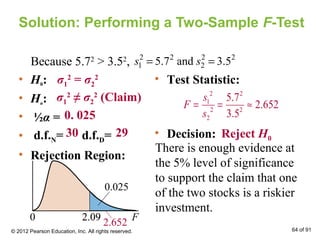
0. 025
30 29
0 F2.09
0.025
Because 5.72
> 3.52
, 2 2 2 2
1 25.7 and 3.5s s= =
2 2
1
2 2
2
5.7
2.652
3.5
s
F
s
= = ≈
There is enough evidence at
the 5% level of significance
to support the claim that one
of the two stocks is a riskier
investment.
2.09
2.652
Reject H0
© 2012 Pearson Education, Inc. All rights reserved. 64 of 91
Section 10.3 Summary
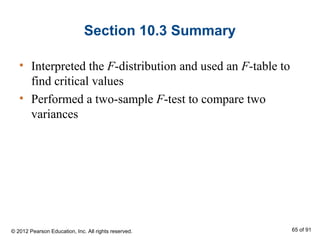
• Interpreted the F-distribution and used an F-table to
find critical values
• Performed a two-sample F-test to compare two
variances
© 2012 Pearson Education, Inc. All rights reserved. 65 of 91
Section 10.4
Analysis of Variance
© 2012 Pearson Education, Inc. All rights reserved. 66 of 91
Section 10.4 Objectives
• Use one-way analysis of variance to test claims
involving three or more means
• Introduce two-way analysis of variance
© 2012 Pearson Education, Inc. All rights reserved. 67 of 91
One-Way ANOVA
One-way analysis of variance
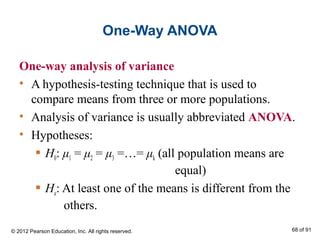
• A hypothesis-testing technique that is used to
compare means from three or more populations.
• Analysis of variance is usually abbreviated ANOVA.
• Hypotheses:
 H0: μ1 = μ2 = μ3 =…= μk (all population means are
equal)
 Ha: At least one of the means is different from the
others.
© 2012 Pearson Education, Inc. All rights reserved. 68 of 91
One-Way ANOVA
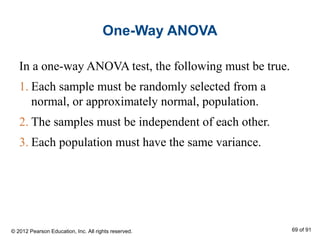
In a one-way ANOVA test, the following must be true.
1. Each sample must be randomly selected from a
normal, or approximately normal, population.
2. The samples must be independent of each other.
3. Each population must have the same variance.
© 2012 Pearson Education, Inc. All rights reserved. 69 of 91
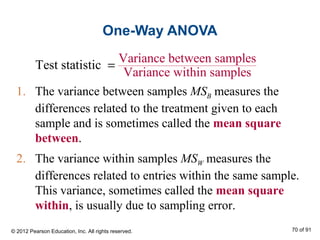
One-Way ANOVA
1. The variance between samples MSB measures the
differences related to the treatment given to each
sample and is sometimes called the mean square
between.
2. The variance within samples MSW measures the
differences related to entries within the same sample.
This variance, sometimes called the mean square
within, is usually due to sampling error.
Variance between samples
Variance
Test stati
within sa
stic
smple
=
© 2012 Pearson Education, Inc. All rights reserved. 70 of 91
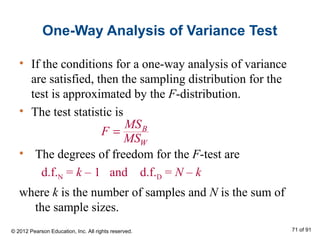
One-Way Analysis of Variance Test
• If the conditions for a one-way analysis of variance
are satisfied, then the sampling distribution for the
test is approximated by the F-distribution.
• The test statistic is
B
W
MS
F
MS
=
• The degrees of freedom for the F-test are
d.f.N = k – 1 and d.f.D = N – k
where k is the number of samples and N is the sum of
the sample sizes.
© 2012 Pearson Education, Inc. All rights reserved. 71 of 91
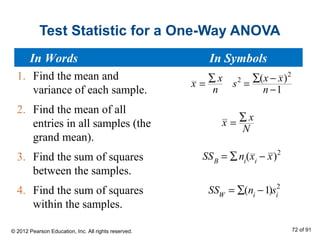
Test Statistic for a One-Way ANOVA
1. Find the mean and
variance of each sample.
2. Find the mean of all
entries in all samples (the
grand mean).
3. Find the sum of squares
between the samples.
4. Find the sum of squares
within the samples.
2
2 ( )
1
x x x
x s
n n
∑ ∑ −
= =
−
x
x
N
∑
=
SSB
= ∑ni
(xi
− x)2
SSW
= ∑(ni
−1)si
2
In Words In Symbols
© 2012 Pearson Education, Inc. All rights reserved. 72 of 91
Test Statistic for a One-Way ANOVA
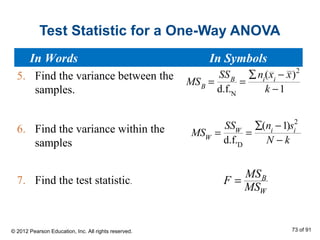
5. Find the variance between the
samples.
6. Find the variance within the
samples
7. Find the test statistic. B
W
MS
F
MS
=
MSB
=
SSB
d.f.N
=
∑ni
(xi
− x)2
k −1
MSW
=
SSW
d.f.D
=
∑(ni
−1)si
2
N − k
In Words In Symbols
© 2012 Pearson Education, Inc. All rights reserved. 73 of 91
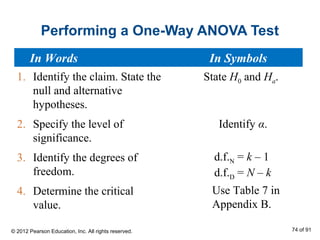
Performing a One-Way ANOVA Test
1. Identify the claim. State the
null and alternative
hypotheses.
2. Specify the level of
significance.
3. Identify the degrees of
freedom.
4. Determine the critical
value.
State H0 and Ha.
Identify α.
Use Table 7 in
Appendix B.
d.f.N = k – 1
d.f.D = N – k
In Words In Symbols
© 2012 Pearson Education, Inc. All rights reserved. 74 of 91
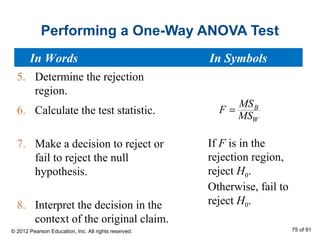
Performing a One-Way ANOVA Test
If F is in the
rejection region,
reject H0.
Otherwise, fail to
reject H0.
5. Determine the rejection
region.
6. Calculate the test statistic.
7. Make a decision to reject or
fail to reject the null
hypothesis.
8. Interpret the decision in the
context of the original claim.
B
W
MS
F
MS
=
In Words In Symbols
© 2012 Pearson Education, Inc. All rights reserved. 75 of 91
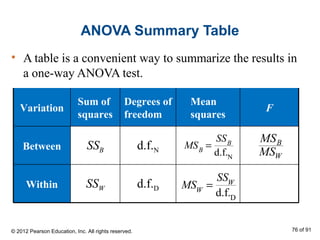
ANOVA Summary Table
• A table is a convenient way to summarize the results in
a one-way ANOVA test.
d.f.DSSWWithin
d.f.NSSBBetween
F
Mean
squares
Degrees of
freedom
Sum of
squares
Variation
MSB
=
SSB
d.f.N
MSW
=
SSW
d.f.D
B
W
MS
MS
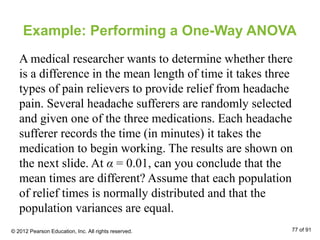
© 2012 Pearson Education, Inc. All rights reserved. 76 of 91
Example: Performing a One-Way ANOVA
A medical researcher wants to determine whether there
is a difference in the mean length of time it takes three
types of pain relievers to provide relief from headache
pain. Several headache sufferers are randomly selected
and given one of the three medications. Each headache
sufferer records the time (in minutes) it takes the
medication to begin working. The results are shown on
the next slide. At α = 0.01, can you conclude that the
mean times are different? Assume that each population
of relief times is normally distributed and that the
population variances are equal.
© 2012 Pearson Education, Inc. All rights reserved. 77 of 91
Example: Performing a One-Way ANOVA
Medication 1 Medication 2 Medication 3
12 16 14
15 14 17
17 21 20
12 15 15
19
1
56
14
4
x = = 2
85
17
5
x = = 3
66
16.5
4
x = =
2
1 6s =
2
2 8.5s = 2
3 7s =
Solution:
k = 3 (3 samples)
N = n1 + n2 + n3 = 4 + 5 + 4 = 13 (sum of sample sizes)
© 2012 Pearson Education, Inc. All rights reserved. 78 of 91
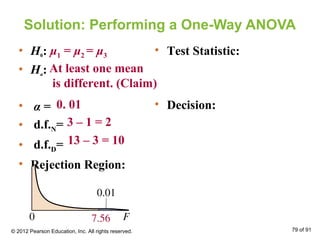
Solution: Performing a One-Way ANOVA
• H0:
• Ha:
• α =
• d.f.N=
• d.f.D=
• Rejection Region:
• Test Statistic:
• Decision:
μ1 = μ2 = μ3
At least one mean
is different. (Claim)
0. 01
3 – 1 = 2
13 – 3 = 10
© 2012 Pearson Education, Inc. All rights reserved. 79 of 91
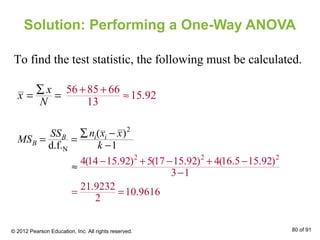
Solution: Performing a One-Way ANOVA
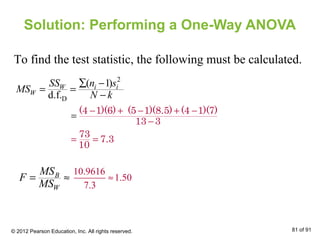
To find the test statistic, the following must be calculated.
x
x
N
∑
= =
56 85 66
15.92
13
+ +
≈
2
N
( )
d.f. 1
i iB
B
n x xSS
MS
k
∑ −
= =
−
2 2 2
4(14 15.92) 5(17 15.92) 4(16.5 15.92)
3 1
21.9232
10.9616
2
− + − + −
−
= =
≈
© 2012 Pearson Education, Inc. All rights reserved. 80 of 91
Solution: Performing a One-Way ANOVA
To find the test statistic, the following must be calculated.
2
D
( 1)
d.f.
W i i
W
SS n s
MS
N k
∑ −
= =
−
− + − + −
−
= =
=
(4 1)(6) (5 1)(8.5) (4 1)(7)
13 3
73
7.3
10
B
W
MS
F
MS
= ≈
10.9616
1.50
7.3
≈
© 2012 Pearson Education, Inc. All rights reserved. 81 of 91
Solution: Performing a One-Way ANOVA
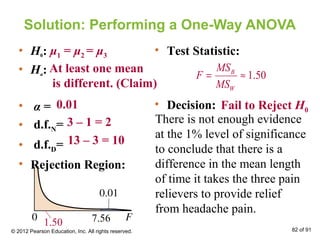
• H0:
• Ha:
• α =
• d.f.N=
• d.f.D=
• Rejection Region:
• Test Statistic:
• Decision:
μ1 = μ2 = μ3
At least one mean
is different. (Claim)
0.01
3 – 1 = 2
13 – 3 = 10
1.50B
W
MS
F
MS
= ≈
There is not enough evidence
at the 1% level of significance
to conclude that there is a
difference in the mean length
of time it takes the three pain
relievers to provide relief
from headache pain.
1.50
Fail to Reject H0
© 2012 Pearson Education, Inc. All rights reserved. 82 of 91
7.56
Example: Using the TI-83/84 to Perform a
One-Way ANOVA
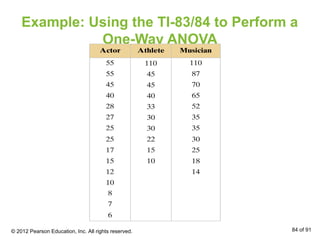
A researcher believes that the mean earnings of top-paid
actors, athletes, and musicians are the same. The
earnings (in millions of dollars) for several randomly
selected from each category are shown in the table in
next slide. Assume that the populations are normally
distributed, the samples are independent, and the
population variances are equal. At α = 0.10, can you
conclude that the mean earnings are the same for the
three categories? Use a technology tool. (Source:
Forbes.com LLC)
© 2012 Pearson Education, Inc. All rights reserved. 83 of 91
Example: Using the TI-83/84 to Perform a
One-Way ANOVA
© 2012 Pearson Education, Inc. All rights reserved. 84 of 91
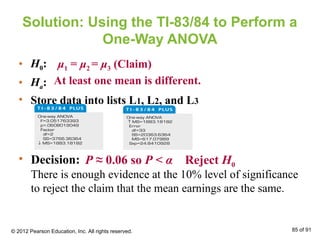
Solution: Using the TI-83/84 to Perform a
One-Way ANOVA
• H0:
• Ha:
• Store data into lists L1, L2, and L3
μ1 = μ2 = μ3 (Claim)
At least one mean is different.
• Decision:
There is enough evidence at the 10% level of significance
to reject the claim that the mean earnings are the same.
P ≈ 0.06 so P < α Reject H0
© 2012 Pearson Education, Inc. All rights reserved. 85 of 91
Two-Way ANOVA
Two-way analysis of variance
• A hypothesis-testing technique that is used to test the
effect of two independent variables, or factors, on
one dependent variable.
© 2012 Pearson Education, Inc. All rights reserved. 86 of 91
Two-Way ANOVA
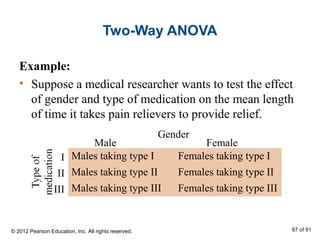
Example:
• Suppose a medical researcher wants to test the effect
of gender and type of medication on the mean length
of time it takes pain relievers to provide relief.
Males taking type I Females taking type I
Males taking type II Females taking type II
Males taking type III Females taking type III
Gender
Male Female
I
II
III
© 2012 Pearson Education, Inc. All rights reserved. 87 of 91
Two-Way ANOVA Hypotheses
Main effect
• The effect of one independent variable on the
dependent variable.
Interaction effect
• The effect of both independent variables on the
dependent variable.
© 2012 Pearson Education, Inc. All rights reserved. 88 of 91
Two-Way ANOVA Hypotheses
Hypotheses for main effects:
• H0: Gender has no effect on the mean length of time it
takes a pain reliever to provide relief.
• Ha: Gender has an effect on the mean length of time it
takes a pain reliever to provide relief.
• H0: Type of medication has no effect on the mean length of
time it takes a pain reliever to provide relief.
• Ha: Type of medication has an effect on the mean length of
time it takes a pain reliever to provide relief.
© 2012 Pearson Education, Inc. All rights reserved. 89 of 91
Two-Way ANOVA Hypotheses
Hypotheses for interaction effects:
• H0: There is no interaction effect between gender and type
of medication on the mean length of time it takes a
pain reliever to provide relief.
• Ha: There is an interaction effect between gender and type
of medication on the mean length of time it takes a
pain reliever to provide relief.
© 2012 Pearson Education, Inc. All rights reserved. 90 of 91
Perform a two-way ANOVA test, calculating the F-statistic for
each hypothesis. It is possible to reject none, one, two, or all of
the null hypotheses. The statistics involved with a two-way
ANOVA test is beyond the scope of this course. You can use a
technology tool such as MINITAB to perform the test.
Section 10.4 Summary
• Used one-way analysis of variance to test claims
involving three or more means
• Introduced two-way analysis of variance
© 2012 Pearson Education, Inc. All rights reserved. 91 of 91

Les5e ppt 10

  • 1.
    Chapter Chi-Square Tests and theF-Distribution 1 of 91 10 © 2012 Pearson Education, Inc. All rights reserved.
  • 2.
    Chapter Outline • 10.1Goodness of Fit • 10.2 Independence • 10.3 Comparing Two Variances • 10.4 Analysis of Variance © 2012 Pearson Education, Inc. All rights reserved. 2 of 91
  • 3.
    Section 10.1 Goodness ofFit © 2012 Pearson Education, Inc. All rights reserved. 3 of 91
  • 4.
    Section 10.1 Objectives •Use the chi-square distribution to test whether a frequency distribution fits a claimed distribution © 2012 Pearson Education, Inc. All rights reserved. 4 of 91
  • 5.
    Multinomial Experiments Multinomial experiment •A probability experiment consisting of a fixed number of independent trials in which there are more than two possible outcomes for each trial. • The probability for each outcome is fixed and each outcome is classified into categories. • Recall that a binomial experiment had only two possible outcomes. © 2012 Pearson Education, Inc. All rights reserved. 5 of 91
  • 6.
    Multinomial Experiments • Atax preparation company wants to determine the proportions of people who used different methods to prepare their taxes. • The company can perform a multinomial experiment. • It wants to test a previous survey’s claim concerning the distribution of proportions of people who use different methods to prepare their taxes. • It can compare the distribution of proportions obtained in the multinomial experiment with the previous survey’s specified distribution. • It can perform a chi-square goodness-of-fit test. © 2012 Pearson Education, Inc. All rights reserved. 6 of 91
  • 7.
    Chi-Square Goodness-of-Fit Test Chi-SquareGoodness-of-Fit Test • Used to test whether a frequency distribution fits an expected distribution. • The null hypothesis states that the frequency distribution fits the specified distribution. • The alternative hypothesis states that the frequency distribution does not fit the specified distribution. © 2012 Pearson Education, Inc. All rights reserved. 7 of 91
  • 8.
    Multinomial Experiments • Resultsof a survey of tax preparation methods. Distribution of tax preparation methods Accountant 25% By hand 20% Computer software 35% Friend/family 5% Tax preparation service 15% Each outcome is classified into categories. The probability for each possible outcome is fixed. © 2012 Pearson Education, Inc. All rights reserved. 8 of 91
  • 9.
    Chi-Square Goodness-of-Fit Test •To test the previous survey’s claim, a company can perform a chi-square goodness-of-fit test using the following hypotheses. H0: The distribution of tax preparation methods is 25% by accountant, 20% by hand, 35% by computer software, 5% by friend or family, and 15 % by tax preparation service. (claim) Ha: The distribution of tax preparation methods differs from the claimed or expected distribution. © 2012 Pearson Education, Inc. All rights reserved. 9 of 91
  • 10.
    Chi-Square Goodness-of-Fit Test •To calculate the test statistic for the chi-square goodness-of-fit test, the observed frequencies and the expected frequencies are used. • The observed frequency O of a category is the frequency for the category observed in the sample data. © 2012 Pearson Education, Inc. All rights reserved. 10 of 91
  • 11.
    Chi-Square Goodness-of-Fit Test •The expected frequency E of a category is the calculated frequency for the category.  Expected frequencies are obtained assuming the specified (or hypothesized) distribution. The expected frequency for the ith category is Ei = npi where n is the number of trials (the sample size) and pi is the assumed probability of the ith category. © 2012 Pearson Education, Inc. All rights reserved. 11 of 91
  • 12.
    Example: Finding Observedand Expected Frequencies A tax preparation company randomly selects 300 adults and asks them how they prepare their taxes. The results are shown at the right. Find the observed frequency and the expected frequency for each tax preparation method. (Adapted from National Retail Federation) Survey results (n = 300) Accountant 71 By hand 40 Computer software 101 Friend/family 35 Tax preparation service 53 © 2012 Pearson Education, Inc. All rights reserved. 12 of 91
  • 13.
    Solution: Finding Observedand Expected Frequencies Observed frequency: The number of adults in the survey naming a particular tax preparation method Survey results (n = 300) Accountant 71 By hand 40 Computer software 101 Friend/family 35 Tax preparation service 53 observed frequency © 2012 Pearson Education, Inc. All rights reserved. 13 of 91
  • 14.
    Solution: Finding Observedand Expected Frequencies Expected Frequency: Ei = npi Tax preparation method % of people Observed frequency Expected frequency Accountant 25% 71 300(0.25) = 75 By hand 20% 40 300(0.20) = 60 Computer Software 35% 101 300(0.35) = 105 Friend/family 5% 35 300(0.05) = 15 Tax preparation service 15% 53 300(0.15) = 45 n = 300© 2012 Pearson Education, Inc. All rights reserved. 14 of 91
  • 15.
    Chi-Square Goodness-of-Fit Test Forthe chi-square goodness-of-fit test to be used, the following must be true. 1.The observed frequencies must be obtained by using a random sample. 2.Each expected frequency must be greater than or equal to 5. © 2012 Pearson Education, Inc. All rights reserved. 15 of 91
  • 16.
    Chi-Square Goodness-of-Fit Test •If these conditions are satisfied, then the sampling distribution for the goodness-of-fit test is approximated by a chi-square distribution with k – 1 degrees of freedom, where k is the number of categories. • The test statistic for the chi-square goodness-of-fit test is where O represents the observed frequency of each category and E represents the expected frequency of each category. 2 2 ( )O E E χ − = ∑ The test is always a right-tailed test. © 2012 Pearson Education, Inc. All rights reserved. 16 of 91
  • 17.
    Chi-Square Goodness-of-Fit Test 1.Identify the claim. State the null and alternative hypotheses. 2. Specify the level of significance. 3. Identify the degrees of freedom. 4. Determine the critical value. State H0 and Ha. Identify α. Use Table 6 in Appendix B. d.f. = k – 1 In Words In Symbols © 2012 Pearson Education, Inc. All rights reserved. 17 of 91
  • 18.
    Chi-Square Goodness-of-Fit Test Ifχ2 is in the rejection region, reject H0. Otherwise, fail to reject H0. 5. Determine the rejection region. 6. Calculate the test statistic. 7. Make a decision to reject or fail to reject the null hypothesis. 8. Interpret the decision in the context of the original claim. 2 2 ( )O E E χ − = ∑ In Words In Symbols © 2012 Pearson Education, Inc. All rights reserved. 18 of 91
  • 19.
    Example: Performing aGoodness of Fit Test Use the tax preparation method data to perform a chi- square goodness-of-fit test to test whether the distributions are different. Use α = 0.01. Survey results (n = 300) Accountant 71 By hand 40 Computer software 101 Friend/family 35 Tax preparation service 53 Distribution of tax preparation methods Accountant 25% By hand 20% Computer software 35% Friend/family 5% Tax preparation service 15% © 2012 Pearson Education, Inc. All rights reserved. 19 of 91
  • 20.
    Solution: Performing aGoodness of Fit Test • H0: • Ha: α = • d.f. = • Rejection Region • Test Statistic: • Decision: • Conclusion: 0.01 5 – 1 = 4 The distribution is 25% by accountant, 20% by hand, 35% by computer software, 5% by friend/ family, and 15% by tax preparation service. (Claim) The distribution of tax preparation methods differs from the claimed or expected distribution. © 2012 Pearson Education, Inc. All rights reserved. 20 of 91
  • 21.
    Solution: Performing aGoodness of Fit Test 2 2 ( )O E E χ − = ∑ Tax preparation method Observed frequency Expected frequency Accountant 71 75 By hand 40 60 Computer hardware 101 105 Friend/family 35 15 Tax preparation service 53 45 2 2 2 2 2 (71 75) (40 60) (101 105) (35 15) (53 45) 75 60 105 15 45 35.121 − − − − − = + + + + ≈ © 2012 Pearson Education, Inc. All rights reserved. 21 of 91
  • 22.
    Solution: Performing aGoodness of Fit Test • H0: • Ha: • α = • d.f. = • Rejection Region • Test Statistic: • Decision: 0.01 5 – 1 = 4 The distribution is 25% by accountant, 20% by hand, 35% by computer software, 5% by friend/ family, and 15% by tax preparation service. (Claim) The distribution of tax preparation methods differs from the claimed or expected distribution. χ2 ≈ 35.121 There is enough evidence at the 1% significance level to conclude that the distribution of tax preparation methods differs from the previous survey’s claimed or expected distribution. Reject H0 © 2012 Pearson Education, Inc. All rights reserved. 22 of 91
  • 23.
    Example: Performing aGoodness of Fit Test A researcher claims that the number of different-colored candies in bags of dark chocolate M&M’s is uniformly distributed. To test this claim, you randomly select a bag that contains 500 dark chocolate M&M’s. The results are shown in the table on the next slide. Using α = 0.10, perform a chi-square goodness-of-fit test to test the claimed or expected distribution. What can you conclude? (Adapted from Mars Incorporated) © 2012 Pearson Education, Inc. All rights reserved. 23 of 91
  • 24.
    Example: Performing aGoodness of Fit Test Color Frequency Brown 80 Yellow 95 Red 88 Blue 83 Orange 76 Green 78 Solution: •The claim is that the distribution is uniform, so the expected frequencies of the colors are equal. •To find each expected frequency, divide the sample size by the number of colors. • E = 500/6 ≈ 83.3 n = 500 © 2012 Pearson Education, Inc. All rights reserved. 24 of 91
  • 25.
    Solution: Performing aGoodness of Fit Test • H0: • Ha: • α = • d.f. = • Rejection Region • Test Statistic: • Decision: • Conclusion: 0.10 6 – 1 = 5 0.10 χ2 0 9.236 Distribution of different-colored candies in bags of dark chocolate M&M’s is uniform. (Claim) Distribution of different-colored candies in bags of dark chocolate M&M’s is not uniform. © 2012 Pearson Education, Inc. All rights reserved. 25 of 91
  • 26.
    Solution: Performing aGoodness of Fit Test 2 2 2 2 2 2 (80 83.33) (95 83.33) (88 83.33) 83.33 83.33 83.33 (83 83.33) (76 83.33) (78 83.33) 83.33 83.33 83.33 3.016 − − − ≈ + + − − − + + + ≈ Color Observed frequency Expected frequency Brown 80 83.33 Yellow 95 83.33 Red 88 83.33 Blue 83 83.33 Orange 76 83.33 Green 78 83.33 2 2 ( )O E E χ − = ∑ © 2012 Pearson Education, Inc. All rights reserved. 26 of 91
  • 27.
    Solution: Performing aGoodness of Fit Test • H0: • Ha: • α = • d.f. = • Rejection Region • Test Statistic: • Decision: 0.01 6 – 1 = 5 0.10 χ2 0 9.236 χ2 ≈ 3.016 3.016 There is not enough evidence at the 10% level of significance to reject the claim that the distribution is uniform. Distribution of different-colored candies in bags of dark chocolate M&M’s is uniform. (Claim) Distribution of different-colored candies in bags of dark chocolate M&M’s is not uniform. Fail to Reject H0 © 2012 Pearson Education, Inc. All rights reserved. 27 of 91
  • 28.
    Section 10.1 Summary •Used the chi-square distribution to test whether a frequency distribution fits a claimed distribution © 2012 Pearson Education, Inc. All rights reserved. 28 of 91
  • 29.
    Section 10.2 Independence © 2012Pearson Education, Inc. All rights reserved. 29 of 91
  • 30.
    Section 10.2 Objectives •Use a contingency table to find expected frequencies • Use a chi-square distribution to test whether two variables are independent © 2012 Pearson Education, Inc. All rights reserved. 30 of 91
  • 31.
    Contingency Tables r ×c contingency table • Shows the observed frequencies for two variables. • The observed frequencies are arranged in r rows and c columns. • The intersection of a row and a column is called a cell. © 2012 Pearson Education, Inc. All rights reserved. 31 of 91
  • 32.
    Contingency Tables Example: • Thecontingency table shows the results of a random sample of 2200 adults classified by their favorite way to eat ice cream and gender. (Adapted from Harris Interactive) © 2012 Pearson Education, Inc. All rights reserved. 32 of 91 Favorite way to eat ice cream Gender Cup Cone Sundae Sandwich Other Male 600 288 204 24 84 Female 410 340 180 20 50
  • 33.
    Finding the ExpectedFrequency • Assuming the two variables are independent, you can use the contingency table to find the expected frequency for each cell. • The expected frequency for a cell Er,c in a contingency table is , (Sum of row ) (Sum of column ) Expected frequency Sample sizer c r c E × = © 2012 Pearson Education, Inc. All rights reserved. 33 of 91
  • 34.
    Example: Finding ExpectedFrequencies Find the expected frequency for each cell in the contingency table. Assume that the variables, favorite way to eat ice cream and gender, are independent. Favorite way to eat ice cream Gender Cup Cone Sundae Sandwich Other Total Male 600 288 204 24 84 1200 Female 410 340 180 20 50 1000 Total 1010 628 384 44 134 2200 marginal totals © 2012 Pearson Education, Inc. All rights reserved. 34 of 91
  • 35.
    Solution: Finding ExpectedFrequencies Favorite way to eat ice cream Gender Cup Cone Sundae Sandwich Other Total Male 600 288 204 24 84 1200 Female 410 340 180 20 50 1000 Total 1010 628 384 44 134 2200 , (Sum of row ) (Sum of column ) Sample sizer c r c E × = 1,1 1200 1010 550.91 2200 E × = ≈ © 2012 Pearson Education, Inc. All rights reserved. 35 of 91
  • 36.
    Solution: Finding ExpectedFrequencies Favorite way to eat ice cream Gender Cup Cone Sundae Sandwich Other Total Male 600 288 204 24 84 1200 Female 410 340 180 20 50 1000 Total 1010 628 384 44 134 2200 1,2 1200 628 342.55 2200 E × = ≈ 1,3 1200 384 209.45 2200 E × = ≈ 1,4 1200 44 24 2200 E × = = 1,5 1200 134 73.09 2200 E × = ≈ © 2012 Pearson Education, Inc. All rights reserved. 36 of 91
  • 37.
    Solution: Finding ExpectedFrequencies Favorite way to eat ice cream Gender Cup Cone Sundae Sandwich Other Total Male 600 288 204 24 84 1200 Female 410 340 180 20 50 1000 Total 1010 628 384 44 134 2200 2,2 1000 628 285.45 2200 E × = ≈ 2,4 1000 44 20 2200 E × = = 2,5 1000 134 60.91 2200 E × = ≈ 2,1 1000 1010 459.09 2200 E × = ≈ 2,3 1000 384 174.55 2200 E × = ≈ © 2012 Pearson Education, Inc. All rights reserved. 37 of 91
  • 38.
    Chi-Square Independence Test Chi-squareindependence test • Used to test the independence of two variables. • Can determine whether the occurrence of one variable affects the probability of the occurrence of the other variable. © 2012 Pearson Education, Inc. All rights reserved. 38 of 91
  • 39.
    Chi-Square Independence Test Forthe chi-square independence test to be used, the following must be true. 1.The observed frequencies must be obtained by using a random sample. 2.Each expected frequency must be greater than or equal to 5. © 2012 Pearson Education, Inc. All rights reserved. 39 of 91
  • 40.
    Chi-Square Independence Test •If these conditions are satisfied, then the sampling distribution for the chi-square independence test is approximated by a chi-square distribution with (r – 1)(c – 1) degrees of freedom, where r and c are the number of rows and columns, respectively, of a contingency table. • The test statistic for the chi-square independence test is where O represents the observed frequencies and E represents the expected frequencies. 2 2 ( )O E E χ − = ∑ The test is always a right-tailed test. © 2012 Pearson Education, Inc. All rights reserved. 40 of 91
  • 41.
    Chi-Square Independence Test 1.Identify the claim. State the null and alternative hypotheses. 2. Specify the level of significance. 3. Determine the degrees of freedom. 4. Determine the critical value. State H0 and Ha. Identify α. Use Table 6 in Appendix B. d.f. = (r – 1)(c – 1) In Words In Symbols © 2012 Pearson Education, Inc. All rights reserved. 41 of 91
  • 42.
    Chi-Square Independence Test Ifχ2 is in the rejection region, reject H0. Otherwise, fail to reject H0. 5. Determine the rejection region. 6. Calculate the test statistic. 7. Make a decision to reject or fail to reject the null hypothesis. 8. Interpret the decision in the context of the original claim. 2 2 ( )O E E χ − = ∑ In Words In Symbols © 2012 Pearson Education, Inc. All rights reserved. 42 of 91
  • 43.
    Example: Performing aχ2 Independence Test Using the gender/favorite way to eat ice cream contingency table, can you conclude that the adults favorite ways to eat ice cream are related to gender? Use α = 0.01. Expected frequencies are shown in parentheses. Favorite way to eat ice cream Gender Cup Cone Sundae Sandwich Other Total Male 600 (550.91) 288 (342.55) 204 (209.45) 24 (24) 84 (73.09) 1200 Female 410 (459.09) 340 (285.45) 180 (174.55) 20 (20) 50 (60.91) 1000 Total 1010 628 384 44 134 2200 © 2012 Pearson Education, Inc. All rights reserved. 43 of 91
  • 44.
    Solution: Performing aGoodness of Fit Test • H0: • Ha: • α = • d.f. = • Rejection Region • Test Statistic: • Decision: 0.01 (2 – 1)(5 – 1) = 4 The adults’ favorite ways to eat ice cream are independent of gender. The adults’ favorite ways to eat ice cream are dependent on gender. (Claim) © 2012 Pearson Education, Inc. All rights reserved. 44 of 91
  • 45.
    Solution: Performing aGoodness of Fit Test 2 2 2 2 2 2 2 2 2 2 (600 550.91) (288 342.55) (204 209.45) (24 24) (84 73.09) 550.91 342.55 209.45 24 73.09 (410 459.09) (340 285.45) (180 174.55) (20 20) (50 60.91) 459.09 285.45 174.55 20 60.91 32.630 − − − − − ≈ + + + + − − − − − + + + + + ≈ 2 2 ( )O E E χ − = ∑ © 2012 Pearson Education, Inc. All rights reserved. 45 of 91
  • 46.
    Solution: Performing aGoodness of Fit Test • H0: • Ha: • α = • d.f. = • Rejection Region • Test Statistic: • Decision: 0.01 (2 – 1)(5 – 1) = 4 The adults’ favorite ways to eat ice cream are independent of gender. The adults’ favorite ways to eat ice cream are dependent on gender. (Claim) χ2 ≈ 32.630 There is enough evidence at the 1% level of significance to conclude that the adults’ favorite ways to eat ice cream and gender are dependent. Reject H0 © 2012 Pearson Education, Inc. All rights reserved. 46 of 91
  • 47.
    Section 10.2 Summary •Used a contingency table to find expected frequencies • Used a chi-square distribution to test whether two variables are independent © 2012 Pearson Education, Inc. All rights reserved. 47 of 91
  • 48.
    Section 10.3 Comparing TwoVariances © 2012 Pearson Education, Inc. All rights reserved. 48 of 91
  • 49.
    Section 10.3 Objectives •Interpret the F-distribution and use an F-table to find critical values • Perform a two-sample F-test to compare two variances © 2012 Pearson Education, Inc. All rights reserved. 49 of 91
  • 50.
    F-Distribution • Let representthe sample variances of two different populations. • If both populations are normal and the population variances are equal, then the sampling distribution of is called an F-distribution. 2 2 1 2ands s 2 2 1 2andσ σ 2 1 2 2 s F s = © 2012 Pearson Education, Inc. All rights reserved. 50 of 91
  • 51.
    Properties of theF-Distribution 1. The F-distribution is a family of curves each of which is determined by two types of degrees of freedom:  The degrees of freedom corresponding to the variance in the numerator, denoted d.f.N  The degrees of freedom corresponding to the variance in the denominator, denoted d.f.D 1. F-distributions are positively skewed. 2. The total area under each curve of an F-distribution is equal to 1. © 2012 Pearson Education, Inc. All rights reserved. 51 of 91
  • 52.
    Properties of theF-Distribution 4. F-values are always greater than or equal to 0. 5. For all F-distributions, the mean value of F is approximately equal to 1. d.f.N = 1 and d.f.D = 8 d.f.N = 8 and d.f.D = 26 d.f.N = 16 and d.f.D = 7 d.f.N = 3 and d.f.D = 11 F 1 2 3 4 © 2012 Pearson Education, Inc. All rights reserved. 52 of 91 F-Distributions
  • 53.
    Finding Critical Valuesfor the F-Distribution 1. Specify the level of significance α. 2. Determine the degrees of freedom for the numerator, d.f.N. 3. Determine the degrees of freedom for the denominator, d.f.D. 4. Use Table 7 in Appendix B to find the critical value. If the hypothesis test is a. one-tailed, use the α F-table. b. two-tailed, use the ½α F-table. © 2012 Pearson Education, Inc. All rights reserved. 53 of 91
  • 54.
    Example: Finding CriticalF-Values Find the critical F-value for a right-tailed test when α = 0.10, d.f.N = 5 and d.f.D = 28. The critical value is F0 = 2.06. Solution: © 2012 Pearson Education, Inc. All rights reserved. 54 of 91
  • 55.
    Example: Finding CriticalF-Values Find the critical F-value for a two-tailed test when α = 0.05, d.f.N = 4 and d.f.D = 8. Solution: •When performing a two-tailed hypothesis test using the F-distribution, you need only to find the right- tailed critical value. •You must remember to use the ½α table. 1 (0.05) 0.025 2 1 2 α == © 2012 Pearson Education, Inc. All rights reserved. 55 of 91
  • 56.
    Solution: Finding CriticalF-Values ½α = 0.025, d.f.N = 4 and d.f.D = 8 The critical value is F0 = 5.05. © 2012 Pearson Education, Inc. All rights reserved. 56 of 91
  • 57.
    Two-Sample F-Test forVariances To use the two-sample F-test for comparing two population variances, the following must be true. 1.The samples must be randomly selected. 2.The samples must be independent. 3.Each population must have a normal distribution. © 2012 Pearson Education, Inc. All rights reserved. 57 of 91
  • 58.
    Two-Sample F-Test forVariances • Test Statistic 2 1 2 2 s F s = where represent the sample variances with • The degrees of freedom for the numerator is d.f.N = n1 – 1 where n1 is the size of the sample having variance • The degrees of freedom for the denominator is d.f.D = n2 – 1, and n2 is the size of the sample having variance 2 2 1 2ands s 2 2 1 2.s s≥ 2 1.s 2 2.s © 2012 Pearson Education, Inc. All rights reserved. 58 of 91
  • 59.
    Two-Sample F-Test forVariances 1. Identify the claim. State the null and alternative hypotheses. 2. Specify the level of significance. 3. Determine the degrees of freedom. 4. Determine the critical value. State H0 and Ha. Identify α. Use Table 7 in Appendix B. d.f.N = n1 – 1 d.f.D = n2 – 1 In Words In Symbols © 2012 Pearson Education, Inc. All rights reserved. 59 of 91
  • 60.
    Two-Sample F-Test forVariances If F is in the rejection region, reject H0. Otherwise, fail to reject H0. 5. Determine the rejection region. 6. Calculate the test statistic. 7. Make a decision to reject or fail to reject the null hypothesis. 8. Interpret the decision in the context of the original claim. 2 1 2 2 s F s = In Words In Symbols © 2012 Pearson Education, Inc. All rights reserved. 60 of 91
  • 61.
    Example: Performing aTwo-Sample F-Test A restaurant manager is designing a system that is intended to decrease the variance of the time customers wait before their meals are served. Under the old system, a random sample of 10 customers had a variance of 400. Under the new system, a random sample of 21 customers had a variance of 256. At α = 0.10, is there enough evidence to convince the manager to switch to the new system? Assume both populations are normally distributed. © 2012 Pearson Education, Inc. All rights reserved. 61 of 91
  • 62.
    Solution: Performing aTwo-Sample F-Test • H0: • Ha: • α = • d.f.N= d.f.D= • Rejection Region: • Test Statistic: • Decision: σ1 2 ≤ σ2 2 σ1 2 > σ2 2 (Claim) 0.10 9 20 0 F1.96 0.10 Because 400 > 256, 2 2 1 2400 and 256s s= = 2 1 2 2 400 1.56 256 s F s = = ≈ There is not enough evidence at the 10% level of significance to convince the manager to switch to the new system. 1.96 1.56 Fail to Reject H0 © 2012 Pearson Education, Inc. All rights reserved. 62 of 91
  • 63.
    Example: Performing aTwo-Sample F-Test You want to purchase stock in a company and are deciding between two different stocks. Because a stock’s risk can be associated with the standard deviation of its daily closing prices, you randomly select samples of the daily closing prices for each stock to obtain the results. At α = 0.05, can you conclude that one of the two stocks is a riskier investment? Assume the stock closing prices are normally distributed. Stock A Stock B n2 = 30 n1 = 31 s2 = 3.5 s1 = 5.7 © 2012 Pearson Education, Inc. All rights reserved. 63 of 91
  • 64.
    Solution: Performing aTwo-Sample F-Test • H0: • Ha: • ½α = • d.f.N= d.f.D= • Rejection Region: • Test Statistic: • Decision: σ1 2 = σ2 2 σ1 2 ≠ σ2 2 (Claim) 0. 025 30 29 0 F2.09 0.025 Because 5.72 > 3.52 , 2 2 2 2 1 25.7 and 3.5s s= = 2 2 1 2 2 2 5.7 2.652 3.5 s F s = = ≈ There is enough evidence at the 5% level of significance to support the claim that one of the two stocks is a riskier investment. 2.09 2.652 Reject H0 © 2012 Pearson Education, Inc. All rights reserved. 64 of 91
  • 65.
    Section 10.3 Summary •Interpreted the F-distribution and used an F-table to find critical values • Performed a two-sample F-test to compare two variances © 2012 Pearson Education, Inc. All rights reserved. 65 of 91
  • 66.
    Section 10.4 Analysis ofVariance © 2012 Pearson Education, Inc. All rights reserved. 66 of 91
  • 67.
    Section 10.4 Objectives •Use one-way analysis of variance to test claims involving three or more means • Introduce two-way analysis of variance © 2012 Pearson Education, Inc. All rights reserved. 67 of 91
  • 68.
    One-Way ANOVA One-way analysisof variance • A hypothesis-testing technique that is used to compare means from three or more populations. • Analysis of variance is usually abbreviated ANOVA. • Hypotheses:  H0: μ1 = μ2 = μ3 =…= μk (all population means are equal)  Ha: At least one of the means is different from the others. © 2012 Pearson Education, Inc. All rights reserved. 68 of 91
  • 69.
    One-Way ANOVA In aone-way ANOVA test, the following must be true. 1. Each sample must be randomly selected from a normal, or approximately normal, population. 2. The samples must be independent of each other. 3. Each population must have the same variance. © 2012 Pearson Education, Inc. All rights reserved. 69 of 91
  • 70.
    One-Way ANOVA 1. Thevariance between samples MSB measures the differences related to the treatment given to each sample and is sometimes called the mean square between. 2. The variance within samples MSW measures the differences related to entries within the same sample. This variance, sometimes called the mean square within, is usually due to sampling error. Variance between samples Variance Test stati within sa stic smple = © 2012 Pearson Education, Inc. All rights reserved. 70 of 91
  • 71.
    One-Way Analysis ofVariance Test • If the conditions for a one-way analysis of variance are satisfied, then the sampling distribution for the test is approximated by the F-distribution. • The test statistic is B W MS F MS = • The degrees of freedom for the F-test are d.f.N = k – 1 and d.f.D = N – k where k is the number of samples and N is the sum of the sample sizes. © 2012 Pearson Education, Inc. All rights reserved. 71 of 91
  • 72.
    Test Statistic fora One-Way ANOVA 1. Find the mean and variance of each sample. 2. Find the mean of all entries in all samples (the grand mean). 3. Find the sum of squares between the samples. 4. Find the sum of squares within the samples. 2 2 ( ) 1 x x x x s n n ∑ ∑ − = = − x x N ∑ = SSB = ∑ni (xi − x)2 SSW = ∑(ni −1)si 2 In Words In Symbols © 2012 Pearson Education, Inc. All rights reserved. 72 of 91
  • 73.
    Test Statistic fora One-Way ANOVA 5. Find the variance between the samples. 6. Find the variance within the samples 7. Find the test statistic. B W MS F MS = MSB = SSB d.f.N = ∑ni (xi − x)2 k −1 MSW = SSW d.f.D = ∑(ni −1)si 2 N − k In Words In Symbols © 2012 Pearson Education, Inc. All rights reserved. 73 of 91
  • 74.
    Performing a One-WayANOVA Test 1. Identify the claim. State the null and alternative hypotheses. 2. Specify the level of significance. 3. Identify the degrees of freedom. 4. Determine the critical value. State H0 and Ha. Identify α. Use Table 7 in Appendix B. d.f.N = k – 1 d.f.D = N – k In Words In Symbols © 2012 Pearson Education, Inc. All rights reserved. 74 of 91
  • 75.
    Performing a One-WayANOVA Test If F is in the rejection region, reject H0. Otherwise, fail to reject H0. 5. Determine the rejection region. 6. Calculate the test statistic. 7. Make a decision to reject or fail to reject the null hypothesis. 8. Interpret the decision in the context of the original claim. B W MS F MS = In Words In Symbols © 2012 Pearson Education, Inc. All rights reserved. 75 of 91
  • 76.
    ANOVA Summary Table •A table is a convenient way to summarize the results in a one-way ANOVA test. d.f.DSSWWithin d.f.NSSBBetween F Mean squares Degrees of freedom Sum of squares Variation MSB = SSB d.f.N MSW = SSW d.f.D B W MS MS © 2012 Pearson Education, Inc. All rights reserved. 76 of 91
  • 77.
    Example: Performing aOne-Way ANOVA A medical researcher wants to determine whether there is a difference in the mean length of time it takes three types of pain relievers to provide relief from headache pain. Several headache sufferers are randomly selected and given one of the three medications. Each headache sufferer records the time (in minutes) it takes the medication to begin working. The results are shown on the next slide. At α = 0.01, can you conclude that the mean times are different? Assume that each population of relief times is normally distributed and that the population variances are equal. © 2012 Pearson Education, Inc. All rights reserved. 77 of 91
  • 78.
    Example: Performing aOne-Way ANOVA Medication 1 Medication 2 Medication 3 12 16 14 15 14 17 17 21 20 12 15 15 19 1 56 14 4 x = = 2 85 17 5 x = = 3 66 16.5 4 x = = 2 1 6s = 2 2 8.5s = 2 3 7s = Solution: k = 3 (3 samples) N = n1 + n2 + n3 = 4 + 5 + 4 = 13 (sum of sample sizes) © 2012 Pearson Education, Inc. All rights reserved. 78 of 91
  • 79.
    Solution: Performing aOne-Way ANOVA • H0: • Ha: • α = • d.f.N= • d.f.D= • Rejection Region: • Test Statistic: • Decision: μ1 = μ2 = μ3 At least one mean is different. (Claim) 0. 01 3 – 1 = 2 13 – 3 = 10 © 2012 Pearson Education, Inc. All rights reserved. 79 of 91
  • 80.
    Solution: Performing aOne-Way ANOVA To find the test statistic, the following must be calculated. x x N ∑ = = 56 85 66 15.92 13 + + ≈ 2 N ( ) d.f. 1 i iB B n x xSS MS k ∑ − = = − 2 2 2 4(14 15.92) 5(17 15.92) 4(16.5 15.92) 3 1 21.9232 10.9616 2 − + − + − − = = ≈ © 2012 Pearson Education, Inc. All rights reserved. 80 of 91
  • 81.
    Solution: Performing aOne-Way ANOVA To find the test statistic, the following must be calculated. 2 D ( 1) d.f. W i i W SS n s MS N k ∑ − = = − − + − + − − = = = (4 1)(6) (5 1)(8.5) (4 1)(7) 13 3 73 7.3 10 B W MS F MS = ≈ 10.9616 1.50 7.3 ≈ © 2012 Pearson Education, Inc. All rights reserved. 81 of 91
  • 82.
    Solution: Performing aOne-Way ANOVA • H0: • Ha: • α = • d.f.N= • d.f.D= • Rejection Region: • Test Statistic: • Decision: μ1 = μ2 = μ3 At least one mean is different. (Claim) 0.01 3 – 1 = 2 13 – 3 = 10 1.50B W MS F MS = ≈ There is not enough evidence at the 1% level of significance to conclude that there is a difference in the mean length of time it takes the three pain relievers to provide relief from headache pain. 1.50 Fail to Reject H0 © 2012 Pearson Education, Inc. All rights reserved. 82 of 91 7.56
  • 83.
    Example: Using theTI-83/84 to Perform a One-Way ANOVA A researcher believes that the mean earnings of top-paid actors, athletes, and musicians are the same. The earnings (in millions of dollars) for several randomly selected from each category are shown in the table in next slide. Assume that the populations are normally distributed, the samples are independent, and the population variances are equal. At α = 0.10, can you conclude that the mean earnings are the same for the three categories? Use a technology tool. (Source: Forbes.com LLC) © 2012 Pearson Education, Inc. All rights reserved. 83 of 91
  • 84.
    Example: Using theTI-83/84 to Perform a One-Way ANOVA © 2012 Pearson Education, Inc. All rights reserved. 84 of 91
  • 85.
    Solution: Using theTI-83/84 to Perform a One-Way ANOVA • H0: • Ha: • Store data into lists L1, L2, and L3 μ1 = μ2 = μ3 (Claim) At least one mean is different. • Decision: There is enough evidence at the 10% level of significance to reject the claim that the mean earnings are the same. P ≈ 0.06 so P < α Reject H0 © 2012 Pearson Education, Inc. All rights reserved. 85 of 91
  • 86.
    Two-Way ANOVA Two-way analysisof variance • A hypothesis-testing technique that is used to test the effect of two independent variables, or factors, on one dependent variable. © 2012 Pearson Education, Inc. All rights reserved. 86 of 91
  • 87.
    Two-Way ANOVA Example: • Supposea medical researcher wants to test the effect of gender and type of medication on the mean length of time it takes pain relievers to provide relief. Males taking type I Females taking type I Males taking type II Females taking type II Males taking type III Females taking type III Gender Male Female I II III © 2012 Pearson Education, Inc. All rights reserved. 87 of 91
  • 88.
    Two-Way ANOVA Hypotheses Maineffect • The effect of one independent variable on the dependent variable. Interaction effect • The effect of both independent variables on the dependent variable. © 2012 Pearson Education, Inc. All rights reserved. 88 of 91
  • 89.
    Two-Way ANOVA Hypotheses Hypothesesfor main effects: • H0: Gender has no effect on the mean length of time it takes a pain reliever to provide relief. • Ha: Gender has an effect on the mean length of time it takes a pain reliever to provide relief. • H0: Type of medication has no effect on the mean length of time it takes a pain reliever to provide relief. • Ha: Type of medication has an effect on the mean length of time it takes a pain reliever to provide relief. © 2012 Pearson Education, Inc. All rights reserved. 89 of 91
  • 90.
    Two-Way ANOVA Hypotheses Hypothesesfor interaction effects: • H0: There is no interaction effect between gender and type of medication on the mean length of time it takes a pain reliever to provide relief. • Ha: There is an interaction effect between gender and type of medication on the mean length of time it takes a pain reliever to provide relief. © 2012 Pearson Education, Inc. All rights reserved. 90 of 91 Perform a two-way ANOVA test, calculating the F-statistic for each hypothesis. It is possible to reject none, one, two, or all of the null hypotheses. The statistics involved with a two-way ANOVA test is beyond the scope of this course. You can use a technology tool such as MINITAB to perform the test.
  • 91.
    Section 10.4 Summary •Used one-way analysis of variance to test claims involving three or more means • Introduced two-way analysis of variance © 2012 Pearson Education, Inc. All rights reserved. 91 of 91