TELE PATHOLOGY
DR.ABHINAV GOLLA
MEDICURE DIAGNOSRICS AND RESEARCH
CENTER
Vijayanagar colony, Hyderabad,
TELANGANA.
TELEPATHOLOGY
• Definition
• Parts
• Types
• Significant areas of development
• Applications
• Technical aspects of telepathology
• Future of telepathology
INTRODUCTION
• Tele is a Greek word meaning - distance .
• Pathos is a Greek word meaning - suffering
• Logia - study
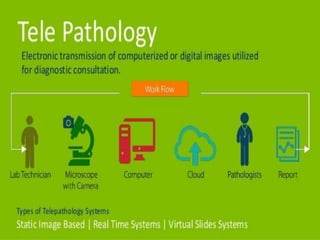
• Telepathology - practice of pathology at a distance .
DEFINITION
• It is acquisition of histological & macroscopic images for
transmission along telecommunication pathways for
Diagnosis
Consultation
Continuing medical education
PARTS
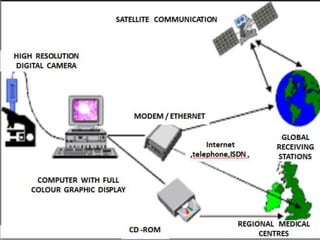
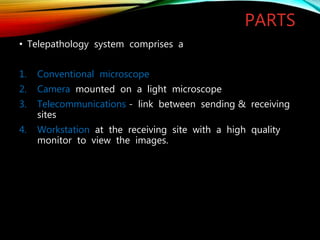
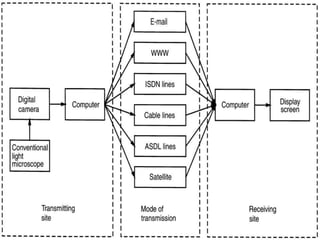
• Telepathology system comprises a
1. Conventional microscope
2. Camera mounted on a light microscope
3. Telecommunications - link between sending & receiving
sites
4. Workstation at the receiving site with a high quality
monitor to view the images.
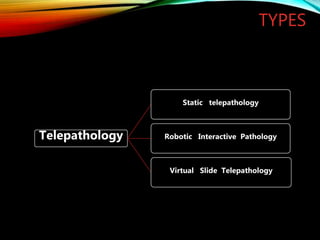
TYPES
Telepathology
Static telepathology
Robotic Interactive Pathology
Virtual Slide Telepathology
1 .STATIC
TELEPATHOLOGY• Synonyms-Store & forward or passive telepathology .
• Advantages –
 It is cheap , simple , need a standard telephone line / internet
connection .
Images are static .
• There is no facility for recipient control .
STATIC TELEPATHOLOGY
• Number of images captured is limited for each case .(1-
40)
• Disadvantages -
Sampling errors
Interpretation & Video imaging quality has problems .
• Sampling errors/ Bias – can be prevented by using a trained
pathologist to select the images .
• There is some discordance between telepathology & glass
slide diagnosis .
• This discordance is due to
Field selection
Diagnostic interpretation
Video image quality
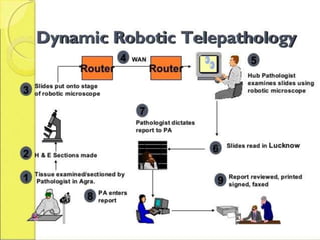
2 .ROBOTIC
INTERACTIVE
PATHOLOGY
( RIT PATH)
• Synonyms – Dynamic telepathology /
Active telepathology /
Real time telepathology
• Advantage –
receiving pathologist can control the movement of the
slide on the stage .
To see the image in real time on a high resolution
monitor .
RIT PATH
• Limitation -
 Transmission time
• Examples -
1. HISTKOM RIT Path system
2. The Apollo image management system (IMS)/Corabi
dynamic module (CDT)
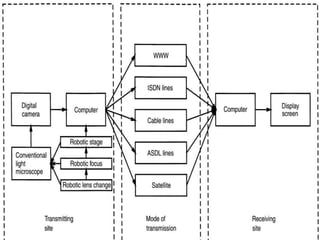
•Histkom rit path system :
• It consists of a
robotic zeiss microscope with triple charge coupled
device(CCD),
Sony video camera transmitting images to a remote station.
HISTKOM RIT PATH
SYSTEM :
• User is able to control all the functions of the
microscope , including the scanning stage , magnification
& light intensity.
• Soft ware at the receiving station stitches the images
together thus stimulating a moving image
• The apollo image management system / Corabi Dynamic
Module (IMS / CDT)
• This system provides remote stage management , focus , light
intensity & magnification .
• It has the capability of functioning as a bidirectional
telepathology system.
• Disadvantage of video conference technology in - its
susceptibility to blurring
- interruptions in image displays
• HYBRID system - capable of both the static telepathology
& dynamic telepathology.
3 . VIRTUAL SLIDE
TELEPATHOLOGY
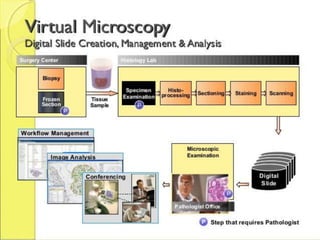
• It requires fast slide scanner.
• Highest image quality & speed .
• Offers better user experience & diagnostic accuracy than
robotic microscopy.
• Examination & storage in one step.
ADVANTAGES DISADVANTAGES
• Virtual Slide doesn't discolor • Not possible to focus the areas
that were not correctly acquired
during scanning due to irregular
surface of the sample.
• Multiple viewers can
observe Virtual Slide at the
same time
• Less space consuming
• Allows exploration of the
whole slide surface with
different magnification
SIGNIFICANT AREAS OF
DEVELOPMENT
• INTERNET : helps in video conferencing & presentation
of graphical images
• Adv: cost & availability
static images are sent as email attachments
• Disadvatages- slow
issue of security
• SLIDE DIGITISATION : It is the conversion of an
analogue source in to a digital format, so that can be
stored by a computer & recreated at a later date .
• Stained sections will fade with time , image stored in
digital form offers a longer lifespan ,
APPLICATIONS
• In places where full time pathologist is not available
telepathology helps in gaining a pathologist
consultation.
• Telepathology helps in taking an expert pathologist
opinion.
• Telepathology can overcome the delays associated with
the postal service .
• External Quality Assessment & Teaching :
 EQA programs has advantage in mass delivery .
Rather than cut multiple sections , selective images for
each case can be sent via E-mail .
Images can be reviewed later .
Educational cases can easily be distributed to trainees .
TECHNICAL ASPECTS OF
TELEPATHOLOGY• IMAGE ACQUISITION
• STORAGE
• IMAGE COMPRESSION
• NETWORKING & LINE SPEEDS
• COMPUTER NETWORKS
IMAGE ACQUISITION
• By camera mounted on the top of the microscope.
• CCD(charge coupled device) sensor convert the images to
an electronic form .
• Out put from the digital video cameras is converted
back either to an analogue signal for viewing on an
television monitor or sent unchanged to a computer
hardware & software for recording.
STORAGE
• 1. Short term storage - hard drive
• 2. Small computer system interface (SCSI) –
It handles multiple devices such as extra hard drives
,scanners ,CD-ROM’S ,simultaneously along a single interphase.
IMAGE COMPRESSION
• DICOM (SM) – Digital Imaging & Communications in
Medicine Standard- provides standardized formats
for image capture & storage .
• IMAGE FORMATS -
Lossy algorithms – discard unnecessary data in the
course of compression .
Lossless algorithms – preserve data at the expense
of compressed image size .
• JPEG - Joint Photographics Experts Group
• GIF - Graphics Interchange Format
• PNG - Portable Network Graphics
• Flash Pix
• WSQ - Wavelet Scalar Quantitisation
• TIFF - Tagged Image File Format
• Fractals Compression
COMPUTER NETWORKS
• This is the key tool used by companies & institutions
world wide .
• LAN (Local area network)
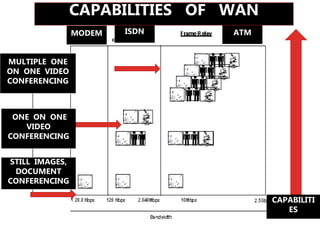
• WAN (Wide area network)
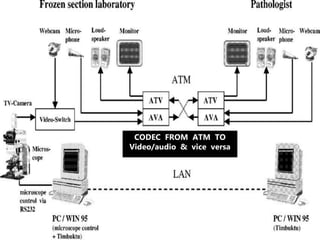
• LAN – it is a high speed communications system designed to
link computers & data processing devices together with in a
small geographic area .EX: ATM
• Multiple LANs are linked together to form a WAN .
• Example of WAN is Telephone network, modems ,ATM , ISDN.
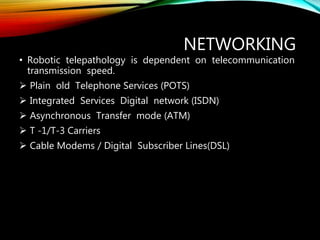
NETWORKING
• Robotic telepathology is dependent on telecommunication
transmission speed.
 Plain old Telephone Services (POTS)
 Integrated Services Digital network (ISDN)
 Asynchronous Transfer mode (ATM)
 T -1/T-3 Carriers
 Cable Modems / Digital Subscriber Lines(DSL)
CODEC FROM ATM TO
Video/audio & vice versa
MULTIPLE ONE
ON ONE VIDEO
CONFERENCING
ONE ON ONE
VIDEO
CONFERENCING
STILL IMAGES,
DOCUMENT
CONFERENCING
CAPABILITI
ES
ISDNMODEM ATM
CAPABILITIES OF WAN
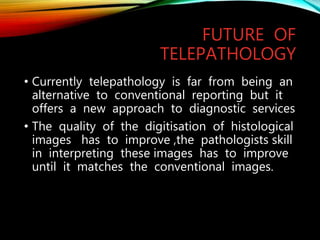
FUTURE OF
TELEPATHOLOGY
• Currently telepathology is far from being an
alternative to conventional reporting but it
offers a new approach to diagnostic services
• The quality of the digitisation of histological
images has to improve ,the pathologists skill
in interpreting these images has to improve
until it matches the conventional images.
TELEPATHOLOGY
WORD.DOCX
• References
• Recent advances in histopathology 18
• internet

Telepathology . Dr. Abhinav Golla , Associate Professor , Lab Director & Consultant Pathologist . Aadhya Medicure Pathlabs .

  • 1.
    TELE PATHOLOGY DR.ABHINAV GOLLA MEDICUREDIAGNOSRICS AND RESEARCH CENTER Vijayanagar colony, Hyderabad, TELANGANA.
  • 2.
    TELEPATHOLOGY • Definition • Parts •Types • Significant areas of development • Applications • Technical aspects of telepathology • Future of telepathology
  • 3.
    INTRODUCTION • Tele isa Greek word meaning - distance . • Pathos is a Greek word meaning - suffering • Logia - study • Telepathology - practice of pathology at a distance .
  • 4.
    DEFINITION • It isacquisition of histological & macroscopic images for transmission along telecommunication pathways for Diagnosis Consultation Continuing medical education
  • 7.
    PARTS • Telepathology systemcomprises a 1. Conventional microscope 2. Camera mounted on a light microscope 3. Telecommunications - link between sending & receiving sites 4. Workstation at the receiving site with a high quality monitor to view the images.
  • 8.
  • 9.
    1 .STATIC TELEPATHOLOGY• Synonyms-Store& forward or passive telepathology . • Advantages –  It is cheap , simple , need a standard telephone line / internet connection . Images are static . • There is no facility for recipient control .
  • 11.
    STATIC TELEPATHOLOGY • Numberof images captured is limited for each case .(1- 40) • Disadvantages - Sampling errors Interpretation & Video imaging quality has problems .
  • 12.
    • Sampling errors/Bias – can be prevented by using a trained pathologist to select the images . • There is some discordance between telepathology & glass slide diagnosis . • This discordance is due to Field selection Diagnostic interpretation Video image quality
  • 13.
    2 .ROBOTIC INTERACTIVE PATHOLOGY ( RITPATH) • Synonyms – Dynamic telepathology / Active telepathology / Real time telepathology • Advantage – receiving pathologist can control the movement of the slide on the stage . To see the image in real time on a high resolution monitor .
  • 14.
    RIT PATH • Limitation-  Transmission time • Examples - 1. HISTKOM RIT Path system 2. The Apollo image management system (IMS)/Corabi dynamic module (CDT)
  • 17.
    •Histkom rit pathsystem : • It consists of a robotic zeiss microscope with triple charge coupled device(CCD), Sony video camera transmitting images to a remote station.
  • 18.
    HISTKOM RIT PATH SYSTEM: • User is able to control all the functions of the microscope , including the scanning stage , magnification & light intensity. • Soft ware at the receiving station stitches the images together thus stimulating a moving image
  • 19.
    • The apolloimage management system / Corabi Dynamic Module (IMS / CDT) • This system provides remote stage management , focus , light intensity & magnification . • It has the capability of functioning as a bidirectional telepathology system. • Disadvantage of video conference technology in - its susceptibility to blurring - interruptions in image displays
  • 20.
    • HYBRID system- capable of both the static telepathology & dynamic telepathology.
  • 21.
    3 . VIRTUALSLIDE TELEPATHOLOGY • It requires fast slide scanner. • Highest image quality & speed . • Offers better user experience & diagnostic accuracy than robotic microscopy. • Examination & storage in one step.
  • 23.
    ADVANTAGES DISADVANTAGES • VirtualSlide doesn't discolor • Not possible to focus the areas that were not correctly acquired during scanning due to irregular surface of the sample. • Multiple viewers can observe Virtual Slide at the same time • Less space consuming • Allows exploration of the whole slide surface with different magnification
  • 24.
    SIGNIFICANT AREAS OF DEVELOPMENT •INTERNET : helps in video conferencing & presentation of graphical images • Adv: cost & availability static images are sent as email attachments • Disadvatages- slow issue of security
  • 25.
    • SLIDE DIGITISATION: It is the conversion of an analogue source in to a digital format, so that can be stored by a computer & recreated at a later date . • Stained sections will fade with time , image stored in digital form offers a longer lifespan ,
  • 26.
    APPLICATIONS • In placeswhere full time pathologist is not available telepathology helps in gaining a pathologist consultation. • Telepathology helps in taking an expert pathologist opinion. • Telepathology can overcome the delays associated with the postal service .
  • 27.
    • External QualityAssessment & Teaching :  EQA programs has advantage in mass delivery . Rather than cut multiple sections , selective images for each case can be sent via E-mail . Images can be reviewed later . Educational cases can easily be distributed to trainees .
  • 28.
    TECHNICAL ASPECTS OF TELEPATHOLOGY•IMAGE ACQUISITION • STORAGE • IMAGE COMPRESSION • NETWORKING & LINE SPEEDS • COMPUTER NETWORKS
  • 29.
    IMAGE ACQUISITION • Bycamera mounted on the top of the microscope. • CCD(charge coupled device) sensor convert the images to an electronic form . • Out put from the digital video cameras is converted back either to an analogue signal for viewing on an television monitor or sent unchanged to a computer hardware & software for recording.
  • 30.
    STORAGE • 1. Shortterm storage - hard drive • 2. Small computer system interface (SCSI) – It handles multiple devices such as extra hard drives ,scanners ,CD-ROM’S ,simultaneously along a single interphase.
  • 31.
    IMAGE COMPRESSION • DICOM(SM) – Digital Imaging & Communications in Medicine Standard- provides standardized formats for image capture & storage . • IMAGE FORMATS - Lossy algorithms – discard unnecessary data in the course of compression . Lossless algorithms – preserve data at the expense of compressed image size .
  • 32.
    • JPEG -Joint Photographics Experts Group • GIF - Graphics Interchange Format • PNG - Portable Network Graphics • Flash Pix • WSQ - Wavelet Scalar Quantitisation • TIFF - Tagged Image File Format • Fractals Compression
  • 33.
    COMPUTER NETWORKS • Thisis the key tool used by companies & institutions world wide . • LAN (Local area network) • WAN (Wide area network)
  • 34.
    • LAN –it is a high speed communications system designed to link computers & data processing devices together with in a small geographic area .EX: ATM • Multiple LANs are linked together to form a WAN . • Example of WAN is Telephone network, modems ,ATM , ISDN.
  • 35.
    NETWORKING • Robotic telepathologyis dependent on telecommunication transmission speed.  Plain old Telephone Services (POTS)  Integrated Services Digital network (ISDN)  Asynchronous Transfer mode (ATM)  T -1/T-3 Carriers  Cable Modems / Digital Subscriber Lines(DSL)
  • 36.
    CODEC FROM ATMTO Video/audio & vice versa
  • 37.
    MULTIPLE ONE ON ONEVIDEO CONFERENCING ONE ON ONE VIDEO CONFERENCING STILL IMAGES, DOCUMENT CONFERENCING CAPABILITI ES ISDNMODEM ATM CAPABILITIES OF WAN
  • 39.
    FUTURE OF TELEPATHOLOGY • Currentlytelepathology is far from being an alternative to conventional reporting but it offers a new approach to diagnostic services • The quality of the digitisation of histological images has to improve ,the pathologists skill in interpreting these images has to improve until it matches the conventional images.
  • 40.
    TELEPATHOLOGY WORD.DOCX • References • Recentadvances in histopathology 18 • internet

Editor's Notes

  • #5 Telepathology is practice of pathology at a distance . It uses telecommunication technology to facilitate the transfer of image – rich pathology data between distant locations for the purposes of diagnosis , education ,& research.
  • #19 Uses- user is able to control all the functions of the microscope , including the scanning stage , magnification & light intensity. designed to be used with low band width networks- ISDN (Integrated services digital network) Systems conforms to transmission control protocol / internet protocol ( TCP / IP ) Remote station is designed for ease of 2 monitors. stage movement is controlled with a joy stick Images are transmitted in compressed JPEG format Soft ware at the receiving station stitches the images together thus stimulating a moving image.
  • #22 The slide is completely digitized and stored in a repository Permits a single or multiple user consultation, in every time and without human intervention. Allows exploration of the whole slide surface with different magnification.