CONTROL SYSTEM
PRRFORMANCE
Dr.Ziad Saeed Alsaleem
2019-2020
Classification of Control Systems
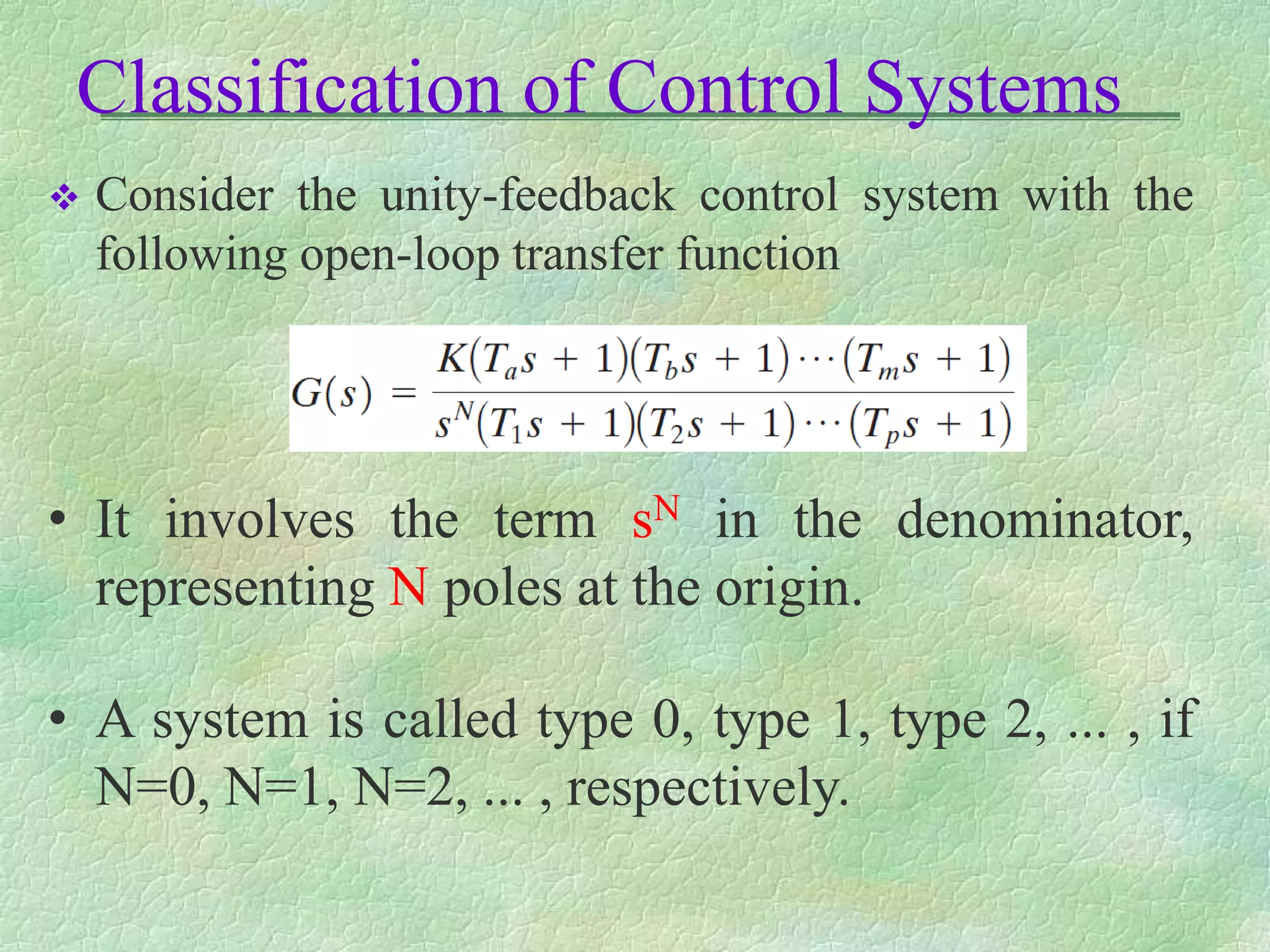
 Consider the unity-feedback control system with the
following open-loop transfer function
• It involves the term sN in the denominator,
representing N poles at the origin.
• A system is called type 0, type 1, type 2, ... , if
N=0, N=1, N=2, ... , respectively.
Classification of Control Systems
 As the type number is increased, accuracy is improved.
 However, increasing the type number aggravates the
stability problem.
 A compromise between steady-state accuracy and
relative stability is always necessary.
Steady State Error of Unity Feedback Systems
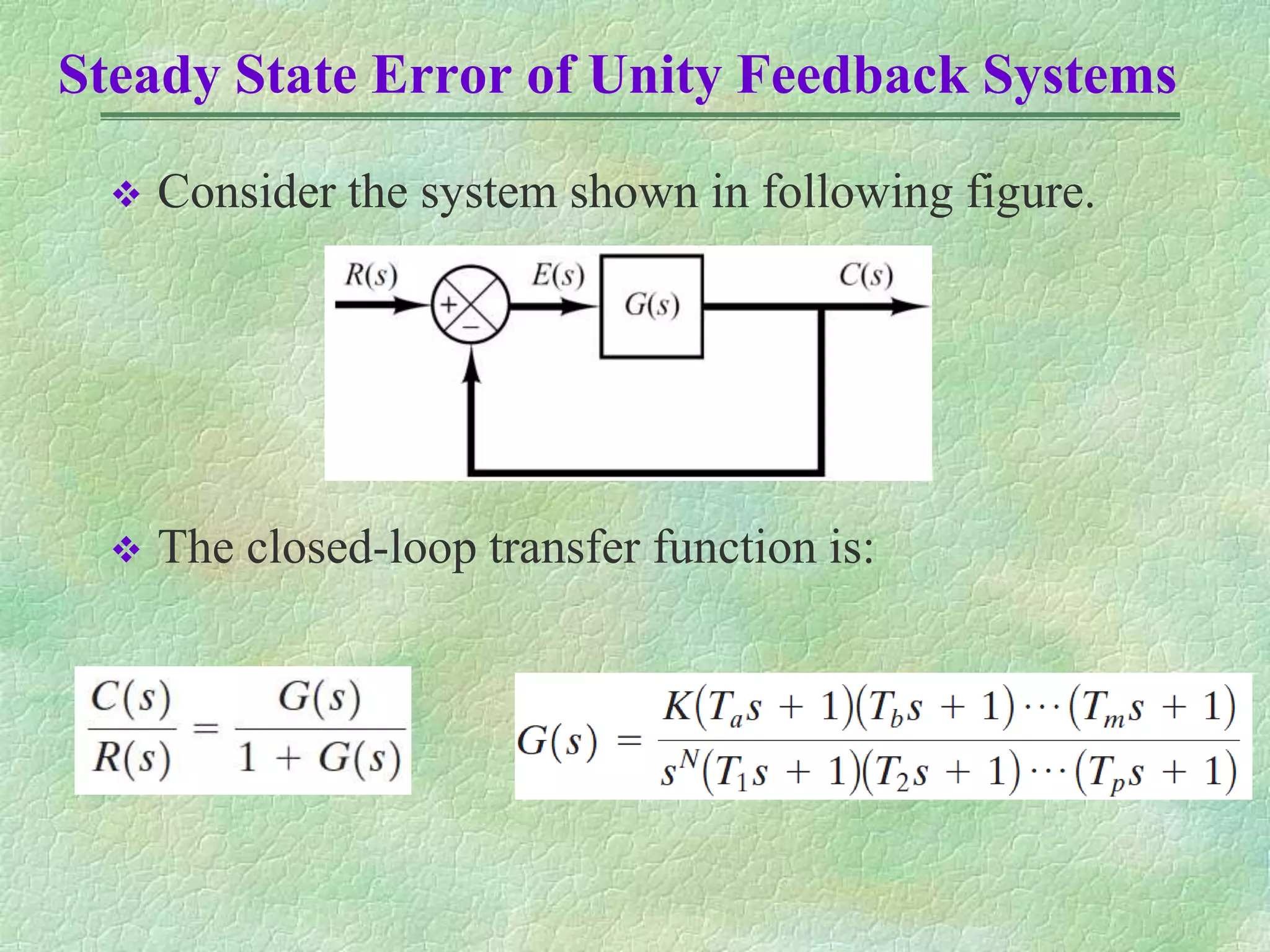
 Consider the system shown in following figure.
 The closed-loop transfer function is:
Steady State Error of Unity Feedback Systems
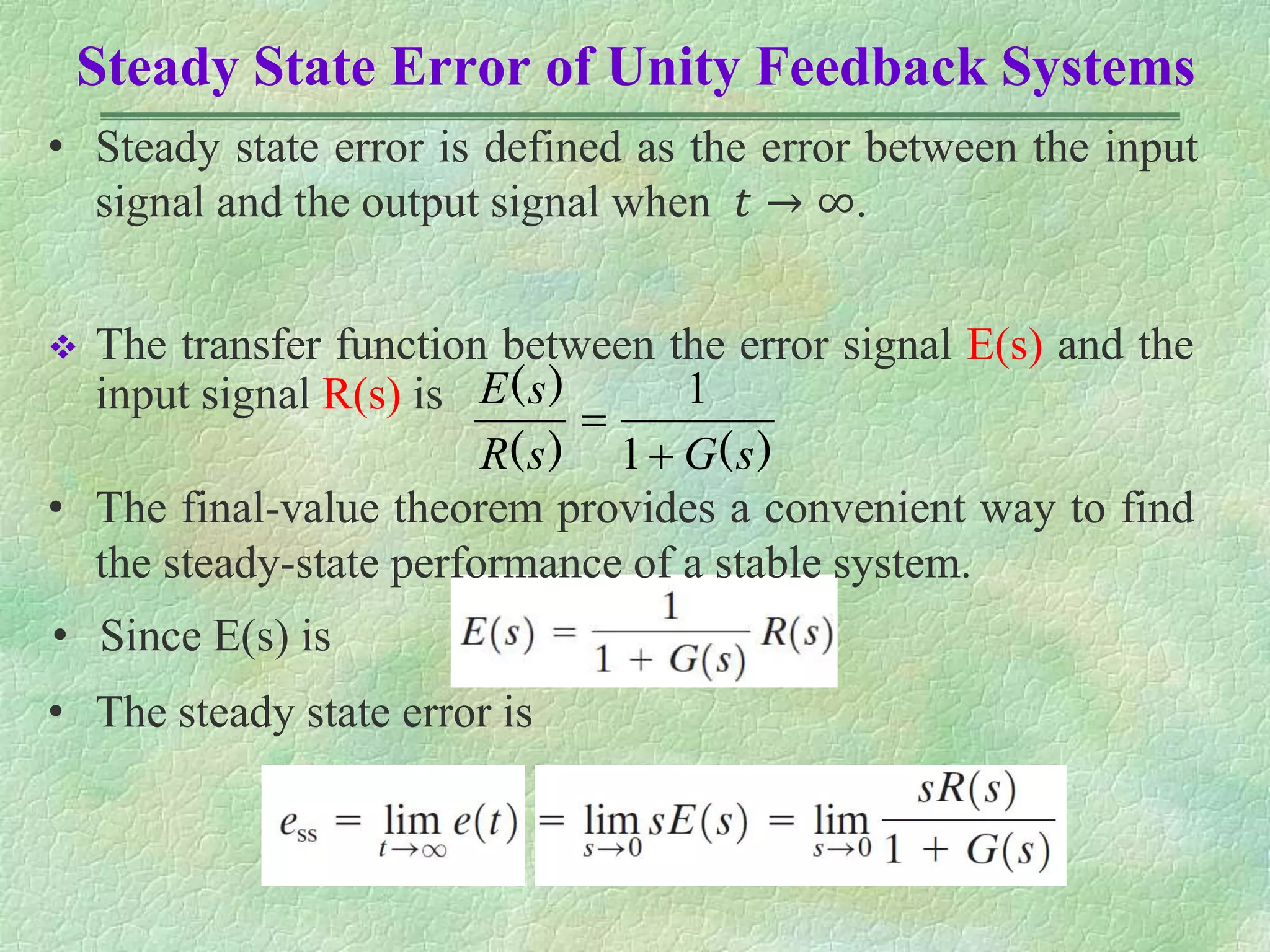
 The transfer function between the error signal E(s) and the
input signal R(s) is
)
(
)
(
)
(
s
G
s
R
s
E


1
1
• The final-value theorem provides a convenient way to find
the steady-state performance of a stable system.
• Since E(s) is
• The steady state error is
• Steady state error is defined as the error between the input
signal and the output signal when 𝑡 → ∞.
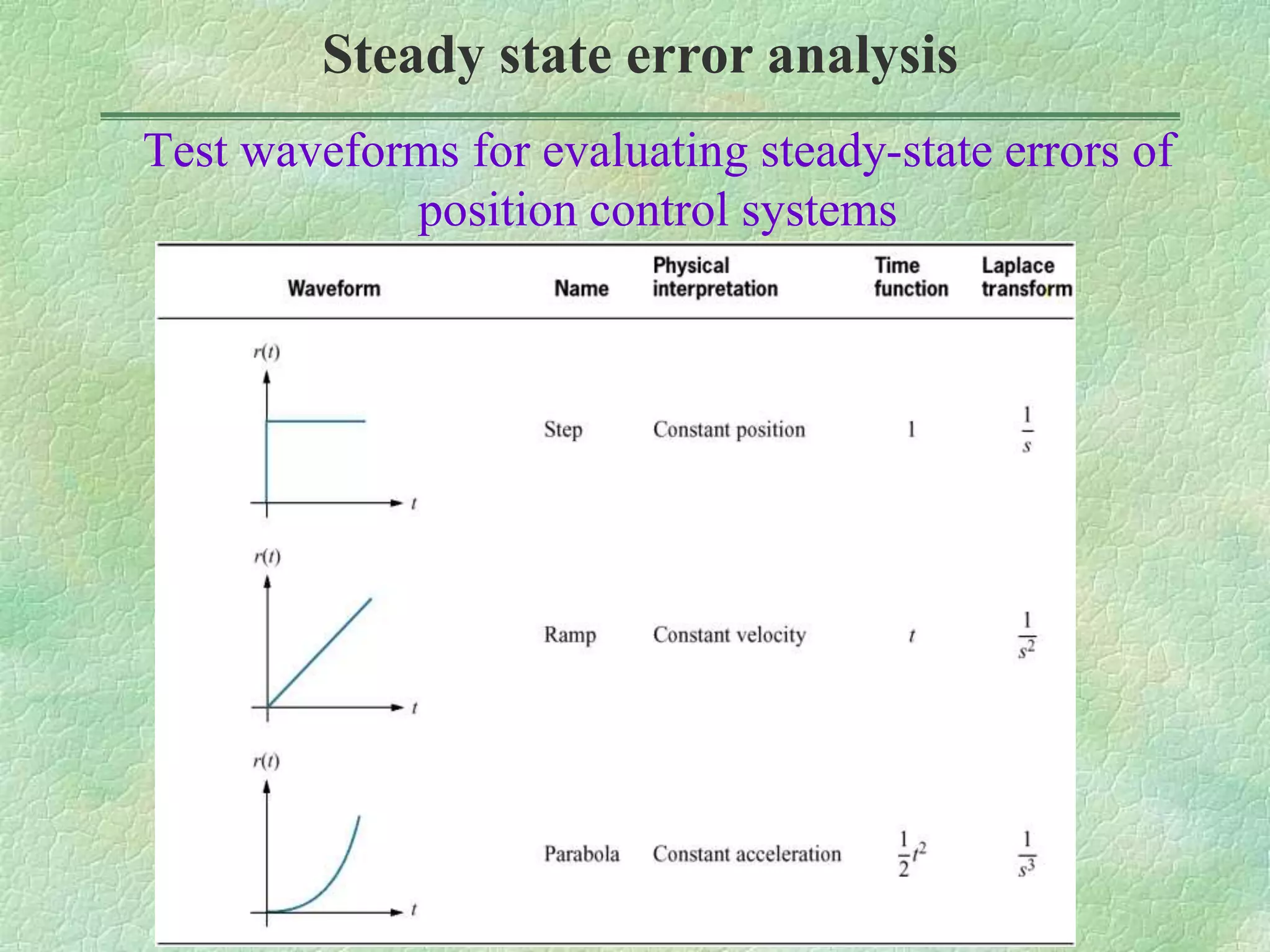
Test waveforms for evaluating steady-state errors of
position control systems
Steady state error analysis
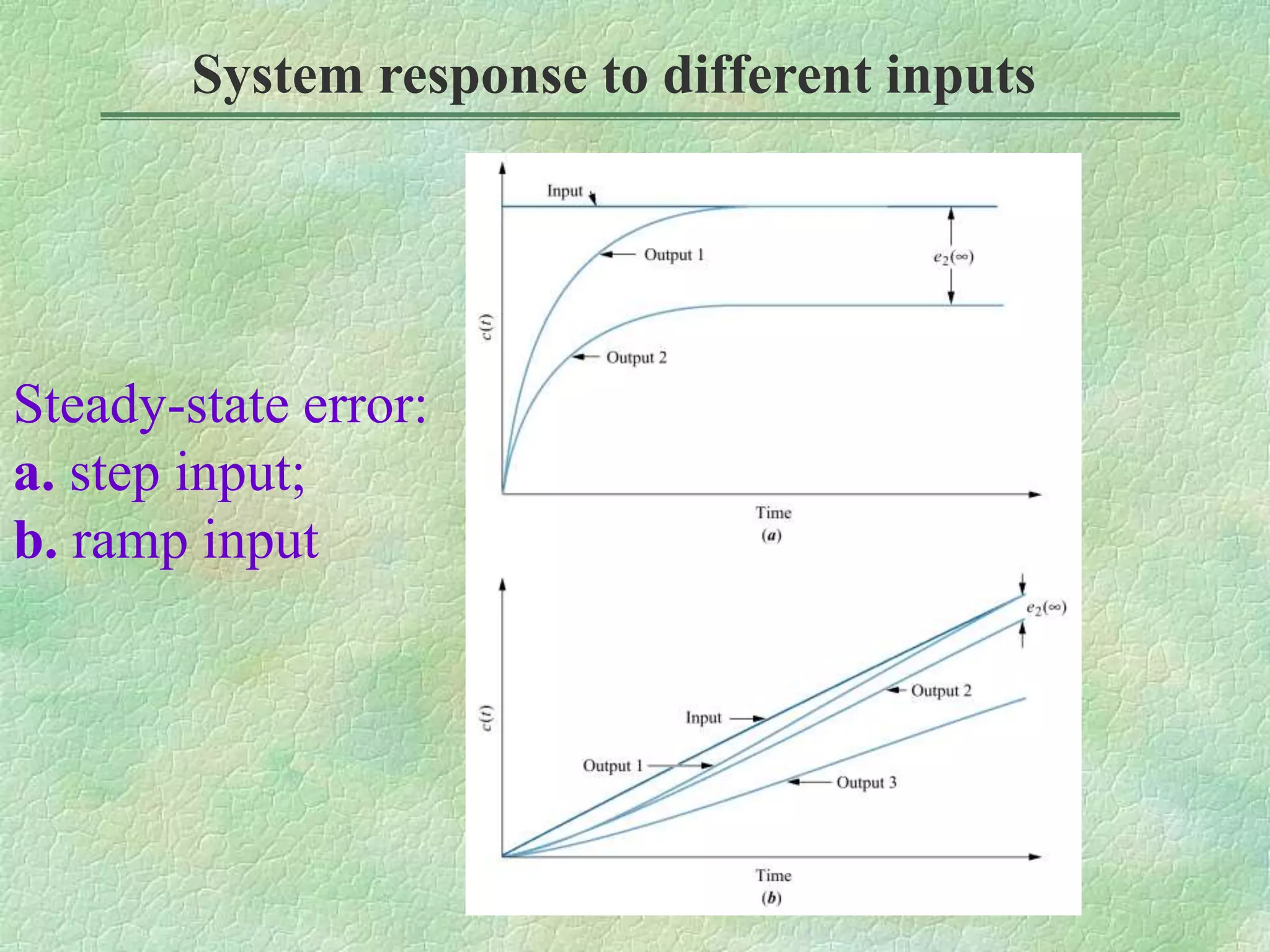
Steady-state error:
a. step input;
b. ramp input
System response to different inputs
Static Error Constants
 The static error constants are figures of merit of control
systems. The higher the constants, the smaller the steady-
state error.
 In a given system, the output may be the position,
velocity, pressure, temperature, or the like.
 Therefore, in what follows, we shall call the output
“position,” the rate of change of the output “velocity,”
and so on.
 This means that in a temperature control system
“position” represents the output temperature, “velocity”
represents the rate of change of the output temperature,
and so on.
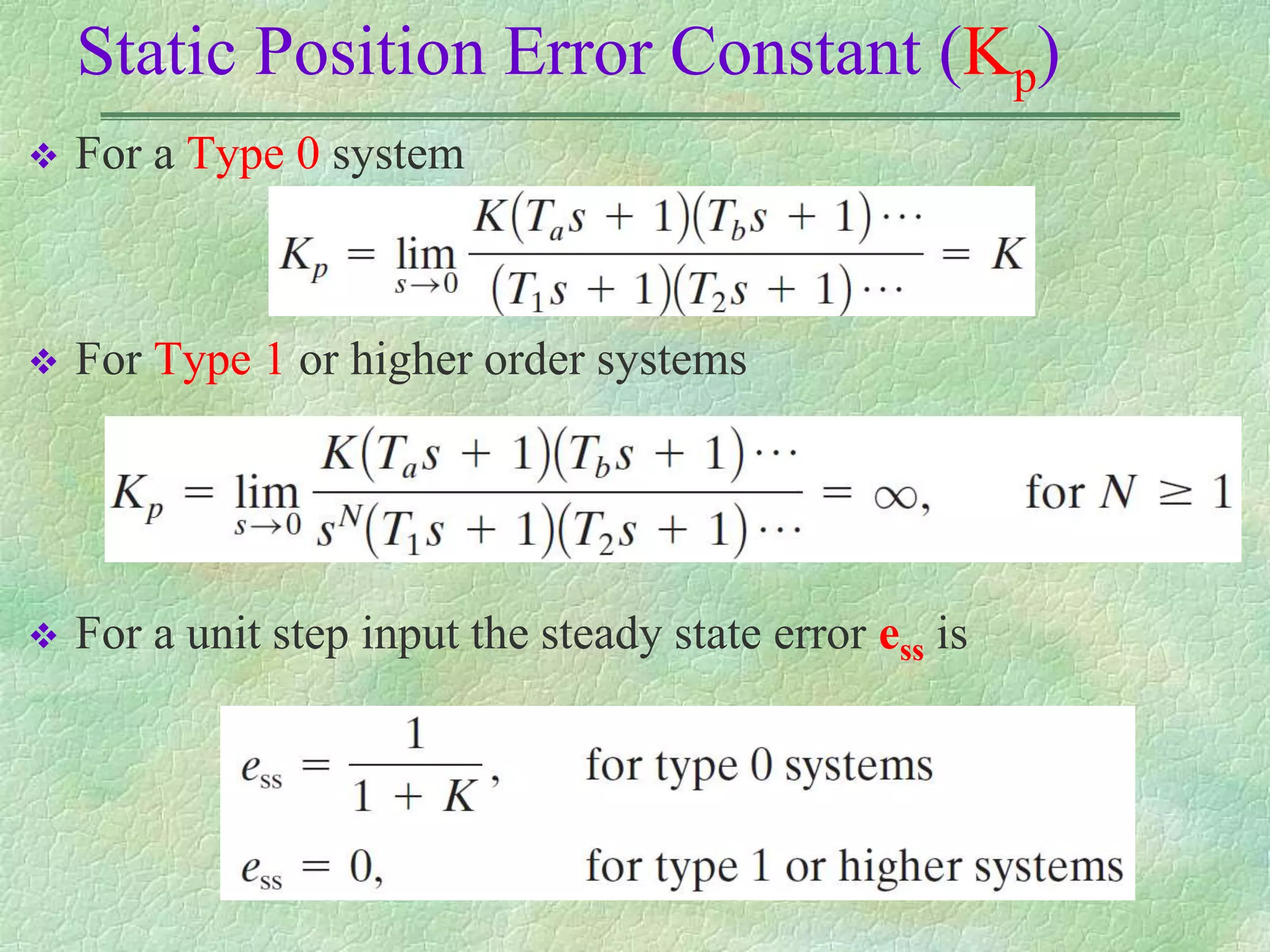
Static Position Error Constant (Kp)
 For a Type 0 system
 For Type 1 or higher order systems
 For a unit step input the steady state error ess is
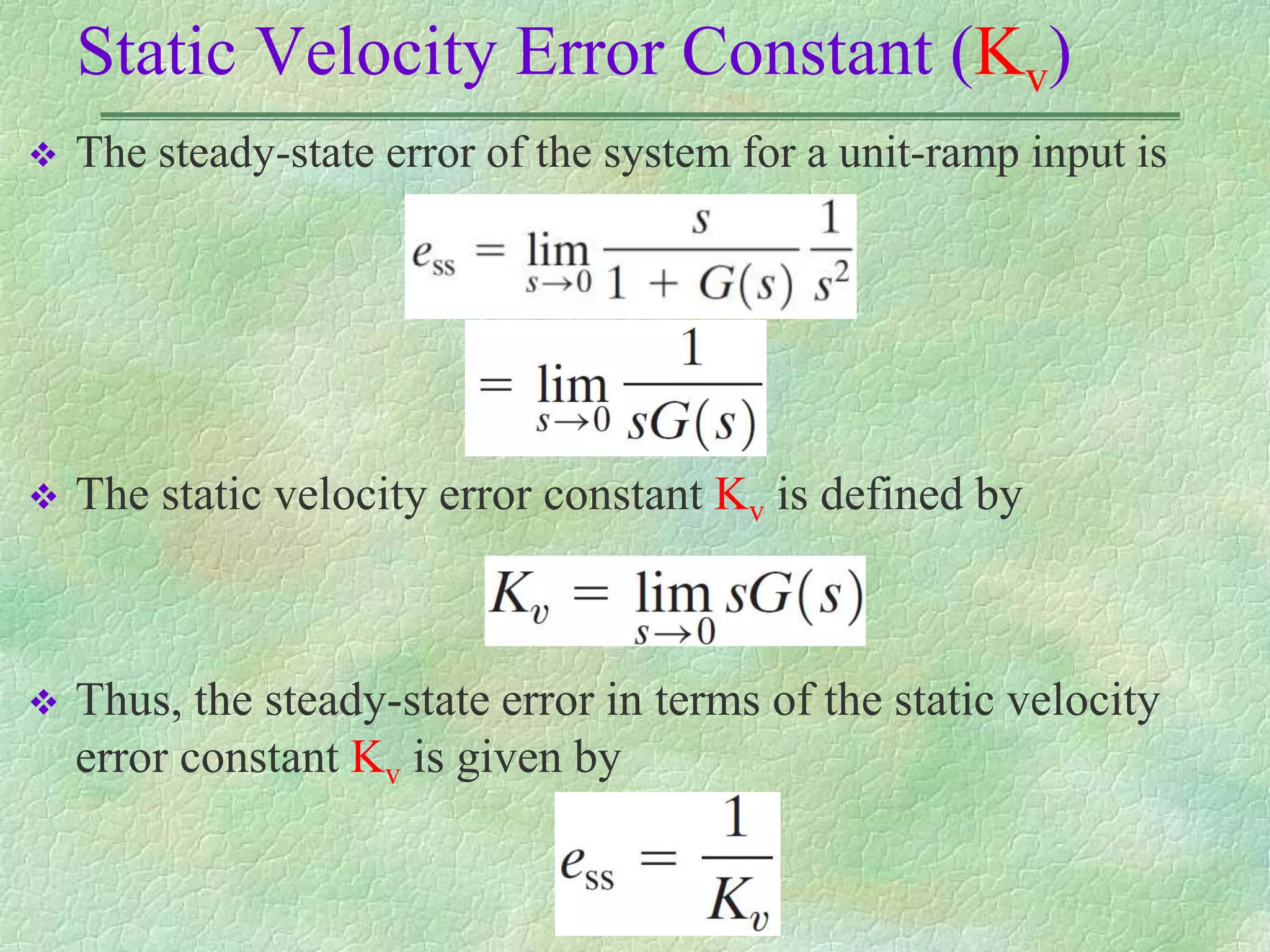
 The steady-state error of the system for a unit-ramp input is
 The static velocity error constant Kv is defined by
 Thus, the steady-state error in terms of the static velocity
error constant Kv is given by
Static Velocity Error Constant (Kv)
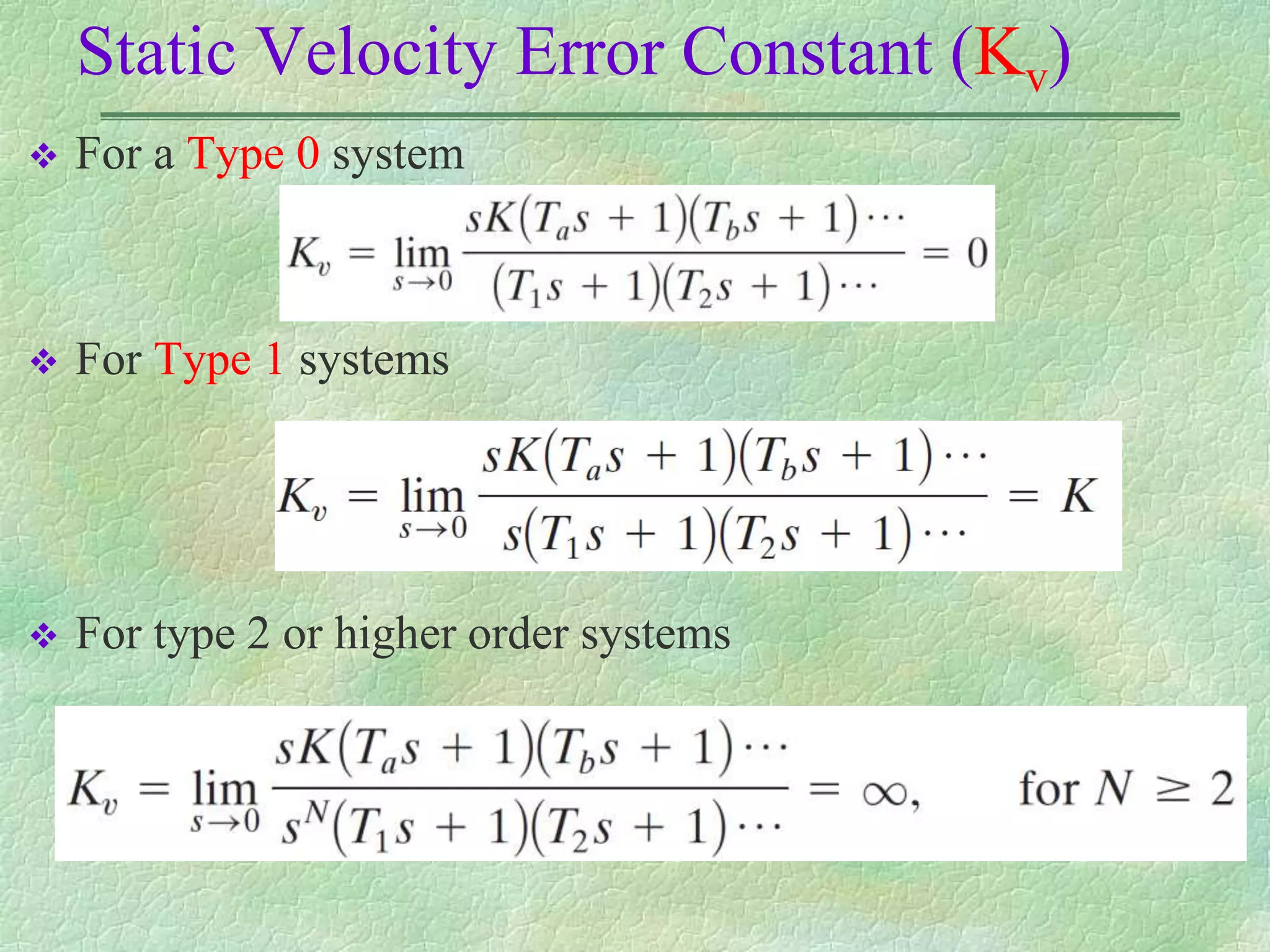
 For a Type 0 system
 For Type 1 systems
 For type 2 or higher order systems
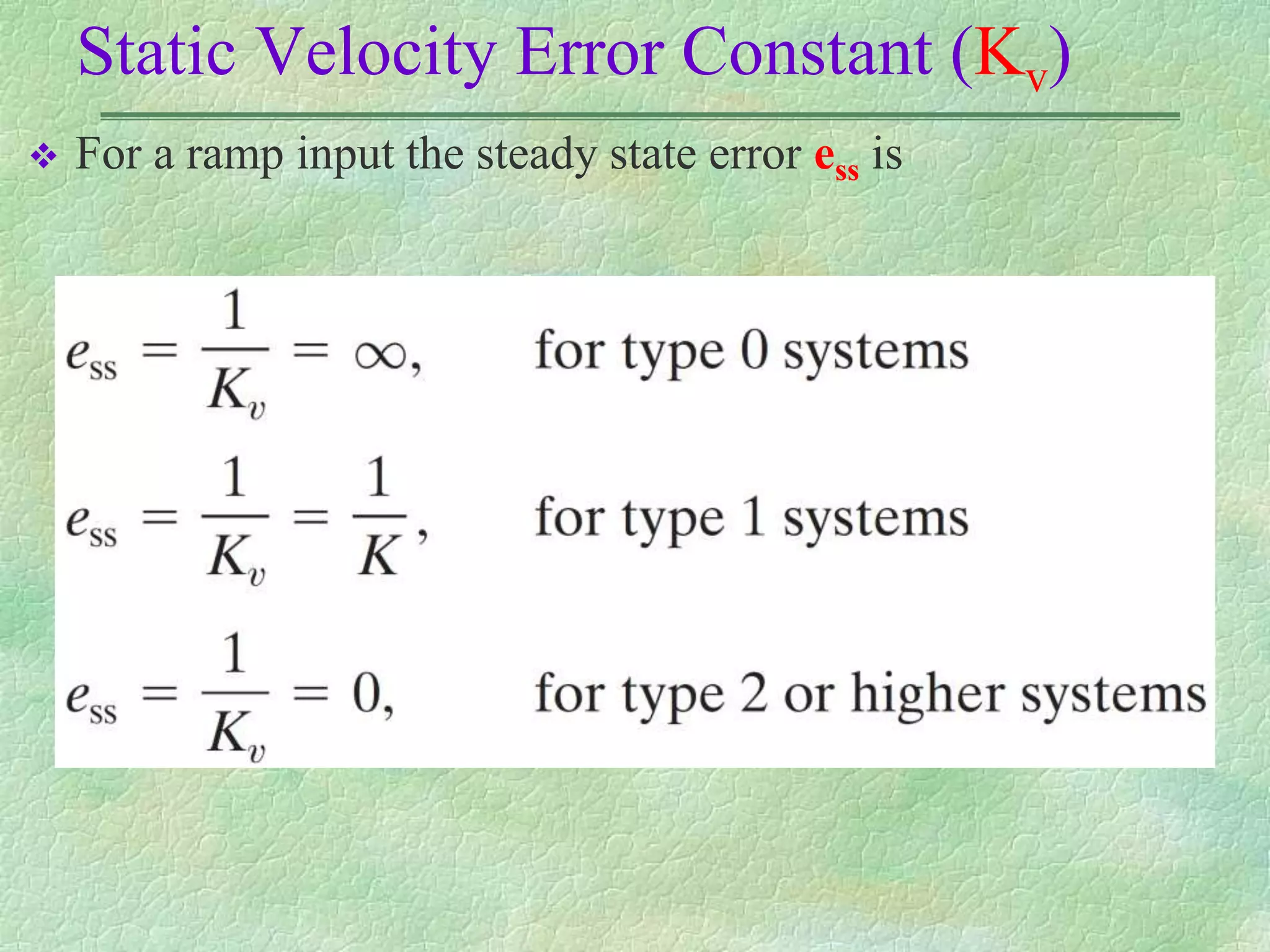
Static Velocity Error Constant (Kv)
 For a ramp input the steady state error ess is
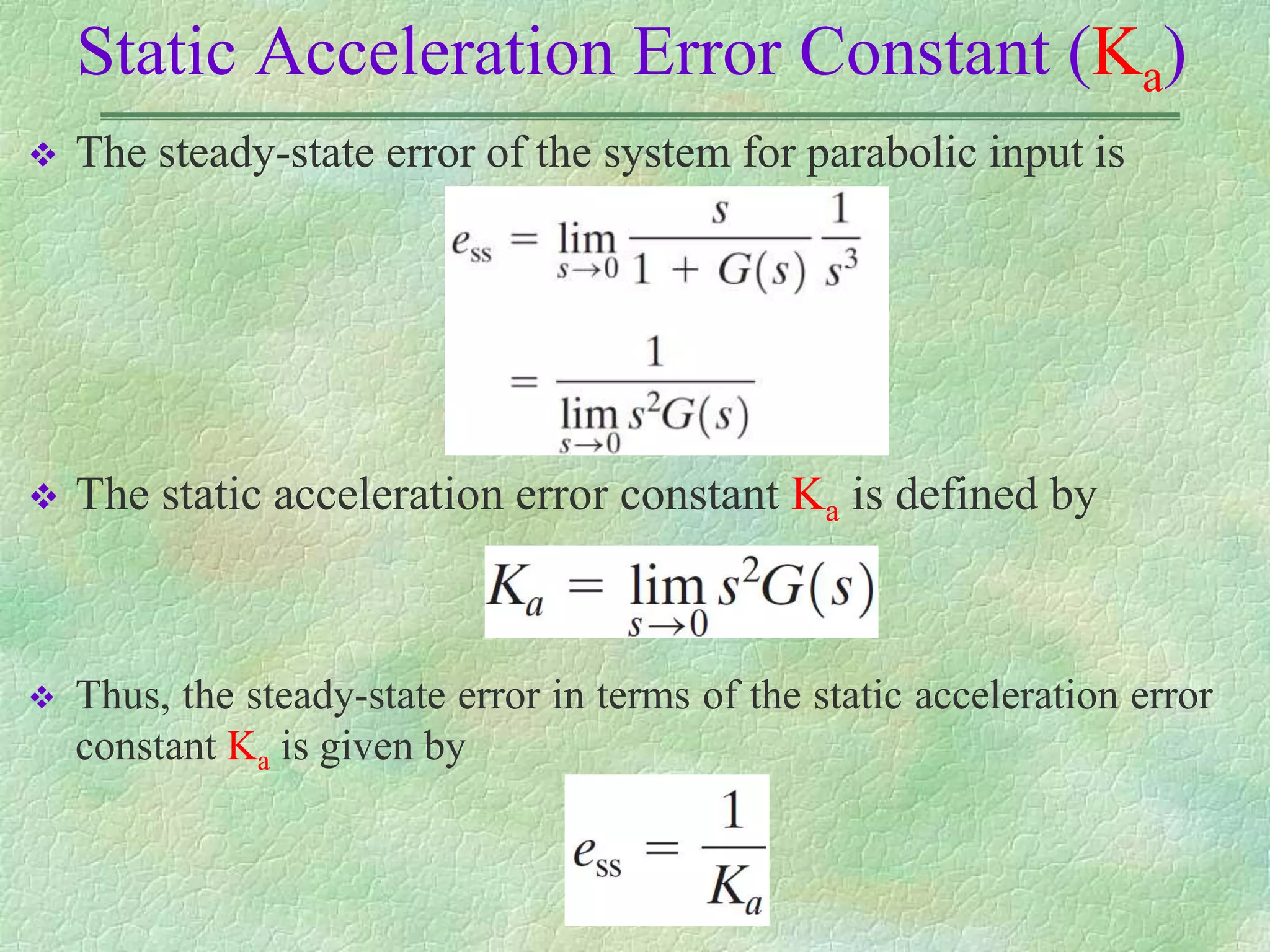
 The steady-state error of the system for parabolic input is
 The static acceleration error constant Ka is defined by
 Thus, the steady-state error in terms of the static acceleration error
constant Ka is given by
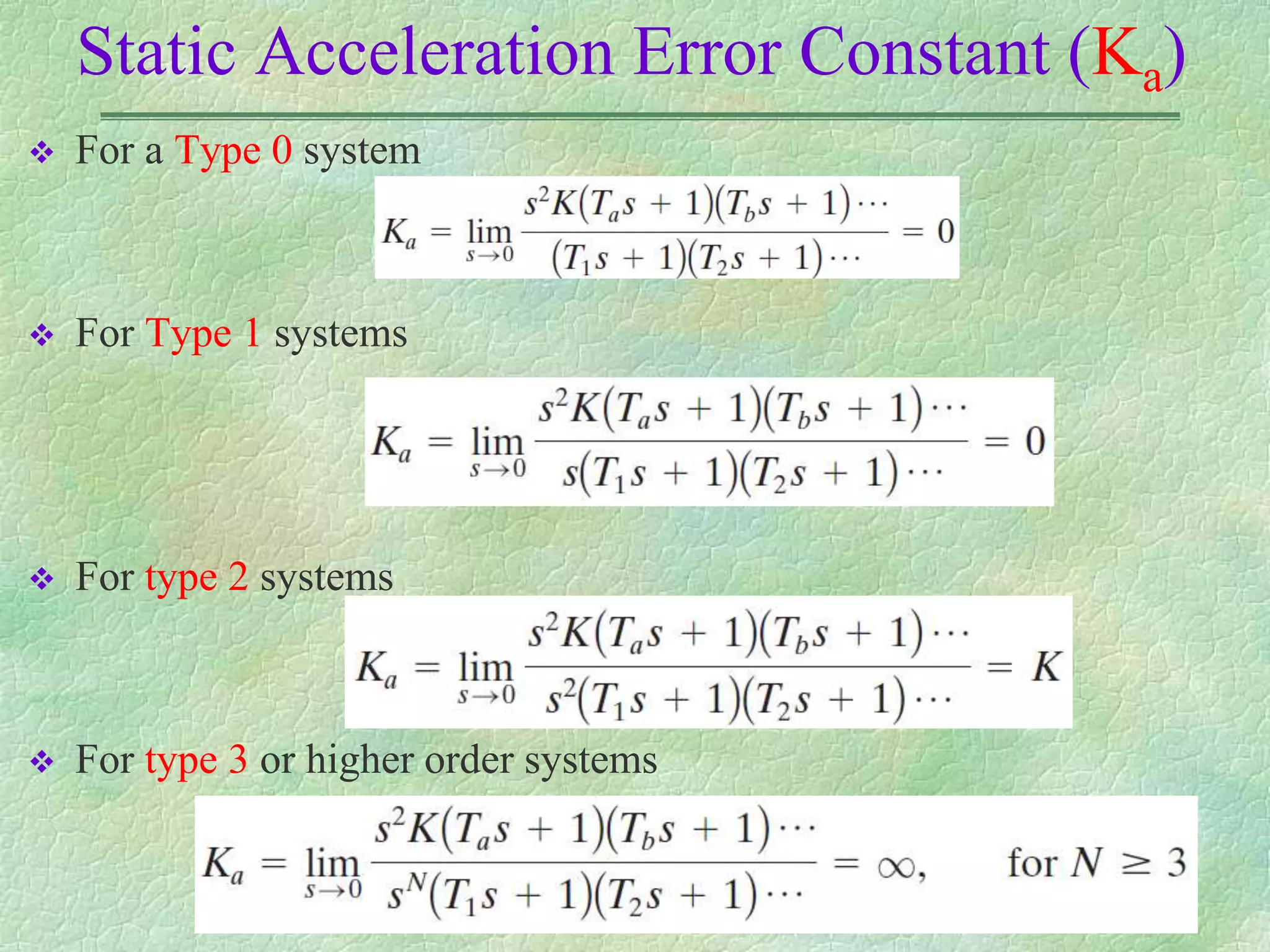
Static Acceleration Error Constant (Ka)
 For a Type 0 system
 For Type 1 systems
 For type 2 systems
 For type 3 or higher order systems
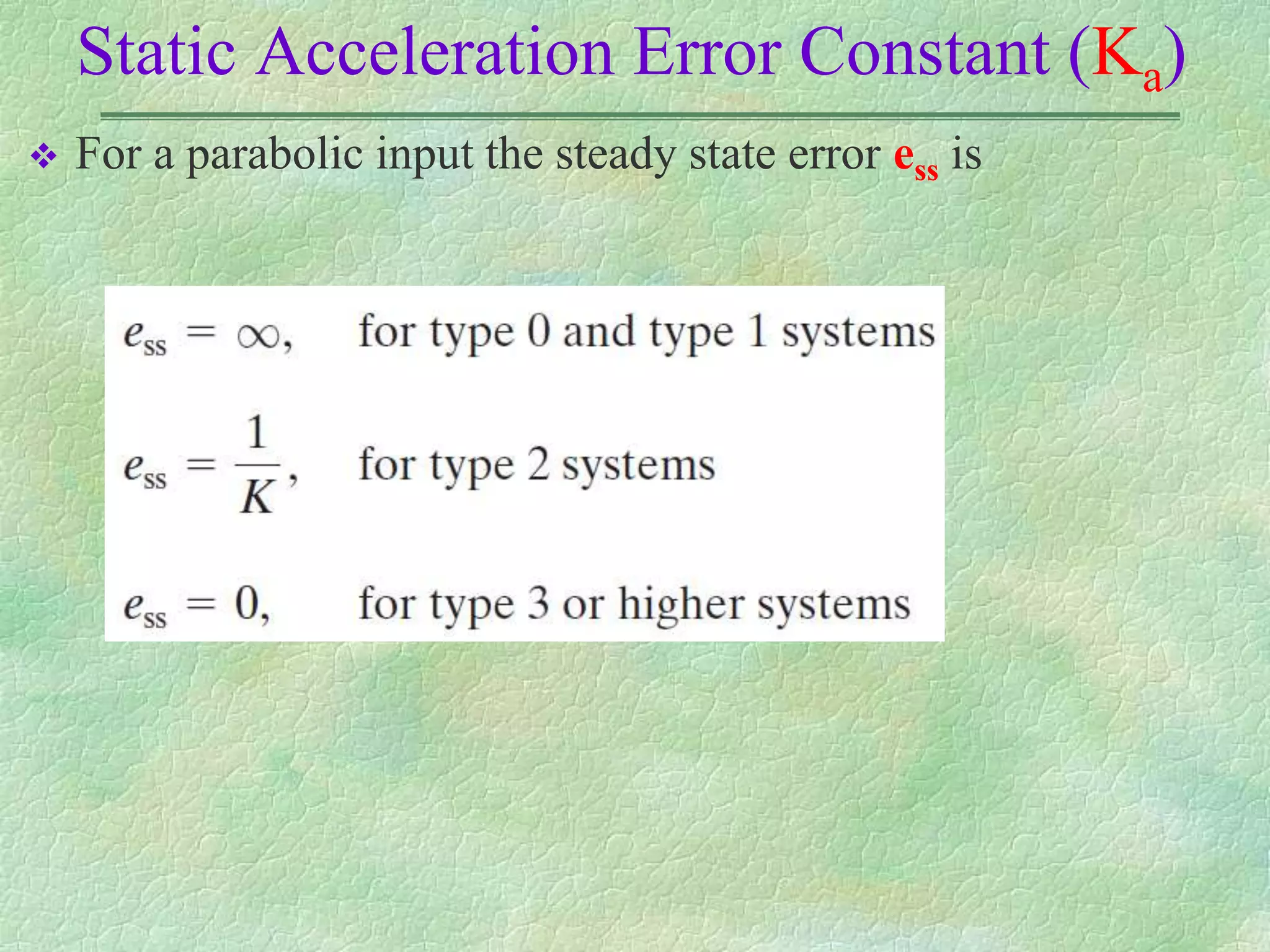
Static Acceleration Error Constant (Ka)
 For a parabolic input the steady state error ess is
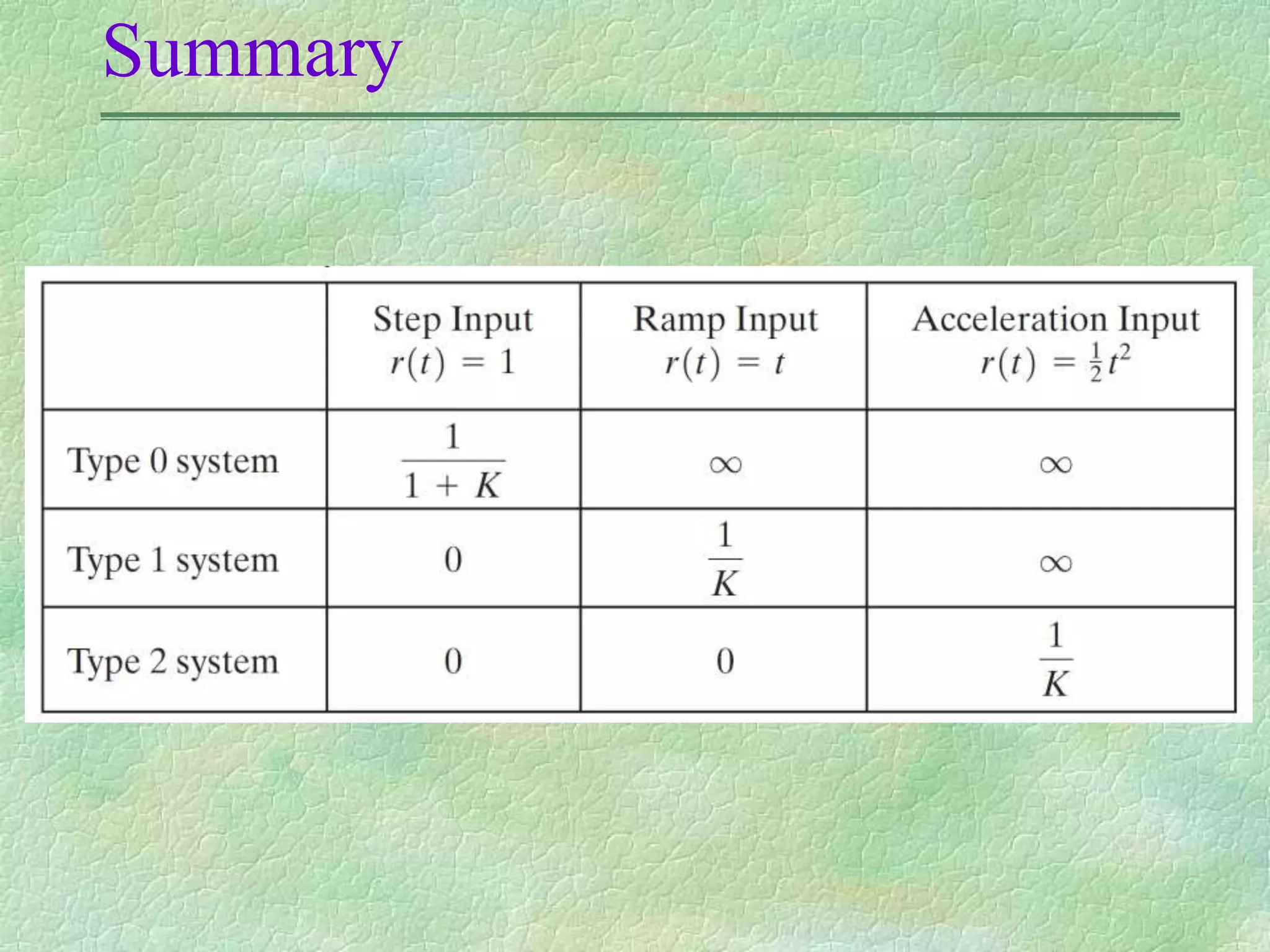
Summary
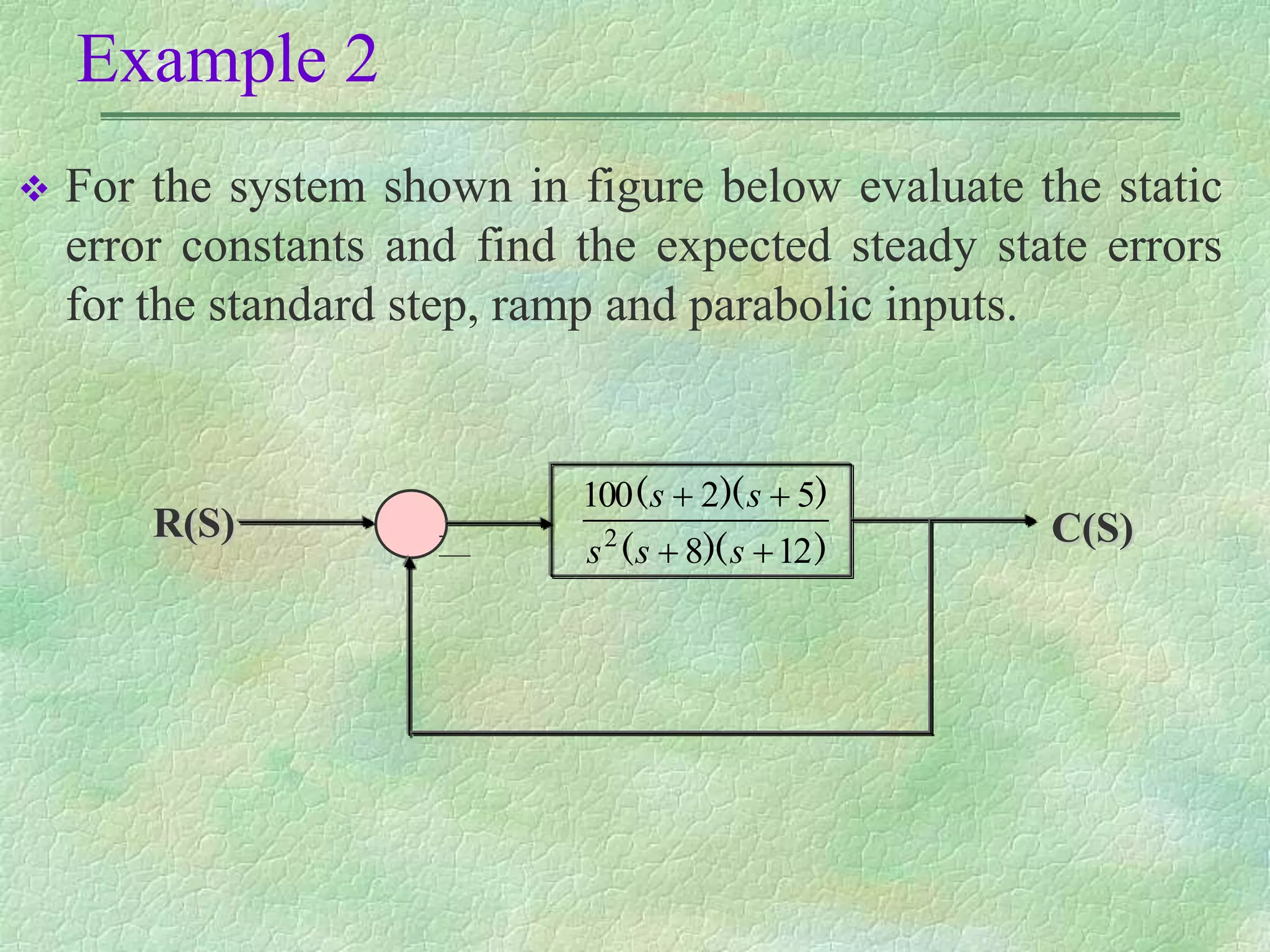
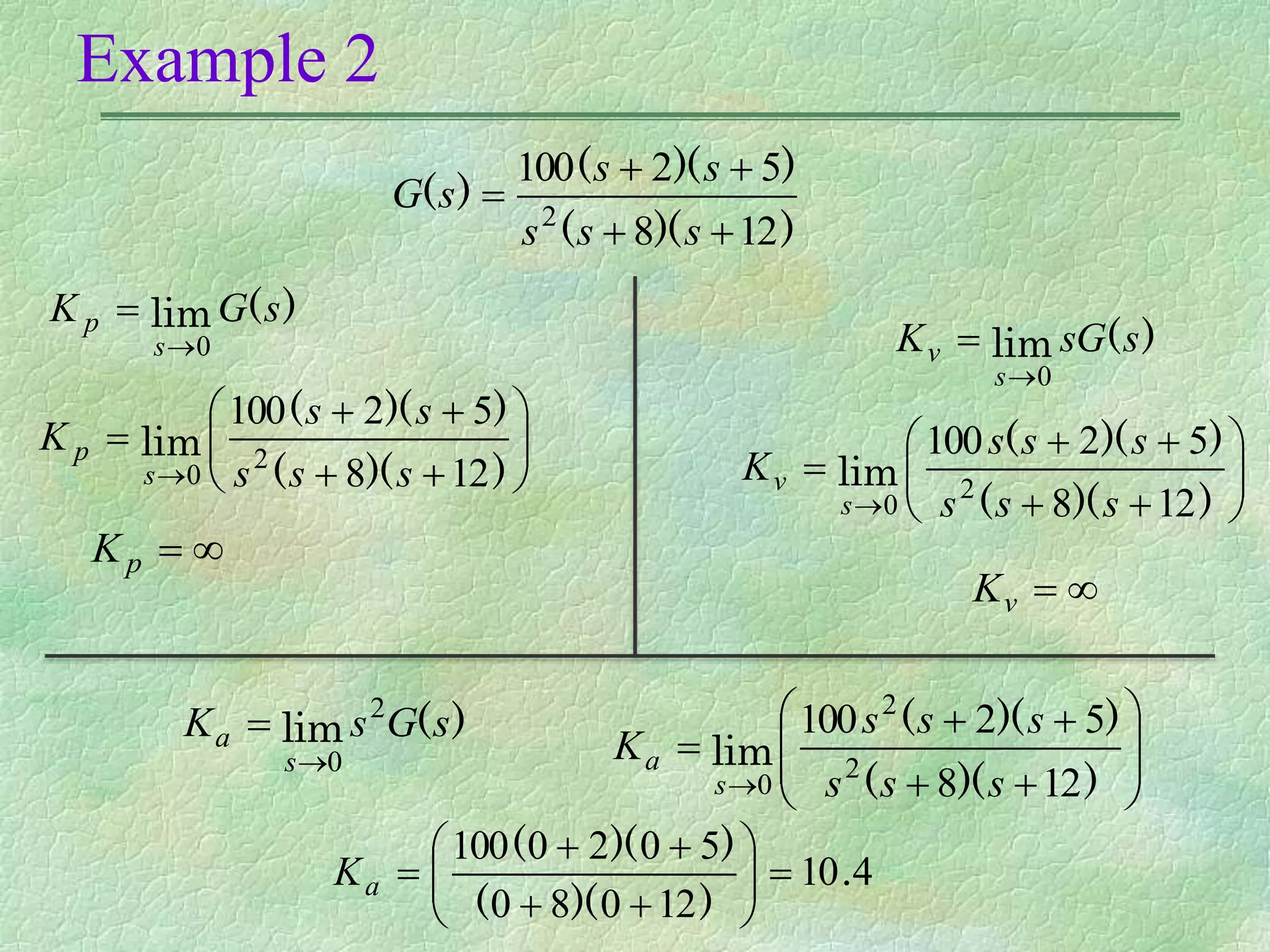
Example 2
 For the system shown in figure below evaluate the static
error constants and find the expected steady state errors
for the standard step, ramp and parabolic inputs.
C(S)
R(S) -
)
)(
(
)
)(
(
12
8
5
2
100
2




s
s
s
s
s
Example 2
)
)(
(
)
)(
(
)
(
12
8
5
2
100
2





s
s
s
s
s
s
G
)
(
lim s
G
K
s
p
0















 )
)(
(
)
)(
(
lim
12
8
5
2
100
2
0 s
s
s
s
s
K
s
p


p
K
)
(
lim s
sG
K
s
v
0















 )
)(
(
)
)(
(
lim
12
8
5
2
100
2
0 s
s
s
s
s
s
K
s
v


v
K
)
(
lim s
G
s
K
s
a
2
0















 )
)(
(
)
)(
(
lim
12
8
5
2
100
2
2
0 s
s
s
s
s
s
K
s
a
4
10
12
0
8
0
5
0
2
0
100
.
)
)(
(
)
)(
(














a
K
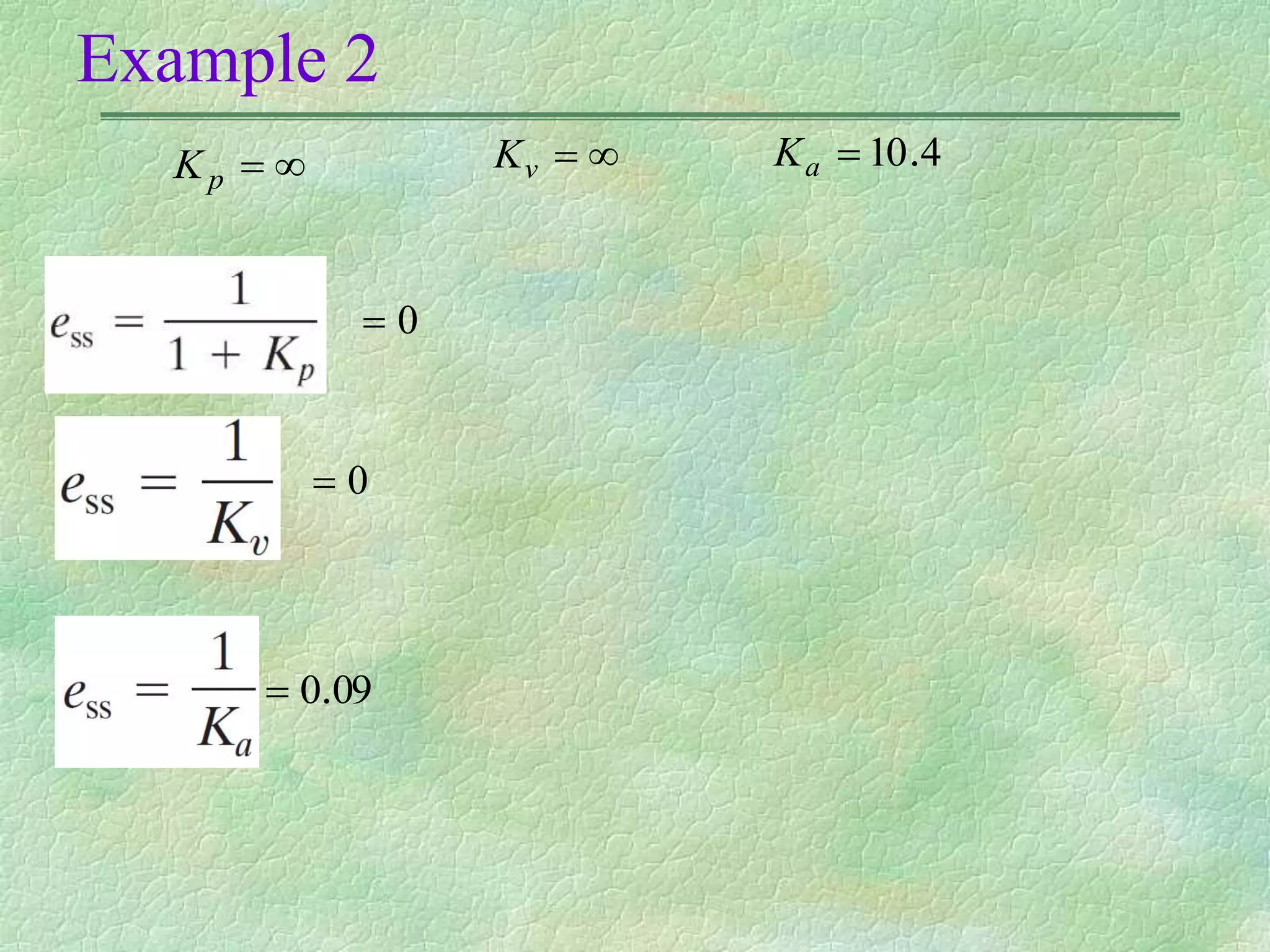
Example 2


p
K 

v
K 4
10.

a
K
0

0

09
0.


lecture1 (5).pptx

  • 1.
  • 2.
    Classification of ControlSystems  Consider the unity-feedback control system with the following open-loop transfer function • It involves the term sN in the denominator, representing N poles at the origin. • A system is called type 0, type 1, type 2, ... , if N=0, N=1, N=2, ... , respectively.
  • 3.
    Classification of ControlSystems  As the type number is increased, accuracy is improved.  However, increasing the type number aggravates the stability problem.  A compromise between steady-state accuracy and relative stability is always necessary.
  • 4.
    Steady State Errorof Unity Feedback Systems  Consider the system shown in following figure.  The closed-loop transfer function is:
  • 5.
    Steady State Errorof Unity Feedback Systems  The transfer function between the error signal E(s) and the input signal R(s) is ) ( ) ( ) ( s G s R s E   1 1 • The final-value theorem provides a convenient way to find the steady-state performance of a stable system. • Since E(s) is • The steady state error is • Steady state error is defined as the error between the input signal and the output signal when 𝑡 → ∞.
  • 6.
    Test waveforms forevaluating steady-state errors of position control systems Steady state error analysis
  • 7.
    Steady-state error: a. stepinput; b. ramp input System response to different inputs
  • 8.
    Static Error Constants The static error constants are figures of merit of control systems. The higher the constants, the smaller the steady- state error.  In a given system, the output may be the position, velocity, pressure, temperature, or the like.  Therefore, in what follows, we shall call the output “position,” the rate of change of the output “velocity,” and so on.  This means that in a temperature control system “position” represents the output temperature, “velocity” represents the rate of change of the output temperature, and so on.
  • 9.
    Static Position ErrorConstant (Kp)  For a Type 0 system  For Type 1 or higher order systems  For a unit step input the steady state error ess is
  • 10.
     The steady-stateerror of the system for a unit-ramp input is  The static velocity error constant Kv is defined by  Thus, the steady-state error in terms of the static velocity error constant Kv is given by Static Velocity Error Constant (Kv)
  • 11.
    Static Velocity ErrorConstant (Kv)  For a Type 0 system  For Type 1 systems  For type 2 or higher order systems
  • 12.
    Static Velocity ErrorConstant (Kv)  For a ramp input the steady state error ess is
  • 13.
     The steady-stateerror of the system for parabolic input is  The static acceleration error constant Ka is defined by  Thus, the steady-state error in terms of the static acceleration error constant Ka is given by Static Acceleration Error Constant (Ka)
  • 14.
    Static Acceleration ErrorConstant (Ka)  For a Type 0 system  For Type 1 systems  For type 2 systems  For type 3 or higher order systems
  • 15.
    Static Acceleration ErrorConstant (Ka)  For a parabolic input the steady state error ess is
  • 16.
  • 17.
    Example 2  Forthe system shown in figure below evaluate the static error constants and find the expected steady state errors for the standard step, ramp and parabolic inputs. C(S) R(S) - ) )( ( ) )( ( 12 8 5 2 100 2     s s s s s
  • 18.
    Example 2 ) )( ( ) )( ( ) ( 12 8 5 2 100 2      s s s s s s G ) ( lim s G K s p 0                ) )( ( ) )( ( lim 12 8 5 2 100 2 0 s s s s s K s p   p K ) ( lim s sG K s v 0                 ) )( ( ) )( ( lim 12 8 5 2 100 2 0 s s s s s s K s v   v K ) ( lim s G s K s a 2 0                 ) )( ( ) )( ( lim 12 8 5 2 100 2 2 0 s s s s s s K s a 4 10 12 0 8 0 5 0 2 0 100 . ) )( ( ) )( (               a K
  • 19.
    Example 2   p K   v K4 10.  a K 0  0  09 0. 