Week 4 ELE 774 - Adaptive Signal Processing 1
LINEAR PREDICTION
ELE 774 - Adaptive Signal Processing2Week 4
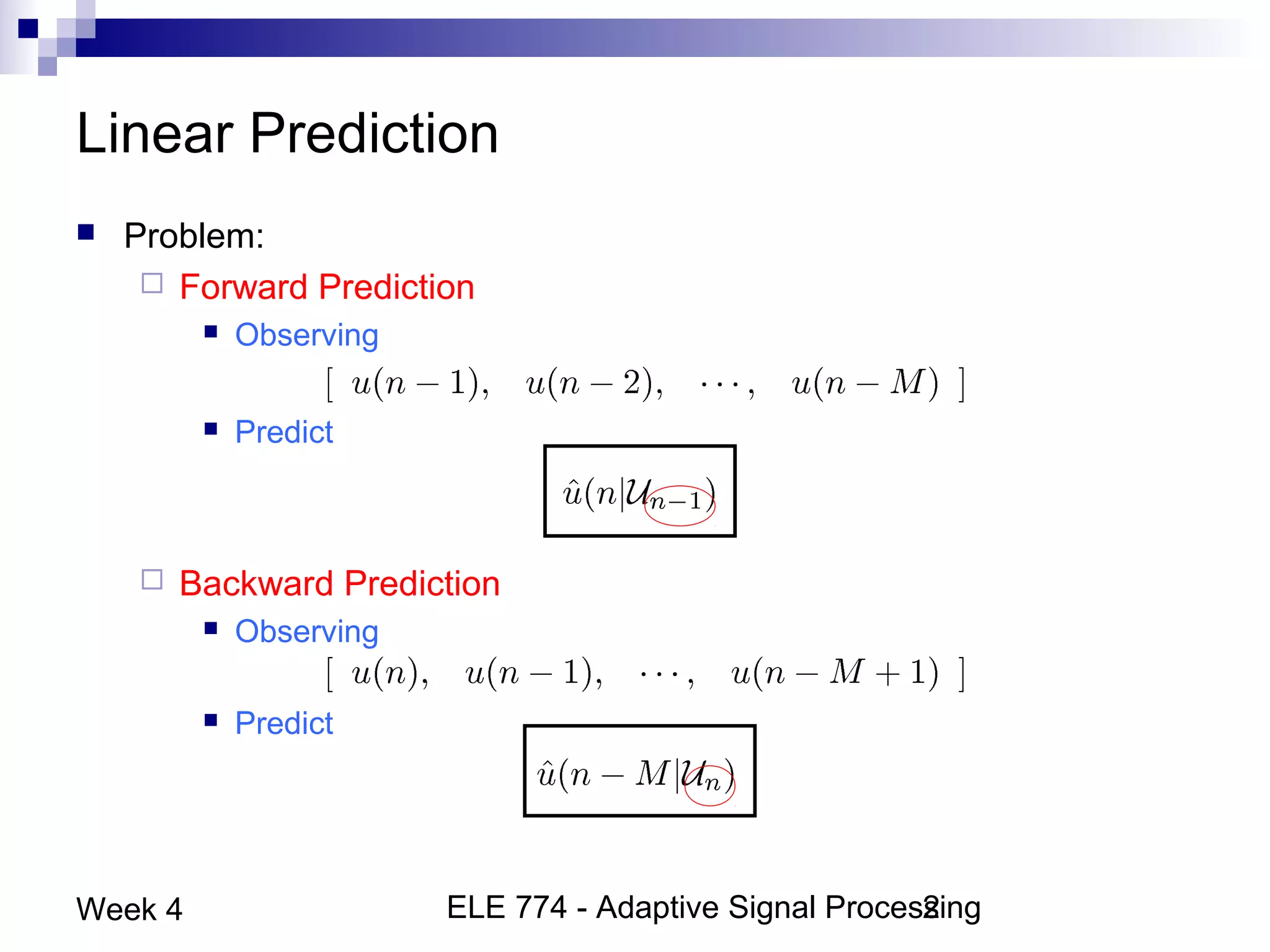
Linear Prediction
 Problem:
 Forward Prediction
 Observing
 Predict
 Backward Prediction
 Observing
 Predict
ELE 774 - Adaptive Signal Processing3Week 4
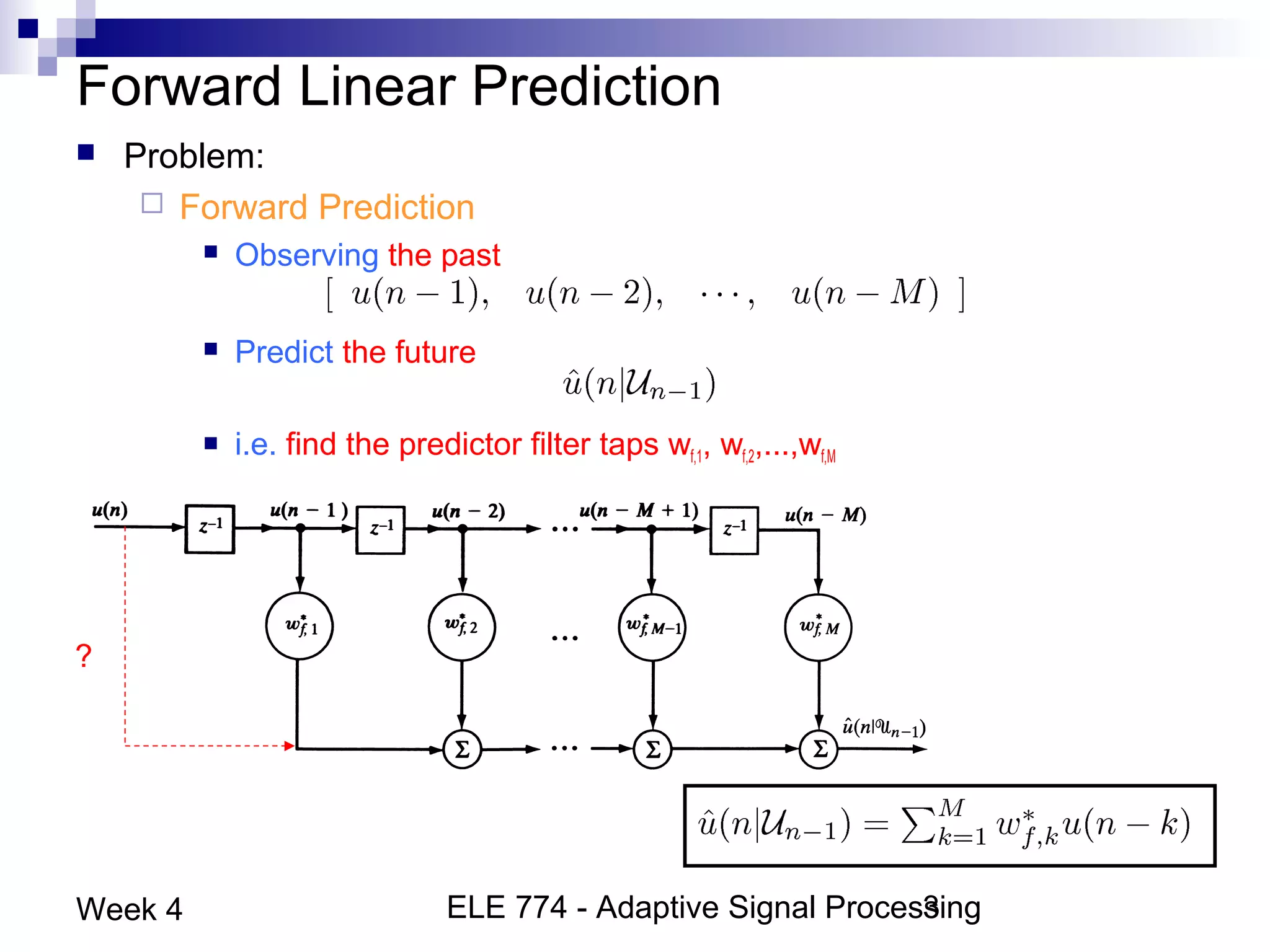
Forward Linear Prediction
 Problem:
 Forward Prediction
 Observing the past
 Predict the future
 i.e. find the predictor filter taps wf,1, wf,2,...,wf,M
?
ELE 774 - Adaptive Signal Processing4Week 4
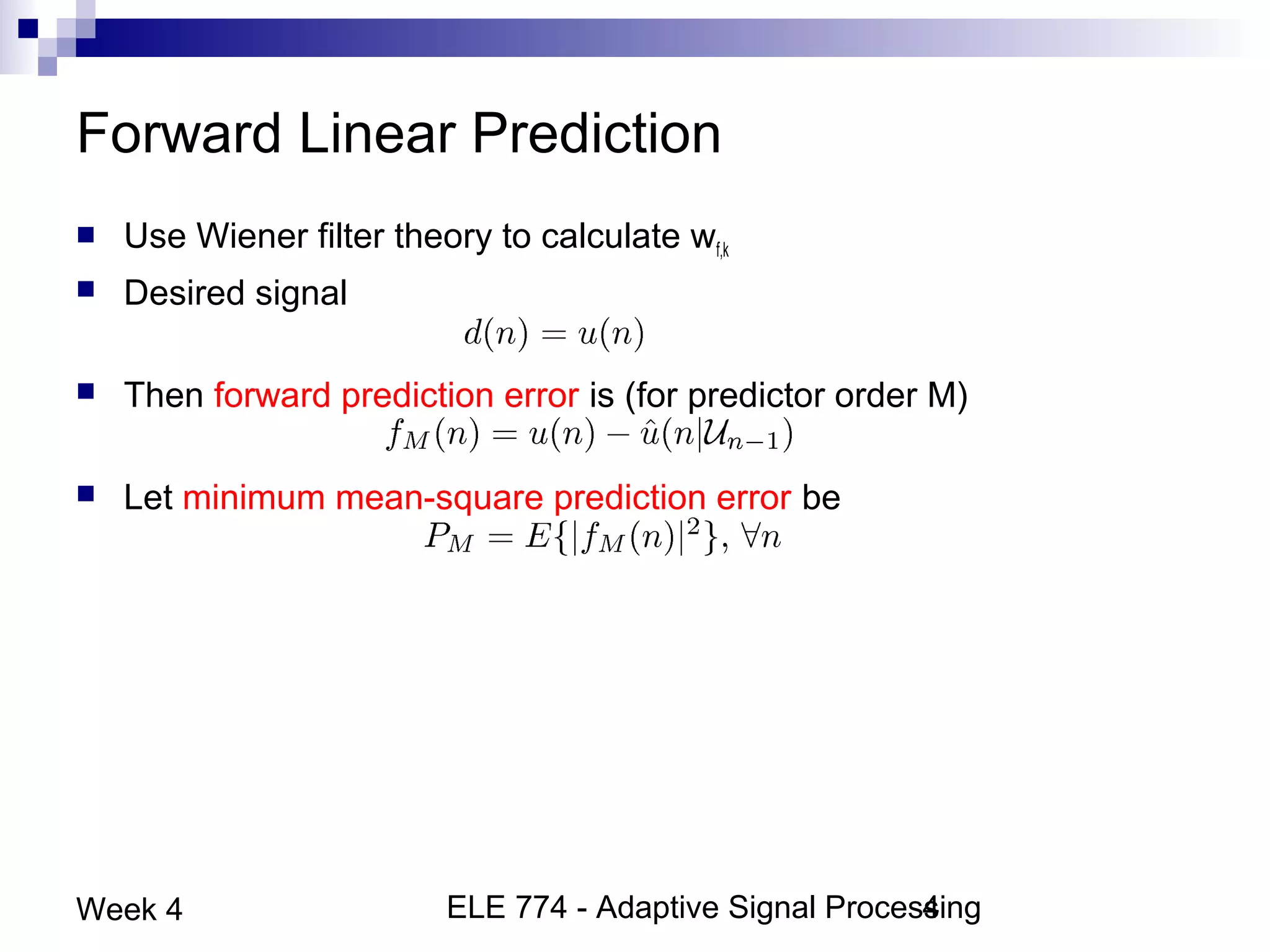
Forward Linear Prediction
 Use Wiener filter theory to calculate wf,k
 Desired signal
 Then forward prediction error is (for predictor order M)
 Let minimum mean-square prediction error be
ELE 774 - Adaptive Signal Processing5Week 4
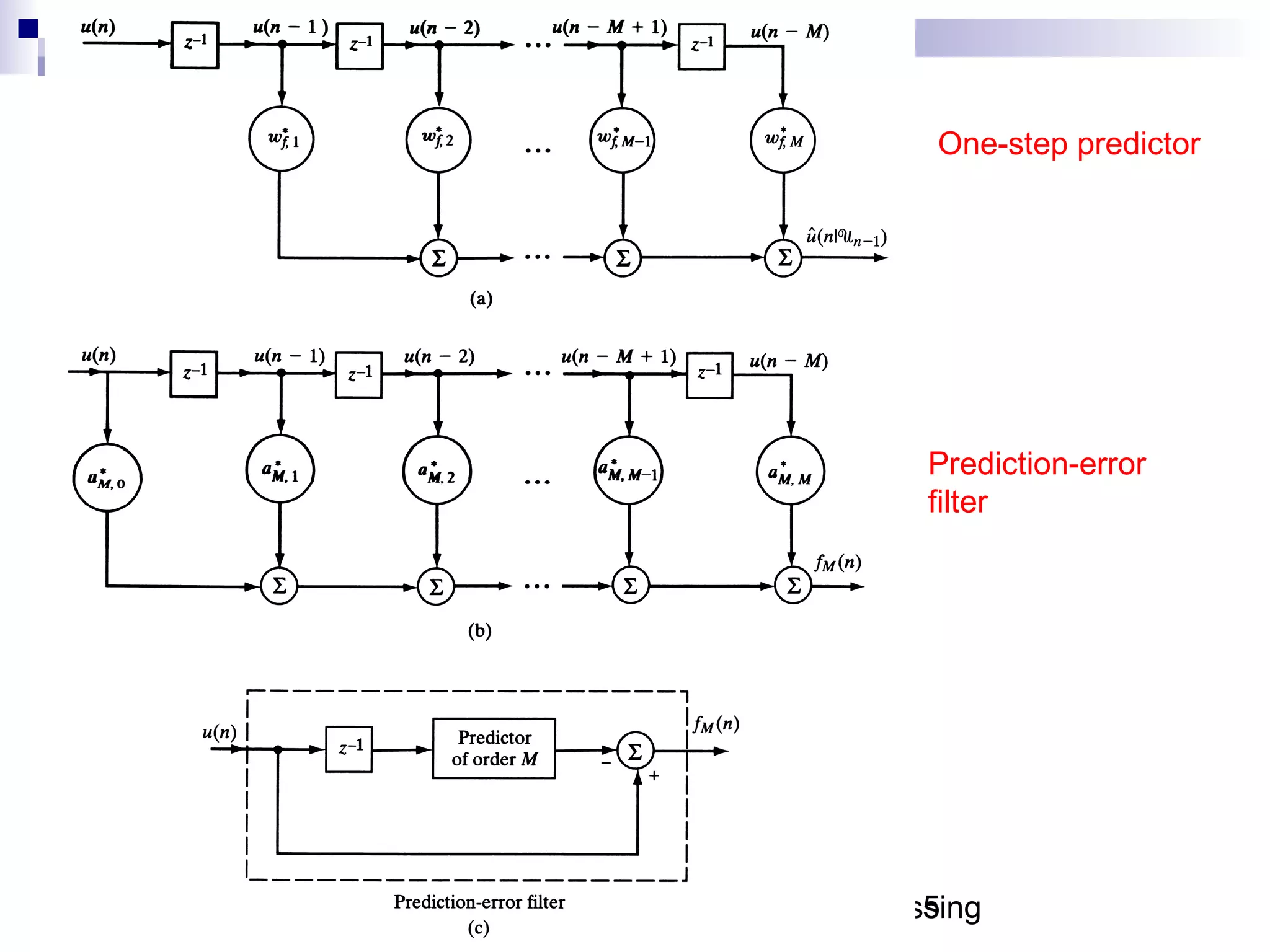
One-step predictor
Prediction-error
filter
ELE 774 - Adaptive Signal Processing6Week 4
Forward Linear Prediction
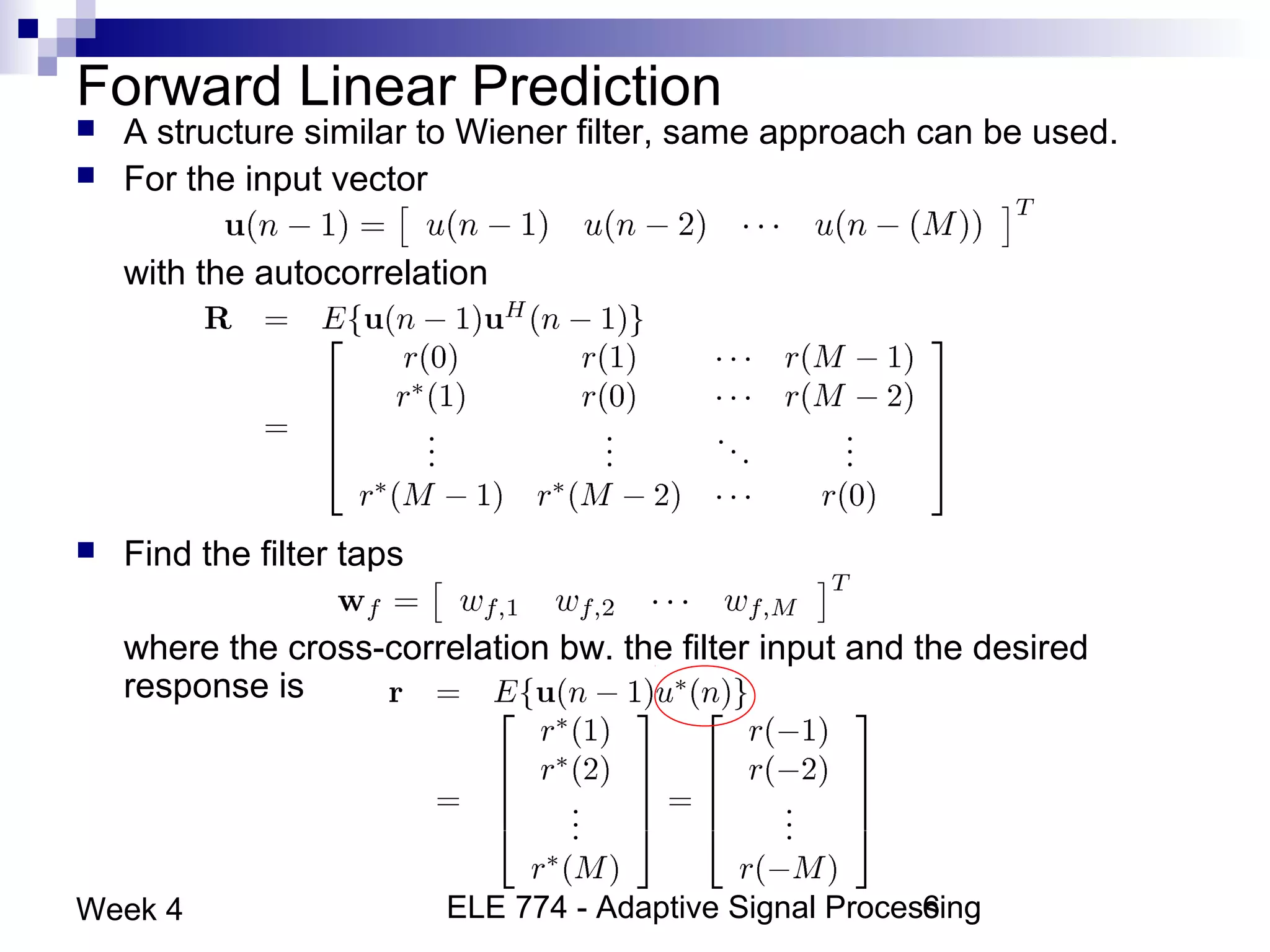
 A structure similar to Wiener filter, same approach can be used.
 For the input vector
with the autocorrelation
 Find the filter taps
where the cross-correlation bw. the filter input and the desired
response is
ELE 774 - Adaptive Signal Processing7Week 4
Forward Linear Prediction
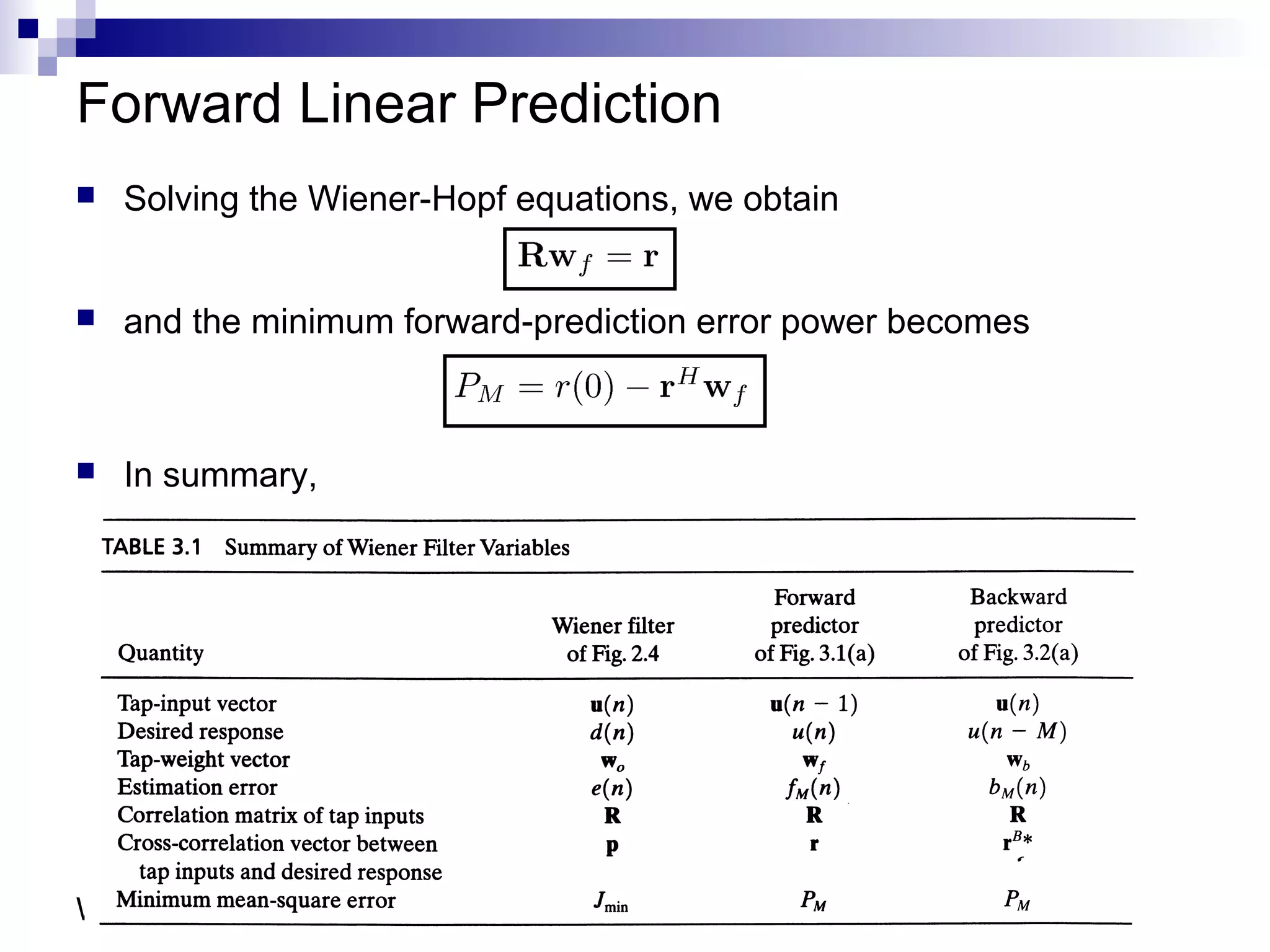
 Solving the Wiener-Hopf equations, we obtain
 and the minimum forward-prediction error power becomes
 In summary,
ELE 774 - Adaptive Signal Processing8Week 4
Relation bw. Linear Prediction and AR Modelling
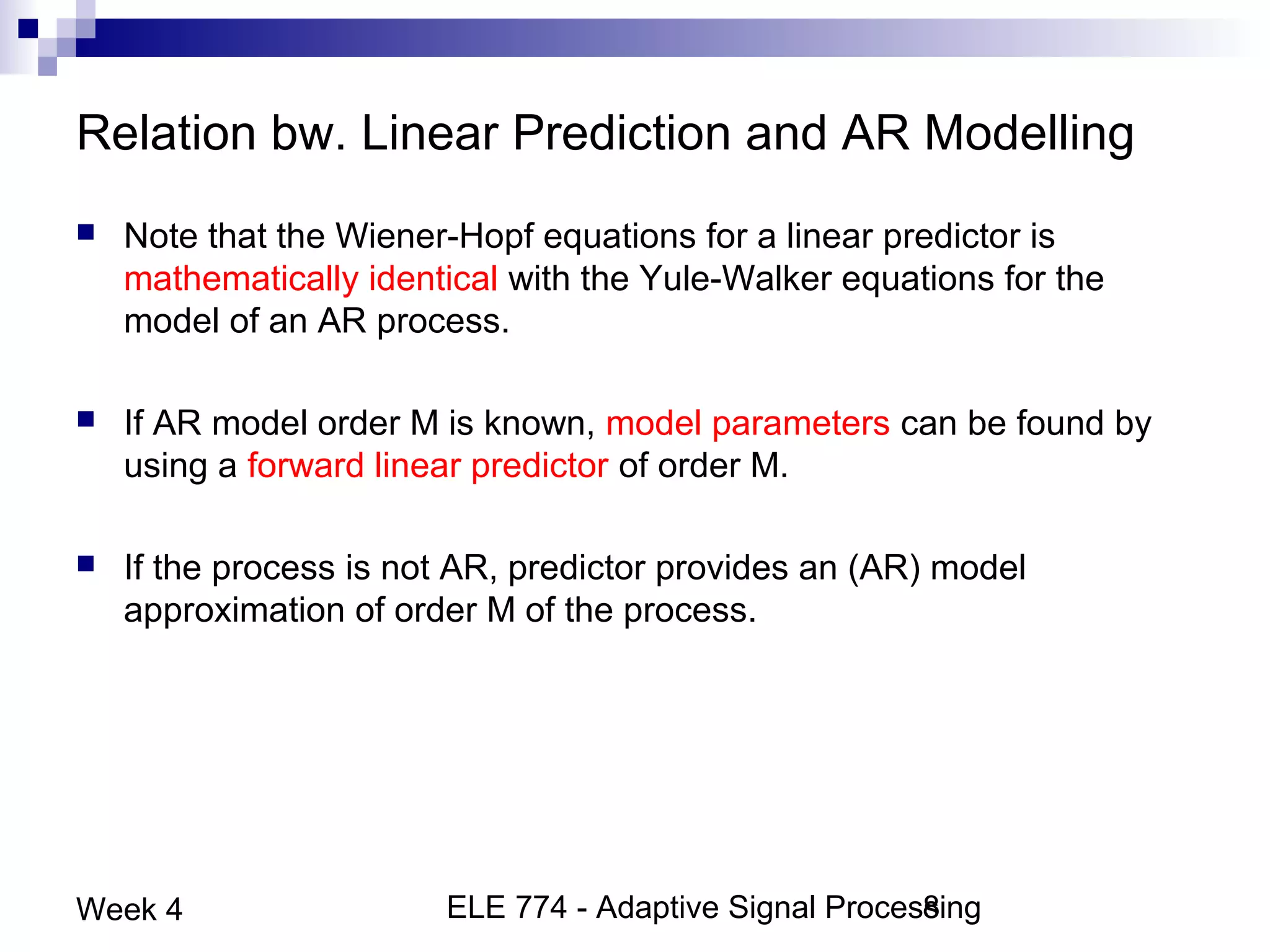
 Note that the Wiener-Hopf equations for a linear predictor is
mathematically identical with the Yule-Walker equations for the
model of an AR process.
 If AR model order M is known, model parameters can be found by
using a forward linear predictor of order M.
 If the process is not AR, predictor provides an (AR) model
approximation of order M of the process.
ELE 774 - Adaptive Signal Processing9Week 4
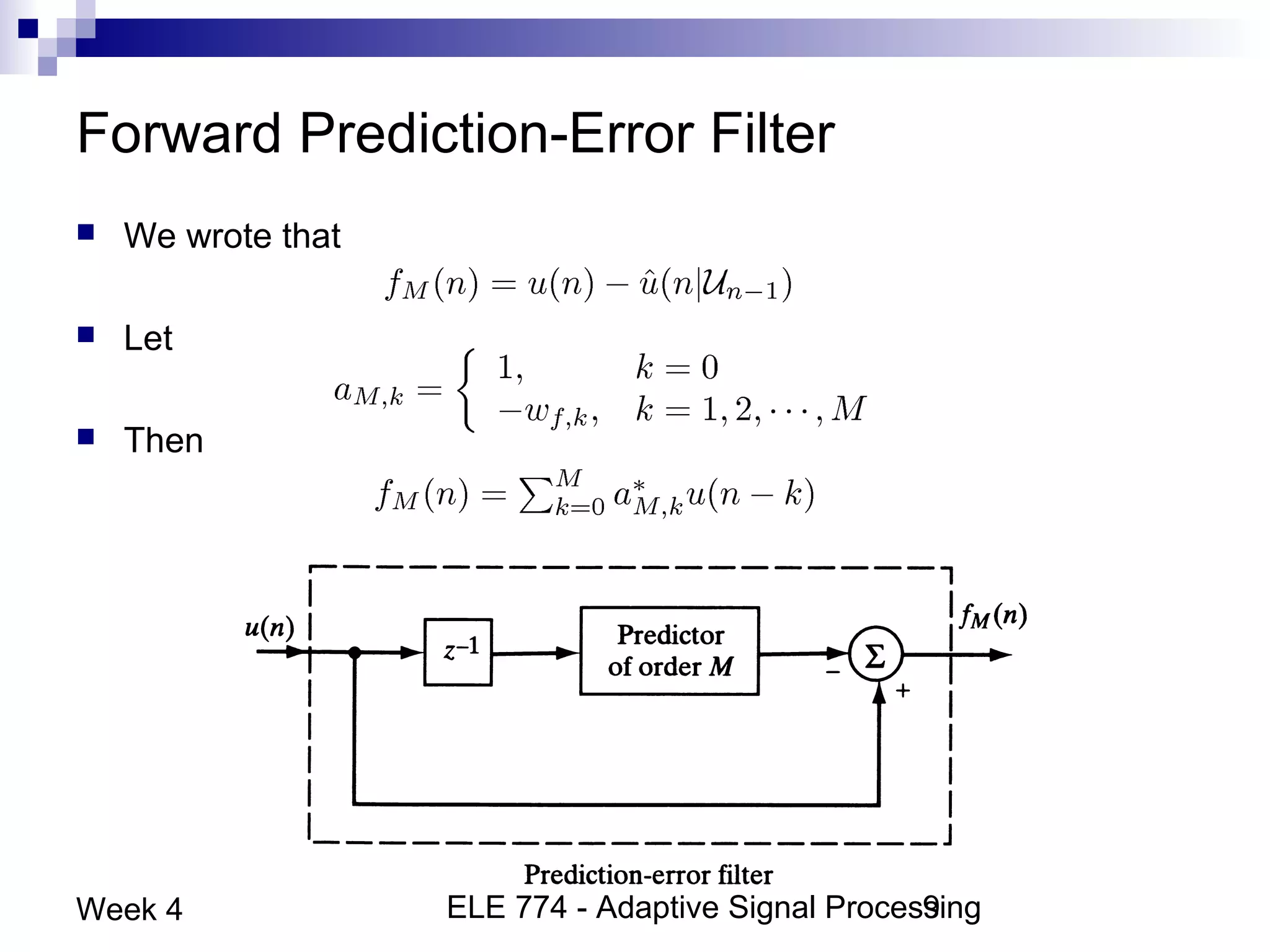
Forward Prediction-Error Filter
 We wrote that
 Let
 Then
ELE 774 - Adaptive Signal Processing10Week 4
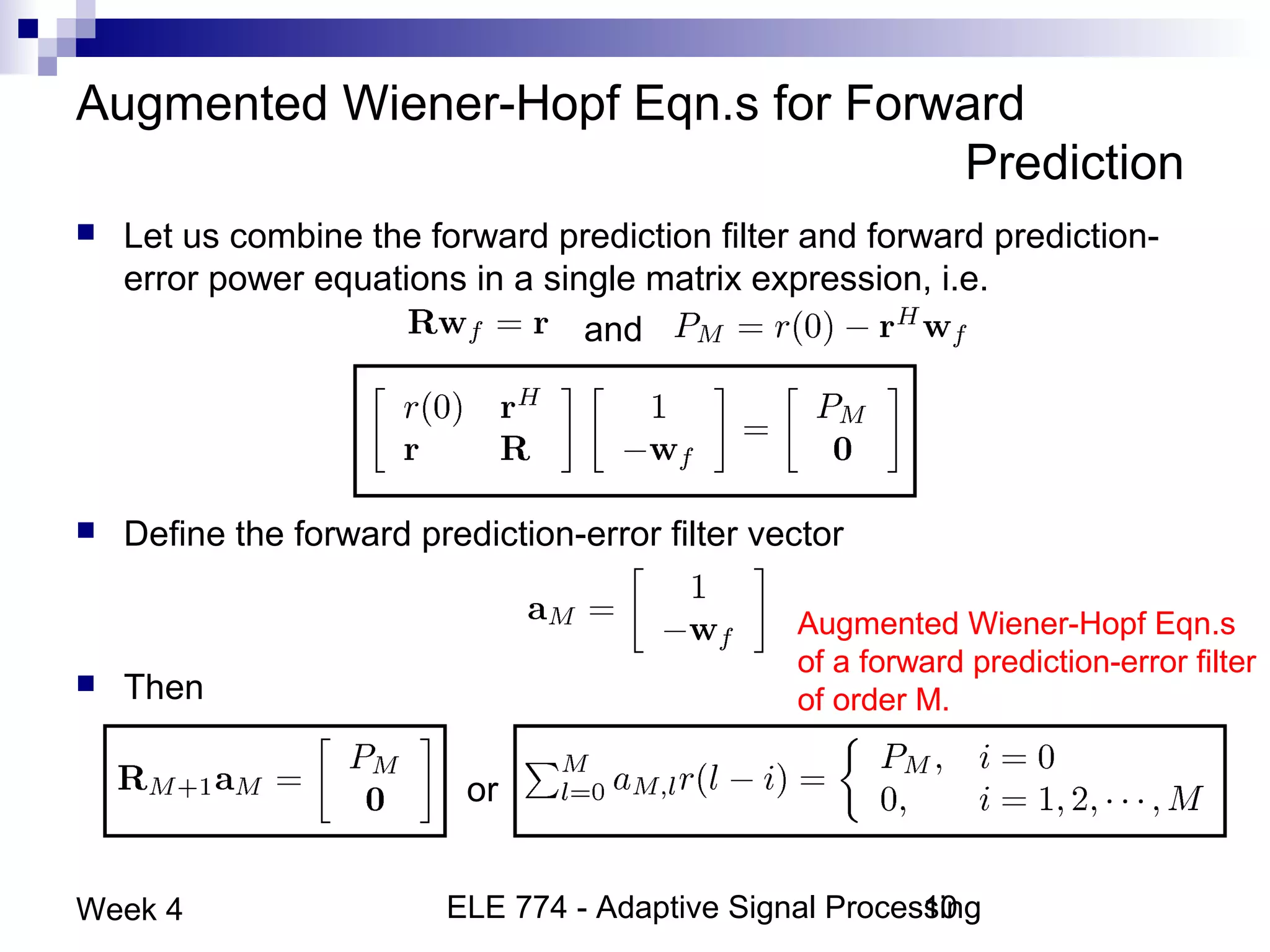
Augmented Wiener-Hopf Eqn.s for Forward
Prediction
 Let us combine the forward prediction filter and forward prediction-
error power equations in a single matrix expression, i.e.
and
 Define the forward prediction-error filter vector
 Then
or
Augmented Wiener-Hopf Eqn.s
of a forward prediction-error filter
of order M.
ELE 774 - Adaptive Signal Processing11Week 4
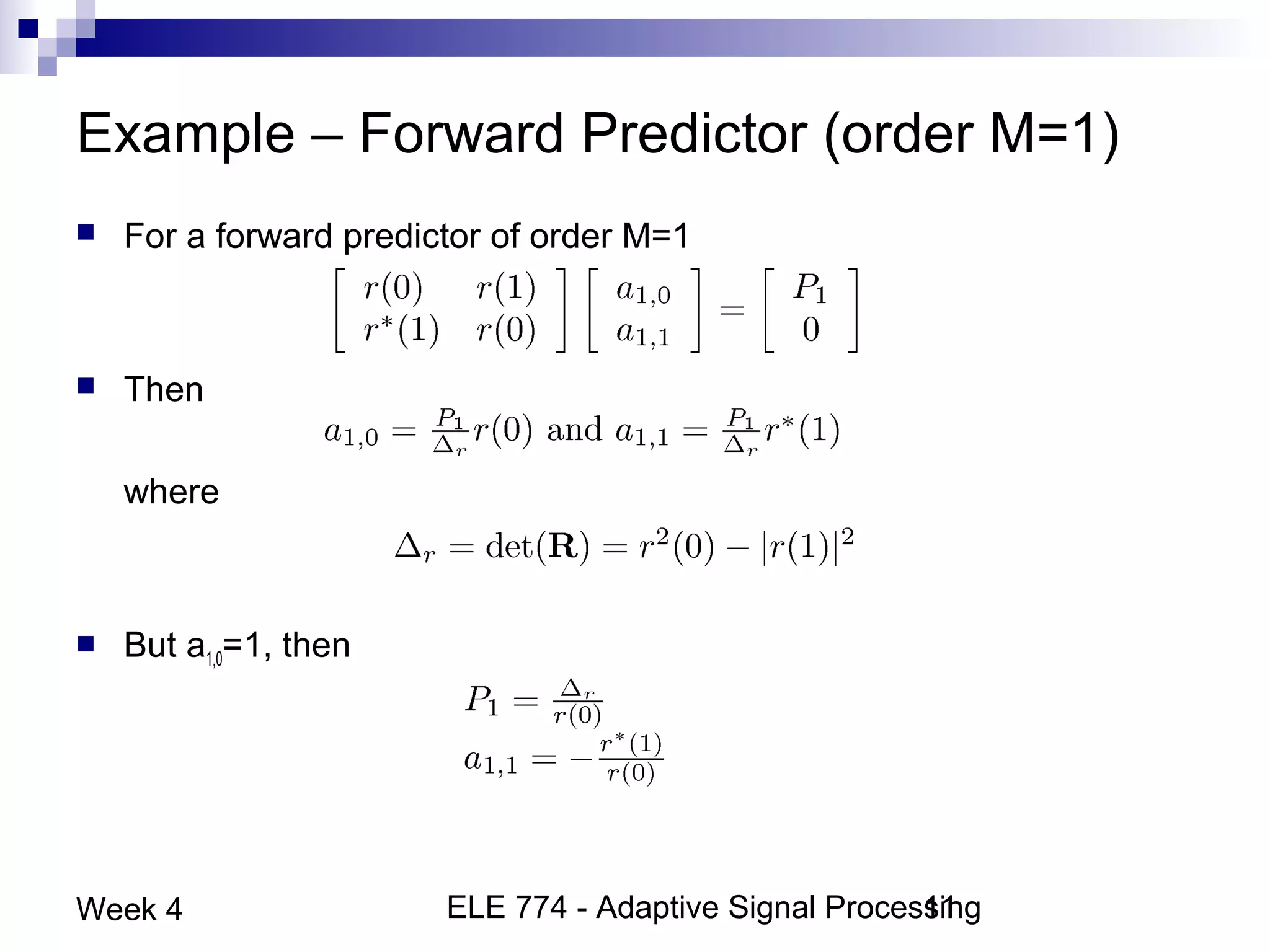
Example – Forward Predictor (order M=1)
 For a forward predictor of order M=1
 Then
where
 But a1,0=1, then
ELE 774 - Adaptive Signal Processing12Week 4
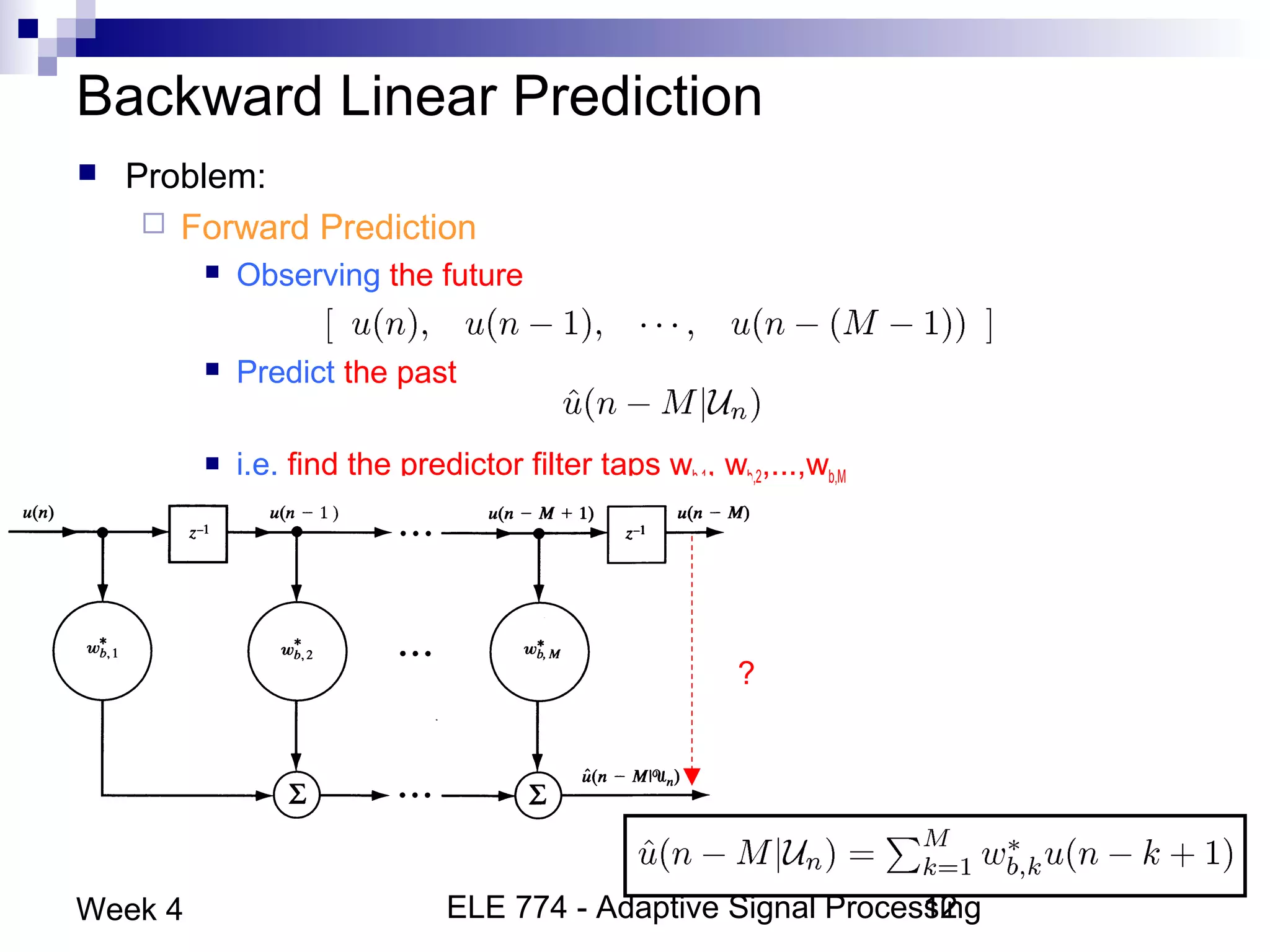
Backward Linear Prediction
 Problem:
 Forward Prediction
 Observing the future
 Predict the past
 i.e. find the predictor filter taps wb,1, wb,2,...,wb,M
?
ELE 774 - Adaptive Signal Processing13Week 4
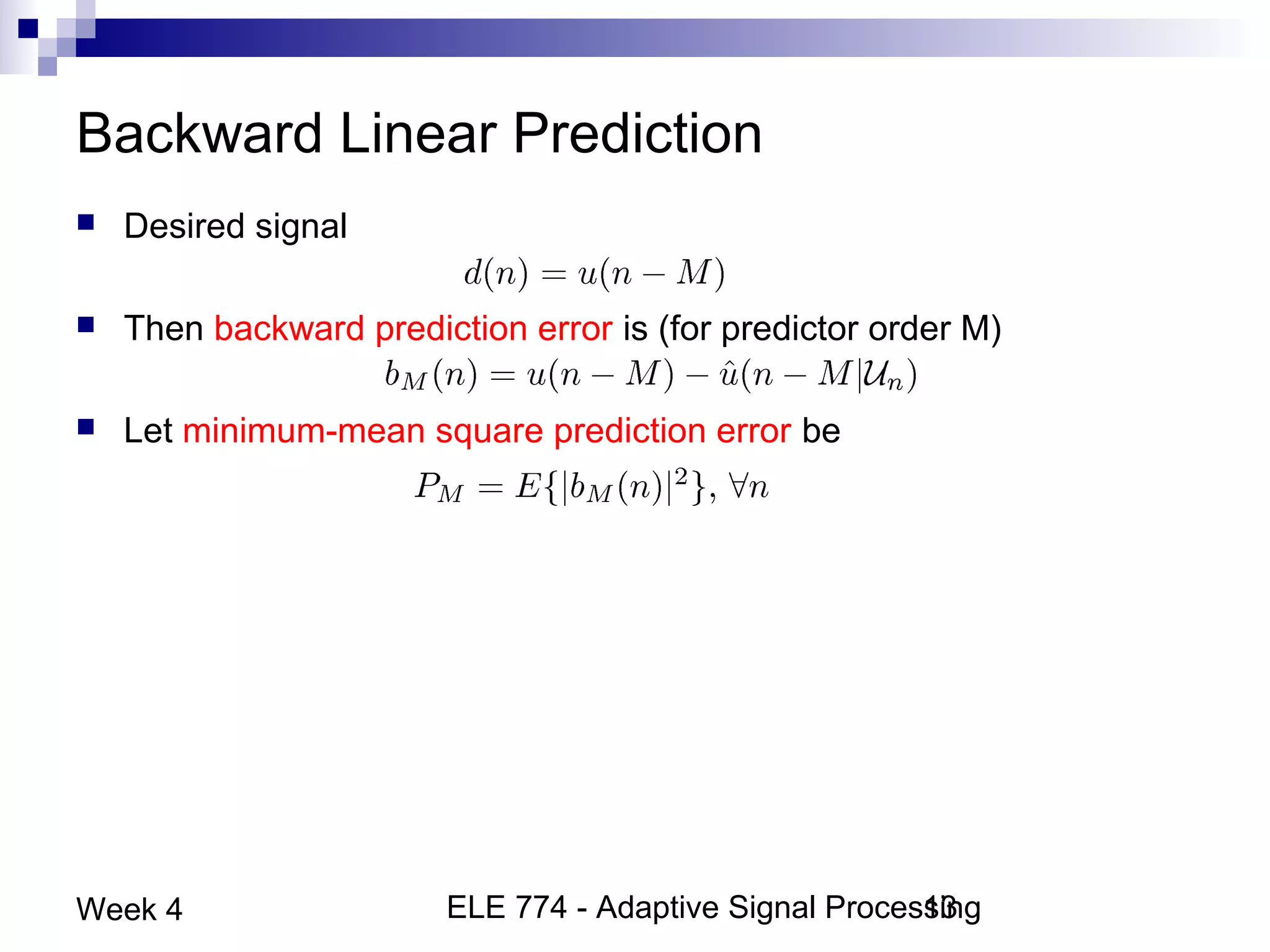
Backward Linear Prediction
 Desired signal
 Then backward prediction error is (for predictor order M)
 Let minimum-mean square prediction error be
ELE 774 - Adaptive Signal Processing14Week 4
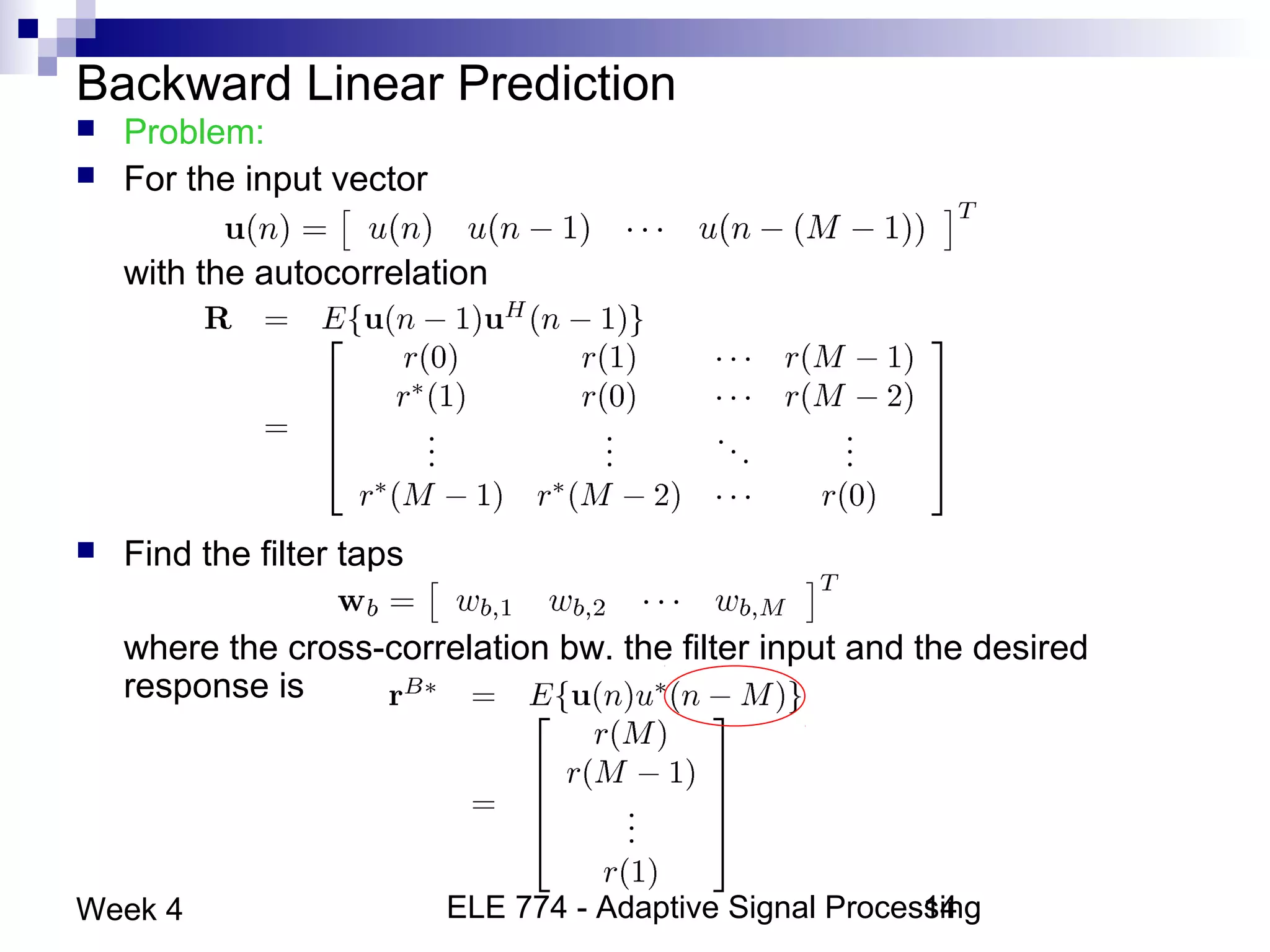
Backward Linear Prediction
 Problem:
 For the input vector
with the autocorrelation
 Find the filter taps
where the cross-correlation bw. the filter input and the desired
response is
ELE 774 - Adaptive Signal Processing15Week 4
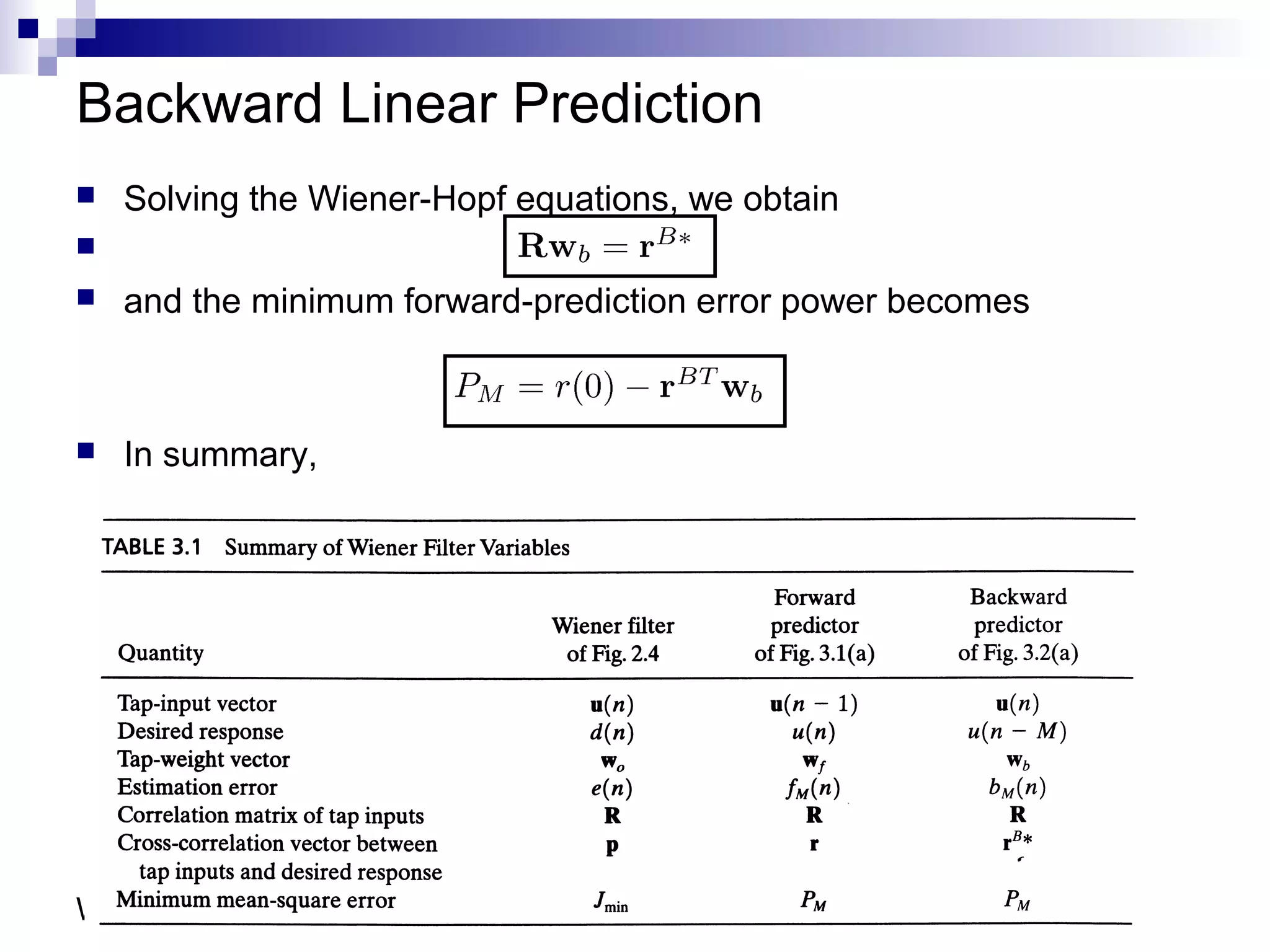
Backward Linear Prediction
 Solving the Wiener-Hopf equations, we obtain

 and the minimum forward-prediction error power becomes
 In summary,
ELE 774 - Adaptive Signal Processing16Week 4
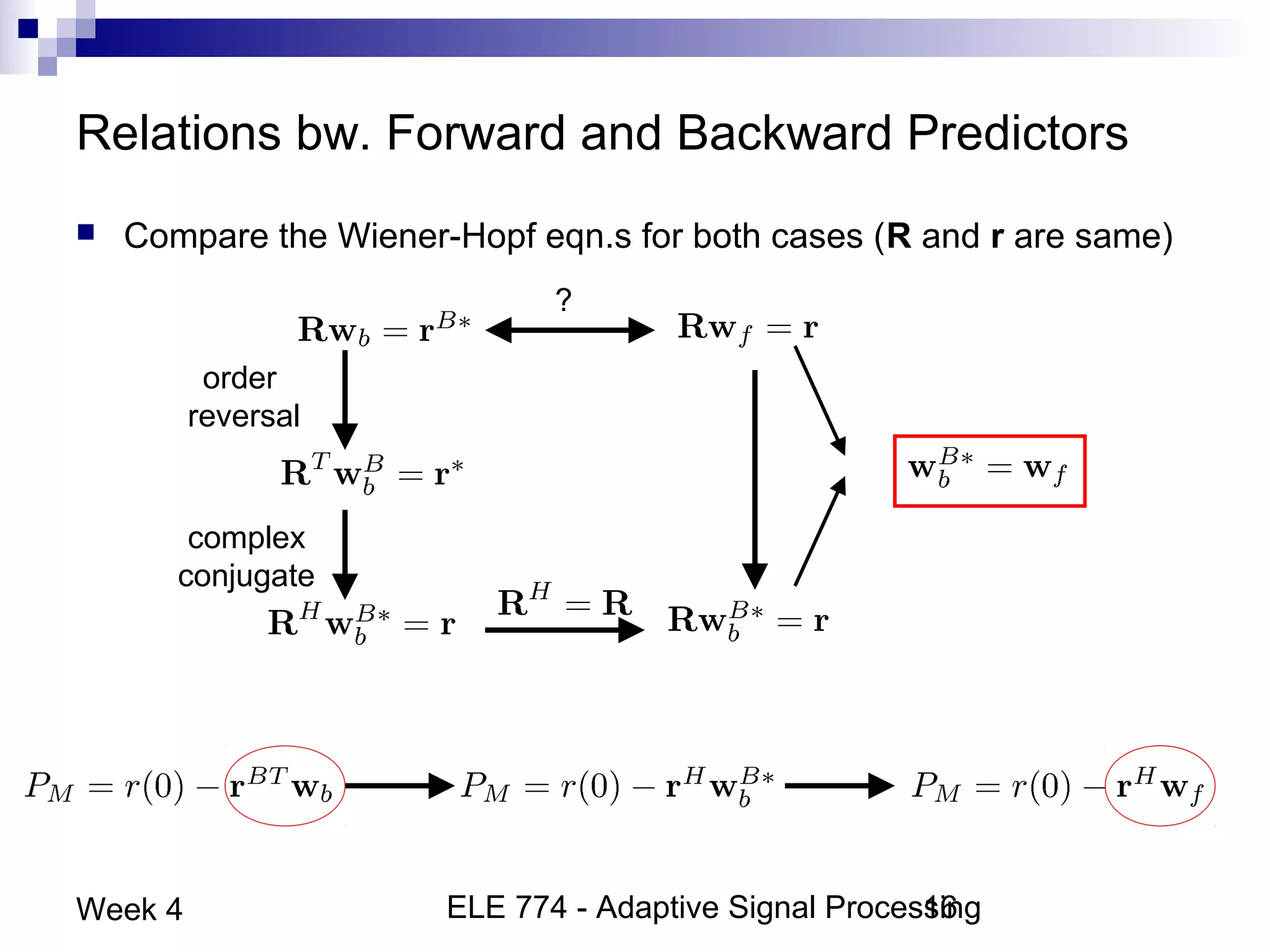
Relations bw. Forward and Backward Predictors
 Compare the Wiener-Hopf eqn.s for both cases (R and r are same)
order
reversal
complex
conjugate
?
ELE 774 - Adaptive Signal Processing17Week 4
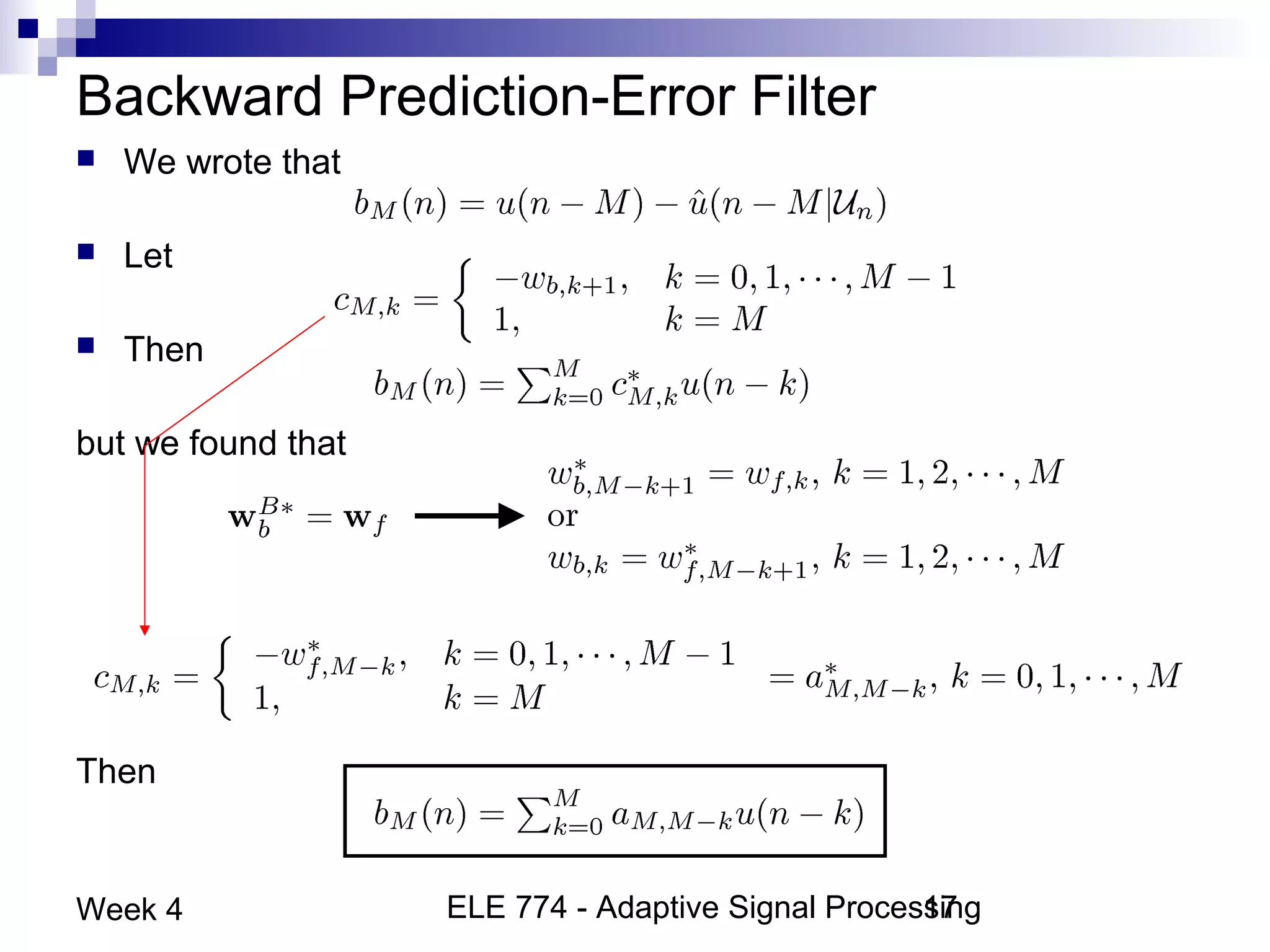
Backward Prediction-Error Filter
 We wrote that
 Let
 Then
but we found that
Then
ELE 774 - Adaptive Signal Processing18Week 4
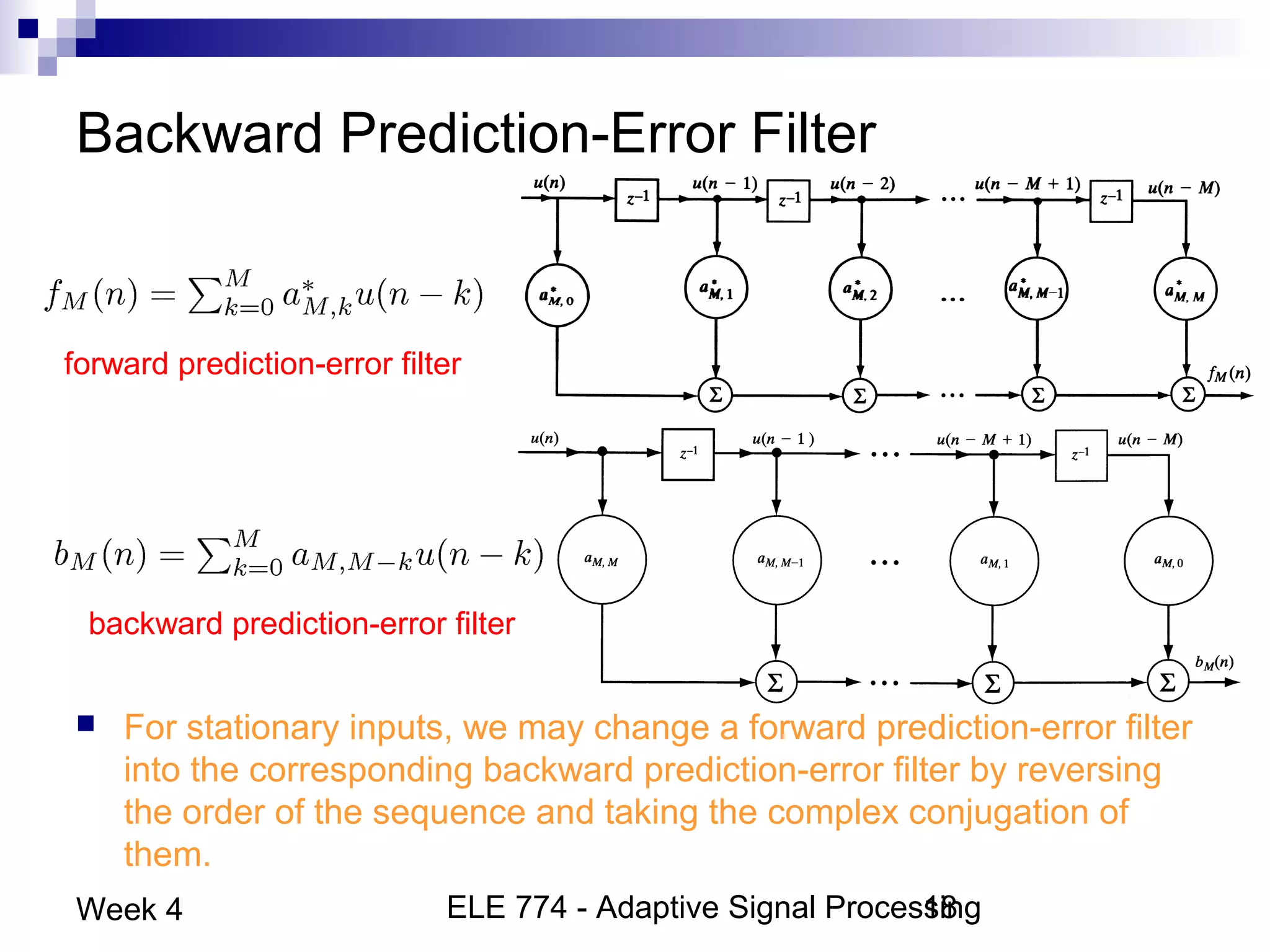
Backward Prediction-Error Filter
 For stationary inputs, we may change a forward prediction-error filter
into the corresponding backward prediction-error filter by reversing
the order of the sequence and taking the complex conjugation of
them.
forward prediction-error filter
backward prediction-error filter
ELE 774 - Adaptive Signal Processing19Week 4
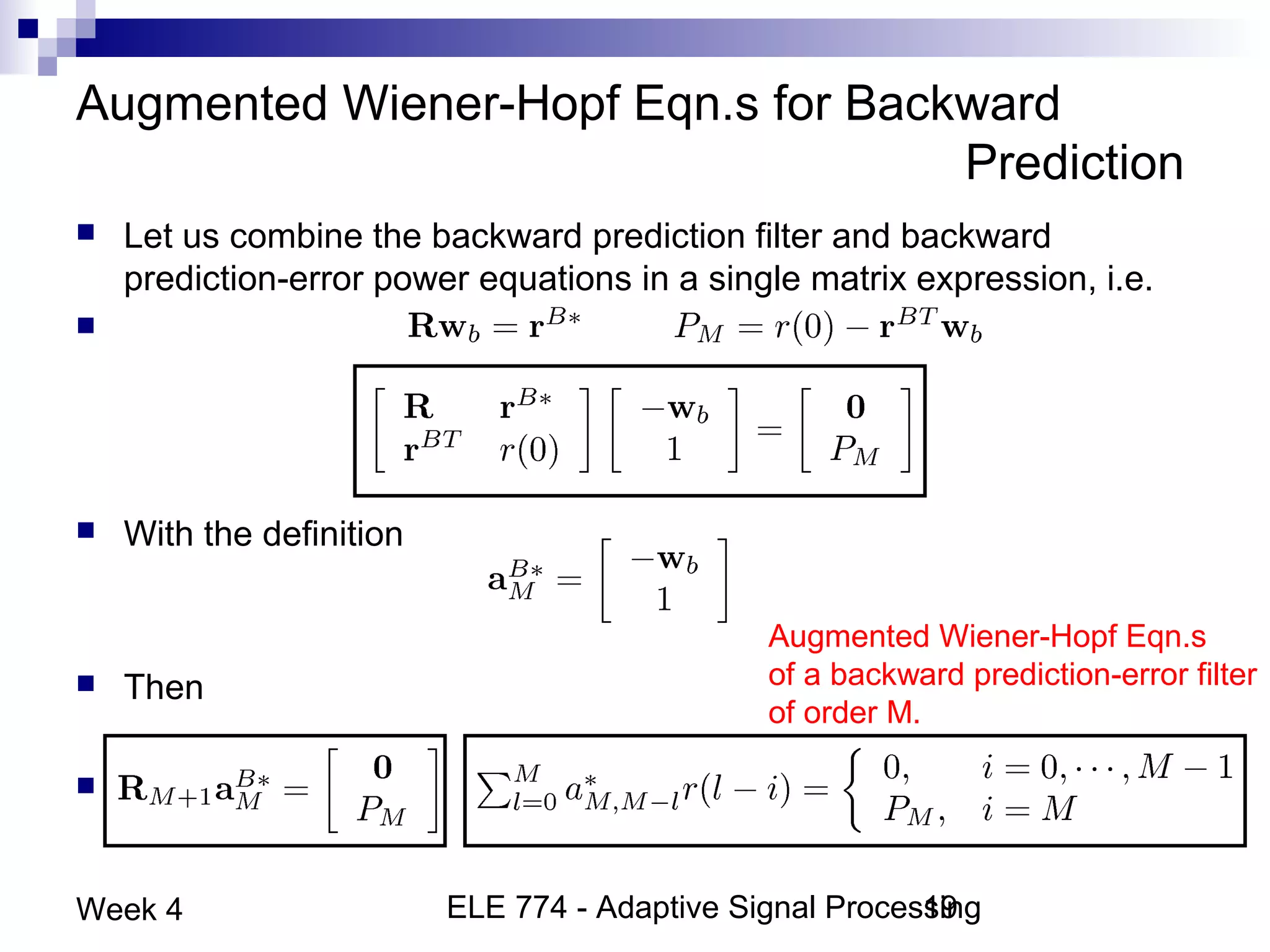
Augmented Wiener-Hopf Eqn.s for Backward
Prediction
 Let us combine the backward prediction filter and backward
prediction-error power equations in a single matrix expression, i.e.
 and
 With the definition
 Then
 or
Augmented Wiener-Hopf Eqn.s
of a backward prediction-error filter
of order M.
ELE 774 - Adaptive Signal Processing20Week 4
Levinson-Durbin Algorithm
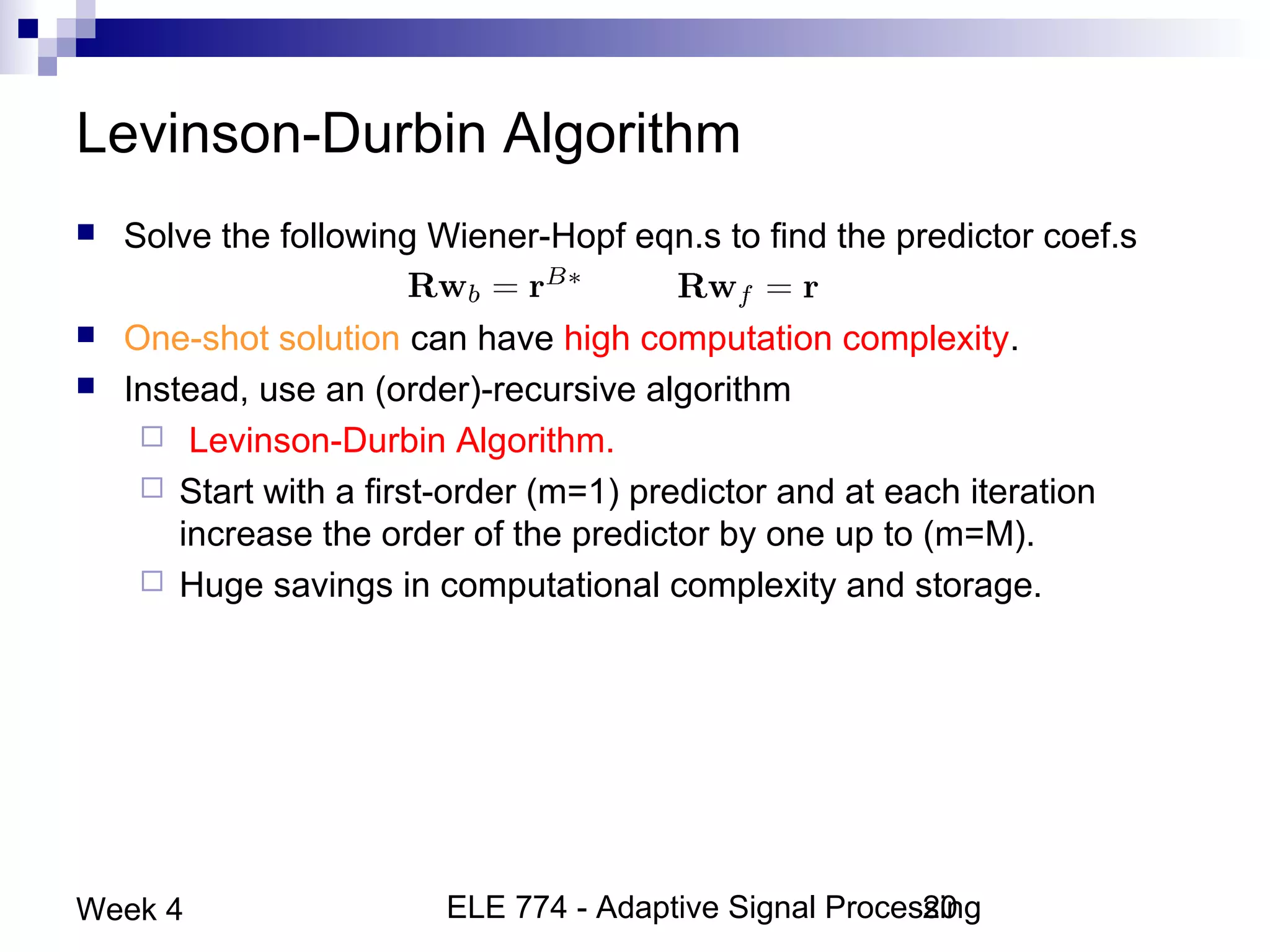
 Solve the following Wiener-Hopf eqn.s to find the predictor coef.s
 One-shot solution can have high computation complexity.
 Instead, use an (order)-recursive algorithm
 Levinson-Durbin Algorithm.
 Start with a first-order (m=1) predictor and at each iteration
increase the order of the predictor by one up to (m=M).
 Huge savings in computational complexity and storage.
ELE 774 - Adaptive Signal Processing21Week 4
Levinson-Durbin Algorithm
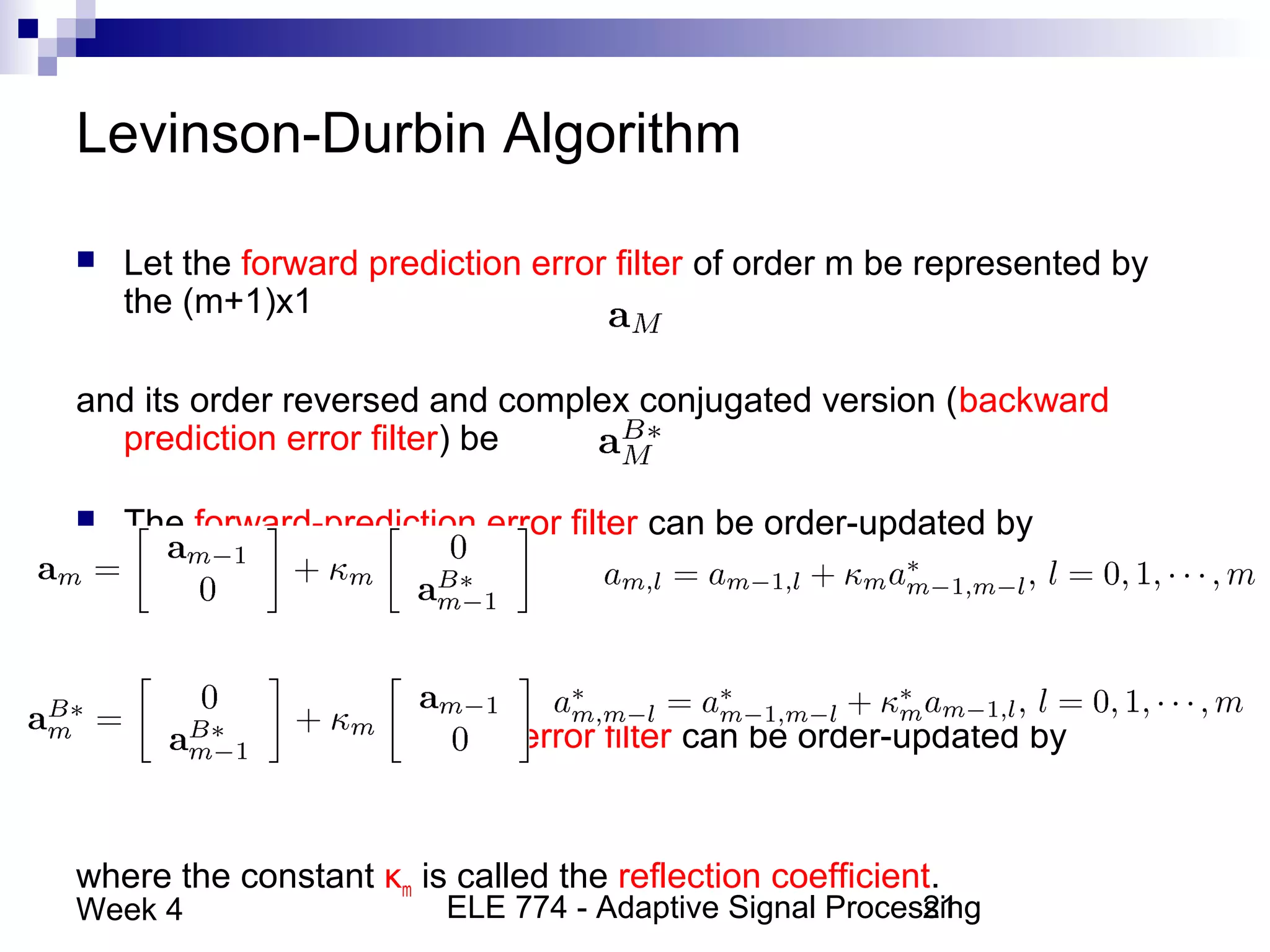
 Let the forward prediction error filter of order m be represented by
the (m+1)x1
and its order reversed and complex conjugated version (backward
prediction error filter) be
 The forward-prediction error filter can be order-updated by
 The backward-prediction error filter can be order-updated by
where the constant κm is called the reflection coefficient.
ELE 774 - Adaptive Signal Processing22Week 4
Levinson-Durbin Recursion
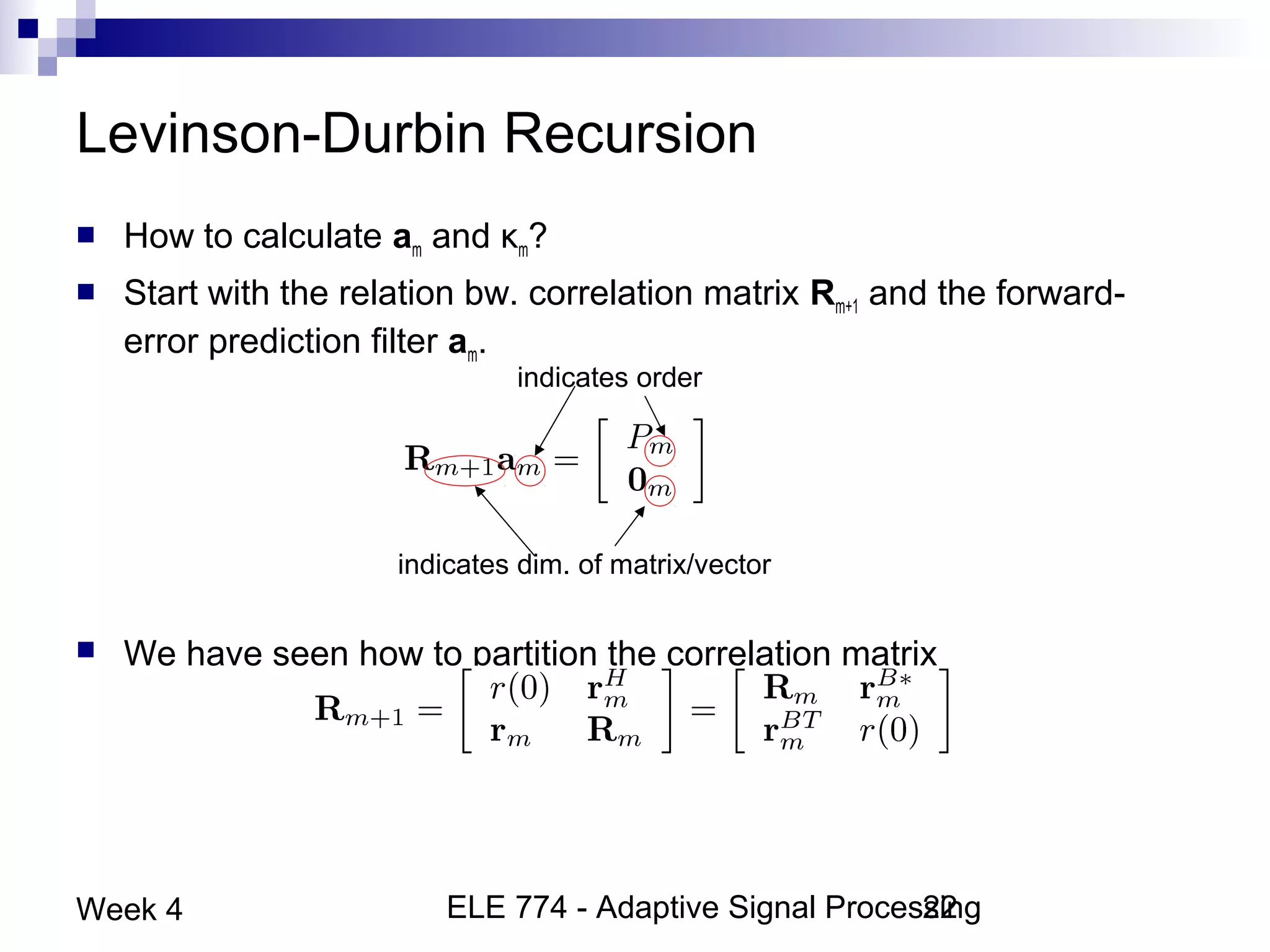
 How to calculate am and κm?
 Start with the relation bw. correlation matrix Rm+1 and the forward-
error prediction filter am.
 We have seen how to partition the correlation matrix
indicates order
indicates dim. of matrix/vector
ELE 774 - Adaptive Signal Processing23Week 4
Levinson-Durbin Recursion
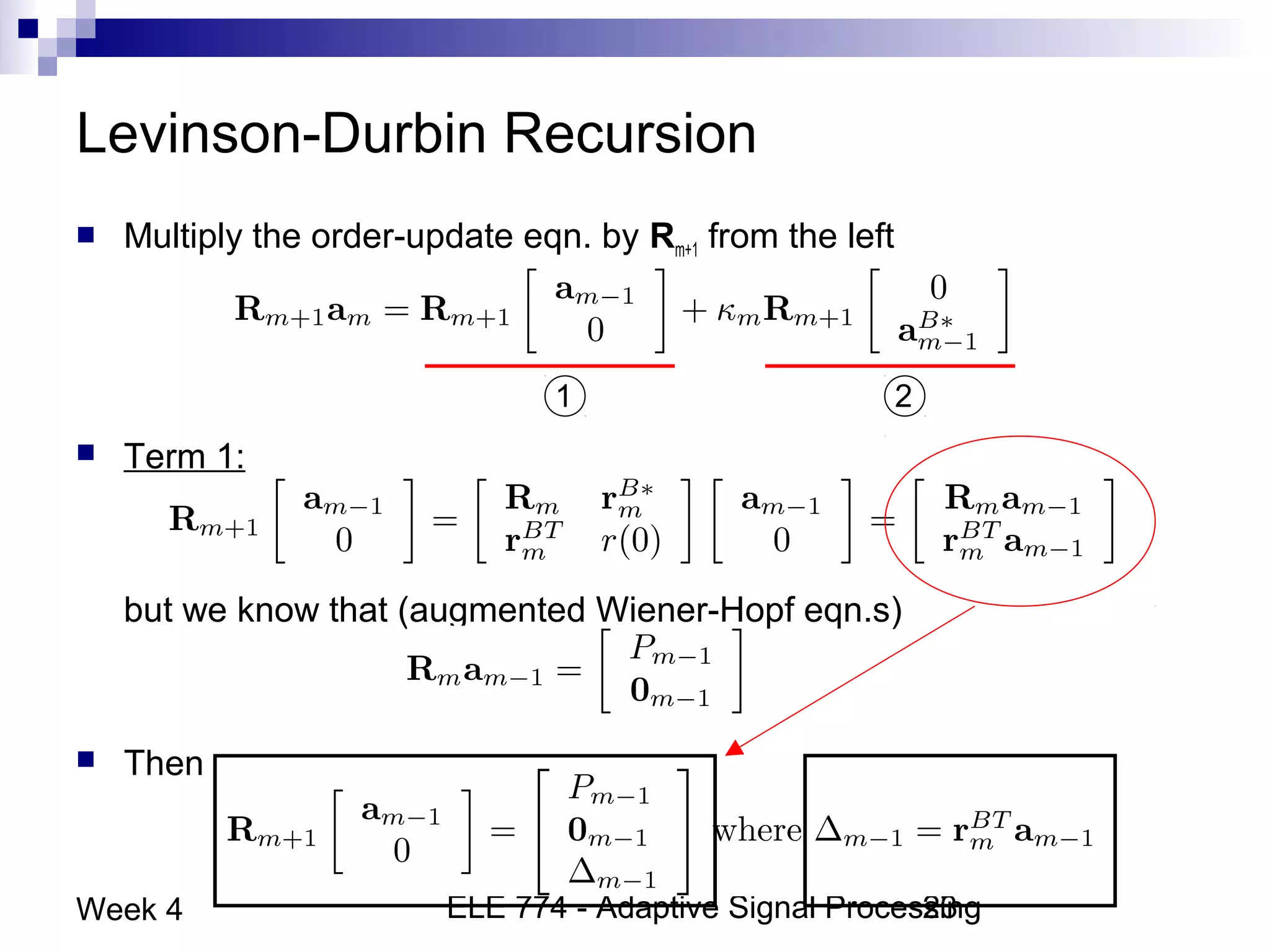
 Multiply the order-update eqn. by Rm+1 from the left
 Term 1:
but we know that (augmented Wiener-Hopf eqn.s)
 Then
1 2
ELE 774 - Adaptive Signal Processing24Week 4
Levinson-Durbin Recursion
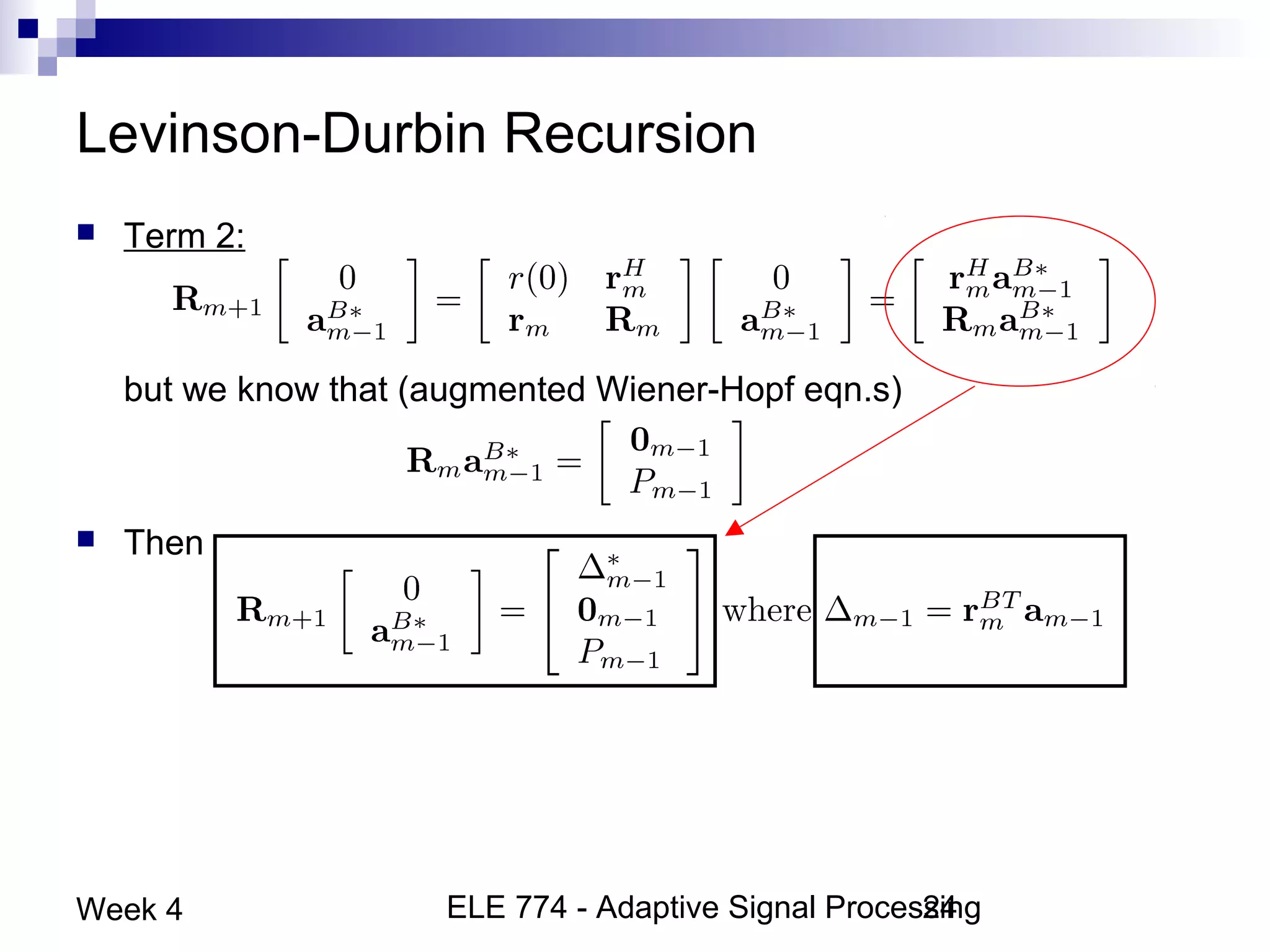
 Term 2:
but we know that (augmented Wiener-Hopf eqn.s)
 Then
ELE 774 - Adaptive Signal Processing25Week 4
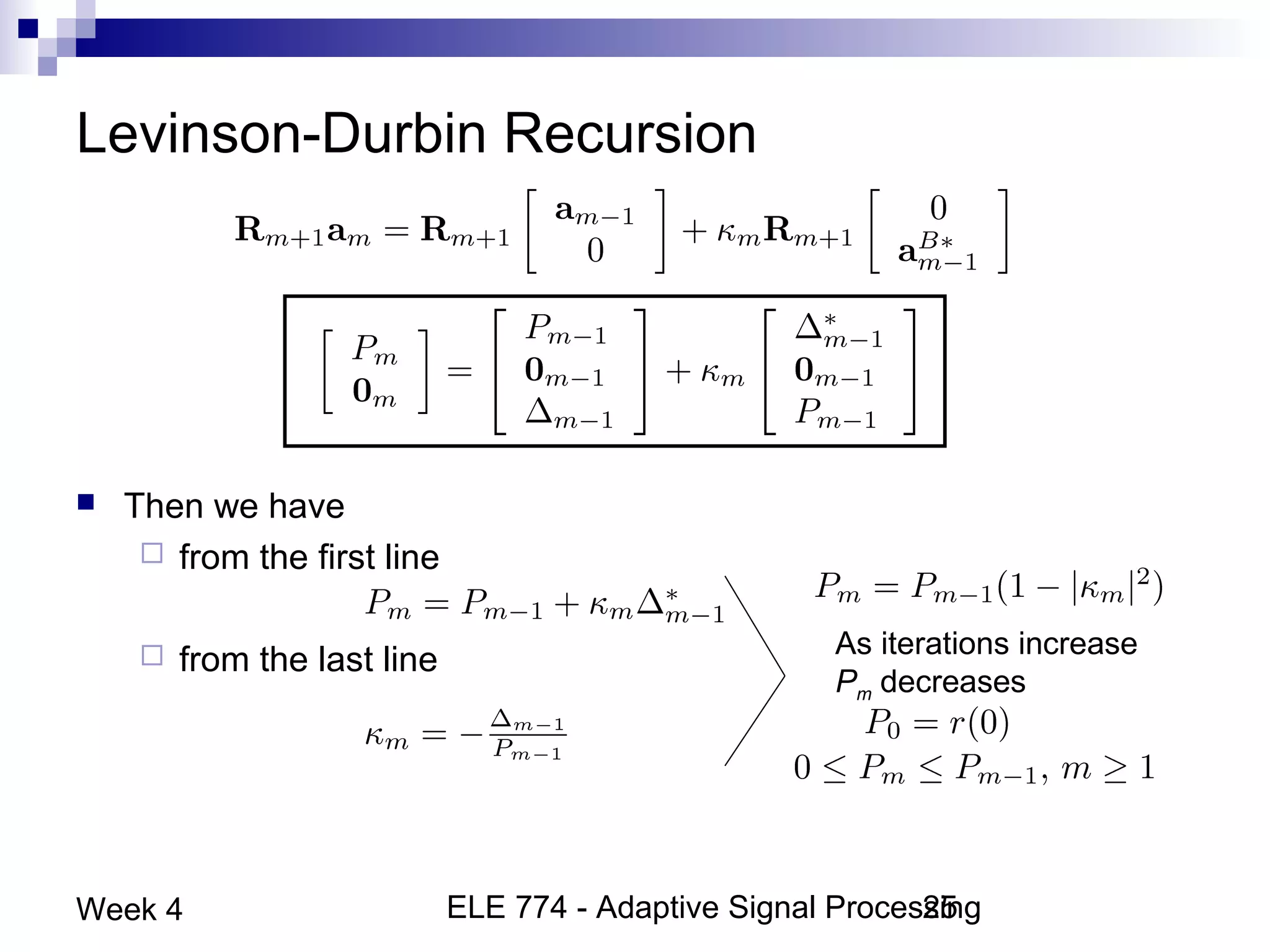
Levinson-Durbin Recursion
 Then we have
 from the first line
 from the last line As iterations increase
Pm decreases
ELE 774 - Adaptive Signal Processing26Week 4
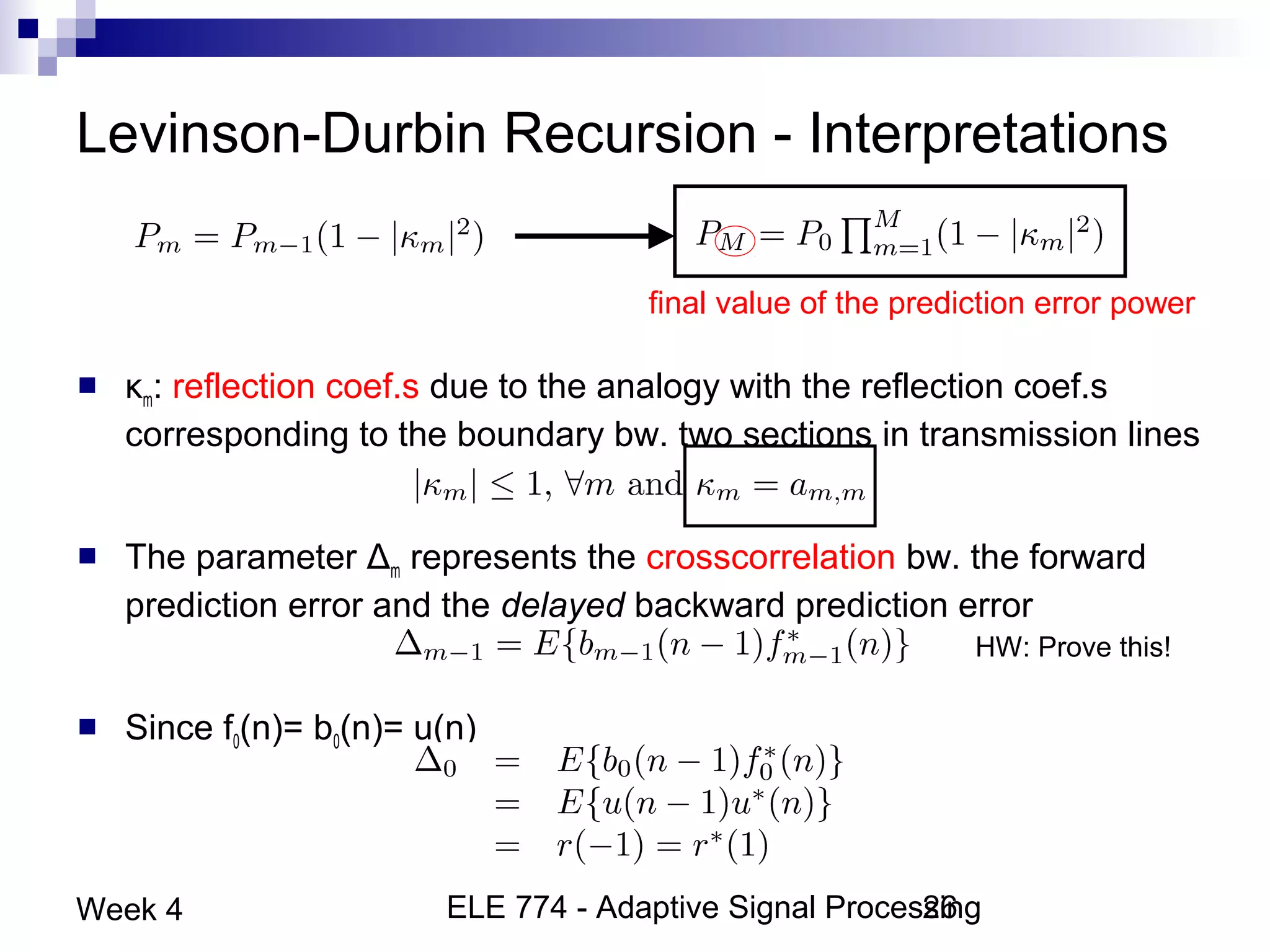
Levinson-Durbin Recursion - Interpretations
 κm: reflection coef.s due to the analogy with the reflection coef.s
corresponding to the boundary bw. two sections in transmission lines
 The parameter Δm represents the crosscorrelation bw. the forward
prediction error and the delayed backward prediction error
 Since f0(n)= b0(n)= u(n)
final value of the prediction error power
HW: Prove this!
ELE 774 - Adaptive Signal Processing27Week 4
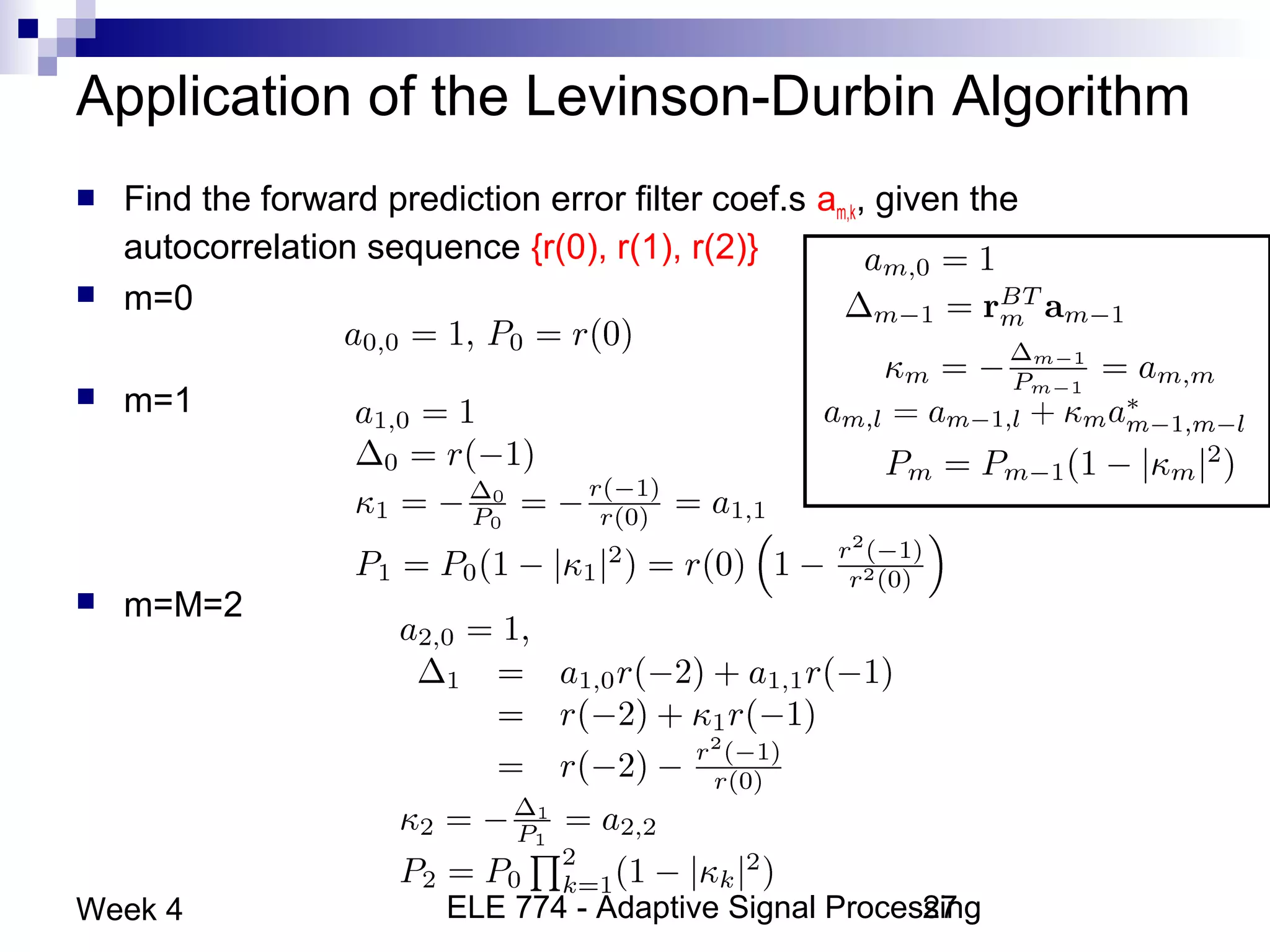
Application of the Levinson-Durbin Algorithm
 Find the forward prediction error filter coef.s am,k, given the
autocorrelation sequence {r(0), r(1), r(2)}
 m=0
 m=1
 m=M=2
ELE 774 - Adaptive Signal Processing28Week 4
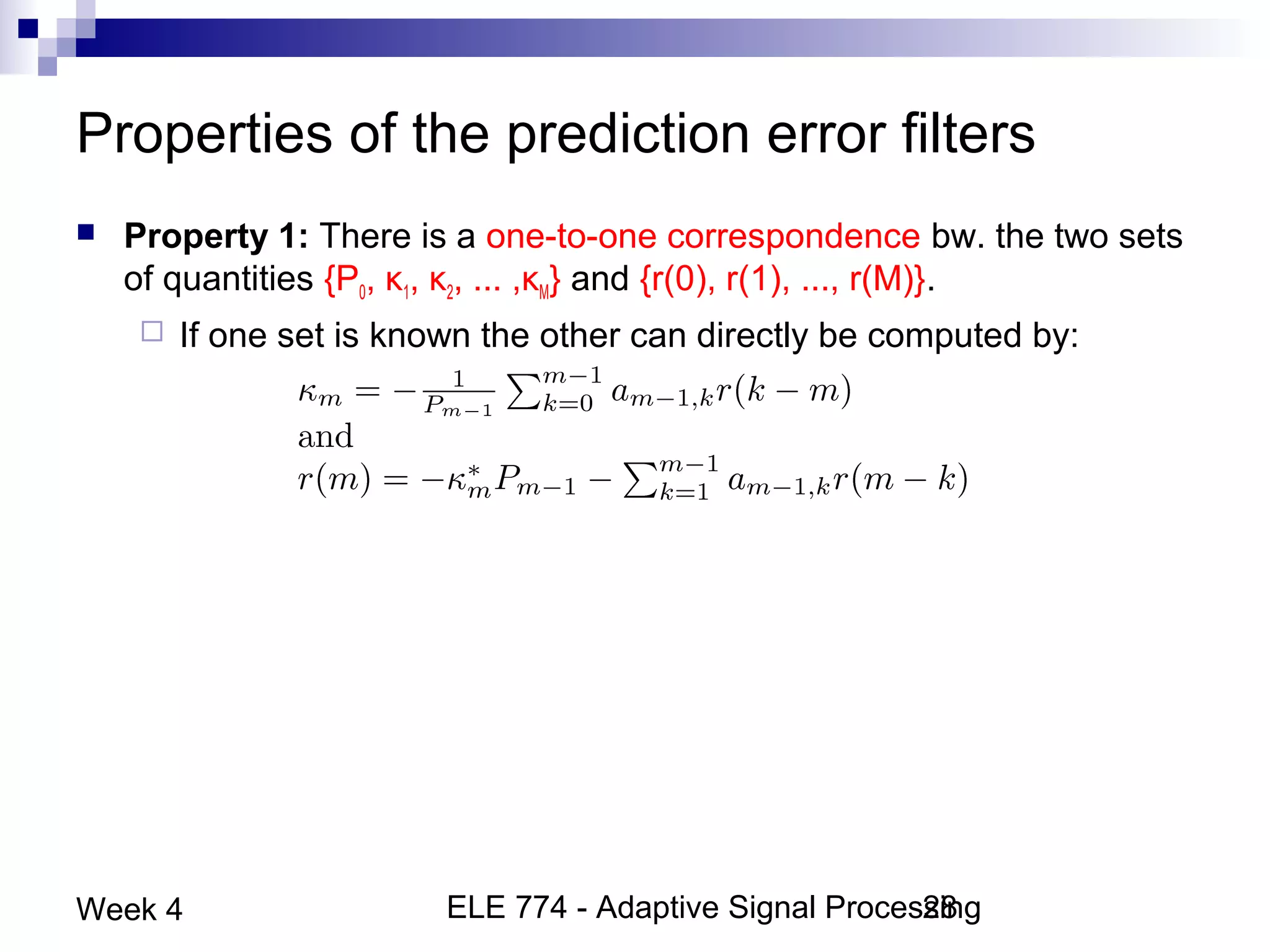
Properties of the prediction error filters
 Property 1: There is a one-to-one correspondence bw. the two sets
of quantities {P0, κ1, κ2, ... ,κM} and {r(0), r(1), ..., r(M)}.
 If one set is known the other can directly be computed by:
ELE 774 - Adaptive Signal Processing29Week 4
Properties of the prediction error filters
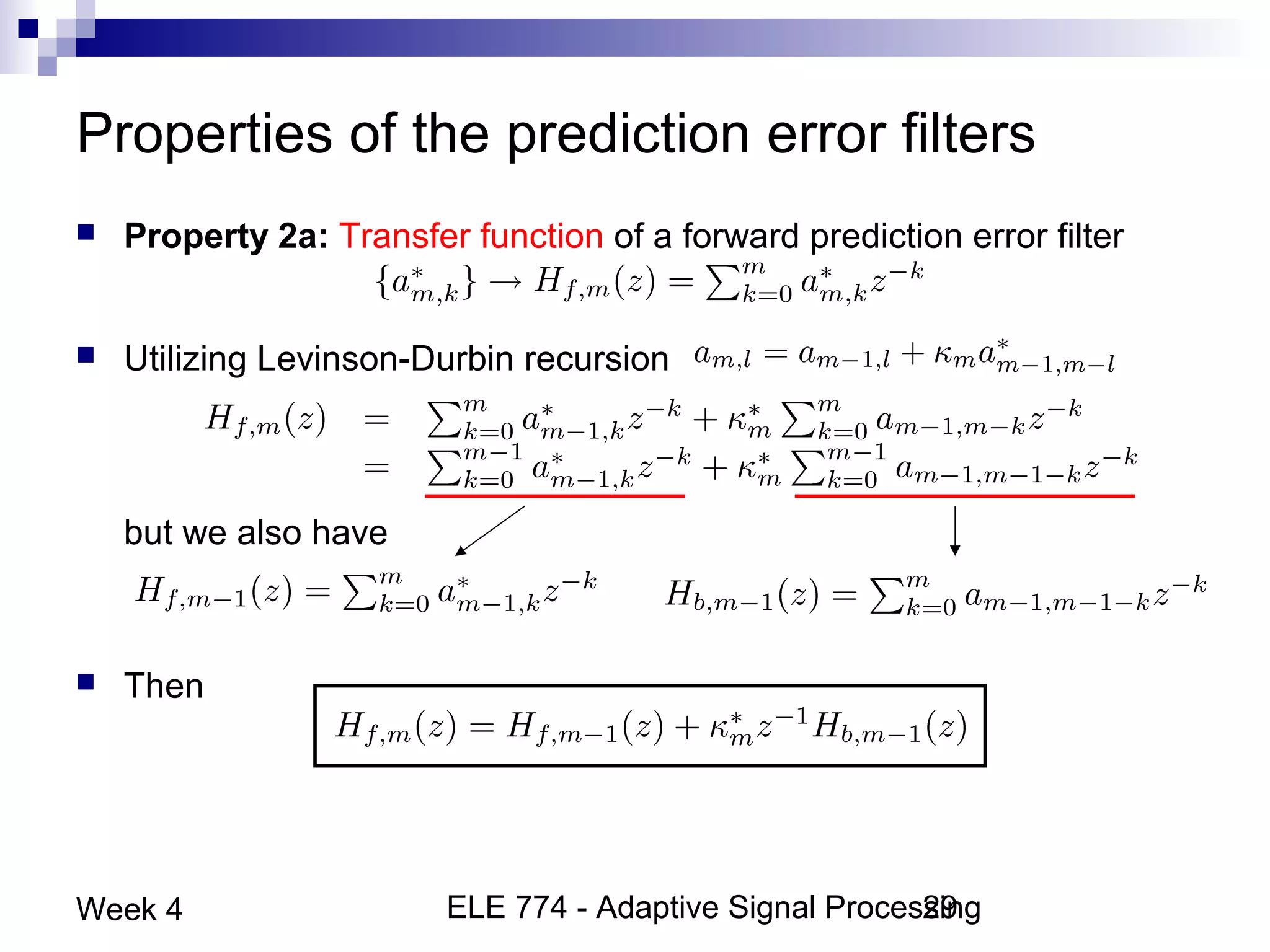
 Property 2a: Transfer function of a forward prediction error filter
 Utilizing Levinson-Durbin recursion
but we also have
 Then
ELE 774 - Adaptive Signal Processing30Week 4
Properties of the prediction error filters
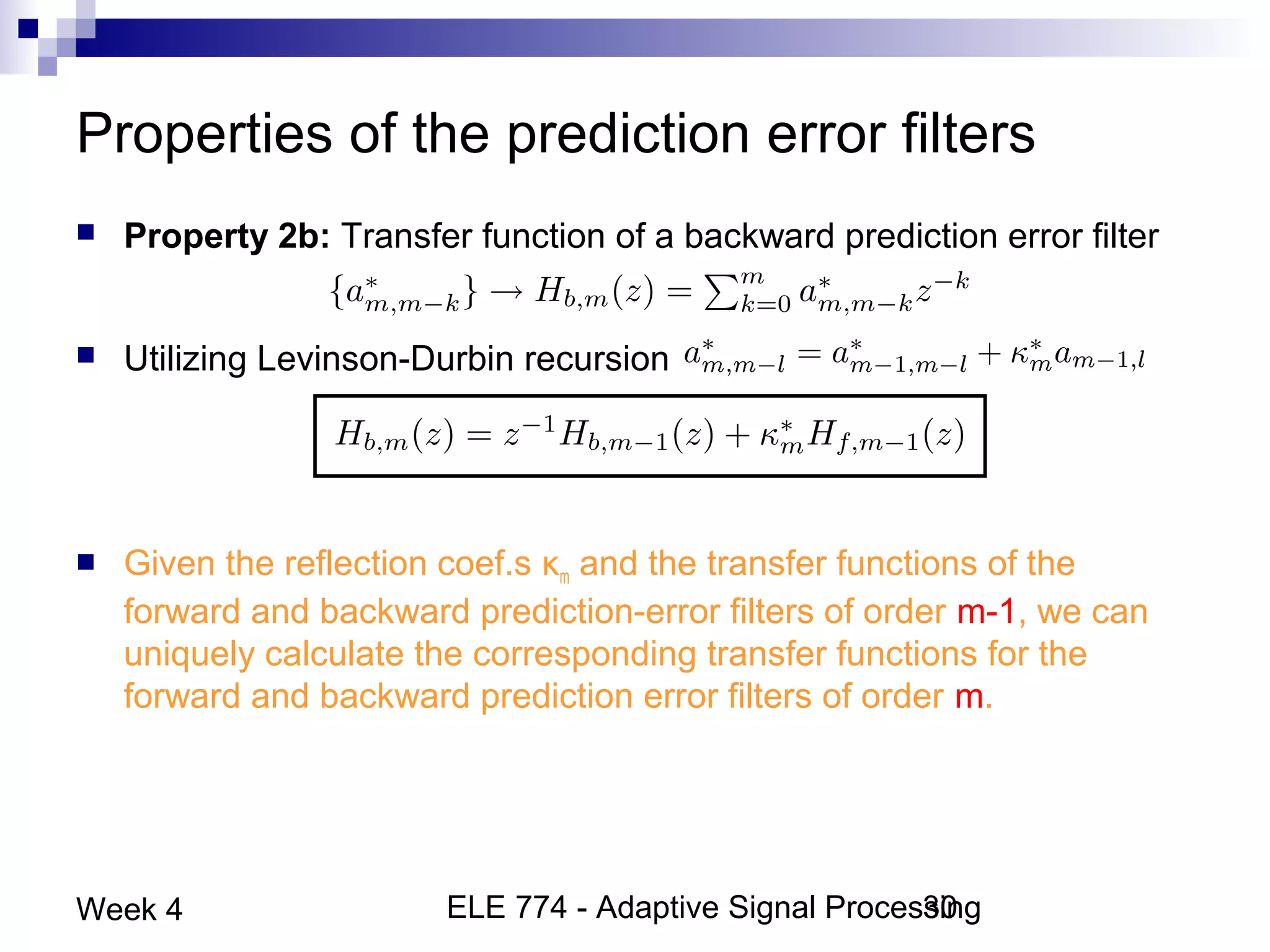
 Property 2b: Transfer function of a backward prediction error filter
 Utilizing Levinson-Durbin recursion
 Given the reflection coef.s κm and the transfer functions of the
forward and backward prediction-error filters of order m-1, we can
uniquely calculate the corresponding transfer functions for the
forward and backward prediction error filters of order m.
ELE 774 - Adaptive Signal Processing31Week 4
Properties of the prediction error filters
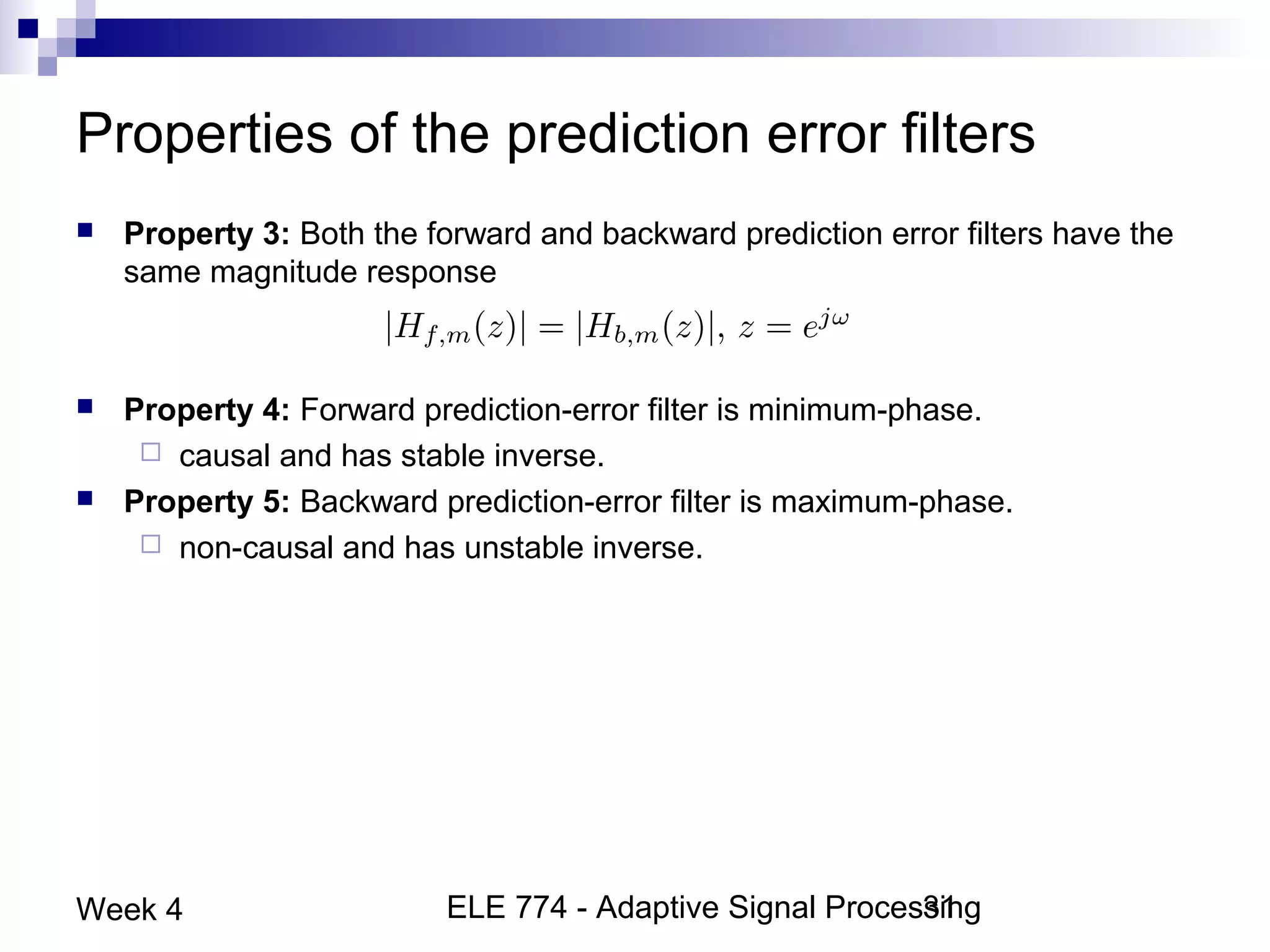
 Property 3: Both the forward and backward prediction error filters have the
same magnitude response
 Property 4: Forward prediction-error filter is minimum-phase.
 causal and has stable inverse.
 Property 5: Backward prediction-error filter is maximum-phase.
 non-causal and has unstable inverse.
ELE 774 - Adaptive Signal Processing32Week 4
Properties of the prediction error filters
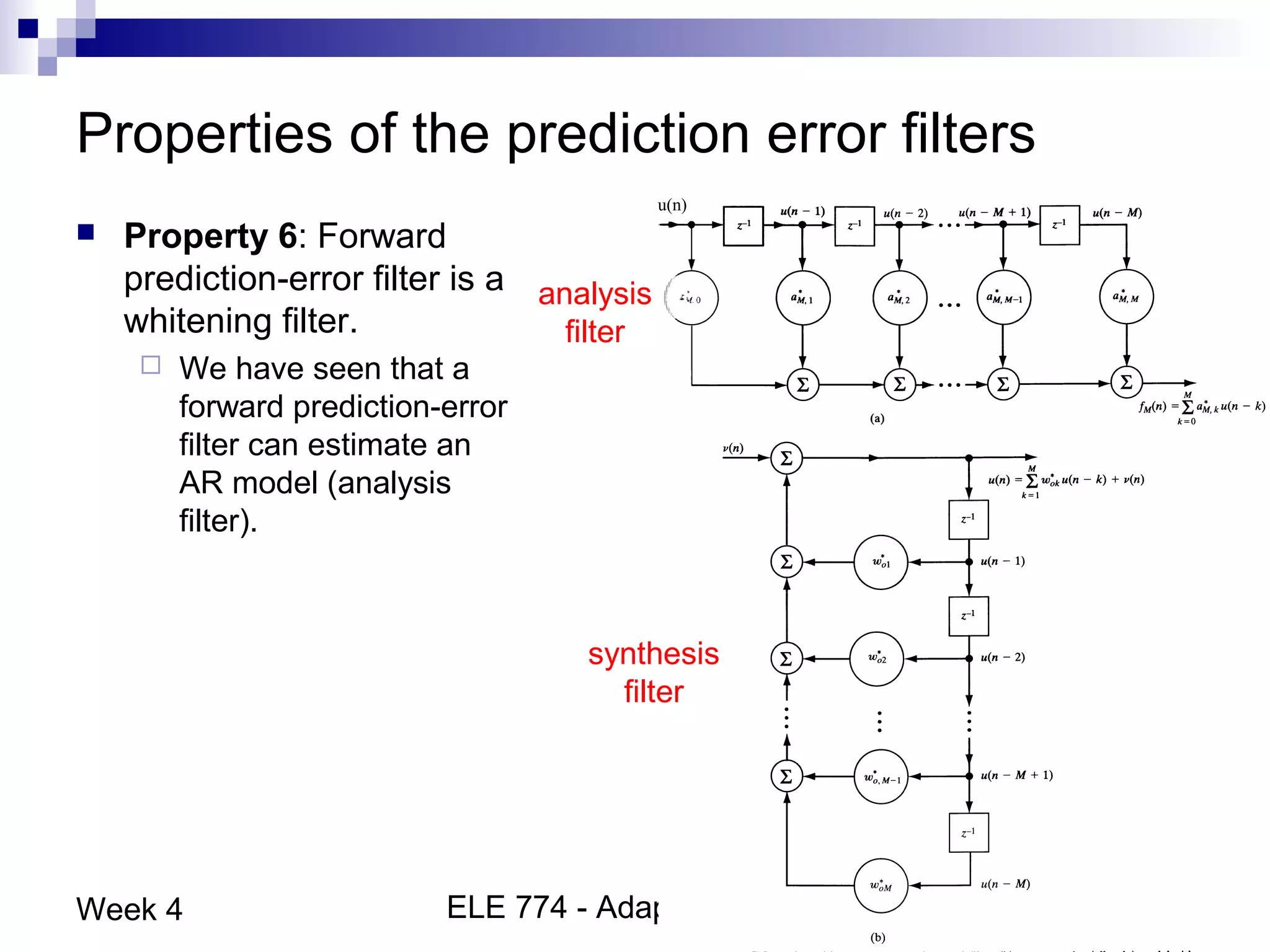
 Property 6: Forward
prediction-error filter is a
whitening filter.
 We have seen that a
forward prediction-error
filter can estimate an
AR model (analysis
filter).
u(n)
synthesis
filter
analysis
filter
ELE 774 - Adaptive Signal Processing33Week 4
Properties of the prediction error filters
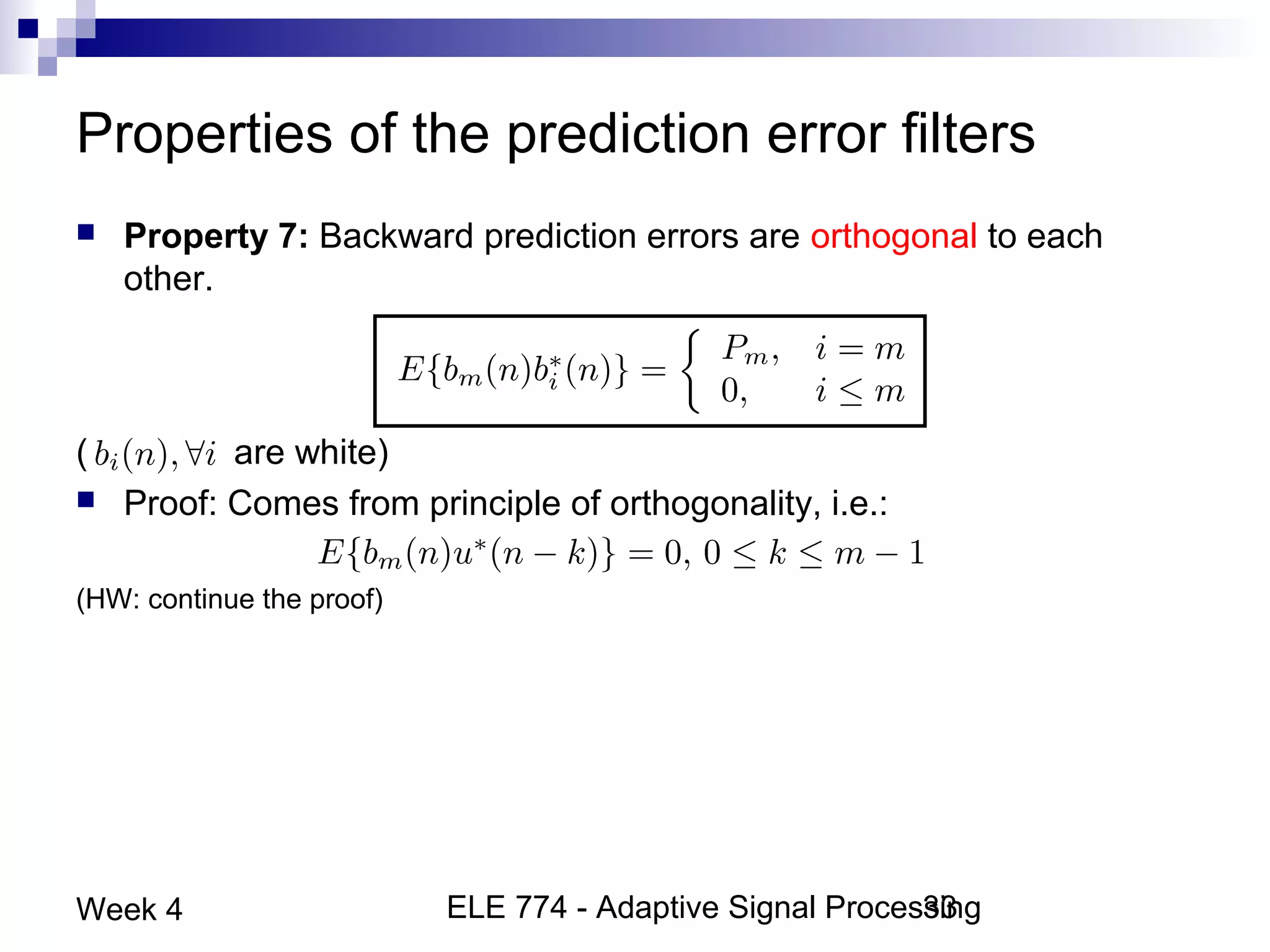
 Property 7: Backward prediction errors are orthogonal to each
other.
( are white)
 Proof: Comes from principle of orthogonality, i.e.:
(HW: continue the proof)
ELE 774 - Adaptive Signal Processing34Week 4
Lattice Predictors
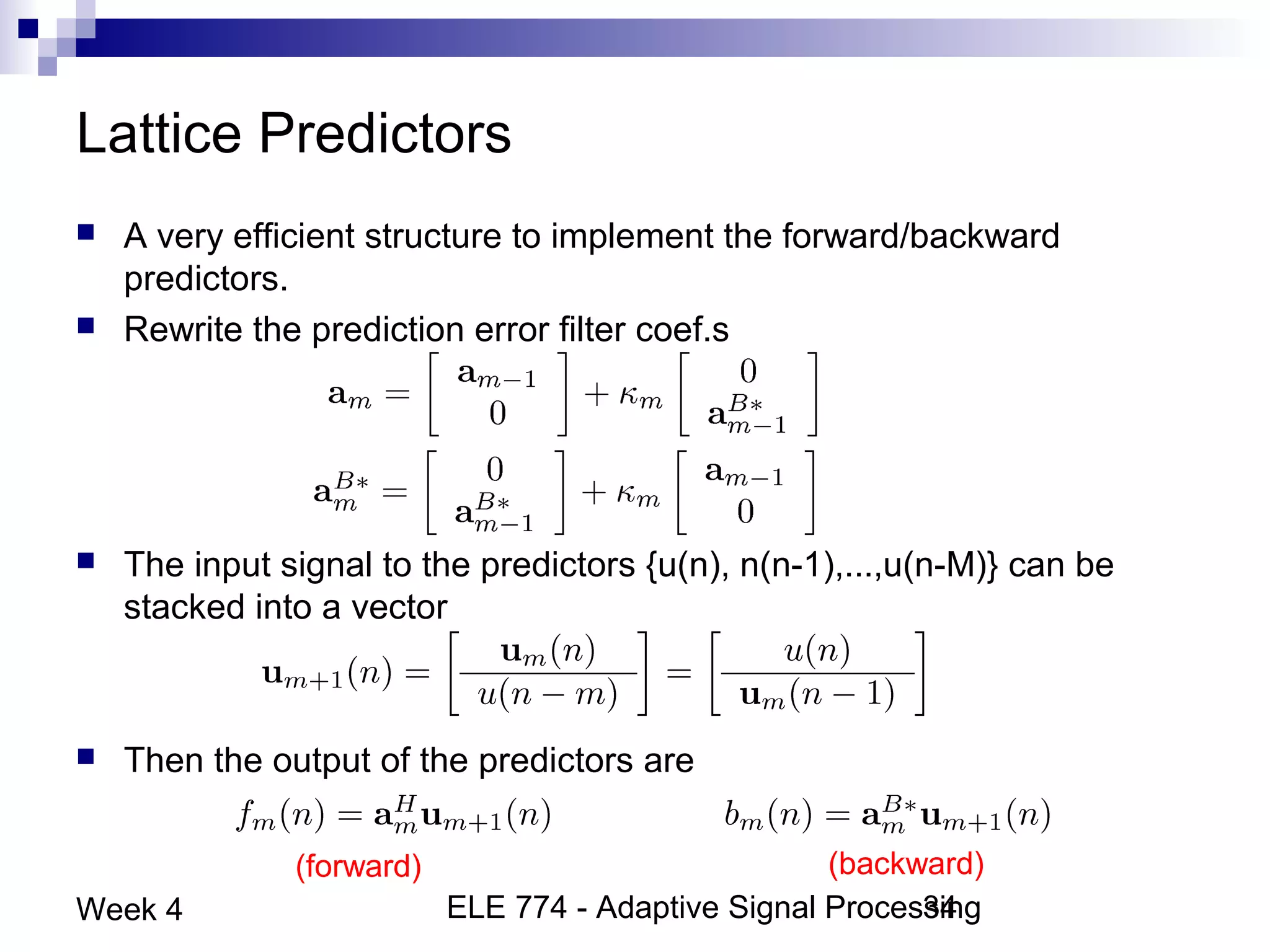
 A very efficient structure to implement the forward/backward
predictors.
 Rewrite the prediction error filter coef.s
 The input signal to the predictors {u(n), n(n-1),...,u(n-M)} can be
stacked into a vector
 Then the output of the predictors are
(forward) (backward)
ELE 774 - Adaptive Signal Processing35Week 4
Lattice Predictors
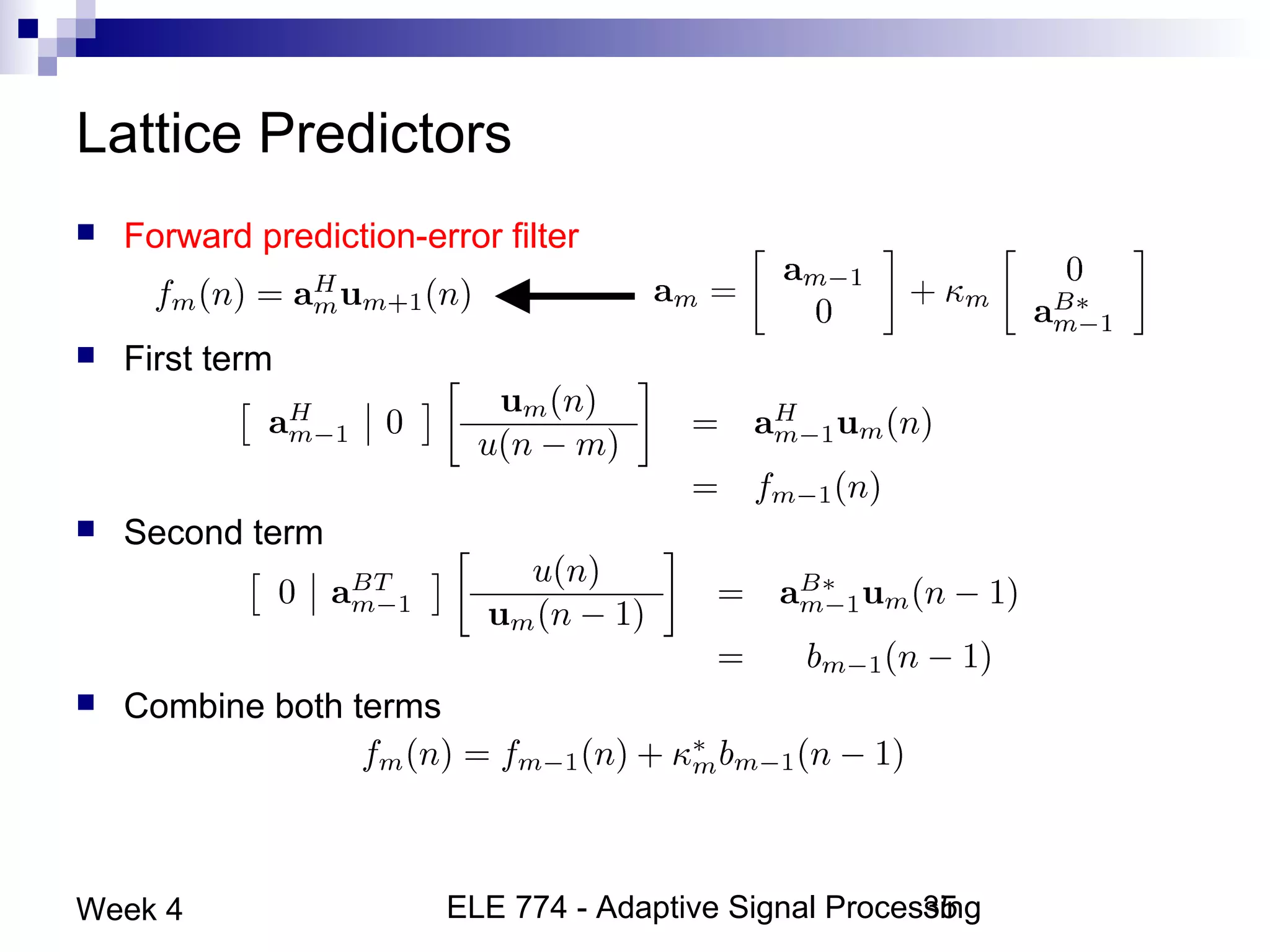
 Forward prediction-error filter
 First term
 Second term
 Combine both terms
ELE 774 - Adaptive Signal Processing36Week 4
Lattice Predictors
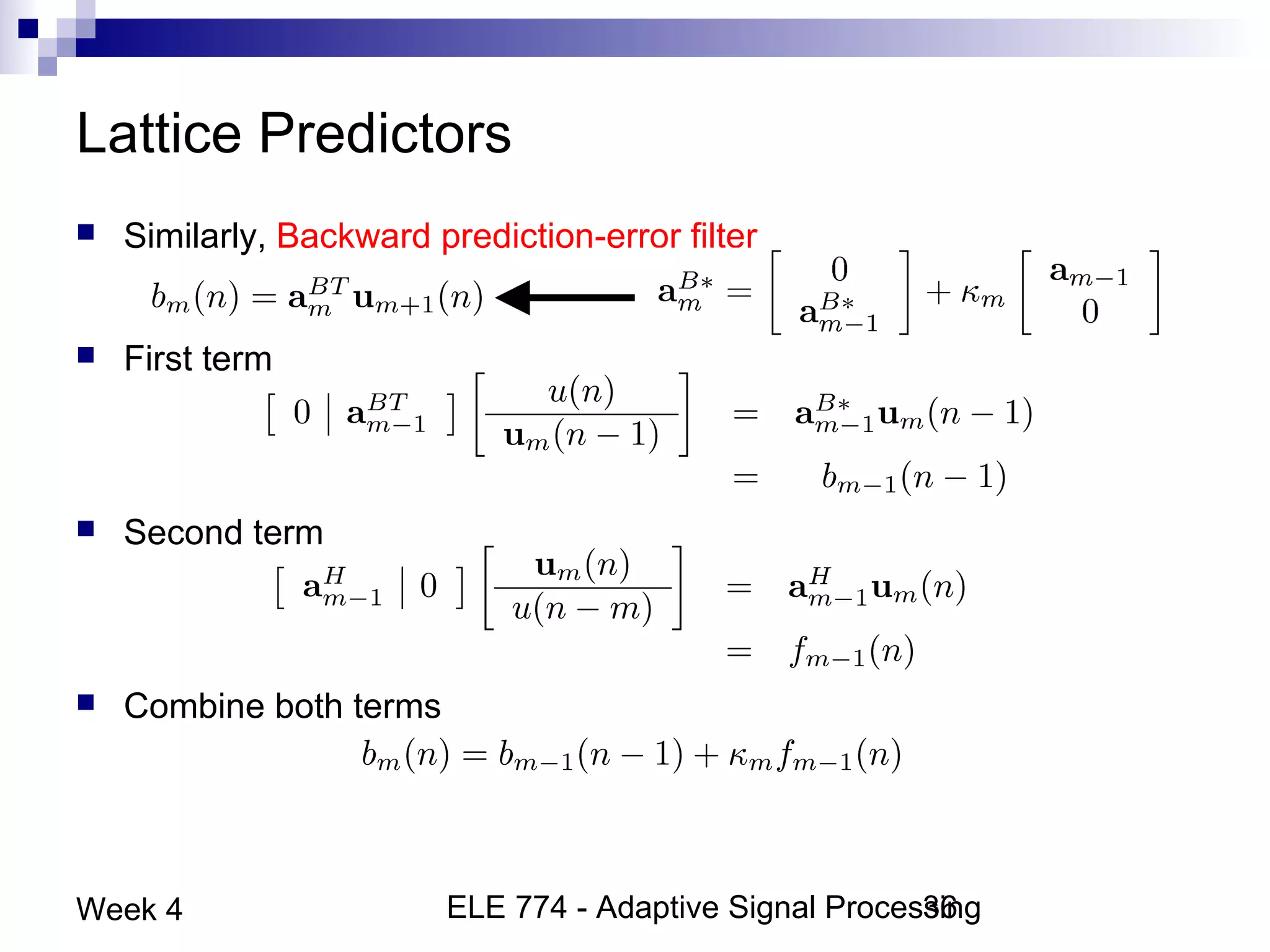
 Similarly, Backward prediction-error filter
 First term
 Second term
 Combine both terms
ELE 774 - Adaptive Signal Processing37Week 4
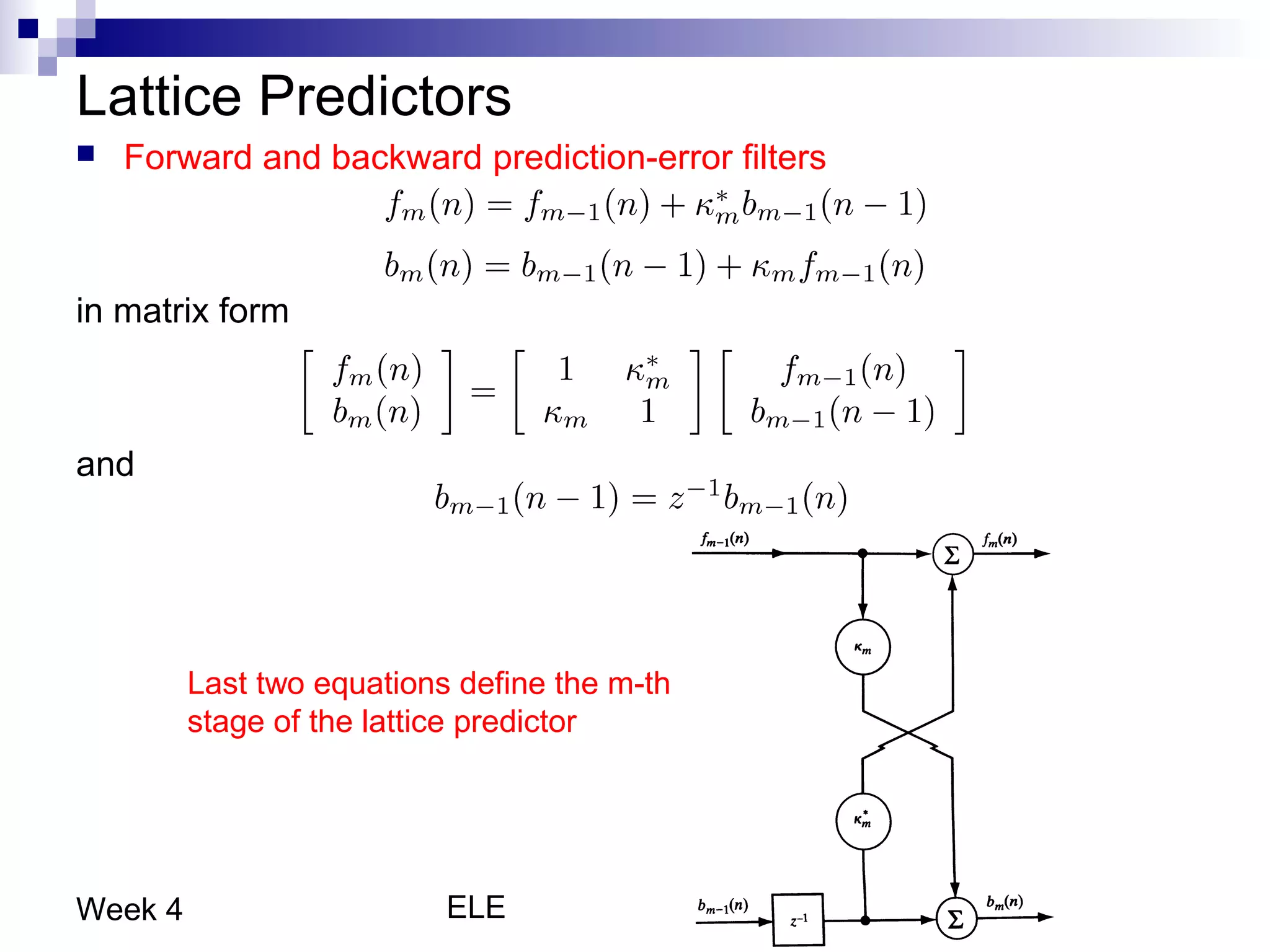
Lattice Predictors
 Forward and backward prediction-error filters
in matrix form
and
Last two equations define the m-th
stage of the lattice predictor
ELE 774 - Adaptive Signal Processing38Week 4
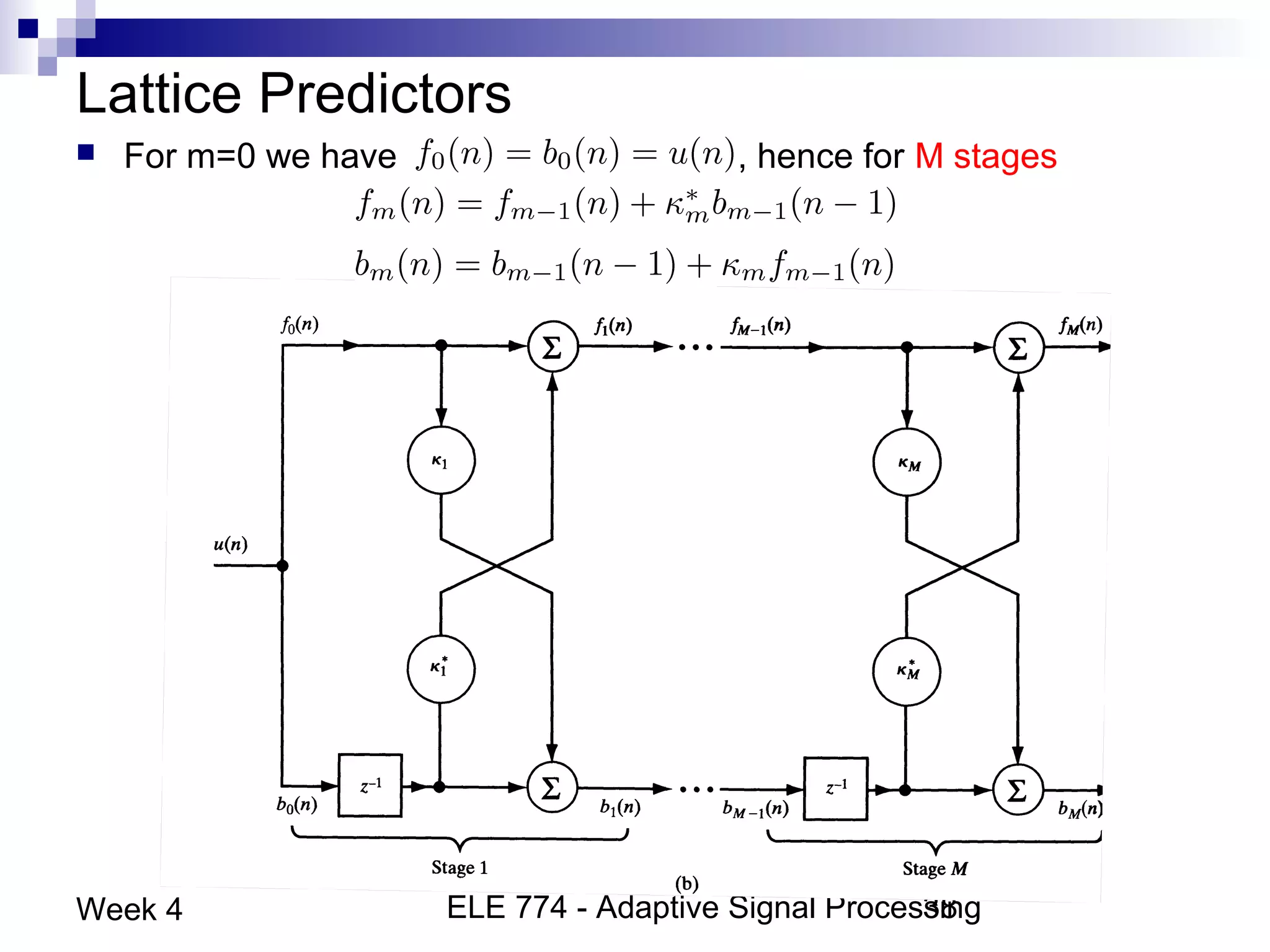
Lattice Predictors
 For m=0 we have , hence for M stages

Linear prediction

  • 1.
    Week 4 ELE774 - Adaptive Signal Processing 1 LINEAR PREDICTION
  • 2.
    ELE 774 -Adaptive Signal Processing2Week 4 Linear Prediction  Problem:  Forward Prediction  Observing  Predict  Backward Prediction  Observing  Predict
  • 3.
    ELE 774 -Adaptive Signal Processing3Week 4 Forward Linear Prediction  Problem:  Forward Prediction  Observing the past  Predict the future  i.e. find the predictor filter taps wf,1, wf,2,...,wf,M ?
  • 4.
    ELE 774 -Adaptive Signal Processing4Week 4 Forward Linear Prediction  Use Wiener filter theory to calculate wf,k  Desired signal  Then forward prediction error is (for predictor order M)  Let minimum mean-square prediction error be
  • 5.
    ELE 774 -Adaptive Signal Processing5Week 4 One-step predictor Prediction-error filter
  • 6.
    ELE 774 -Adaptive Signal Processing6Week 4 Forward Linear Prediction  A structure similar to Wiener filter, same approach can be used.  For the input vector with the autocorrelation  Find the filter taps where the cross-correlation bw. the filter input and the desired response is
  • 7.
    ELE 774 -Adaptive Signal Processing7Week 4 Forward Linear Prediction  Solving the Wiener-Hopf equations, we obtain  and the minimum forward-prediction error power becomes  In summary,
  • 8.
    ELE 774 -Adaptive Signal Processing8Week 4 Relation bw. Linear Prediction and AR Modelling  Note that the Wiener-Hopf equations for a linear predictor is mathematically identical with the Yule-Walker equations for the model of an AR process.  If AR model order M is known, model parameters can be found by using a forward linear predictor of order M.  If the process is not AR, predictor provides an (AR) model approximation of order M of the process.
  • 9.
    ELE 774 -Adaptive Signal Processing9Week 4 Forward Prediction-Error Filter  We wrote that  Let  Then
  • 10.
    ELE 774 -Adaptive Signal Processing10Week 4 Augmented Wiener-Hopf Eqn.s for Forward Prediction  Let us combine the forward prediction filter and forward prediction- error power equations in a single matrix expression, i.e. and  Define the forward prediction-error filter vector  Then or Augmented Wiener-Hopf Eqn.s of a forward prediction-error filter of order M.
  • 11.
    ELE 774 -Adaptive Signal Processing11Week 4 Example – Forward Predictor (order M=1)  For a forward predictor of order M=1  Then where  But a1,0=1, then
  • 12.
    ELE 774 -Adaptive Signal Processing12Week 4 Backward Linear Prediction  Problem:  Forward Prediction  Observing the future  Predict the past  i.e. find the predictor filter taps wb,1, wb,2,...,wb,M ?
  • 13.
    ELE 774 -Adaptive Signal Processing13Week 4 Backward Linear Prediction  Desired signal  Then backward prediction error is (for predictor order M)  Let minimum-mean square prediction error be
  • 14.
    ELE 774 -Adaptive Signal Processing14Week 4 Backward Linear Prediction  Problem:  For the input vector with the autocorrelation  Find the filter taps where the cross-correlation bw. the filter input and the desired response is
  • 15.
    ELE 774 -Adaptive Signal Processing15Week 4 Backward Linear Prediction  Solving the Wiener-Hopf equations, we obtain   and the minimum forward-prediction error power becomes  In summary,
  • 16.
    ELE 774 -Adaptive Signal Processing16Week 4 Relations bw. Forward and Backward Predictors  Compare the Wiener-Hopf eqn.s for both cases (R and r are same) order reversal complex conjugate ?
  • 17.
    ELE 774 -Adaptive Signal Processing17Week 4 Backward Prediction-Error Filter  We wrote that  Let  Then but we found that Then
  • 18.
    ELE 774 -Adaptive Signal Processing18Week 4 Backward Prediction-Error Filter  For stationary inputs, we may change a forward prediction-error filter into the corresponding backward prediction-error filter by reversing the order of the sequence and taking the complex conjugation of them. forward prediction-error filter backward prediction-error filter
  • 19.
    ELE 774 -Adaptive Signal Processing19Week 4 Augmented Wiener-Hopf Eqn.s for Backward Prediction  Let us combine the backward prediction filter and backward prediction-error power equations in a single matrix expression, i.e.  and  With the definition  Then  or Augmented Wiener-Hopf Eqn.s of a backward prediction-error filter of order M.
  • 20.
    ELE 774 -Adaptive Signal Processing20Week 4 Levinson-Durbin Algorithm  Solve the following Wiener-Hopf eqn.s to find the predictor coef.s  One-shot solution can have high computation complexity.  Instead, use an (order)-recursive algorithm  Levinson-Durbin Algorithm.  Start with a first-order (m=1) predictor and at each iteration increase the order of the predictor by one up to (m=M).  Huge savings in computational complexity and storage.
  • 21.
    ELE 774 -Adaptive Signal Processing21Week 4 Levinson-Durbin Algorithm  Let the forward prediction error filter of order m be represented by the (m+1)x1 and its order reversed and complex conjugated version (backward prediction error filter) be  The forward-prediction error filter can be order-updated by  The backward-prediction error filter can be order-updated by where the constant κm is called the reflection coefficient.
  • 22.
    ELE 774 -Adaptive Signal Processing22Week 4 Levinson-Durbin Recursion  How to calculate am and κm?  Start with the relation bw. correlation matrix Rm+1 and the forward- error prediction filter am.  We have seen how to partition the correlation matrix indicates order indicates dim. of matrix/vector
  • 23.
    ELE 774 -Adaptive Signal Processing23Week 4 Levinson-Durbin Recursion  Multiply the order-update eqn. by Rm+1 from the left  Term 1: but we know that (augmented Wiener-Hopf eqn.s)  Then 1 2
  • 24.
    ELE 774 -Adaptive Signal Processing24Week 4 Levinson-Durbin Recursion  Term 2: but we know that (augmented Wiener-Hopf eqn.s)  Then
  • 25.
    ELE 774 -Adaptive Signal Processing25Week 4 Levinson-Durbin Recursion  Then we have  from the first line  from the last line As iterations increase Pm decreases
  • 26.
    ELE 774 -Adaptive Signal Processing26Week 4 Levinson-Durbin Recursion - Interpretations  κm: reflection coef.s due to the analogy with the reflection coef.s corresponding to the boundary bw. two sections in transmission lines  The parameter Δm represents the crosscorrelation bw. the forward prediction error and the delayed backward prediction error  Since f0(n)= b0(n)= u(n) final value of the prediction error power HW: Prove this!
  • 27.
    ELE 774 -Adaptive Signal Processing27Week 4 Application of the Levinson-Durbin Algorithm  Find the forward prediction error filter coef.s am,k, given the autocorrelation sequence {r(0), r(1), r(2)}  m=0  m=1  m=M=2
  • 28.
    ELE 774 -Adaptive Signal Processing28Week 4 Properties of the prediction error filters  Property 1: There is a one-to-one correspondence bw. the two sets of quantities {P0, κ1, κ2, ... ,κM} and {r(0), r(1), ..., r(M)}.  If one set is known the other can directly be computed by:
  • 29.
    ELE 774 -Adaptive Signal Processing29Week 4 Properties of the prediction error filters  Property 2a: Transfer function of a forward prediction error filter  Utilizing Levinson-Durbin recursion but we also have  Then
  • 30.
    ELE 774 -Adaptive Signal Processing30Week 4 Properties of the prediction error filters  Property 2b: Transfer function of a backward prediction error filter  Utilizing Levinson-Durbin recursion  Given the reflection coef.s κm and the transfer functions of the forward and backward prediction-error filters of order m-1, we can uniquely calculate the corresponding transfer functions for the forward and backward prediction error filters of order m.
  • 31.
    ELE 774 -Adaptive Signal Processing31Week 4 Properties of the prediction error filters  Property 3: Both the forward and backward prediction error filters have the same magnitude response  Property 4: Forward prediction-error filter is minimum-phase.  causal and has stable inverse.  Property 5: Backward prediction-error filter is maximum-phase.  non-causal and has unstable inverse.
  • 32.
    ELE 774 -Adaptive Signal Processing32Week 4 Properties of the prediction error filters  Property 6: Forward prediction-error filter is a whitening filter.  We have seen that a forward prediction-error filter can estimate an AR model (analysis filter). u(n) synthesis filter analysis filter
  • 33.
    ELE 774 -Adaptive Signal Processing33Week 4 Properties of the prediction error filters  Property 7: Backward prediction errors are orthogonal to each other. ( are white)  Proof: Comes from principle of orthogonality, i.e.: (HW: continue the proof)
  • 34.
    ELE 774 -Adaptive Signal Processing34Week 4 Lattice Predictors  A very efficient structure to implement the forward/backward predictors.  Rewrite the prediction error filter coef.s  The input signal to the predictors {u(n), n(n-1),...,u(n-M)} can be stacked into a vector  Then the output of the predictors are (forward) (backward)
  • 35.
    ELE 774 -Adaptive Signal Processing35Week 4 Lattice Predictors  Forward prediction-error filter  First term  Second term  Combine both terms
  • 36.
    ELE 774 -Adaptive Signal Processing36Week 4 Lattice Predictors  Similarly, Backward prediction-error filter  First term  Second term  Combine both terms
  • 37.
    ELE 774 -Adaptive Signal Processing37Week 4 Lattice Predictors  Forward and backward prediction-error filters in matrix form and Last two equations define the m-th stage of the lattice predictor
  • 38.
    ELE 774 -Adaptive Signal Processing38Week 4 Lattice Predictors  For m=0 we have , hence for M stages