Forces and Motion
Reference:
Prentice Hall
Physical Science: Concepts in Action
Chapter 12
What is Force?
• A push or pull that acts on an object
• Can cause a resting object to move
• Can accelerate a moving object
– By changing its speed or direction
How is force measured?
• Spring scale
– Stretch of the spring depends on the mass
of the object acting on it
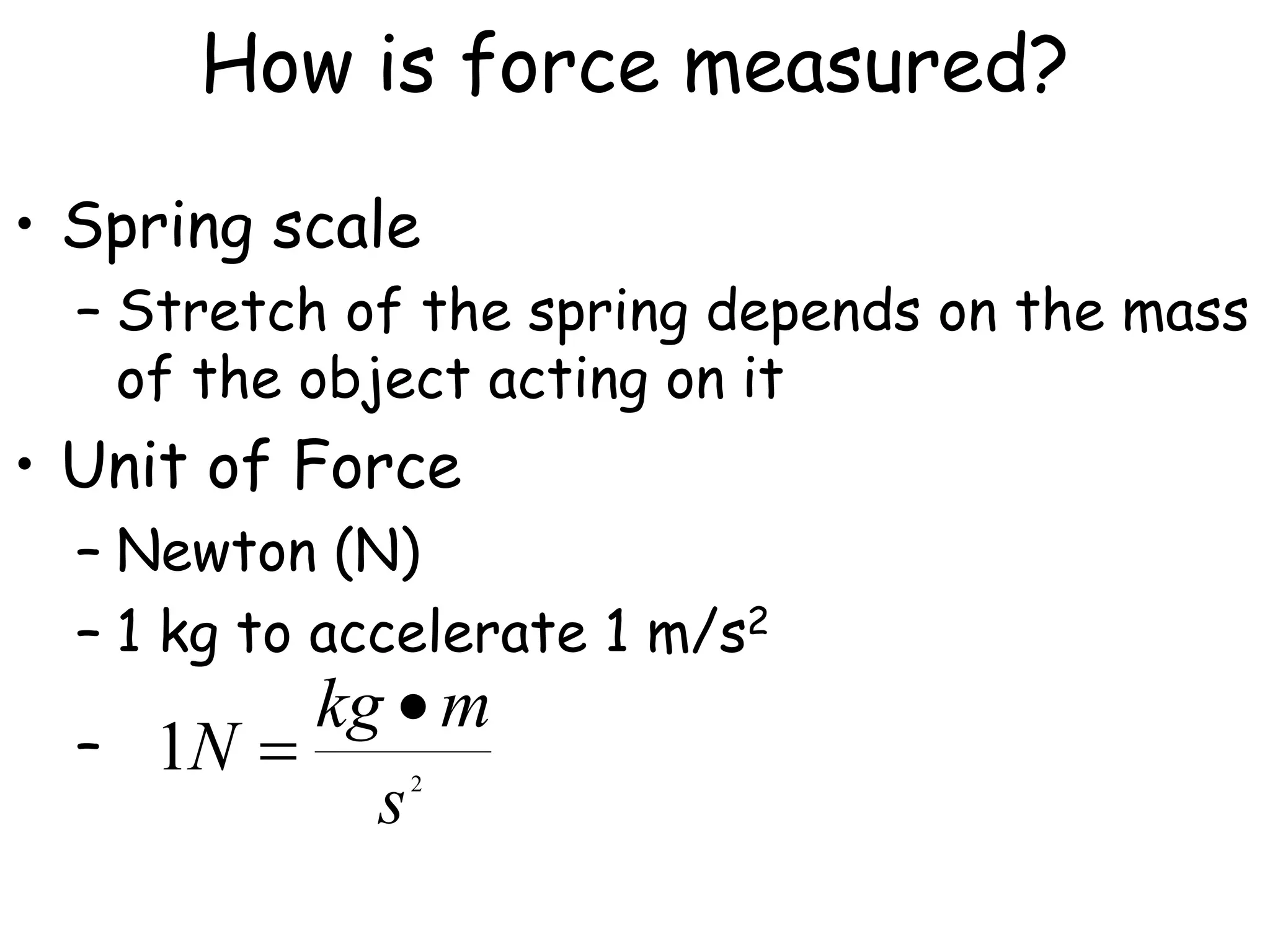
• Unit of Force
– Newton (N)
– 1 kg to accelerate 1 m/s2
– 2
1
s
m
kg
N


How is force represented?
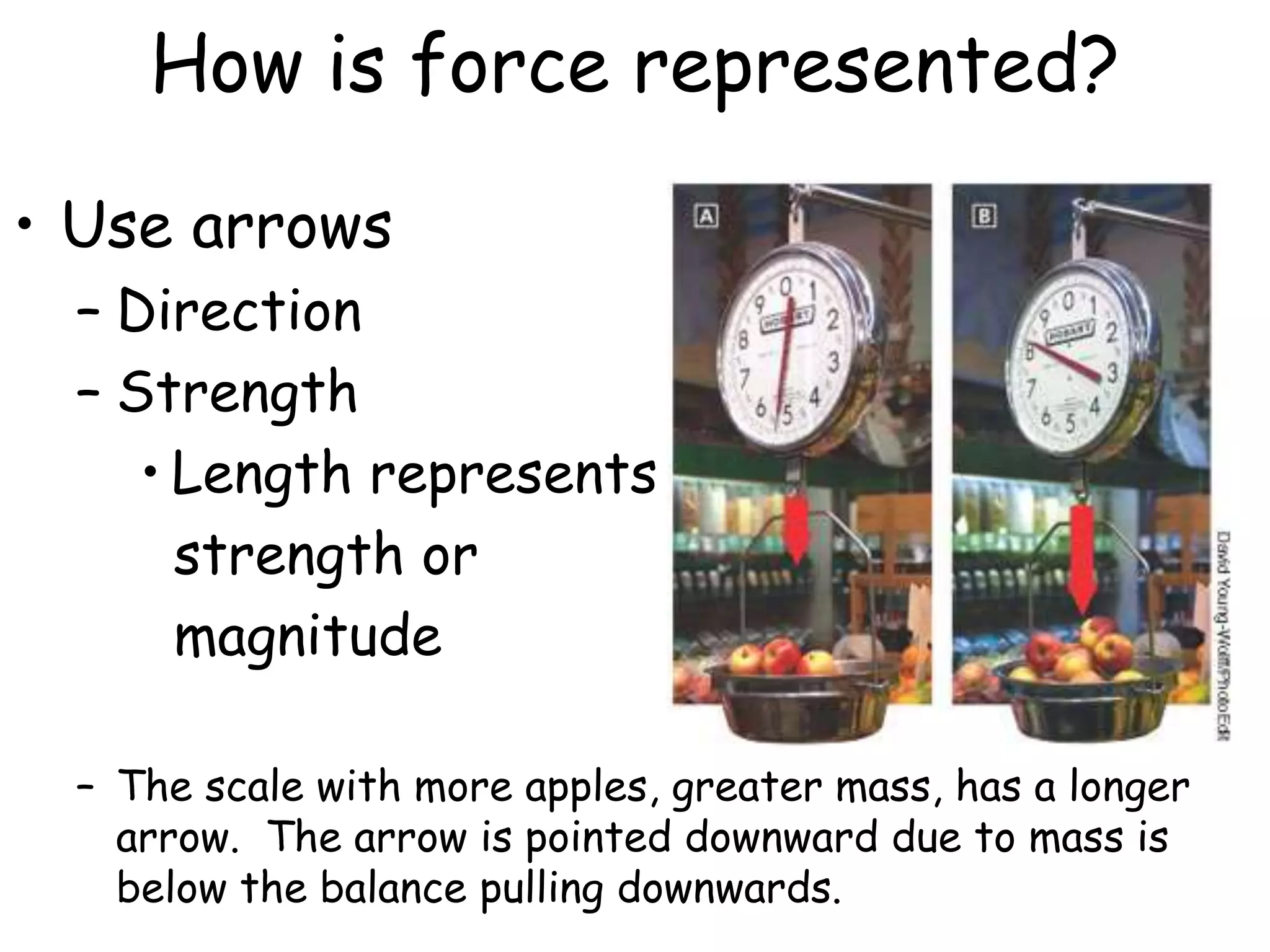
• Use arrows
– Direction
– Strength
• Length represents
strength or
magnitude
– The scale with more apples, greater mass, has a longer
arrow. The arrow is pointed downward due to mass is
below the balance pulling downwards.
Combining Forces
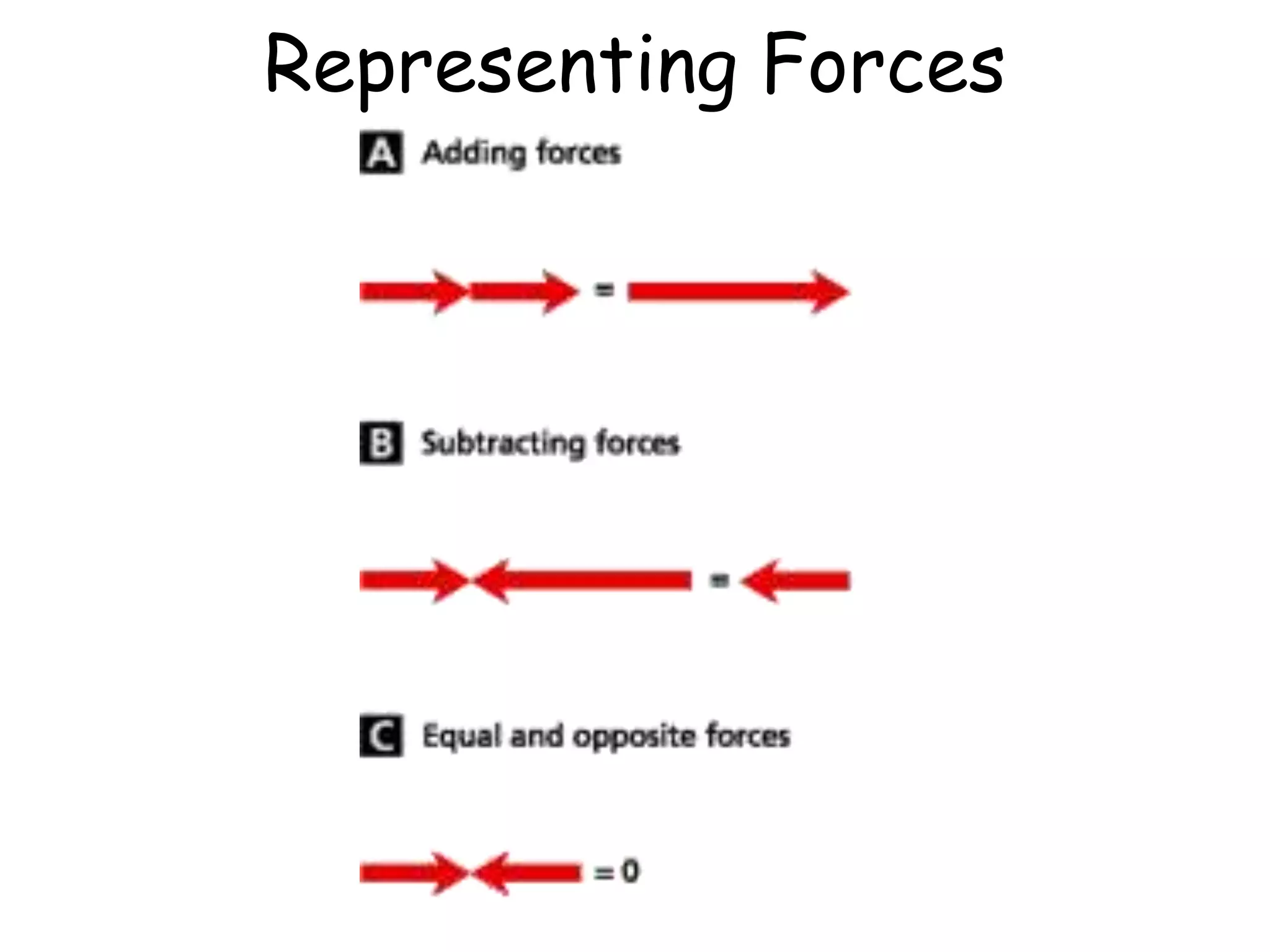
• Forces in the same direction are added
together
• Force in the opposite direction are
subtracted
• Net Force
– Overall force acting on an object
Balanced vs. Unbalanced Forces
• Balanced
– Combine to produce a net force of zero
– No change in the object’s motion
• Unbalanced
– Net force equals the size of the larger
force minus the size of the smaller force
– Net force does not equal zero
– Causes an object to accelerate
Representing Forces
Friction
• Force that opposes the motion of
objects that touch as they move past
each other
• Acts at the surface where objects are
in contact
• 4 types of friction
4 Types of Friction
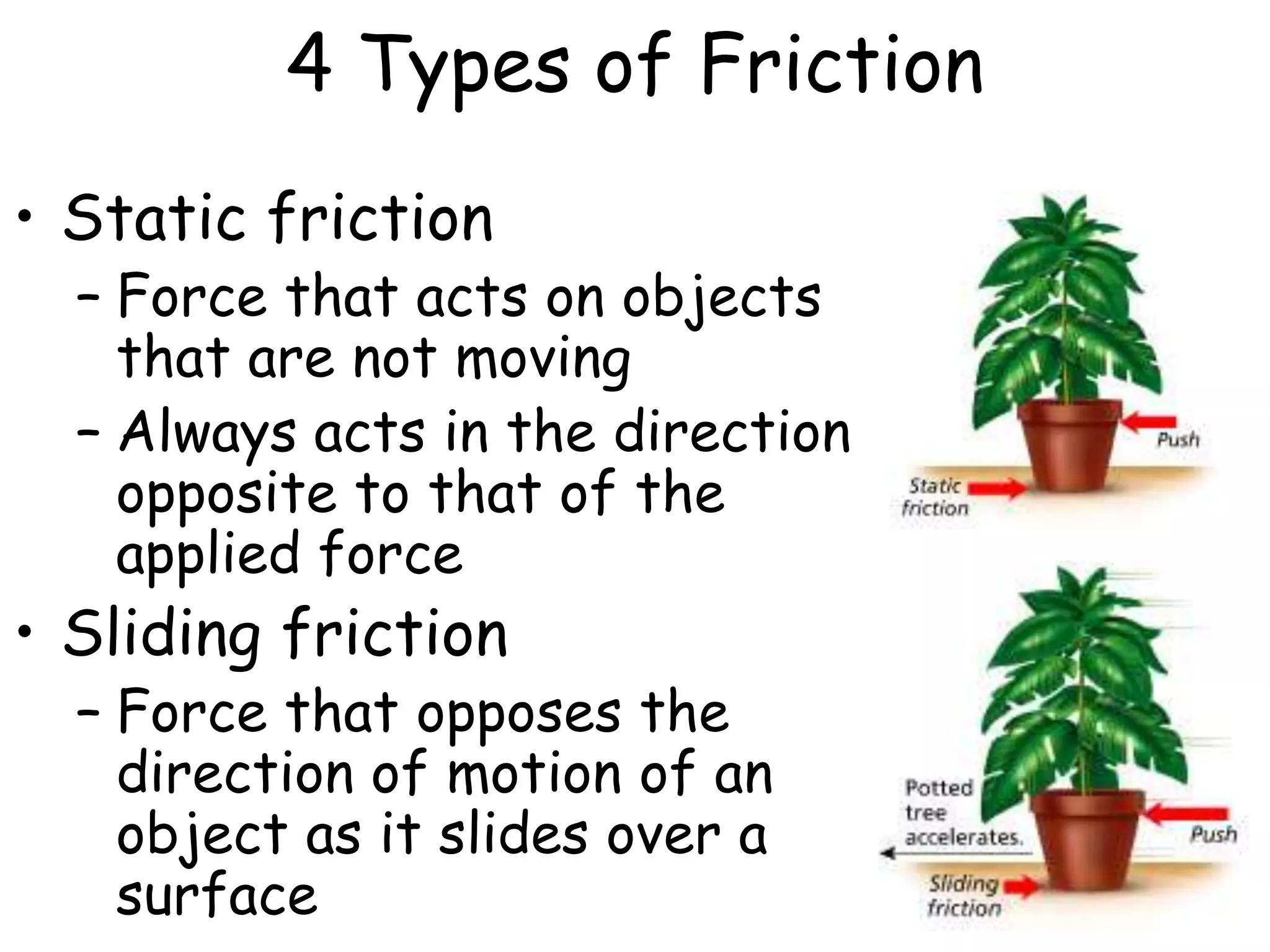
• Static friction
– Force that acts on objects
that are not moving
– Always acts in the direction
opposite to that of the
applied force
• Sliding friction
– Force that opposes the
direction of motion of an
object as it slides over a
surface
4 Types of Friction
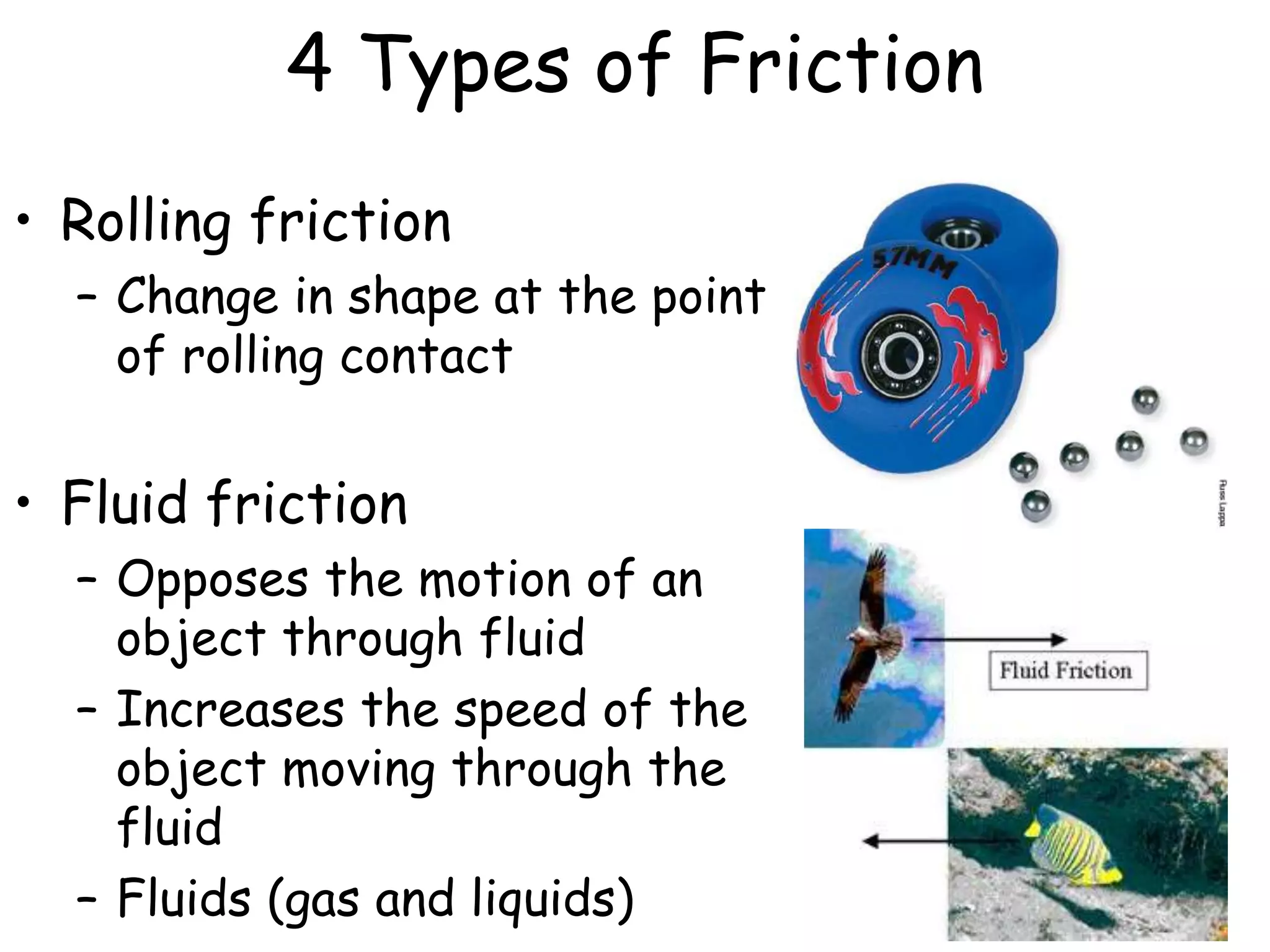
• Rolling friction
– Change in shape at the point
of rolling contact
• Fluid friction
– Opposes the motion of an
object through fluid
– Increases the speed of the
object moving through the
fluid
– Fluids (gas and liquids)
Gravity
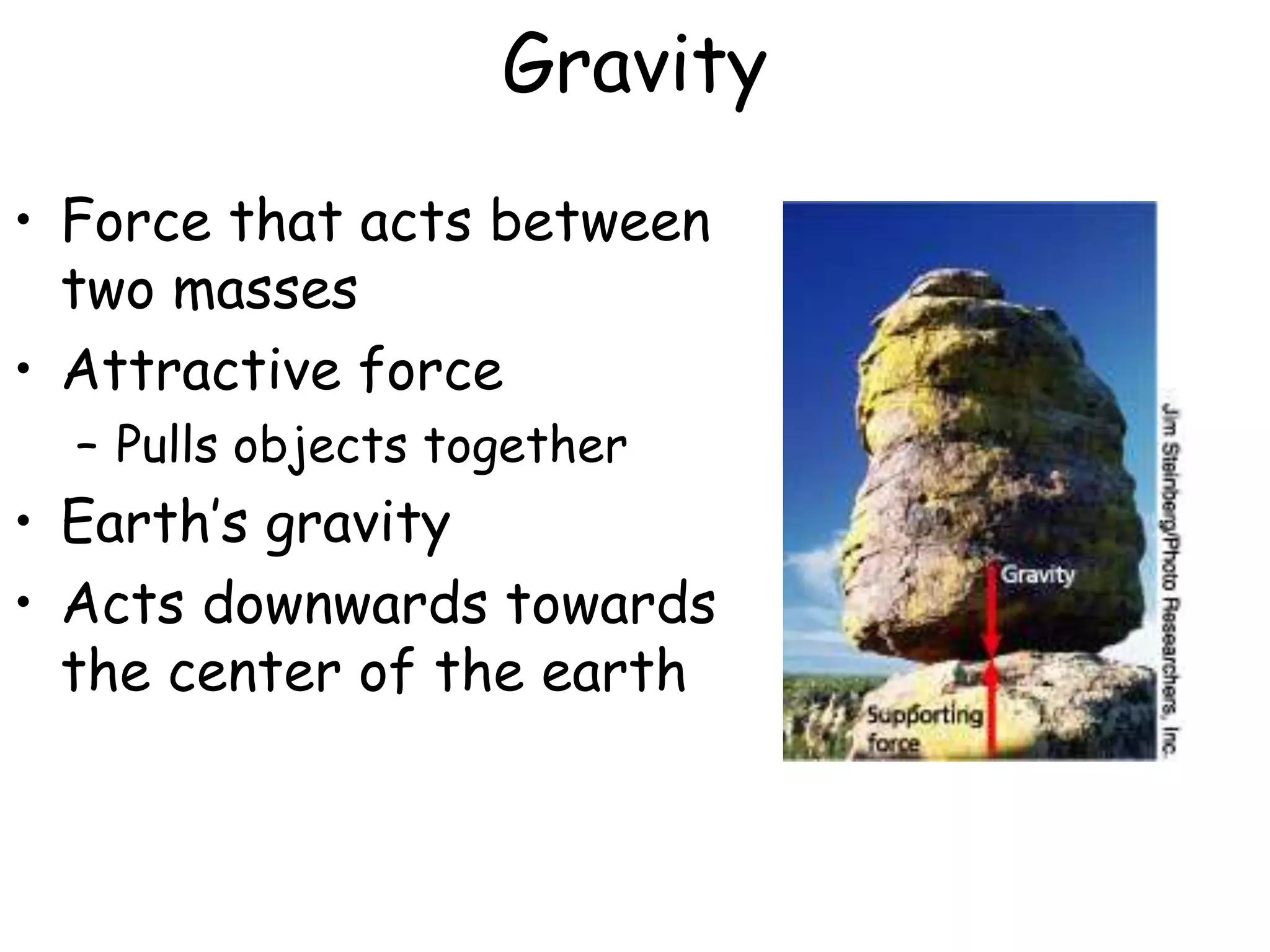
• Force that acts between
two masses
• Attractive force
– Pulls objects together
• Earth’s gravity
• Acts downwards towards
the center of the earth
Gravity and Falling Objects
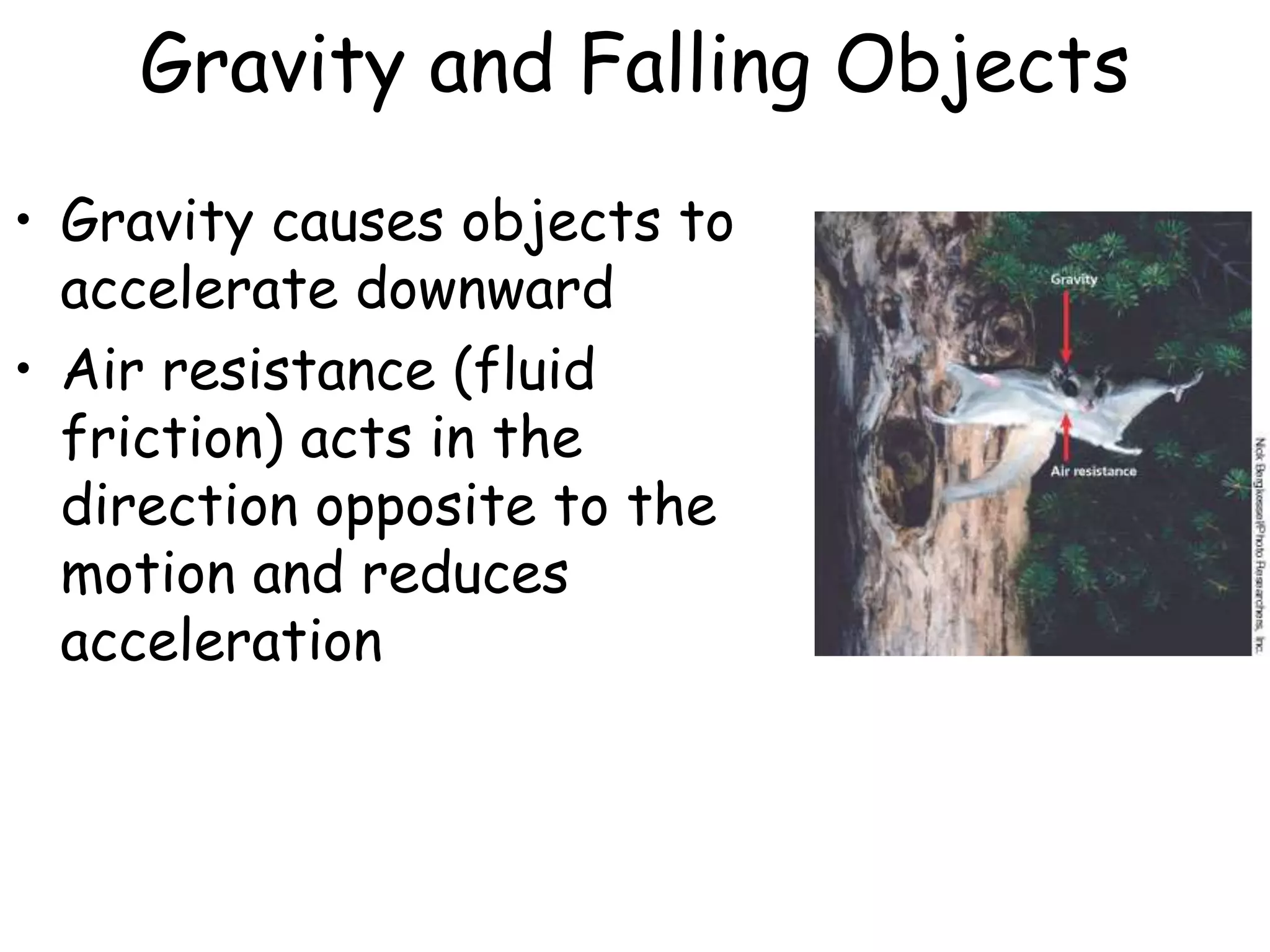
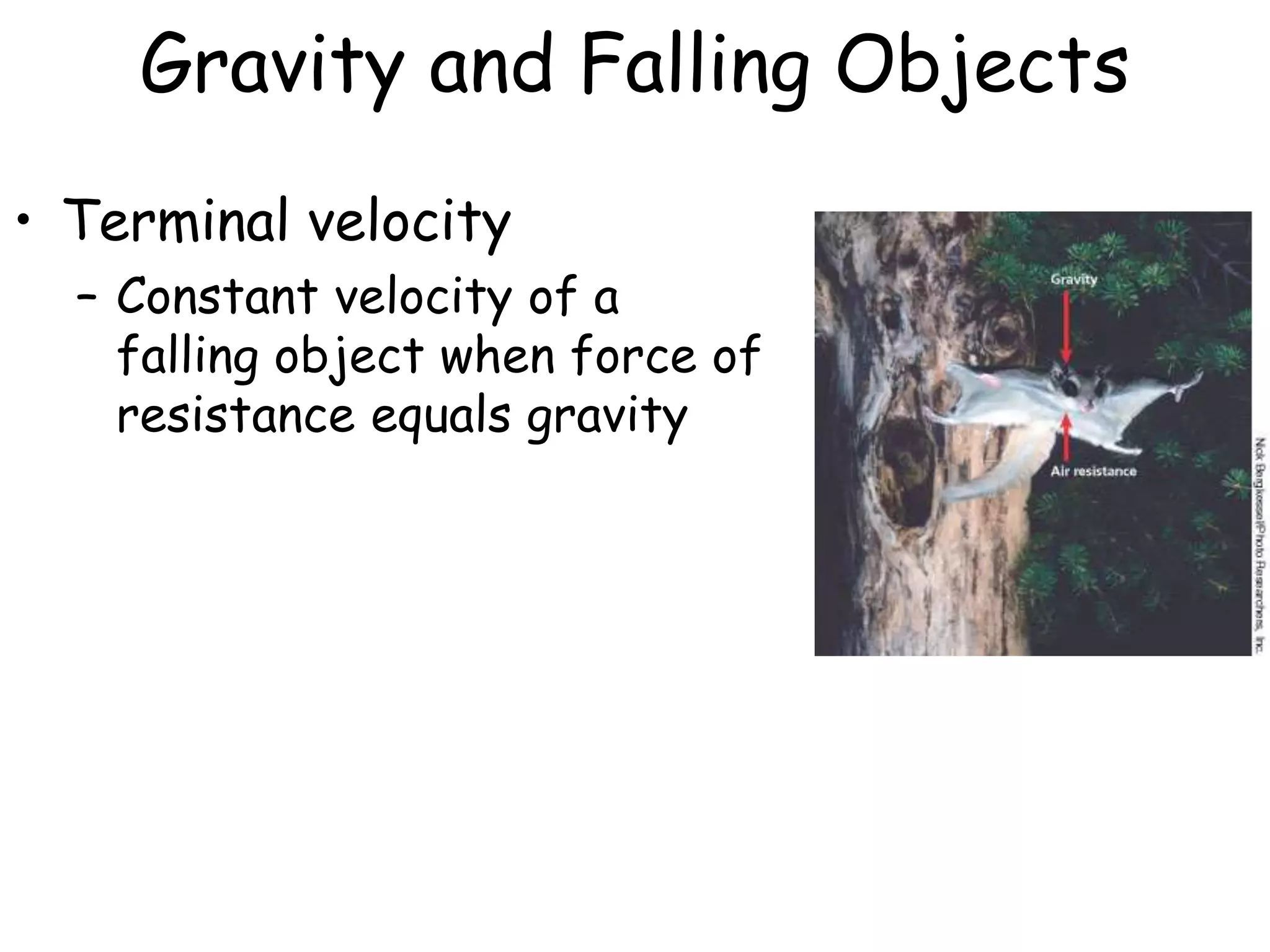
• Gravity causes objects to
accelerate downward
• Air resistance (fluid
friction) acts in the
direction opposite to the
motion and reduces
acceleration
Gravity and Falling Objects
• Terminal velocity
– Constant velocity of a
falling object when force of
resistance equals gravity
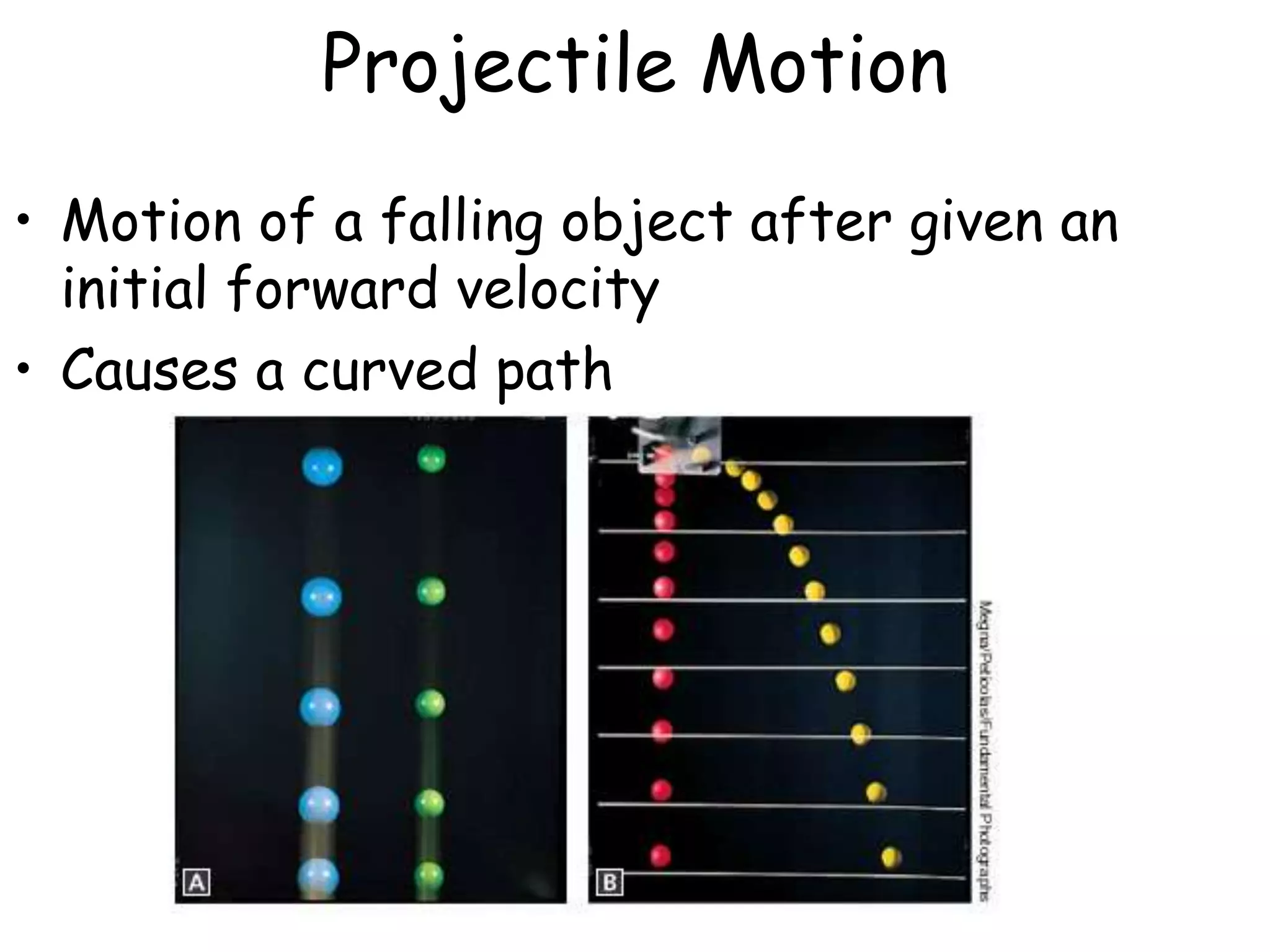
Projectile Motion
• Motion of a falling object after given an
initial forward velocity
• Causes a curved path
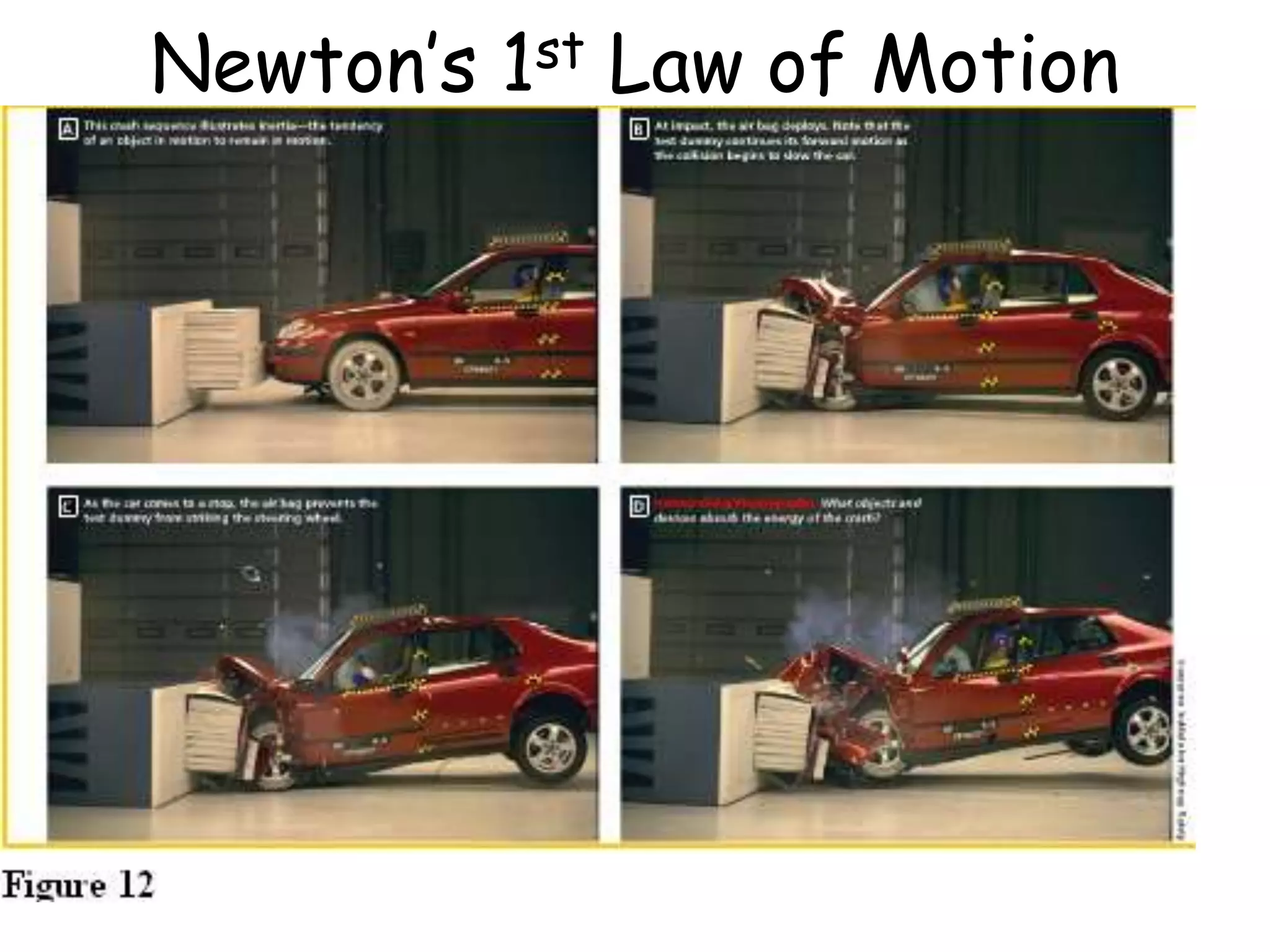
Newton’s 1st Law of Motion
• Law of inertia
– Inertia
• Tendency of an object to resist change
in its motion
• State of an object does not change as long
as the net force acting on it is zero
• An object at rest stays at rest, an object in
motion stays in motion at the same direction
and speed (until something acts on it)
• Inertia mini lab
Newton’s 1st Law of Motion
Videos
• animated videos
• real videos
• physics in sports
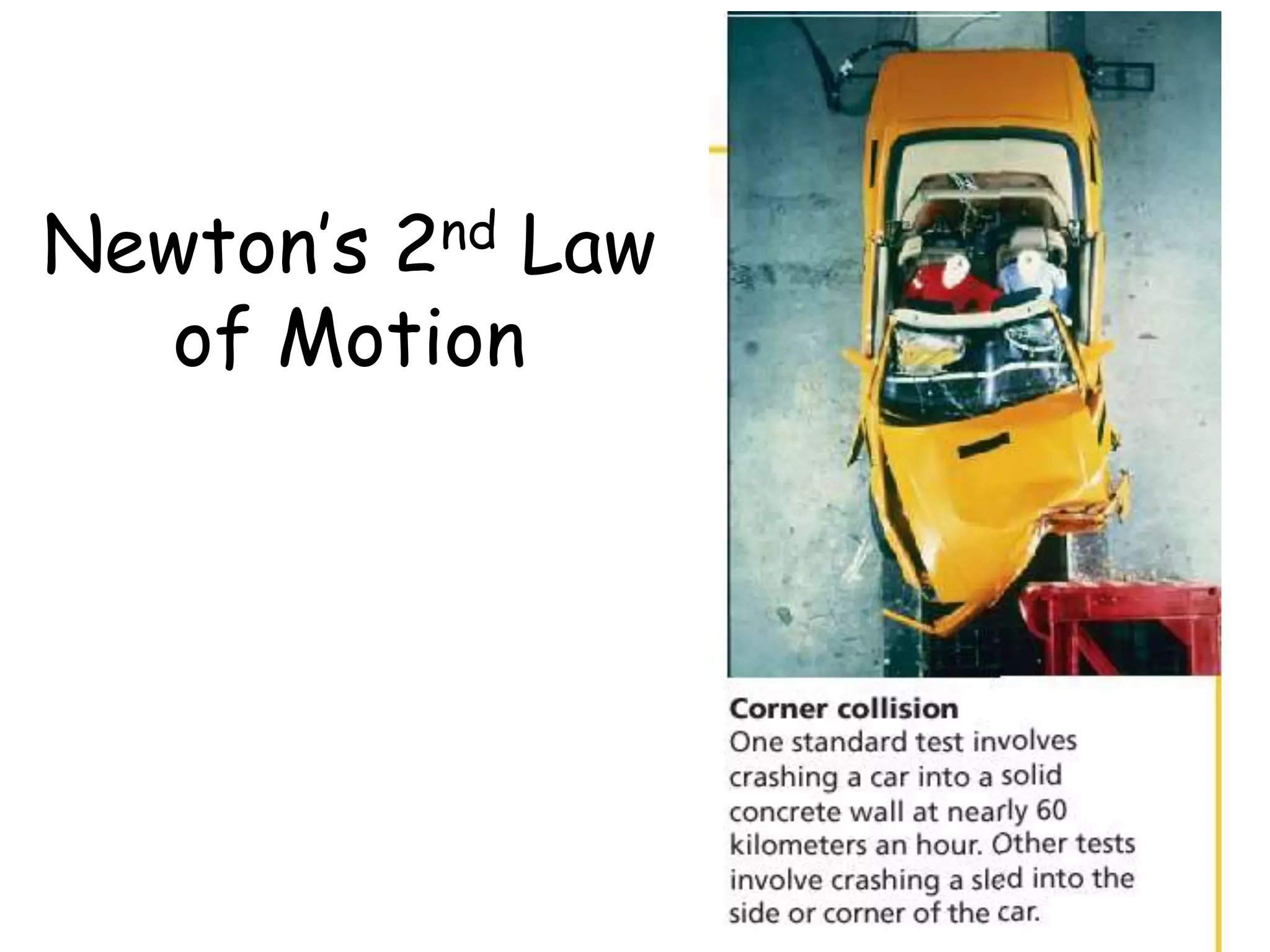
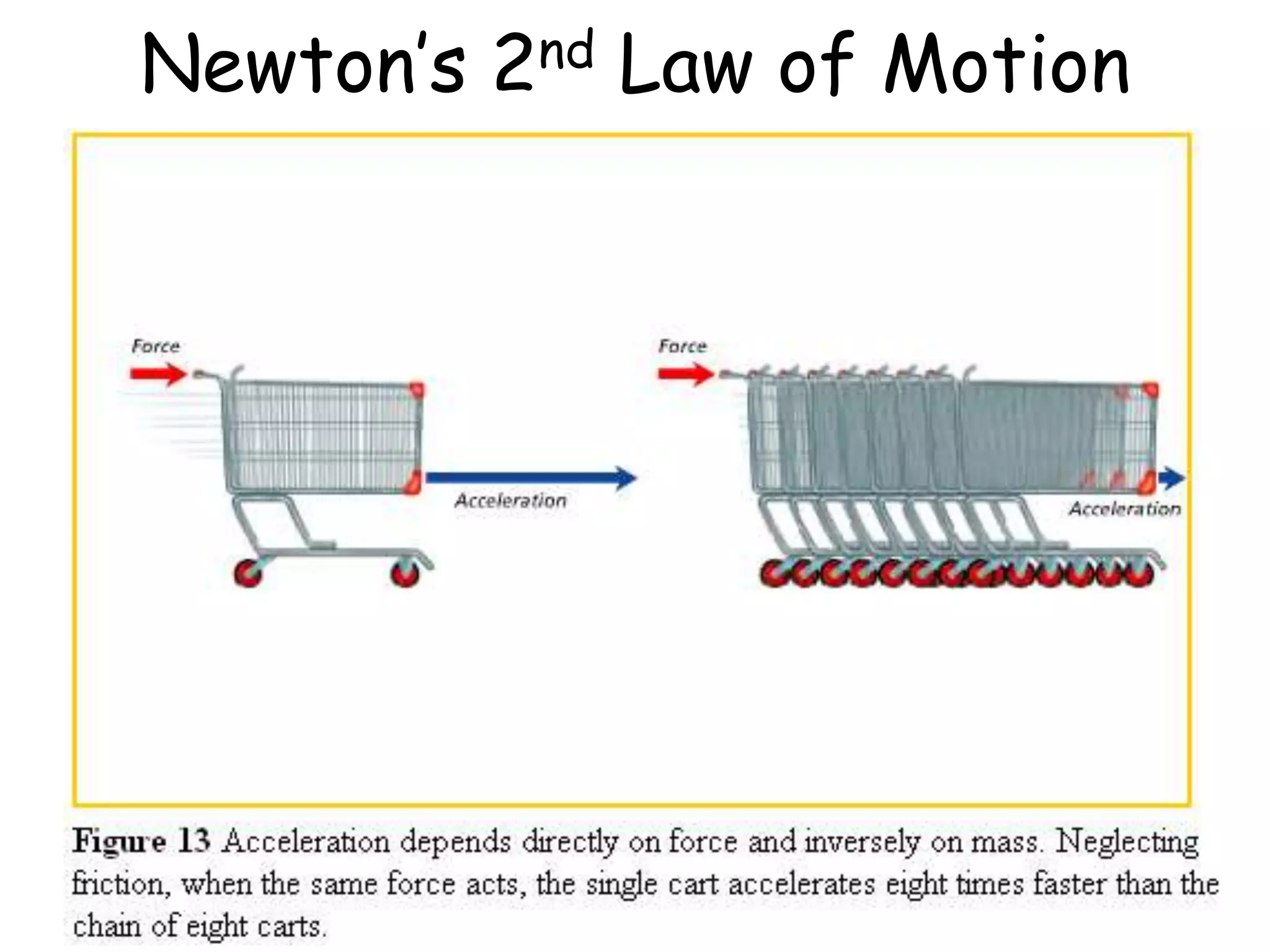
Newton’s 2nd Law of Motion
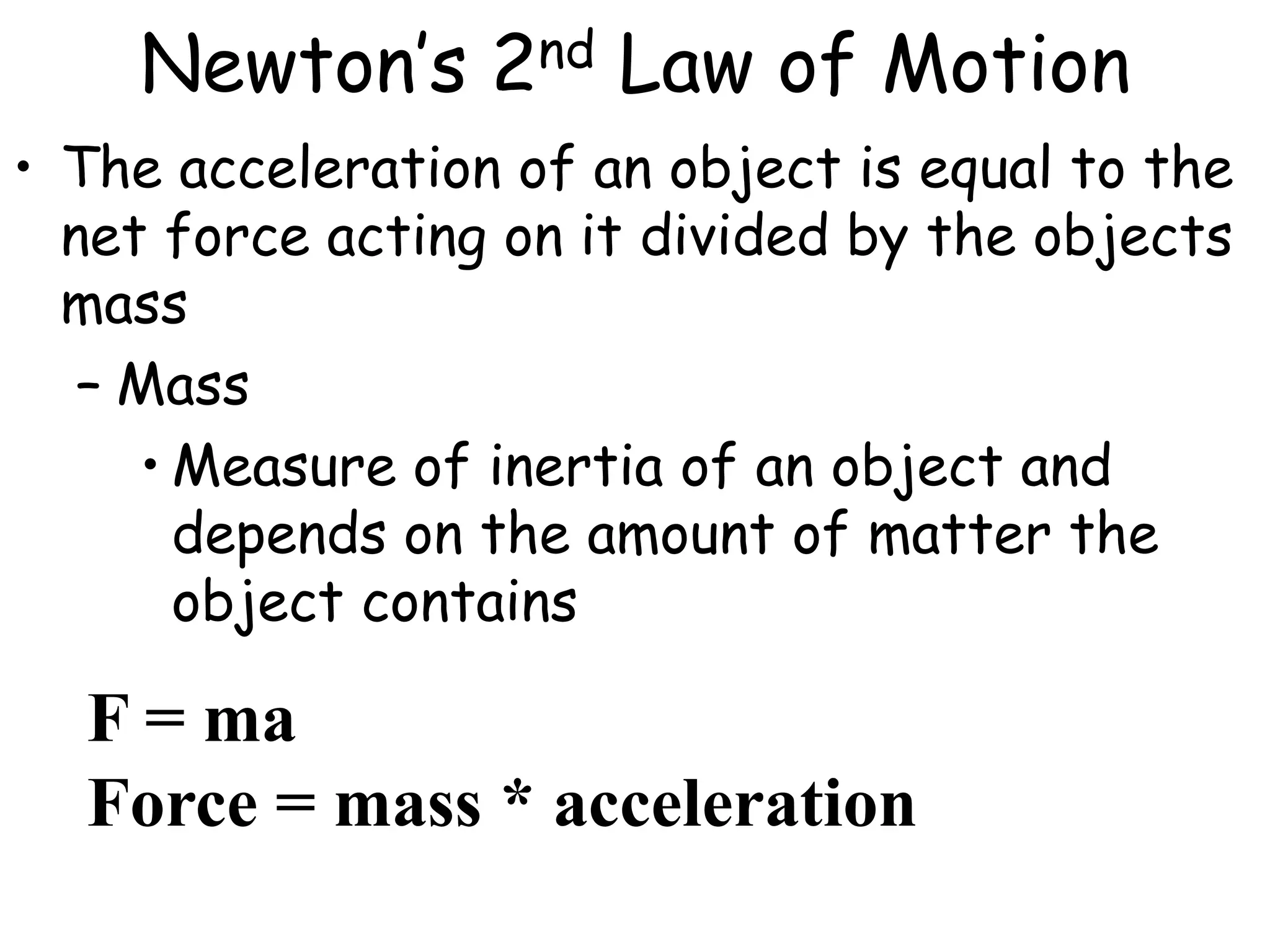
• The acceleration of an object is equal to the
net force acting on it divided by the objects
mass
– Mass
• Measure of inertia of an object and
depends on the amount of matter the
object contains
F = ma
Force = mass * acceleration
Newton’s 2nd Law of Motion
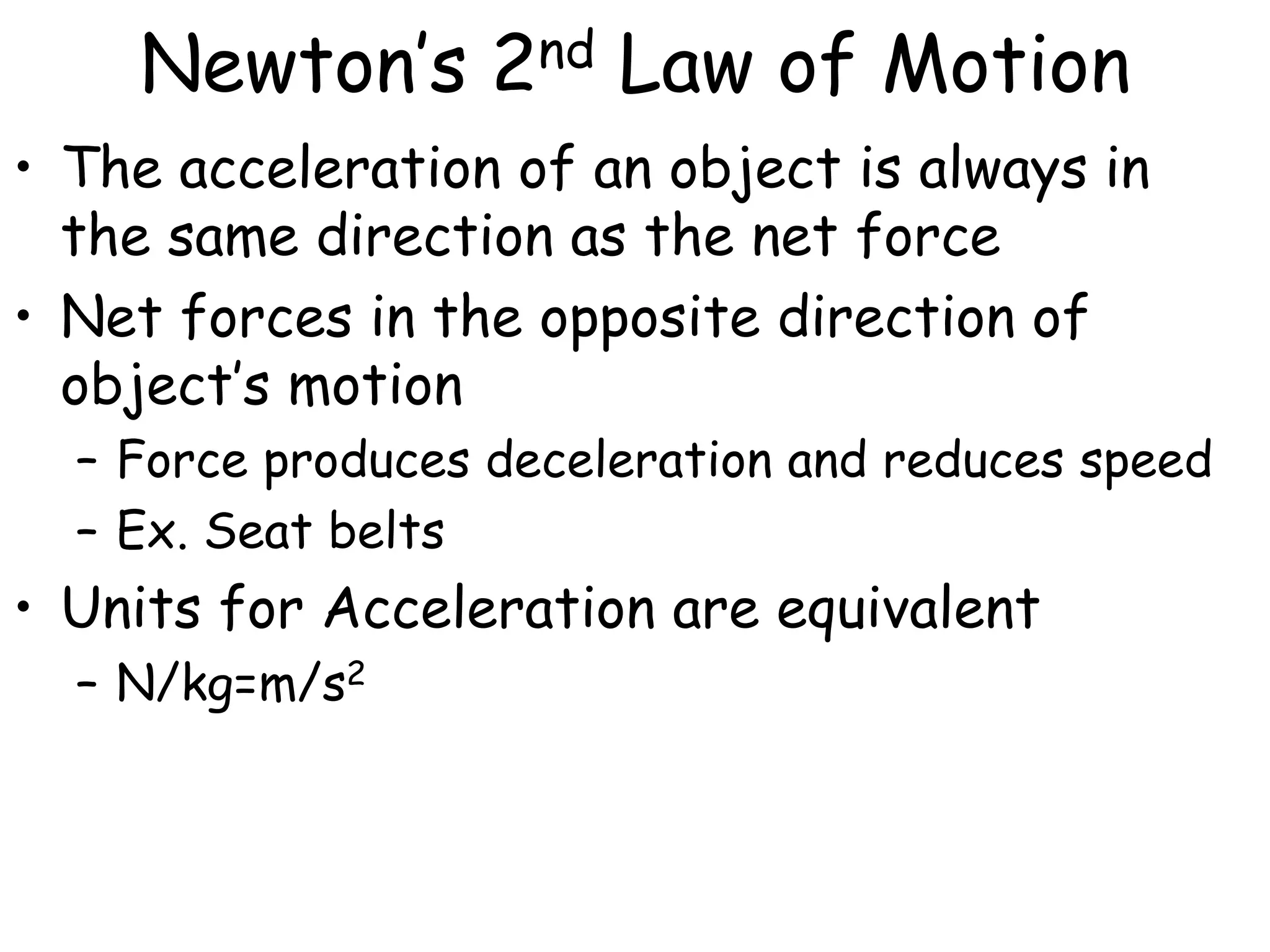
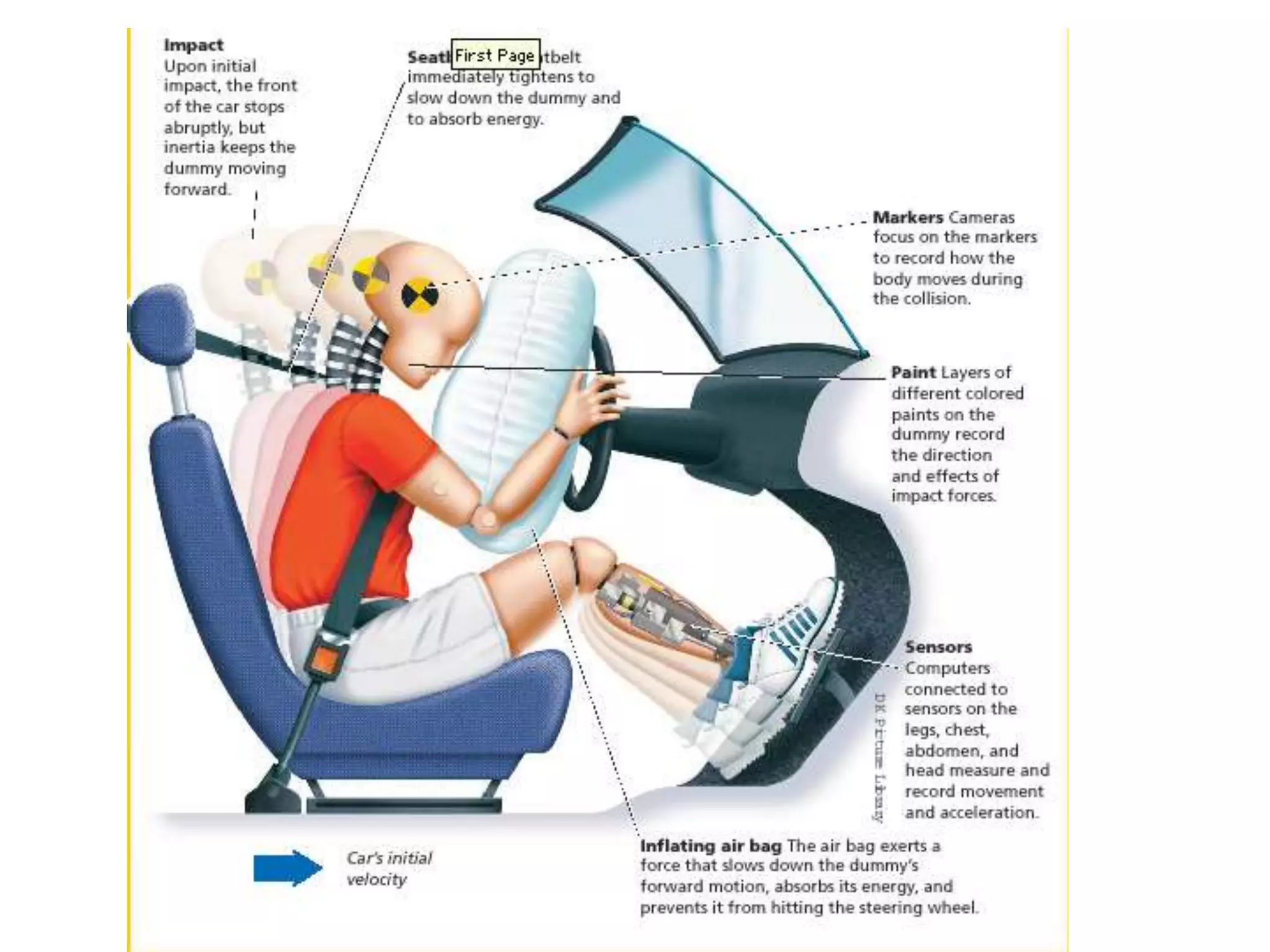
• The acceleration of an object is always in
the same direction as the net force
• Net forces in the opposite direction of
object’s motion
– Force produces deceleration and reduces speed
– Ex. Seat belts
• Units for Acceleration are equivalent
– N/kg=m/s2
Newton’s 2nd Law of Motion
Newton’s 2nd Law
of Motion
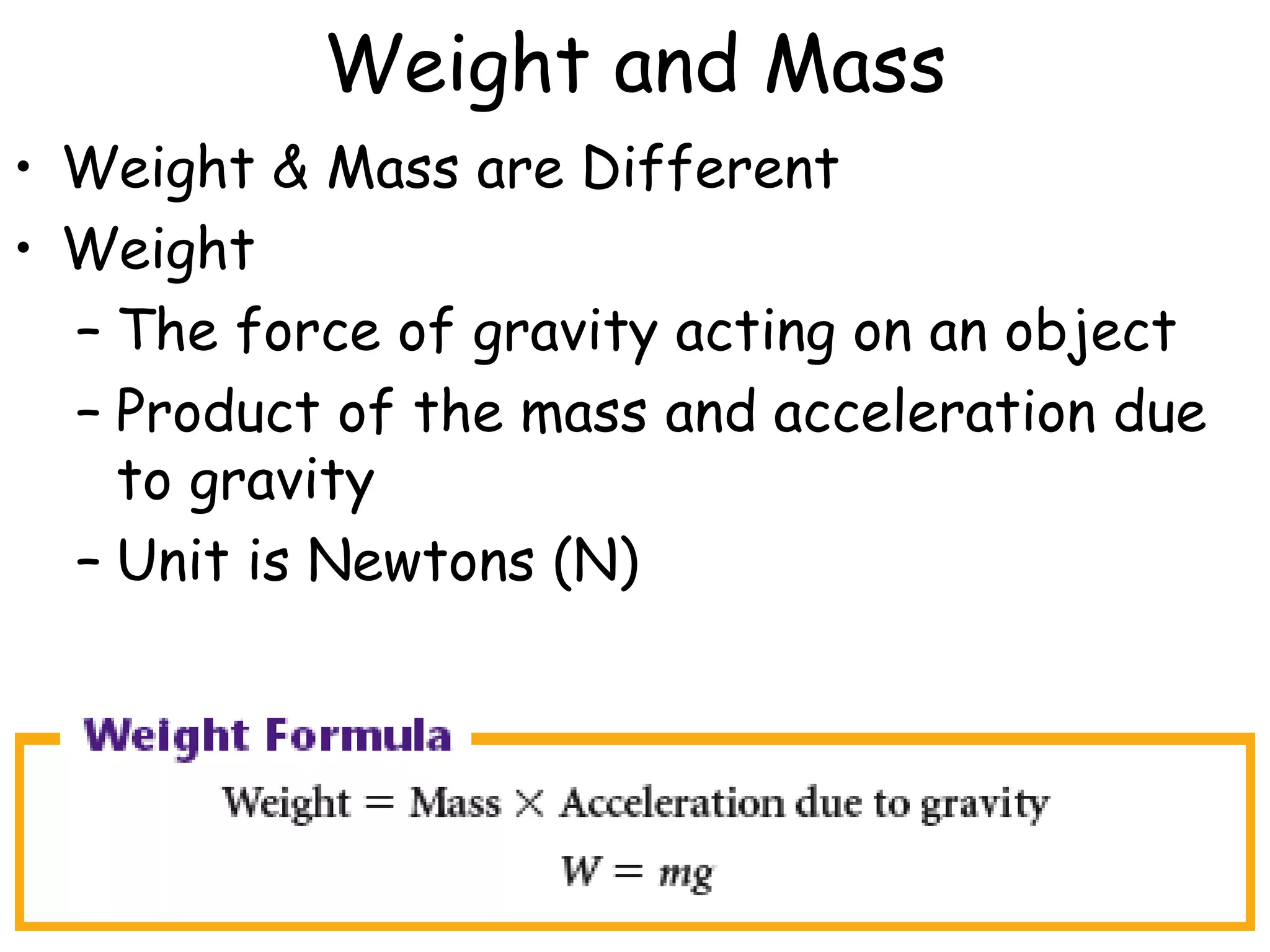
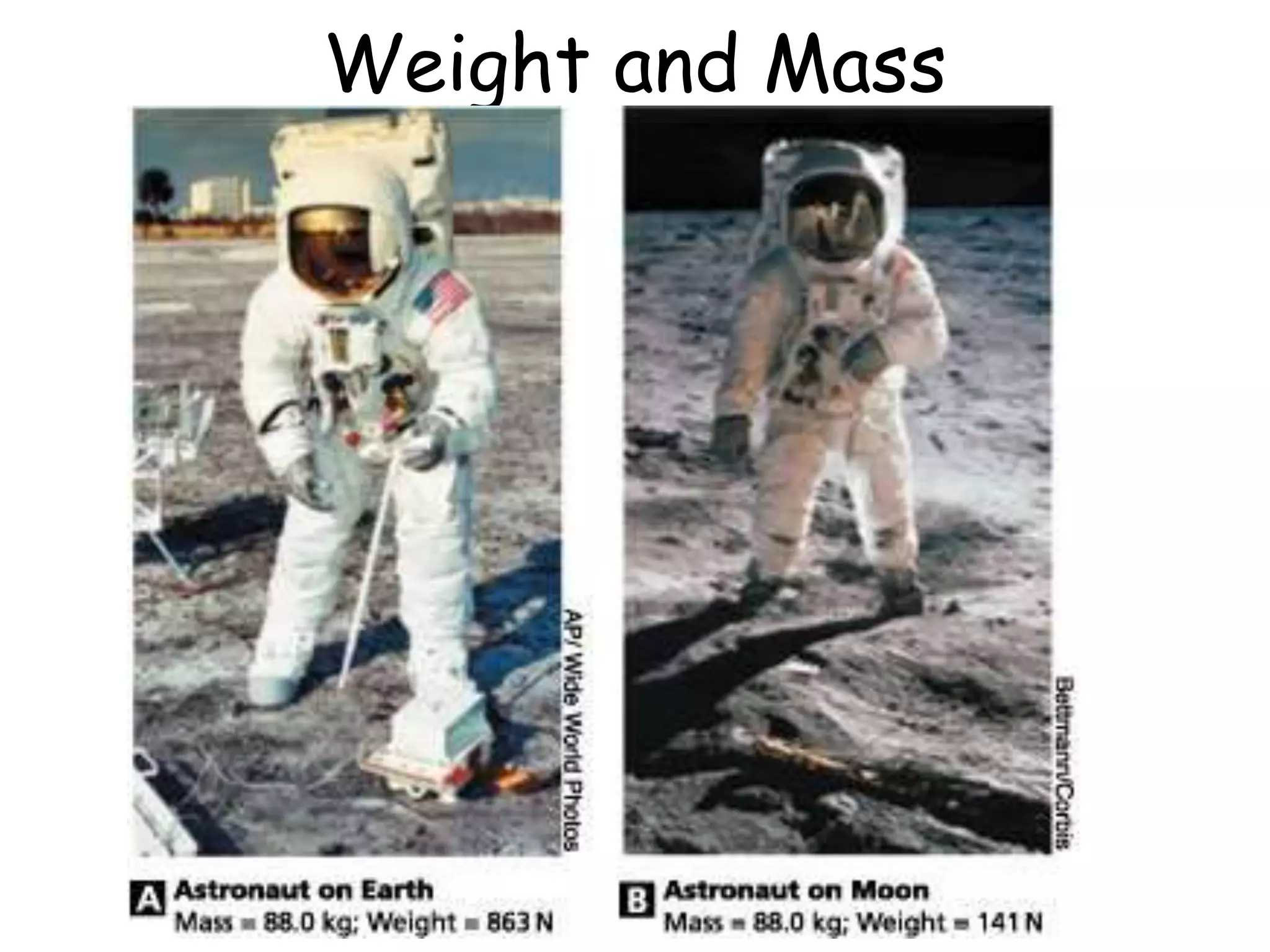
Weight and Mass
• Weight & Mass are Different
• Weight
– The force of gravity acting on an object
– Product of the mass and acceleration due
to gravity
– Unit is Newtons (N)
Weight and Mass
Newton’s 2nd Law of Motion
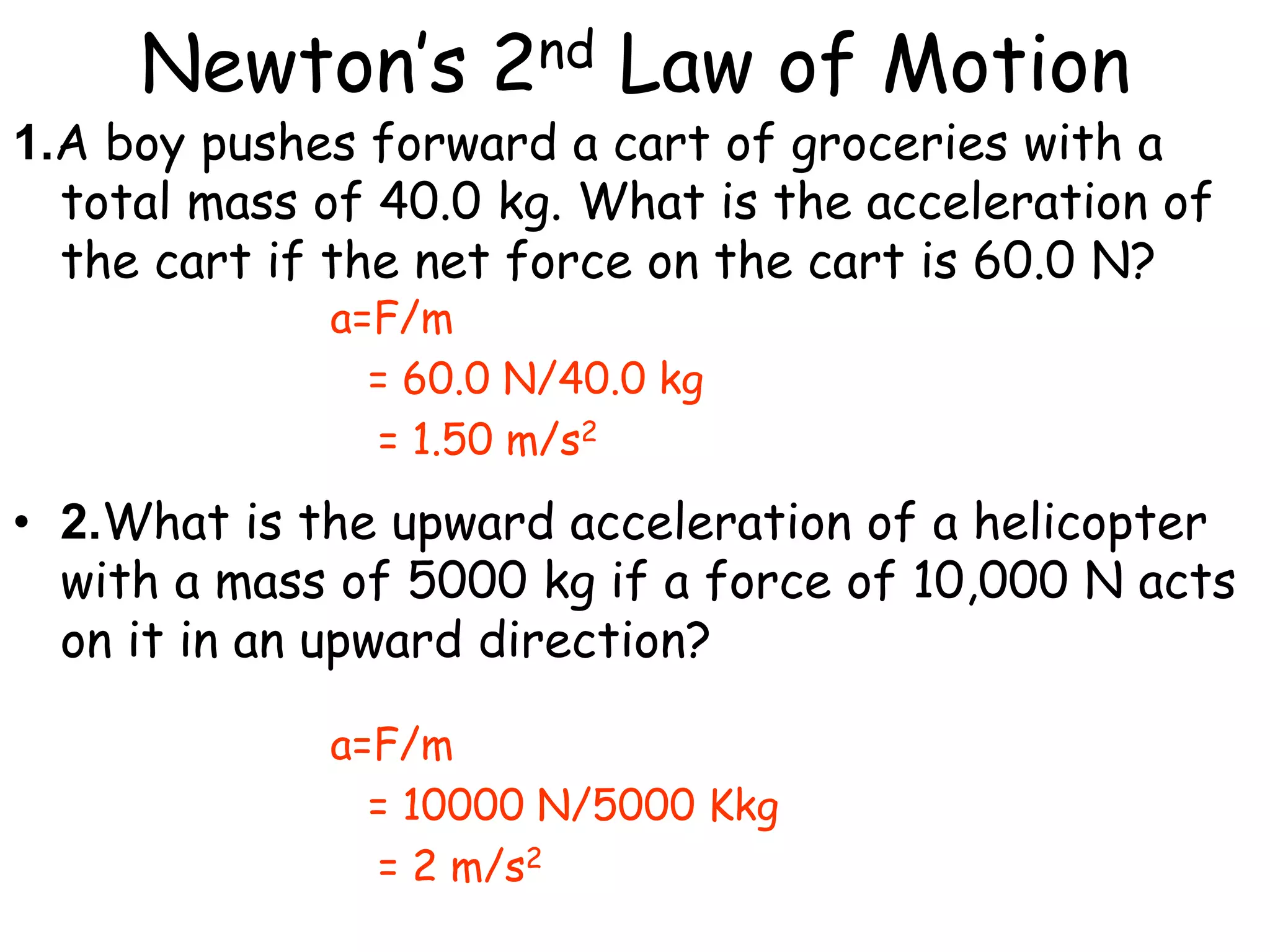
a=F/m
= 60.0 N/40.0 kg
= 1.50 m/s2
a=F/m
= 10000 N/5000 Kkg
= 2 m/s2
1.A boy pushes forward a cart of groceries with a
total mass of 40.0 kg. What is the acceleration of
the cart if the net force on the cart is 60.0 N?
• 2.What is the upward acceleration of a helicopter
with a mass of 5000 kg if a force of 10,000 N acts
on it in an upward direction?
Newton’s 2nd Law of Motion
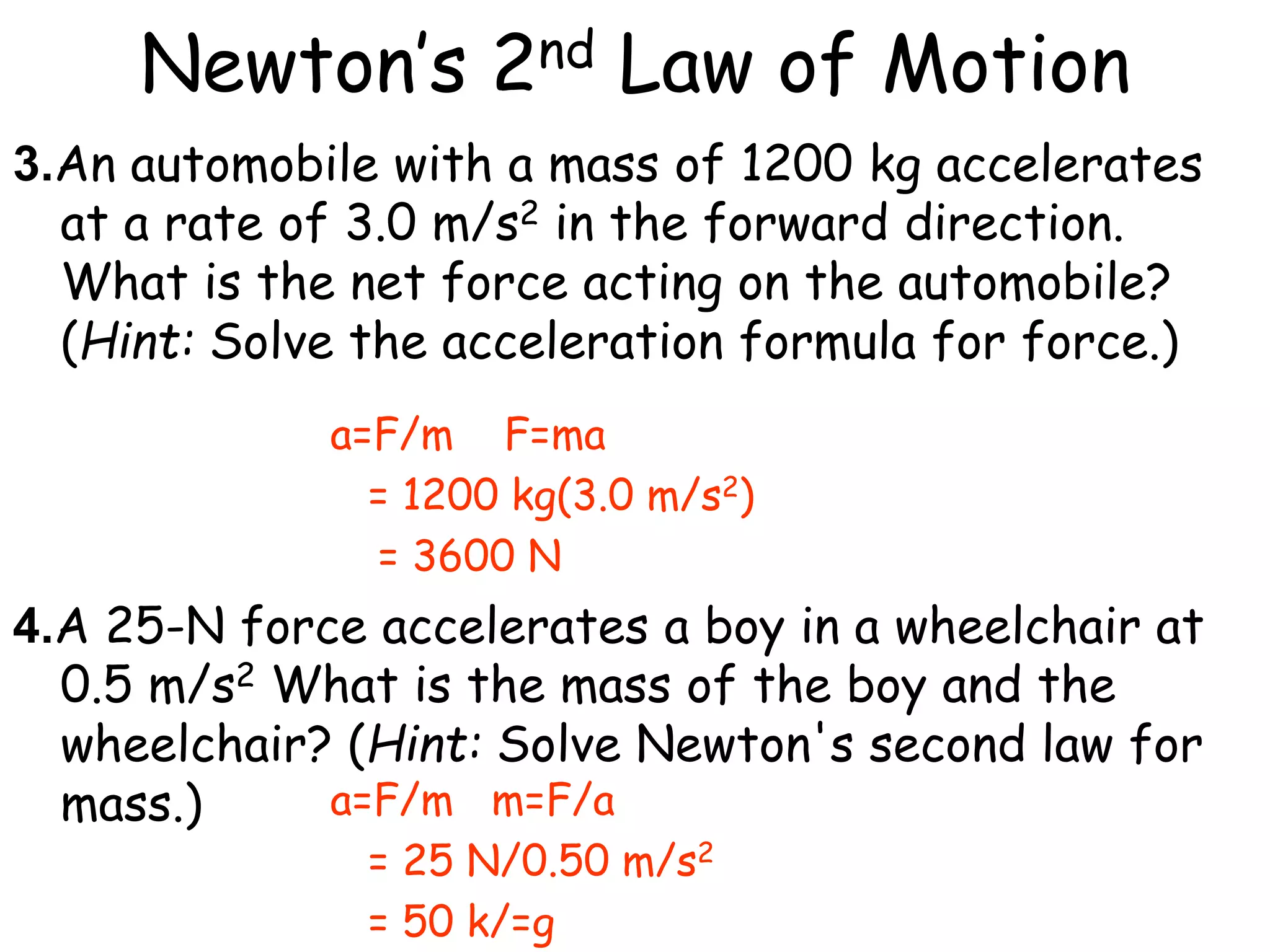
3.An automobile with a mass of 1200 kg accelerates
at a rate of 3.0 m/s2 in the forward direction.
What is the net force acting on the automobile?
(Hint: Solve the acceleration formula for force.)
4.A 25-N force accelerates a boy in a wheelchair at
0.5 m/s2 What is the mass of the boy and the
wheelchair? (Hint: Solve Newton's second law for
mass.)
a=F/m F=ma
= 1200 kg(3.0 m/s2)
= 3600 N
a=F/m m=F/a
= 25 N/0.50 m/s2
= 50 k/=g
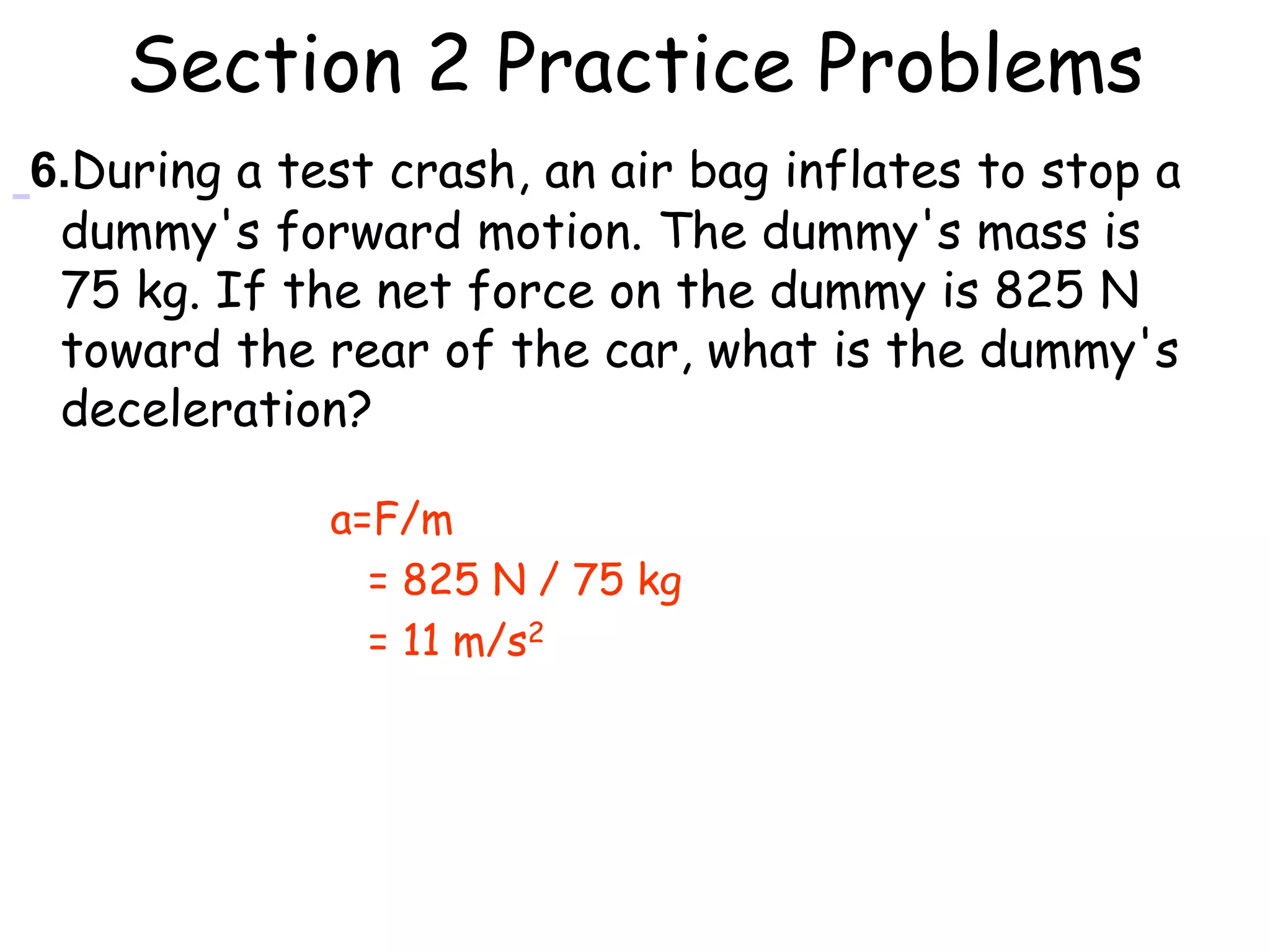
Section 2 Practice Problems
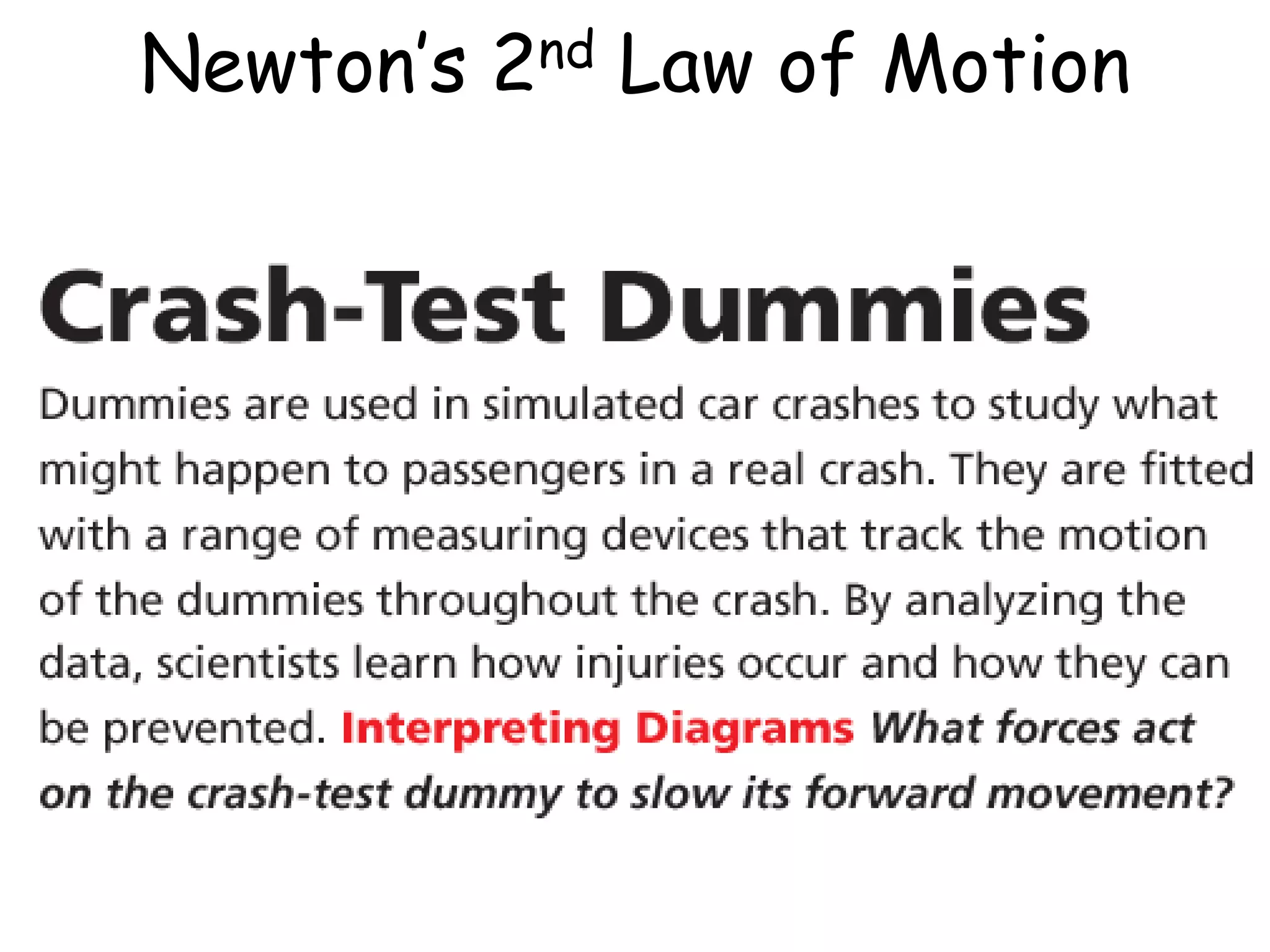
6.During a test crash, an air bag inflates to stop a
dummy's forward motion. The dummy's mass is
75 kg. If the net force on the dummy is 825 N
toward the rear of the car, what is the dummy's
deceleration?
a=F/m
= 825 N / 75 kg
= 11 m/s2
Section 2 Practice Problems
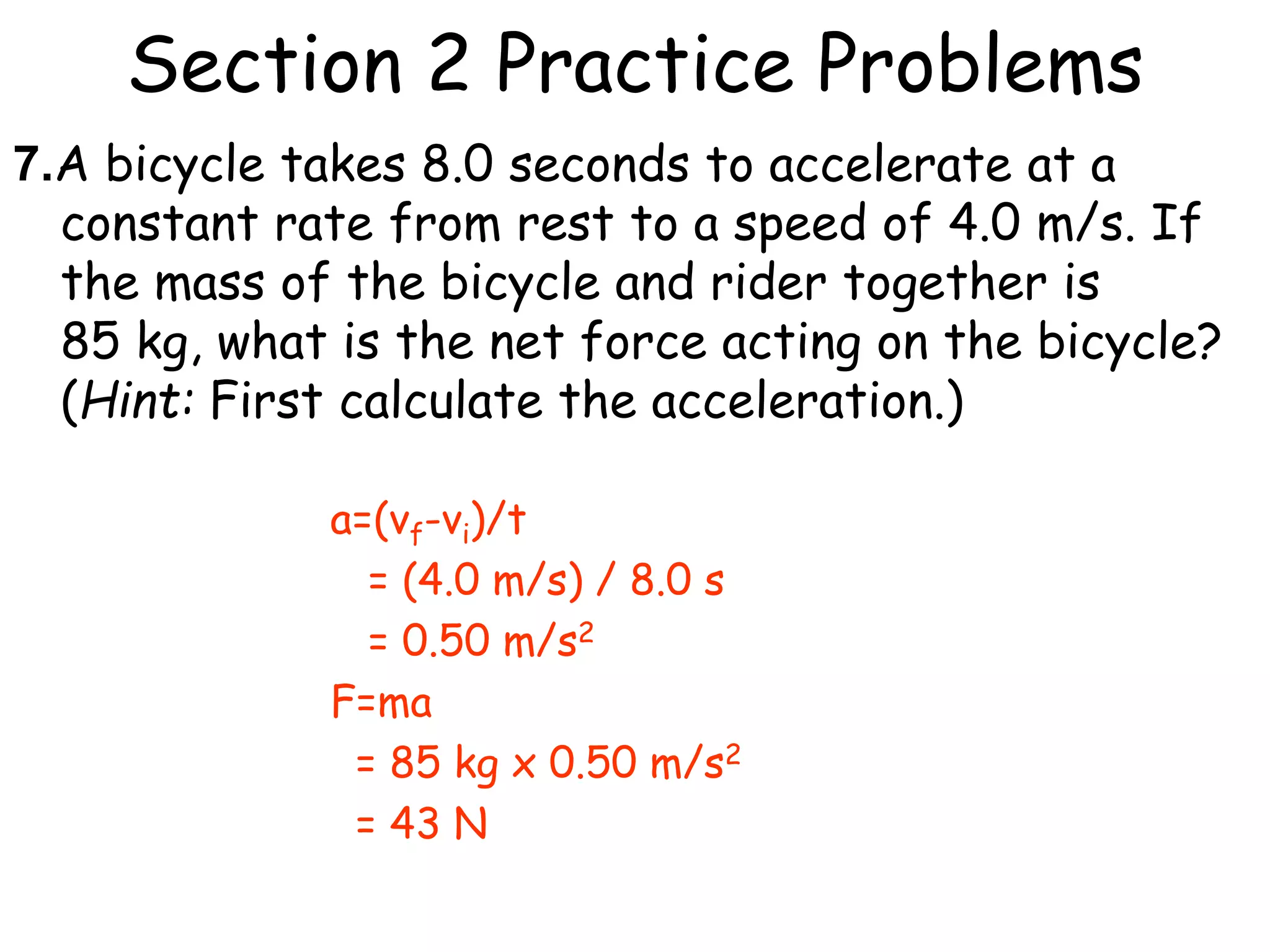
7.A bicycle takes 8.0 seconds to accelerate at a
constant rate from rest to a speed of 4.0 m/s. If
the mass of the bicycle and rider together is
85 kg, what is the net force acting on the bicycle?
(Hint: First calculate the acceleration.)
a=(vf-vi)/t
= (4.0 m/s) / 8.0 s
= 0.50 m/s2
F=ma
= 85 kg x 0.50 m/s2
= 43 N
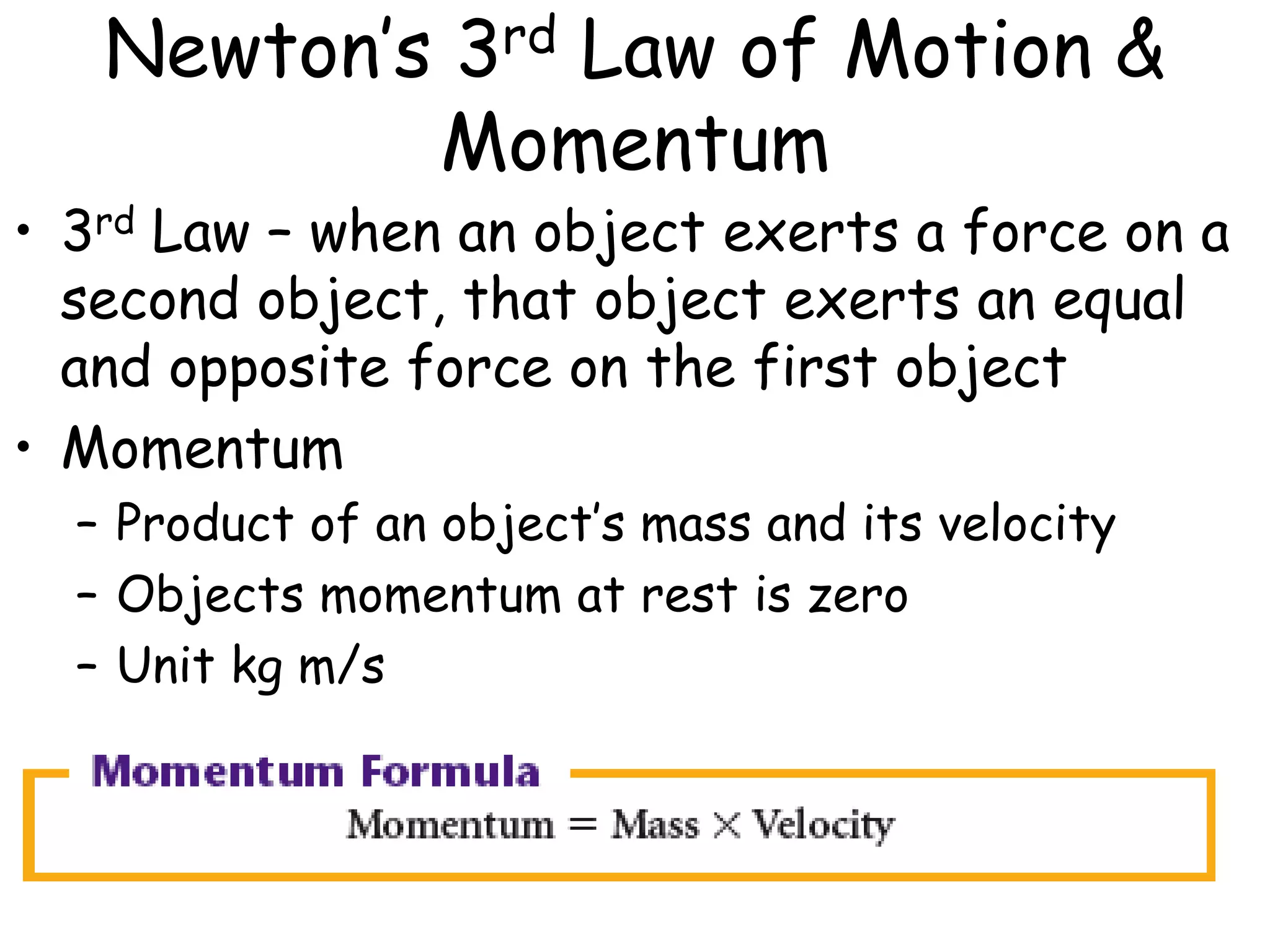
Newton’s 3rd Law of Motion &
Momentum
• 3rd Law – when an object exerts a force on a
second object, that object exerts an equal
and opposite force on the first object
• Momentum
– Product of an object’s mass and its velocity
– Objects momentum at rest is zero
– Unit kg m/s
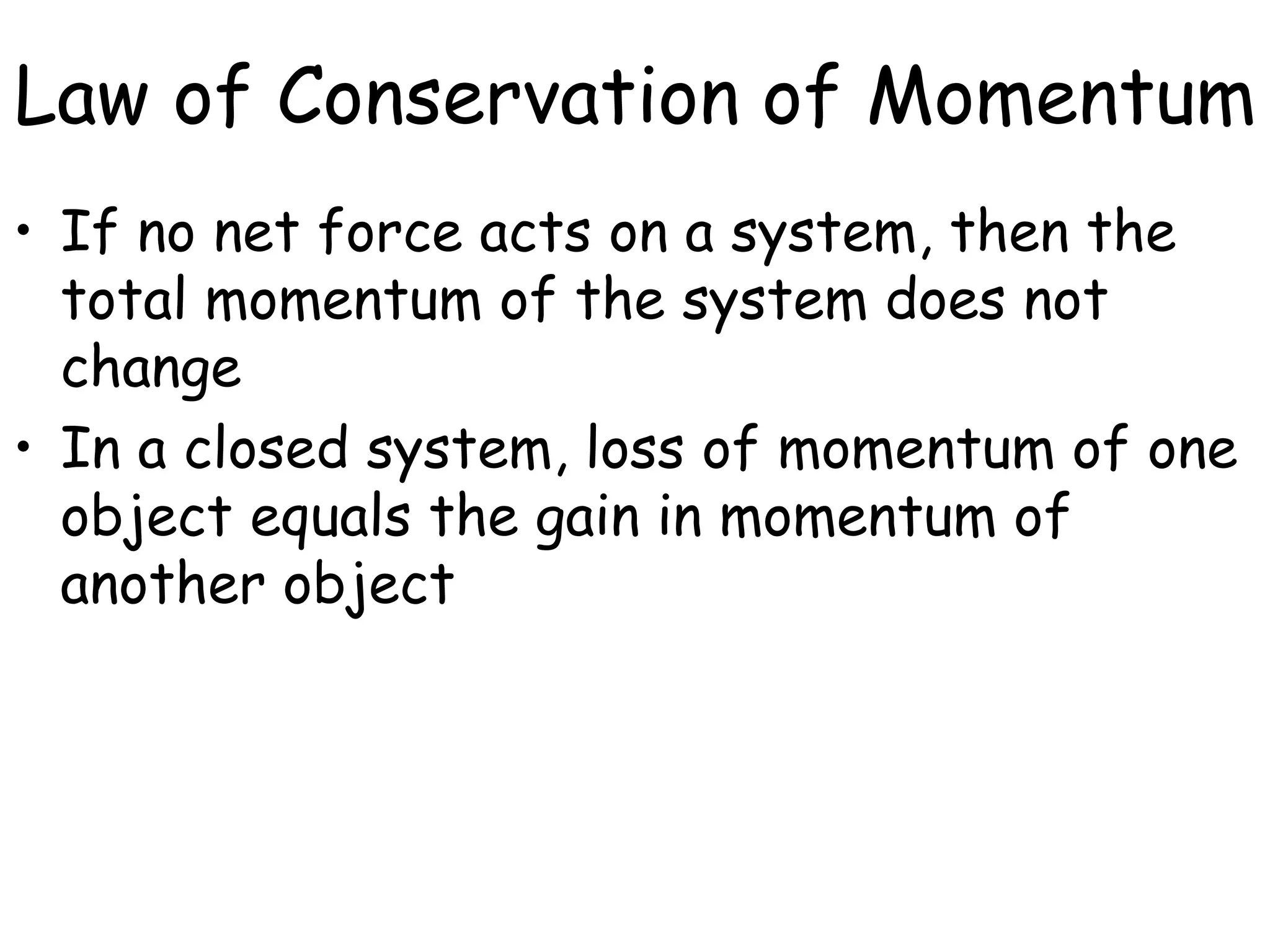
Law of Conservation of Momentum
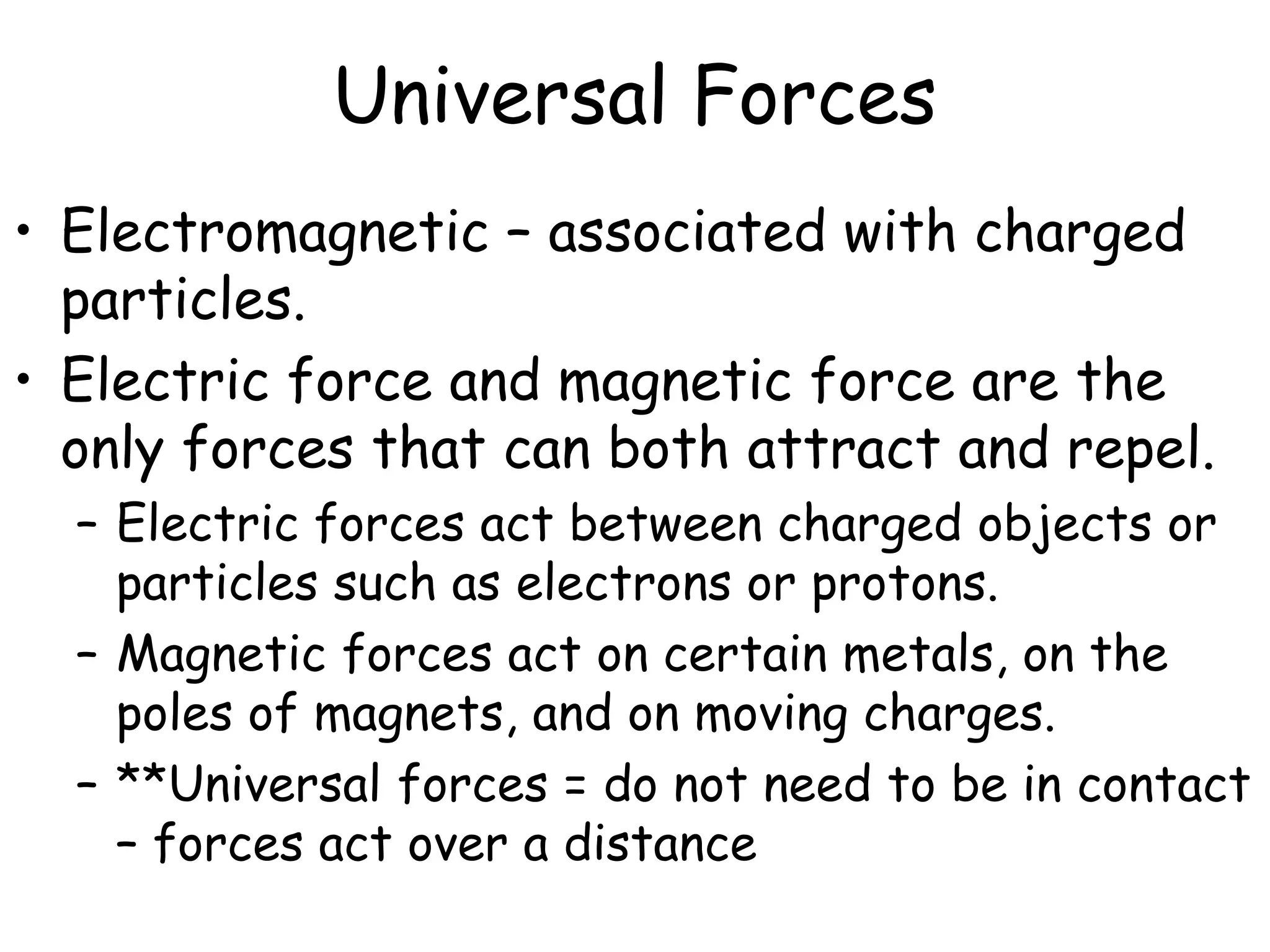
• If no net force acts on a system, then the
total momentum of the system does not
change
• In a closed system, loss of momentum of one
object equals the gain in momentum of
another object
Law of Conservation of Momentum
Universal Forces
• Electromagnetic – associated with charged
particles.
• Electric force and magnetic force are the
only forces that can both attract and repel.
– Electric forces act between charged objects or
particles such as electrons or protons.
– Magnetic forces act on certain metals, on the
poles of magnets, and on moving charges.
– **Universal forces = do not need to be in contact
– forces act over a distance
Universal Forces
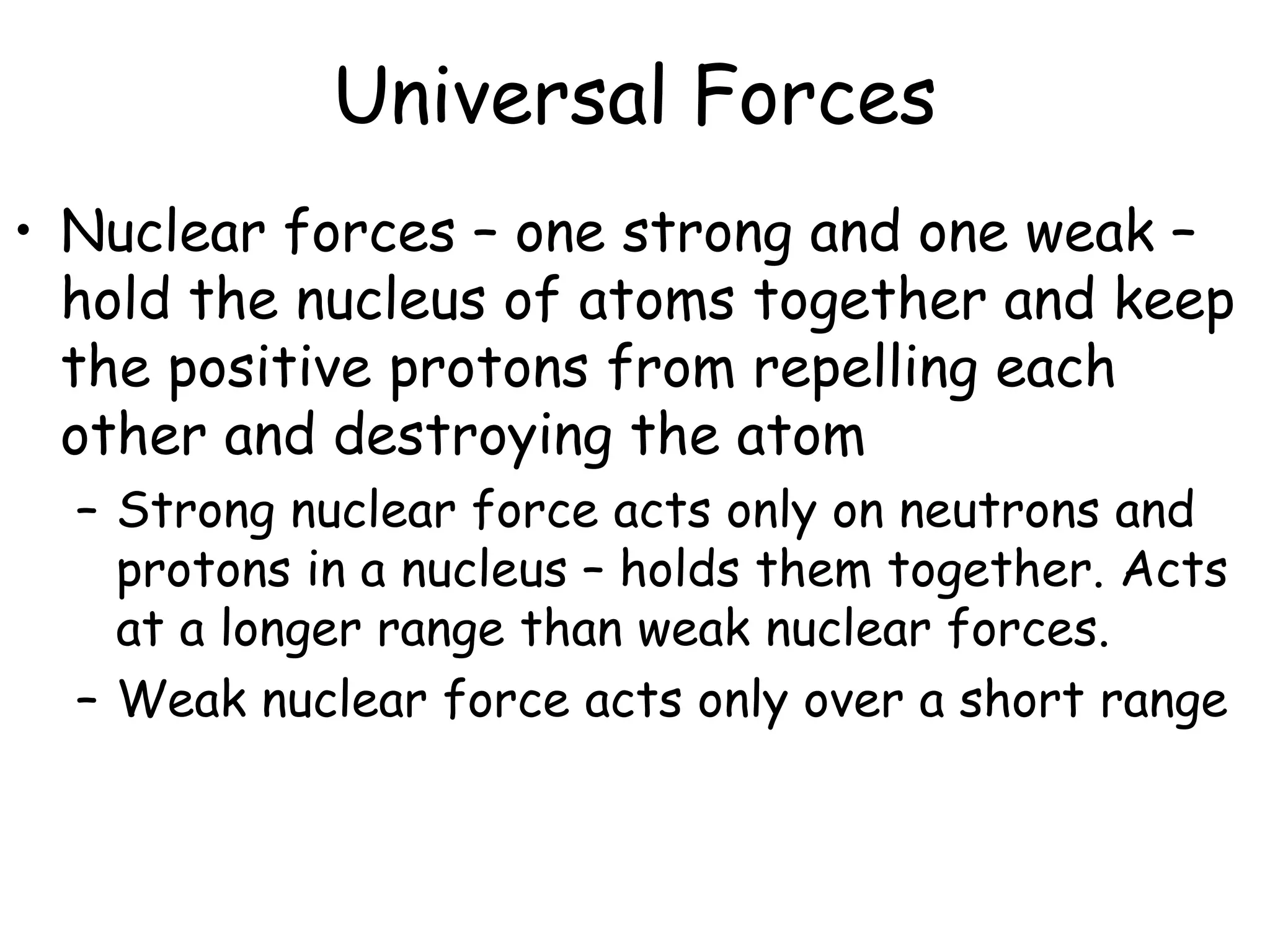
• Nuclear forces – one strong and one weak –
hold the nucleus of atoms together and keep
the positive protons from repelling each
other and destroying the atom
– Strong nuclear force acts only on neutrons and
protons in a nucleus – holds them together. Acts
at a longer range than weak nuclear forces.
– Weak nuclear force acts only over a short range
Universal Forces
• Gravitational Force – an attractive force
acting between any two masses
– Gravitational force depends on two factors:
mass and distance apart
– More mass or less distance = more gravity
– Gravity acts over LARGE distances
– Weakest universal force
Universal Forces
• Centripetal force – center-directed force that
continuously changes the direction of an
object to make it move in a circle
• Centrifugal force (centrifuge) doesn’t
actually exist in science!
• Earth’s gravitational attraction keeps the
moon in an orbit around the Earth. This
gives us tides. Similarly to how the moon
orbits Earth, satellites are able to orbit!
Assignment
• On your own paper: answers only
• P. 367 #1-4
• P. 369 #1-3, 6, 7
• P. 377 #1-4
• P. 382 #1-4
• Due before you leave class
• STOP STEALING THE TEXTBOOKS
(you will have to do assignments online if it
happens one more time!)

Forces_and_Motion.ppt

  • 1.
    Forces and Motion Reference: PrenticeHall Physical Science: Concepts in Action Chapter 12
  • 2.
    What is Force? •A push or pull that acts on an object • Can cause a resting object to move • Can accelerate a moving object – By changing its speed or direction
  • 3.
    How is forcemeasured? • Spring scale – Stretch of the spring depends on the mass of the object acting on it • Unit of Force – Newton (N) – 1 kg to accelerate 1 m/s2 – 2 1 s m kg N  
  • 4.
    How is forcerepresented? • Use arrows – Direction – Strength • Length represents strength or magnitude – The scale with more apples, greater mass, has a longer arrow. The arrow is pointed downward due to mass is below the balance pulling downwards.
  • 5.
    Combining Forces • Forcesin the same direction are added together • Force in the opposite direction are subtracted • Net Force – Overall force acting on an object
  • 6.
    Balanced vs. UnbalancedForces • Balanced – Combine to produce a net force of zero – No change in the object’s motion • Unbalanced – Net force equals the size of the larger force minus the size of the smaller force – Net force does not equal zero – Causes an object to accelerate
  • 7.
  • 8.
    Friction • Force thatopposes the motion of objects that touch as they move past each other • Acts at the surface where objects are in contact • 4 types of friction
  • 9.
    4 Types ofFriction • Static friction – Force that acts on objects that are not moving – Always acts in the direction opposite to that of the applied force • Sliding friction – Force that opposes the direction of motion of an object as it slides over a surface
  • 10.
    4 Types ofFriction • Rolling friction – Change in shape at the point of rolling contact • Fluid friction – Opposes the motion of an object through fluid – Increases the speed of the object moving through the fluid – Fluids (gas and liquids)
  • 11.
    Gravity • Force thatacts between two masses • Attractive force – Pulls objects together • Earth’s gravity • Acts downwards towards the center of the earth
  • 12.
    Gravity and FallingObjects • Gravity causes objects to accelerate downward • Air resistance (fluid friction) acts in the direction opposite to the motion and reduces acceleration
  • 13.
    Gravity and FallingObjects • Terminal velocity – Constant velocity of a falling object when force of resistance equals gravity
  • 14.
    Projectile Motion • Motionof a falling object after given an initial forward velocity • Causes a curved path
  • 15.
    Newton’s 1st Lawof Motion • Law of inertia – Inertia • Tendency of an object to resist change in its motion • State of an object does not change as long as the net force acting on it is zero • An object at rest stays at rest, an object in motion stays in motion at the same direction and speed (until something acts on it) • Inertia mini lab
  • 16.
  • 17.
    Videos • animated videos •real videos • physics in sports
  • 18.
    Newton’s 2nd Lawof Motion • The acceleration of an object is equal to the net force acting on it divided by the objects mass – Mass • Measure of inertia of an object and depends on the amount of matter the object contains F = ma Force = mass * acceleration
  • 19.
    Newton’s 2nd Lawof Motion • The acceleration of an object is always in the same direction as the net force • Net forces in the opposite direction of object’s motion – Force produces deceleration and reduces speed – Ex. Seat belts • Units for Acceleration are equivalent – N/kg=m/s2
  • 20.
  • 21.
  • 23.
    Weight and Mass •Weight & Mass are Different • Weight – The force of gravity acting on an object – Product of the mass and acceleration due to gravity – Unit is Newtons (N)
  • 24.
  • 25.
  • 26.
    Newton’s 2nd Lawof Motion a=F/m = 60.0 N/40.0 kg = 1.50 m/s2 a=F/m = 10000 N/5000 Kkg = 2 m/s2 1.A boy pushes forward a cart of groceries with a total mass of 40.0 kg. What is the acceleration of the cart if the net force on the cart is 60.0 N? • 2.What is the upward acceleration of a helicopter with a mass of 5000 kg if a force of 10,000 N acts on it in an upward direction?
  • 27.
    Newton’s 2nd Lawof Motion 3.An automobile with a mass of 1200 kg accelerates at a rate of 3.0 m/s2 in the forward direction. What is the net force acting on the automobile? (Hint: Solve the acceleration formula for force.) 4.A 25-N force accelerates a boy in a wheelchair at 0.5 m/s2 What is the mass of the boy and the wheelchair? (Hint: Solve Newton's second law for mass.) a=F/m F=ma = 1200 kg(3.0 m/s2) = 3600 N a=F/m m=F/a = 25 N/0.50 m/s2 = 50 k/=g
  • 28.
    Section 2 PracticeProblems 6.During a test crash, an air bag inflates to stop a dummy's forward motion. The dummy's mass is 75 kg. If the net force on the dummy is 825 N toward the rear of the car, what is the dummy's deceleration? a=F/m = 825 N / 75 kg = 11 m/s2
  • 29.
    Section 2 PracticeProblems 7.A bicycle takes 8.0 seconds to accelerate at a constant rate from rest to a speed of 4.0 m/s. If the mass of the bicycle and rider together is 85 kg, what is the net force acting on the bicycle? (Hint: First calculate the acceleration.) a=(vf-vi)/t = (4.0 m/s) / 8.0 s = 0.50 m/s2 F=ma = 85 kg x 0.50 m/s2 = 43 N
  • 30.
    Newton’s 3rd Lawof Motion & Momentum • 3rd Law – when an object exerts a force on a second object, that object exerts an equal and opposite force on the first object • Momentum – Product of an object’s mass and its velocity – Objects momentum at rest is zero – Unit kg m/s
  • 31.
    Law of Conservationof Momentum • If no net force acts on a system, then the total momentum of the system does not change • In a closed system, loss of momentum of one object equals the gain in momentum of another object
  • 32.
  • 33.
    Universal Forces • Electromagnetic– associated with charged particles. • Electric force and magnetic force are the only forces that can both attract and repel. – Electric forces act between charged objects or particles such as electrons or protons. – Magnetic forces act on certain metals, on the poles of magnets, and on moving charges. – **Universal forces = do not need to be in contact – forces act over a distance
  • 34.
    Universal Forces • Nuclearforces – one strong and one weak – hold the nucleus of atoms together and keep the positive protons from repelling each other and destroying the atom – Strong nuclear force acts only on neutrons and protons in a nucleus – holds them together. Acts at a longer range than weak nuclear forces. – Weak nuclear force acts only over a short range
  • 35.
    Universal Forces • GravitationalForce – an attractive force acting between any two masses – Gravitational force depends on two factors: mass and distance apart – More mass or less distance = more gravity – Gravity acts over LARGE distances – Weakest universal force
  • 36.
    Universal Forces • Centripetalforce – center-directed force that continuously changes the direction of an object to make it move in a circle • Centrifugal force (centrifuge) doesn’t actually exist in science! • Earth’s gravitational attraction keeps the moon in an orbit around the Earth. This gives us tides. Similarly to how the moon orbits Earth, satellites are able to orbit!
  • 37.
    Assignment • On yourown paper: answers only • P. 367 #1-4 • P. 369 #1-3, 6, 7 • P. 377 #1-4 • P. 382 #1-4 • Due before you leave class • STOP STEALING THE TEXTBOOKS (you will have to do assignments online if it happens one more time!)