Newton’s Second Law of Motion
Force, Mass, & Acceleration How does force cause motion to change?  What is the difference between throwing a baseball and tossing one gently? In both examples they start at rest.  One has a faster velocity than the other.  Which one has a greater acceleration, the baseball thrown or the baseball gently tossed?
Force, Mass, & Acceleration The greater the force applied to an object, the greater the acceleration will be.  AKA – the harder the baseball is thrown the faster it will accelerate.
Force & Mass If you throw a cotton ball and a baseball as hard as you can, why don’t they have the same speed?  Because of their different masses. The acceleration of an object depends on its mass as well as the force applied to it. Force, mass, and acceleration are all connected.  Newton’s Second Law of motion describes this relationship!
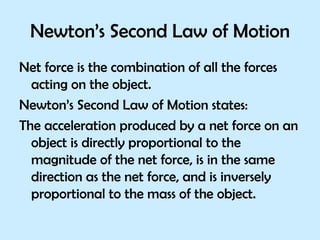
Newton’s Second Law of Motion Net force is the combination of all the forces acting on the object. Newton’s Second Law of Motion states: The acceleration produced by a net force on an object is directly proportional to the magnitude of the net force, is in the same direction as the net force, and is inversely proportional to the mass of the object.
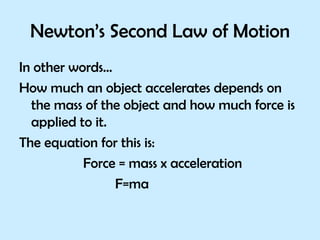
Newton’s Second Law of Motion In other words… How much an object accelerates depends on the mass of the object and how much force is applied to it. The equation for this is: Force = mass x acceleration F=ma
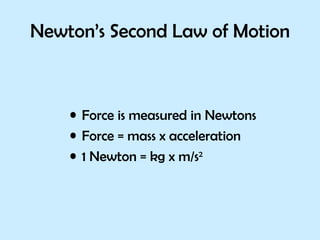
Newton’s Second Law of Motion Force is measured in Newtons  Force = mass x acceleration 1 Newton = kg x m/s 2
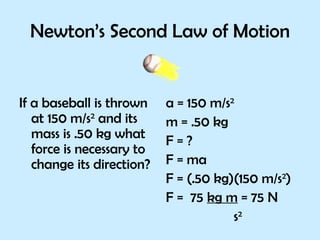
Newton’s Second Law of Motion If a baseball is thrown at 150 m/s 2  and its mass is .50 kg what force is necessary to change its direction? a = 150 m/s 2 m = .50 kg F = ? F = ma F = (.50 kg)(150 m/s 2 ) F =  75  kg m  = 75 N s 2

Ppt Newtons Second Law

  • 1.
  • 2.
    Force, Mass, &Acceleration How does force cause motion to change? What is the difference between throwing a baseball and tossing one gently? In both examples they start at rest. One has a faster velocity than the other. Which one has a greater acceleration, the baseball thrown or the baseball gently tossed?
  • 3.
    Force, Mass, &Acceleration The greater the force applied to an object, the greater the acceleration will be. AKA – the harder the baseball is thrown the faster it will accelerate.
  • 4.
    Force & MassIf you throw a cotton ball and a baseball as hard as you can, why don’t they have the same speed? Because of their different masses. The acceleration of an object depends on its mass as well as the force applied to it. Force, mass, and acceleration are all connected. Newton’s Second Law of motion describes this relationship!
  • 5.
    Newton’s Second Lawof Motion Net force is the combination of all the forces acting on the object. Newton’s Second Law of Motion states: The acceleration produced by a net force on an object is directly proportional to the magnitude of the net force, is in the same direction as the net force, and is inversely proportional to the mass of the object.
  • 6.
    Newton’s Second Lawof Motion In other words… How much an object accelerates depends on the mass of the object and how much force is applied to it. The equation for this is: Force = mass x acceleration F=ma
  • 7.
    Newton’s Second Lawof Motion Force is measured in Newtons Force = mass x acceleration 1 Newton = kg x m/s 2
  • 8.
    Newton’s Second Lawof Motion If a baseball is thrown at 150 m/s 2 and its mass is .50 kg what force is necessary to change its direction? a = 150 m/s 2 m = .50 kg F = ? F = ma F = (.50 kg)(150 m/s 2 ) F = 75 kg m = 75 N s 2