Art of India & Southeast Asia Interconnected architecture, painting, sculpture, culture, and philosophies of Hinduism and Buddhism
Philosophy & Religion in Daily Life in India http://kaladarshan.arts.ohio-state.edu/Exhibitions/meetgod/indx.htm Interconnectiveness of all Indian arts Folk art traditions of painting, symbolism Temples and religious festivals (Hindu and Buddhist) major events
 
India:  Historical Background Fertile Indus & Ganges Valley Invasion & assimilations 18 official languages in India Arts play critical role in Indian life Uniformity of style in Indian monuments Buddhism & Hinduism major religions (also Jain, Christianity, Islam, etc.)
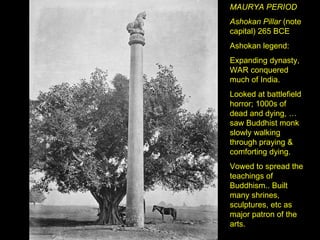
MAURYA PERIOD Ashokan Pillar  (note capital) 265 BCE Ashokan legend:  Expanding dynasty, WAR conquered much of India. Looked at battlefield horror; 1000s of dead and dying, … saw Buddhist monk slowly walking through praying & comforting dying. Vowed to spread the teachings of Buddhism.. Built many shrines, sculptures, etc as major patron of the arts.
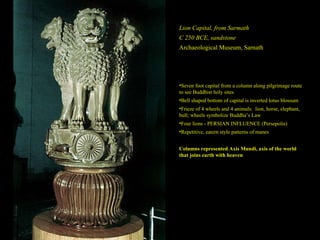
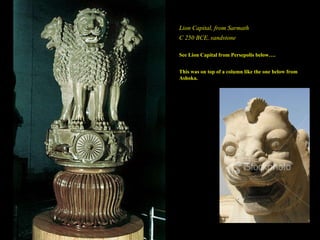
Lion Capital, from Sarmath C 250 BCE, sandstone Archaeological Museum, Sarnath Seven foot capital from a column along pilgrimage route to see Buddhist holy sites Bell shaped bottom of capital is inverted lotus blossum Frieze of 4 wheels and 4 animals:  lion, horse, elephant, bull; wheels symbolize Buddha’s Law Four lions - PERSIAN INFLUENCE (Persepolis) Repetitive, eatern style patterns of manes Columns represented Axis Mundi, axis of the world that joins earth with heaven
Lion Capital, from Sarmath C 250 BCE, sandstone See Lion Capital from Persepolis below…. This was on top of a column like the one below from Ashoka.
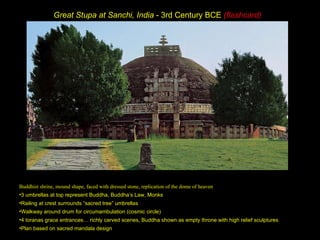
Buddhist shrine, mound shape, faced with dressed stone, replication of the dome of heaven 3 umbrellas at top represent Buddha, Buddha’s Law, Monks Railing at crest surrounds “sacred tree” umbrellas Walkway around drum for circumambulation (cosmic circle) 4 toranas grace entrances… richly carved scenes, Buddha shown as empty throne with high relief sculptures Plan based on sacred mandala design Great Stupa at Sanchi, India  - 3rd Century BCE  (flashcard)
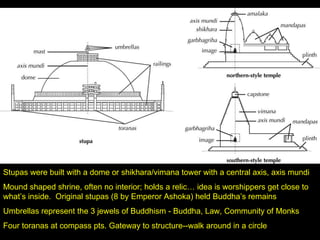
Stupas were built with a dome or shikhara/vimana tower with a central axis, axis mundi Mound shaped shrine, often no interior; holds a relic… idea is worshippers get close to what’s inside.  Original stupas (8 by Emperor Ashoka) held Buddha’s remains Umbrellas represent the 3 jewels of Buddhism - Buddha, Law, Community of Monks Four toranas at compass pts. Gateway to structure--walk around in a circle
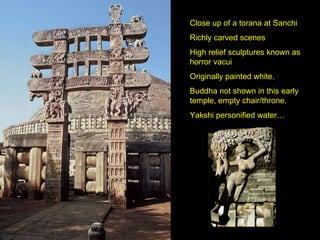
Close up of a torana at Sanchi Richly carved scenes High relief sculptures known as horror vacui Originally painted white. Buddha not shown in this early temple, empty chair/throne. Yakshi personified water…
Student presentation on life of Buddha Class takes notes
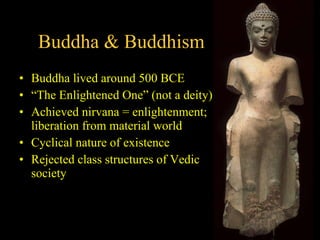
Buddha & Buddhism Buddha lived around 500 BCE  “ The Enlightened One” (not a deity) Achieved nirvana = enlightenment; liberation from material world Cyclical nature of existence Rejected class structures of Vedic society
Buddhist Religion Shakyamuni Buddha from Nepal Siddartha, child prince, shielded from pain & suffering Left palace at age 29, travelled, meditated,  Samsara:  cycle of birth, death, rebirth Nirvana:  ultimate enlightenment Compassion and learning are KEYs. Different buddhas are recognized Bodhisattvas - help others reach enlightenment Dalai Lama, leader of Tibetan Buddhism and Nobel Peace prize winner
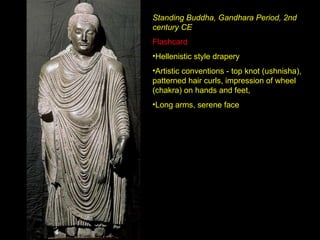
Standing Buddha, Gandhara Period, 2nd century CE Flashcard Hellenistic style drapery Artistic conventions - top knot (ushnisha), patterned hair curls, impression of wheel (chakra) on hands and feet,  Long arms, serene face
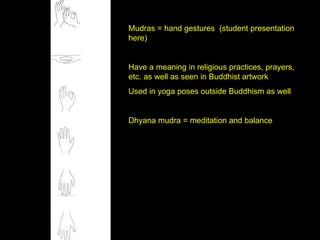
Mudras = hand gestures  (student presentation here) Have a meaning in religious practices, prayers, etc. as well as seen in Buddhist artwork Used in yoga poses outside Buddhism as well Dhyana mudra = meditation and balance
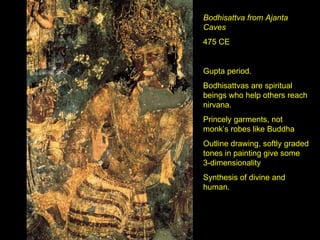
Bodhisattva from Ajanta Caves  475 CE Gupta period. Bodhisattvas are spiritual beings who help others reach nirvana. Princely garments, not monk’s robes like Buddha Outline drawing, softly graded tones in painting give some 3-dimensionality Synthesis of divine and human.
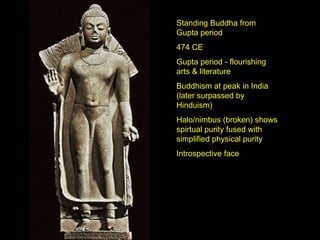
Standing Buddha from Gupta period 474 CE Gupta period - flourishing arts & literature Buddhism at peak in India (later surpassed by Hinduism) Halo/nimbus (broken) shows spirtual purity fused with simplified physical purity Introspective face
Student presentation on Hinduism and Hindu Art Class takes notes
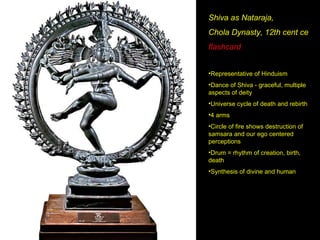
Shiva as Nataraja, Chola Dynasty, 12th cent ce flashcard Representative of Hinduism Dance of Shiva - graceful, multiple aspects of deity Universe cycle of death and rebirth 4 arms Circle of fire shows destruction of samsara and our ego centered perceptions Drum = rhythm of creation, birth, death Synthesis of divine and human
Hinduism and Hindu Temples Began during post Gupta period Many gods and goddesses; local shrines in villages Hindu temples built on mandala design Womb chambers Belief that deity is present in image (statue) Individual devotion, not group worship
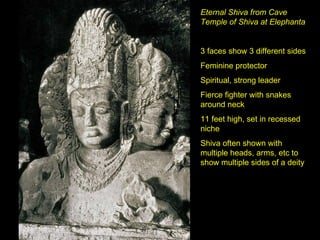
Eternal Shiva from Cave Temple of Shiva at Elephanta 3 faces show 3 different sides Feminine protector Spiritual, strong leader Fierce fighter with snakes around neck 11 feet high, set in recessed niche Shiva often shown with multiple heads, arms, etc to show multiple sides of a deity
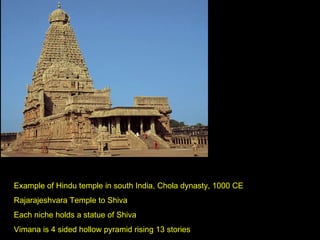
Example of Hindu temple in south India, Chola dynasty, 1000 CE Rajarajeshvara Temple to Shiva Each niche holds a statue of Shiva Vimana is 4 sided hollow pyramid rising 13 stories
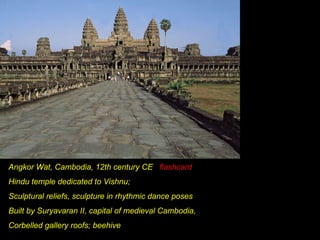
Angkor Wat, Cambodia, 12th century CE  flashcard Hindu temple dedicated to Vishnu;  Sculptural reliefs, sculpture in rhythmic dance poses Built by Suryavaran II, capital of medieval Cambodia,  Corbelled gallery roofs; beehive
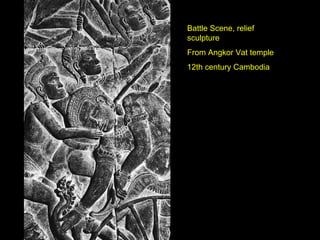
Battle Scene, relief sculpture From Angkor Vat temple 12th century Cambodia
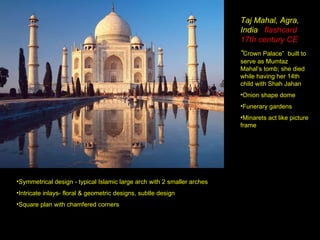
Symmetrical design - typical Islamic large arch with 2 smaller arches Intricate inlays- floral & geometric designs, subtle design Square plan with chamfered corners Taj Mahal, Agra, India  flashcard  17th century CE “ Crown Palace”  built to serve as Mumtaz Mahal’s tomb; she died while having her 14th child with Shah Jahan  Onion shape dome Funerary gardens Minarets act like picture frame
Student presentations on  Rangoli ‘folk” painting &  Rajput school painting Class takes notes
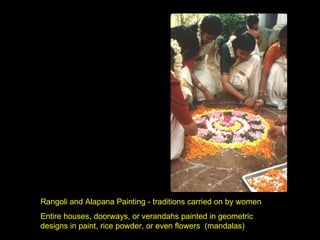
Rangoli and Alapana Painting - traditions carried on by women Entire houses, doorways, or verandahs painted in geometric designs in paint, rice powder, or even flowers  (mandalas)
Indian Watercolor Painting Strong tradition of opaque watercolors on paper Outlining, but subtly modeled sahdes Hindu gods such as Krishna often subjects (he is usually blue) Mughal school fostered painting traditions
Mughal school of minatures - developed during middle ages
Hamza’s Spies Scale the Fortress ,  Mughal Period (16th century) Gouache on cotton (opaque w.c.) 3- d setting, yet undercut by flat geometric patterns Robust naturalistic style (not so linear) Rocks, monkeys, birds, and more FLASHCARD Fusion of Indian and Persia styles Also painting on paper… burnished on stones to make it gleam, details added last with thick white paint
Krishna and the Gopis,  from the Gita Govinda (epic poem about Krishna and Radha) Mughal Period, Rajput India.  16th century, gouche on paper  (flashcard) Radha is jealous of Krishna and the Gopis (cowherds) .. Emotional tension.. Plump faces in profile with oversized frontal eyes…line & pattern in the dramatic scene.
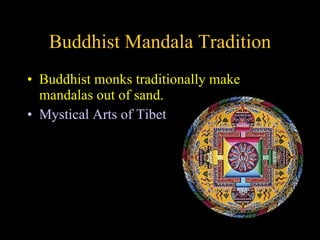
Buddhist Mandala Tradition Buddhist monks traditionally make mandalas out of sand. Mystical Arts of Tibet
Check out this video http://www. youtube .com/watch? v=9piFA7MCmbQ
Mandalas & Cultural/Religious Used for healing Used to promote peace Symbols reflect Buddhist traditions This type of mandala is temporary (like beauty)
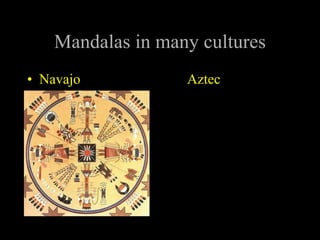
Mandalas in many cultures Navajo Aztec

Indianart

  • 1.
    Art of India& Southeast Asia Interconnected architecture, painting, sculpture, culture, and philosophies of Hinduism and Buddhism
  • 2.
    Philosophy & Religionin Daily Life in India http://kaladarshan.arts.ohio-state.edu/Exhibitions/meetgod/indx.htm Interconnectiveness of all Indian arts Folk art traditions of painting, symbolism Temples and religious festivals (Hindu and Buddhist) major events
  • 3.
  • 4.
    India: HistoricalBackground Fertile Indus & Ganges Valley Invasion & assimilations 18 official languages in India Arts play critical role in Indian life Uniformity of style in Indian monuments Buddhism & Hinduism major religions (also Jain, Christianity, Islam, etc.)
  • 5.
    MAURYA PERIOD AshokanPillar (note capital) 265 BCE Ashokan legend: Expanding dynasty, WAR conquered much of India. Looked at battlefield horror; 1000s of dead and dying, … saw Buddhist monk slowly walking through praying & comforting dying. Vowed to spread the teachings of Buddhism.. Built many shrines, sculptures, etc as major patron of the arts.
  • 6.
    Lion Capital, fromSarmath C 250 BCE, sandstone Archaeological Museum, Sarnath Seven foot capital from a column along pilgrimage route to see Buddhist holy sites Bell shaped bottom of capital is inverted lotus blossum Frieze of 4 wheels and 4 animals: lion, horse, elephant, bull; wheels symbolize Buddha’s Law Four lions - PERSIAN INFLUENCE (Persepolis) Repetitive, eatern style patterns of manes Columns represented Axis Mundi, axis of the world that joins earth with heaven
  • 7.
    Lion Capital, fromSarmath C 250 BCE, sandstone See Lion Capital from Persepolis below…. This was on top of a column like the one below from Ashoka.
  • 8.
    Buddhist shrine, moundshape, faced with dressed stone, replication of the dome of heaven 3 umbrellas at top represent Buddha, Buddha’s Law, Monks Railing at crest surrounds “sacred tree” umbrellas Walkway around drum for circumambulation (cosmic circle) 4 toranas grace entrances… richly carved scenes, Buddha shown as empty throne with high relief sculptures Plan based on sacred mandala design Great Stupa at Sanchi, India - 3rd Century BCE (flashcard)
  • 9.
    Stupas were builtwith a dome or shikhara/vimana tower with a central axis, axis mundi Mound shaped shrine, often no interior; holds a relic… idea is worshippers get close to what’s inside. Original stupas (8 by Emperor Ashoka) held Buddha’s remains Umbrellas represent the 3 jewels of Buddhism - Buddha, Law, Community of Monks Four toranas at compass pts. Gateway to structure--walk around in a circle
  • 10.
    Close up ofa torana at Sanchi Richly carved scenes High relief sculptures known as horror vacui Originally painted white. Buddha not shown in this early temple, empty chair/throne. Yakshi personified water…
  • 11.
    Student presentation onlife of Buddha Class takes notes
  • 12.
    Buddha & BuddhismBuddha lived around 500 BCE “ The Enlightened One” (not a deity) Achieved nirvana = enlightenment; liberation from material world Cyclical nature of existence Rejected class structures of Vedic society
  • 13.
    Buddhist Religion ShakyamuniBuddha from Nepal Siddartha, child prince, shielded from pain & suffering Left palace at age 29, travelled, meditated, Samsara: cycle of birth, death, rebirth Nirvana: ultimate enlightenment Compassion and learning are KEYs. Different buddhas are recognized Bodhisattvas - help others reach enlightenment Dalai Lama, leader of Tibetan Buddhism and Nobel Peace prize winner
  • 14.
    Standing Buddha, GandharaPeriod, 2nd century CE Flashcard Hellenistic style drapery Artistic conventions - top knot (ushnisha), patterned hair curls, impression of wheel (chakra) on hands and feet, Long arms, serene face
  • 15.
    Mudras = handgestures (student presentation here) Have a meaning in religious practices, prayers, etc. as well as seen in Buddhist artwork Used in yoga poses outside Buddhism as well Dhyana mudra = meditation and balance
  • 16.
    Bodhisattva from AjantaCaves 475 CE Gupta period. Bodhisattvas are spiritual beings who help others reach nirvana. Princely garments, not monk’s robes like Buddha Outline drawing, softly graded tones in painting give some 3-dimensionality Synthesis of divine and human.
  • 17.
    Standing Buddha fromGupta period 474 CE Gupta period - flourishing arts & literature Buddhism at peak in India (later surpassed by Hinduism) Halo/nimbus (broken) shows spirtual purity fused with simplified physical purity Introspective face
  • 18.
    Student presentation onHinduism and Hindu Art Class takes notes
  • 19.
    Shiva as Nataraja,Chola Dynasty, 12th cent ce flashcard Representative of Hinduism Dance of Shiva - graceful, multiple aspects of deity Universe cycle of death and rebirth 4 arms Circle of fire shows destruction of samsara and our ego centered perceptions Drum = rhythm of creation, birth, death Synthesis of divine and human
  • 20.
    Hinduism and HinduTemples Began during post Gupta period Many gods and goddesses; local shrines in villages Hindu temples built on mandala design Womb chambers Belief that deity is present in image (statue) Individual devotion, not group worship
  • 21.
    Eternal Shiva fromCave Temple of Shiva at Elephanta 3 faces show 3 different sides Feminine protector Spiritual, strong leader Fierce fighter with snakes around neck 11 feet high, set in recessed niche Shiva often shown with multiple heads, arms, etc to show multiple sides of a deity
  • 22.
    Example of Hindutemple in south India, Chola dynasty, 1000 CE Rajarajeshvara Temple to Shiva Each niche holds a statue of Shiva Vimana is 4 sided hollow pyramid rising 13 stories
  • 23.
    Angkor Wat, Cambodia,12th century CE flashcard Hindu temple dedicated to Vishnu; Sculptural reliefs, sculpture in rhythmic dance poses Built by Suryavaran II, capital of medieval Cambodia, Corbelled gallery roofs; beehive
  • 24.
    Battle Scene, reliefsculpture From Angkor Vat temple 12th century Cambodia
  • 25.
    Symmetrical design -typical Islamic large arch with 2 smaller arches Intricate inlays- floral & geometric designs, subtle design Square plan with chamfered corners Taj Mahal, Agra, India flashcard 17th century CE “ Crown Palace” built to serve as Mumtaz Mahal’s tomb; she died while having her 14th child with Shah Jahan Onion shape dome Funerary gardens Minarets act like picture frame
  • 26.
    Student presentations on Rangoli ‘folk” painting & Rajput school painting Class takes notes
  • 27.
    Rangoli and AlapanaPainting - traditions carried on by women Entire houses, doorways, or verandahs painted in geometric designs in paint, rice powder, or even flowers (mandalas)
  • 28.
    Indian Watercolor PaintingStrong tradition of opaque watercolors on paper Outlining, but subtly modeled sahdes Hindu gods such as Krishna often subjects (he is usually blue) Mughal school fostered painting traditions
  • 29.
    Mughal school ofminatures - developed during middle ages
  • 30.
    Hamza’s Spies Scalethe Fortress , Mughal Period (16th century) Gouache on cotton (opaque w.c.) 3- d setting, yet undercut by flat geometric patterns Robust naturalistic style (not so linear) Rocks, monkeys, birds, and more FLASHCARD Fusion of Indian and Persia styles Also painting on paper… burnished on stones to make it gleam, details added last with thick white paint
  • 31.
    Krishna and theGopis, from the Gita Govinda (epic poem about Krishna and Radha) Mughal Period, Rajput India. 16th century, gouche on paper (flashcard) Radha is jealous of Krishna and the Gopis (cowherds) .. Emotional tension.. Plump faces in profile with oversized frontal eyes…line & pattern in the dramatic scene.
  • 32.
    Buddhist Mandala TraditionBuddhist monks traditionally make mandalas out of sand. Mystical Arts of Tibet
  • 33.
    Check out thisvideo http://www. youtube .com/watch? v=9piFA7MCmbQ
  • 34.
    Mandalas & Cultural/ReligiousUsed for healing Used to promote peace Symbols reflect Buddhist traditions This type of mandala is temporary (like beauty)
  • 35.
    Mandalas in manycultures Navajo Aztec

Editor's Notes

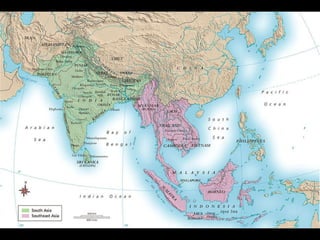
  • #4 Artist: n/a Title: The Indian Subcontinent Medium : n/a Size: n/a Date: n/a Source/Museum: n/a
  • #6 Artist: n/a Title: Ashokan Pillar Medium: n/a Size: n/a Date: Maurya period. 246 BCE Source/Museum: Lauriya, Nandangarh
  • #7 Artist: n/a Title: Lion Capital Medium: Polished sandstone Size: height 7' (2.13 m) Date: Maurya period, c. 250 BCE Source/Museum: Ashokan pillar at Sarnath, Uttar Pradesh, India. / Archaeological Museum, Sarnath
  • #8 Artist: n/a Title: Lion Capital Medium: Polished sandstone Size: height 7' (2.13 m) Date: Maurya period, c. 250 BCE Source/Museum: Ashokan pillar at Sarnath, Uttar Pradesh, India. / Archaeological Museum, Sarnath
  • #9 Artist: n/a Title: Lion Capital Medium: Polished sandstone Size: height 7' (2.13 m) Date: Maurya period, c. 250 BCE Source/Museum: Ashokan pillar at Sarnath, Uttar Pradesh, India. / Archaeological Museum, Sarnath
  • #10 Artist: n/a Title: Elements of Architecture: Stupa and Temples Medium: n/a Size: n/a Date: n/a Source/Museum: Stupa, northern-style temple, southern-style temple
  • #11 Artist: n/a Title: East torana of the Great Stupa at Sanchi Medium: Stone Size: height 35' (10.66 m) Date: Early Andhra period, mid-1st century BCE Source/Museum: n/a
  • #15 Artist: n/a Title: Standing Buddha Medium: Schist Size: height 7'6" (2.28 m) Date: c. 2nd–3rd century CE Source/Museum: Gandhara, Pakistan. / Lahore Museum, Lahore
  • #16 Artist: n/a Title: Myth and Religion: Mudras Medium: n/a Size: n/a Date: n/a Source/Museum: Mudras: Dharmachakra Mudra, Dhyana Mudra, Vitarka Mudra, Abhaya, Mudra, Bhumiparsha Mudra, Varada Mudra
  • #17 Artist: n/a Title: Bodhisattva Medium: Detail of a wall painting Size: n/a Date: Gupta period, c. 475 CE Source/Museum: In Cave I, Ajanta, Maharashtra, India
  • #18 Artist: n/a Title: Standing Buddha Medium: Chunar sandstone Size: height 6' 4" (1.93 m) Date: Gupta period, 474 CE Source/Museum: Sarnath, Uttar Pradesh, India. / Archaeological Museum, Sarnath
  • #20 Artist: n/a Title: Shiva Nataraja Medium: Bronze Size: 32" (81.25 cm) Date: Chola dynasty, 12th century CE Source/Museum: Thanjavur, Tamil Nadu. / National Museum of India, New Delhi
  • #22 Artist: n/a Title: Eternal Shiva Medium: Rock-cut relief Size: height approx. 11' (3.4 m) Date: Mid-6th century CE Source/Museum: In the Cave-Temple of Shiva at Elephanta
  • #23 Artist: n/a Title: Rajarajeshvara Temple to Shiva, Thanjavur Medium: n/a Size: n/a Date: Chola dynasty, 1003–10 CE Source/Museum: Tamil Nadu, India
  • #24 Artist: n/a Title: Angkor Vat Medium: n/a Size: n/a Date: 12th century Source/Museum: Angkor, Cambodia
  • #25 Artist: n/a Title: Battle Scene Medium: Detail of relief sculpture Size: n/a Date: n/a Source/Museum: Angkor Vat
  • #26 Artist: n/a Title: Angkor Vat Medium: n/a Size: n/a Date: 12th century Source/Museum: Angkor, Cambodia
  • #28 Artist: n/a Title: Rajarajeshvara Temple to Shiva, Thanjavur Medium: n/a Size: n/a Date: Chola dynasty, 1003–10 CE Source/Museum: Tamil Nadu, India
  • #30 Artist: n/a Title: Rajarajeshvara Temple to Shiva, Thanjavur Medium: n/a Size: n/a Date: Chola dynasty, 1003–10 CE Source/Museum: Tamil Nadu, India
  • #31 Artist: n/a Title: Rajarajeshvara Temple to Shiva, Thanjavur Medium: n/a Size: n/a Date: Chola dynasty, 1003–10 CE Source/Museum: Tamil Nadu, India
  • #32 Artist: n/a Title: Rajarajeshvara Temple to Shiva, Thanjavur Medium: n/a Size: n/a Date: Chola dynasty, 1003–10 CE Source/Museum: Tamil Nadu, India