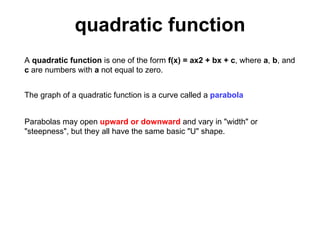
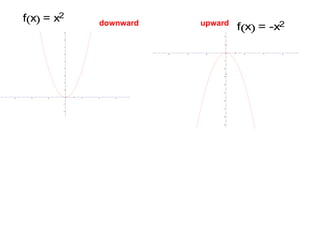
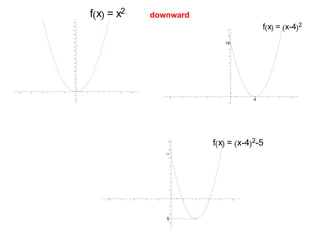
quadratic function A  quadratic function  is one of the form  f(x) = ax2 + bx + c , where  a ,  b , and  c  are numbers with  a  not equal to zero.  The graph of a quadratic function is a curve called a  parabola   Parabolas may open  upward or downward  and vary in "width" or "steepness", but they all have the same basic "U" shape.
All parabolas are symmetric with respect to a line  called the  axis of symmetry .  A parabola intersects its axis of symmetry at a point  called the  vertex  of the parabola.
upward downward
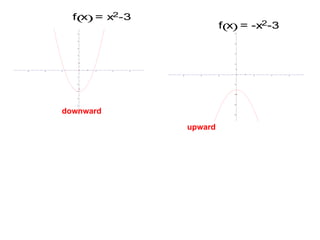
downward upward
downward
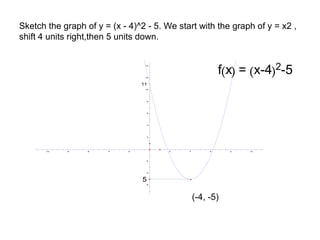
(-4, -5) Sketch the graph of y = (x - 4)^2 - 5. We start with the graph of y = x2 , shift 4 units right,then 5 units down.
 
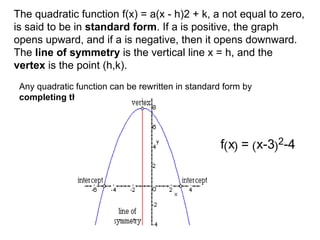
The quadratic function f(x) = a(x - h)2 + k, a not equal to zero, is said to be in  standard form . If a is positive, the graph opens upward, and if a is negative, then it opens downward. The  line of symmetry  is the vertical line x = h, and the  vertex  is the point (h,k).  Any quadratic function can be rewritten in standard form by  completing the square .
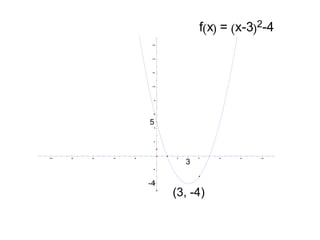
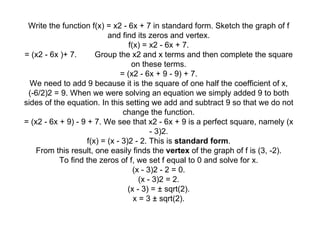
Write the function f(x) = x2 - 6x + 7 in standard form. Sketch the graph of f and find its zeros and vertex. f(x) = x2 - 6x + 7. = (x2 - 6x )+ 7.        Group the x2 and x terms and then complete the square on these terms. = (x2 - 6x + 9 - 9) + 7. We need to add 9 because it is the square of one half the coefficient of x, (-6/2)2 = 9. When we were solving an equation we simply added 9 to both sides of the equation. In this setting we add and subtract 9 so that we do not change the function. = (x2 - 6x + 9) - 9 + 7. We see that x2 - 6x + 9 is a perfect square, namely (x - 3)2. f(x) = (x - 3)2 - 2. This is  standard form . From this result, one easily finds the  vertex  of the graph of f is (3, -2). To find the zeros of f, we set f equal to 0 and solve for x. (x - 3)2 - 2 = 0. (x - 3)2 = 2. (x - 3) = ± sqrt(2). x = 3 ± sqrt(2).
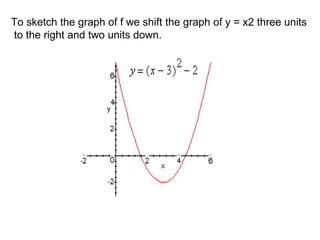
To sketch the graph of f we shift the graph of y = x2 three units to the right and two units down.
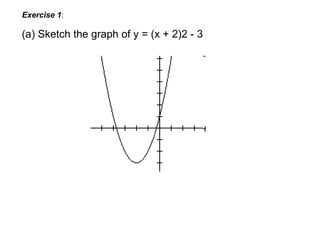
(a) Sketch the graph of y = (x + 2)2 - 3  Exercise 1 :
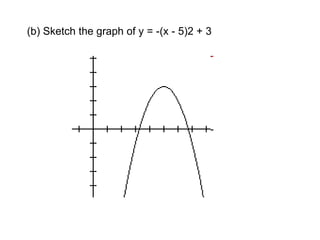
(b) Sketch the graph of y = -(x - 5)2 + 3
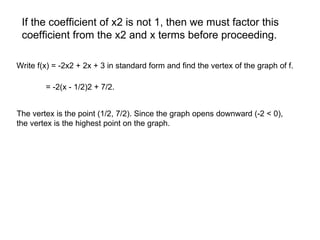
If the coefficient of x2 is not 1, then we must factor this  coefficient from the x2 and x terms before proceeding.  Write f(x) = -2x2 + 2x + 3 in standard form and find the vertex of the graph of f.  = -2(x - 1/2)2 + 7/2.  The vertex is the point (1/2, 7/2). Since the graph opens downward (-2 < 0),  the vertex is the highest point on the graph.
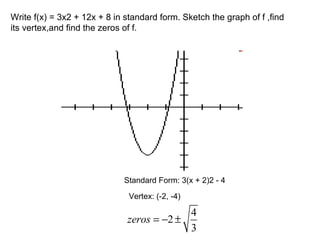
Standard Form: 3(x + 2)2 - 4 Write f(x) = 3x2 + 12x + 8 in standard form. Sketch the graph of f ,find its vertex,and find the zeros of f.  Vertex: (-2, -4)
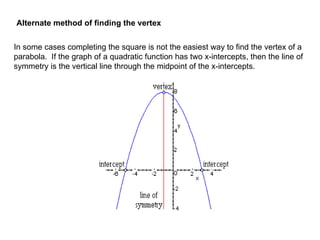
Alternate method of finding the vertex   In some cases completing the square is not the easiest way to find the vertex of a parabola.  If the graph of a quadratic function has two x-intercepts, then the line of symmetry is the vertical line through the midpoint of the x-intercepts.
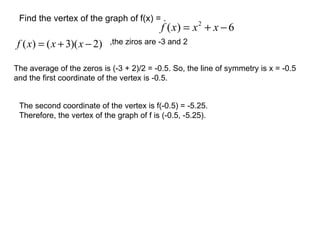
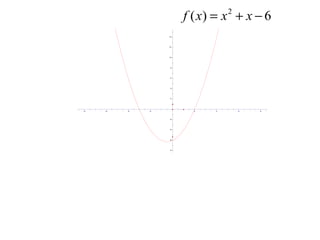
Find the vertex of the graph of f(x) = . The average of the zeros is (-3 + 2)/2 = -0.5. So, the line of symmetry is x = -0.5 and the first coordinate of the vertex is -0.5. The second coordinate of the vertex is f(-0.5) = -5.25. Therefore, the vertex of the graph of f is (-0.5, -5.25). ,the ziros are -3 and 2
 

Quadraticfuntions

  • 1.
    quadratic function A quadratic function is one of the form f(x) = ax2 + bx + c , where a , b , and c are numbers with a not equal to zero. The graph of a quadratic function is a curve called a parabola Parabolas may open upward or downward and vary in &quot;width&quot; or &quot;steepness&quot;, but they all have the same basic &quot;U&quot; shape.
  • 2.
    All parabolas aresymmetric with respect to a line called the axis of symmetry . A parabola intersects its axis of symmetry at a point called the vertex of the parabola.
  • 3.
  • 4.
  • 5.
  • 6.
    (-4, -5) Sketchthe graph of y = (x - 4)^2 - 5. We start with the graph of y = x2 , shift 4 units right,then 5 units down.
  • 7.
  • 8.
    The quadratic functionf(x) = a(x - h)2 + k, a not equal to zero, is said to be in standard form . If a is positive, the graph opens upward, and if a is negative, then it opens downward. The line of symmetry is the vertical line x = h, and the vertex is the point (h,k). Any quadratic function can be rewritten in standard form by completing the square .
  • 9.
    Write the functionf(x) = x2 - 6x + 7 in standard form. Sketch the graph of f and find its zeros and vertex. f(x) = x2 - 6x + 7. = (x2 - 6x )+ 7.        Group the x2 and x terms and then complete the square on these terms. = (x2 - 6x + 9 - 9) + 7. We need to add 9 because it is the square of one half the coefficient of x, (-6/2)2 = 9. When we were solving an equation we simply added 9 to both sides of the equation. In this setting we add and subtract 9 so that we do not change the function. = (x2 - 6x + 9) - 9 + 7. We see that x2 - 6x + 9 is a perfect square, namely (x - 3)2. f(x) = (x - 3)2 - 2. This is standard form . From this result, one easily finds the vertex of the graph of f is (3, -2). To find the zeros of f, we set f equal to 0 and solve for x. (x - 3)2 - 2 = 0. (x - 3)2 = 2. (x - 3) = ± sqrt(2). x = 3 ± sqrt(2).
  • 10.
    To sketch thegraph of f we shift the graph of y = x2 three units to the right and two units down.
  • 11.
    (a) Sketch thegraph of y = (x + 2)2 - 3 Exercise 1 :
  • 12.
    (b) Sketch thegraph of y = -(x - 5)2 + 3
  • 13.
    If the coefficientof x2 is not 1, then we must factor this coefficient from the x2 and x terms before proceeding. Write f(x) = -2x2 + 2x + 3 in standard form and find the vertex of the graph of f. = -2(x - 1/2)2 + 7/2. The vertex is the point (1/2, 7/2). Since the graph opens downward (-2 < 0), the vertex is the highest point on the graph.
  • 14.
    Standard Form: 3(x+ 2)2 - 4 Write f(x) = 3x2 + 12x + 8 in standard form. Sketch the graph of f ,find its vertex,and find the zeros of f. Vertex: (-2, -4)
  • 15.
    Alternate method offinding the vertex In some cases completing the square is not the easiest way to find the vertex of a parabola. If the graph of a quadratic function has two x-intercepts, then the line of symmetry is the vertical line through the midpoint of the x-intercepts.
  • 16.
    Find the vertexof the graph of f(x) = . The average of the zeros is (-3 + 2)/2 = -0.5. So, the line of symmetry is x = -0.5 and the first coordinate of the vertex is -0.5. The second coordinate of the vertex is f(-0.5) = -5.25. Therefore, the vertex of the graph of f is (-0.5, -5.25). ,the ziros are -3 and 2
  • 17.