Lecture 6.1- The Periodic Table
Chemists use the properties
of elements to sort them into
groups.
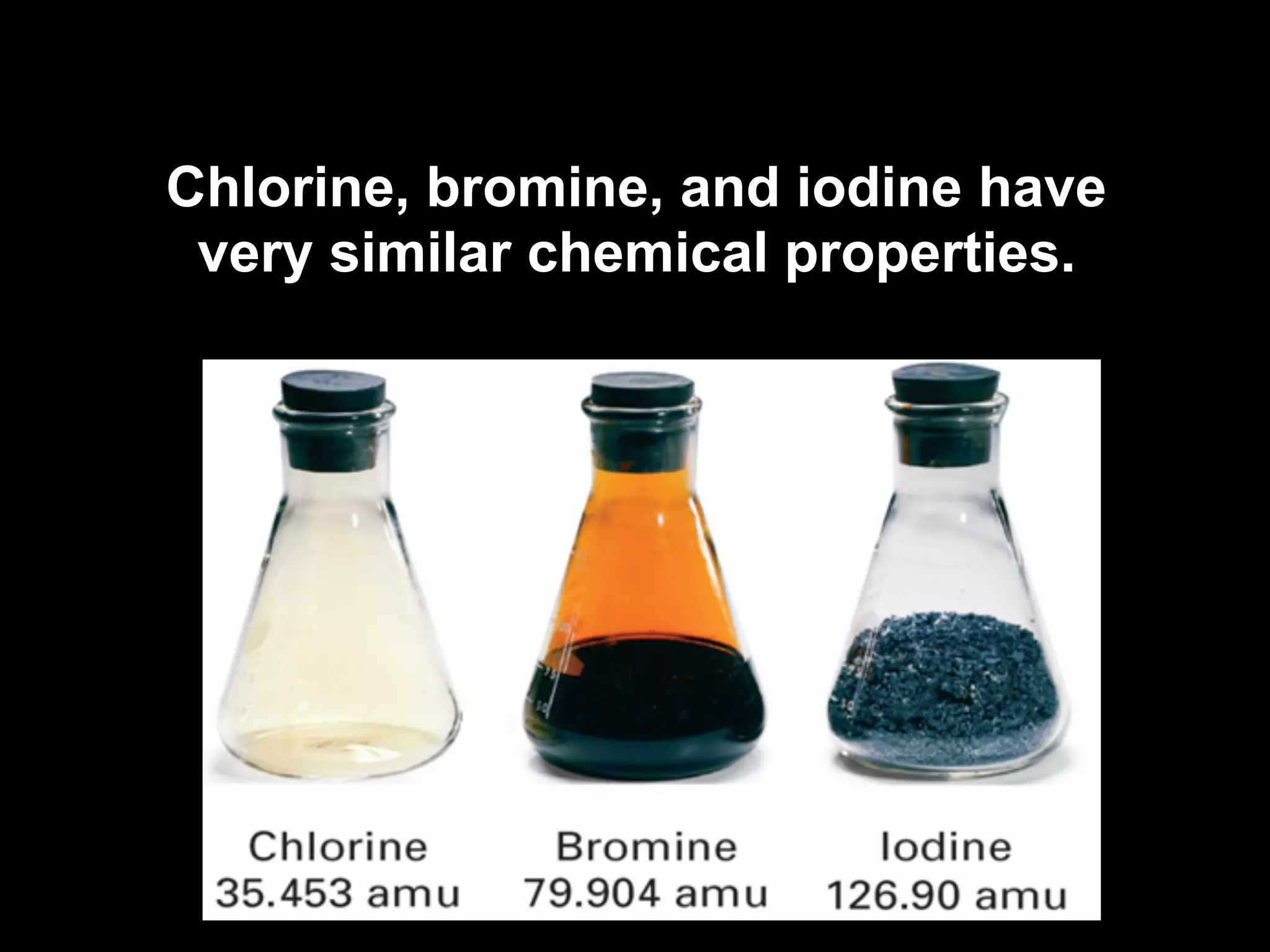
Chlorine, bromine, and iodine have
 very similar chemical properties.
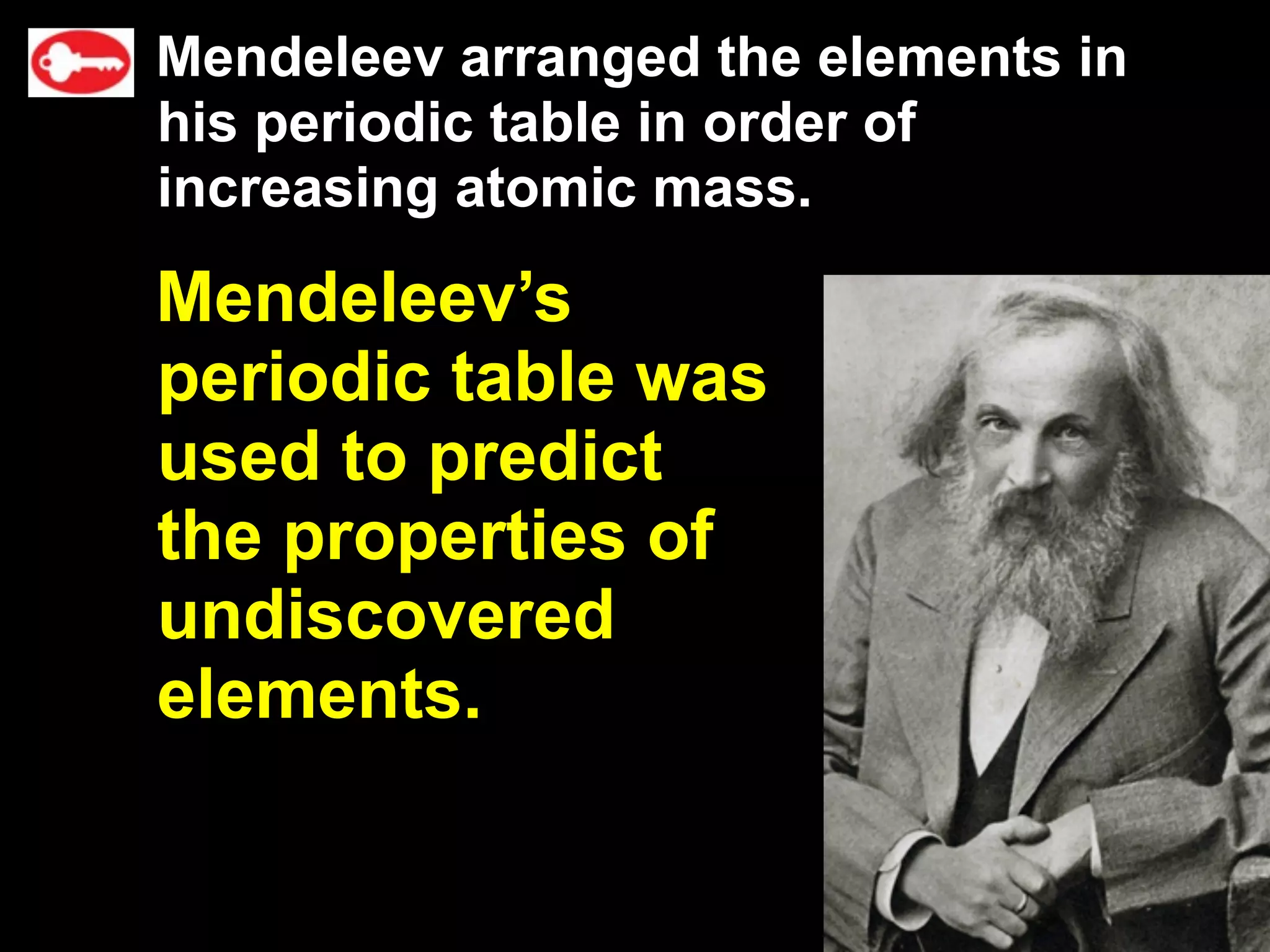
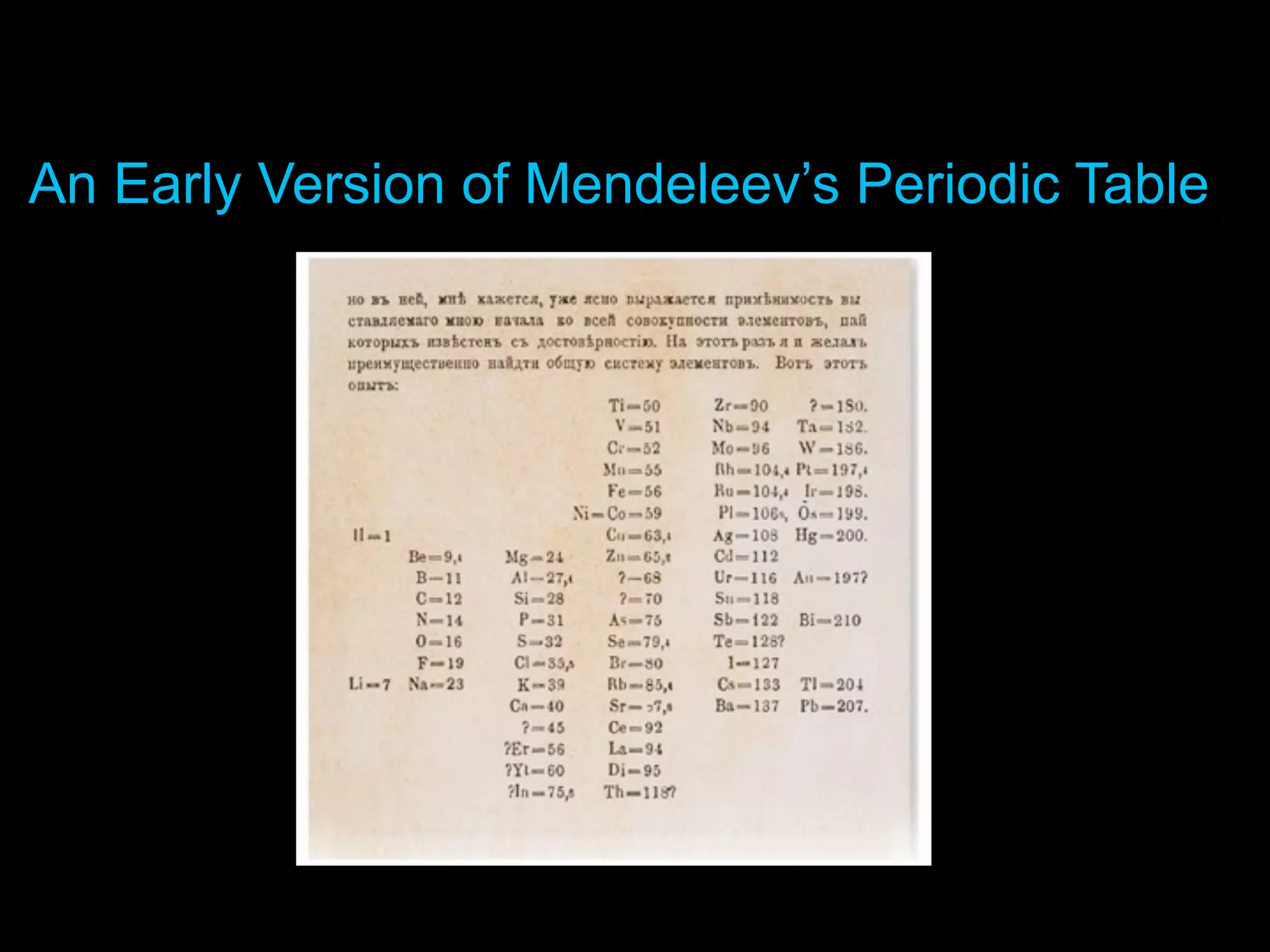
Mendeleev arranged the elements in
his periodic table in order of
increasing atomic mass.

Mendeleev’s
periodic table was
used to predict
the properties of
undiscovered
elements.
An Early Version of Mendeleev’s Periodic Table
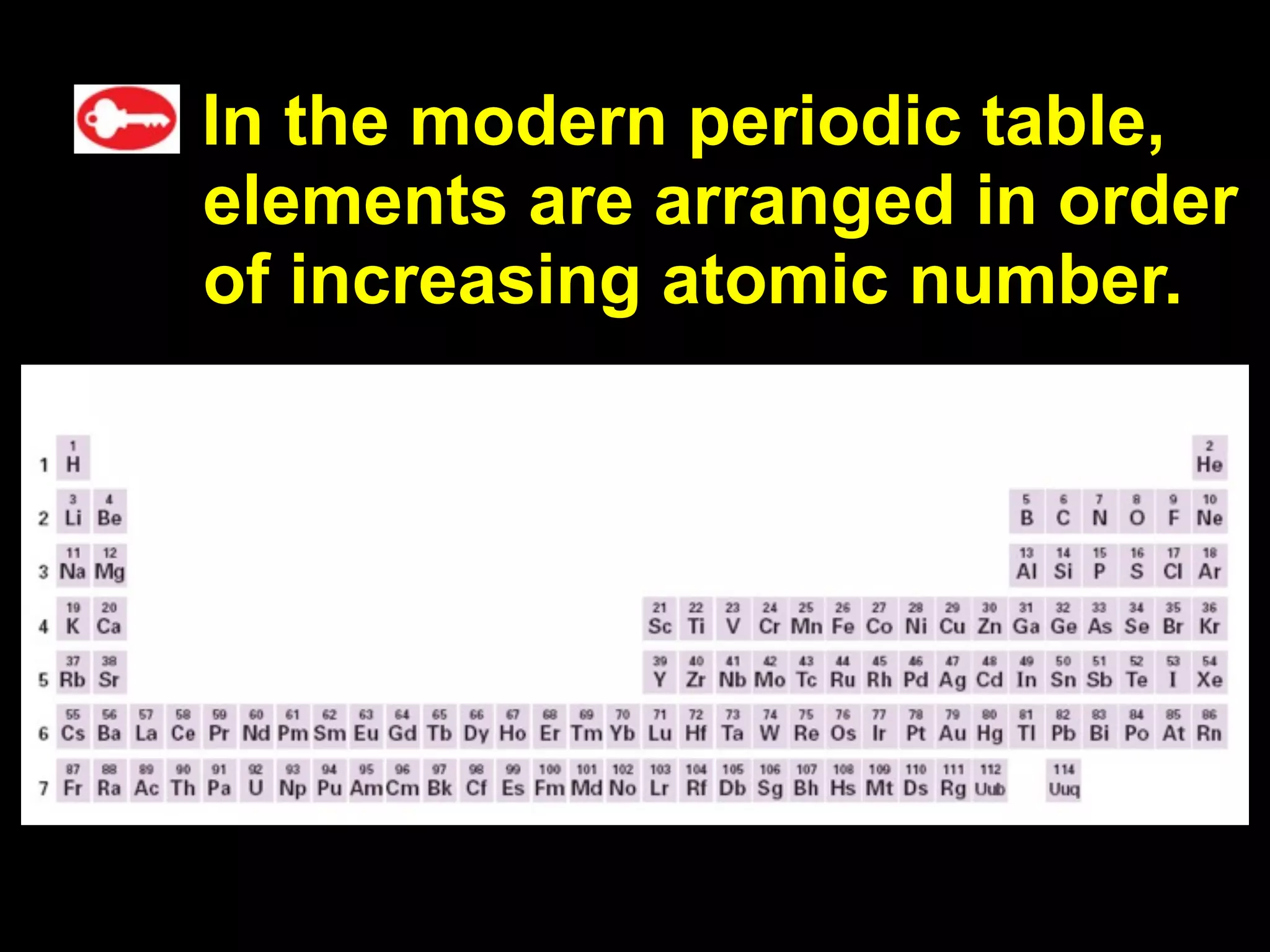
In the modern periodic table,
elements are arranged in order
of increasing atomic number.
The periodic law: When elements are
arranged in order of increasing atomic
number, there is a periodic repetition of
their physical and chemical properties.
 –The properties of the elements within a
  period change as you move across a
  period from left to right.
 –The pattern of properties within a period
  repeats as you move from one period to
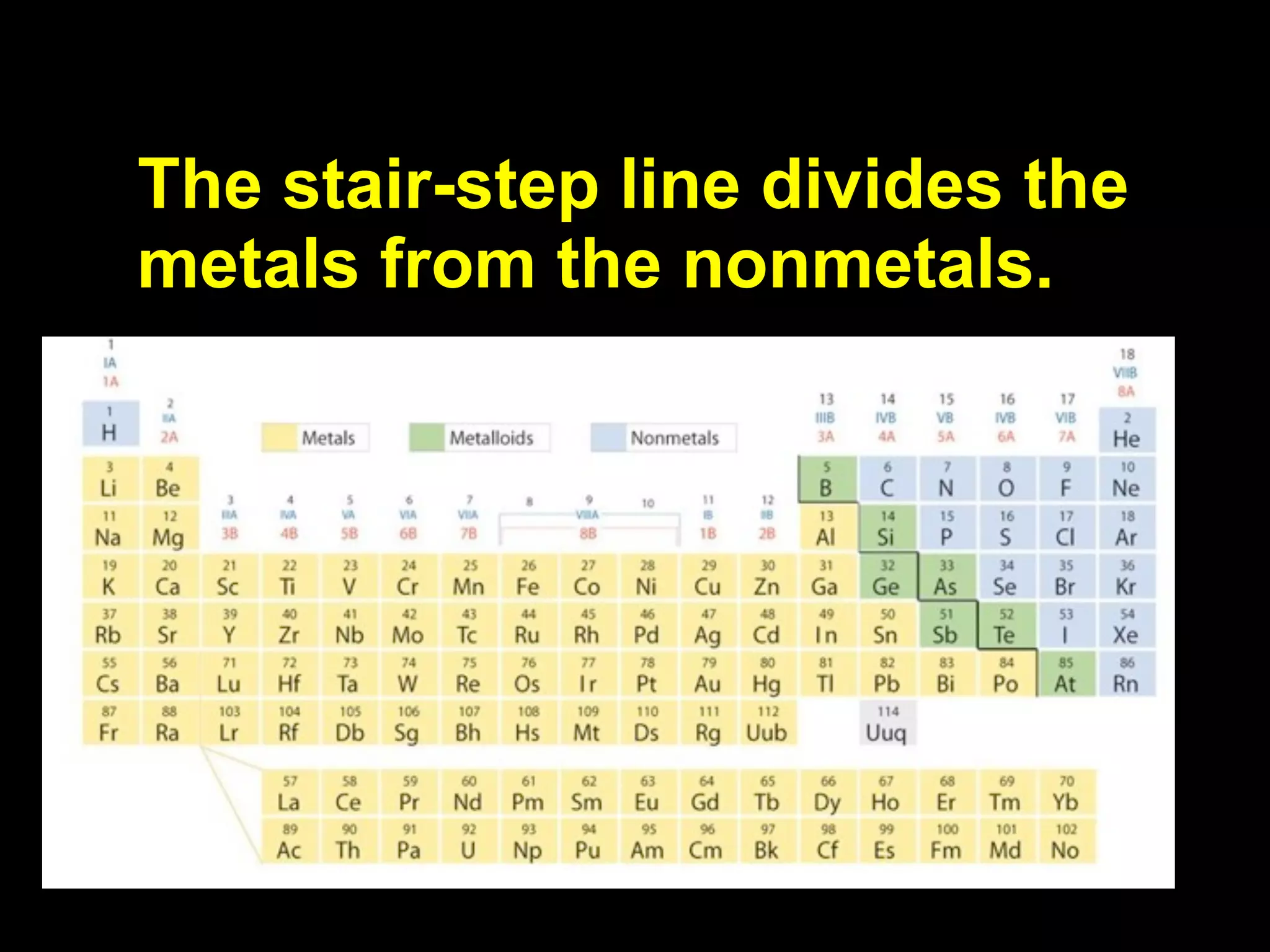
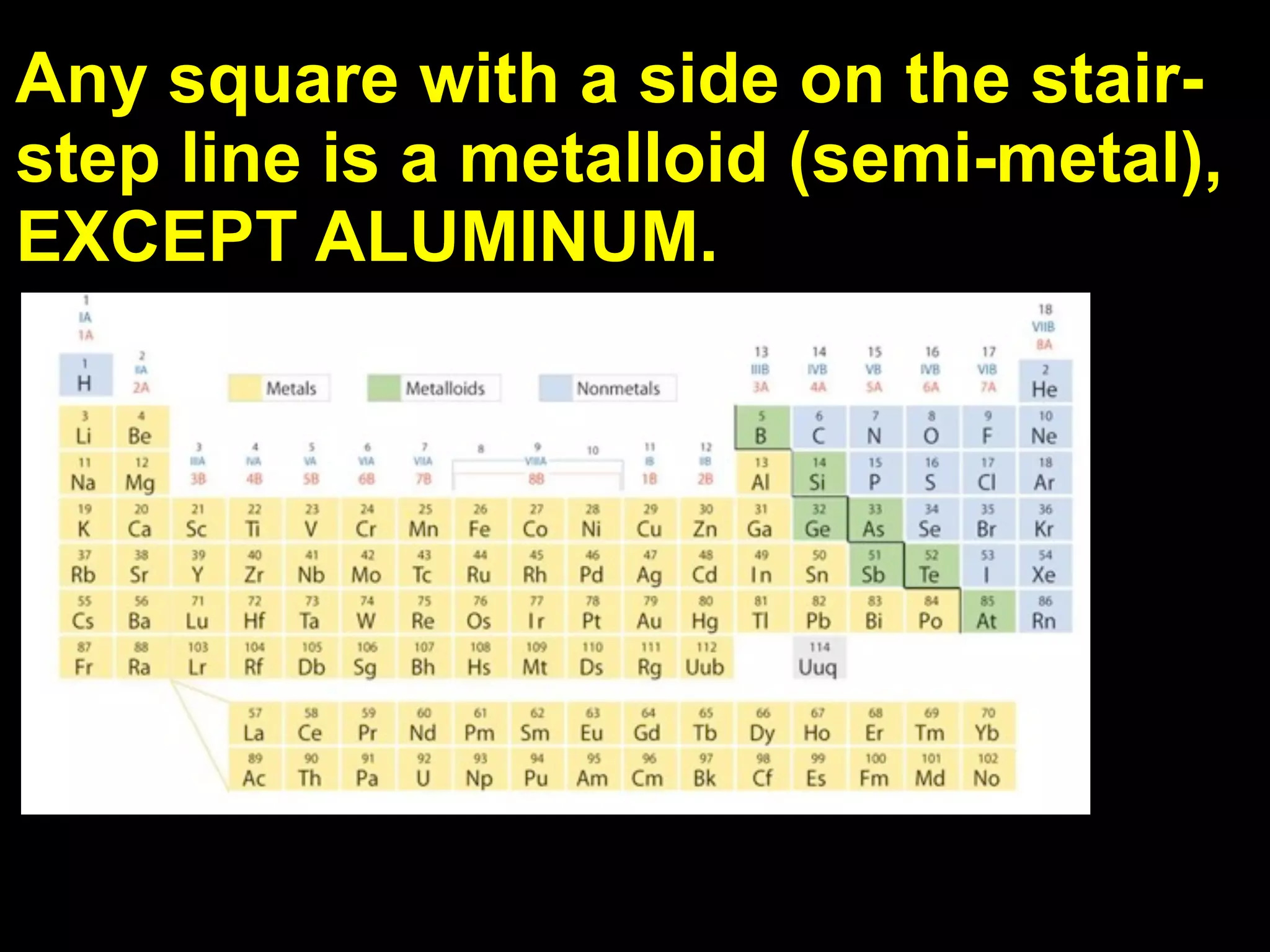
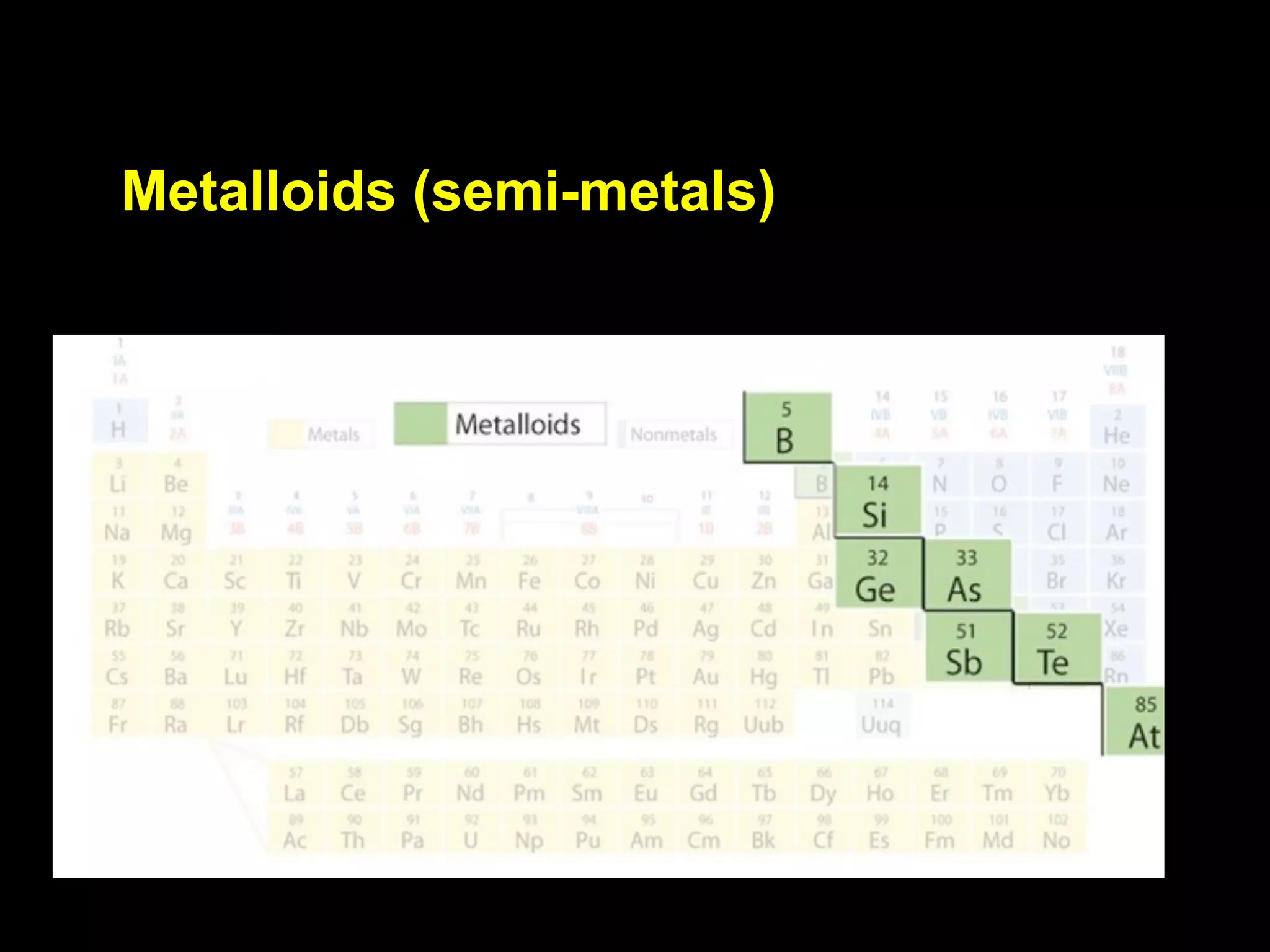
The stair-step line divides the
metals from the nonmetals.
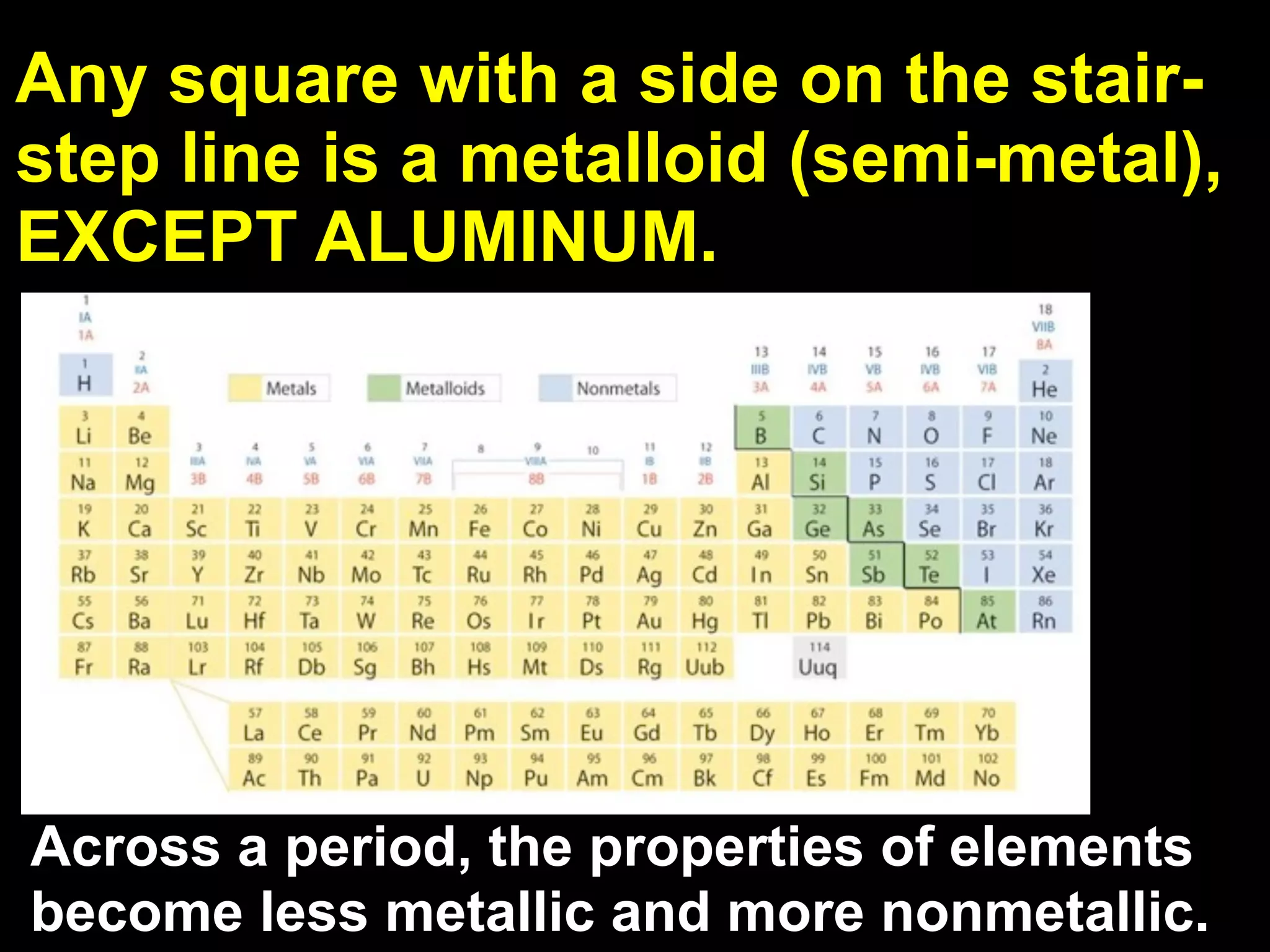
Any square with a side on the stair-
step line is a metalloid (semi-metal),
EXCEPT ALUMINUM.
Any square with a side on the stair-
step line is a metalloid (semi-metal),
EXCEPT ALUMINUM.


Across a period, the properties of elements
become less metallic and more nonmetallic.
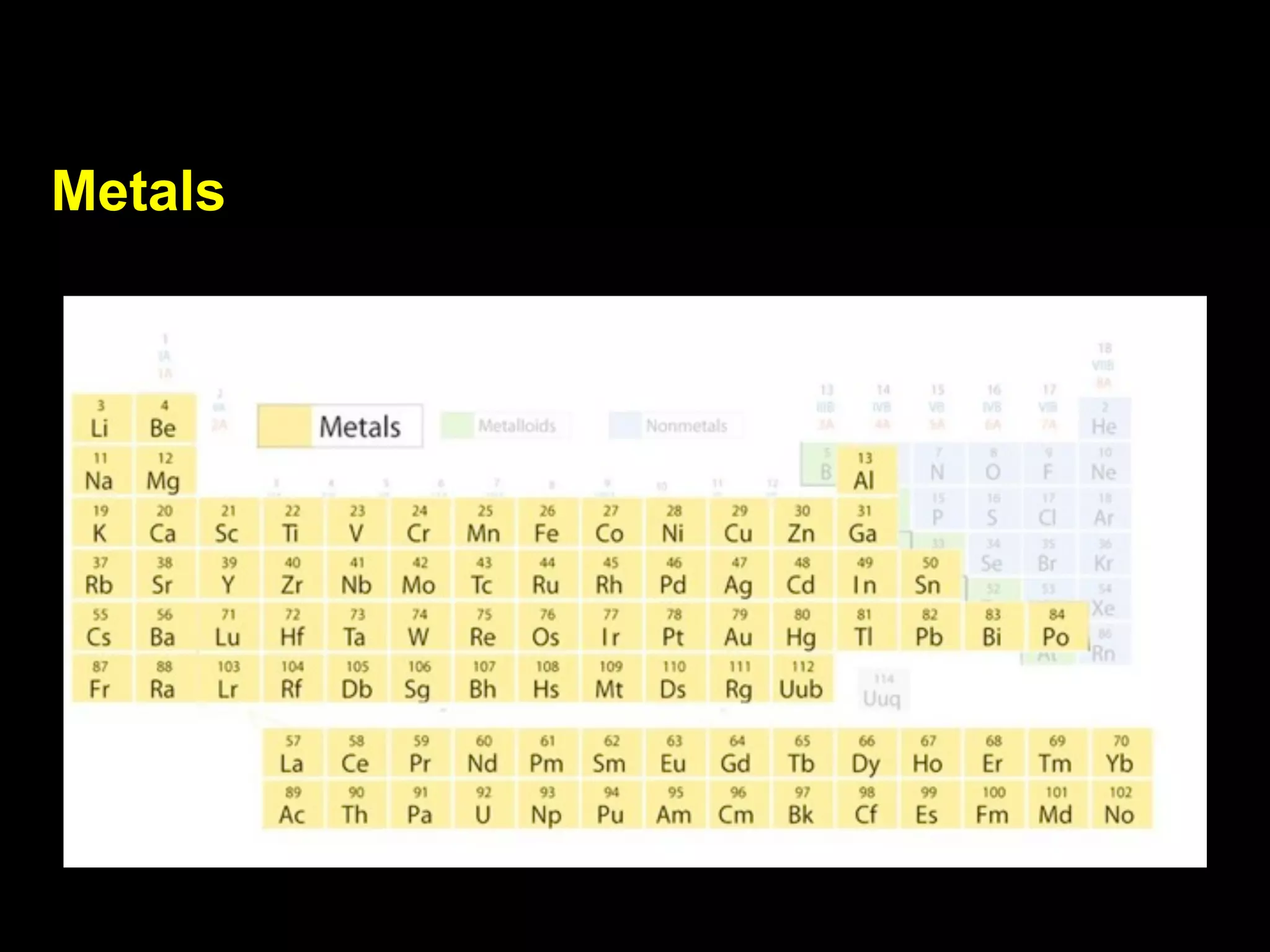
Metals
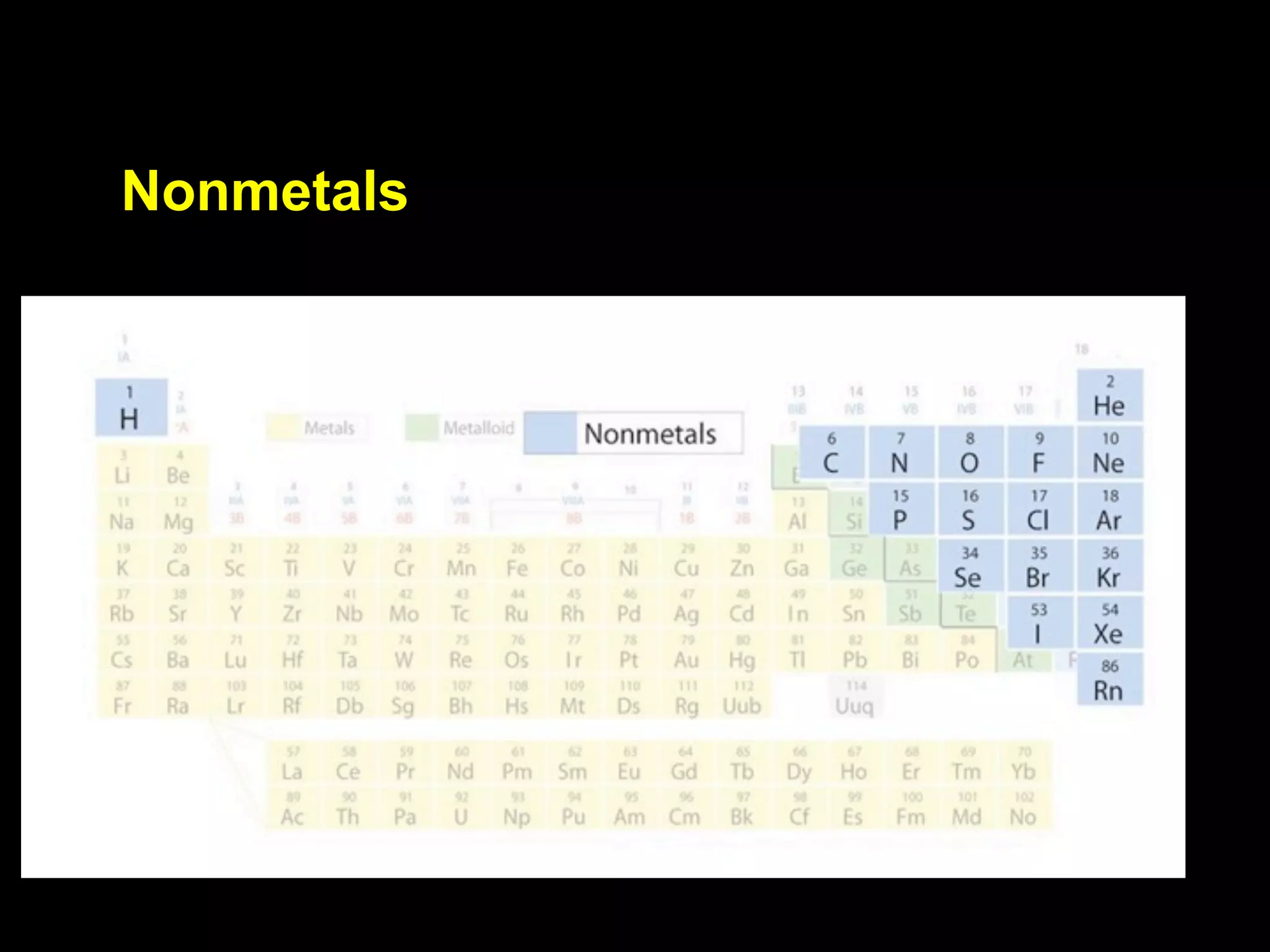
Nonmetals
Metalloids (semi-metals)
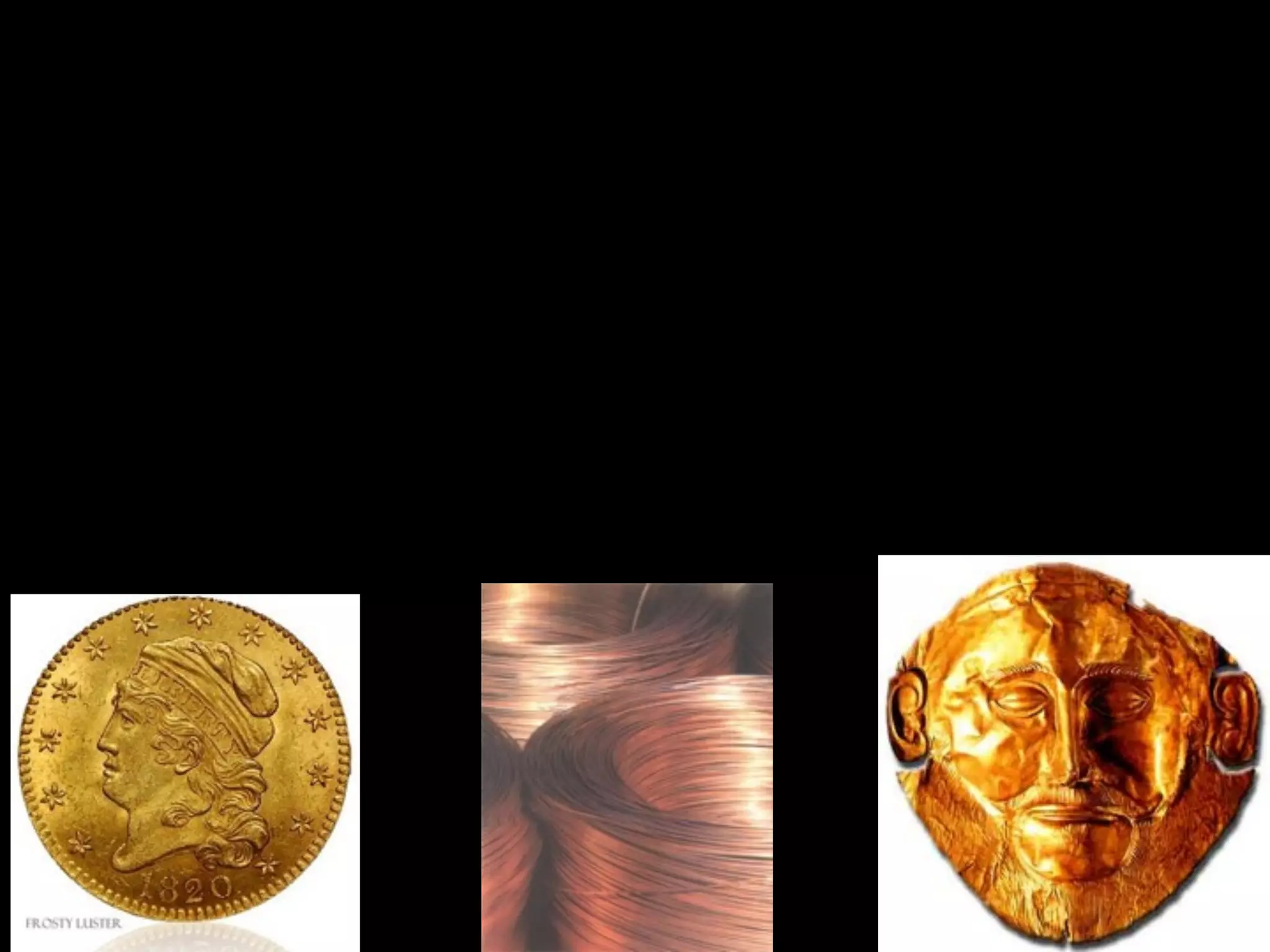
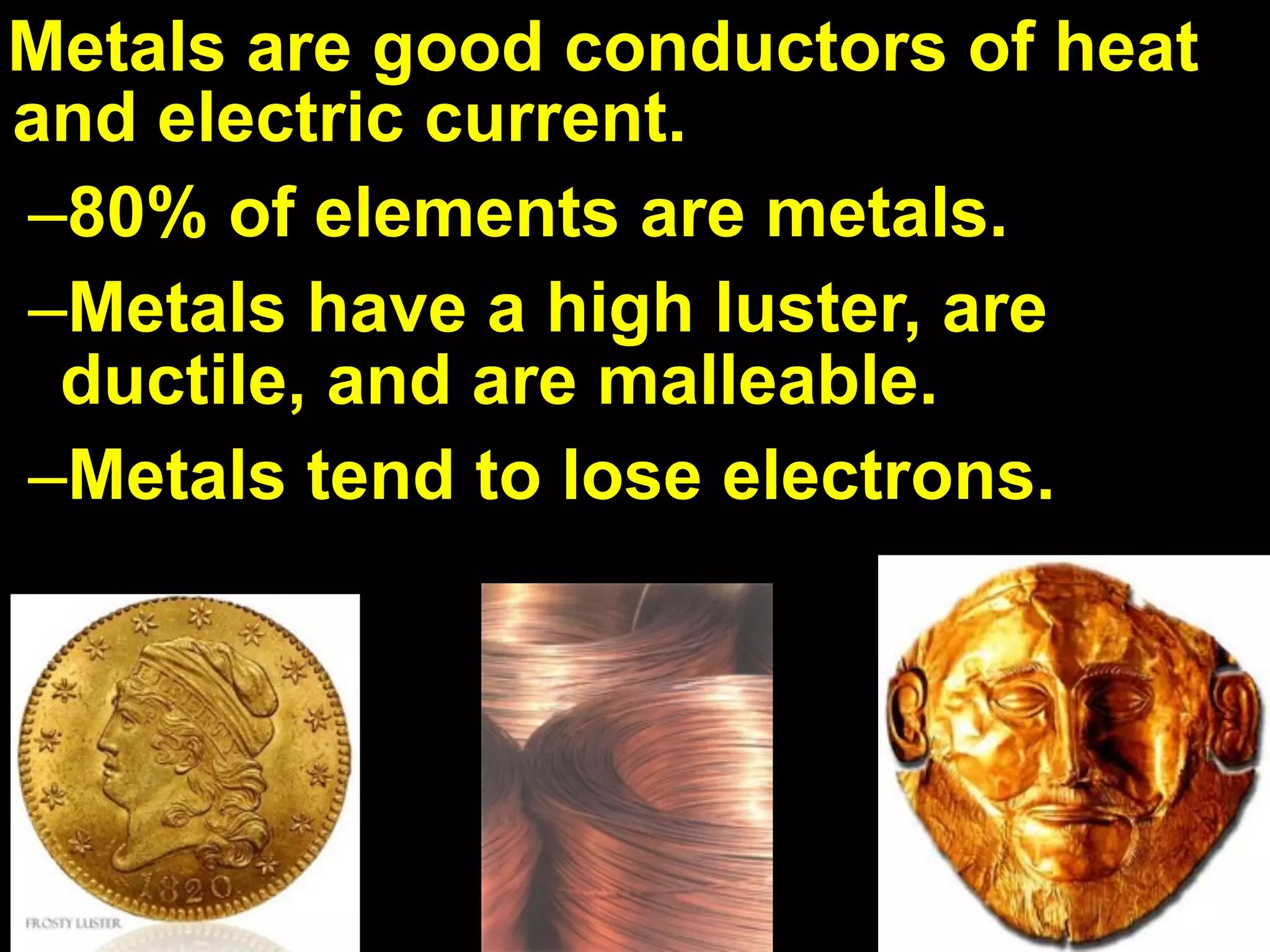
Metals are good conductors of heat
and electric current.
–80% of elements are metals.
–Metals have a high luster, are
 ductile, and are malleable.
–Metals tend to lose electrons.
6.1

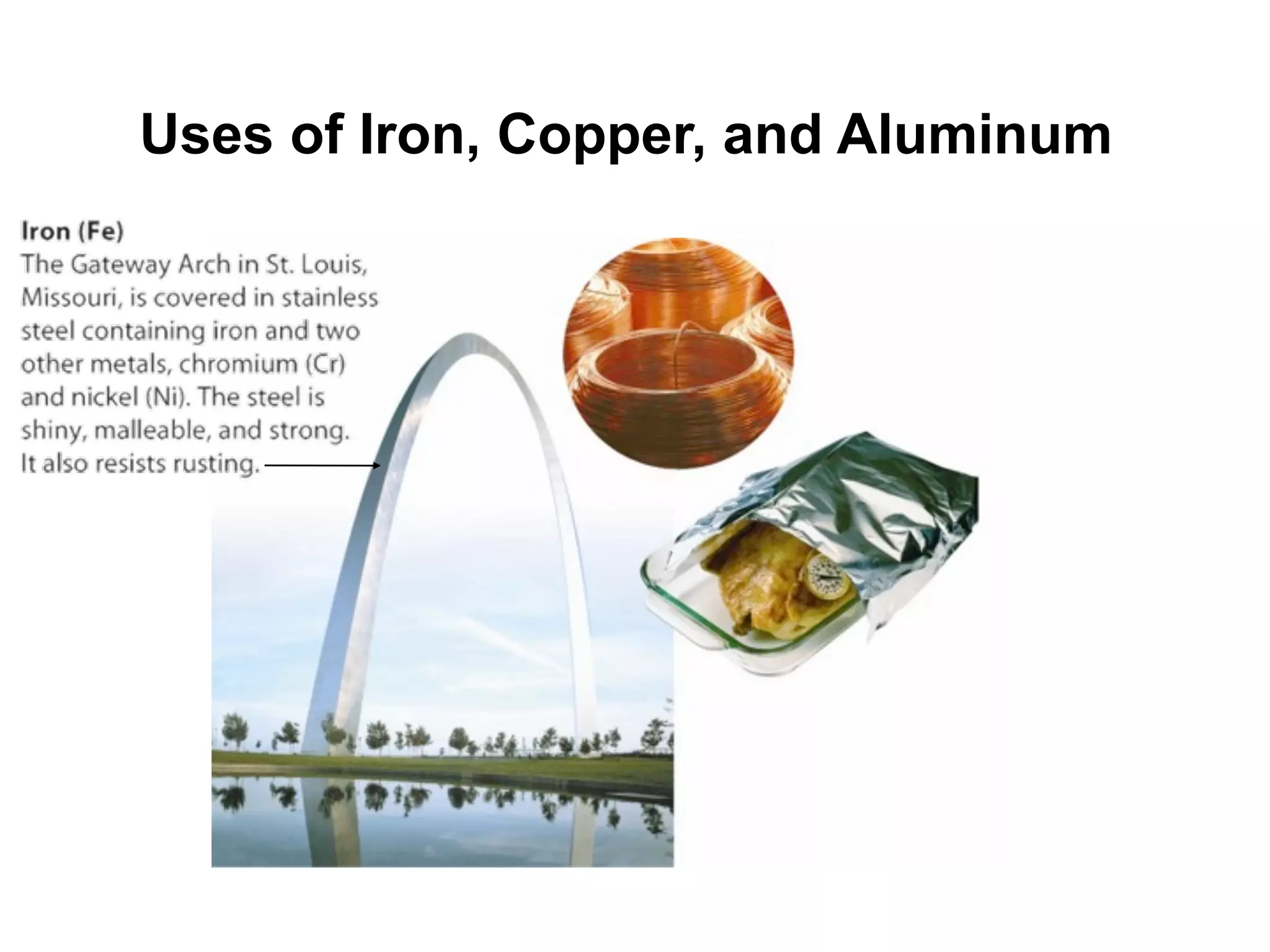
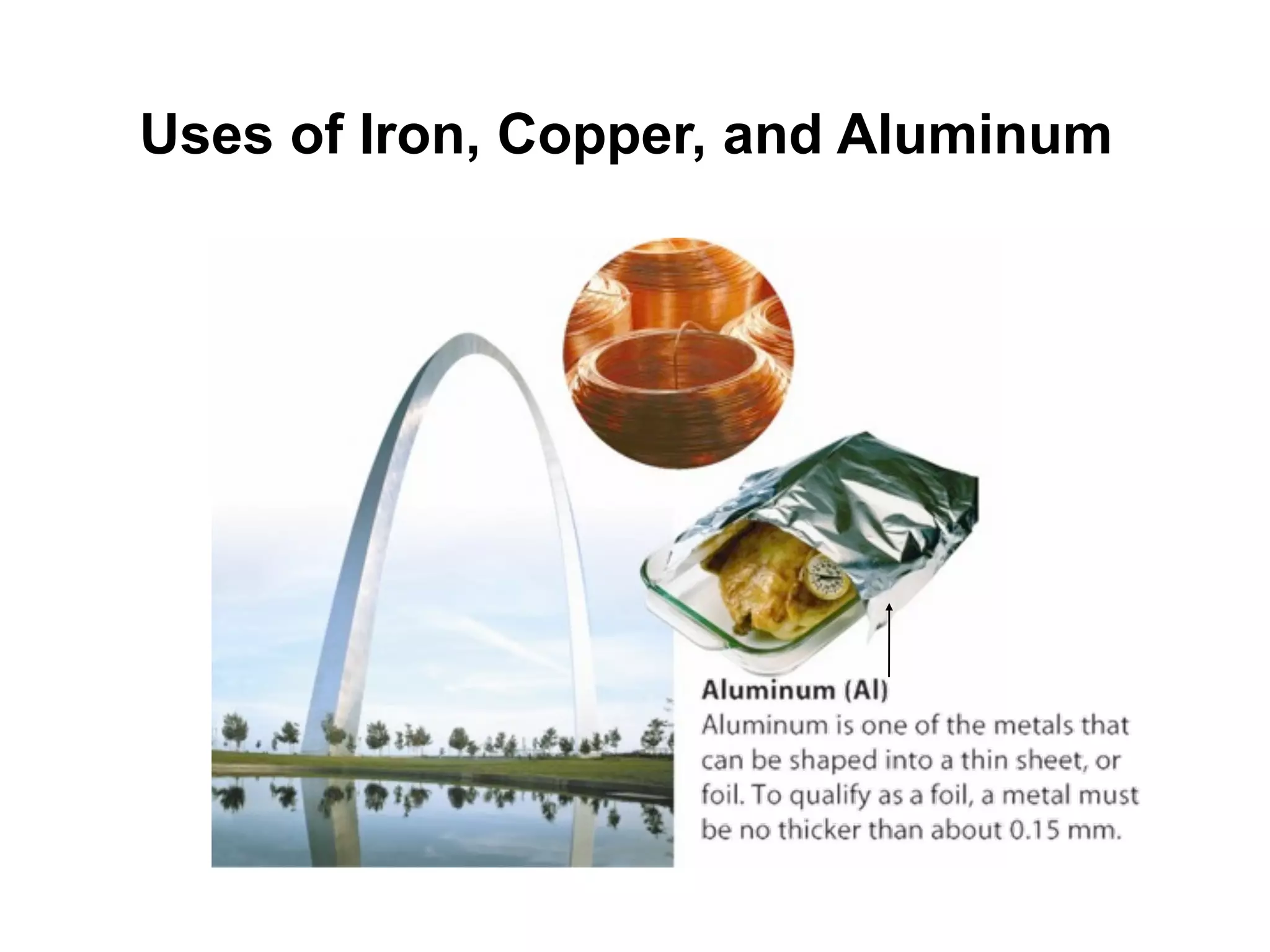
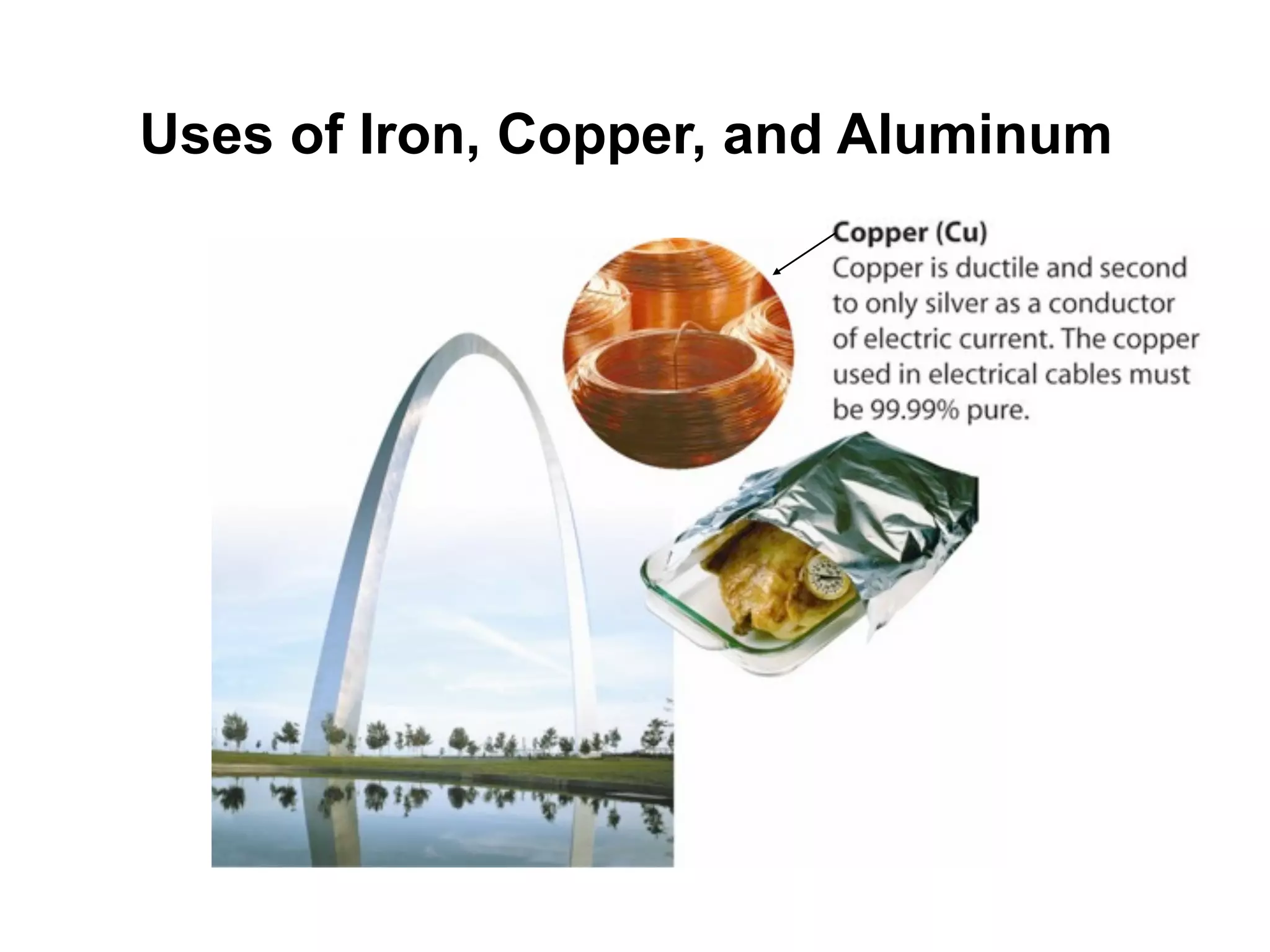
Uses of Iron, Copper, and Aluminum
6.1

Uses of Iron, Copper, and Aluminum
6.1

Uses of Iron, Copper, and Aluminum
In general, nonmetals are poor
conductors of heat and electric
current.
 –Non-metals tend to gain e-
–Most nonmetals are gases at room
 temperature.
–A few nonmetals are solids, like sulfur,
 carbon, and phosphorus.
A metalloid generally has
properties that are similar to those
of metals and nonmetals.

      •Also called semi-metals
      The behavior of a metalloid can be
      controlled by changing conditions.
If a small amount of boron is mixed with
silicon, the mixture is a good conductor of
electric current. Silicon can be cut into
wafers, and used to make computer chips.
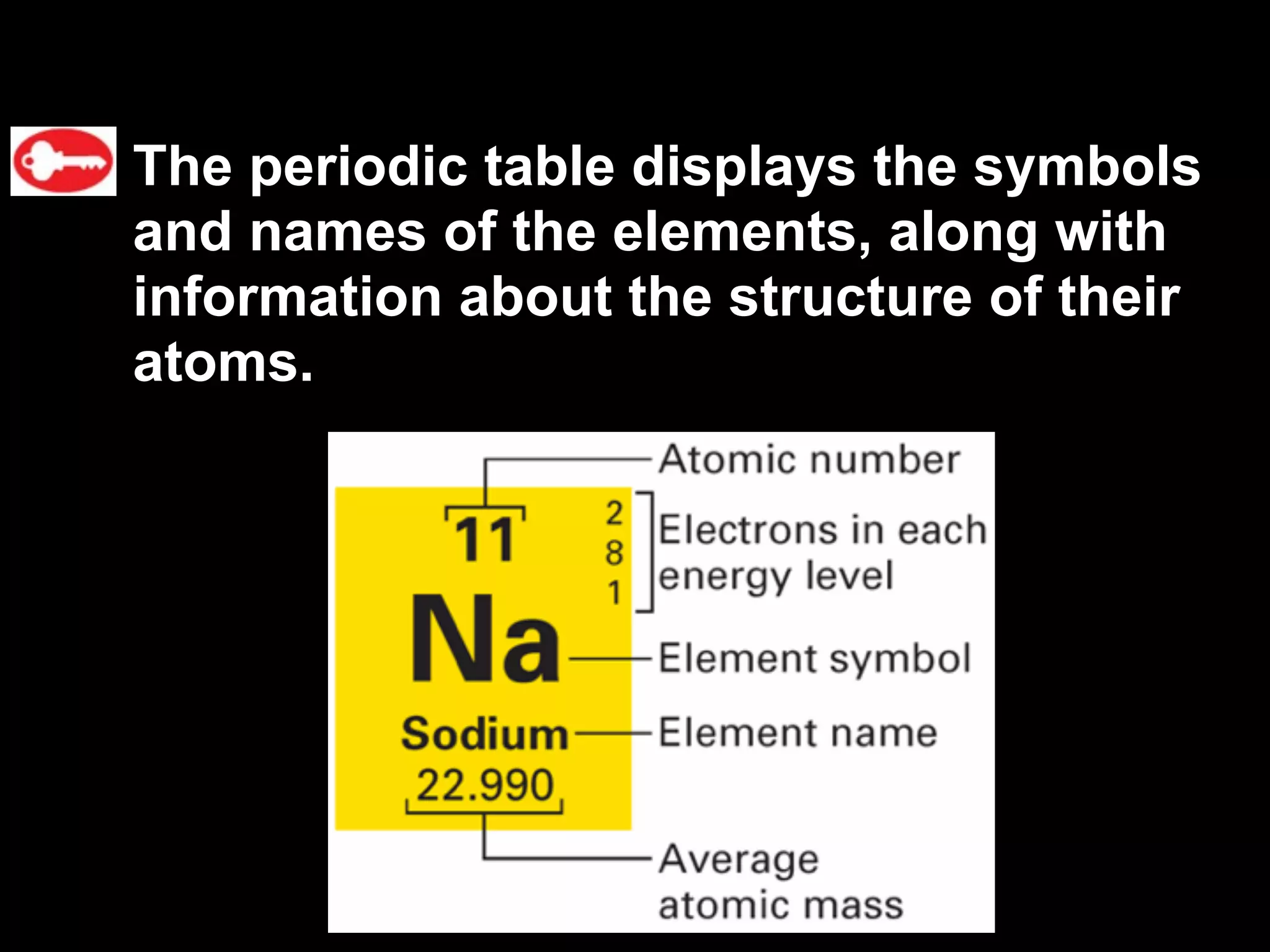
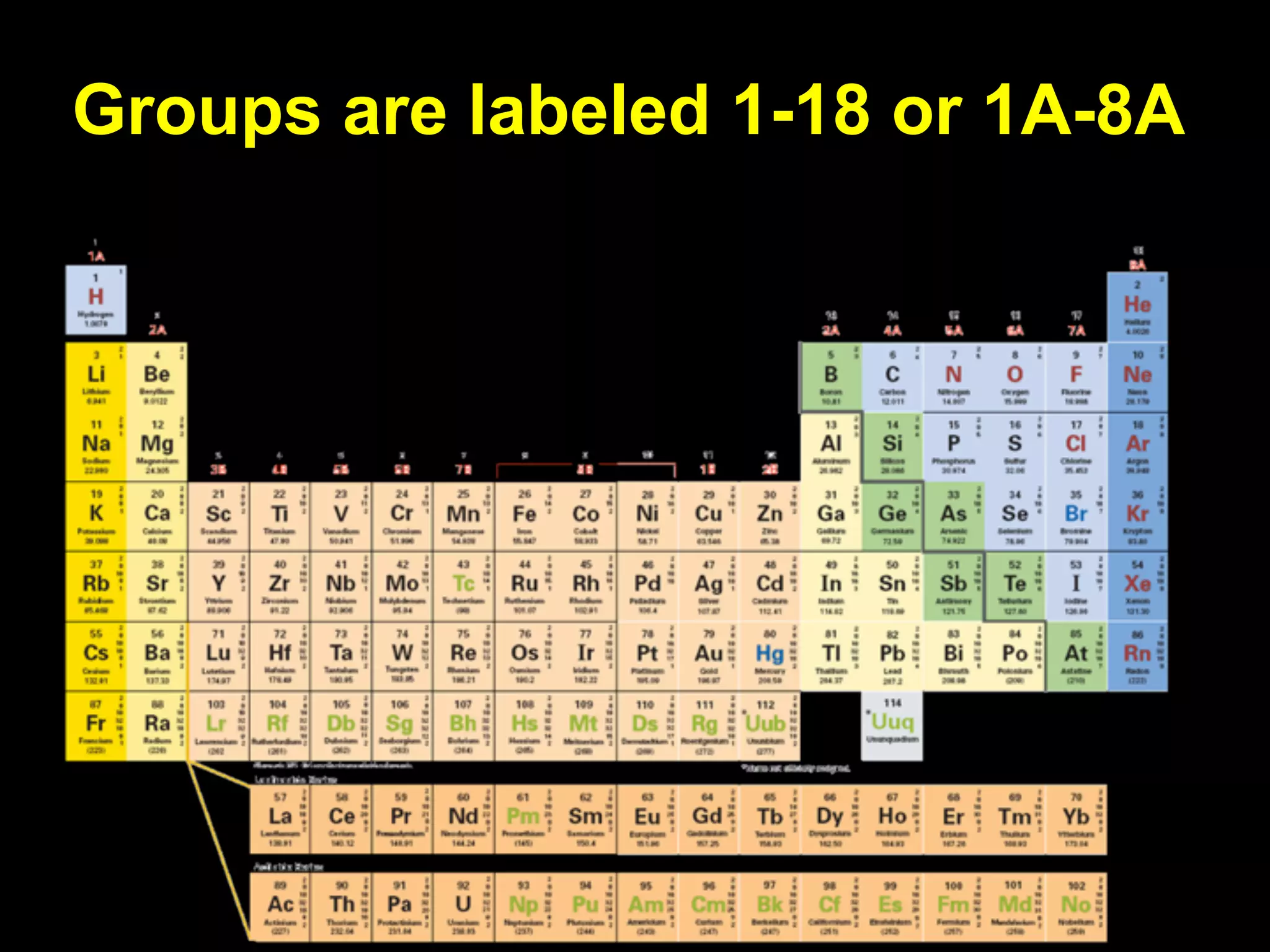
The periodic table displays the symbols
and names of the elements, along with
information about the structure of their
atoms.
Groups are labeled 1-18 or 1A-8A
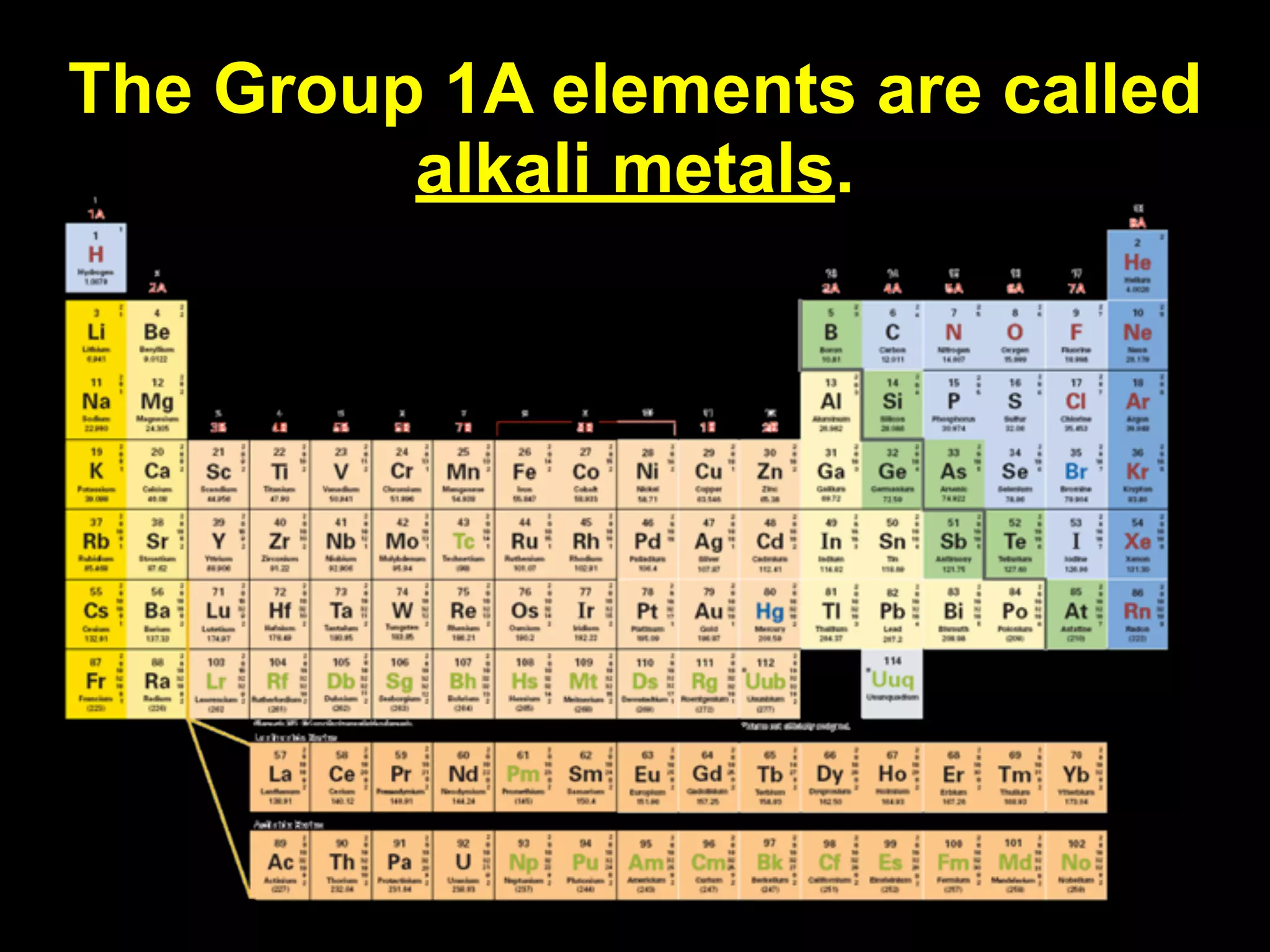
The Group 1A elements are called
         alkali metals.
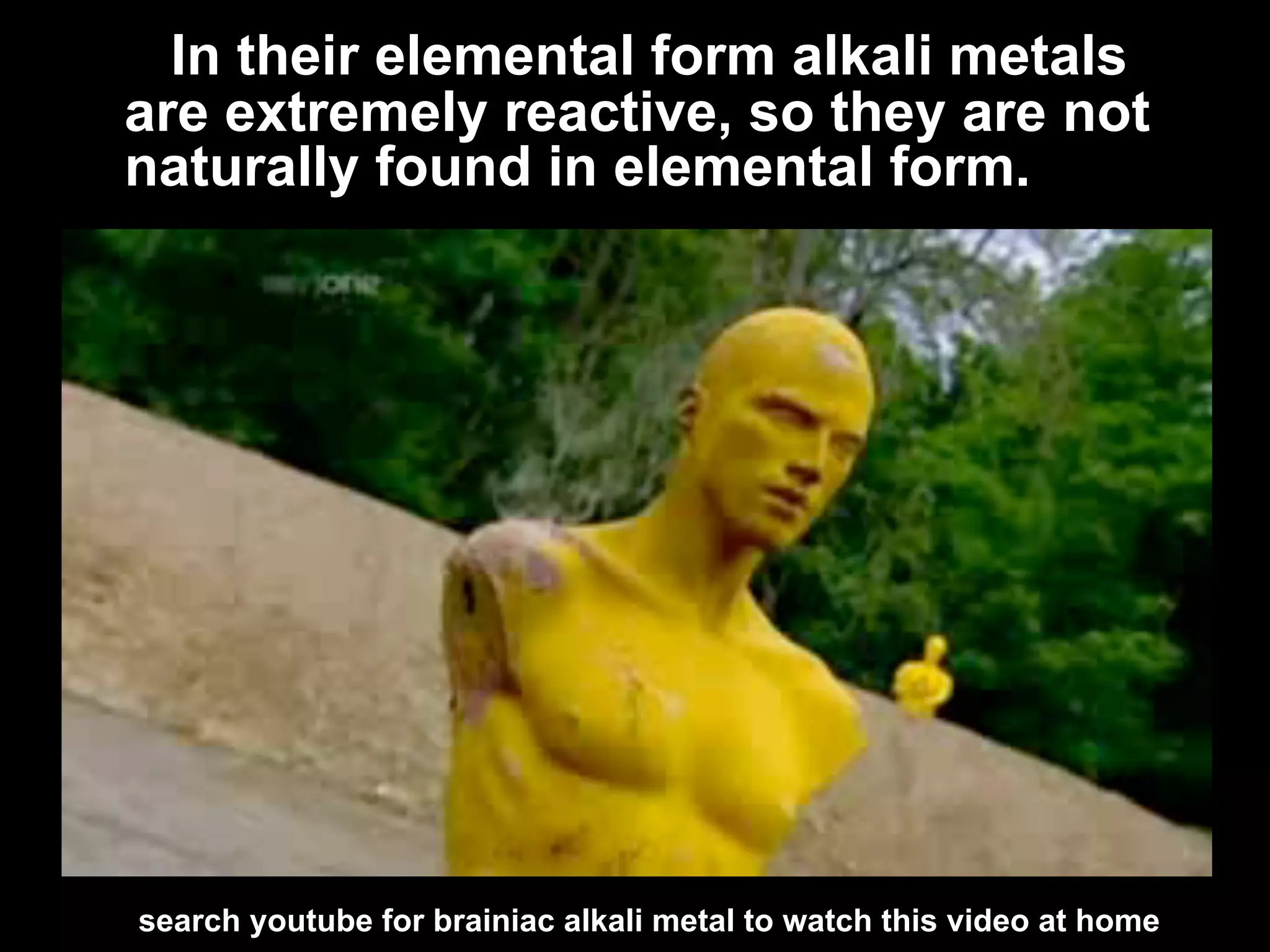
In their elemental form alkali metals
are extremely reactive, so they are not
naturally found in elemental form.


search youtube for brainiac alkali metal to watch this video at home
In their elemental form alkali metals
are extremely reactive, so they are not
naturally found in elemental form.


search youtube for brainiac alkali metal to watch this video at home
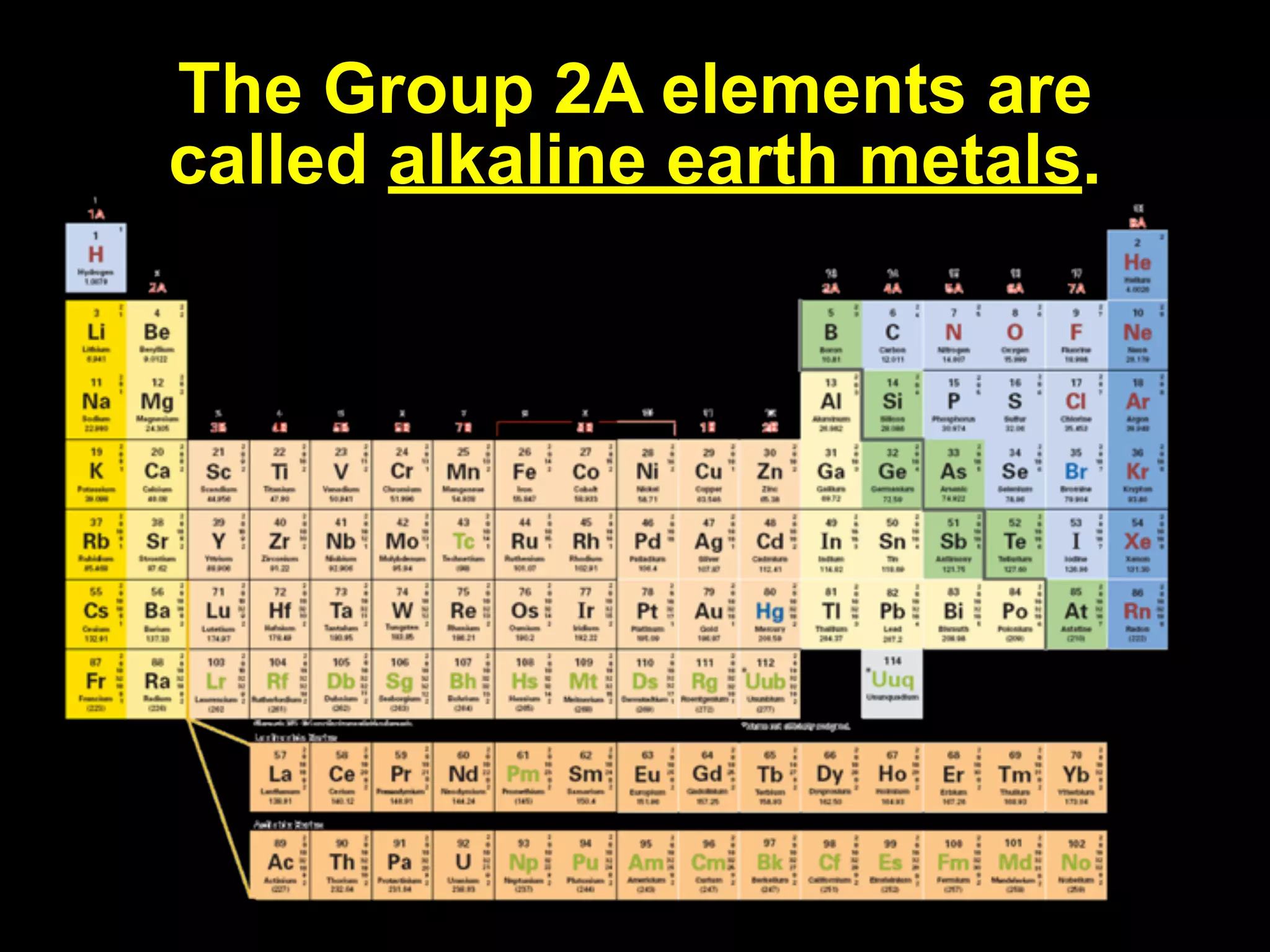
The Group 2A elements are
called alkaline earth metals.
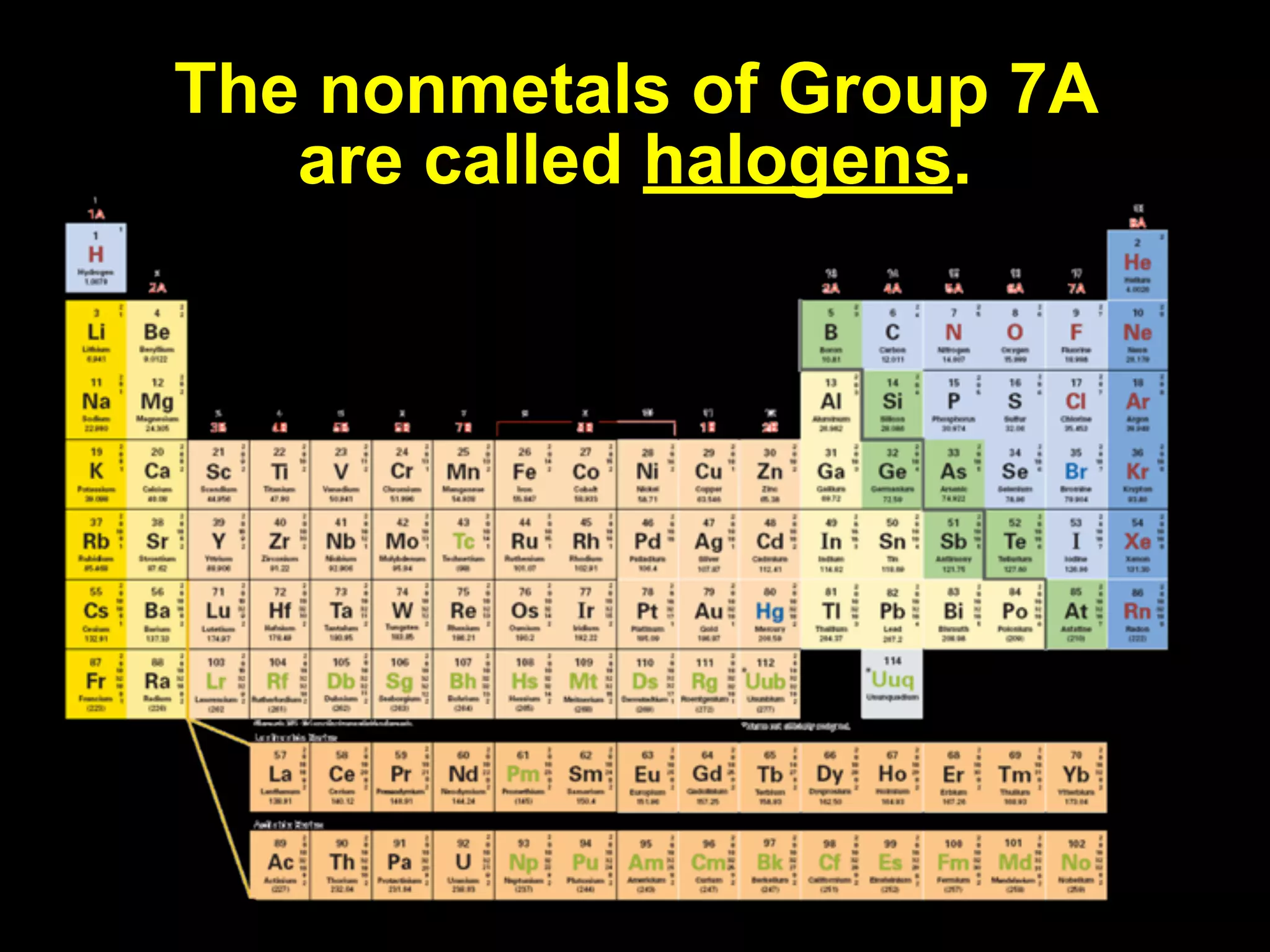
The nonmetals of Group 7A
   are called halogens.
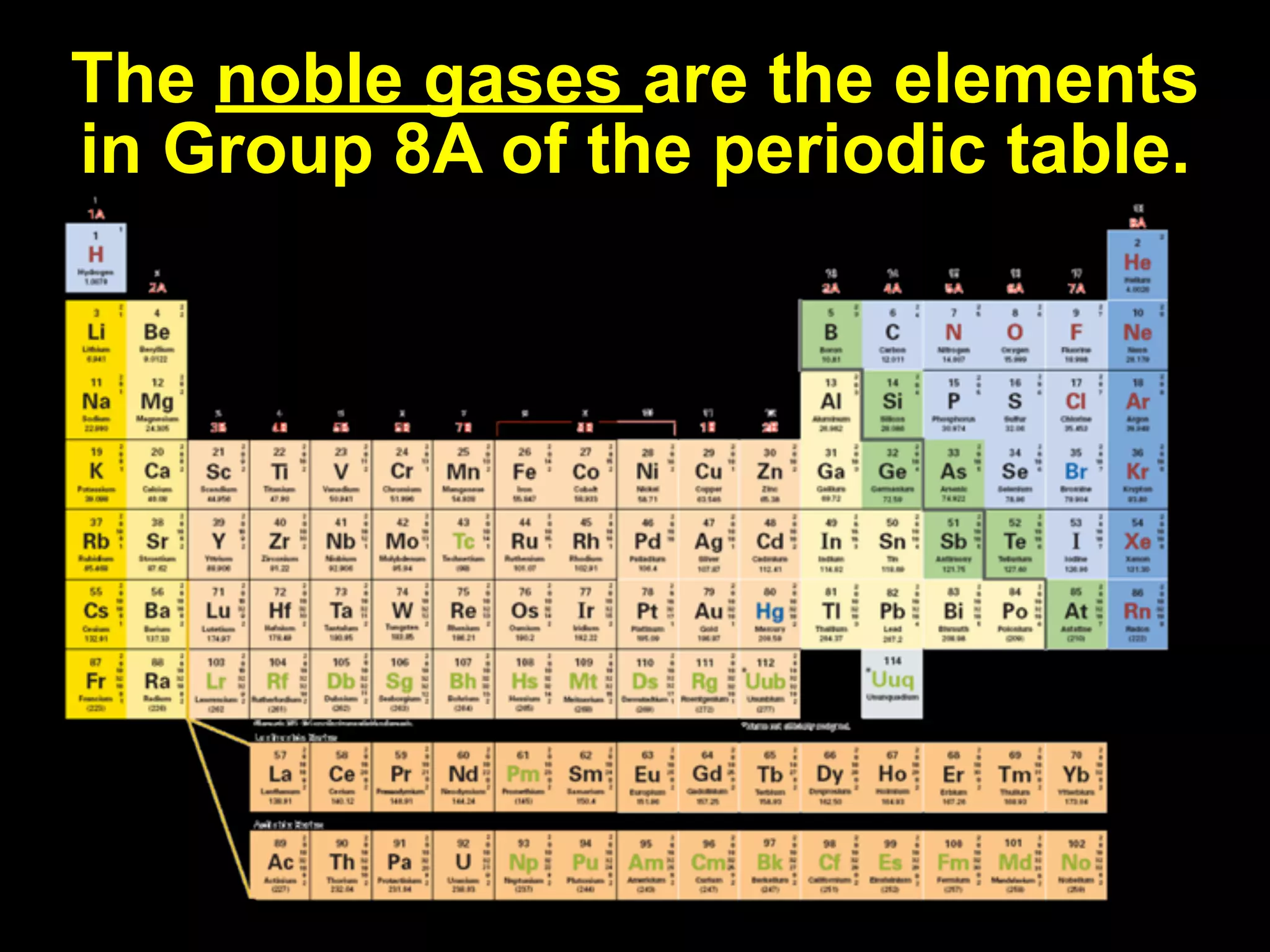
The noble gases are the elements
in Group 8A of the periodic table.

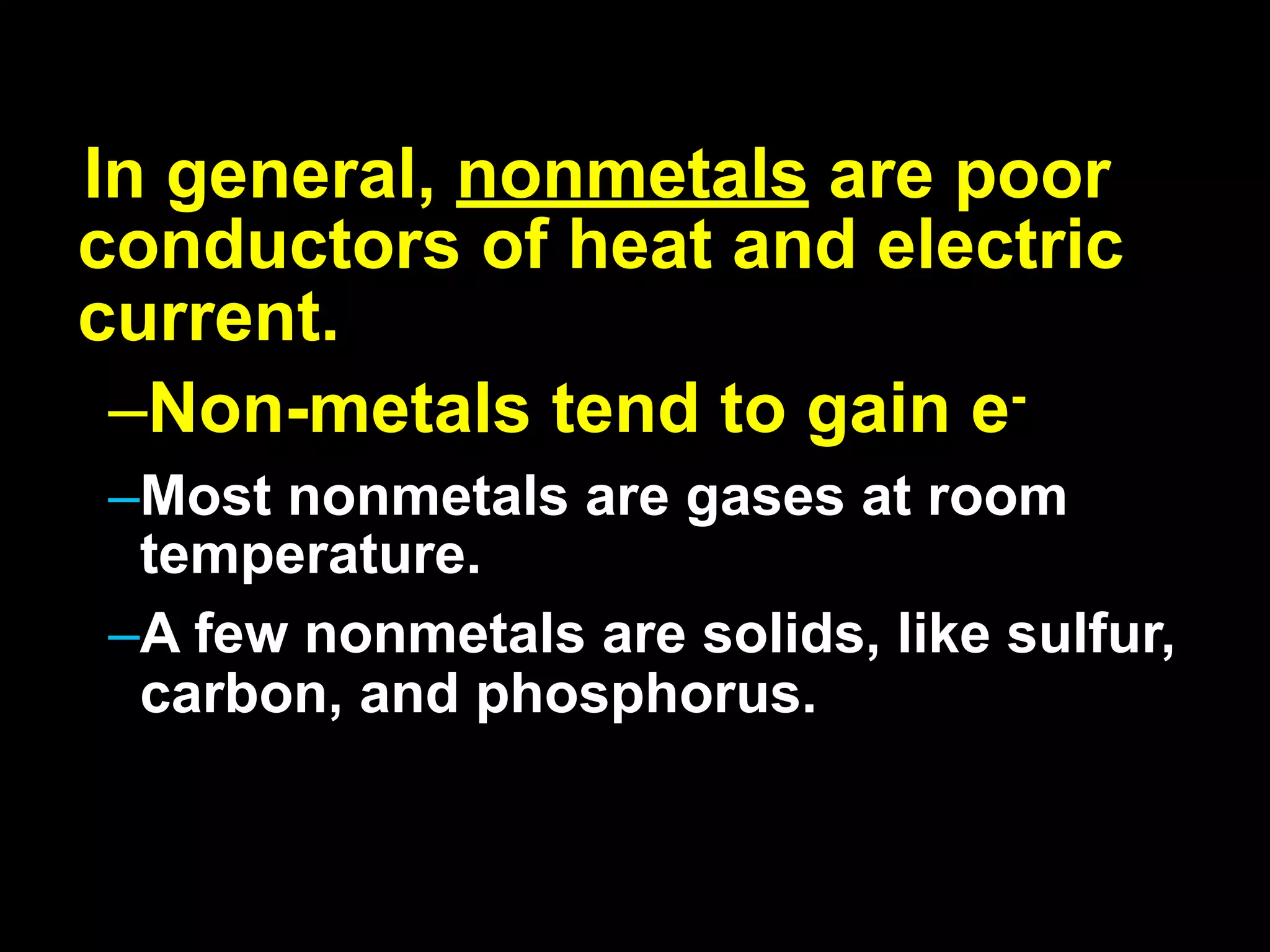
The blimp contains
helium, one of the
noble gases.
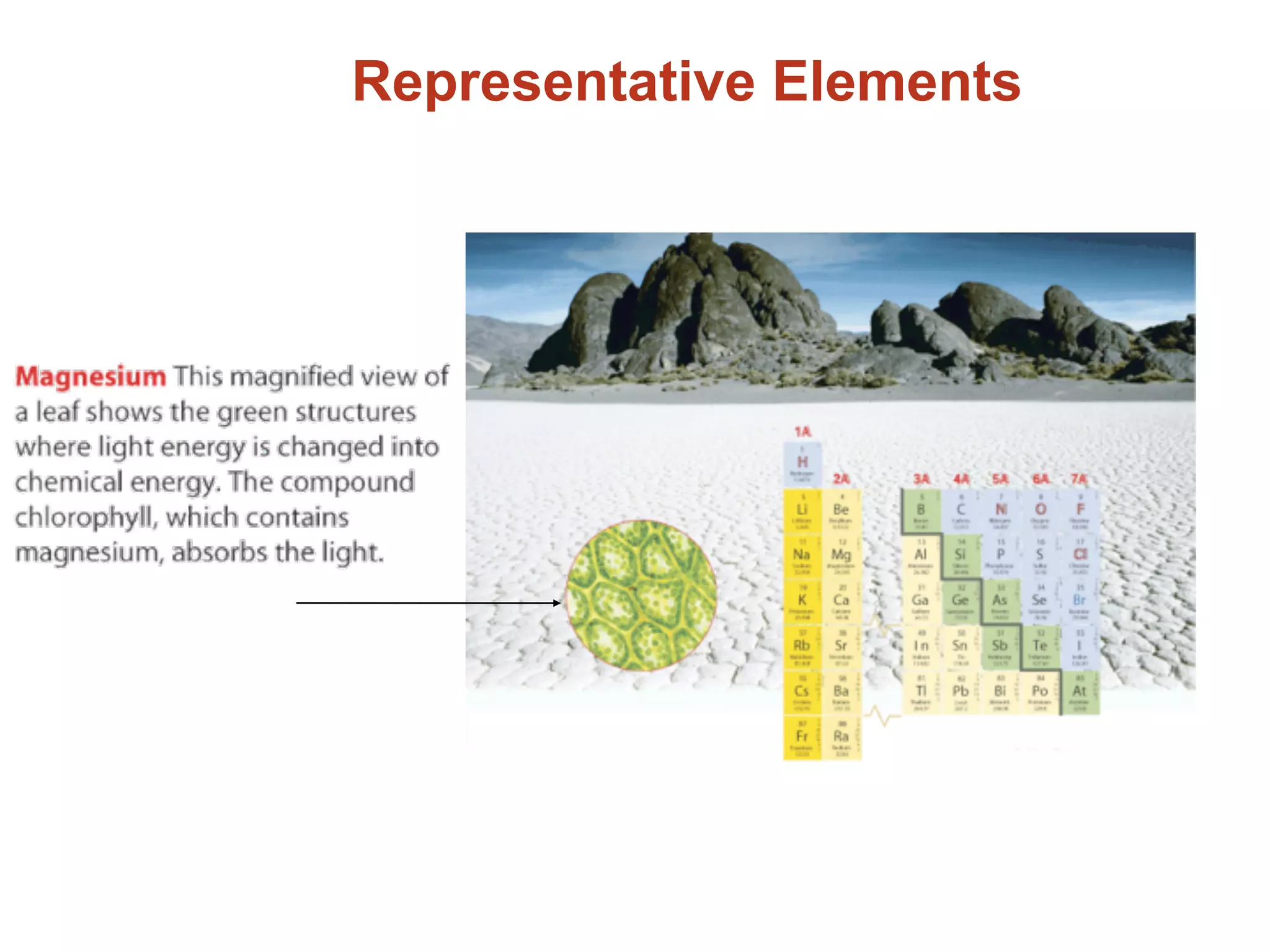
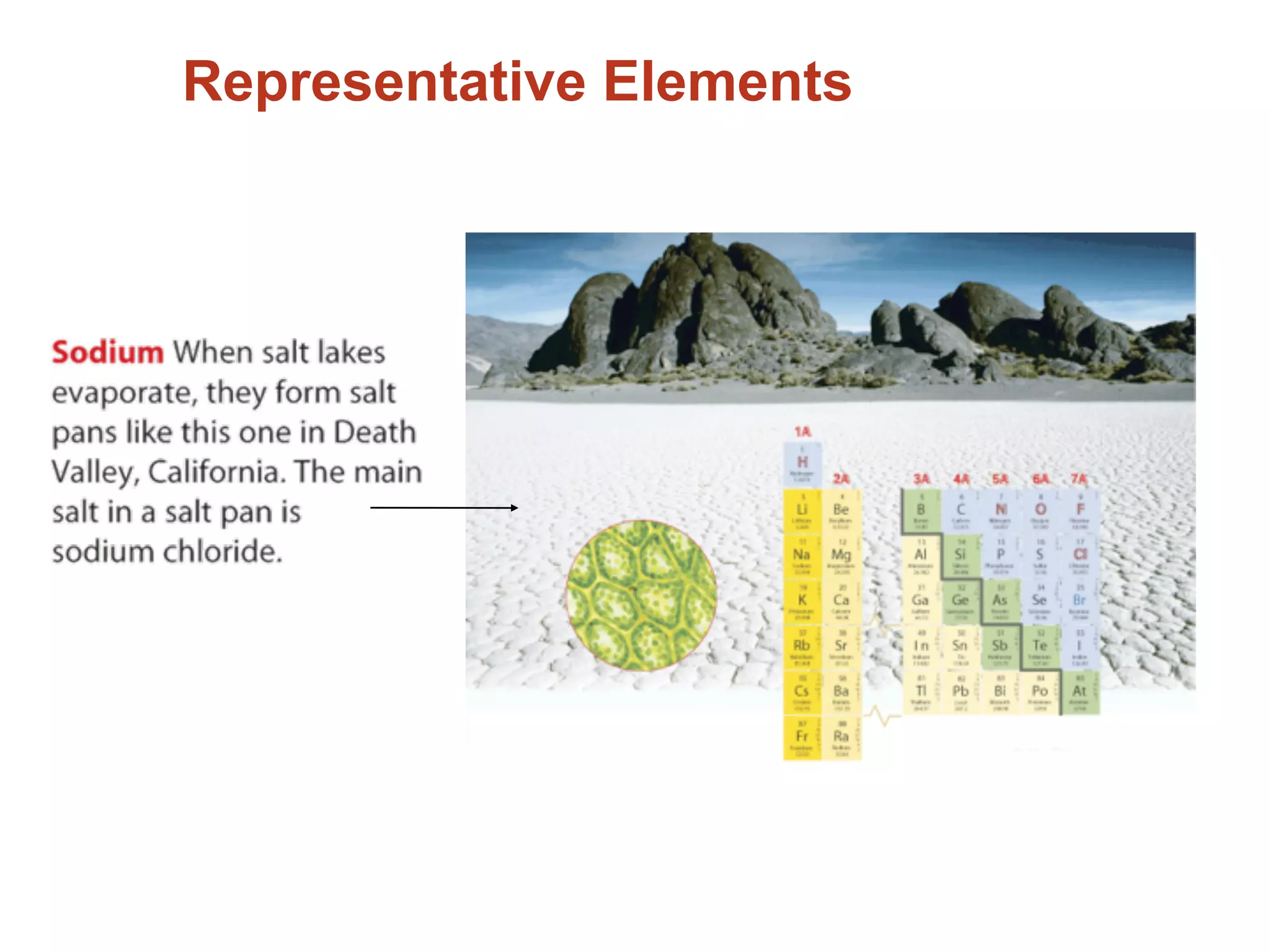
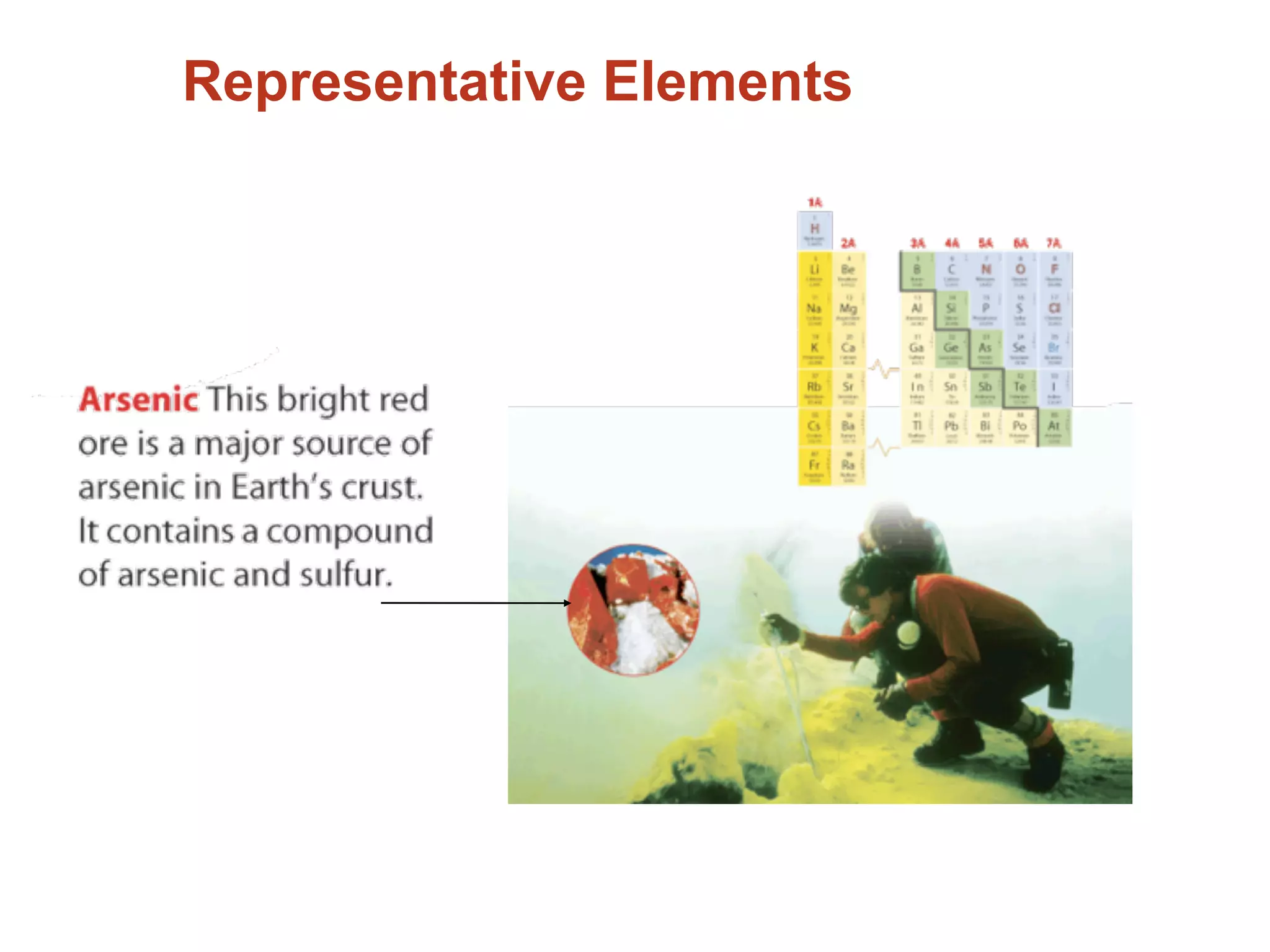
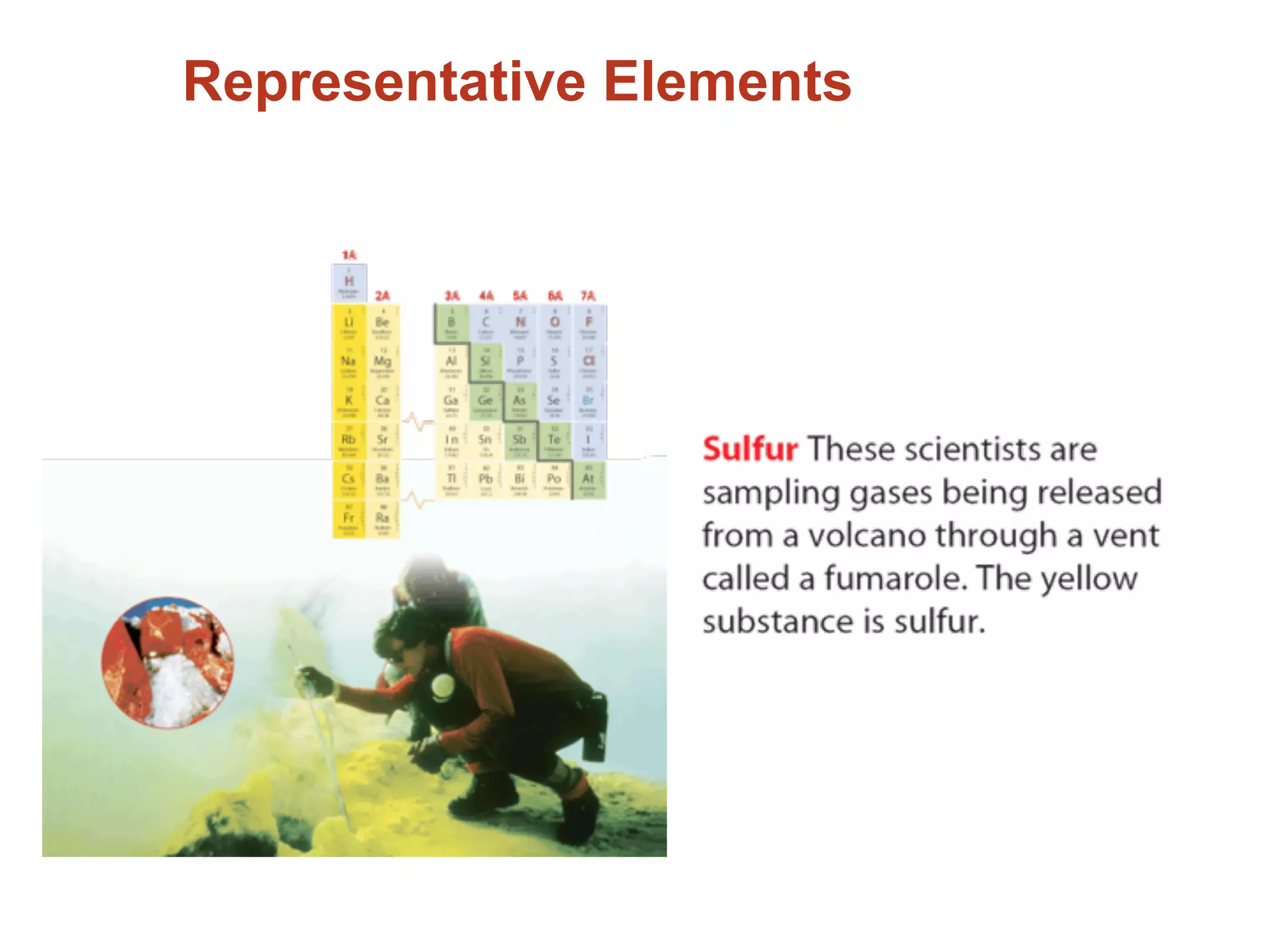
The Representative Elements
 Elements in groups 1A through 7A are
 often referred to as representative elements
 because they display a wide range of
 physical and chemical properties.
6.2
      Representative Elements
6.2
  Representative Elements
6.2
  Representative Elements
6.2
  Representative Elements
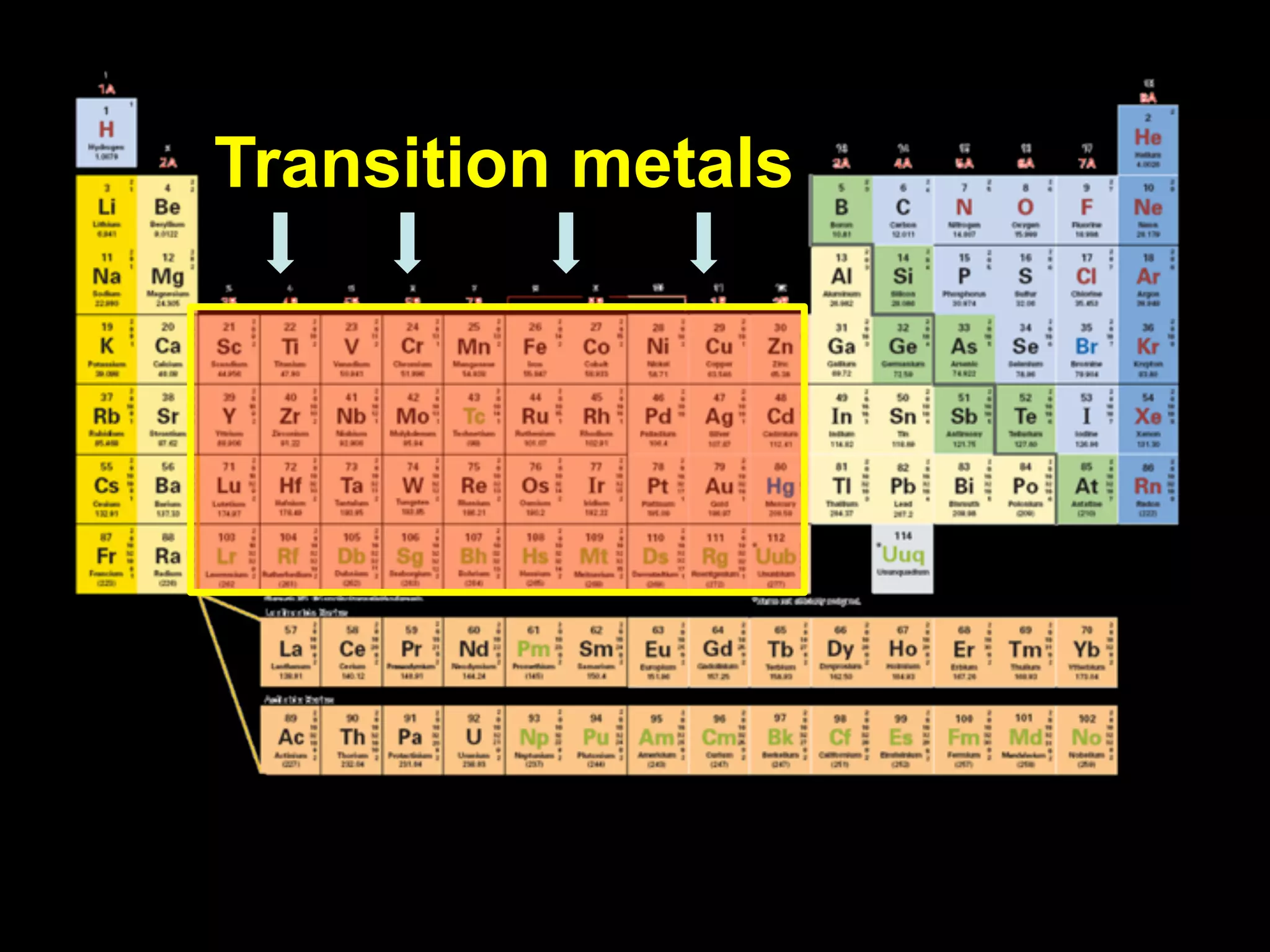
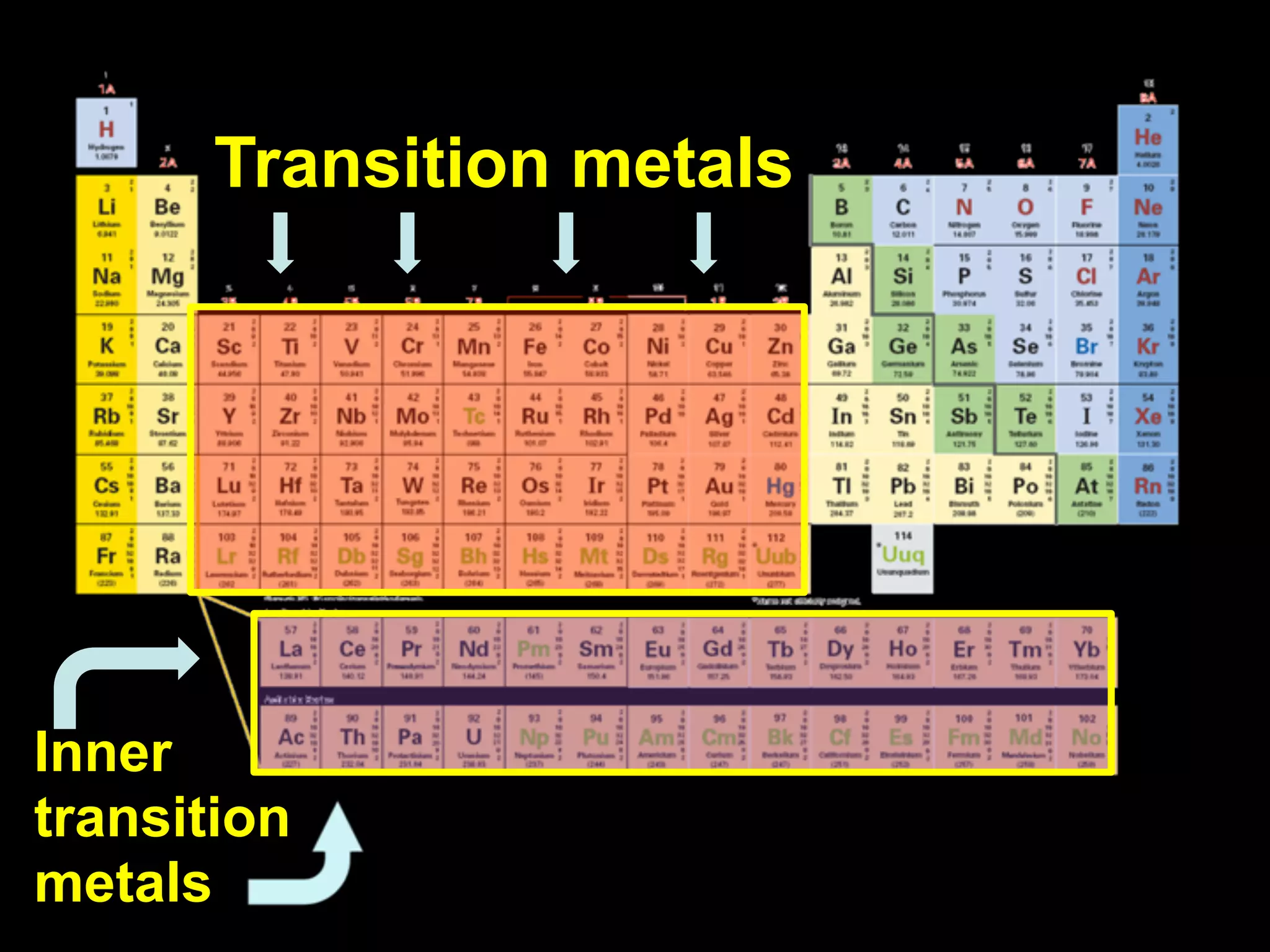
Transition metals
Transition metals


Inner
transition
metals

Lecture 6.1- The Periodic Table

  • 1.
    Lecture 6.1- ThePeriodic Table
  • 2.
    Chemists use theproperties of elements to sort them into groups.
  • 3.
    Chlorine, bromine, andiodine have very similar chemical properties.
  • 4.
    Mendeleev arranged theelements in his periodic table in order of increasing atomic mass. Mendeleev’s periodic table was used to predict the properties of undiscovered elements.
  • 5.
    An Early Versionof Mendeleev’s Periodic Table
  • 6.
    In the modernperiodic table, elements are arranged in order of increasing atomic number.
  • 8.
    The periodic law:When elements are arranged in order of increasing atomic number, there is a periodic repetition of their physical and chemical properties. –The properties of the elements within a period change as you move across a period from left to right. –The pattern of properties within a period repeats as you move from one period to
  • 9.
    The stair-step linedivides the metals from the nonmetals.
  • 10.
    Any square witha side on the stair- step line is a metalloid (semi-metal), EXCEPT ALUMINUM.
  • 11.
    Any square witha side on the stair- step line is a metalloid (semi-metal), EXCEPT ALUMINUM. Across a period, the properties of elements become less metallic and more nonmetallic.
  • 12.
  • 13.
  • 14.
  • 16.
    Metals are goodconductors of heat and electric current. –80% of elements are metals. –Metals have a high luster, are ductile, and are malleable. –Metals tend to lose electrons.
  • 17.
    6.1 Uses of Iron,Copper, and Aluminum
  • 18.
    6.1 Uses of Iron,Copper, and Aluminum
  • 19.
    6.1 Uses of Iron,Copper, and Aluminum
  • 21.
    In general, nonmetalsare poor conductors of heat and electric current. –Non-metals tend to gain e- –Most nonmetals are gases at room temperature. –A few nonmetals are solids, like sulfur, carbon, and phosphorus.
  • 23.
    A metalloid generallyhas properties that are similar to those of metals and nonmetals. •Also called semi-metals The behavior of a metalloid can be controlled by changing conditions.
  • 24.
    If a smallamount of boron is mixed with silicon, the mixture is a good conductor of electric current. Silicon can be cut into wafers, and used to make computer chips.
  • 25.
    The periodic tabledisplays the symbols and names of the elements, along with information about the structure of their atoms.
  • 26.
    Groups are labeled1-18 or 1A-8A
  • 27.
    The Group 1Aelements are called alkali metals.
  • 28.
    In their elementalform alkali metals are extremely reactive, so they are not naturally found in elemental form. search youtube for brainiac alkali metal to watch this video at home
  • 29.
    In their elementalform alkali metals are extremely reactive, so they are not naturally found in elemental form. search youtube for brainiac alkali metal to watch this video at home
  • 30.
    The Group 2Aelements are called alkaline earth metals.
  • 31.
    The nonmetals ofGroup 7A are called halogens.
  • 32.
    The noble gasesare the elements in Group 8A of the periodic table.
  • 33.
    The blimp contains helium,one of the noble gases.
  • 34.
    The Representative Elements Elements in groups 1A through 7A are often referred to as representative elements because they display a wide range of physical and chemical properties.
  • 35.
    6.2 Representative Elements
  • 36.
  • 37.
  • 38.
  • 40.
  • 41.

Editor's Notes

  • #4 Chlorine, bromine, and iodine have very similar chemical properties. The numbers shown are the average atomic masses for these elements.
  • #6 In this early version of Mendeleev’s periodic table, the rows contain elements with similar properties. Observing A fourth element is grouped with chlorine (Cl), bromine (Br), and (I) iodine. What is this element’s symbol?
  • #7 In the modern periodic table, the elements are arranged in order of increasing atomic number. Interpreting Diagrams How many elements are there in the second period?
  • #9 One way to classify elements in the periodic table is as metals, nonmetals, and metalloids. Inferring What is the purpose for the black stair-step line?
  • #11 One way to classify elements in the periodic table is as metals, nonmetals, and metalloids. Inferring What is the purpose for the black stair-step line?
  • #12 One way to classify elements in the periodic table is as metals, nonmetals, and metalloids. Inferring What is the purpose for the black stair-step line?
  • #13 One way to classify elements in the periodic table is as metals, nonmetals, and metalloids. Inferring What is the purpose for the black stair-step line?
  • #15 The metals iron, copper, and aluminum have many important uses. How each metal is used is determined by its properties.
  • #16 The metals iron, copper, and aluminum have many important uses. How each metal is used is determined by its properties.
  • #17 The metals iron, copper, and aluminum have many important uses. How each metal is used is determined by its properties.
  • #21 This is the element square for sodium from the periodic table. Interpreting Diagrams What does the data in the square tell you about the structure of sodium atoms?

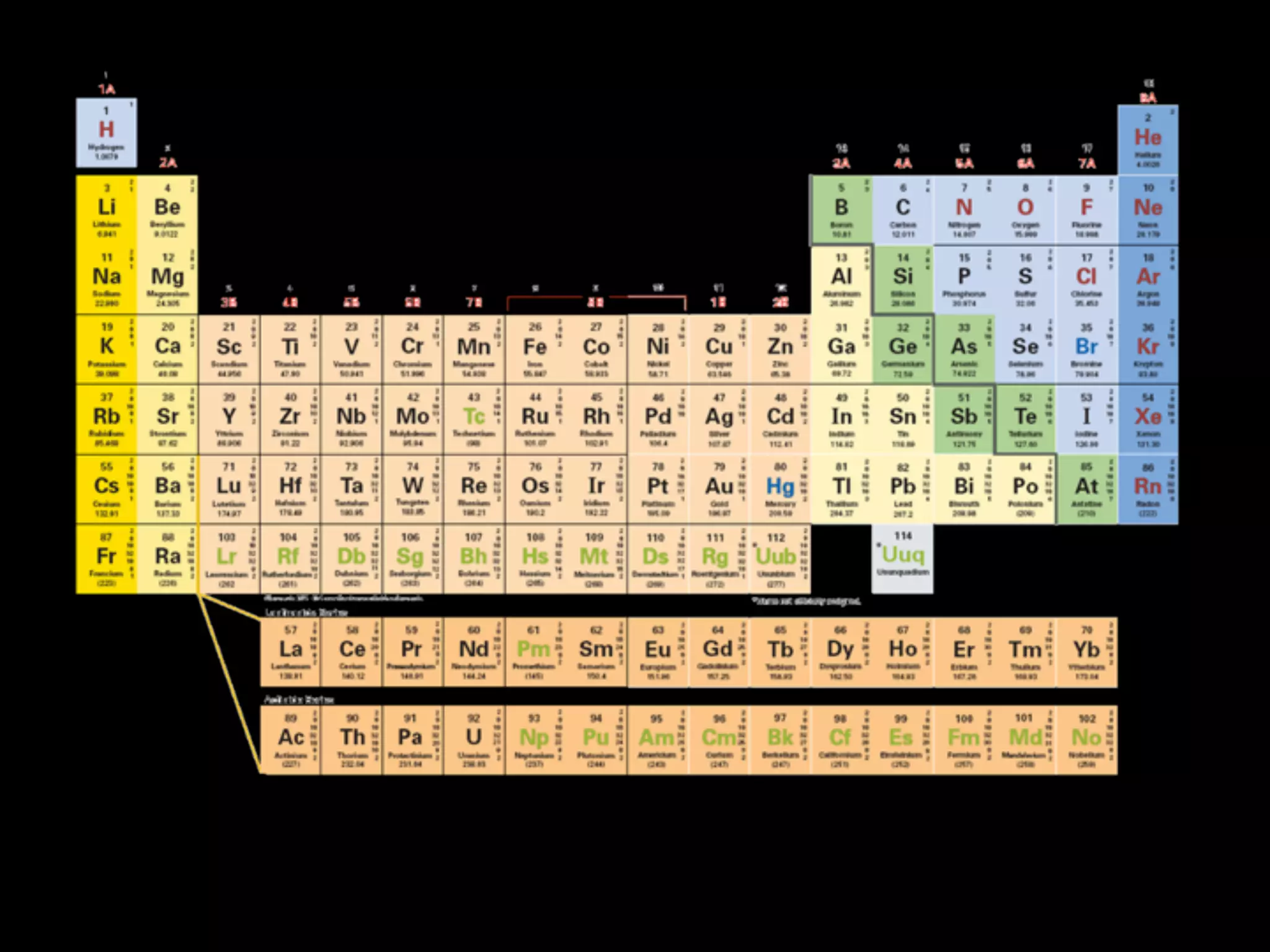
  • #23 In this periodic table, the colors of the boxes are used to classify representative elements and transition elements.
  • #25 In this periodic table, the colors of the boxes are used to classify representative elements and transition elements.
  • #26 In this periodic table, the colors of the boxes are used to classify representative elements and transition elements.
  • #27 In this periodic table, the colors of the boxes are used to classify representative elements and transition elements.
  • #28 This blimp contains helium, one of the noble gases. Applying Concepts What does the ability of a helium-filled blimp to rise in air tell you about the density of helium?
  • #30 Some of the representative elements exist in nature as elements. Others are found only in compounds.
  • #31 Some of the representative elements exist in nature as elements. Others are found only in compounds.
  • #32 Some of the representative elements exist in nature as elements. Others are found only in compounds.
  • #33 Some of the representative elements exist in nature as elements. Others are found only in compounds.