Periodic Table
Classification of elements in the Periodic Table
Sharifah Mona Abdul Aziz Abdullah
Abdul Al-Hafiz Ismail
Centre for Pre-University Studies
Universiti Malaysia Sarawak
This OpenCourseWare@UNIMAS and its related course materials are licensed under
a Creative Commons Attribution-NonCommercial-ShareAlike 4.0 International License.
Introduction
The periodic table shows all of the known elements
in order of increasing atomic number.
Horizontal row of periodic table is called period.
Periods are arranged horizontally across the
periodic table, labeled as rows 1 – 7.
These elements have the same number of valence
shells.
The periodic table is organized to group elements
with similar properties in vertical columns.
Groups are arranged vertically down the periodic
table, labeled as column 1 – 18.
These elements have the same number electrons in
the outer most shells, the valence shell.
Introduction
Elements can be grouped into 3 classes based
on their general properties:
Metal – shiny and conduct electricity
Non-metal – do not conduct electricity
Metalloids – semiconductors
Introduction
Periods and Groups
GROUP
PERIOD
Elements can be grouped into 3 classes based
on their general properties:
Metal – shiny and conduct electricity
Non-metal – do not conduct electricity
Metalloids – semiconductors
Introduction
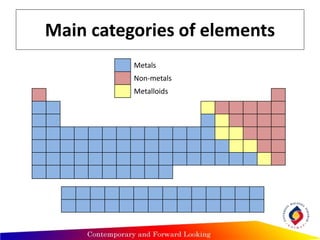
Main categories of elements
Metals
Non-metals
Metalloids
Classifying the Elements
Alkali Metals
They are in group 1 of periodic table
(except Hydrogen)
They are shiny, soft and can be cut with a knife
They have 1 valence electron
The most reactive metals (react violently with
water)
Reactivity increasing down the group
Never found as free elements in nature
Li
Na
K
Rb
Cs
Fr
Alkaline Earth Metal
They are in Group 2 of periodic table
They are less reactive than alkali metal
They are shiny and silvery-white in
colour
They have 2 valence electrons
Thay are never found uncombined in
nature.
Be
Mg
Ca
Sr
Ba
Ra
Transition Metals
They are in Group 3 to 12 of periodic table
Good conductors of heat and electricity
The compounds of transition metals are usually brightly coloured
Have variable oxidation number
Sc Ti V Cr Mn Fe Co Ni Cu Zn
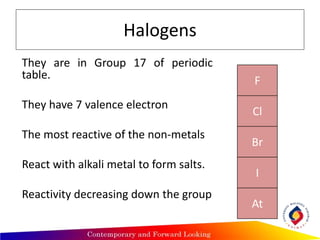
Halogens
They are in Group 17 of periodic
table.
They have 7 valence electron
The most reactive of the non-metals
React with alkali metal to form salts.
Reactivity decreasing down the group
F
Cl
Br
I
At
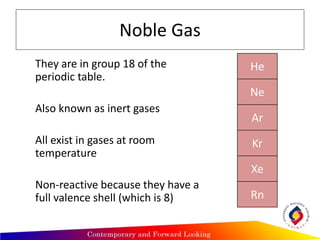
Noble Gas
They are in group 18 of the
periodic table.
Also known as inert gases
All exist in gases at room
temperature
Non-reactive because they have a
full valence shell (which is 8)
He
Ne
Ar
Kr
Xe
Rn

Classification of Elements

  • 1.
    Periodic Table Classification ofelements in the Periodic Table Sharifah Mona Abdul Aziz Abdullah Abdul Al-Hafiz Ismail Centre for Pre-University Studies Universiti Malaysia Sarawak This OpenCourseWare@UNIMAS and its related course materials are licensed under a Creative Commons Attribution-NonCommercial-ShareAlike 4.0 International License.
  • 2.
    Introduction The periodic tableshows all of the known elements in order of increasing atomic number. Horizontal row of periodic table is called period. Periods are arranged horizontally across the periodic table, labeled as rows 1 – 7. These elements have the same number of valence shells.
  • 3.
    The periodic tableis organized to group elements with similar properties in vertical columns. Groups are arranged vertically down the periodic table, labeled as column 1 – 18. These elements have the same number electrons in the outer most shells, the valence shell. Introduction
  • 4.
    Elements can begrouped into 3 classes based on their general properties: Metal – shiny and conduct electricity Non-metal – do not conduct electricity Metalloids – semiconductors Introduction
  • 5.
  • 6.
    Elements can begrouped into 3 classes based on their general properties: Metal – shiny and conduct electricity Non-metal – do not conduct electricity Metalloids – semiconductors Introduction
  • 7.
    Main categories ofelements Metals Non-metals Metalloids
  • 8.
  • 9.
    Alkali Metals They arein group 1 of periodic table (except Hydrogen) They are shiny, soft and can be cut with a knife They have 1 valence electron The most reactive metals (react violently with water) Reactivity increasing down the group Never found as free elements in nature Li Na K Rb Cs Fr
  • 10.
    Alkaline Earth Metal Theyare in Group 2 of periodic table They are less reactive than alkali metal They are shiny and silvery-white in colour They have 2 valence electrons Thay are never found uncombined in nature. Be Mg Ca Sr Ba Ra
  • 11.
    Transition Metals They arein Group 3 to 12 of periodic table Good conductors of heat and electricity The compounds of transition metals are usually brightly coloured Have variable oxidation number Sc Ti V Cr Mn Fe Co Ni Cu Zn
  • 12.
    Halogens They are inGroup 17 of periodic table. They have 7 valence electron The most reactive of the non-metals React with alkali metal to form salts. Reactivity decreasing down the group F Cl Br I At
  • 13.
    Noble Gas They arein group 18 of the periodic table. Also known as inert gases All exist in gases at room temperature Non-reactive because they have a full valence shell (which is 8) He Ne Ar Kr Xe Rn