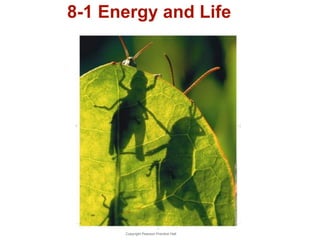
8-1 Energy and Life 
Copyright Pearson Prentice Hall
Living things need energy to survive. 
This energy comes from food. The energy 
in most food comes from the sun. 
Copyright Pearson Prentice Hall
Plants are able to use light 
energy from the sun to 
produce food.
autotrophs –Organisms that make their 
own food, such as plants. 
heterotrophs must get energy from the 
foods they consume. Ex. Animals 
I can 
make my 
own 
food!! 
Copyright Pearson Prentice Hall 
I will 
eat 
you!!
Chemical Energy and ATP 
Energy comes in many forms including light, 
heat, and electricity. 
Energy can be stored in chemical 
compounds, too. 
Copyright Pearson Prentice Hall
Chemical Energy and ATP 
An important chemical compound that cells use to 
store and release energy is adenosine 
triphosphate, abbreviated ATP. 
Adenosine triphosphate or ATP is 
used by all types of cells as their 
basic energy source. 
ATP 
Movie
ATP consists of: 
•adenine 
•ribose (a 5-carbon sugar) 
•3 phosphate groups 
Adenine 
ATP 
Ribose 3 Phosphate groups
Chemical Energy and ATP 
The three phosphate groups are the key to 
ATP's ability to store and release energy.
Storing Energy 
ADP has two phosphate groups 
instead of three. 
A cell can store small amounts of energy by 
adding a phosphate group to ADP. 
ADP ATP 
Energy 
Energy 
Copyright Pearson Prentice Hall 
Partially 
charged 
battery 
Fully 
charged 
battery 
+ 
Adenosine Diphosphate 
(ADP) + Phosphate 
Adenosine Triphosphate (ATP)
Chemical Energy and ATP 
Releasing Energy 
Energy stored in ATP is released 
by breaking off the third 
phosphate. 
Copyright Pearson Prentice Hall 
P 
ADP 
2 Phosphate groups
Chemical Energy and ATP 
The energy from ATP is needed for many 
cellular activities, including active transport 
across cell membranes, protein synthesis 
and muscle contraction. 
ATP’s characteristics make it 
exceptionally useful as the basic 
energy source of all cells. 
Copyright Pearson Prentice Hall
Using Biochemical Energy 
Most cells have only a small amount of ATP, 
because it is not a good way to store large 
amounts of energy. 
Cells can regenerate ATP from ADP as 
needed by using the energy in foods like 
glucose. 
Copyright Pearson Prentice Hall
Copyright Pearson Prentice Hall 
8-1 
Organisms that make their own food are called 
a. autotrophs. 
b. heterotrophs. 
c. decomposers. 
d. consumers.
Copyright Pearson Prentice Hall 
8-1 
Most autotrophs obtain their energy from 
a. chemicals in the environment. 
b. sunlight. 
c. carbon dioxide in the air. 
d. other producers.
Copyright Pearson Prentice Hall 
8-1 
How is energy released from ATP? 
a. A phosphate is added. 
b. An adenine is added. 
c. A phosphate is removed. 
d. A ribose is removed.
Copyright Pearson Prentice Hall 
8-1 
How is it possible for most cells to function 
with only a small amount of ATP? 
a. Cells do not require ATP for 
energy. 
b. ATP can be quickly regenerated from 
ADP and P. 
c. Cells use very small amounts of 
energy. 
d. ATP stores large amounts of energy.
Copyright Pearson Prentice Hall 
8-1 
Compared to the energy stored in a molecule of 
glucose, ATP stores 
a. much more energy. 
b. much less energy. 
c. about the same amount of energy. 
d. more energy sometimes and less at 
others.
8-2 Photosynthesis: An 
Copyright Pearson Prentice Hall 
Overview
Copyright Pearson Prentice Hall 
Photosy 
nthesis: 
An 
Overvie 
w 
The key cellular process identified with energy 
production is photosynthesis. 
Photosynthesis is the process 
in which green plants use the 
energy of sunlight to convert 
water and carbon dioxide 
into sugar and oxygen.
Investigating Photosynthesis 
Research into photosynthesis began centuries ago. 
Van Helmont’s Experiment 
a. In the 1600s, Jan van Helmont wanted to find out 
if plants grew by taking material out of the soil. 
b. He determined the mass of a pot of dry soil and 
a small seedling, planted the seedling in the pot, 
and watered it regularly. 
c. After five years, the seedling was a small tree 
and had gained 75 kg, but the soil’s mass was 
almost unchanged.
Copyright Pearson Prentice Hall 
igatin 
g 
Photo 
synth 
a.Van Helmont concluded that 
the gain in a plants’ mass 
comes from water because water 
was the only thing he had added. 
b. His experiment accounts for the “hydrate,” or 
water, portion of the carbohydrate produced 
by photosynthesis.
Copyright Pearson Prentice Hall 
igatin 
g 
Photo 
synth a. Although van Helmont did not realize it, 
carbon dioxide in the air also made a 
major contribution to the mass of his 
tree. 
b. In photosynthesis, the carbon in carbon 
dioxide is used to make sugars and 
other carbohydrates. 
c. Van Helmont had only part of the story, 
but he had made a major contribution 
to science.
Joseph Priestley discovered oxygen 
and that plants release it. 
More than 100 years after van Helmont’s 
experiment-- 
a. Priestley took a candle, placed a glass jar over 
it, and watched as the flame gradually died 
out. 
b. He reasoned that the flame needed something 
in the air to keep burning and when it was 
used up, the flame went out. That substance 
was oxygen. 
Copyright Pearson Prentice Hall
a. Priestley then placed a live sprig of mint 
under the jar and allowed a few days to pass. 
b. He found that the candle could be relighted 
and would remain lighted for a while. 
c. The mint plant had produced the substance 
required for burning. In other words, it had 
released oxygen. 
Copyright Pearson Prentice Hall
Jan Ingenhousz 
a.Later, Jan Ingenhousz 
showed that the effect observed by 
Priestley occurred only when the plant 
was exposed to light. 
b. The results of both Priestley’s and 
Ingenhousz’s experiments showed that 
light is necessary for plants 
to produce oxygen. 
Copyright Pearson Prentice Hall
Copyright Pearson Prentice Hall 
igatin 
g 
Photo 
synth 
The experiments performed by van 
Helmont, Priestley, and Ingenhousz led to 
work by other scientists who finally 
discovered that, in the presence of light, 
plants transform carbon dioxide and water 
into carbohydrates, and they also release 
oxygen.
The equation for photosynthesis is 
6CO2 + 6H2O Light 
C6H12O6 + 6O2 
carbon water sugars oxygen 
dioxide 
Photosynthesis uses the energy of sunlight 
to convert water and carbon dioxide into 
high-energy sugars and oxygen. 
Photosynthesis 
activity
Light energy 
Copyright Pearson Prentice Hall 
O2 
CO2 
+ 
H20 
ADP 
NADP+ 
Sugar 
Light- 
Dependent 
Reactions 
(thylakoids) 
H2O 
ATP 
NADPH 
Calvin 
Cycle 
(stroma)
Copyright Pearson Prentice Hall 
Light 
and 
Pigme 
nts 
In addition to water and carbon 
dioxide, photosynthesis 
requires light and chlorophyll.
Plants gather the sun's energy 
with light-absorbing molecules 
called pigments. 
The main light-absorbing pigment 
in plants is chlorophyll. 
There are two main types of chlorophyll: 
Copyright Pearson Prentice Hall 
chlorophyll a 
chlorophyll b
Chlorophyll absorbs light well in the blue-violet 
and red regions of the visible spectrum. 
Wavelength (nm) 
Copyright Pearson Prentice Hall 
100 
80 
60 
40 
20 
0 
400 450 500 550 600 650 700 750 
Wavelength (nm) 
Estimated Absorption (%)
Chlorophyll does not absorb light well in the green 
region of the spectrum. Green light is reflected 
by leaves, which is why plants look green. 
Wavelength (nm) 
Copyright Pearson Prentice Hall 
100 
80 
60 
40 
20 
0 
400 450 500 550 600 650 700 750 
Wavelength (nm) 
Estimated Absorption (%)
Light is a form of energy, so any compound 
that absorbs light also absorbs energy from 
that light. 
When chlorophyll absorbs light, much of the 
energy is transferred directly to electrons in 
the chlorophyll molecule, raising the energy 
levels of these electrons. 
These high-energy electrons are what make 
photosynthesis work. 
Copyright Pearson Prentice Hall
Copyright Pearson Prentice Hall 
8-2 
In van Helmont's experiment, most of the added 
mass of the tree came from 
a. soil and carbon dioxide. 
b. water and carbon dioxide. 
c. oxygen and carbon dioxide. 
d. soil and oxygen.
Copyright Pearson Prentice Hall 
8-2 
Plants use the sugars produced in 
photosynthesis to make 
a. oxygen. 
b. starches. 
c. carbon dioxide. 
d. protein.
Copyright Pearson Prentice Hall 
8-2 
The raw materials required for plants to carry out 
photosynthesis are 
a. carbon dioxide and oxygen. 
b. oxygen and sugars. 
c. carbon dioxide and water. 
d. oxygen and water.
Copyright Pearson Prentice Hall 
8-2 
The principal pigment in plants is 
a. chloroplast. 
b. chlorophyll. 
c. carotene. 
d. carbohydrate.
Copyright Pearson Prentice Hall 
8-2 
The colors of light that are absorbed by 
chlorophylls are 
a. green and yellow. 
b. green, blue, and violet. 
c. blue, violet, and red. 
d. red and yellow.
8-3 The Reactions of 
Photosynthesis 
Copyright Pearson Prentice Hall
Inside a Chloroplast 
In plants, photosynthesis takes 
place inside chloroplasts. 
Plant 
Plant cells 
Copyright Pearson Prentice Hall 
Chloroplast 
Chloroplast 
movie
Chloroplasts contain thylakoids— 
saclike photosynthetic membranes. 
Copyright Pearson Prentice Hall 
Chloroplast 
Single 
thylakoid
Copyright Pearson Prentice Hall 
Inside 
a 
Chlor 
opTlahstylakoids are arranged in stacks known as 
grana. A singular stack is called a granum. 
Granum 
Chloroplast
Proteins in the thylakoid membrane organize 
chlorophyll and other pigments into 
clusters called photosystems, which are 
the light-collecting units of the chloroplast. 
Copyright Pearson Prentice Hall 
Chloroplast 
Photosystems
The long chain of photosynthesis reactions is 
divided into two parts 
The light-dependent reactions take 
place within the thylakoid 
membranes. 
The Calvin cycle takes 
place in the stroma, 
which is the region outside the 
thylakoid membranes. 
Copyright Pearson Prentice Hall
Light 
Chloroplast 
H2O 
O2 
Copyright PHOTOSYNTHESIS Pearson Prentice Hall 
CO2 
Sugars 
NADP+ 
ADP + P 
Light-dependent 
reactions 
Calvin 
cycle
Copyright Pearson Prentice Hall 
Electr 
on 
Carrie 
rs 
When electrons in chlorophyll absorb sunlight, 
the electrons gain a great deal of energy. 
Cells use electron carriers to transport these 
high-energy electrons from chlorophyll to 
other molecules.
Copyright Pearson Prentice Hall 
Electr 
on 
Carrie 
rs 
One carrier molecule is NADP+. 
Electron carriers, such as NADP+, 
transport electrons. 
NADP+ accepts and holds 2 high-energy 
electrons along with a hydrogen ion (H 
+). This converts the NADP+ into 
NADPH.
Copyright Pearson Prentice Hall 
Electr 
on 
Carrie 
rs 
The conversion of NADP+ into NADPH is one 
way some of the energy of sunlight can be 
trapped in chemical form. 
The NADPH carries high-energy electrons to 
chemical reactions elsewhere in the cell. 
These high-energy electrons are used to help 
build a variety of molecules the cell needs, 
including carbohydrates like glucose.
The light-dependent reactions require light. 
The light-dependent reactions 
produce oxygen gas and 
convert ADP and NADP+ 
into the energy carriers 
ATP and NADPH. 
Copyright Pearson Prentice Hall 
Light-dependent 
movie
Copyright Pearson Prentice Hall 
Depen 
dent 
Reacti 
ons 
Photosystems I and II carry out the 
light-dependent reactions and are 
in the thylakoid membrane.
Depen 
dent 
Reacti 
ons Photosynthesis begins when pigments in 
Copyright Pearson Prentice Hall 
Photosystem 
II 
photosystem II absorb light, increasing 
their energy level.
These high-energy electrons are passed 
on to the electron transport chain. 
Photosystem 
II 
Electron 
carriers 
High-energy 
electron
Enzymes on the thylakoid membrane 
break water molecules into: 
Copyright Pearson Prentice Hall 
Photosystem 
II 
2H2O 
Electron 
carriers 
High-energy 
electron
hydrogen ions 
oxygen atoms 
energized electrons 
Copyright Pearson Prentice Hall 
Photosystem 
II 
2H2O 
+ O2 
Electron 
carriers 
High-energy 
electron
The energized electrons from water replace 
the high-energy electrons that chlorophyll 
lost to the electron transport chain. 
Copyright Pearson Prentice Hall 
Photosystem 
II 
2H2O 
+ O2 
High-energy 
electron
As plants remove electrons from water, oxygen 
is left behind and is released into the air. 
Copyright Pearson Prentice Hall 
Photosystem 
II 
2H2O 
+ O2 
High-energy 
electron
The hydrogen ions left behind when water is 
broken apart are released inside the 
thylakoid membrane. 
Copyright Pearson Prentice Hall 
Photosystem 
II 
2H2O 
+ O2 
High-energy 
electron
Energy from the electrons is used to 
transport H+ ions from the stroma into the 
inner thylakoid space. 
Copyright Pearson Prentice Hall 
Photosystem 
II 
2H2O 
+ O2
High-energy electrons move through the 
electron transport chain from photosystem II 
to photosystem I. 
Copyright Pearson Prentice Hall 
Photosystem 
II 
2H2O 
+ O2 
Photosystem I
Pigments in photosystem I use energy 
from light to re-energize the electrons. 
Copyright Pearson Prentice Hall 
2H2O 
+ O2 
Photosystem I
NADP+ then picks up these high-energy 
electrons, along with H+ ions, and becomes 
NADPH. 
Copyright Pearson Prentice Hall 
2H2O 
+ O2 
2 NADP+ 
2 
2 NADPH
As electrons are passed from chlorophyll 
to NADP+, more H+ ions are pumped 
across the membrane. 
Copyright Pearson Prentice Hall 
2H2O 
+ O2 
2 NADP+ 
2 
2 NADPH
Soon, the inside of the membrane fills up 
with positively charged hydrogen ions, 
which makes the outside of the membrane 
negatively charged. 
Copyright Pearson Prentice Hall 
2H2O 
+ O2 
2 NADP+ 
2 
2 NADPH
The difference in charges across the 
membrane provides the energy to make ATP 
Copyright Pearson Prentice Hall 
2H2O 
+ O2 
2 NADP+ 
2 
2 NADPH
H+ ions cannot cross the membrane directly. 
Copyright Pearson Prentice Hall 
2H2O 
+ O2 
ATP synthase 
2 NADP+ 
2 
2 NADPH
The cell membrane contains a protein called 
ATP synthase that allows H+ ions to pass 
through it 
Copyright Pearson Prentice Hall 
2H2O 
+ O2 
ATP synthase 
2 NADP+ 
2 
2 NADPH
As H+ ions pass through ATP synthase, the 
protein rotates. 
Copyright Pearson Prentice Hall 
2H2O 
+ O2 
ATP synthase 
2 NADP+ 
2 
2 NADPH
As it rotates, ATP synthase binds ADP and a 
phosphate group together to produce ATP. 
Copyright Pearson Prentice Hall 
2H2O 
+ O2 
2 NADP+ 
2 
ATP synthase 
ADP 
2 NADPH
Because of this system, light-dependent 
electron transport produces not only high-energy 
Copyright Pearson Prentice Hall 
2H2O 
electrons but ATP as well. 
+ O2 
ATP synthase 
2 NADP+ ADP 
2 
2 NADPH
The light-dependent reactions use water, 
ADP, and NADP+. 
The light-dependent reactions produce 
oxygen, ATP, and NADPH. 
These compounds provide the energy to 
build energy-containing sugars from low-energy 
compounds. 
Copyright Pearson Prentice Hall
The Calvin Cycle 
ATP and NADPH formed by the light-dependent 
reactions contain an abundance 
of chemical energy, but they are not stable 
enough to store that energy for more than a 
few minutes. 
During the Calvin cycle plants use the energy 
that ATP and NADPH contain to build high-energy 
compounds that can be stored for a 
Copyright Pearson Prentice Hall 
long time.
The Calvin cycle uses ATP and 
NADPH from the light-dependent 
reactions to 
produce high-energy sugars. 
Because the Calvin cycle does not require 
light, these reactions are also called 
the light-independent 
reactions. 
Copyright Pearson Prentice Hall 
Calvin Cycle 
Movie
Six carbon dioxide molecules enter the cycle from 
the atmosphere and combine with six 5-carbon 
molecules. 
Copyright Pearson Prentice Hall 
CO2 Enters 
the Cycle
The result is twelve 3-carbon molecules, which 
are then converted into higher-energy forms. 
Copyright Pearson Prentice Hall
The energy for this conversion comes from 
ATP and high-energy electrons from NADPH. 
Copyright Pearson Prentice Hall 
Energy Input 
12 
12 ADP 
12 NADPH 
12 NADP+
Two of twelve 3-carbon molecules are 
removed from the cycle. 
Copyright Pearson Prentice Hall 
Energy Input 
12 
12 ADP 
12 NADPH 
12 NADP+
Copyright Pearson Prentice Hall 
The Calvin Cycle 
The molecules are used to produce sugars, 
lipids, amino acids and other compounds. 
12 
12 ADP 
6-Carbon sugar 
produced 
Sugars and other compounds 
12 NADPH 
12 NADP+
The 10 remaining 3-carbon molecules are 
converted back into six 5-carbon molecules, 
which are used to begin the next cycle. 
Copyright Pearson Prentice Hall 
6 ADP 
5-Carbon Molecules 
Regenerated 
12 
12 ADP 
Sugars and other compounds 
6 
12 NADPH 
12 NADP+
The two sets of photosynthetic reactions 
work together. 
The light-dependent reactions trap 
sunlight energy in chemical form. 
The light-independent reactions use that 
chemical energy to produce 
stable, high-energy sugars from 
carbon dioxide and water. 
Copyright Pearson Prentice Hall
Many factors affect the rate of 
photosynthesis, including: 
• Water 
• Temperature 
• Intensity of light 
Copyright Pearson Prentice Hall 
Photosynthesis 
overview movie
Copyright Pearson Prentice Hall 
8-3 
In plants, photosynthesis takes place inside the 
a. thylakoids. 
b. chloroplasts. 
c. photosystems. 
d. chlorophyll.
Copyright Pearson Prentice Hall 
8-3 
Energy to make ATP in the chloroplast comes 
most directly from 
a. hydrogen ions flowing through an enzyme in 
the thylakoid membrane. 
b. transfer of a phosphate from ADP. 
c. electrons moving through the electron 
transport chain. 
d. electrons transferred directly from 
NADPH.
Copyright Pearson Prentice Hall 
8-3 
NADPH is produced in light-dependent reactions 
and carries energy in the form of 
a. ATP. 
b. high-energy electrons. 
c. low-energy electrons. 
d. ADP.
Copyright Pearson Prentice Hall 
8-3 
What is another name for the Calvin cycle? 
a. light-dependent reactions 
b. light-independent reactions 
c. electron transport chain 
d. photosynthesis
Copyright Pearson Prentice Hall 
8-3 
Which of the following factors does NOT directly 
affect photosynthesis? 
a. wind 
b. water supply 
c. temperature 
d. light intensity

Chapter Eight- Photosynthesis

  • 1.
    8-1 Energy andLife Copyright Pearson Prentice Hall
  • 2.
    Living things needenergy to survive. This energy comes from food. The energy in most food comes from the sun. Copyright Pearson Prentice Hall
  • 3.
    Plants are ableto use light energy from the sun to produce food.
  • 4.
    autotrophs –Organisms thatmake their own food, such as plants. heterotrophs must get energy from the foods they consume. Ex. Animals I can make my own food!! Copyright Pearson Prentice Hall I will eat you!!
  • 5.
    Chemical Energy andATP Energy comes in many forms including light, heat, and electricity. Energy can be stored in chemical compounds, too. Copyright Pearson Prentice Hall
  • 6.
    Chemical Energy andATP An important chemical compound that cells use to store and release energy is adenosine triphosphate, abbreviated ATP. Adenosine triphosphate or ATP is used by all types of cells as their basic energy source. ATP Movie
  • 7.
    ATP consists of: •adenine •ribose (a 5-carbon sugar) •3 phosphate groups Adenine ATP Ribose 3 Phosphate groups
  • 8.
    Chemical Energy andATP The three phosphate groups are the key to ATP's ability to store and release energy.
  • 9.
    Storing Energy ADPhas two phosphate groups instead of three. A cell can store small amounts of energy by adding a phosphate group to ADP. ADP ATP Energy Energy Copyright Pearson Prentice Hall Partially charged battery Fully charged battery + Adenosine Diphosphate (ADP) + Phosphate Adenosine Triphosphate (ATP)
  • 10.
    Chemical Energy andATP Releasing Energy Energy stored in ATP is released by breaking off the third phosphate. Copyright Pearson Prentice Hall P ADP 2 Phosphate groups
  • 11.
    Chemical Energy andATP The energy from ATP is needed for many cellular activities, including active transport across cell membranes, protein synthesis and muscle contraction. ATP’s characteristics make it exceptionally useful as the basic energy source of all cells. Copyright Pearson Prentice Hall
  • 12.
    Using Biochemical Energy Using Biochemical Energy Most cells have only a small amount of ATP, because it is not a good way to store large amounts of energy. Cells can regenerate ATP from ADP as needed by using the energy in foods like glucose. Copyright Pearson Prentice Hall
  • 13.
    Copyright Pearson PrenticeHall 8-1 Organisms that make their own food are called a. autotrophs. b. heterotrophs. c. decomposers. d. consumers.
  • 14.
    Copyright Pearson PrenticeHall 8-1 Most autotrophs obtain their energy from a. chemicals in the environment. b. sunlight. c. carbon dioxide in the air. d. other producers.
  • 15.
    Copyright Pearson PrenticeHall 8-1 How is energy released from ATP? a. A phosphate is added. b. An adenine is added. c. A phosphate is removed. d. A ribose is removed.
  • 16.
    Copyright Pearson PrenticeHall 8-1 How is it possible for most cells to function with only a small amount of ATP? a. Cells do not require ATP for energy. b. ATP can be quickly regenerated from ADP and P. c. Cells use very small amounts of energy. d. ATP stores large amounts of energy.
  • 17.
    Copyright Pearson PrenticeHall 8-1 Compared to the energy stored in a molecule of glucose, ATP stores a. much more energy. b. much less energy. c. about the same amount of energy. d. more energy sometimes and less at others.
  • 18.
    8-2 Photosynthesis: An Copyright Pearson Prentice Hall Overview
  • 19.
    Copyright Pearson PrenticeHall Photosy nthesis: An Overvie w The key cellular process identified with energy production is photosynthesis. Photosynthesis is the process in which green plants use the energy of sunlight to convert water and carbon dioxide into sugar and oxygen.
  • 20.
    Investigating Photosynthesis Researchinto photosynthesis began centuries ago. Van Helmont’s Experiment a. In the 1600s, Jan van Helmont wanted to find out if plants grew by taking material out of the soil. b. He determined the mass of a pot of dry soil and a small seedling, planted the seedling in the pot, and watered it regularly. c. After five years, the seedling was a small tree and had gained 75 kg, but the soil’s mass was almost unchanged.
  • 21.
    Copyright Pearson PrenticeHall igatin g Photo synth a.Van Helmont concluded that the gain in a plants’ mass comes from water because water was the only thing he had added. b. His experiment accounts for the “hydrate,” or water, portion of the carbohydrate produced by photosynthesis.
  • 22.
    Copyright Pearson PrenticeHall igatin g Photo synth a. Although van Helmont did not realize it, carbon dioxide in the air also made a major contribution to the mass of his tree. b. In photosynthesis, the carbon in carbon dioxide is used to make sugars and other carbohydrates. c. Van Helmont had only part of the story, but he had made a major contribution to science.
  • 23.
    Joseph Priestley discoveredoxygen and that plants release it. More than 100 years after van Helmont’s experiment-- a. Priestley took a candle, placed a glass jar over it, and watched as the flame gradually died out. b. He reasoned that the flame needed something in the air to keep burning and when it was used up, the flame went out. That substance was oxygen. Copyright Pearson Prentice Hall
  • 24.
    a. Priestley thenplaced a live sprig of mint under the jar and allowed a few days to pass. b. He found that the candle could be relighted and would remain lighted for a while. c. The mint plant had produced the substance required for burning. In other words, it had released oxygen. Copyright Pearson Prentice Hall
  • 25.
    Jan Ingenhousz a.Later,Jan Ingenhousz showed that the effect observed by Priestley occurred only when the plant was exposed to light. b. The results of both Priestley’s and Ingenhousz’s experiments showed that light is necessary for plants to produce oxygen. Copyright Pearson Prentice Hall
  • 26.
    Copyright Pearson PrenticeHall igatin g Photo synth The experiments performed by van Helmont, Priestley, and Ingenhousz led to work by other scientists who finally discovered that, in the presence of light, plants transform carbon dioxide and water into carbohydrates, and they also release oxygen.
  • 27.
    The equation forphotosynthesis is 6CO2 + 6H2O Light C6H12O6 + 6O2 carbon water sugars oxygen dioxide Photosynthesis uses the energy of sunlight to convert water and carbon dioxide into high-energy sugars and oxygen. Photosynthesis activity
  • 28.
    Light energy CopyrightPearson Prentice Hall O2 CO2 + H20 ADP NADP+ Sugar Light- Dependent Reactions (thylakoids) H2O ATP NADPH Calvin Cycle (stroma)
  • 29.
    Copyright Pearson PrenticeHall Light and Pigme nts In addition to water and carbon dioxide, photosynthesis requires light and chlorophyll.
  • 30.
    Plants gather thesun's energy with light-absorbing molecules called pigments. The main light-absorbing pigment in plants is chlorophyll. There are two main types of chlorophyll: Copyright Pearson Prentice Hall chlorophyll a chlorophyll b
  • 31.
    Chlorophyll absorbs lightwell in the blue-violet and red regions of the visible spectrum. Wavelength (nm) Copyright Pearson Prentice Hall 100 80 60 40 20 0 400 450 500 550 600 650 700 750 Wavelength (nm) Estimated Absorption (%)
  • 32.
    Chlorophyll does notabsorb light well in the green region of the spectrum. Green light is reflected by leaves, which is why plants look green. Wavelength (nm) Copyright Pearson Prentice Hall 100 80 60 40 20 0 400 450 500 550 600 650 700 750 Wavelength (nm) Estimated Absorption (%)
  • 33.
    Light is aform of energy, so any compound that absorbs light also absorbs energy from that light. When chlorophyll absorbs light, much of the energy is transferred directly to electrons in the chlorophyll molecule, raising the energy levels of these electrons. These high-energy electrons are what make photosynthesis work. Copyright Pearson Prentice Hall
  • 34.
    Copyright Pearson PrenticeHall 8-2 In van Helmont's experiment, most of the added mass of the tree came from a. soil and carbon dioxide. b. water and carbon dioxide. c. oxygen and carbon dioxide. d. soil and oxygen.
  • 35.
    Copyright Pearson PrenticeHall 8-2 Plants use the sugars produced in photosynthesis to make a. oxygen. b. starches. c. carbon dioxide. d. protein.
  • 36.
    Copyright Pearson PrenticeHall 8-2 The raw materials required for plants to carry out photosynthesis are a. carbon dioxide and oxygen. b. oxygen and sugars. c. carbon dioxide and water. d. oxygen and water.
  • 37.
    Copyright Pearson PrenticeHall 8-2 The principal pigment in plants is a. chloroplast. b. chlorophyll. c. carotene. d. carbohydrate.
  • 38.
    Copyright Pearson PrenticeHall 8-2 The colors of light that are absorbed by chlorophylls are a. green and yellow. b. green, blue, and violet. c. blue, violet, and red. d. red and yellow.
  • 39.
    8-3 The Reactionsof Photosynthesis Copyright Pearson Prentice Hall
  • 40.
    Inside a Chloroplast In plants, photosynthesis takes place inside chloroplasts. Plant Plant cells Copyright Pearson Prentice Hall Chloroplast Chloroplast movie
  • 41.
    Chloroplasts contain thylakoids— saclike photosynthetic membranes. Copyright Pearson Prentice Hall Chloroplast Single thylakoid
  • 42.
    Copyright Pearson PrenticeHall Inside a Chlor opTlahstylakoids are arranged in stacks known as grana. A singular stack is called a granum. Granum Chloroplast
  • 43.
    Proteins in thethylakoid membrane organize chlorophyll and other pigments into clusters called photosystems, which are the light-collecting units of the chloroplast. Copyright Pearson Prentice Hall Chloroplast Photosystems
  • 44.
    The long chainof photosynthesis reactions is divided into two parts The light-dependent reactions take place within the thylakoid membranes. The Calvin cycle takes place in the stroma, which is the region outside the thylakoid membranes. Copyright Pearson Prentice Hall
  • 45.
    Light Chloroplast H2O O2 Copyright PHOTOSYNTHESIS Pearson Prentice Hall CO2 Sugars NADP+ ADP + P Light-dependent reactions Calvin cycle
  • 46.
    Copyright Pearson PrenticeHall Electr on Carrie rs When electrons in chlorophyll absorb sunlight, the electrons gain a great deal of energy. Cells use electron carriers to transport these high-energy electrons from chlorophyll to other molecules.
  • 47.
    Copyright Pearson PrenticeHall Electr on Carrie rs One carrier molecule is NADP+. Electron carriers, such as NADP+, transport electrons. NADP+ accepts and holds 2 high-energy electrons along with a hydrogen ion (H +). This converts the NADP+ into NADPH.
  • 48.
    Copyright Pearson PrenticeHall Electr on Carrie rs The conversion of NADP+ into NADPH is one way some of the energy of sunlight can be trapped in chemical form. The NADPH carries high-energy electrons to chemical reactions elsewhere in the cell. These high-energy electrons are used to help build a variety of molecules the cell needs, including carbohydrates like glucose.
  • 49.
    The light-dependent reactionsrequire light. The light-dependent reactions produce oxygen gas and convert ADP and NADP+ into the energy carriers ATP and NADPH. Copyright Pearson Prentice Hall Light-dependent movie
  • 50.
    Copyright Pearson PrenticeHall Depen dent Reacti ons Photosystems I and II carry out the light-dependent reactions and are in the thylakoid membrane.
  • 51.
    Depen dent Reacti ons Photosynthesis begins when pigments in Copyright Pearson Prentice Hall Photosystem II photosystem II absorb light, increasing their energy level.
  • 52.
    These high-energy electronsare passed on to the electron transport chain. Photosystem II Electron carriers High-energy electron
  • 53.
    Enzymes on thethylakoid membrane break water molecules into: Copyright Pearson Prentice Hall Photosystem II 2H2O Electron carriers High-energy electron
  • 54.
    hydrogen ions oxygenatoms energized electrons Copyright Pearson Prentice Hall Photosystem II 2H2O + O2 Electron carriers High-energy electron
  • 55.
    The energized electronsfrom water replace the high-energy electrons that chlorophyll lost to the electron transport chain. Copyright Pearson Prentice Hall Photosystem II 2H2O + O2 High-energy electron
  • 56.
    As plants removeelectrons from water, oxygen is left behind and is released into the air. Copyright Pearson Prentice Hall Photosystem II 2H2O + O2 High-energy electron
  • 57.
    The hydrogen ionsleft behind when water is broken apart are released inside the thylakoid membrane. Copyright Pearson Prentice Hall Photosystem II 2H2O + O2 High-energy electron
  • 58.
    Energy from theelectrons is used to transport H+ ions from the stroma into the inner thylakoid space. Copyright Pearson Prentice Hall Photosystem II 2H2O + O2
  • 59.
    High-energy electrons movethrough the electron transport chain from photosystem II to photosystem I. Copyright Pearson Prentice Hall Photosystem II 2H2O + O2 Photosystem I
  • 60.
    Pigments in photosystemI use energy from light to re-energize the electrons. Copyright Pearson Prentice Hall 2H2O + O2 Photosystem I
  • 61.
    NADP+ then picksup these high-energy electrons, along with H+ ions, and becomes NADPH. Copyright Pearson Prentice Hall 2H2O + O2 2 NADP+ 2 2 NADPH
  • 62.
    As electrons arepassed from chlorophyll to NADP+, more H+ ions are pumped across the membrane. Copyright Pearson Prentice Hall 2H2O + O2 2 NADP+ 2 2 NADPH
  • 63.
    Soon, the insideof the membrane fills up with positively charged hydrogen ions, which makes the outside of the membrane negatively charged. Copyright Pearson Prentice Hall 2H2O + O2 2 NADP+ 2 2 NADPH
  • 64.
    The difference incharges across the membrane provides the energy to make ATP Copyright Pearson Prentice Hall 2H2O + O2 2 NADP+ 2 2 NADPH
  • 65.
    H+ ions cannotcross the membrane directly. Copyright Pearson Prentice Hall 2H2O + O2 ATP synthase 2 NADP+ 2 2 NADPH
  • 66.
    The cell membranecontains a protein called ATP synthase that allows H+ ions to pass through it Copyright Pearson Prentice Hall 2H2O + O2 ATP synthase 2 NADP+ 2 2 NADPH
  • 67.
    As H+ ionspass through ATP synthase, the protein rotates. Copyright Pearson Prentice Hall 2H2O + O2 ATP synthase 2 NADP+ 2 2 NADPH
  • 68.
    As it rotates,ATP synthase binds ADP and a phosphate group together to produce ATP. Copyright Pearson Prentice Hall 2H2O + O2 2 NADP+ 2 ATP synthase ADP 2 NADPH
  • 69.
    Because of thissystem, light-dependent electron transport produces not only high-energy Copyright Pearson Prentice Hall 2H2O electrons but ATP as well. + O2 ATP synthase 2 NADP+ ADP 2 2 NADPH
  • 70.
    The light-dependent reactionsuse water, ADP, and NADP+. The light-dependent reactions produce oxygen, ATP, and NADPH. These compounds provide the energy to build energy-containing sugars from low-energy compounds. Copyright Pearson Prentice Hall
  • 71.
    The Calvin Cycle ATP and NADPH formed by the light-dependent reactions contain an abundance of chemical energy, but they are not stable enough to store that energy for more than a few minutes. During the Calvin cycle plants use the energy that ATP and NADPH contain to build high-energy compounds that can be stored for a Copyright Pearson Prentice Hall long time.
  • 72.
    The Calvin cycleuses ATP and NADPH from the light-dependent reactions to produce high-energy sugars. Because the Calvin cycle does not require light, these reactions are also called the light-independent reactions. Copyright Pearson Prentice Hall Calvin Cycle Movie
  • 73.
    Six carbon dioxidemolecules enter the cycle from the atmosphere and combine with six 5-carbon molecules. Copyright Pearson Prentice Hall CO2 Enters the Cycle
  • 74.
    The result istwelve 3-carbon molecules, which are then converted into higher-energy forms. Copyright Pearson Prentice Hall
  • 75.
    The energy forthis conversion comes from ATP and high-energy electrons from NADPH. Copyright Pearson Prentice Hall Energy Input 12 12 ADP 12 NADPH 12 NADP+
  • 76.
    Two of twelve3-carbon molecules are removed from the cycle. Copyright Pearson Prentice Hall Energy Input 12 12 ADP 12 NADPH 12 NADP+
  • 77.
    Copyright Pearson PrenticeHall The Calvin Cycle The molecules are used to produce sugars, lipids, amino acids and other compounds. 12 12 ADP 6-Carbon sugar produced Sugars and other compounds 12 NADPH 12 NADP+
  • 78.
    The 10 remaining3-carbon molecules are converted back into six 5-carbon molecules, which are used to begin the next cycle. Copyright Pearson Prentice Hall 6 ADP 5-Carbon Molecules Regenerated 12 12 ADP Sugars and other compounds 6 12 NADPH 12 NADP+
  • 79.
    The two setsof photosynthetic reactions work together. The light-dependent reactions trap sunlight energy in chemical form. The light-independent reactions use that chemical energy to produce stable, high-energy sugars from carbon dioxide and water. Copyright Pearson Prentice Hall
  • 80.
    Many factors affectthe rate of photosynthesis, including: • Water • Temperature • Intensity of light Copyright Pearson Prentice Hall Photosynthesis overview movie
  • 81.
    Copyright Pearson PrenticeHall 8-3 In plants, photosynthesis takes place inside the a. thylakoids. b. chloroplasts. c. photosystems. d. chlorophyll.
  • 82.
    Copyright Pearson PrenticeHall 8-3 Energy to make ATP in the chloroplast comes most directly from a. hydrogen ions flowing through an enzyme in the thylakoid membrane. b. transfer of a phosphate from ADP. c. electrons moving through the electron transport chain. d. electrons transferred directly from NADPH.
  • 83.
    Copyright Pearson PrenticeHall 8-3 NADPH is produced in light-dependent reactions and carries energy in the form of a. ATP. b. high-energy electrons. c. low-energy electrons. d. ADP.
  • 84.
    Copyright Pearson PrenticeHall 8-3 What is another name for the Calvin cycle? a. light-dependent reactions b. light-independent reactions c. electron transport chain d. photosynthesis
  • 85.
    Copyright Pearson PrenticeHall 8-3 Which of the following factors does NOT directly affect photosynthesis? a. wind b. water supply c. temperature d. light intensity