Quantitative Research Design
EDU 521: Research Methods in Education
By
Prabin Shakya, PhD Fellow
School of Education
Kathmandu University
8 April 2013
1
Organization of Presentation
• Meaning of research design
• Components of research design
• Meaning of quantitative research
• Characteristics of quantitative research
• Basic principles of quantitative research design
• Philosophical worldview of quantitative research
• Strategy of inquiry in quantitative research
• Research methods in quantitative research
• Types of quantitative research
• Review of Thesis
2
Meaning of Research Design
• Conceptual structure; blue print for the collection, measurement
and analysis of data (Kothari, 1999).
• Plan and procedure for conducting research that spans the
decisions from broad assumption to detailed methods of data
collection and analysis (Creswell, 2011).
• For me..whole package of assumptions (philosophical
worldviews), strategy of inquiry, date collection, data analysis
and interpretation of findings.
3
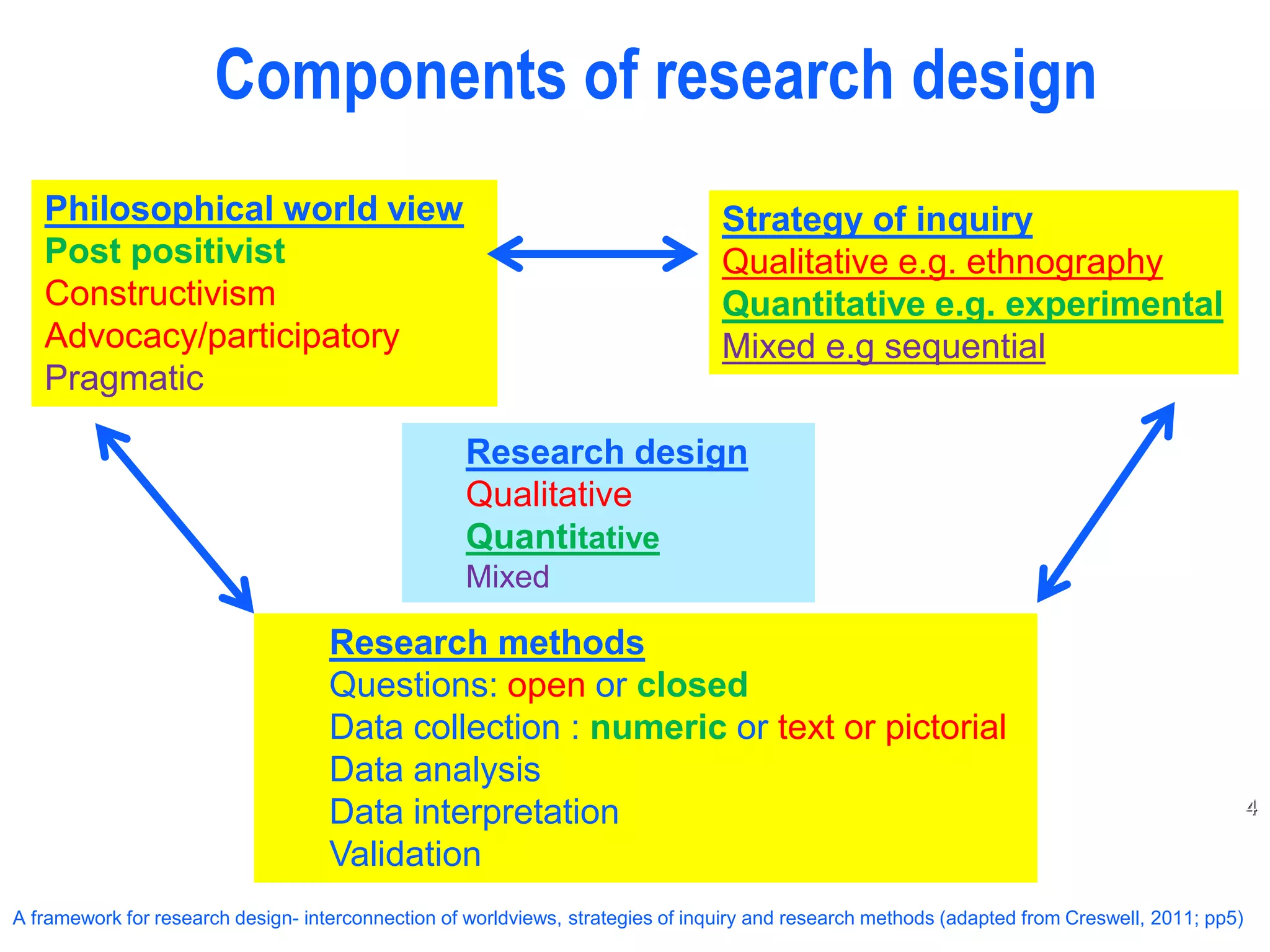
Components of research design
A framework for research design- interconnection of worldviews, strategies of inquiry and research methods (adapted from Creswell, 2011; pp5)
Research design
Qualitative
Quantitative
Mixed
Philosophical world view
Post positivist
Constructivism
Advocacy/participatory
Pragmatic
Strategy of inquiry
Qualitative e.g. ethnography
Quantitative e.g. experimental
Mixed e.g sequential
Research methods
Questions: open or closed
Data collection : numeric or text or pictorial
Data analysis
Data interpretation
Validation
4
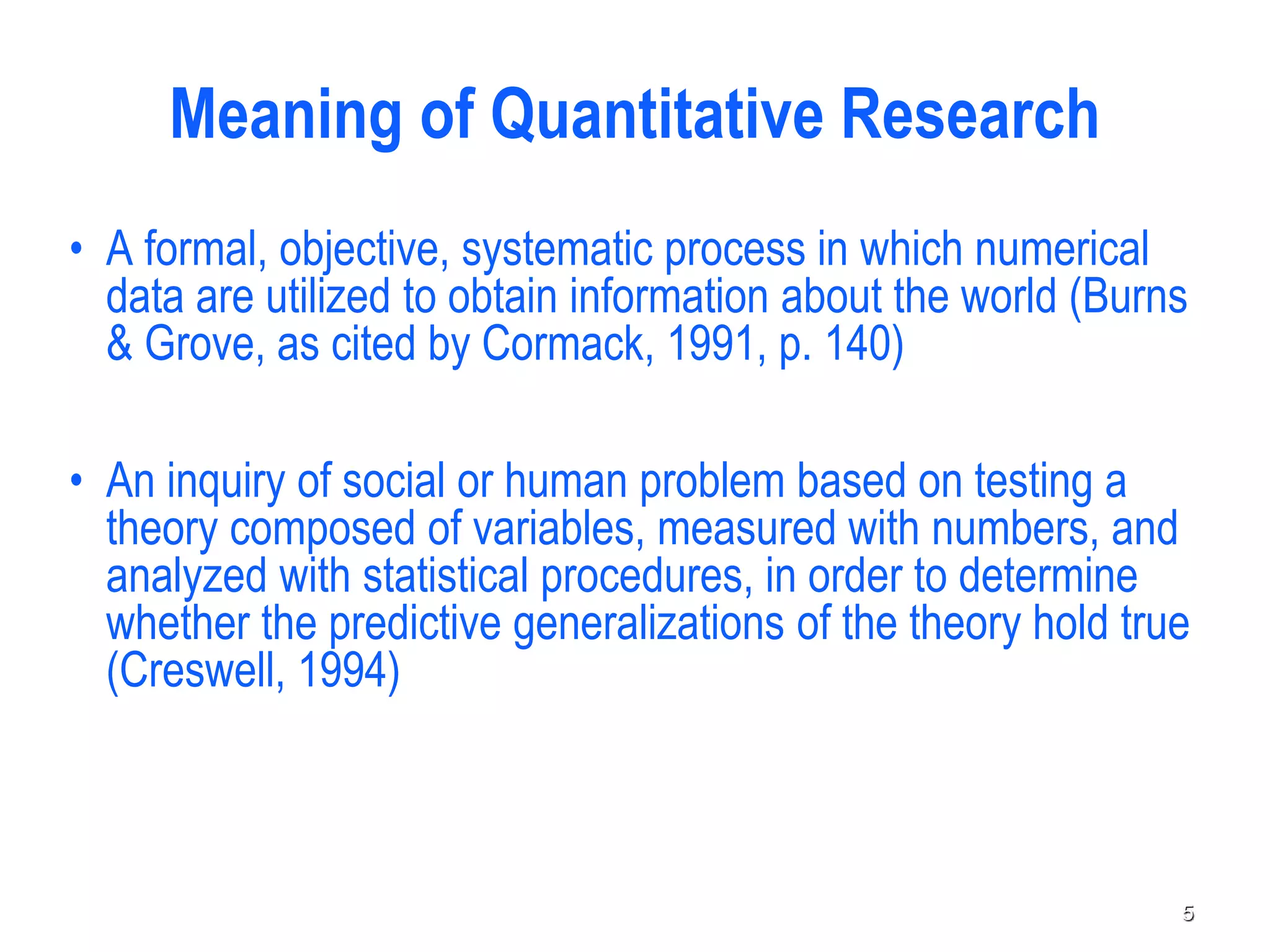
Meaning of Quantitative Research
• A formal, objective, systematic process in which numerical
data are utilized to obtain information about the world (Burns
& Grove, as cited by Cormack, 1991, p. 140)
• An inquiry of social or human problem based on testing a
theory composed of variables, measured with numbers, and
analyzed with statistical procedures, in order to determine
whether the predictive generalizations of the theory hold true
(Creswell, 1994)
5
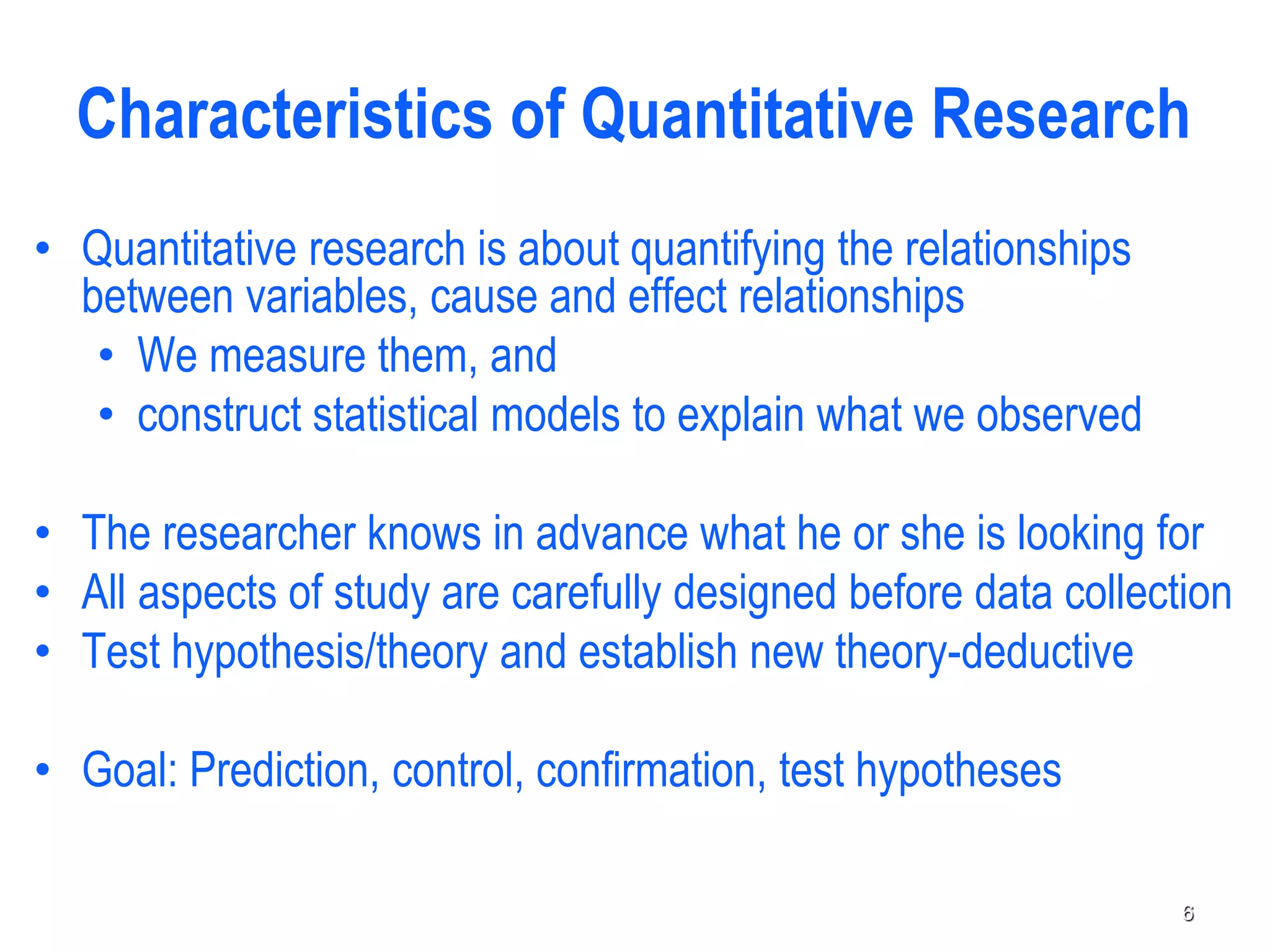
Characteristics of Quantitative Research
• Quantitative research is about quantifying the relationships
between variables, cause and effect relationships
• We measure them, and
• construct statistical models to explain what we observed
• The researcher knows in advance what he or she is looking for
• All aspects of study are carefully designed before data collection
• Test hypothesis/theory and establish new theory-deductive
• Goal: Prediction, control, confirmation, test hypotheses
6
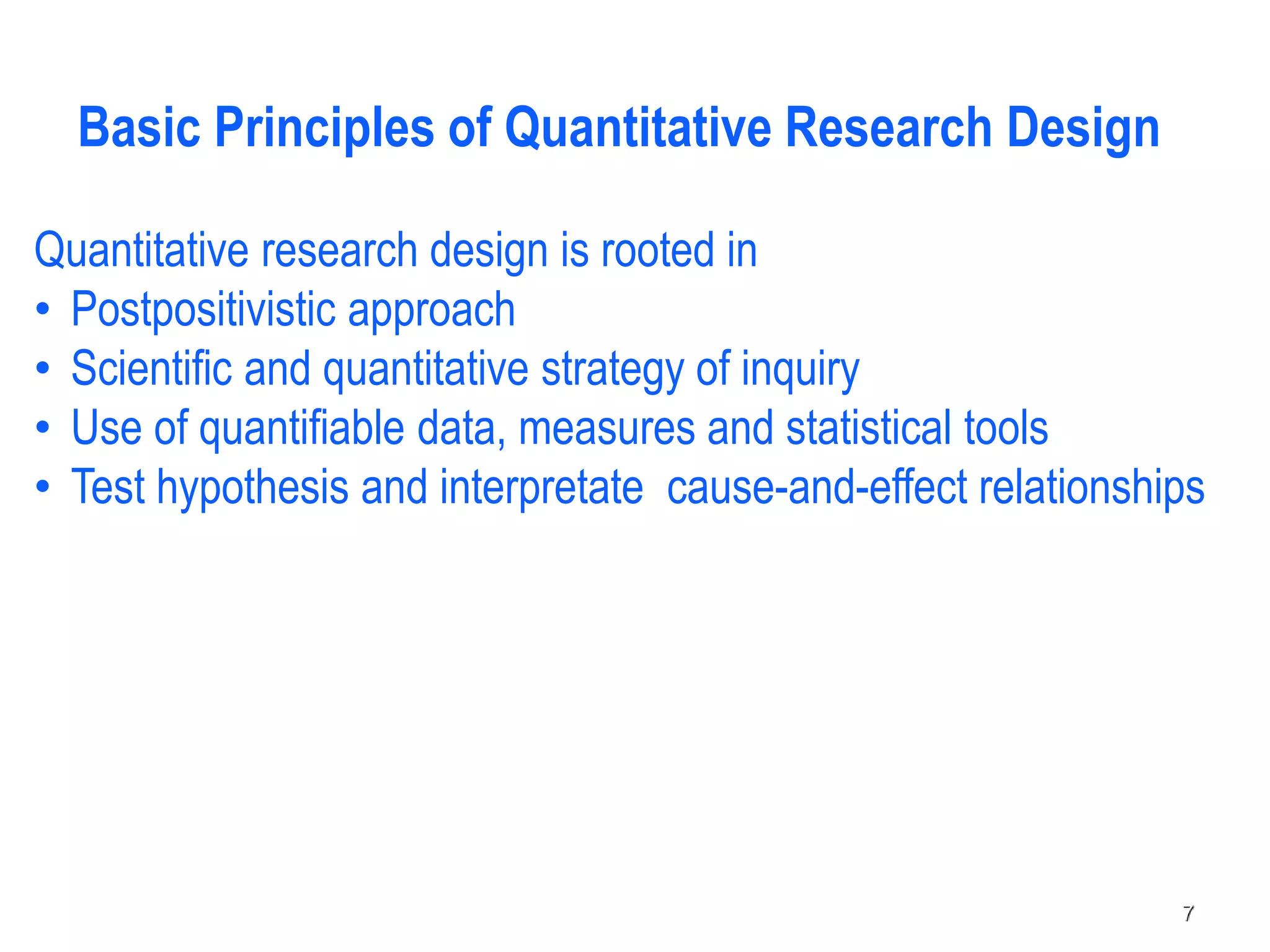
Quantitative research design is rooted in
• Postpositivistic approach
• Scientific and quantitative strategy of inquiry
• Use of quantifiable data, measures and statistical tools
• Test hypothesis and interpretate cause-and-effect relationships
Basic Principles of Quantitative Research Design
7
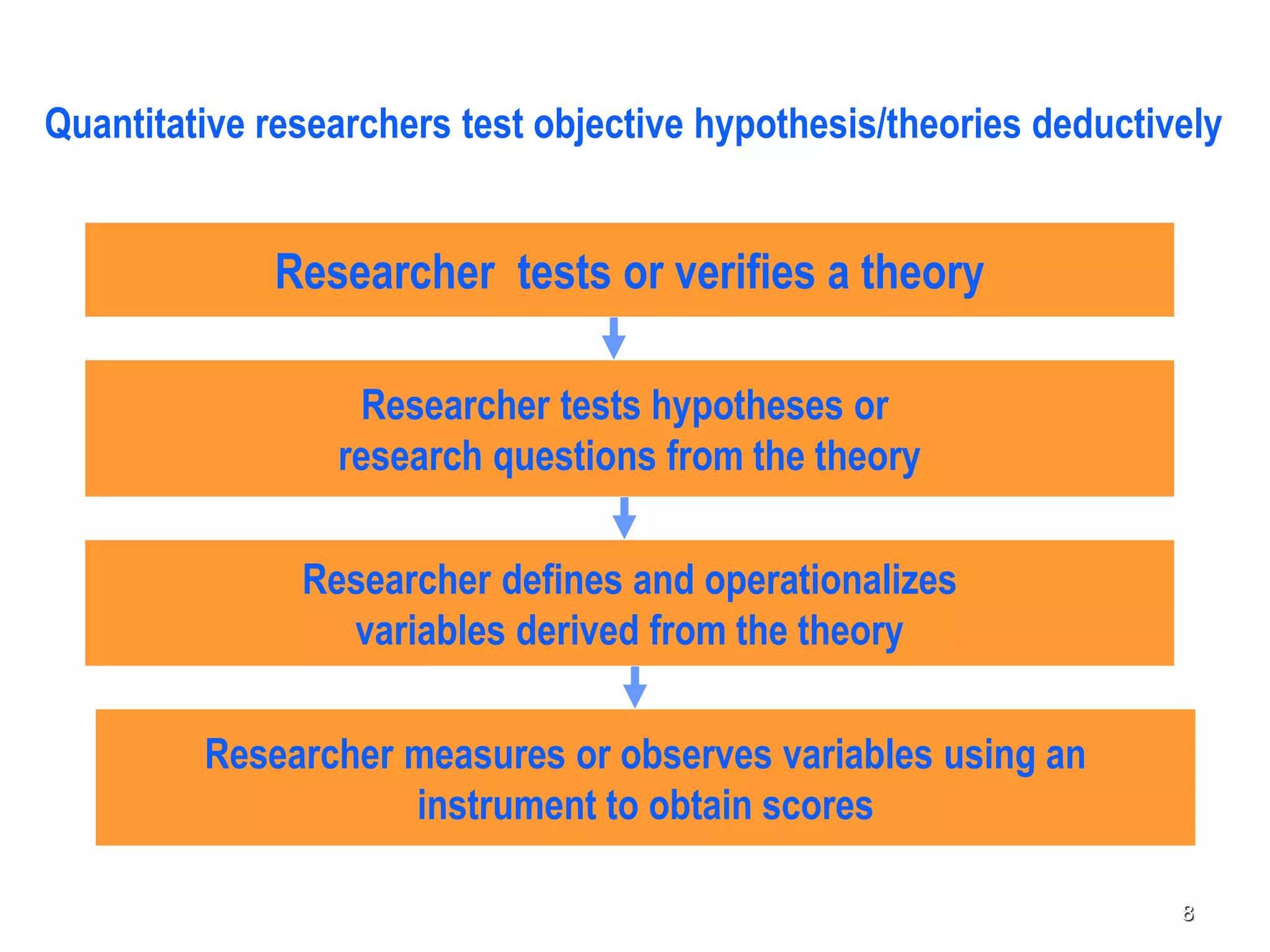
Quantitative researchers test objective hypothesis/theories deductively
Researcher tests or verifies a theory
Researcher tests hypotheses or
research questions from the theory
Researcher defines and operationalizes
variables derived from the theory
Researcher measures or observes variables using an
instrument to obtain scores
8
Philosophical worldview of quantitative research
• Use postpositivist philosophical worldview
• Knowledge is conjectural- absolute truth can never be found
• Research is the process of making claims
• Quantify relationships between variables
• Supports or refutes hypothesis
• Shape new knowledge based on collective date and evidences
9
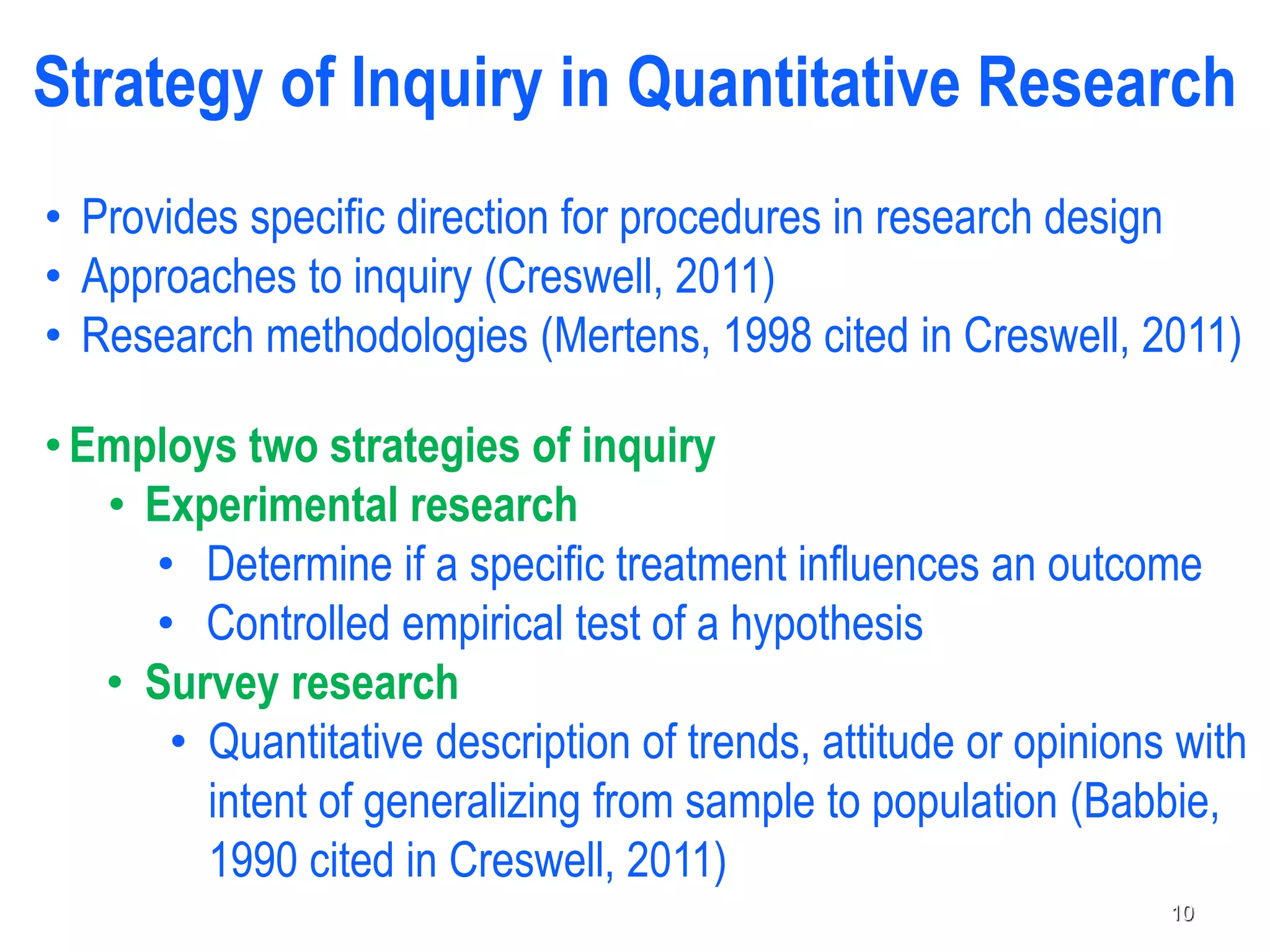
Strategy of Inquiry in Quantitative Research
• Provides specific direction for procedures in research design
• Approaches to inquiry (Creswell, 2011)
• Research methodologies (Mertens, 1998 cited in Creswell, 2011)
•Employs two strategies of inquiry
• Experimental research
• Determine if a specific treatment influences an outcome
• Controlled empirical test of a hypothesis
• Survey research
• Quantitative description of trends, attitude or opinions with
intent of generalizing from sample to population (Babbie,
1990 cited in Creswell, 2011)
10
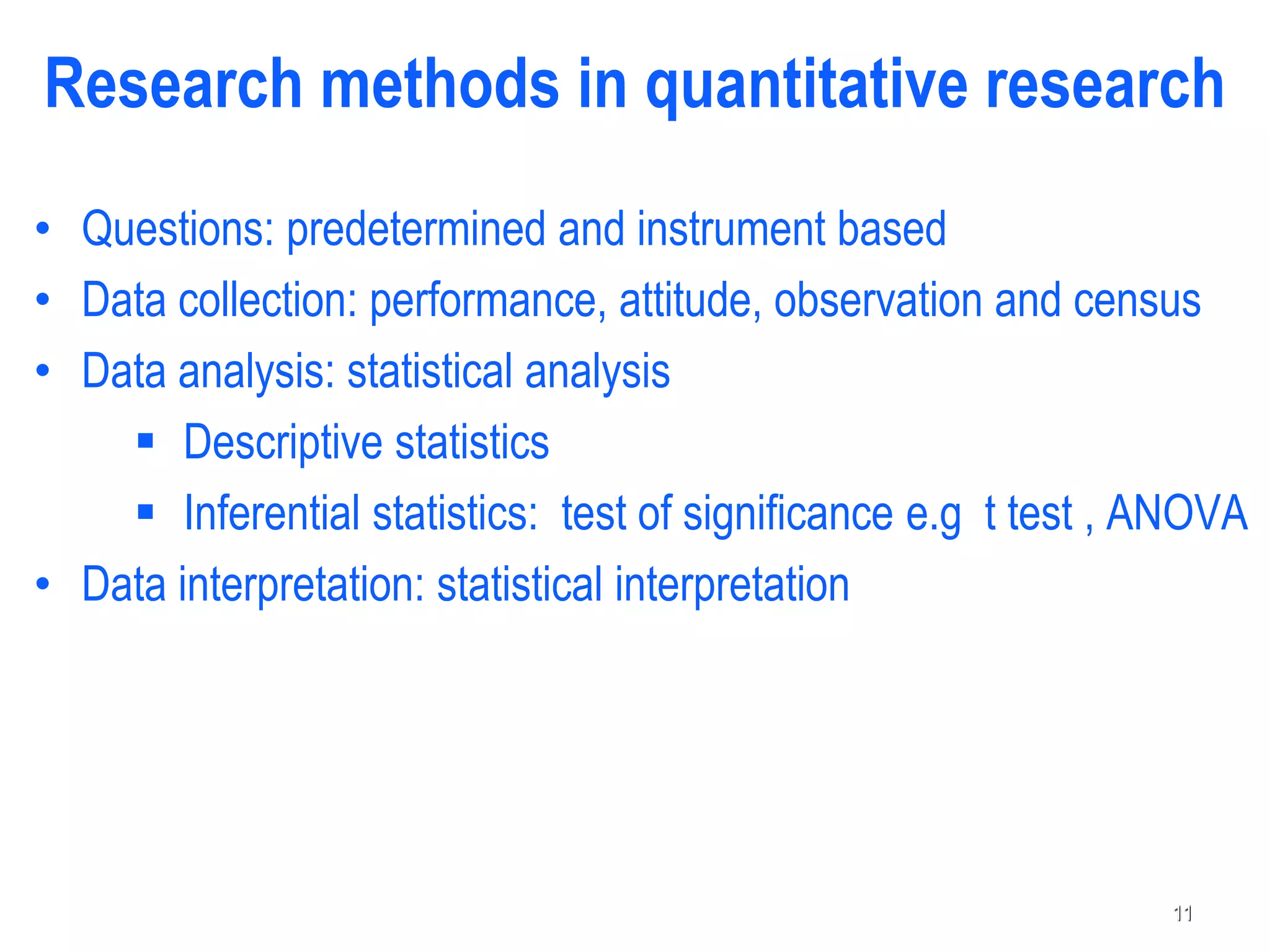
Research methods in quantitative research
• Questions: predetermined and instrument based
• Data collection: performance, attitude, observation and census
• Data analysis: statistical analysis
ď‚§ Descriptive statistics
ď‚§ Inferential statistics: test of significance e.g t test , ANOVA
• Data interpretation: statistical interpretation
11
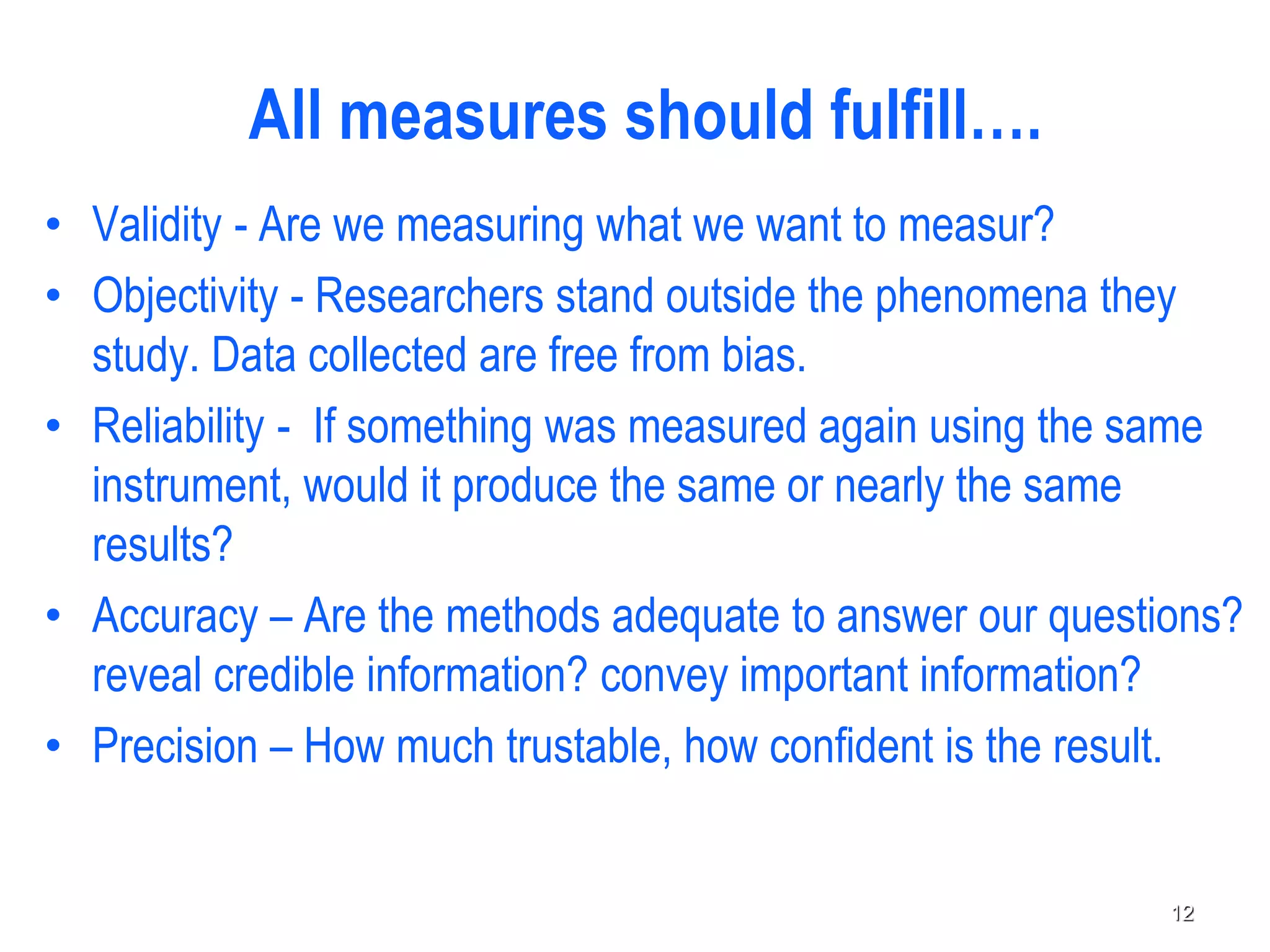
• Validity - Are we measuring what we want to measur?
• Objectivity - Researchers stand outside the phenomena they
study. Data collected are free from bias.
• Reliability - If something was measured again using the same
instrument, would it produce the same or nearly the same
results?
• Accuracy – Are the methods adequate to answer our questions?
reveal credible information? convey important information?
• Precision – How much trustable, how confident is the result.
All measures should fulfill….
12
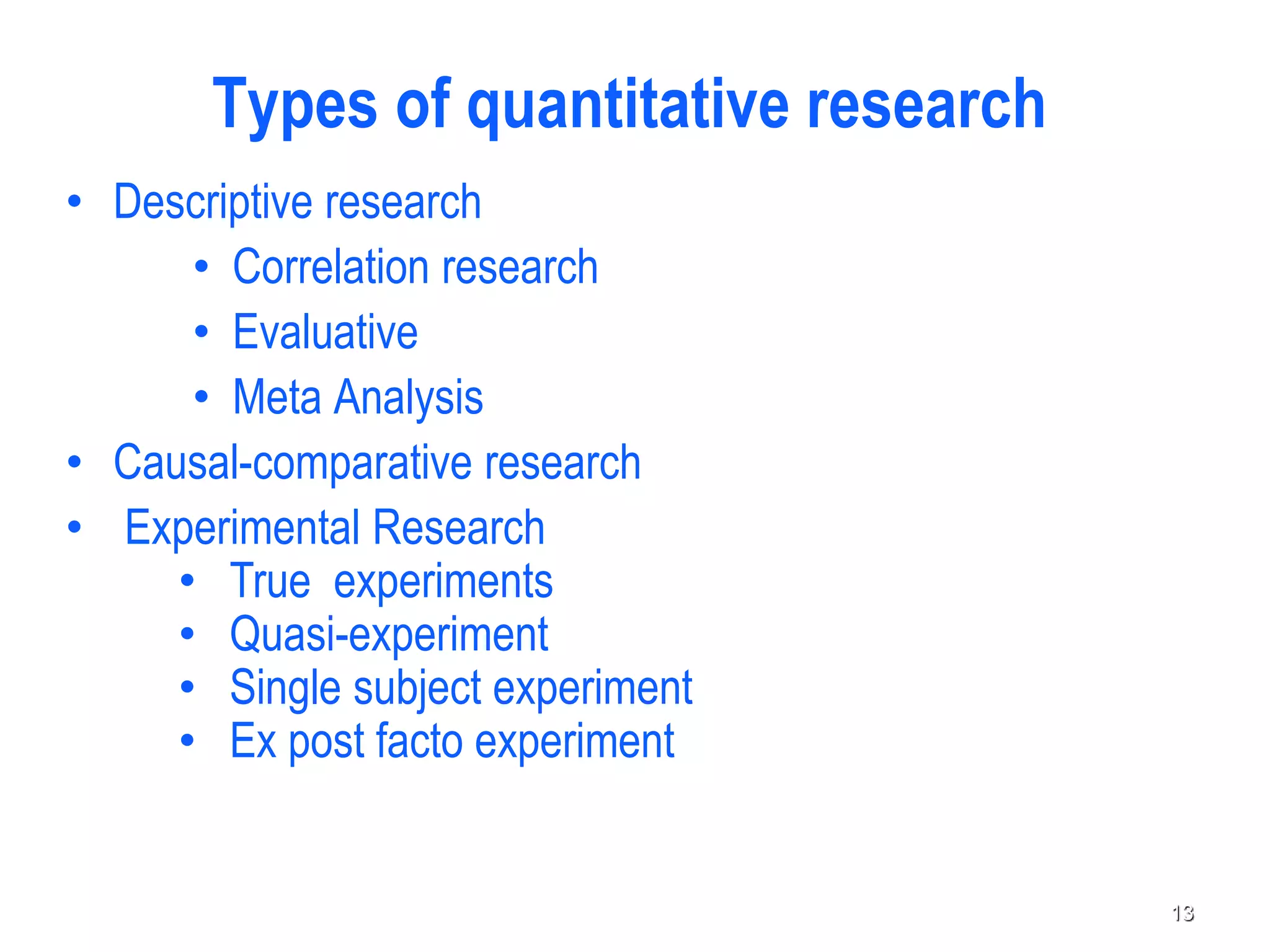
• Descriptive research
• Correlation research
• Evaluative
• Meta Analysis
• Causal-comparative research
• Experimental Research
• True experiments
• Quasi-experiment
• Single subject experiment
• Ex post facto experiment
Types of quantitative research
13
References
Creswll, J. W. (2009). Research design: Qualitative, quantitative and
mixed methods approachs (3rd ed.). India: Sage Publication
Cormack, D. (1991). Team spirit motivation and commitment team
leadership and membership, team evaluation. Grand Rapids, MI:
Pyranee Books.
Creswell, J. W. (2004). Educational research: Planning, conducting,
and evaluating quantitative and qualitative research (2nd
ed.). Ohio: Merrill Prentice Hall.
Kothari, C.R. (1999). Research Methodology: Methods and techniques
(2nd ed.).India: Wishwo Prakashan
14

Quantitative Research Design-PS2

  • 1.
    Quantitative Research Design EDU521: Research Methods in Education By Prabin Shakya, PhD Fellow School of Education Kathmandu University 8 April 2013 1
  • 2.
    Organization of Presentation •Meaning of research design • Components of research design • Meaning of quantitative research • Characteristics of quantitative research • Basic principles of quantitative research design • Philosophical worldview of quantitative research • Strategy of inquiry in quantitative research • Research methods in quantitative research • Types of quantitative research • Review of Thesis 2
  • 3.
    Meaning of ResearchDesign • Conceptual structure; blue print for the collection, measurement and analysis of data (Kothari, 1999). • Plan and procedure for conducting research that spans the decisions from broad assumption to detailed methods of data collection and analysis (Creswell, 2011). • For me..whole package of assumptions (philosophical worldviews), strategy of inquiry, date collection, data analysis and interpretation of findings. 3
  • 4.
    Components of researchdesign A framework for research design- interconnection of worldviews, strategies of inquiry and research methods (adapted from Creswell, 2011; pp5) Research design Qualitative Quantitative Mixed Philosophical world view Post positivist Constructivism Advocacy/participatory Pragmatic Strategy of inquiry Qualitative e.g. ethnography Quantitative e.g. experimental Mixed e.g sequential Research methods Questions: open or closed Data collection : numeric or text or pictorial Data analysis Data interpretation Validation 4
  • 5.
    Meaning of QuantitativeResearch • A formal, objective, systematic process in which numerical data are utilized to obtain information about the world (Burns & Grove, as cited by Cormack, 1991, p. 140) • An inquiry of social or human problem based on testing a theory composed of variables, measured with numbers, and analyzed with statistical procedures, in order to determine whether the predictive generalizations of the theory hold true (Creswell, 1994) 5
  • 6.
    Characteristics of QuantitativeResearch • Quantitative research is about quantifying the relationships between variables, cause and effect relationships • We measure them, and • construct statistical models to explain what we observed • The researcher knows in advance what he or she is looking for • All aspects of study are carefully designed before data collection • Test hypothesis/theory and establish new theory-deductive • Goal: Prediction, control, confirmation, test hypotheses 6
  • 7.
    Quantitative research designis rooted in • Postpositivistic approach • Scientific and quantitative strategy of inquiry • Use of quantifiable data, measures and statistical tools • Test hypothesis and interpretate cause-and-effect relationships Basic Principles of Quantitative Research Design 7
  • 8.
    Quantitative researchers testobjective hypothesis/theories deductively Researcher tests or verifies a theory Researcher tests hypotheses or research questions from the theory Researcher defines and operationalizes variables derived from the theory Researcher measures or observes variables using an instrument to obtain scores 8
  • 9.
    Philosophical worldview ofquantitative research • Use postpositivist philosophical worldview • Knowledge is conjectural- absolute truth can never be found • Research is the process of making claims • Quantify relationships between variables • Supports or refutes hypothesis • Shape new knowledge based on collective date and evidences 9
  • 10.
    Strategy of Inquiryin Quantitative Research • Provides specific direction for procedures in research design • Approaches to inquiry (Creswell, 2011) • Research methodologies (Mertens, 1998 cited in Creswell, 2011) •Employs two strategies of inquiry • Experimental research • Determine if a specific treatment influences an outcome • Controlled empirical test of a hypothesis • Survey research • Quantitative description of trends, attitude or opinions with intent of generalizing from sample to population (Babbie, 1990 cited in Creswell, 2011) 10
  • 11.
    Research methods inquantitative research • Questions: predetermined and instrument based • Data collection: performance, attitude, observation and census • Data analysis: statistical analysis  Descriptive statistics  Inferential statistics: test of significance e.g t test , ANOVA • Data interpretation: statistical interpretation 11
  • 12.
    • Validity -Are we measuring what we want to measur? • Objectivity - Researchers stand outside the phenomena they study. Data collected are free from bias. • Reliability - If something was measured again using the same instrument, would it produce the same or nearly the same results? • Accuracy – Are the methods adequate to answer our questions? reveal credible information? convey important information? • Precision – How much trustable, how confident is the result. All measures should fulfill…. 12
  • 13.
    • Descriptive research •Correlation research • Evaluative • Meta Analysis • Causal-comparative research • Experimental Research • True experiments • Quasi-experiment • Single subject experiment • Ex post facto experiment Types of quantitative research 13
  • 14.
    References Creswll, J. W.(2009). Research design: Qualitative, quantitative and mixed methods approachs (3rd ed.). India: Sage Publication Cormack, D. (1991). Team spirit motivation and commitment team leadership and membership, team evaluation. Grand Rapids, MI: Pyranee Books. Creswell, J. W. (2004). Educational research: Planning, conducting, and evaluating quantitative and qualitative research (2nd ed.). Ohio: Merrill Prentice Hall. Kothari, C.R. (1999). Research Methodology: Methods and techniques (2nd ed.).India: Wishwo Prakashan 14

Editor's Notes