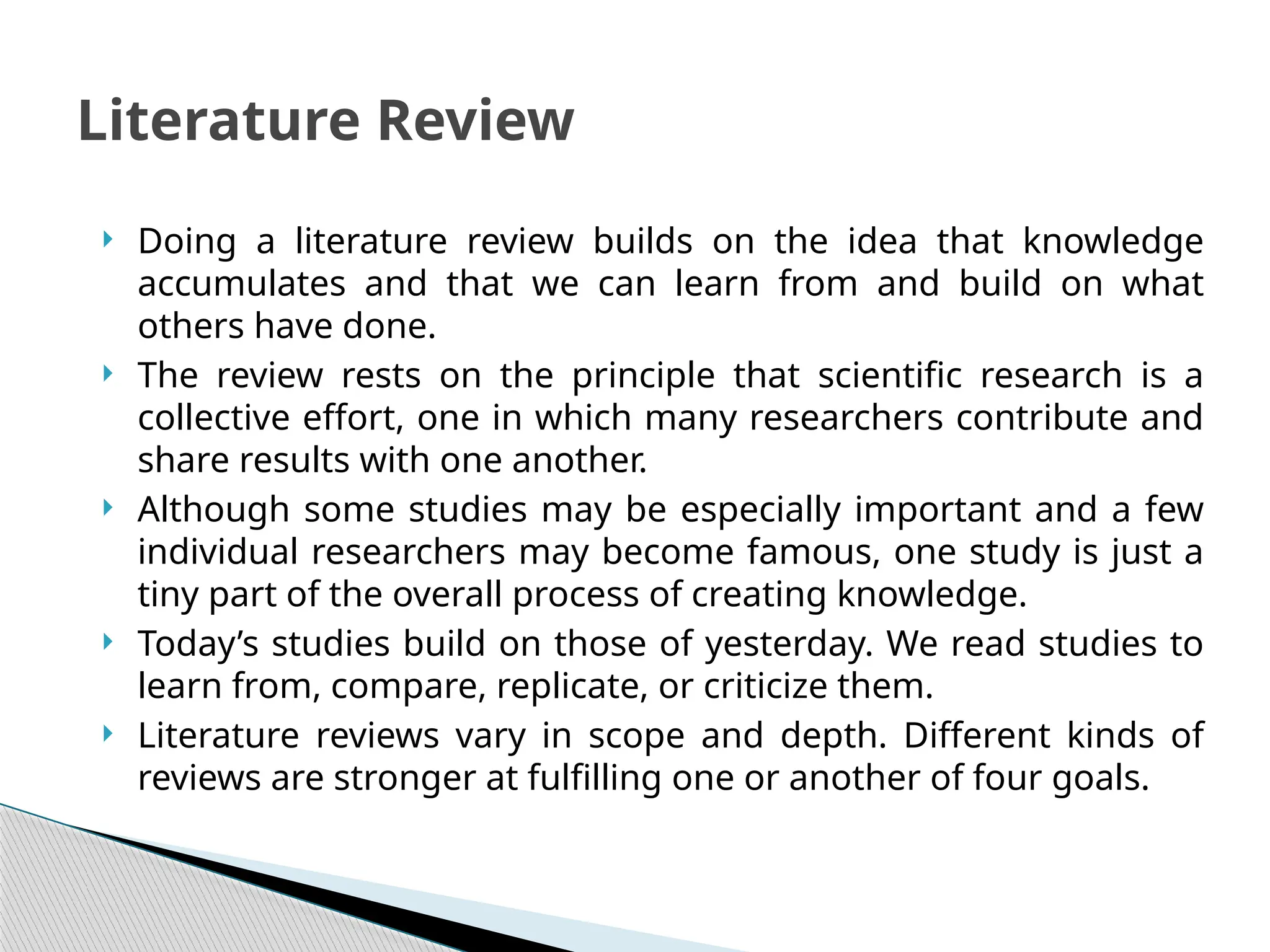
Doing aliterature review builds on the idea that knowledge
accumulates and that we can learn from and build on what
others have done.
The review rests on the principle that scientific research is a
collective effort, one in which many researchers contribute and
share results with one another.
Although some studies may be especially important and a few
individual researchers may become famous, one study is just a
tiny part of the overall process of creating knowledge.
Today’s studies build on those of yesterday. We read studies to
learn from, compare, replicate, or criticize them.
Literature reviews vary in scope and depth. Different kinds of
reviews are stronger at fulfilling one or another of four goals.
Literature Review
3.
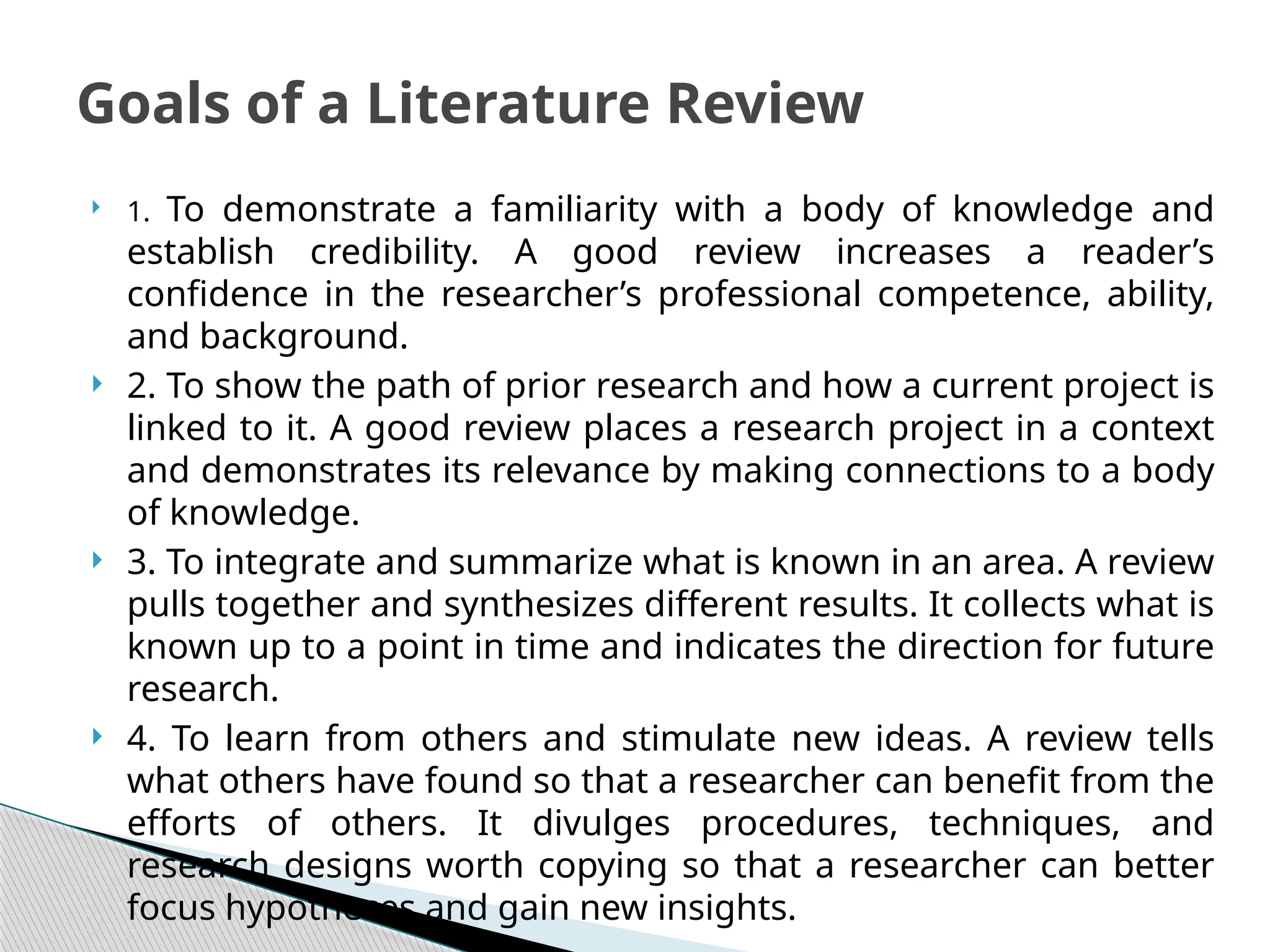
1. Todemonstrate a familiarity with a body of knowledge and
establish credibility. A good review increases a reader’s
confidence in the researcher’s professional competence, ability,
and background.
2. To show the path of prior research and how a current project is
linked to it. A good review places a research project in a context
and demonstrates its relevance by making connections to a body
of knowledge.
3. To integrate and summarize what is known in an area. A review
pulls together and synthesizes different results. It collects what is
known up to a point in time and indicates the direction for future
research.
4. To learn from others and stimulate new ideas. A review tells
what others have found so that a researcher can benefit from the
efforts of others. It divulges procedures, techniques, and
research designs worth copying so that a researcher can better
focus hypotheses and gain new insights.
Goals of a Literature Review
4.
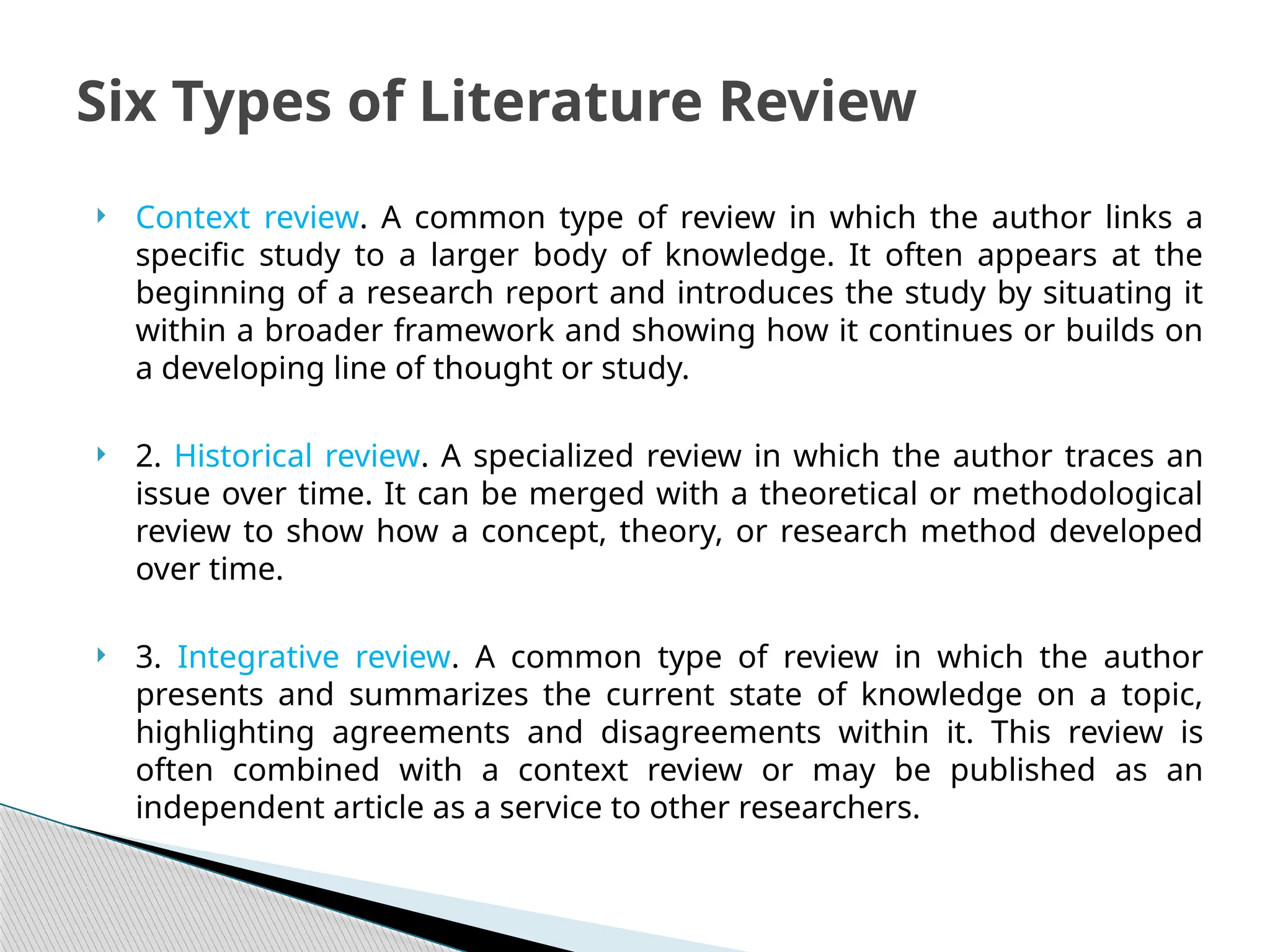
Context review.A common type of review in which the author links a
specific study to a larger body of knowledge. It often appears at the
beginning of a research report and introduces the study by situating it
within a broader framework and showing how it continues or builds on
a developing line of thought or study.
2. Historical review. A specialized review in which the author traces an
issue over time. It can be merged with a theoretical or methodological
review to show how a concept, theory, or research method developed
over time.
3. Integrative review. A common type of review in which the author
presents and summarizes the current state of knowledge on a topic,
highlighting agreements and disagreements within it. This review is
often combined with a context review or may be published as an
independent article as a service to other researchers.
Six Types of Literature Review
5.
4. Methodologicalreview. A specialized type of integrative review in
which the author compares and evaluates the relative
methodological strength of various studies and shows how different
methodologies (e.g., research designs, measures, samples) account
for different results.
5. Self-study review. A review in which an author demonstrates his or
her familiarity with a subject area. It is often part of an educational
program or course requirement.
6. Theoretical review. A specialized review in which the author
presents several theories or concepts focused on the same topic
and compares them on the basis of assumptions, logical
consistency, and scope of explanation.
Continue……………
6.
Periodicals. Studyresults appear in newspapers, in popular magazines,
on television or radio broad casts, and in Internet news summaries, but
these are not the full, complete reports of research you need to prepare a
literature review.
Scholarly Journals. The primary source to use for a literature review is
the scholarly journal. It is filled with peer-reviewed reports of research.
One can rarely find these journals outside of college and university
libraries.
Books. Books communicate many types of information, provoke thought,
and entertain. The many types of books include picture books, textbooks,
short story books, novels, popular fiction or non fiction, religious books,
and children’s books. Our concern here is with those books containing
reports of original research or collections of research articles.
Where we find research literature
7.
Dissertations. Allgraduate students who receive the doctor of philosophy
(Ph.D.) degree are required to complete a work of original research, called a
dissertation thesis. The dissertation is bound and shelved in the library of
the university that granted the degree. About half of all dissertations are
eventually published as books or articles. Because dissertations report on
original research, they can be valuable sources of information.
Government Documents. The federal government of the United States,
the governments of other nations, state- or provincial-level governments,
the United Nations, and other international agencies such as the World
Bank, sponsor studies and publish reports of the research.
Policy Reports and Presented Papers. If you are conducting a thorough
literature review, you may look at these two sources. Some are on the
Internet, but most are difficult for all but the trained special its to obtain.
Research institutes and policy centers (e.g., Brookings Institute, Institute
for Research on Poverty, Rand Corporation) publish papers and reports.
continue……….
8.
Define andRefine a Topic. Just as you must plan and clearly define a topic and research
question as you begin a research project, you need to begin a literature review with a clearly
defined, well-focused research question and a plan. A good review topic should be in the form
of a research question. For example, “divorce” or “crime” is much too broad. Amore appropriate
review topic might be “What contributes to the stability of families with step children?” or “Does
economic inequality produce crime rates across nations?” If you conduct a con text review for a
research project, it should be slightly broader than the specific research question being
examined. Often, a researcher will not finalize a specific research question for a study until he
or she has reviewed the literature. The review usually helps to focus on the research question.
Design a Search. After choosing a focused research question for the review, the next step is to
plan a search strategy. You must decide on the type of review, its extensiveness, and the types
of materials to include. The key is to be careful, systematic, and organized. Set parameters on
your search: how much time you will devote to it, how far back in time you will look, the
minimum number of research reports you will examine, how many libraries you will visit, and
so forth.
Locate Research Reports. Locating research reports depends on the type of report or research
“outlet” for which you are searching. As a general rule, use multiple search strategies to
counteract the limitations of a single search method. Articles in Scholarly Journals. As discussed
earlier, most social research is published in scholarly jour nals. With hundreds of journals, each
containing hundreds of articles, an article search can be formi dable. Luckily, online services
and specialized pub locations make the task easier.
How to Conduct a Systematic
Literature Review
9.
1. Examinethe title. A good title is specific, indicates the nature of the
research without describing the results, and avoids asking a yes or no
question. It describes the topic, may mention one or two major
variables, and tells about the setting or par tic pants. An example of a
good title is “Parental Involvement in Schooling and Reduced
Discipline Problems among Junior High School Students in Singapore.”
2. Read the abstract. A good abstract summarizes critical information
about a study. It gives the study’s purpose, identifies methods used,
and highlights major findings. It avoids vague references to future
implications. After an initial screening by title, you should be able to
determine a report’s relevance from a well-prepared abstract. In
addition to screening for relevance, a title and abstract prepare you
for examining a report in detail.
How to Evaluate Research Articles
10.
3. Readthe article. Before reading the entire article, you may want
to skim the first several paragraphs at the beginning and quickly
read the conclusion. This will give you a picture of what the article is
about. Certain factors affect the amount of time and effort and
overall payoff from reading a scholarly article. The time and effort
are lower and results higher under three conditions:
(1) the article is a high-quality article with a well-defined purpose,
clear writing, and smooth, logical organization,
(2) you are sharply focused on a particular issue or question, and
(3) you have a solid theoretical back ground, know a lot about the
substantive topic, and are familiar with research methodology.
Continue…………………..
11.
As yougather the relevant research literature, you may feel overwhelmed by the
quantity of information, so you need a system for taking notes.
The old-fashioned note-taking approach was to write the notes onto index cards
and then shift and sort the note cards, place them in piles, and so forth. This
method still works. Today, however, most people use word processing software
and gather photocopies or printed versions of many articles.
As you discover new sources, you may want to create two file types for note
cards or computer documents, a source file and a content file. Record all
bibliographic information for each source in the source file even though you
may not use some of it.
Do not forget anything in a complete bibliographic citation, such as a page
number or the name of the second author; if you do, you will regret it later
It should be best creating two kinds of source files, or dividing a master file into
two parts: have file and potential file. The have file is for sources that you have
found and for which you have already taken content notes. The potential file is
for leads and possible new sources that you have yet to track down or read. You
can add to the potential file anytime you come across a new source or a new
article’s bibliography.
How to Take Notes
12.
It isbetter to err in the direction of recording too much rather than too little. In
general, record the hypotheses tested, the measurement of major concepts,
the main findings, the basic design of the research, the group or sample used,
and ideas for future study.
It is wise to examine the report’s bibliography and note sources that you can
add to your search.. Today, however, most people use word processing software
and gather photocopies or printed versions of many articles.
Photocopying all relevant articles or reports will save you time recording notes
and will ensure that you will have an entire report. Also, you can make notes on
the photocopy, but consider several facts about this practice.
First, photocopying can be expensive for a large literature search.
Second, be aware of and obey copyright laws. U.S. copyright laws permit photo
copying for personal research use.
Third, remember to record or photocopy the entire article, including all citation
information.
Fourth, organizing a large pile of articles can be cumbersome, especially if you
want to use several different parts of a single article.
Finally, unless you highlight carefully or take good notes, you may have to
reread the entire article later.
What to record
13.
After youhave gathered many references and notes, you need an
organizing method. One approach is to group various studies or
specific findings by skimming notes and creating a mental map of how
they fit together. Organizing is a skill that improves with practice.
You may discover gaps or areas and topics that are relevant but you
have not examined yet. This necessitates return visits to the library. The
best organizational method depends on the purpose of the review.
A context review implies organizing recent reports around a specific
research question.
A historical review implies organizing studies by major theme and by
the date of publication.
An integrative review implies organizing studies around core common
findings of a field and the main hypotheses tested.
A methodological review implies organizing studies by topic and, within
each topic, by the design or method used.
A theoretical review implies organizing studies by theories and major
thinkers.
Organize Notes




![[DSC Europe 25] Branko Urosevic -Rethinking Financial Talent: Integrating Cod...](https://cdn.slidesharecdn.com/ss_thumbnails/8jjrus8ttko6qj64f58f-3-251212103250-642c6374-thumbnail.jpg?width=640&height=640&fit=bounds)
![[DSC Europe 25] Ivan Peric - Intelligence Swarm Logic and Techno-Functional M...](https://cdn.slidesharecdn.com/ss_thumbnails/7my7c97fsduiccadgavw-2-251212103249-5a03f7c6-thumbnail.jpg?width=640&height=640&fit=bounds)


![[DSC Europe 25] Sara Polak - The Archaeology of Innovation: AI as the Next Cr...](https://cdn.slidesharecdn.com/ss_thumbnails/7ecbscdnt8mlcuqbd2ln-2-sara-polak-ai-creative-industries-251208152533-aa1fcf54-thumbnail.jpg?width=640&height=640&fit=bounds)


![[DSC Europe 25] Milan Sekuloski - Data, Defence, and Development: Cybersecuri...](https://cdn.slidesharecdn.com/ss_thumbnails/dfrkwwx4qly6atqpbl4z-4-251209104645-c3d4b0ca-thumbnail.jpg?width=640&height=640&fit=bounds)
![[DSC Europe 25] Behzad Hosseini - AI Agents in the Wild: Deploying Models tha...](https://cdn.slidesharecdn.com/ss_thumbnails/3qtejajvsjqrzwfept2c-10-251212103250-7f2b1068-thumbnail.jpg?width=640&height=640&fit=bounds)
![[DSC Europe 25] Dunja Adzic Jovanovic - AI and Cybersecurity: Defending Data ...](https://cdn.slidesharecdn.com/ss_thumbnails/o1zylpbhrtwnixxq2xj8-7-251211083048-185086f6-thumbnail.jpg?width=640&height=640&fit=bounds)


![[DSC Europe 25] Branko Dzakula - From Defense to Attack: How AI Redefines Cyb...](https://cdn.slidesharecdn.com/ss_thumbnails/80bdzdxpr3ky2g0qvyk9-8-251211083048-ce5fc1ee-thumbnail.jpg?width=640&height=640&fit=bounds)
![[DSC Europe 25] Marko Krstic - Understanding the AI Threat Landscape - Risks,...](https://cdn.slidesharecdn.com/ss_thumbnails/tiyim1ins5jvbrvzpzla-2-251209104645-c69d3553-thumbnail.jpg?width=640&height=640&fit=bounds)