Dr. Allam Ameen
Assistant Professor
Egyptian Chinese University, Faculty of Engineering and Technology
Electronics Research Institute, Microstrip Department
Lecture 3
Spring 2025
Electronic Circuits
(MCT 123)
Last Lecture Topics
Dr. Allam Ameen Electronic Circuits
2
 PN Junction.
 Applications of PN Junction.
 Diode.
 Biasing of the Diode.
 Diode Models.
 V-I Characteristic of a Diode.
Today’s Topics
Dr. Allam Ameen Electronic Circuits
3
 Half-Wave Rectifiers.
 Full-Wave Rectifiers.
 Power Supply Filters.
 Diode Limiters.
 Diode Clippers.
 Diode Clampers.
 Completed Power Supply.
Full-Wave Rectifiers
Dr. Allam Ameen Electronic Circuits
4
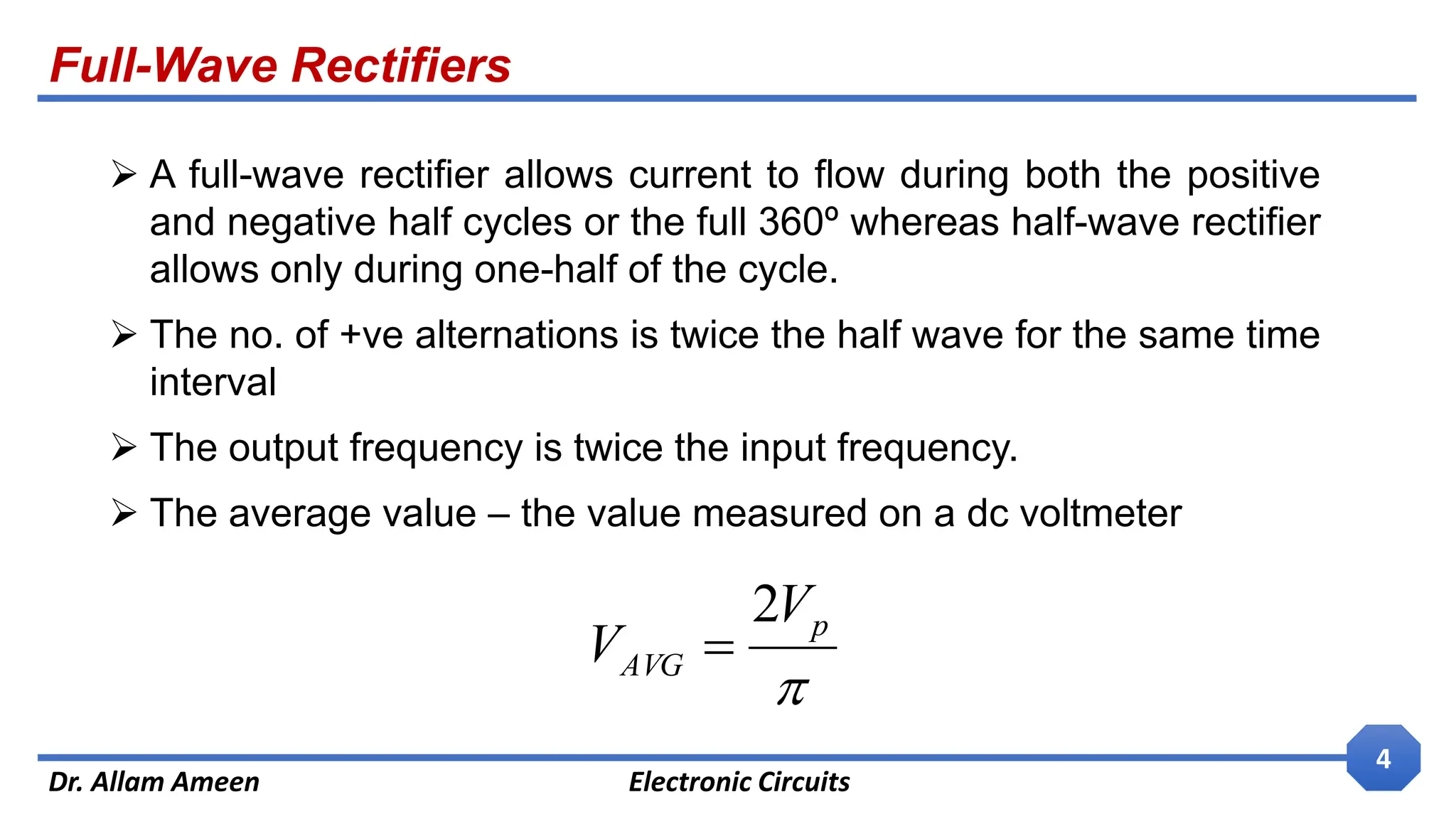
 A full-wave rectifier allows current to flow during both the positive
and negative half cycles or the full 360º whereas half-wave rectifier
allows only during one-half of the cycle.
 The no. of +ve alternations is twice the half wave for the same time
interval
 The output frequency is twice the input frequency.
 The average value – the value measured on a dc voltmeter

p
AVG
V
V
2

Full-Wave Rectifiers
Dr. Allam Ameen Electronic Circuits
5
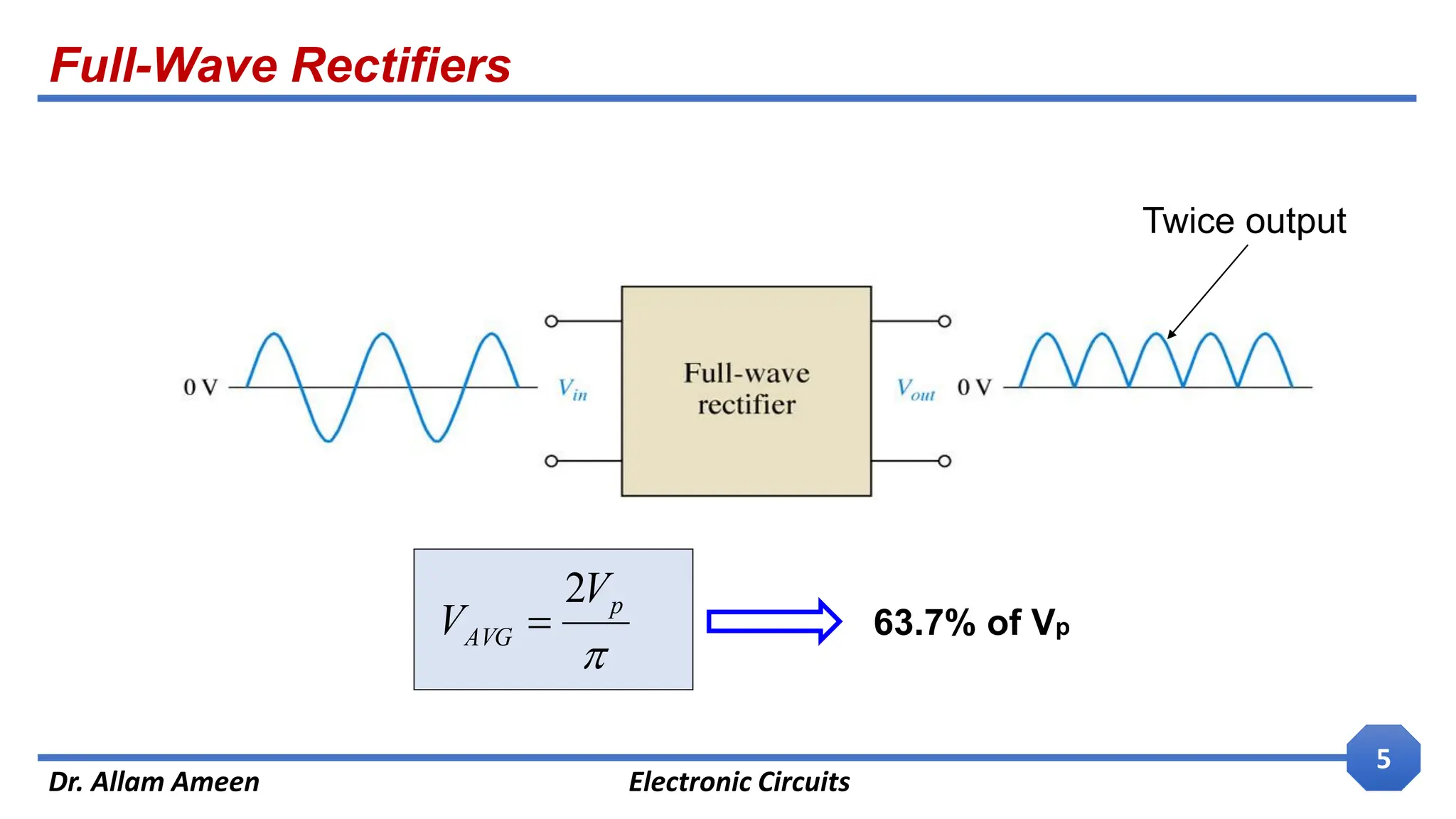
Twice output

p
AVG
V
V
2
 63.7% of Vp
Full-Wave Rectifiers
Dr. Allam Ameen Electronic Circuits
6
The Center-Tapped Full-Wave Rectifier
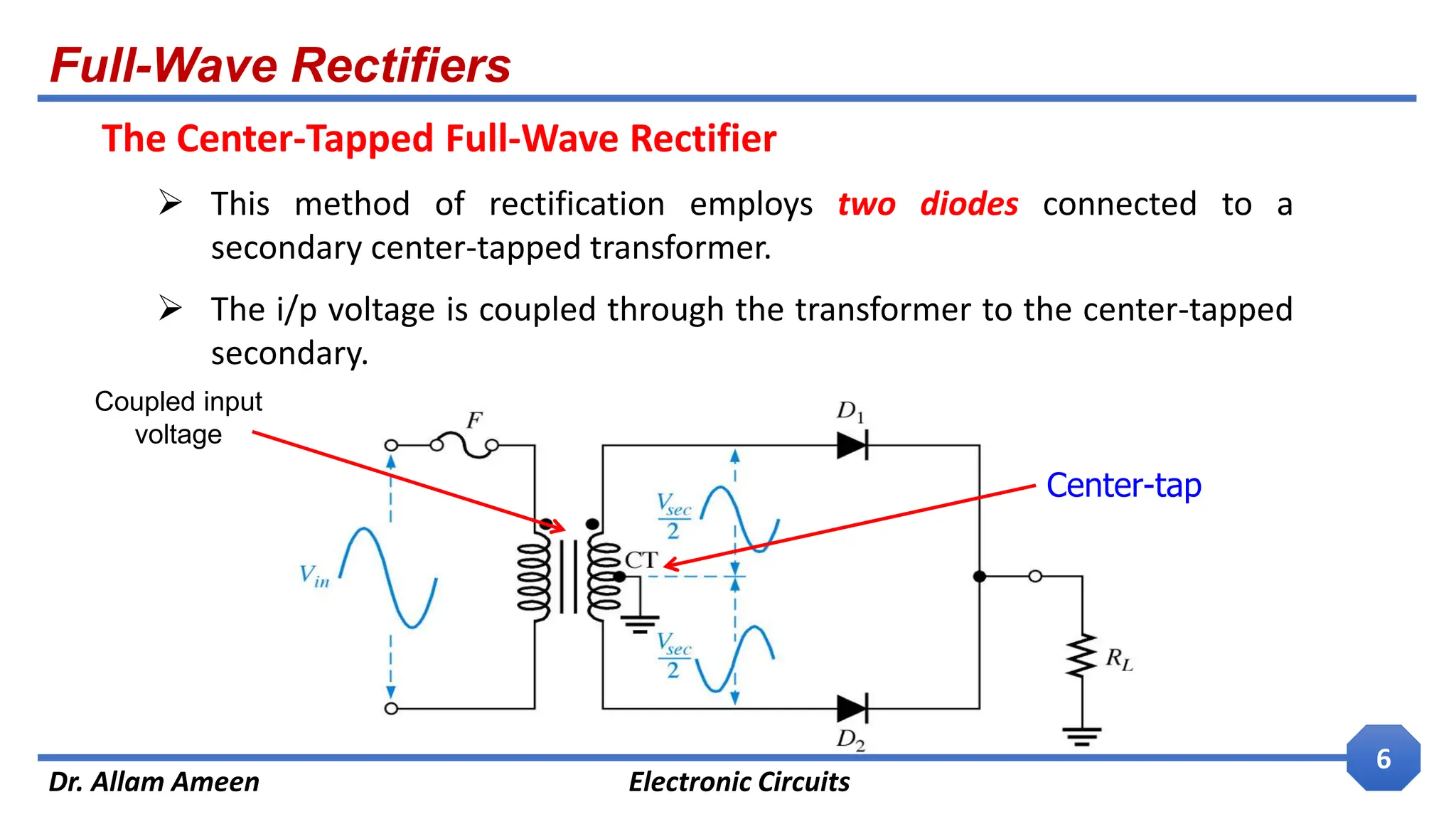
 This method of rectification employs two diodes connected to a
secondary center-tapped transformer.
 The i/p voltage is coupled through the transformer to the center-tapped
secondary.
Coupled input
voltage
Center-tap
Full-Wave Rectifiers
Dr. Allam Ameen Electronic Circuits
7
The Center-Tapped Full-Wave Rectifier
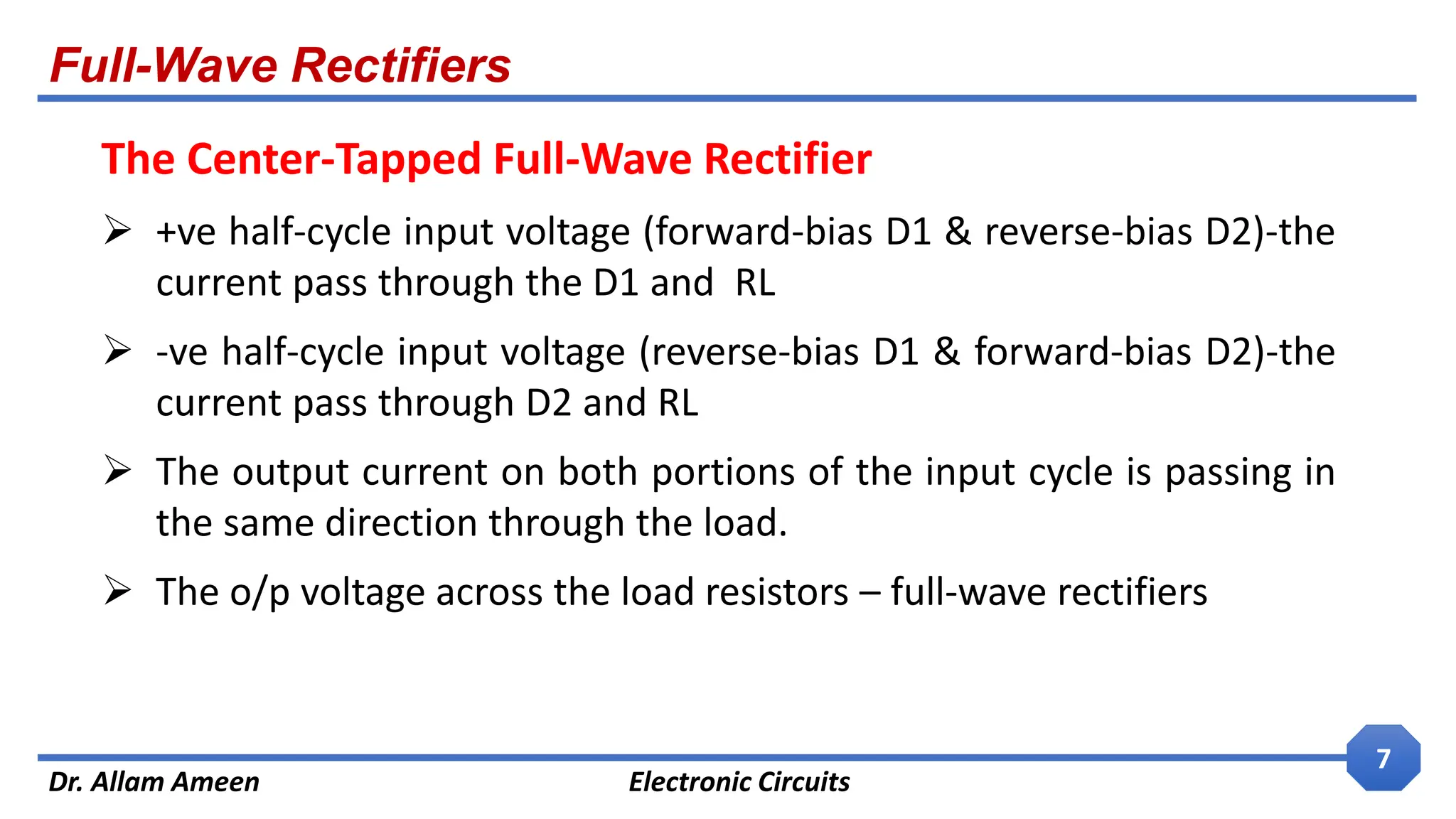
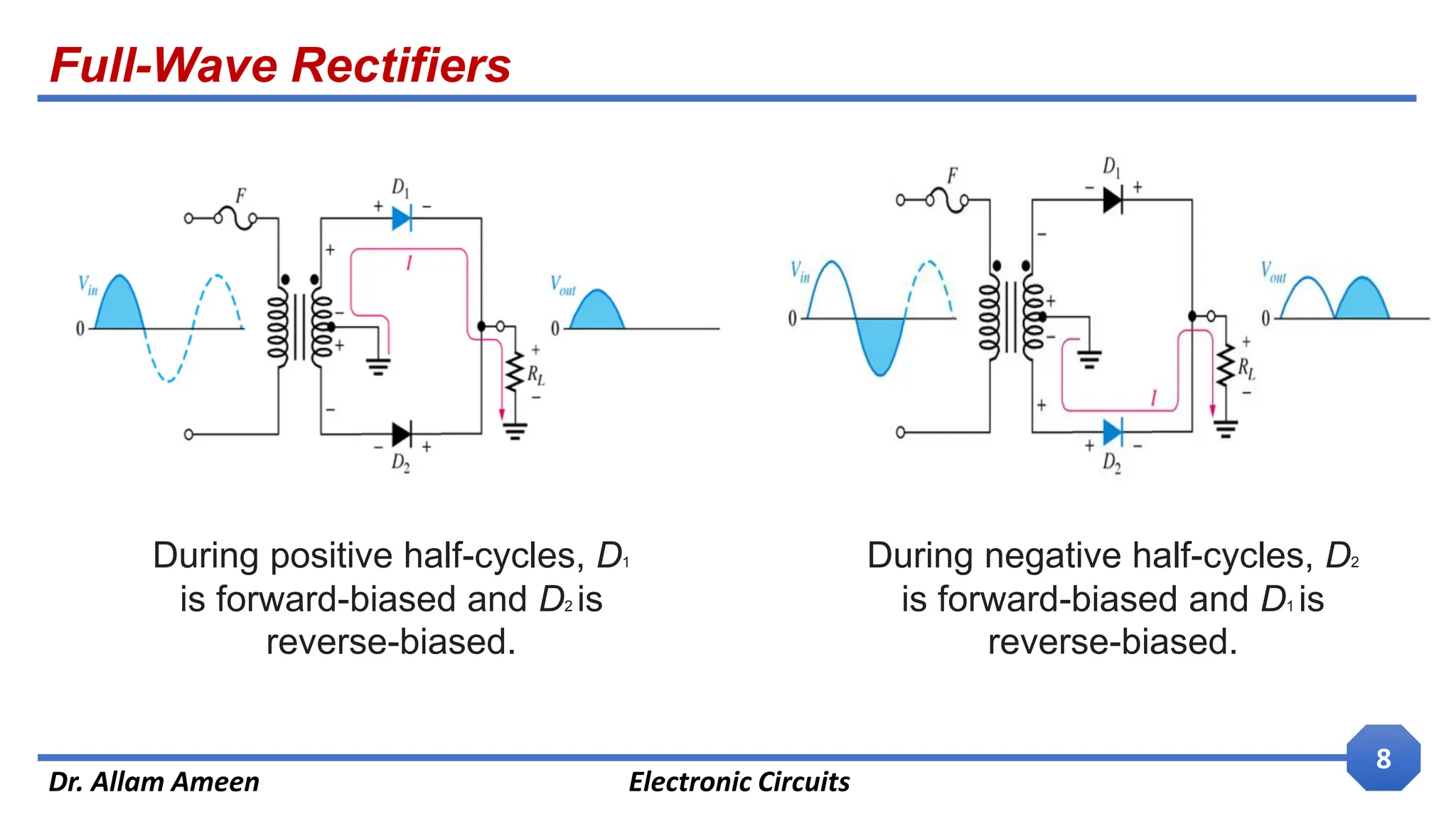
 +ve half-cycle input voltage (forward-bias D1 & reverse-bias D2)-the
current pass through the D1 and RL
 -ve half-cycle input voltage (reverse-bias D1 & forward-bias D2)-the
current pass through D2 and RL
 The output current on both portions of the input cycle is passing in
the same direction through the load.
 The o/p voltage across the load resistors – full-wave rectifiers
Full-Wave Rectifiers
Dr. Allam Ameen Electronic Circuits
8
During positive half-cycles, D1
is forward-biased and D2 is
reverse-biased.
During negative half-cycles, D2
is forward-biased and D1 is
reverse-biased.
Full-Wave Rectifiers
Dr. Allam Ameen Electronic Circuits
9
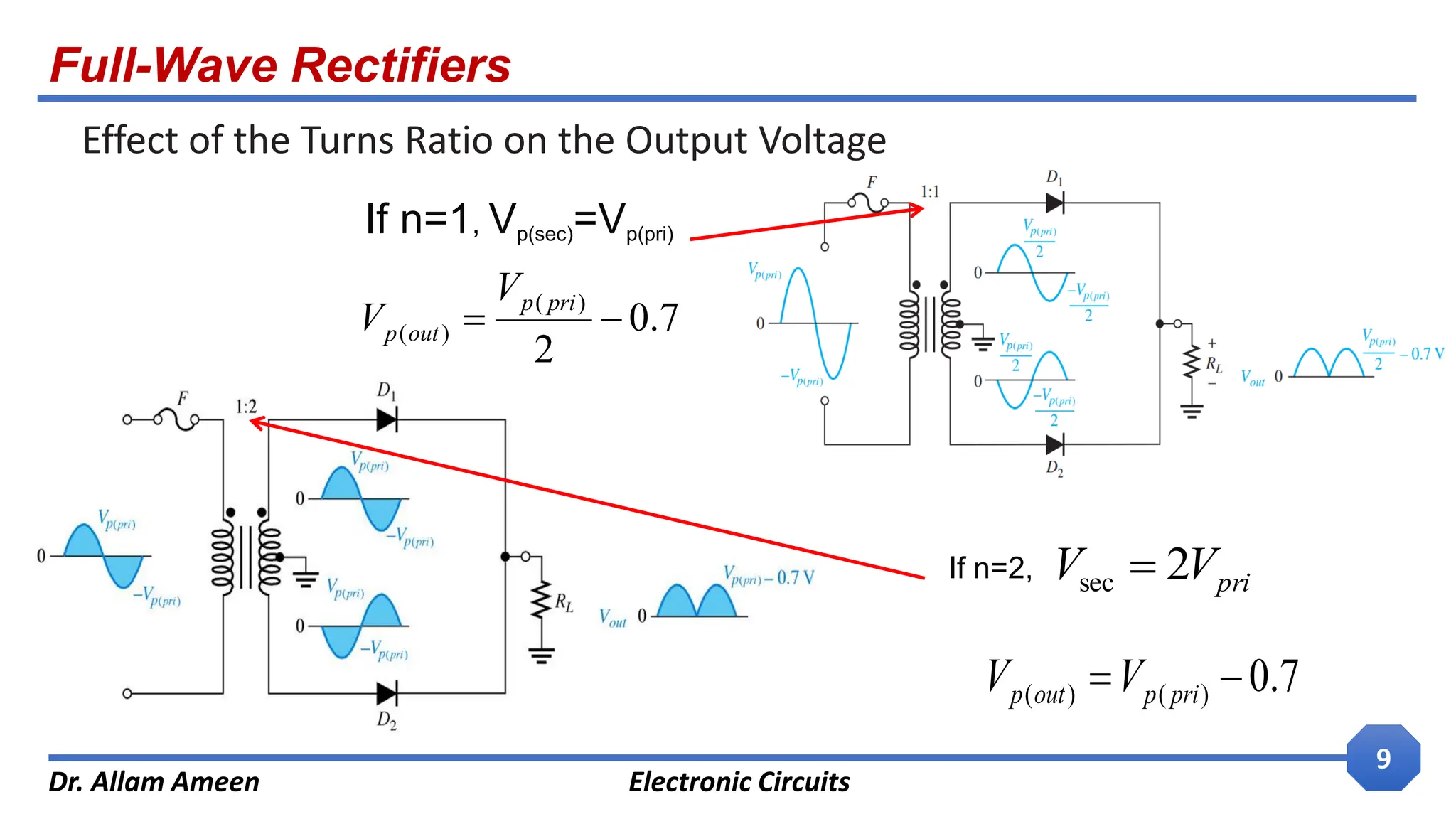
Effect of the Turns Ratio on the Output Voltage
If n=1, Vp(sec)=Vp(pri)
If n=2,
7
.
0
)
(
)
( 
 pri
p
out
p V
V
pri
V
V 2
sec 
7
.
0
2
)
(
)
( 

pri
p
out
p
V
V
Full-Wave Rectifiers
Dr. Allam Ameen Electronic Circuits
10
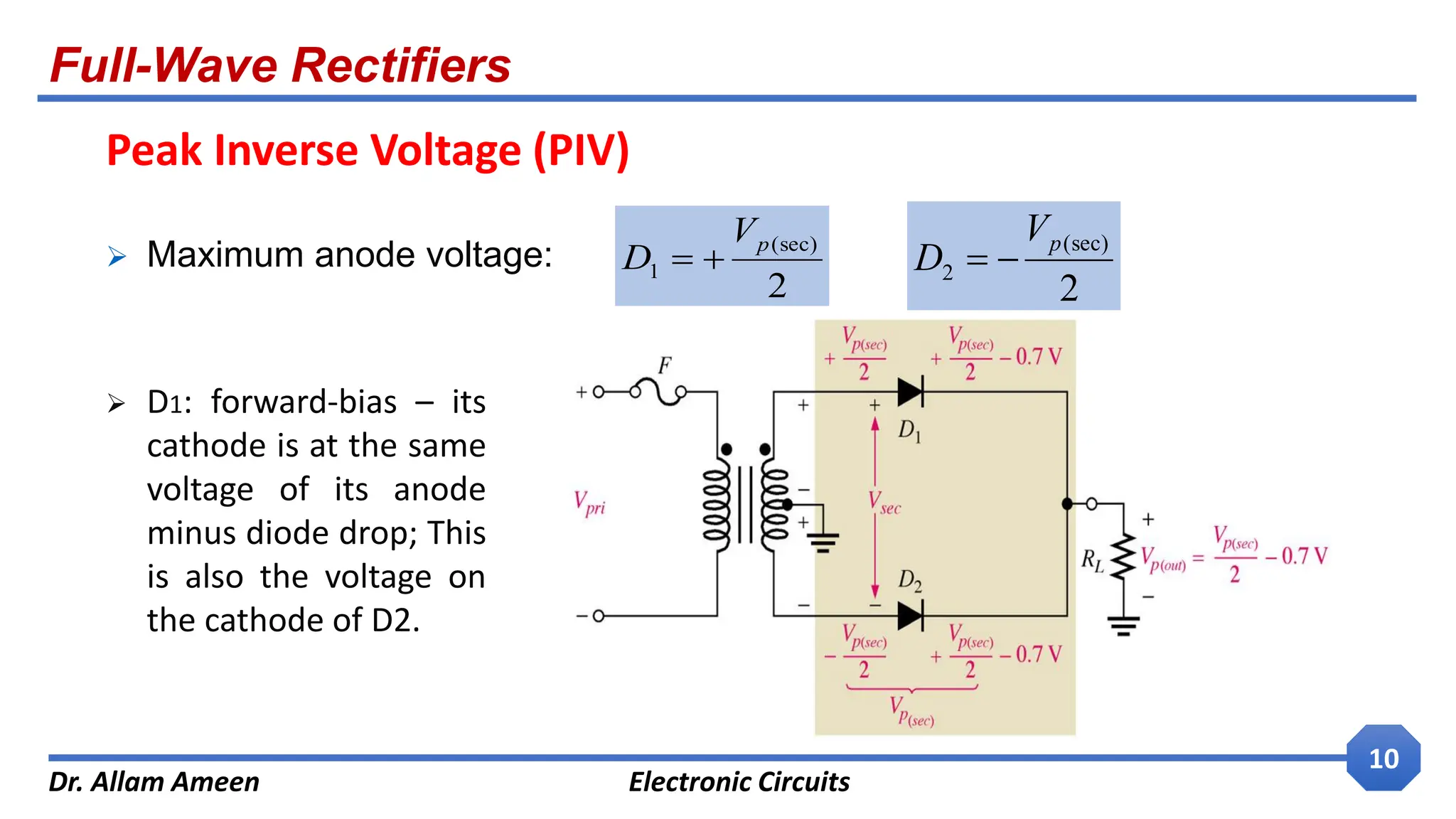
Peak Inverse Voltage (PIV)
 Maximum anode voltage:
2
(sec)
1
p
V
D 

2
(sec)
2
p
V
D 

 D1: forward-bias – its
cathode is at the same
voltage of its anode
minus diode drop; This
is also the voltage on
the cathode of D2.
Full-Wave Rectifiers
Dr. Allam Ameen Electronic Circuits
11
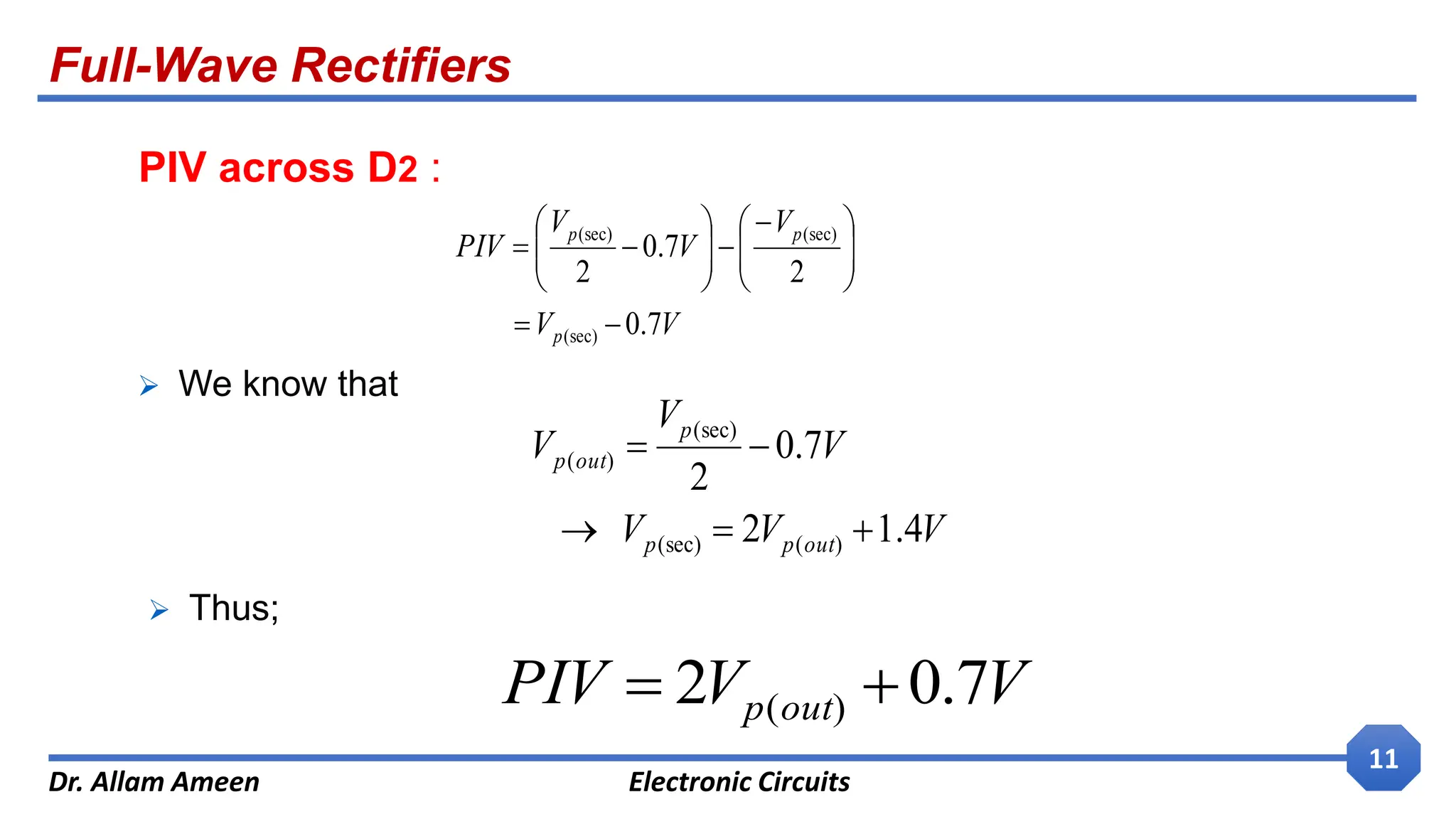
PIV across D2 :
V
V
V
V
V
PIV
p
p
p
7
.
0
2
7
.
0
2
(sec)
(sec)
(sec)









 











V
V
V
V
V
V
out
p
p
p
out
p
4
.
1
2
7
.
0
2
)
(
(sec)
(sec)
)
(





 We know that
 Thus;
V
V
PIV out
p 7
.
0
2 )
( 

Full-Wave Rectifiers
Dr. Allam Ameen Electronic Circuits
12
 It employs four diodes arranged such that current flows in the
direction through the load during each half of the cycle.
 When Vin +ve, D1 and D2 FB and conduct current. A voltage across
RL looks like +ve half of the input cycle. During this time, D3 and D4
are RB.
 When Vin –ve, D3 and D4 are FB and conduct current. D1 and D2 are
RB.
The Bridge Full-Wave Rectifier
Full-Wave Rectifiers
Dr. Allam Ameen Electronic Circuits
13
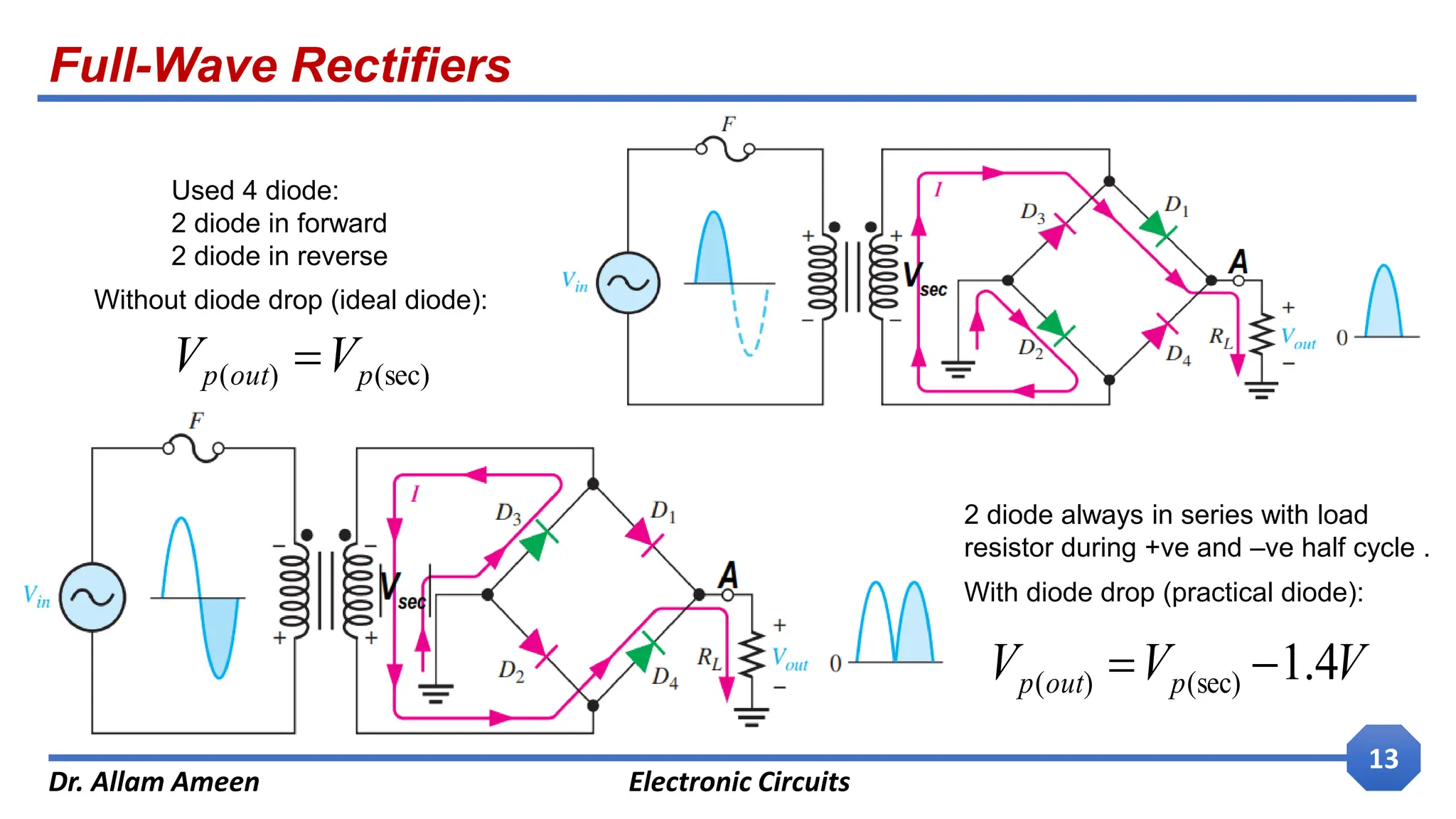
Used 4 diode:
2 diode in forward
2 diode in reverse
Without diode drop (ideal diode):
(sec)
)
( p
out
p V
V 
2 diode always in series with load
resistor during +ve and –ve half cycle .
With diode drop (practical diode):
V
V
V p
out
p 4
.
1
(sec)
)
( 

Full-Wave Rectifiers
Dr. Allam Ameen Electronic Circuits
14
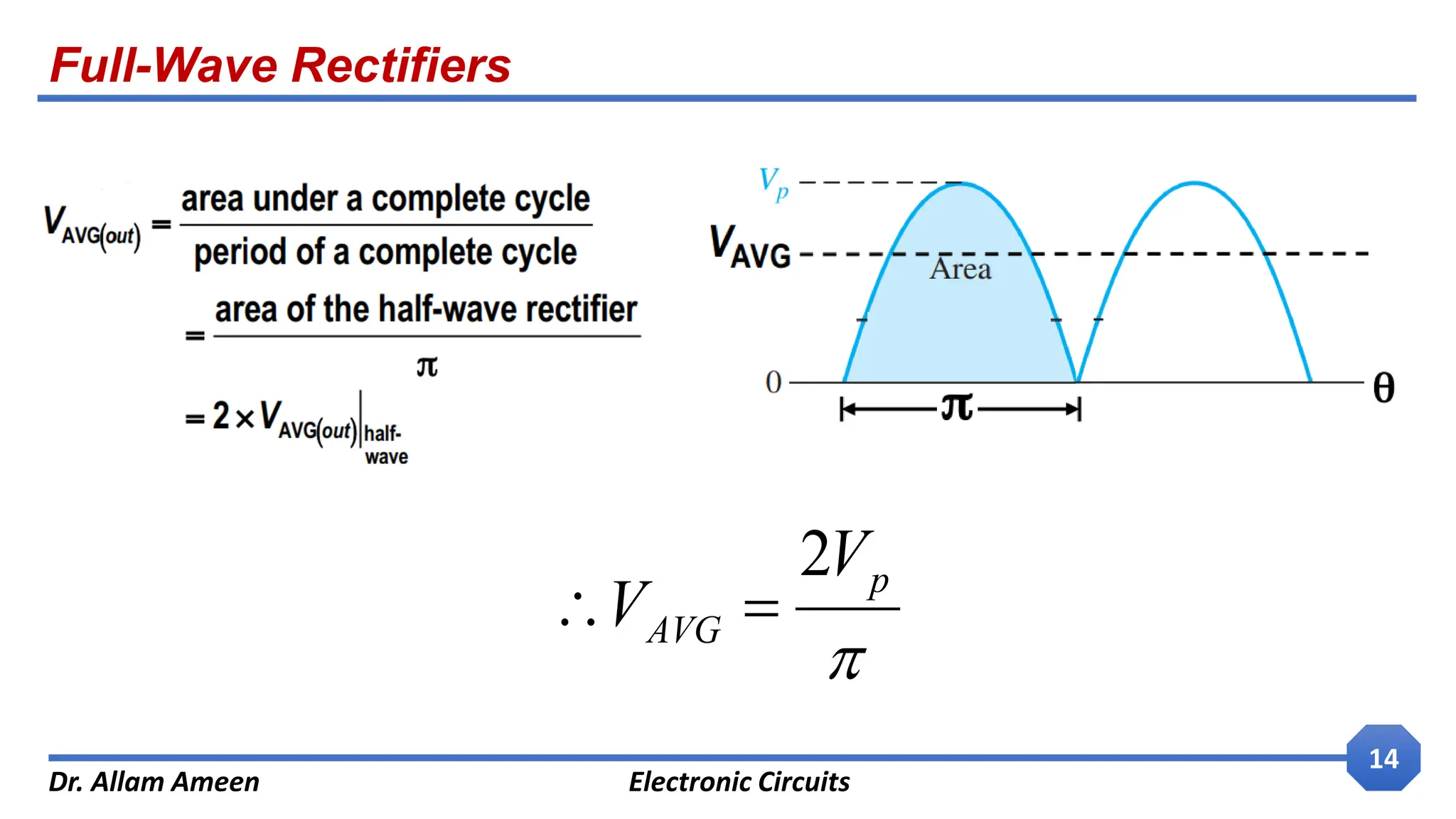

p
AVG
V
V
2


Full-Wave Rectifiers
Dr. Allam Ameen Electronic Circuits
15
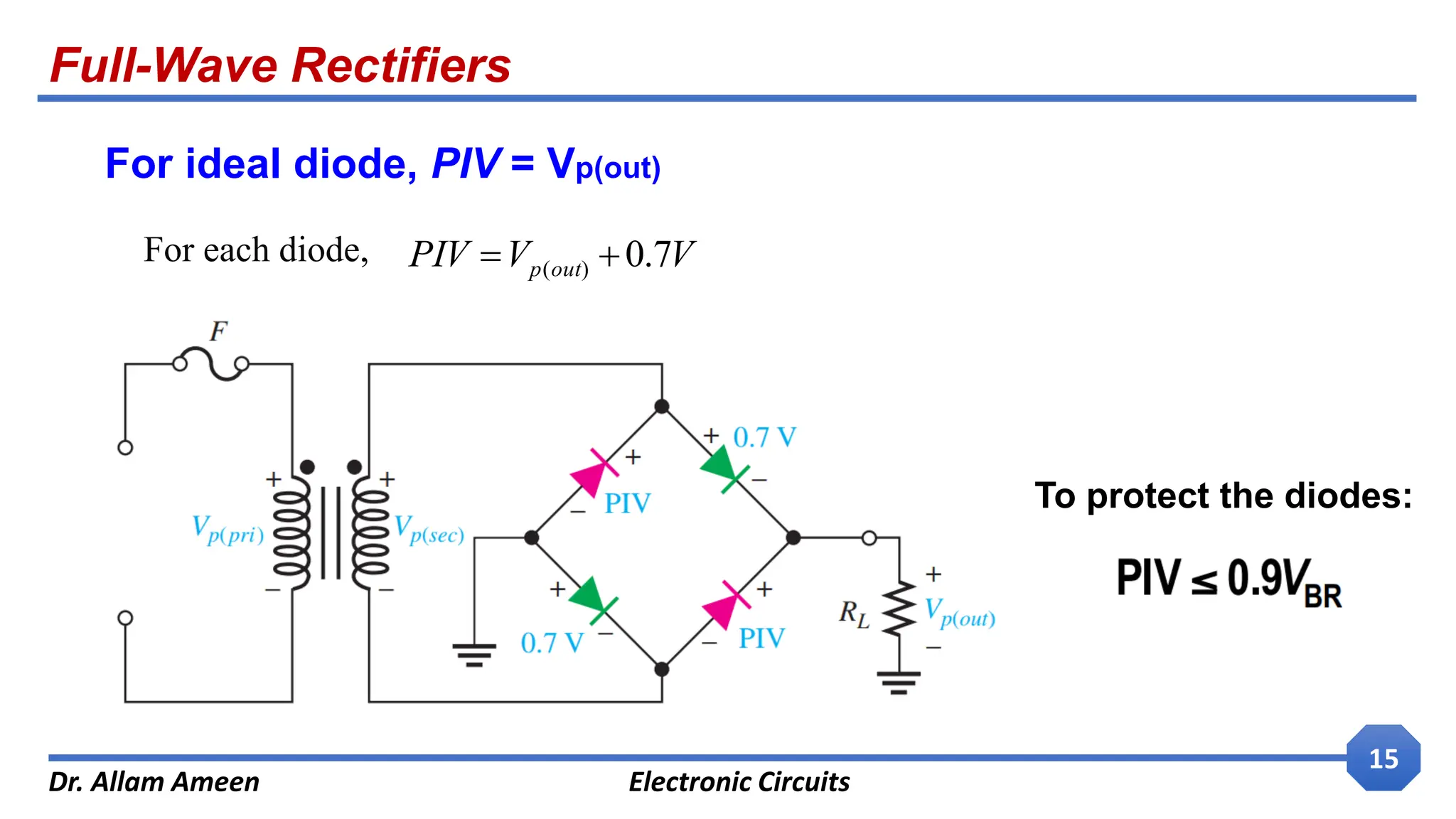
For ideal diode, PIV = Vp(out)
V
V
PIV out
p 7
.
0
)
( 

For each diode,
To protect the diodes:
Full-Wave Rectifiers
Dr. Allam Ameen Electronic Circuits
16
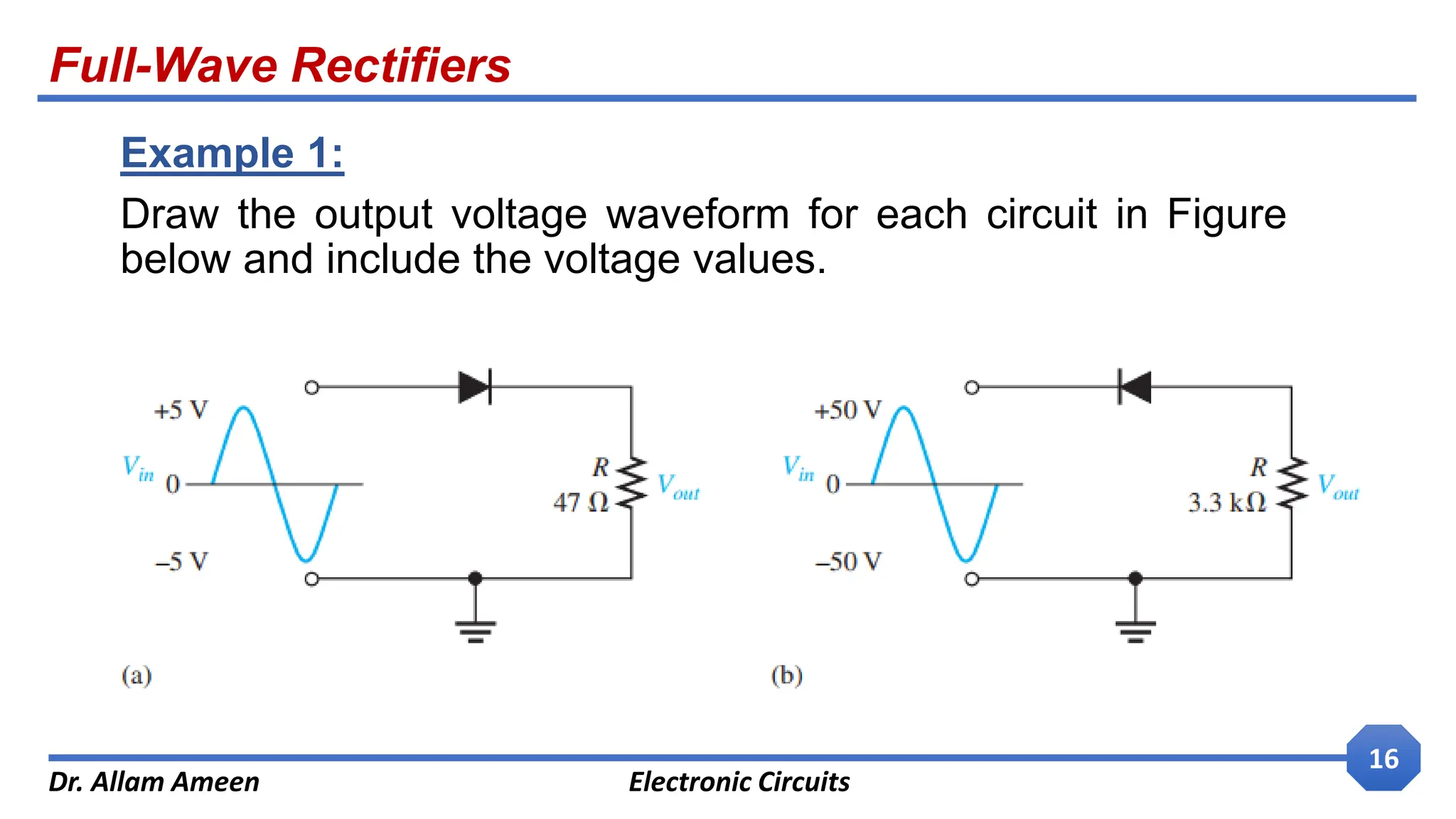
Example 1:
Draw the output voltage waveform for each circuit in Figure
below and include the voltage values.
Solved Problems
Dr. Allam Ameen Electronic Circuits
17
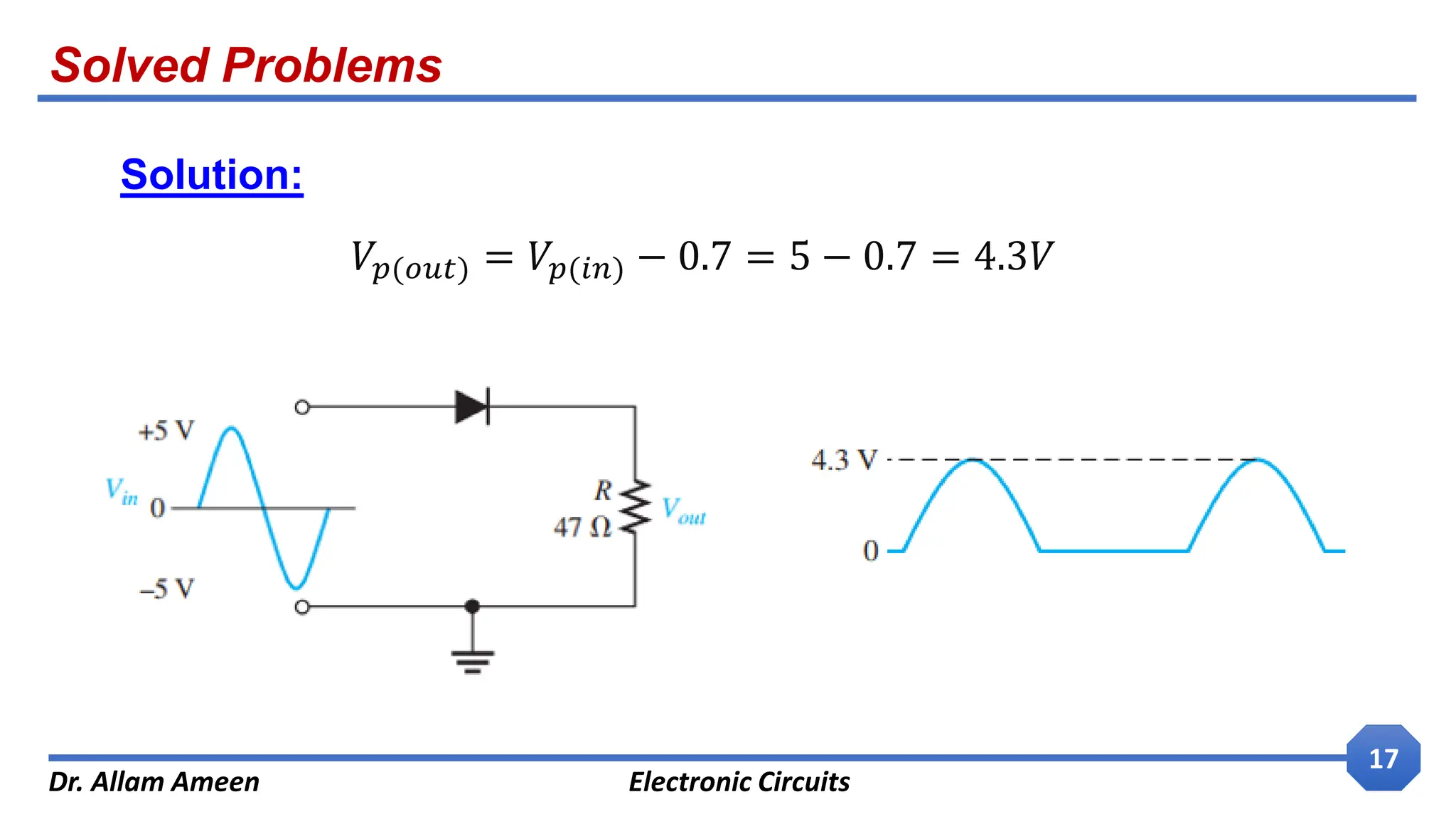
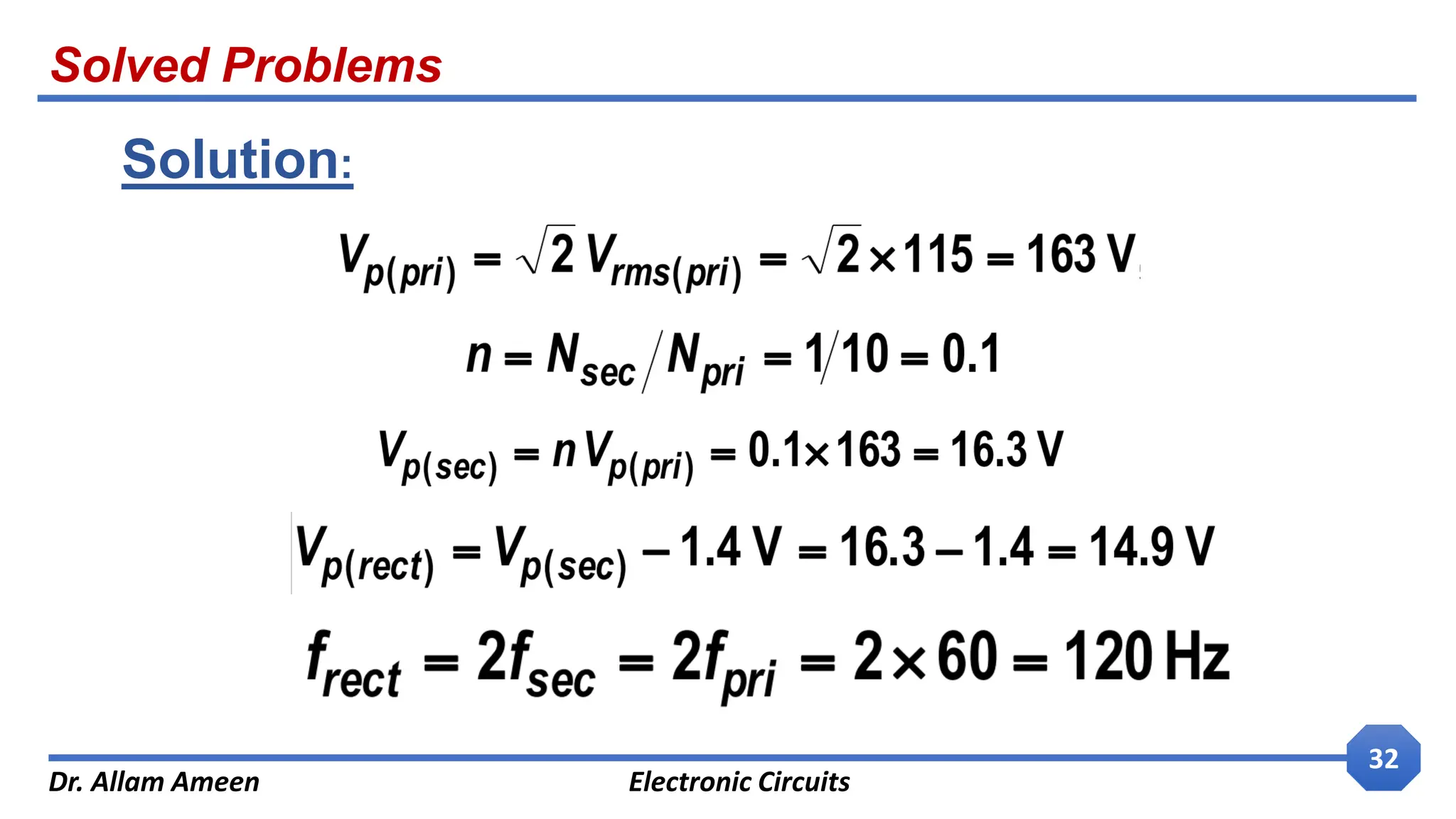
Solution:
𝑉𝑝(𝑜𝑢𝑡) = 𝑉𝑝(𝑖𝑛) − 0.7 = 5 − 0.7 = 4.3𝑉
Solved Problems
Dr. Allam Ameen Electronic Circuits
18
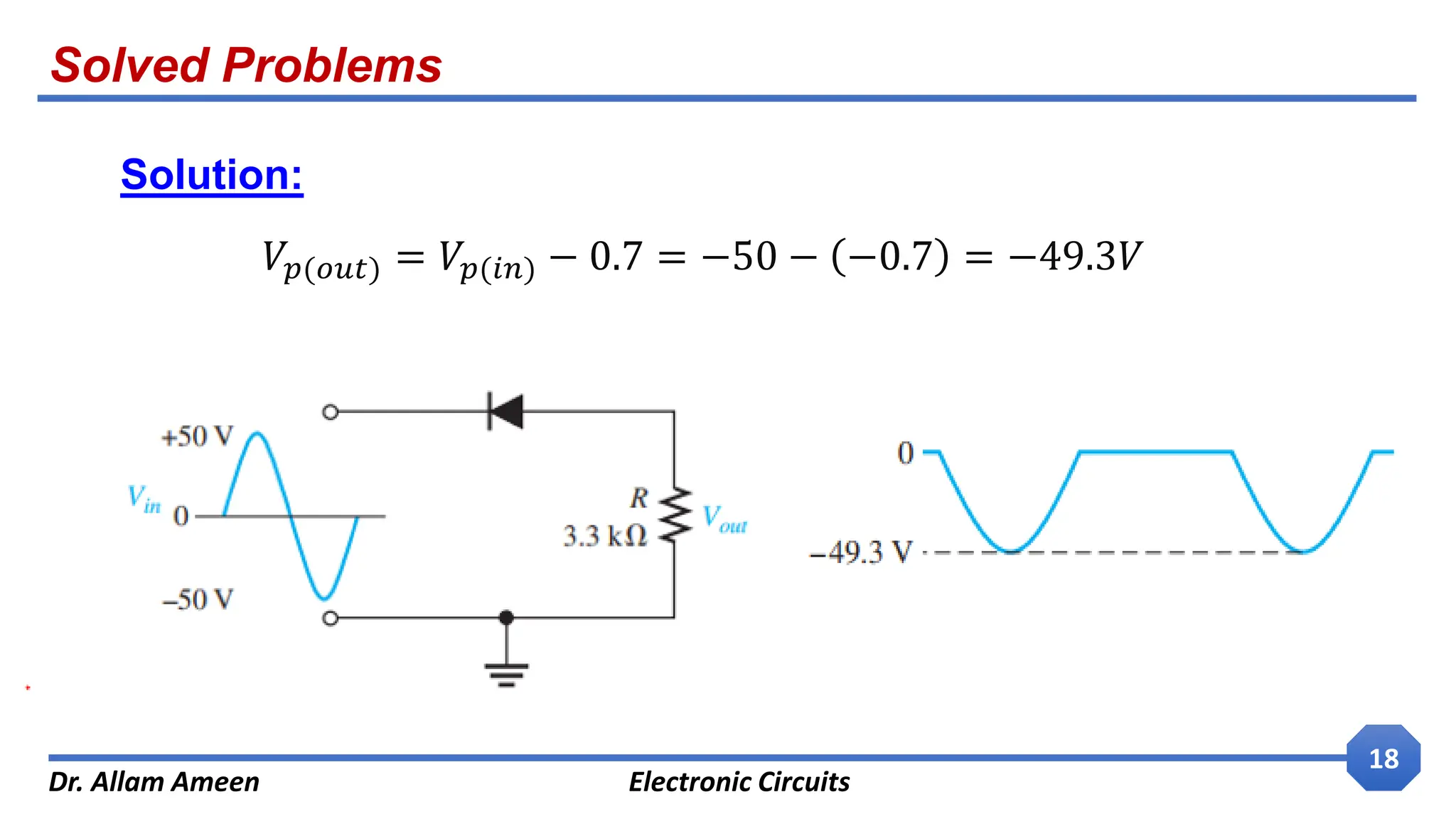
Solution:
𝑉𝑝(𝑜𝑢𝑡) = 𝑉𝑝(𝑖𝑛) − 0.7 = −50 − −0.7 = −49.3𝑉
Solved Problems
Dr. Allam Ameen Electronic Circuits
19
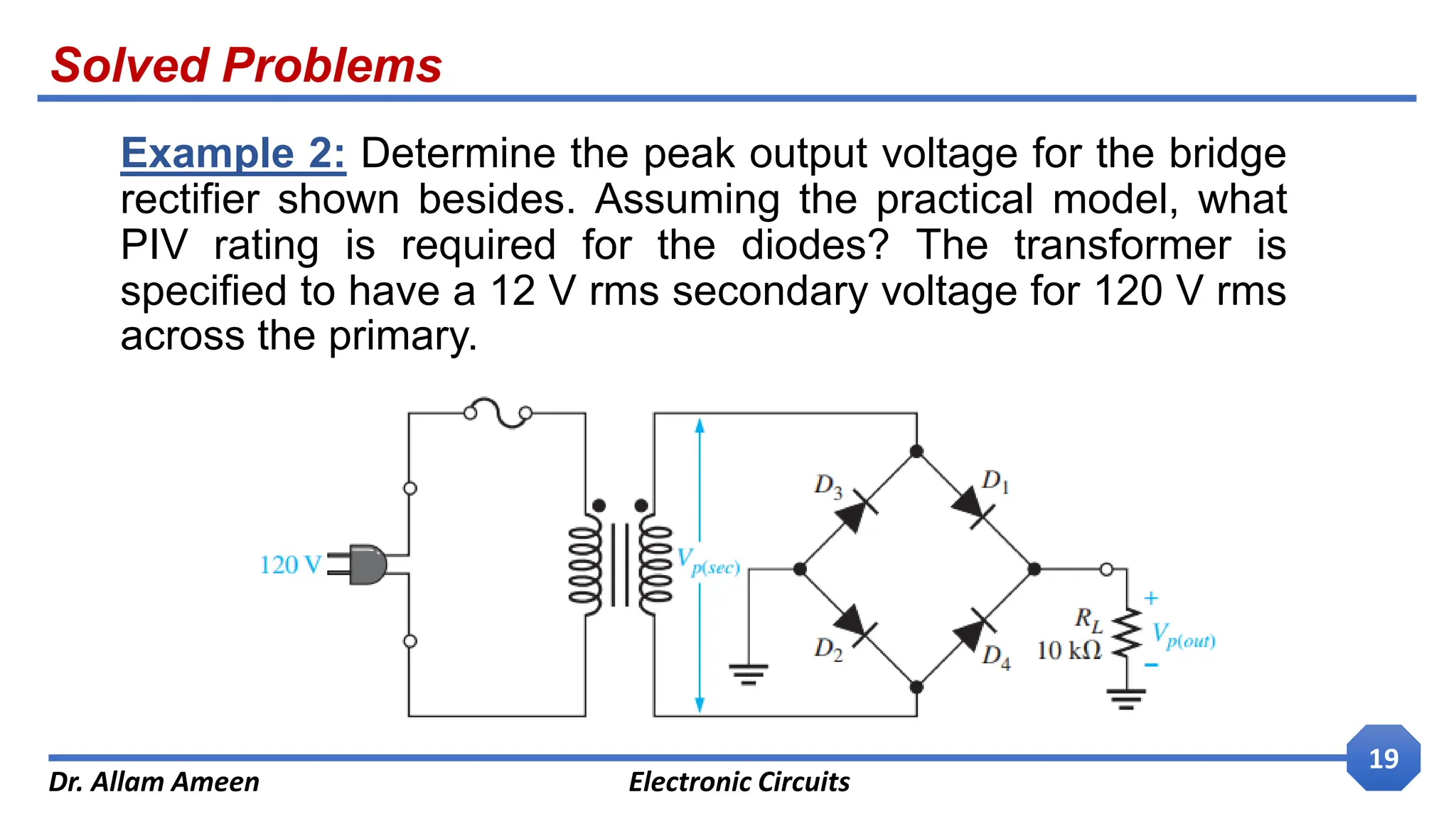
Example 2: Determine the peak output voltage for the bridge
rectifier shown besides. Assuming the practical model, what
PIV rating is required for the diodes? The transformer is
specified to have a 12 V rms secondary voltage for 120 V rms
across the primary.
Solved Problems
Dr. Allam Ameen Electronic Circuits
20
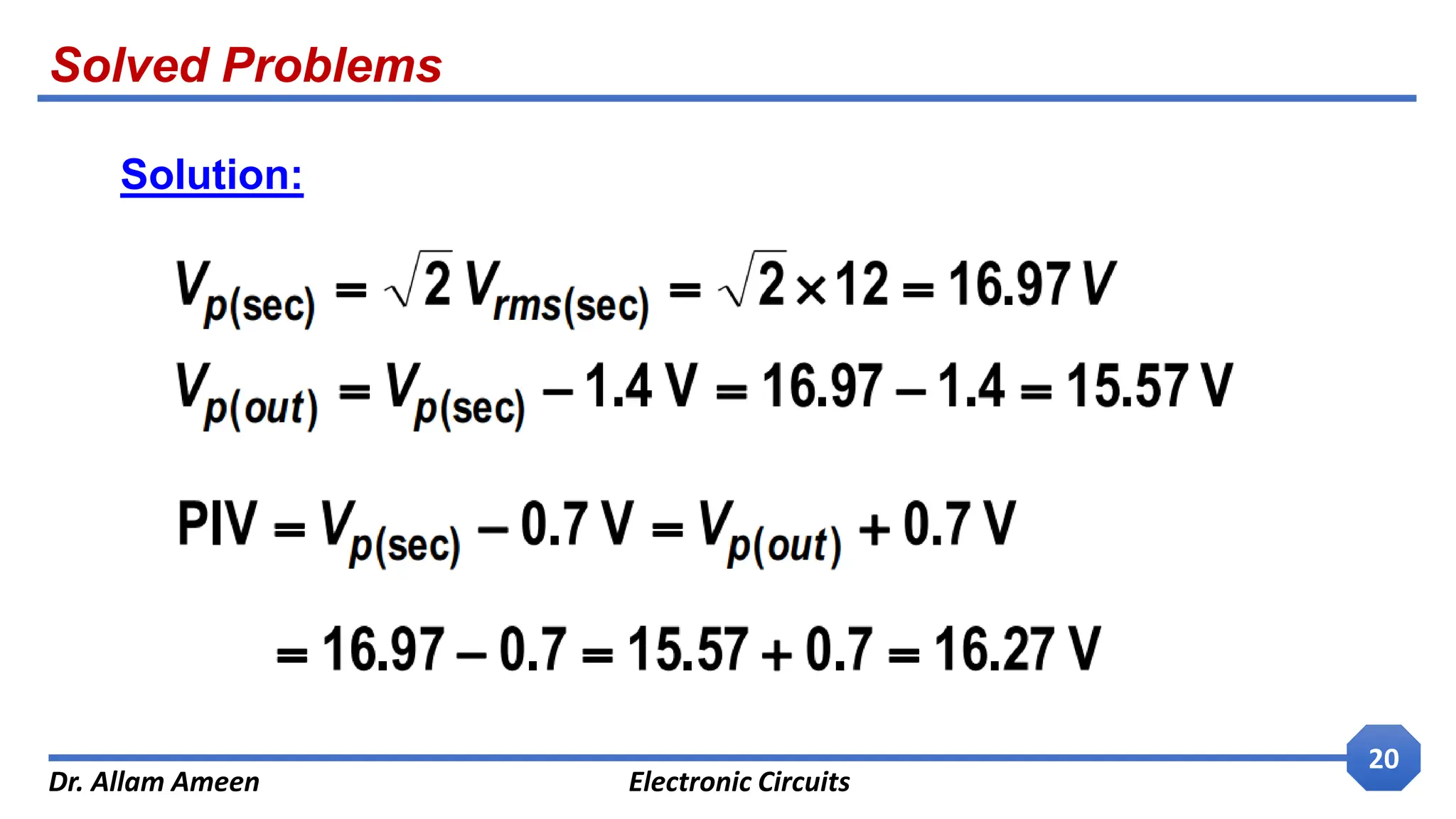
Solution:
Power Supply Filters
Dr. Allam Ameen Electronic Circuits
21
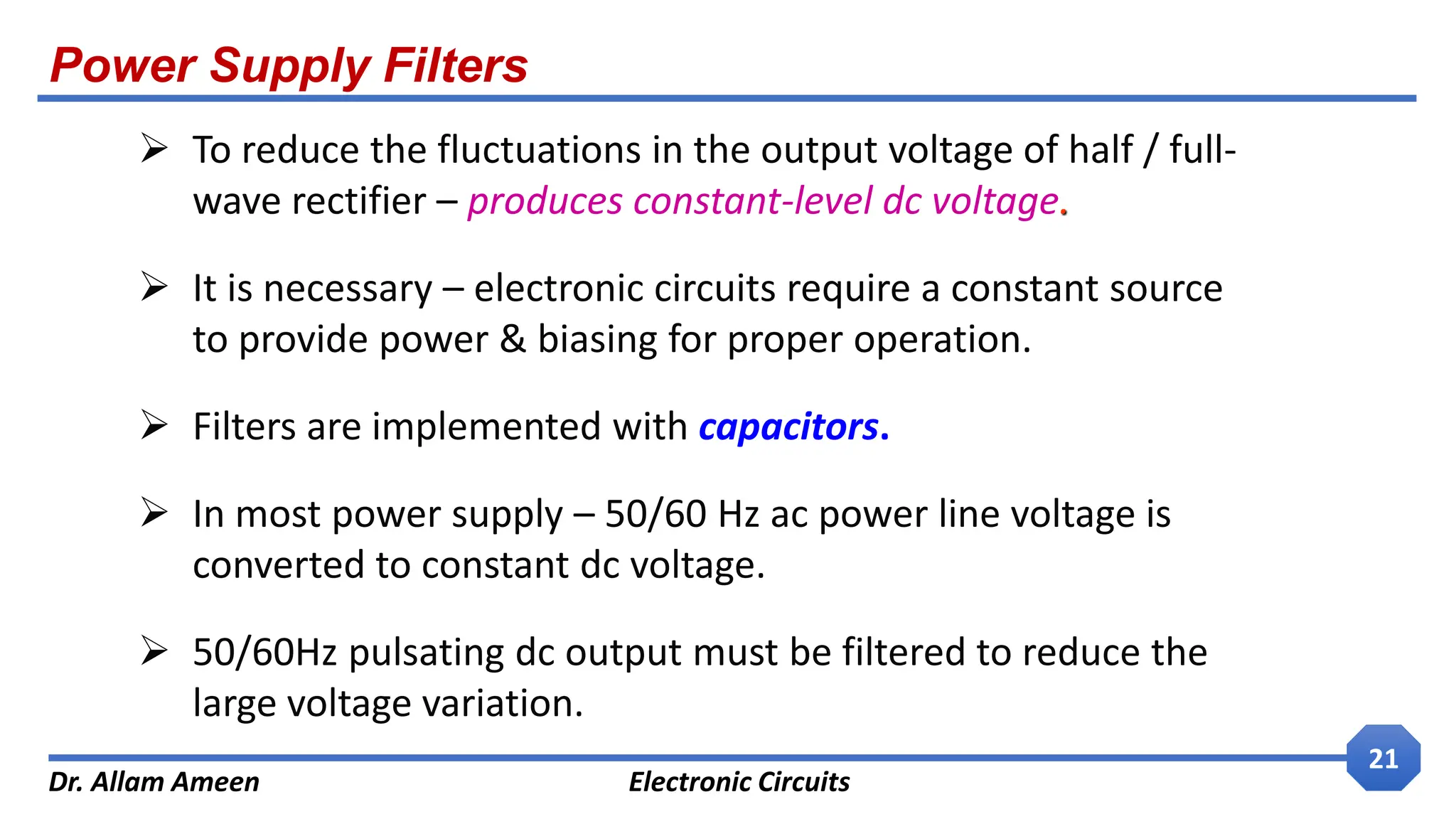
 To reduce the fluctuations in the output voltage of half / full-
wave rectifier – produces constant-level dc voltage.
 It is necessary – electronic circuits require a constant source
to provide power & biasing for proper operation.
 Filters are implemented with capacitors.
 In most power supply – 50/60 Hz ac power line voltage is
converted to constant dc voltage.
 50/60Hz pulsating dc output must be filtered to reduce the
large voltage variation.
Power Supply Filters
Dr. Allam Ameen Electronic Circuits
22
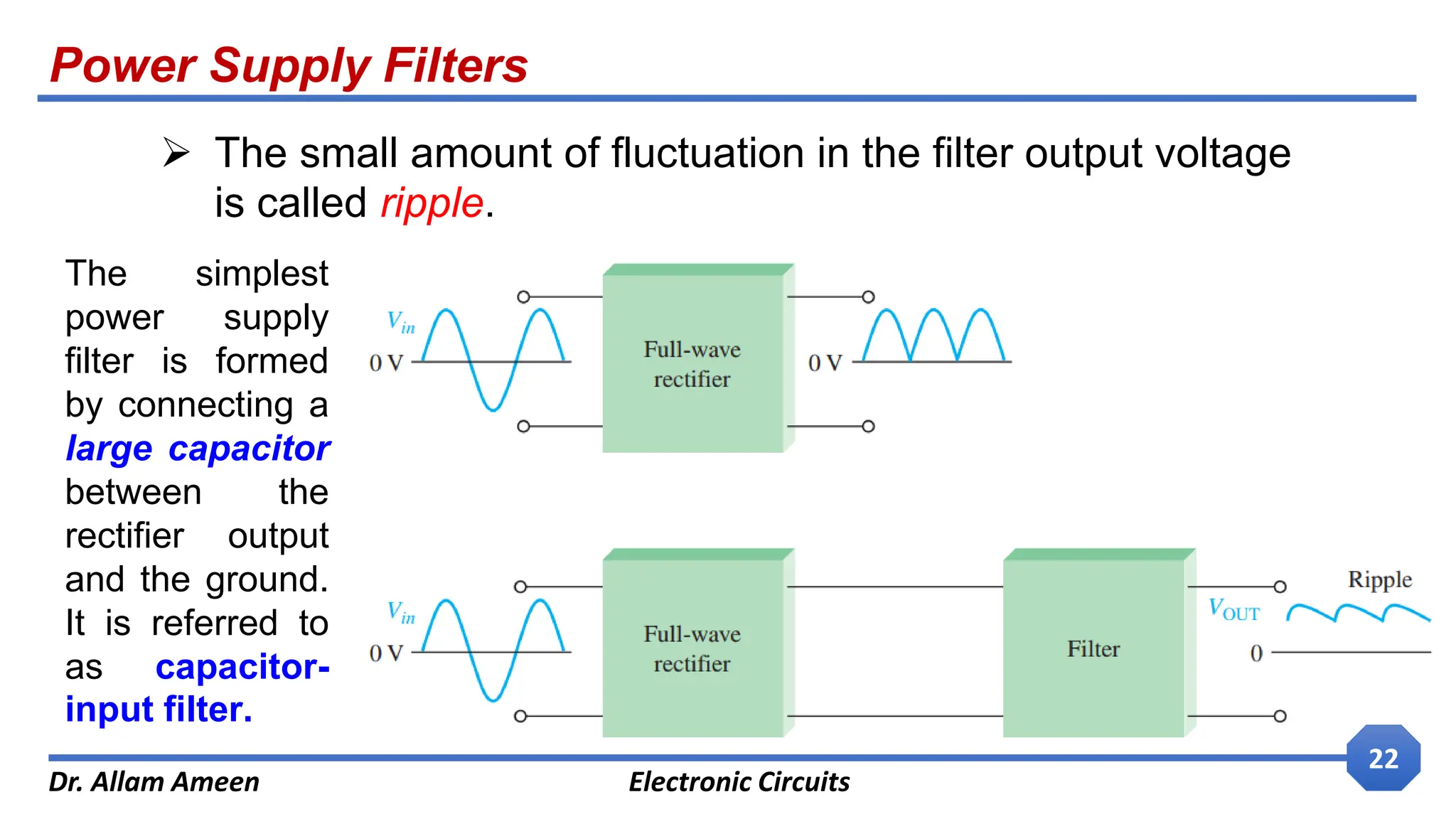
 The small amount of fluctuation in the filter output voltage
is called ripple.
The simplest
power supply
filter is formed
by connecting a
large capacitor
between the
rectifier output
and the ground.
It is referred to
as capacitor-
input filter.
Power Supply Filters
Dr. Allam Ameen Electronic Circuits
23
Capacitive Filter
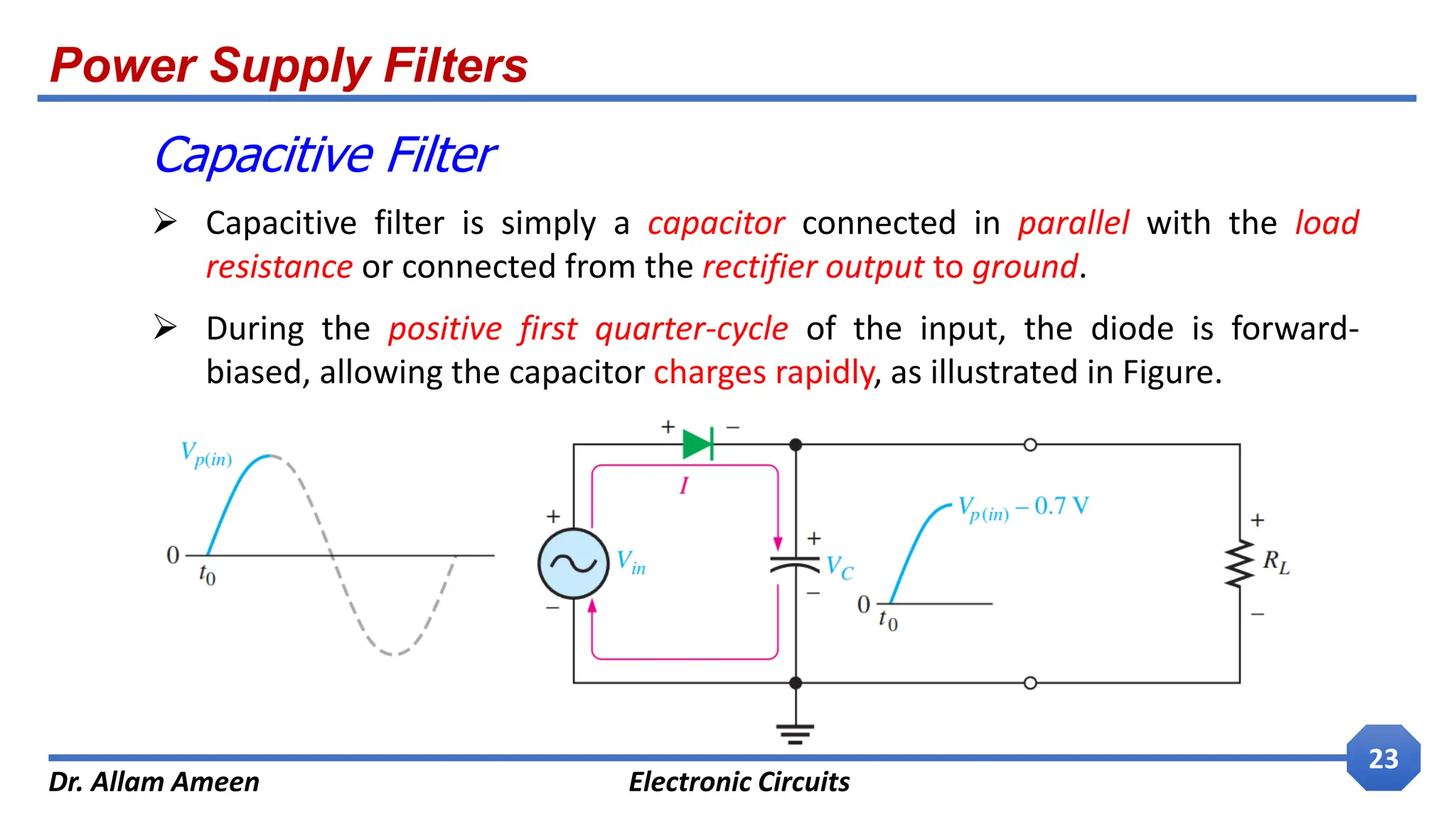
 Capacitive filter is simply a capacitor connected in parallel with the load
resistance or connected from the rectifier output to ground.
 During the positive first quarter-cycle of the input, the diode is forward-
biased, allowing the capacitor charges rapidly, as illustrated in Figure.
Power Supply Filters
Dr. Allam Ameen Electronic Circuits
24
Capacitive Filter
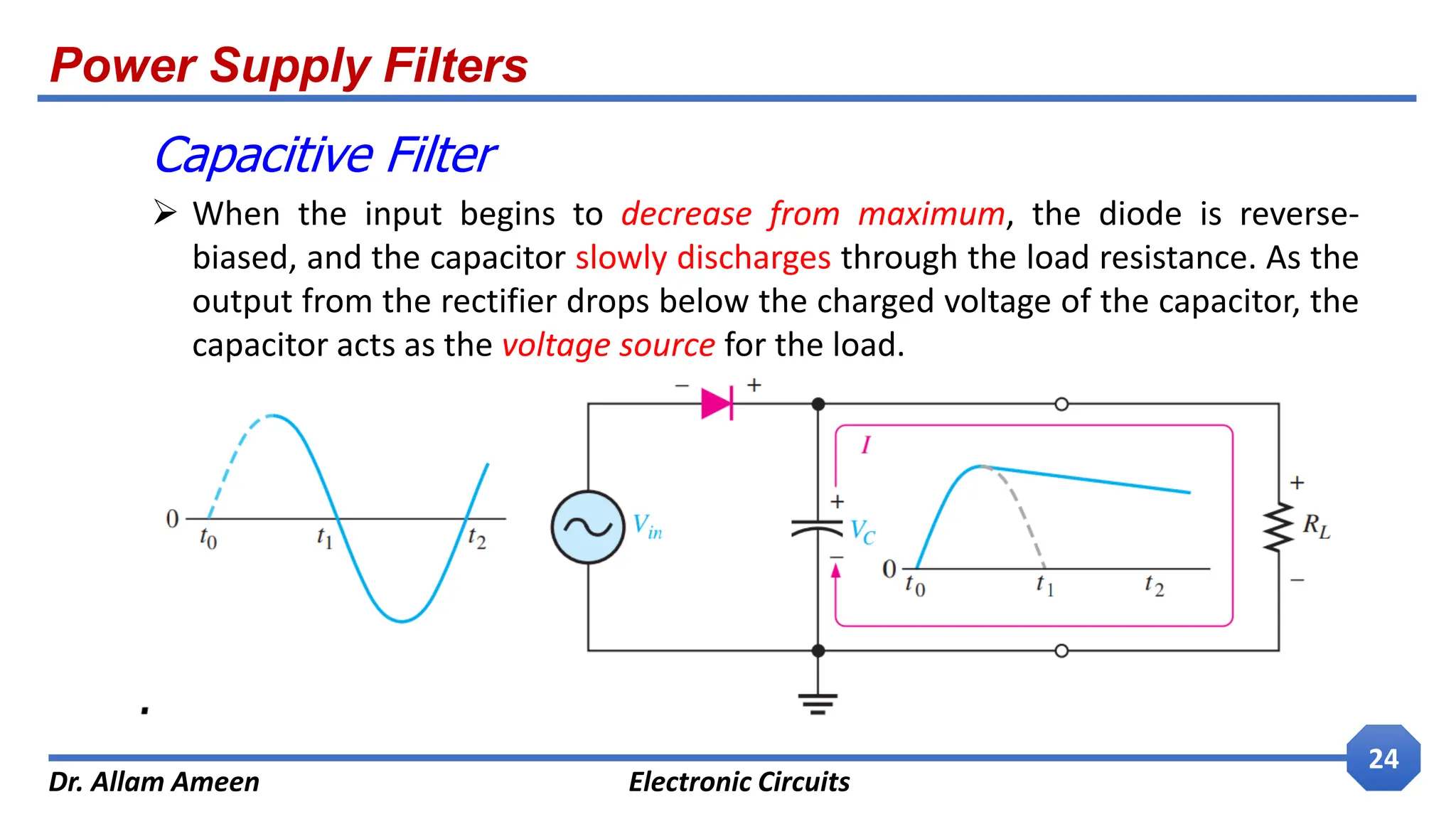
 When the input begins to decrease from maximum, the diode is reverse-
biased, and the capacitor slowly discharges through the load resistance. As the
output from the rectifier drops below the charged voltage of the capacitor, the
capacitor acts as the voltage source for the load.
Power Supply Filters
Dr. Allam Ameen Electronic Circuits
25
Capacitive Filter
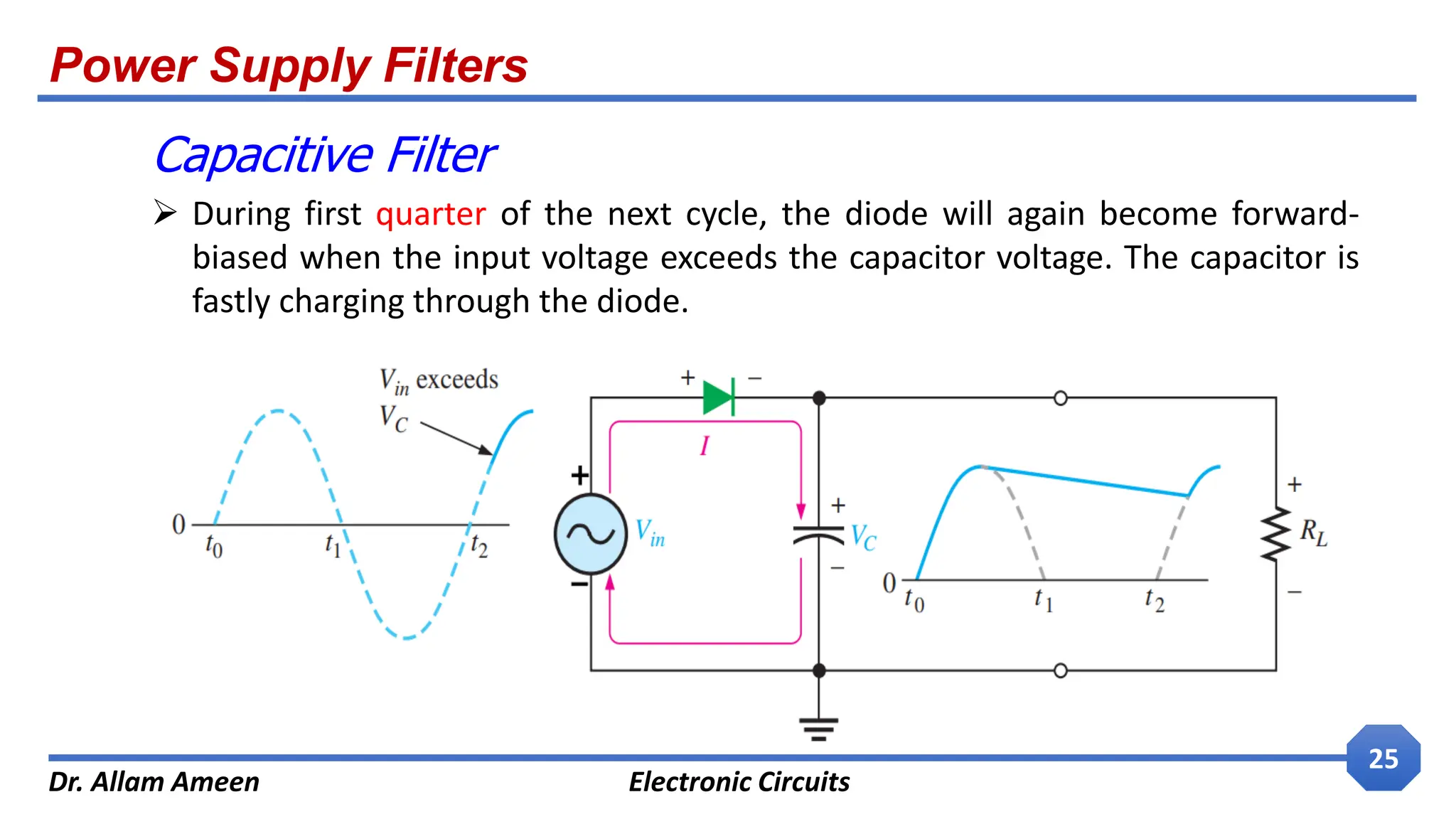
 During first quarter of the next cycle, the diode will again become forward-
biased when the input voltage exceeds the capacitor voltage. The capacitor is
fastly charging through the diode.
Power Supply Filters
Dr. Allam Ameen Electronic Circuits
26
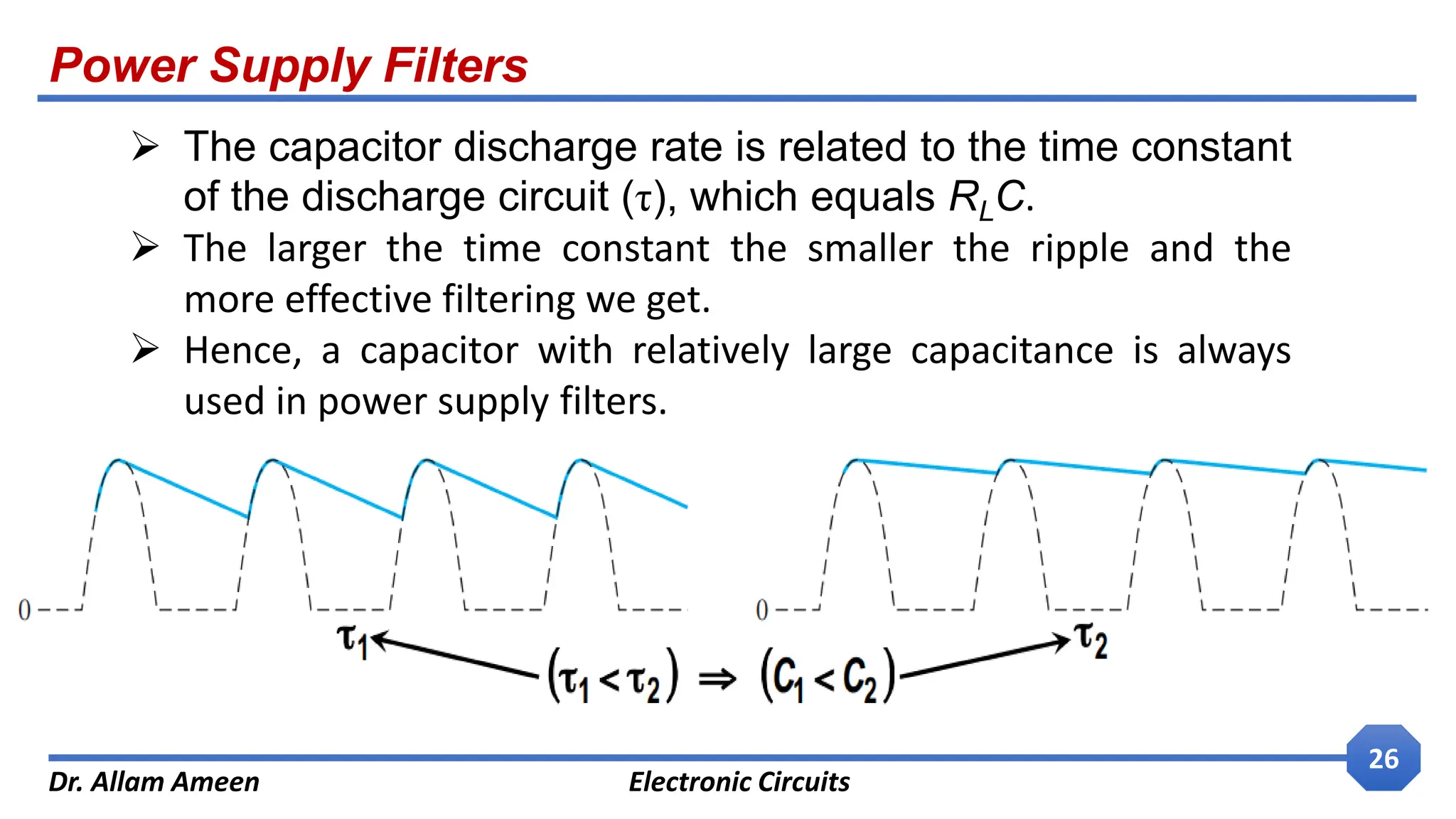
 The capacitor discharge rate is related to the time constant
of the discharge circuit (τ), which equals RLC.
 The larger the time constant the smaller the ripple and the
more effective filtering we get.
 Hence, a capacitor with relatively large capacitance is always
used in power supply filters.
Power Supply Filters
Dr. Allam Ameen Electronic Circuits
27
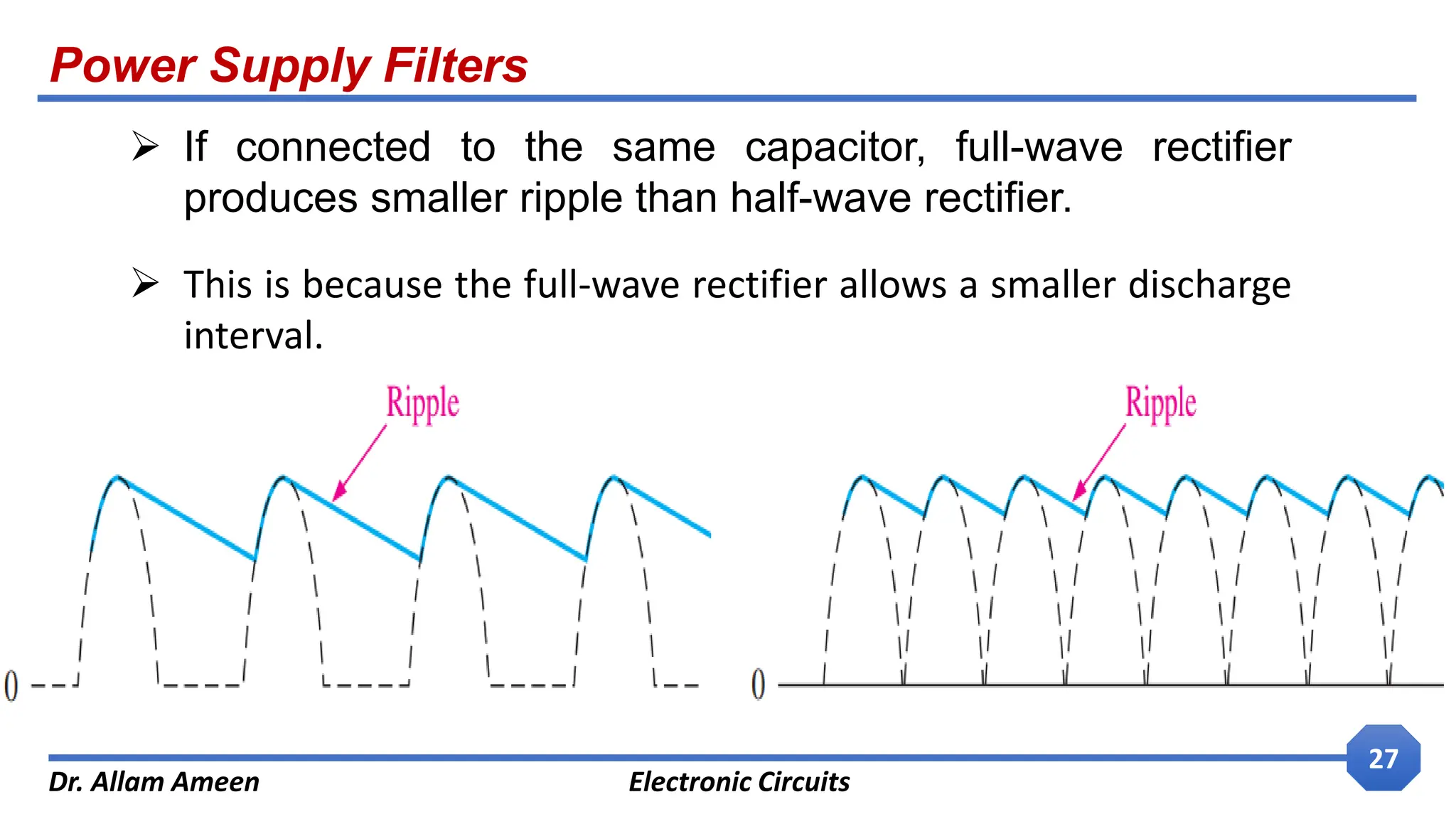
 If connected to the same capacitor, full-wave rectifier
produces smaller ripple than half-wave rectifier.
 This is because the full-wave rectifier allows a smaller discharge
interval.
Power Supply Filters
Dr. Allam Ameen Electronic Circuits
28
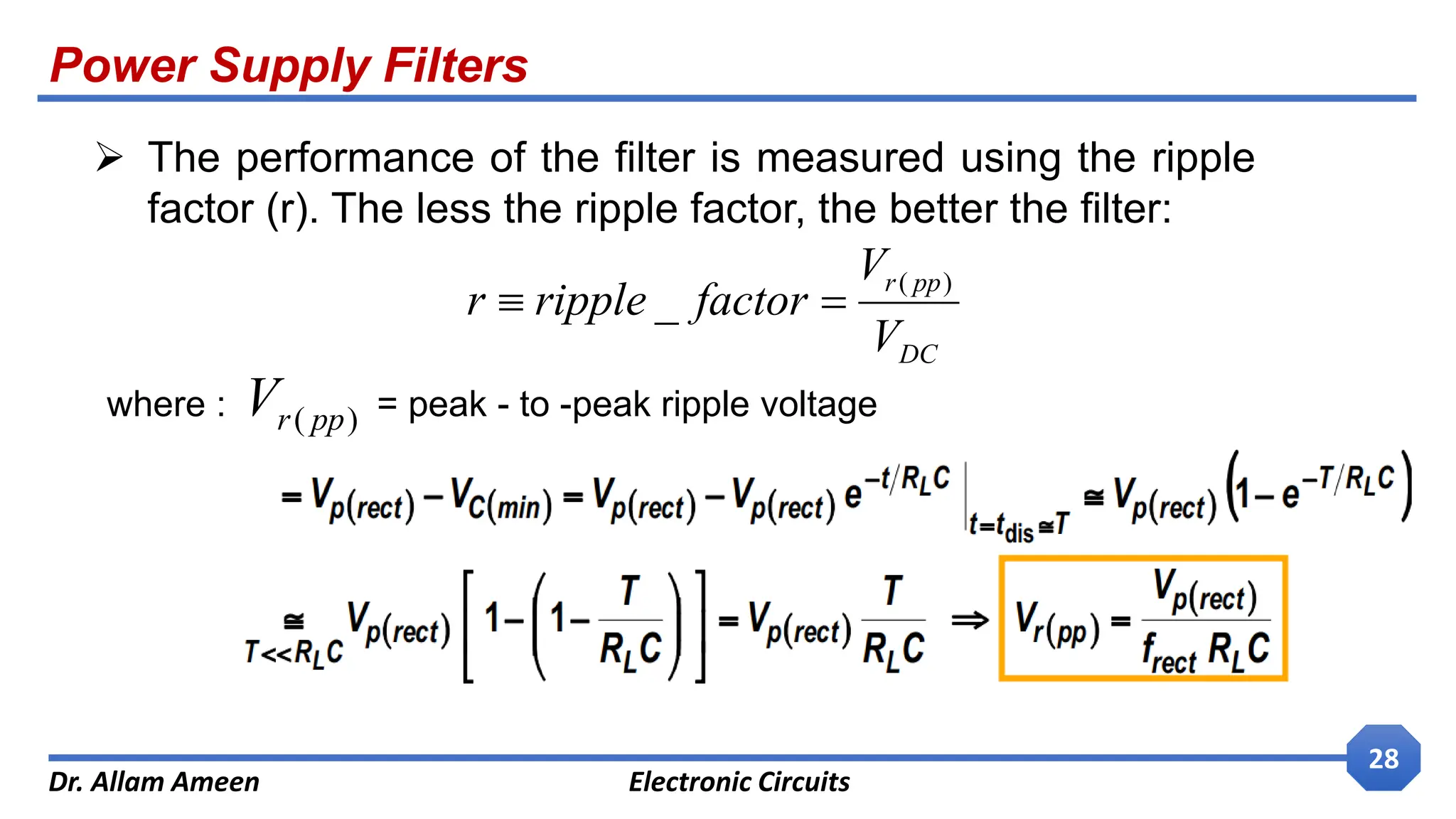
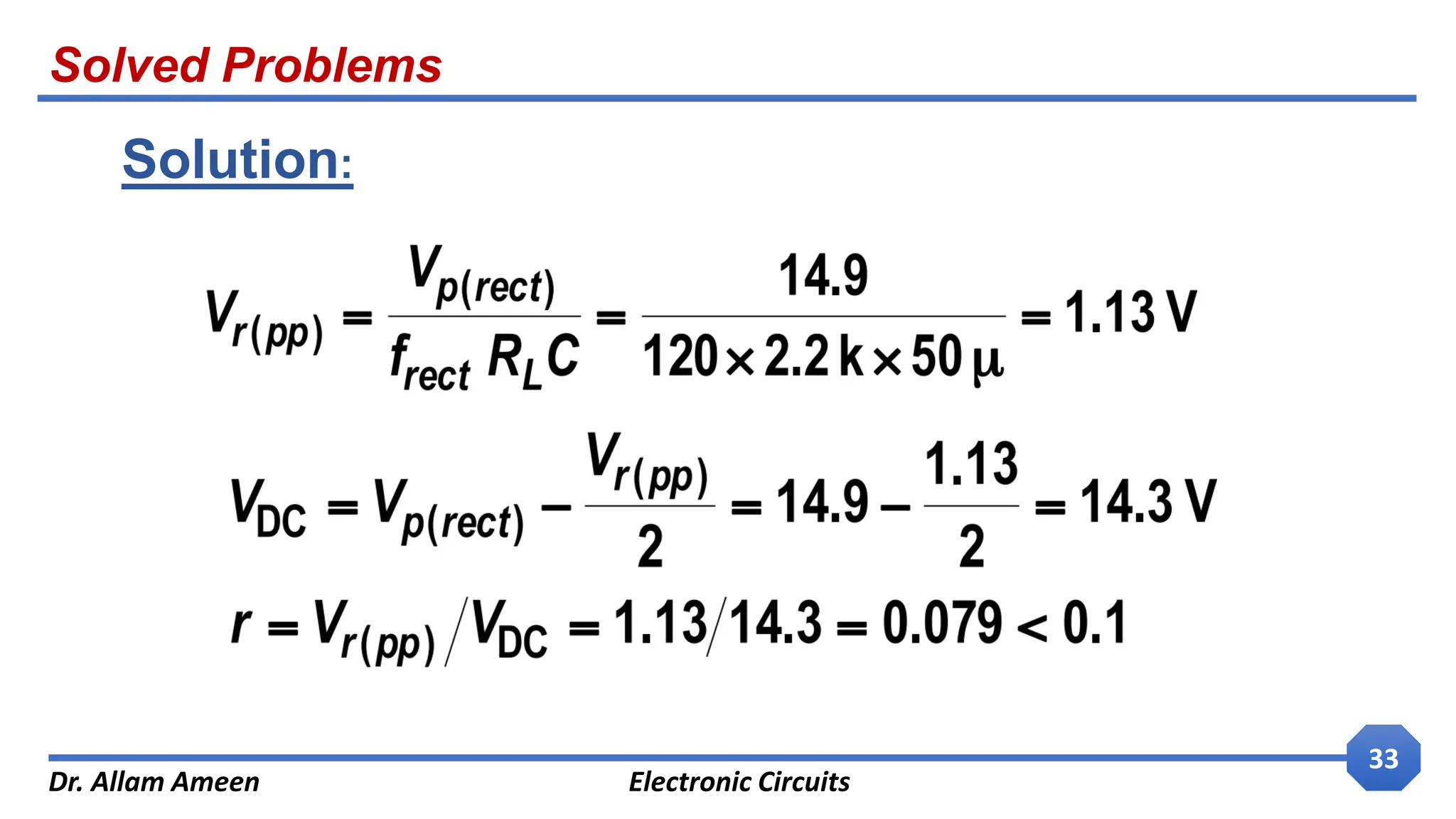
 The performance of the filter is measured using the ripple
factor (r). The less the ripple factor, the better the filter:
DC
pp
r
V
V
factor
ripple
r
)
(
_ 

where : = peak - to -peak ripple voltage
)
( pp
r
V
Power Supply Filters
Dr. Allam Ameen Electronic Circuits
29
 Lower ripple factor  better filter [can be lowered by
increasing the value of filter capacitor or increasing the load
resistance]
Power Supply Filters
Dr. Allam Ameen Electronic Circuits
30
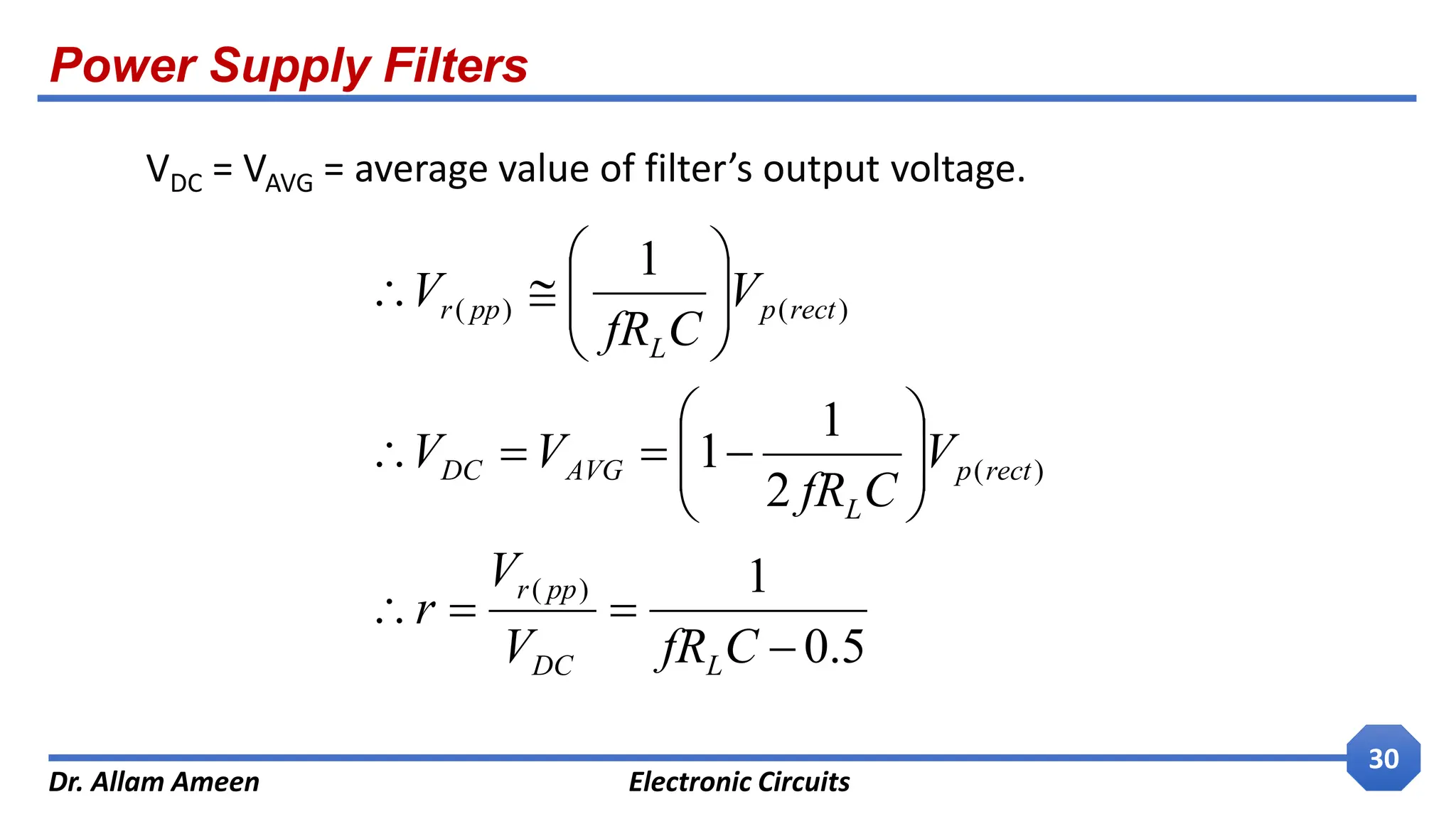
VDC = VAVG = average value of filter’s output voltage.
5
.
0
1
2
1
1
1
)
(
)
(
)
(
)
(


























C
fR
V
V
r
V
C
fR
V
V
V
C
fR
V
L
DC
pp
r
rect
p
L
AVG
DC
rect
p
L
pp
r
Solved Problems
Dr. Allam Ameen Electronic Circuits
31
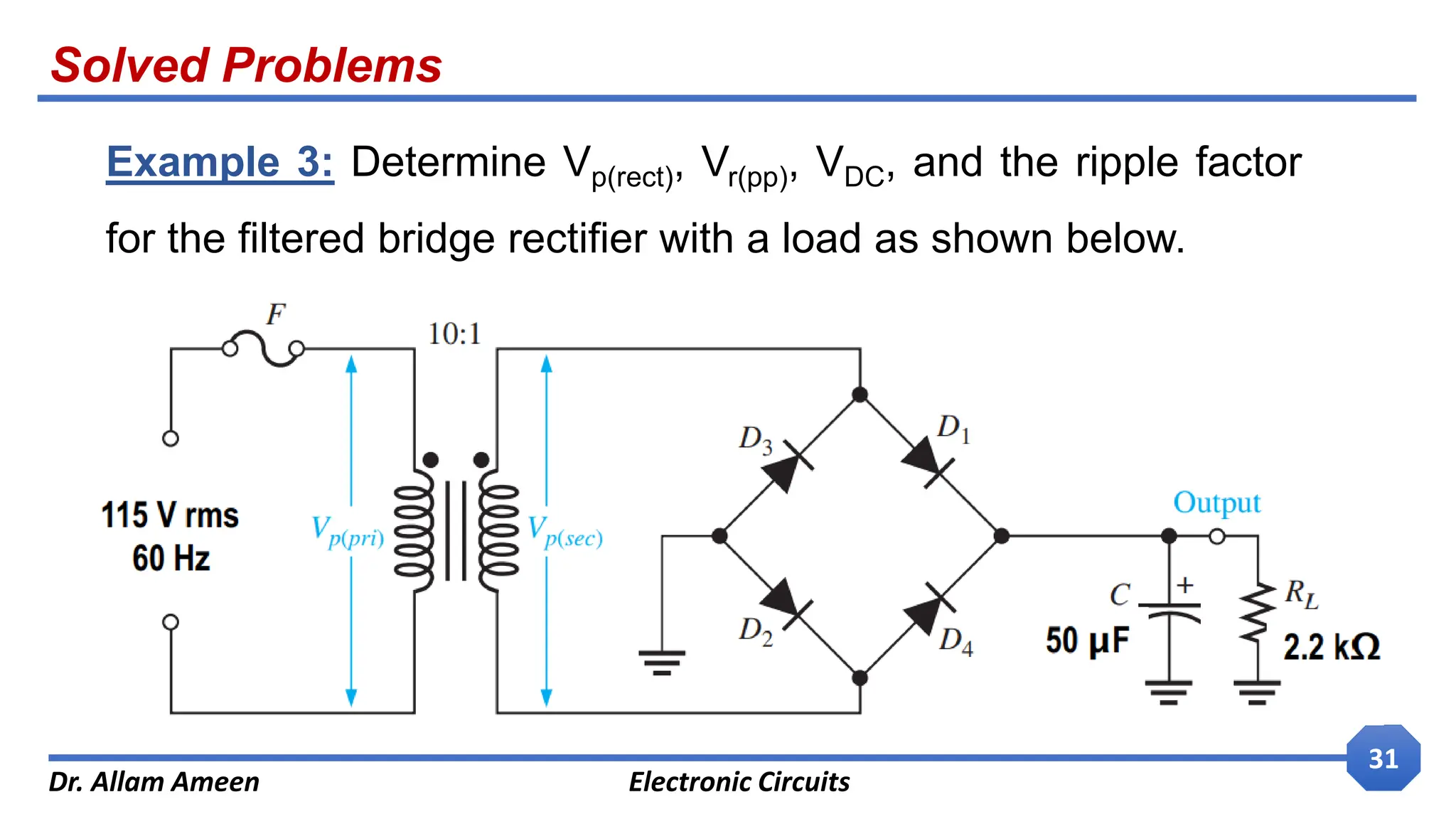
Example 3: Determine Vp(rect), Vr(pp), VDC, and the ripple factor
for the filtered bridge rectifier with a load as shown below.
Solved Problems
Dr. Allam Ameen Electronic Circuits
32
Solution:
Solved Problems
Dr. Allam Ameen Electronic Circuits
33
Solution:
Diode Limiters
Dr. Allam Ameen Electronic Circuits
34
 The diode limiter (clipper) is a circuit that clips the portion from
the input waveform that falls either above or below certain
reference level.
 Limiting circuits limit the positive or negative amount of an input
voltage to a specific value. It is very useful for protection.
 2 basic clipper configuration:
 Positive clipper.
 Negative clipper.
Diode Limiters
Dr. Allam Ameen Electronic Circuits
35
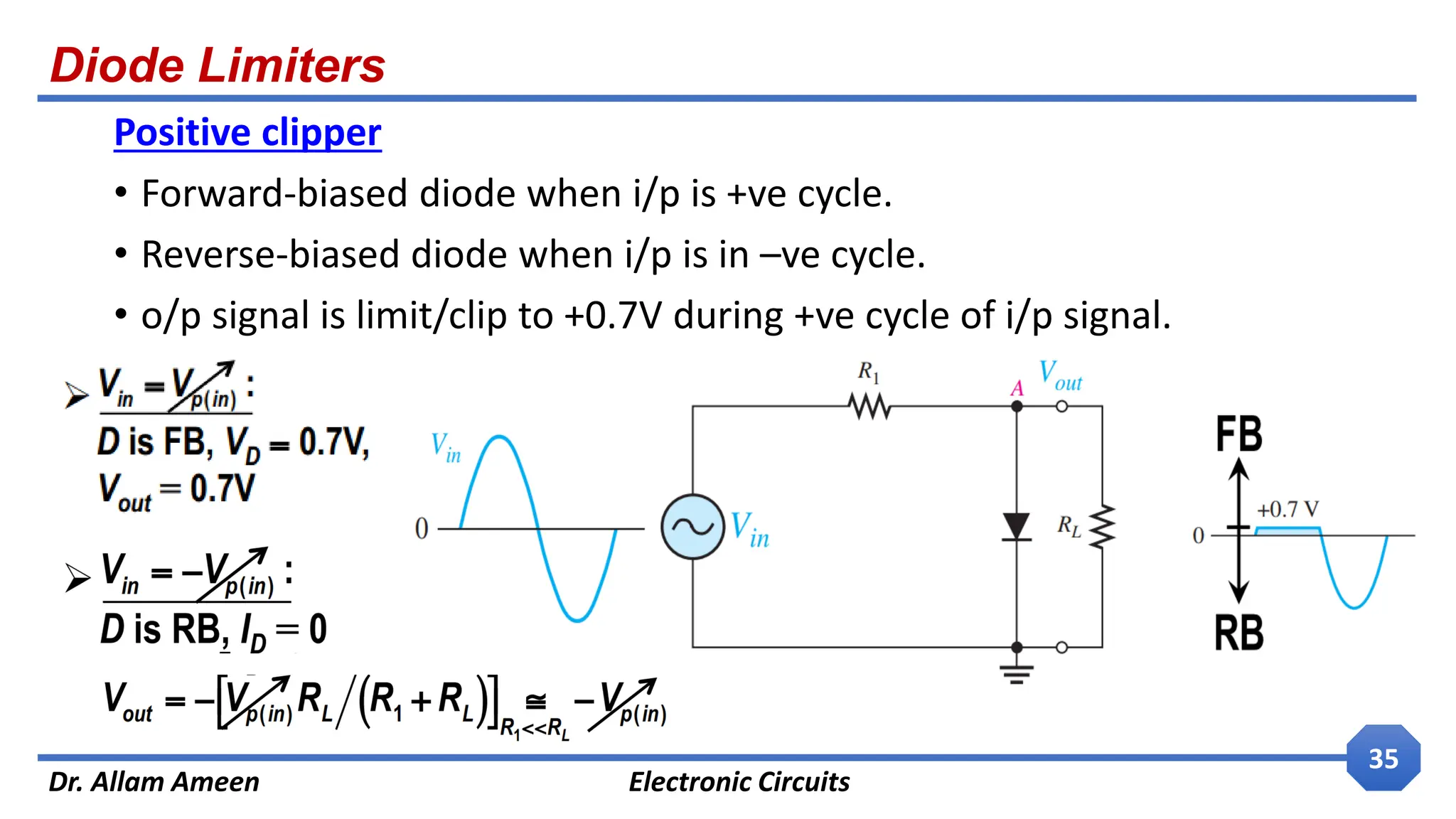
Positive clipper
• Forward-biased diode when i/p is +ve cycle.
• Reverse-biased diode when i/p is in –ve cycle.
• o/p signal is limit/clip to +0.7V during +ve cycle of i/p signal.
Diode Limiters
Dr. Allam Ameen Electronic Circuits
36
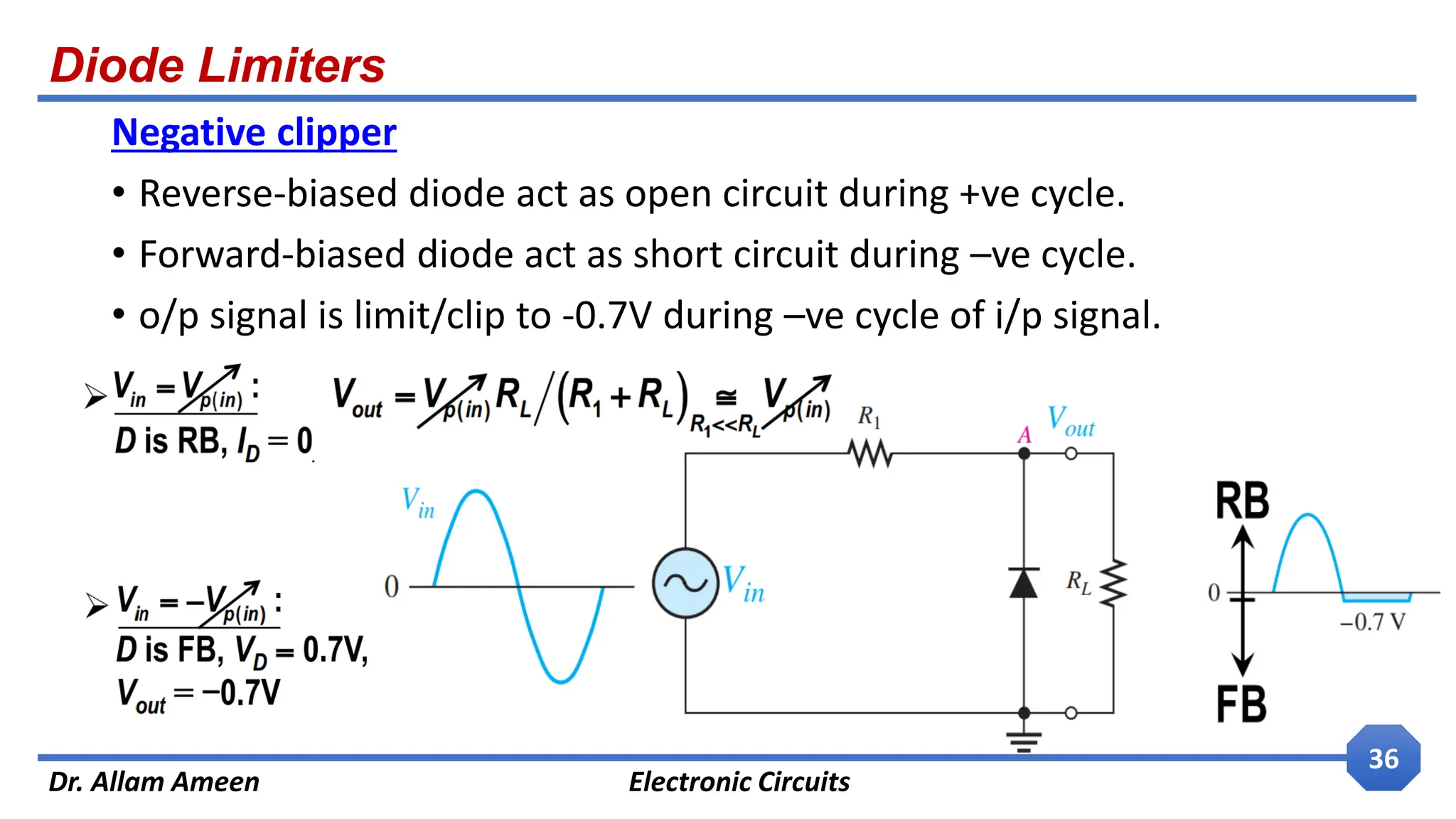
Negative clipper
• Reverse-biased diode act as open circuit during +ve cycle.
• Forward-biased diode act as short circuit during –ve cycle.
• o/p signal is limit/clip to -0.7V during –ve cycle of i/p signal.
Diode Limiters
Dr. Allam Ameen Electronic Circuits
37
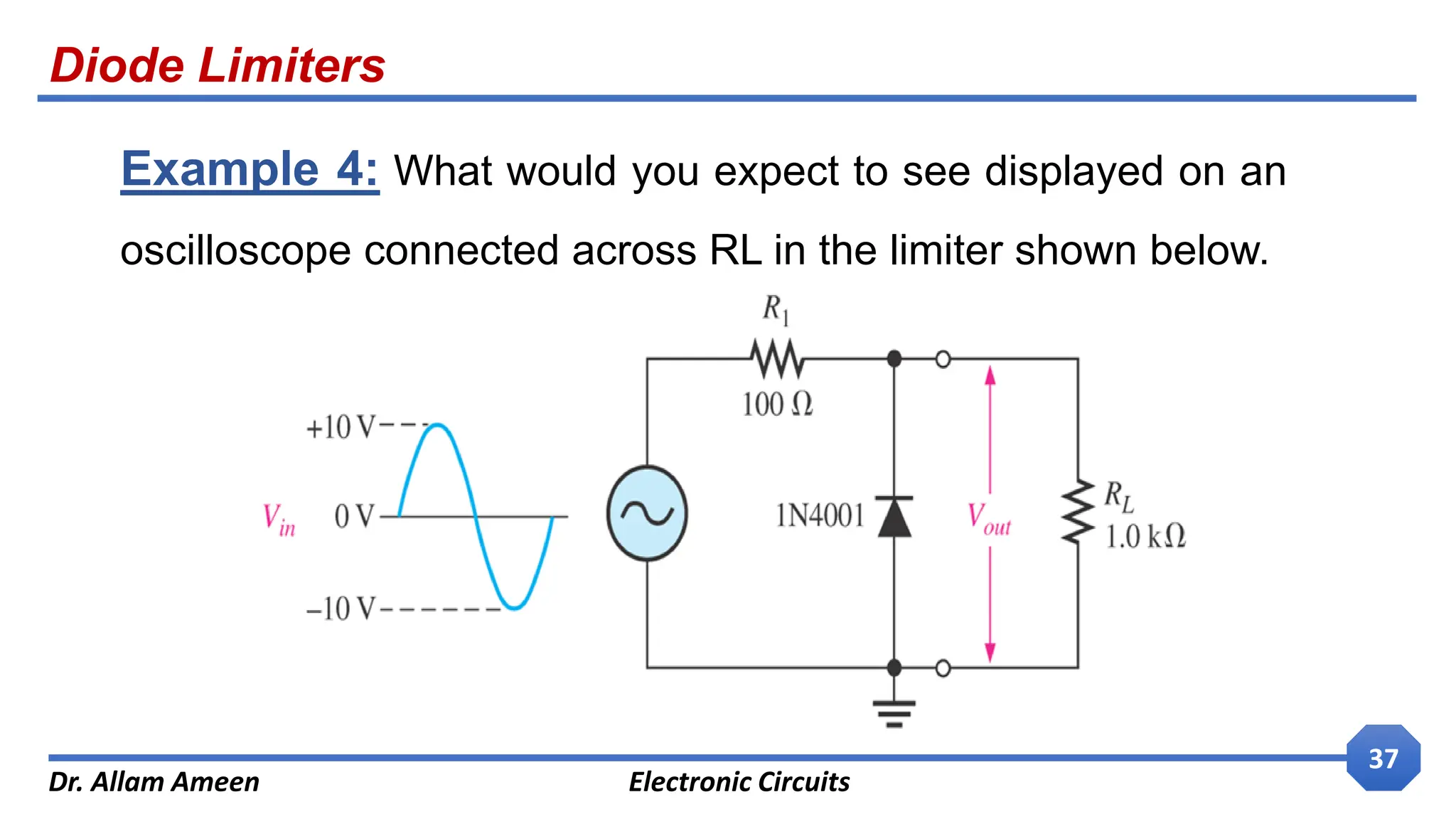
Example 4: What would you expect to see displayed on an
oscilloscope connected across RL in the limiter shown below.
Diode Limiters
Dr. Allam Ameen Electronic Circuits
38
Solution:
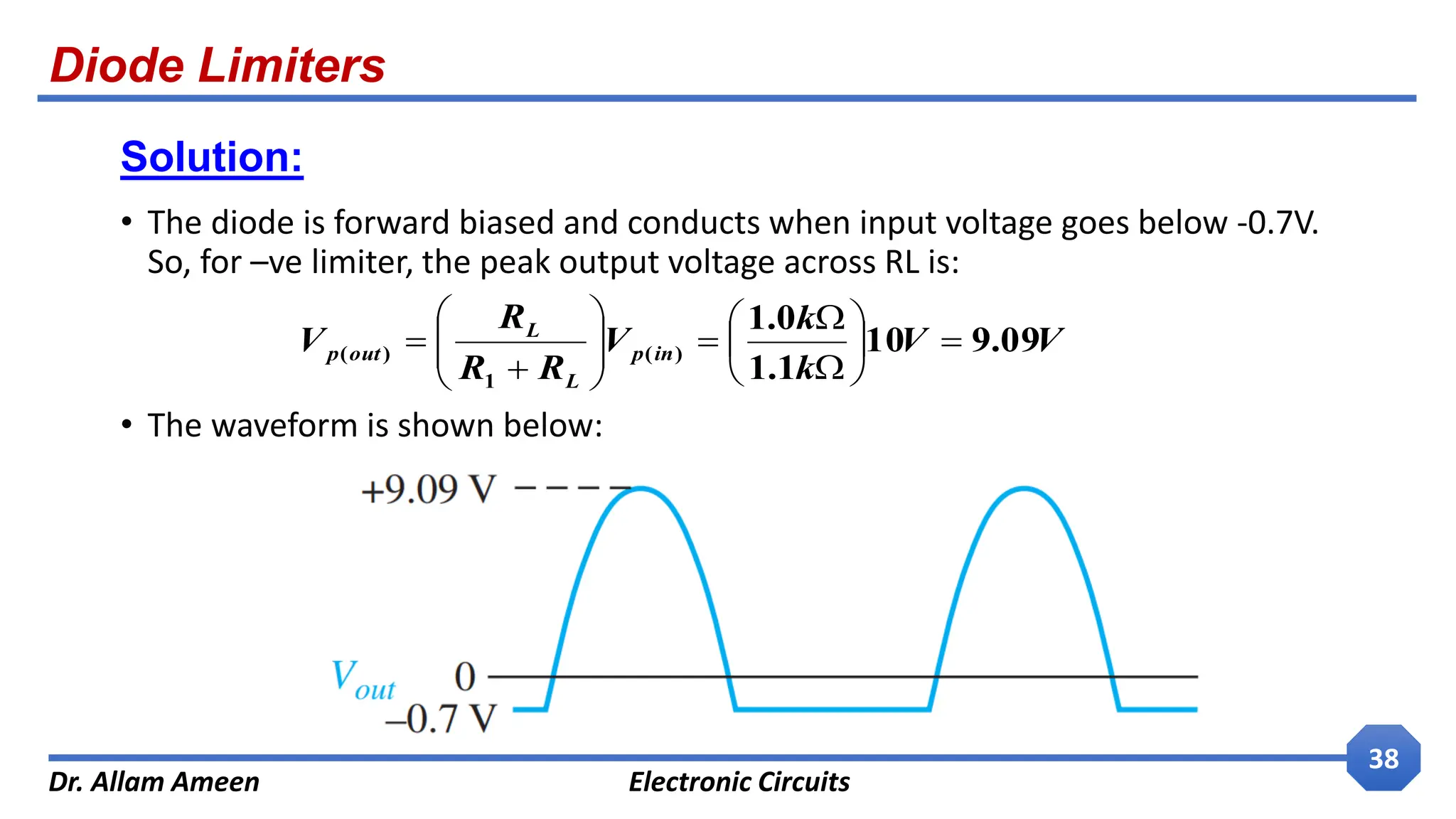
• The diode is forward biased and conducts when input voltage goes below -0.7V.
So, for –ve limiter, the peak output voltage across RL is:
• The waveform is shown below:
V
V
k
k
V
R
R
R
V in
p
L
L
out
p 09
.
9
10
1
.
1
0
.
1
)
(
1
)
( 



















Diode Limiters
Dr. Allam Ameen Electronic Circuits
39
Biased Limiters :
 Use dc biasing source, VBIAS to set limit on the circuit output voltage.
 This allow the circuit to clip input waveform at values other than diode
forward voltage, 0.7V.
 In each circuit, bias voltage is in series with shunt diode. As a result,
the diode conducts and clips the i/p waveform when signal voltage
equals sum of VF and VBIAS.
 2 type of biased limiter:
• Positive-biased limiter
• Negative-biased limiter
Diode Limiters
Dr. Allam Ameen Electronic Circuits
40
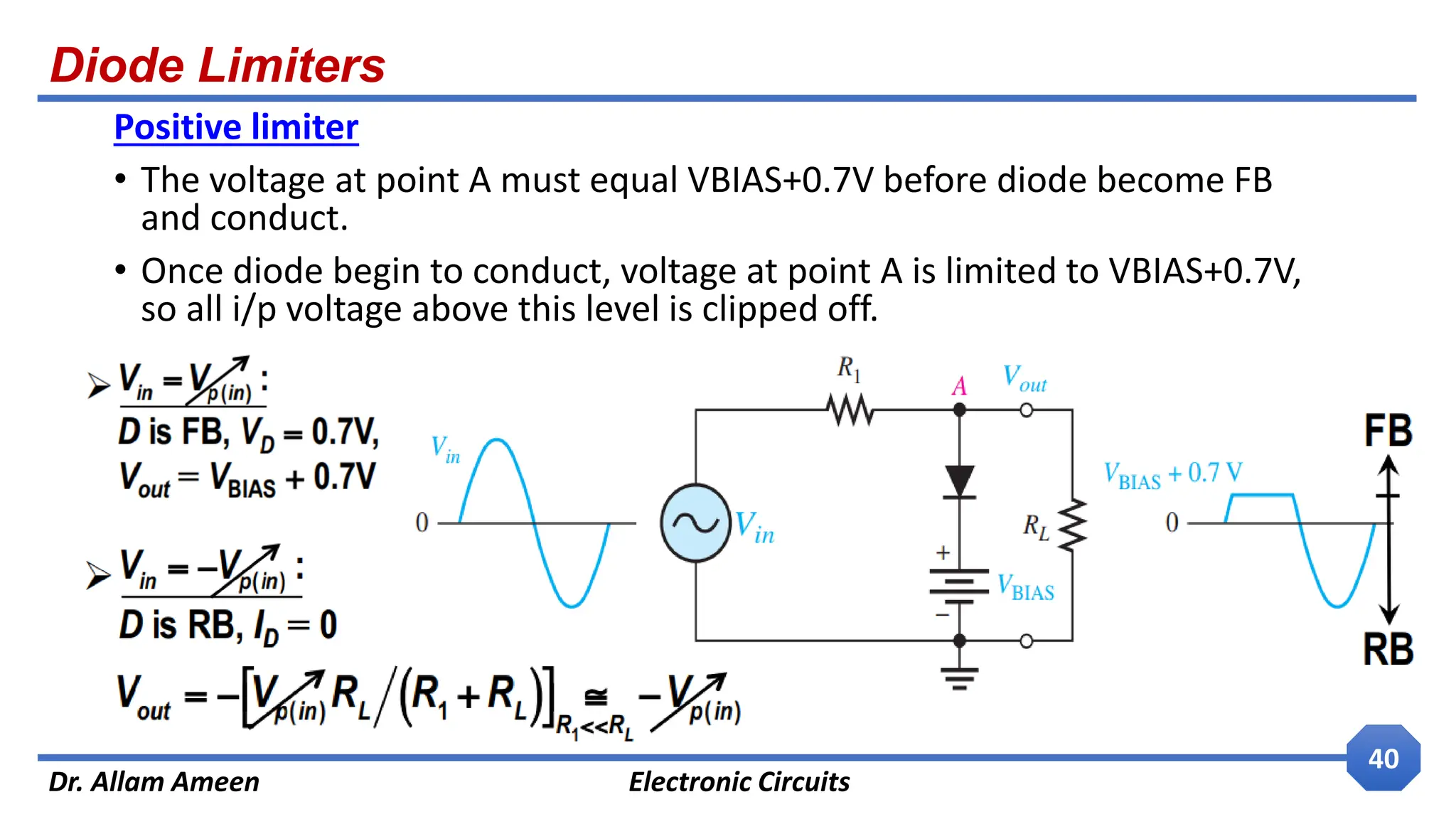
Positive limiter
• The voltage at point A must equal VBIAS+0.7V before diode become FB
and conduct.
• Once diode begin to conduct, voltage at point A is limited to VBIAS+0.7V,
so all i/p voltage above this level is clipped off.
Diode Limiters
Dr. Allam Ameen Electronic Circuits
41
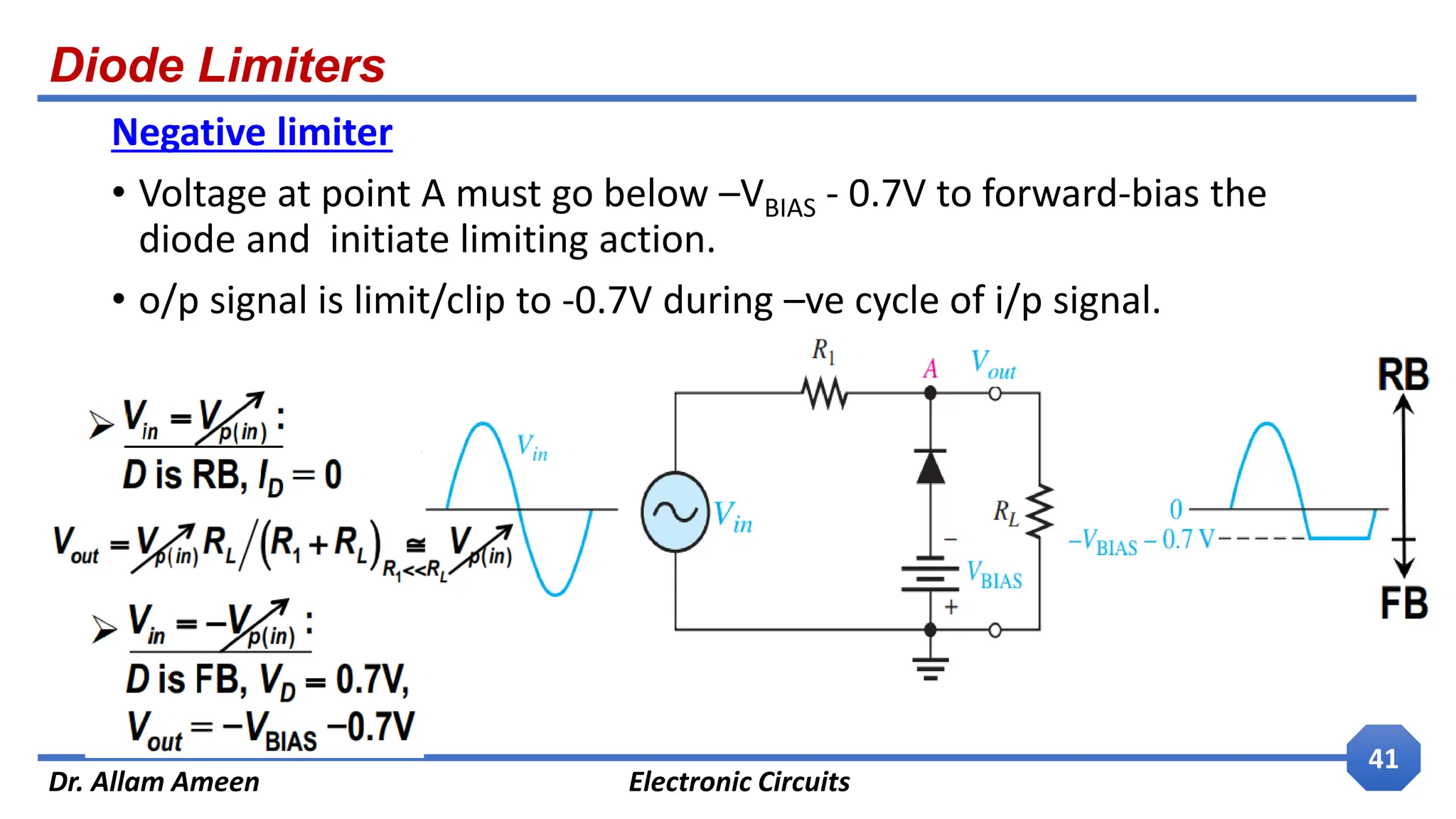
Negative limiter
• Voltage at point A must go below –VBIAS - 0.7V to forward-bias the
diode and initiate limiting action.
• o/p signal is limit/clip to -0.7V during –ve cycle of i/p signal.
Diode Limiters
Dr. Allam Ameen Electronic Circuits
42
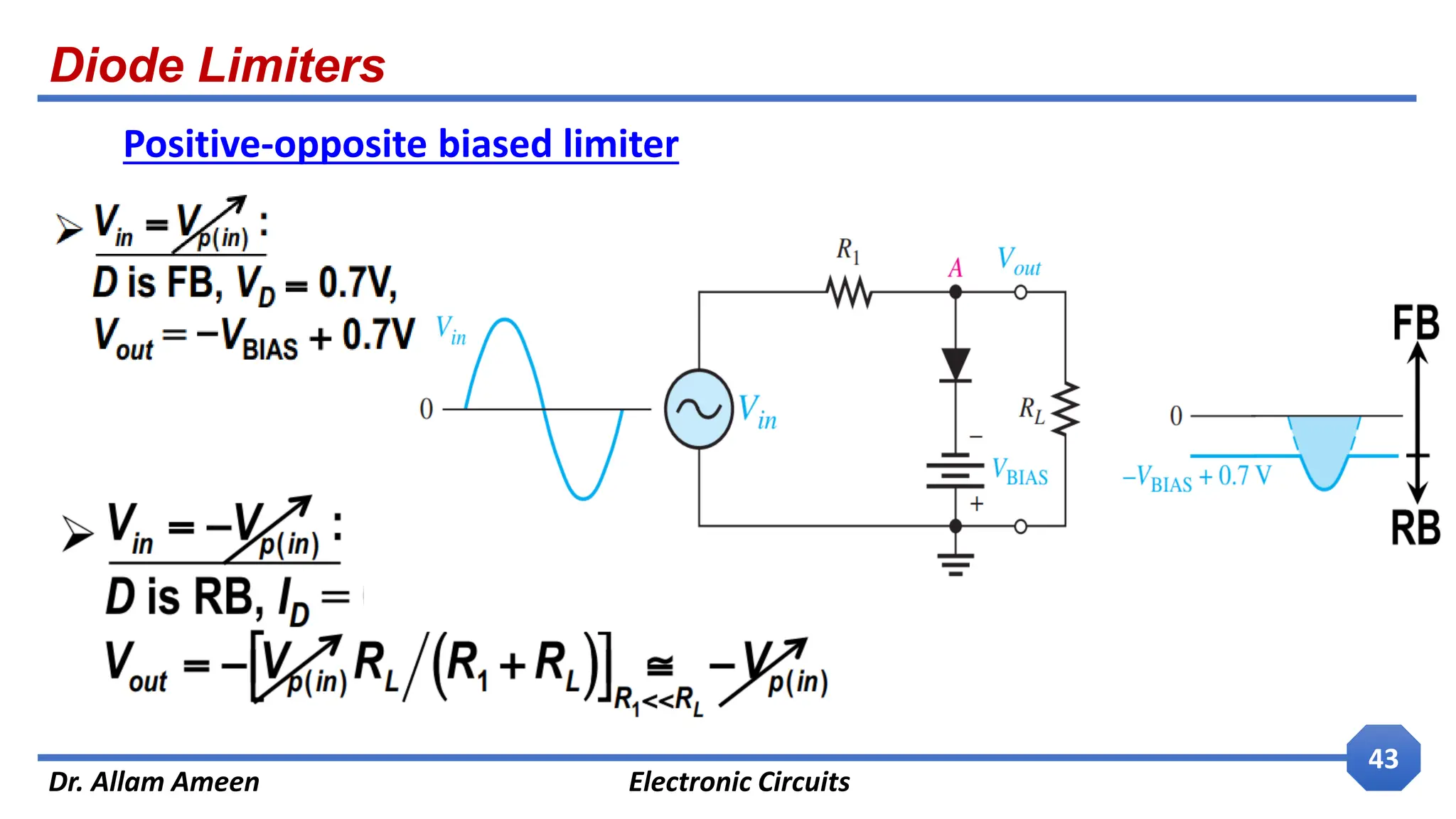
Opposite Biased Limiters :
 Use dc biasing source, VBIAS to set limit on the circuit output voltage.
 If VBIAS is connected is series with the diode, such that their polarities
are opposite to each other, the limiter circuit passes a small portion
from the input waveform and rejects the rest.
 2 type of biased limiter:
• Positive-opposite biased limiter
• Negative-opposite biased limiter
Diode Limiters
Dr. Allam Ameen Electronic Circuits
43
Positive-opposite biased limiter
Diode Limiters
Dr. Allam Ameen Electronic Circuits
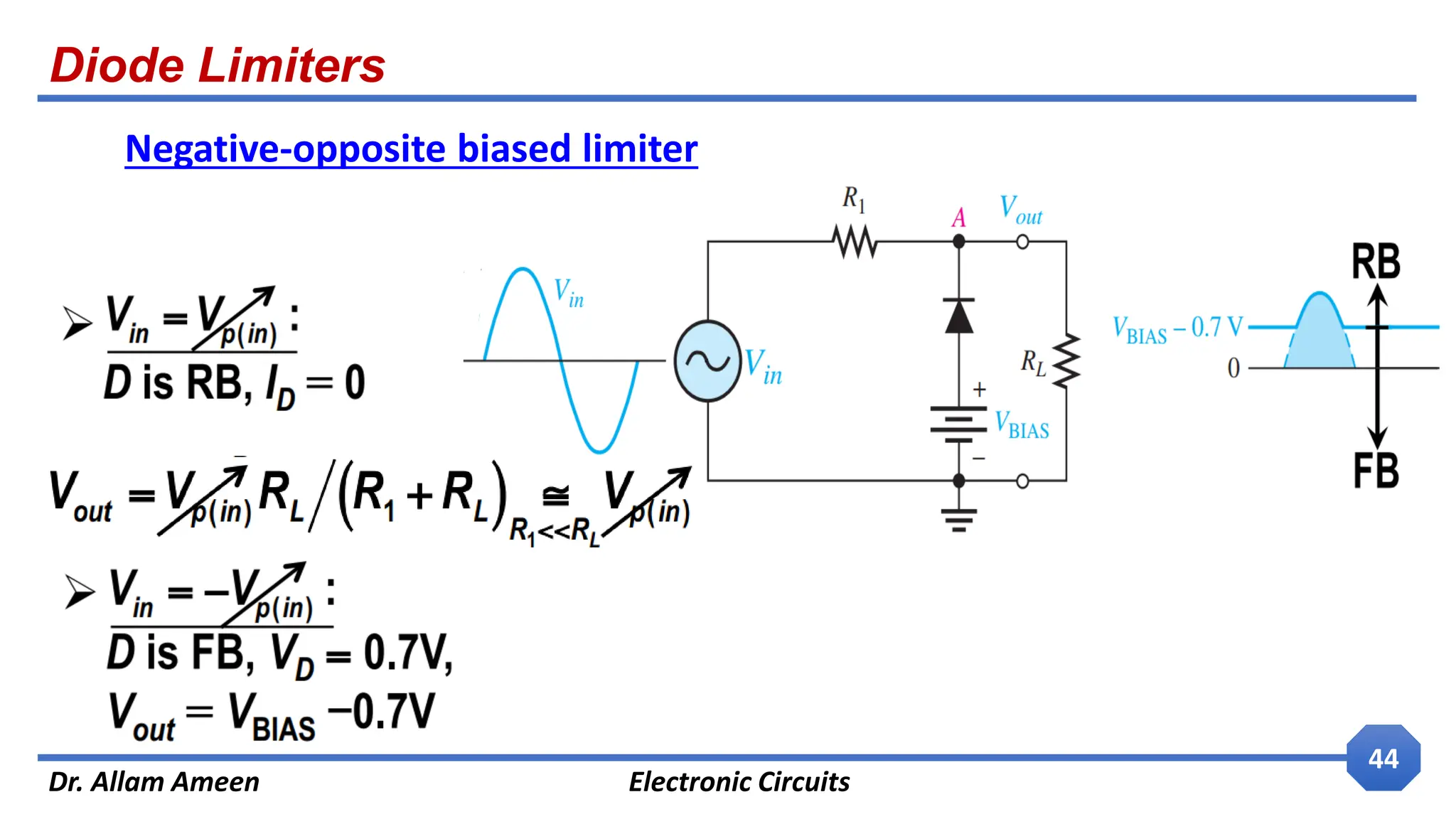
44
Negative-opposite biased limiter
Diode Limiters
Dr. Allam Ameen Electronic Circuits
45
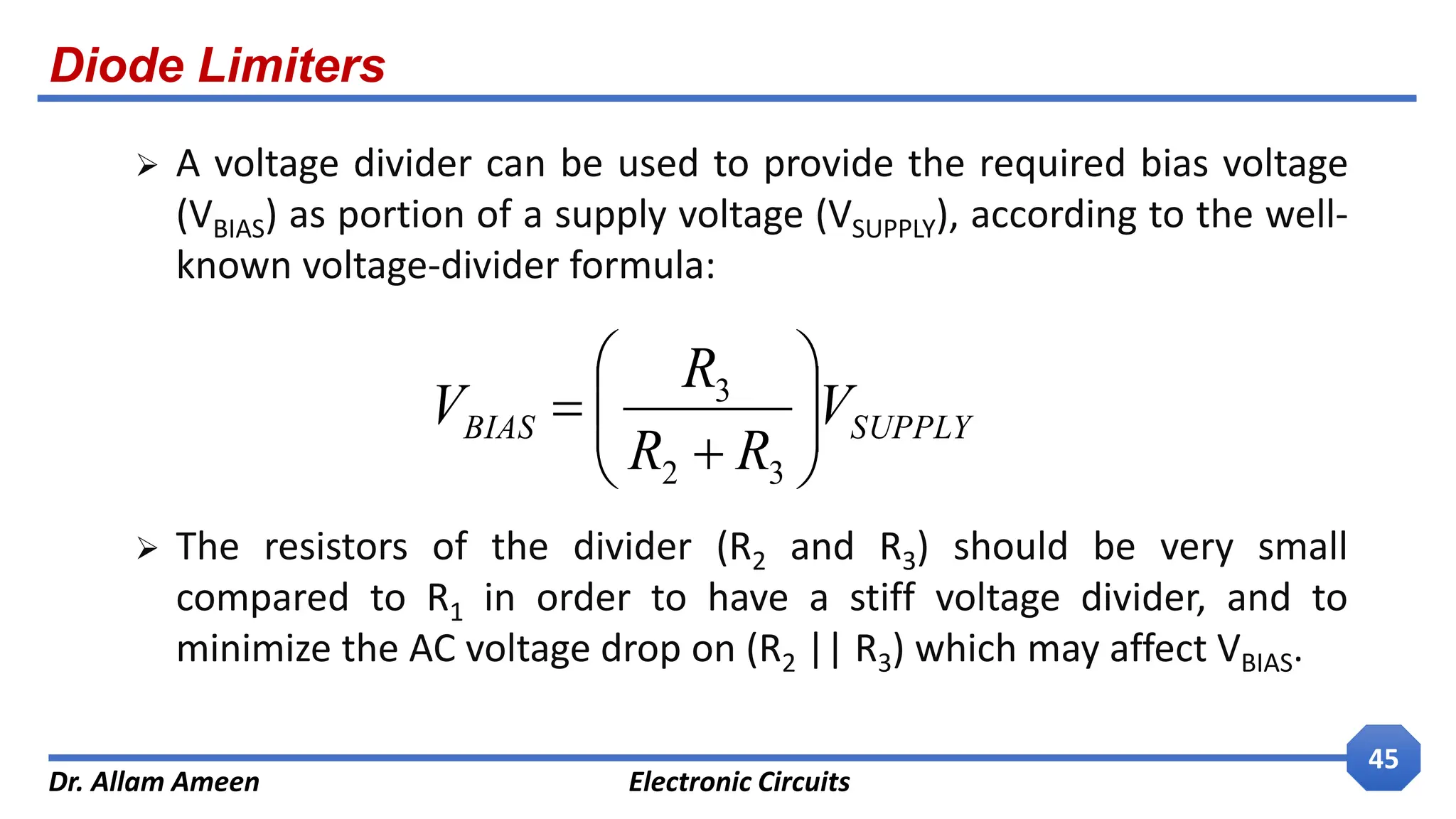
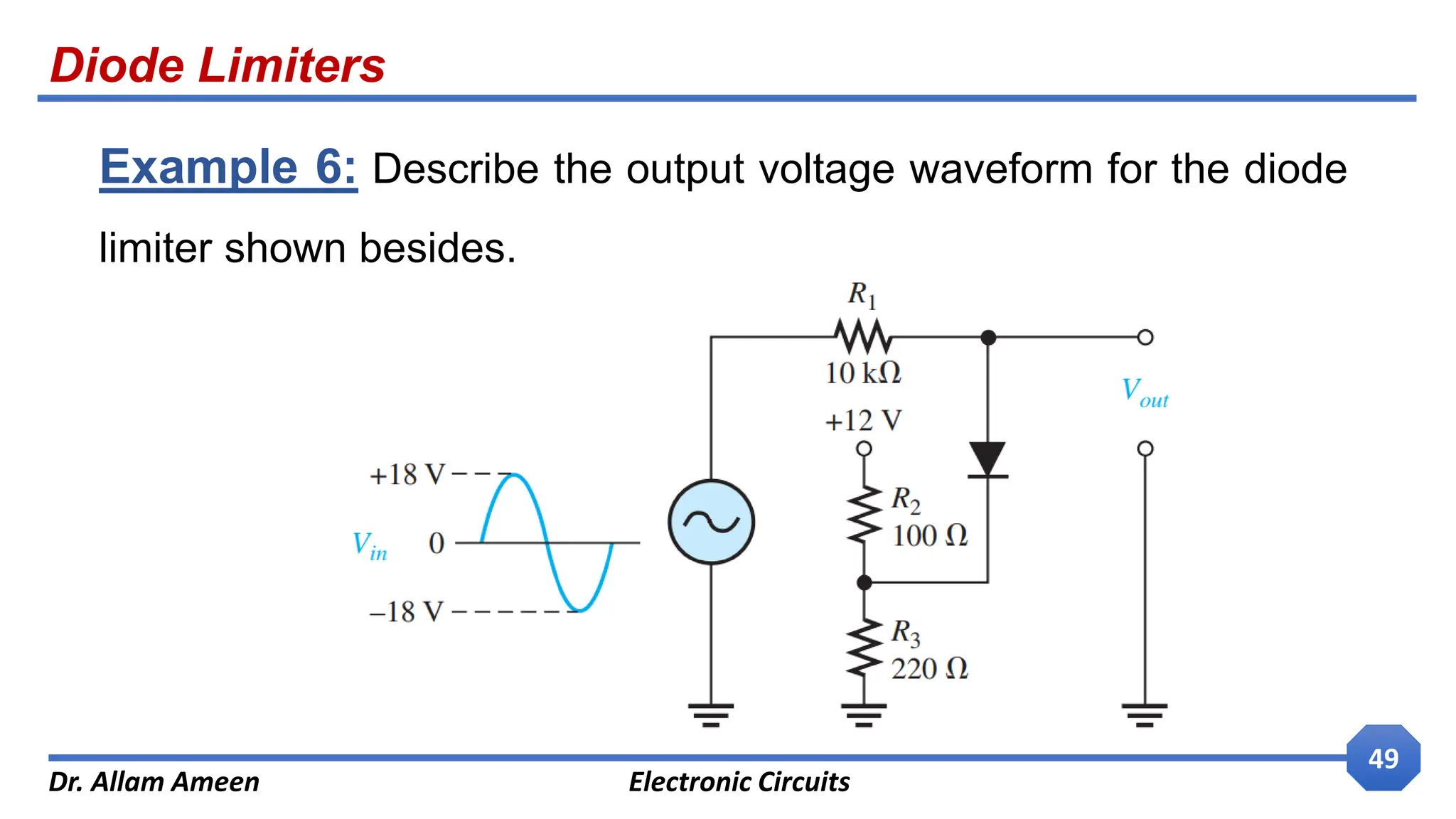
 A voltage divider can be used to provide the required bias voltage
(VBIAS) as portion of a supply voltage (VSUPPLY), according to the well-
known voltage-divider formula:
 The resistors of the divider (R2 and R3) should be very small
compared to R1 in order to have a stiff voltage divider, and to
minimize the AC voltage drop on (R2 || R3) which may affect VBIAS.
SUPPLY
BIAS V
R
R
R
V 









3
2
3
Diode Limiters
Dr. Allam Ameen Electronic Circuits
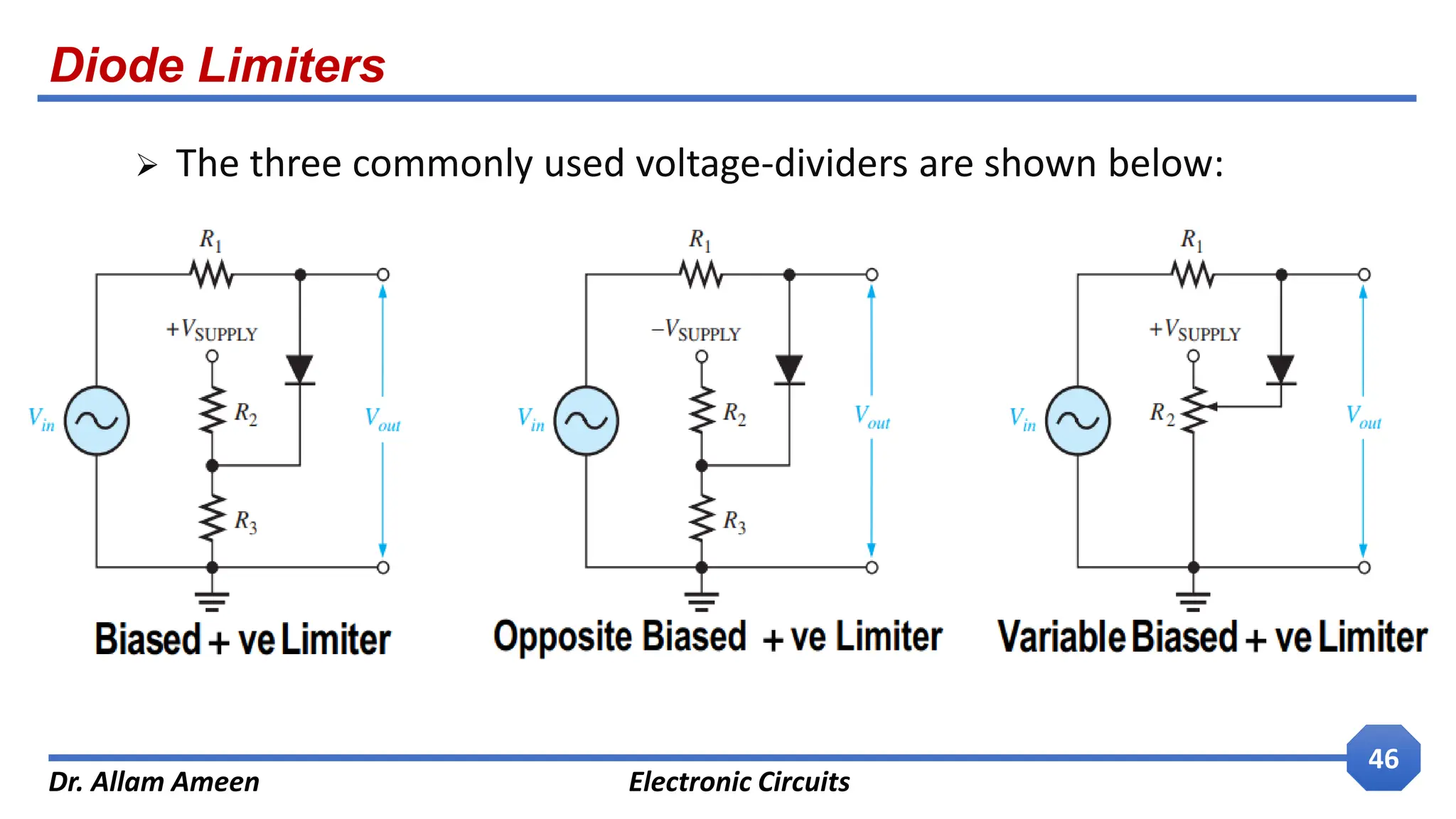
46
 The three commonly used voltage-dividers are shown below:
Diode Limiters
Dr. Allam Ameen Electronic Circuits
47
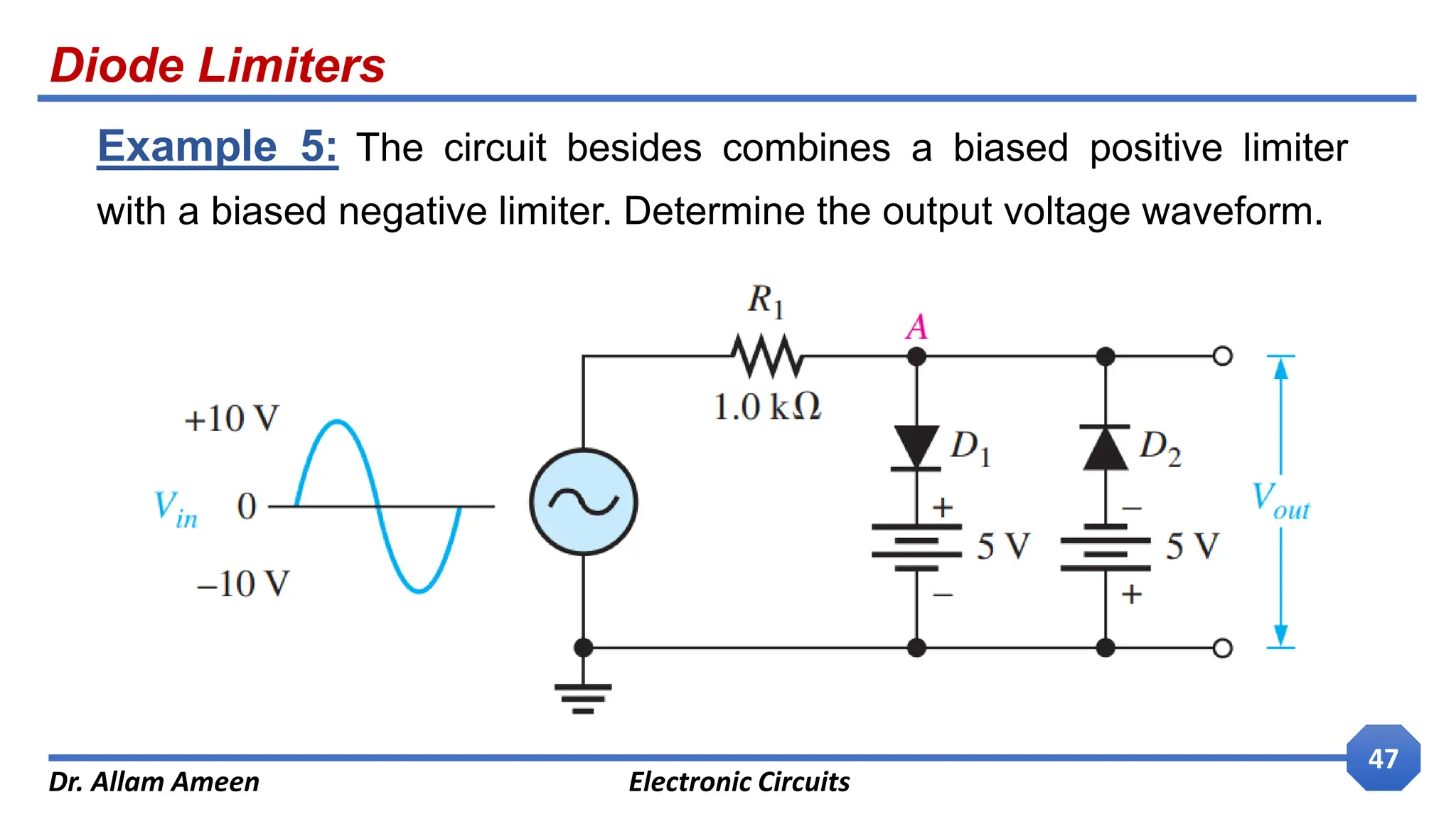
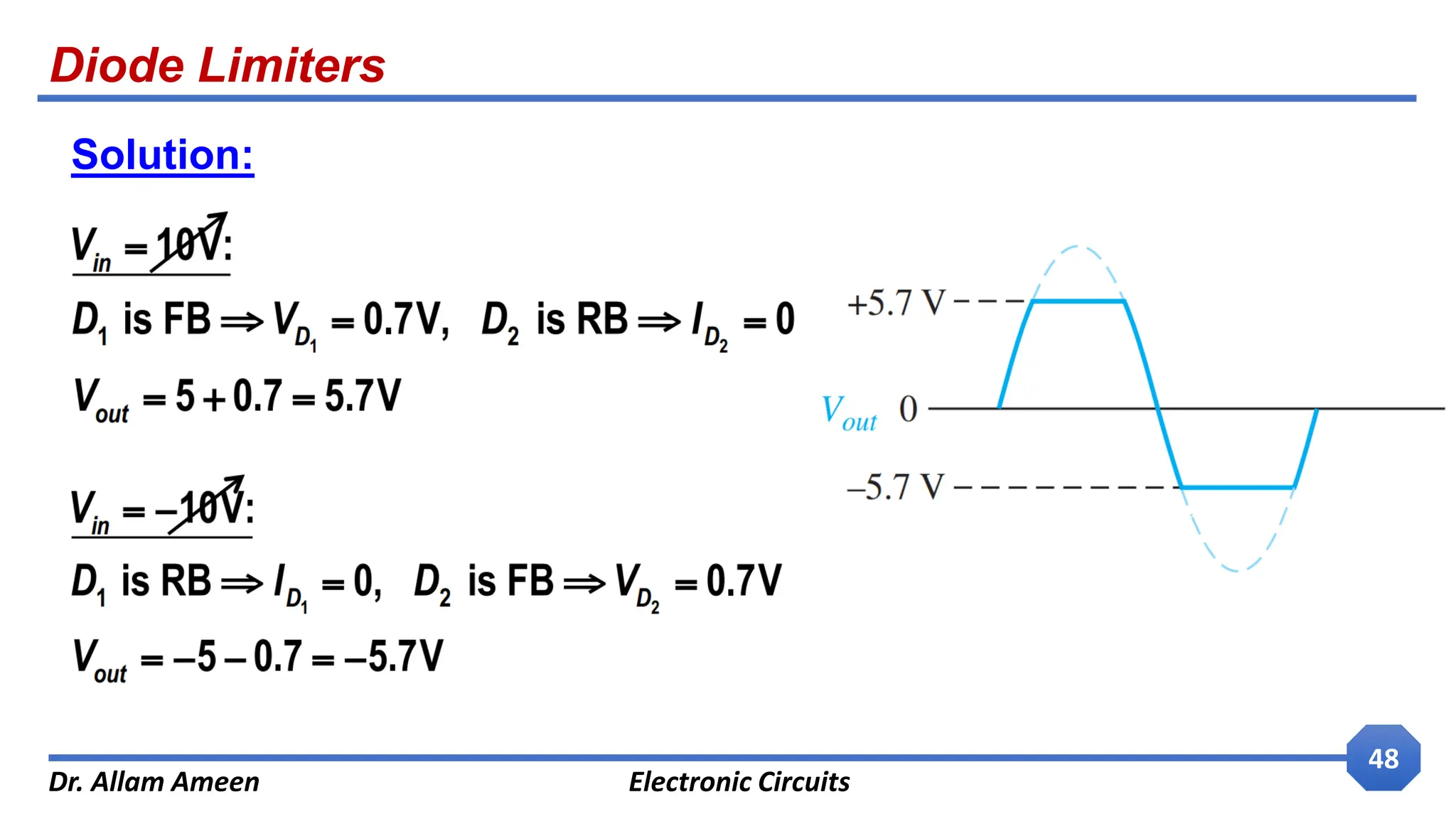
Example 5: The circuit besides combines a biased positive limiter
with a biased negative limiter. Determine the output voltage waveform.
Diode Limiters
Dr. Allam Ameen Electronic Circuits
48
Solution:
Diode Limiters
Dr. Allam Ameen Electronic Circuits
49
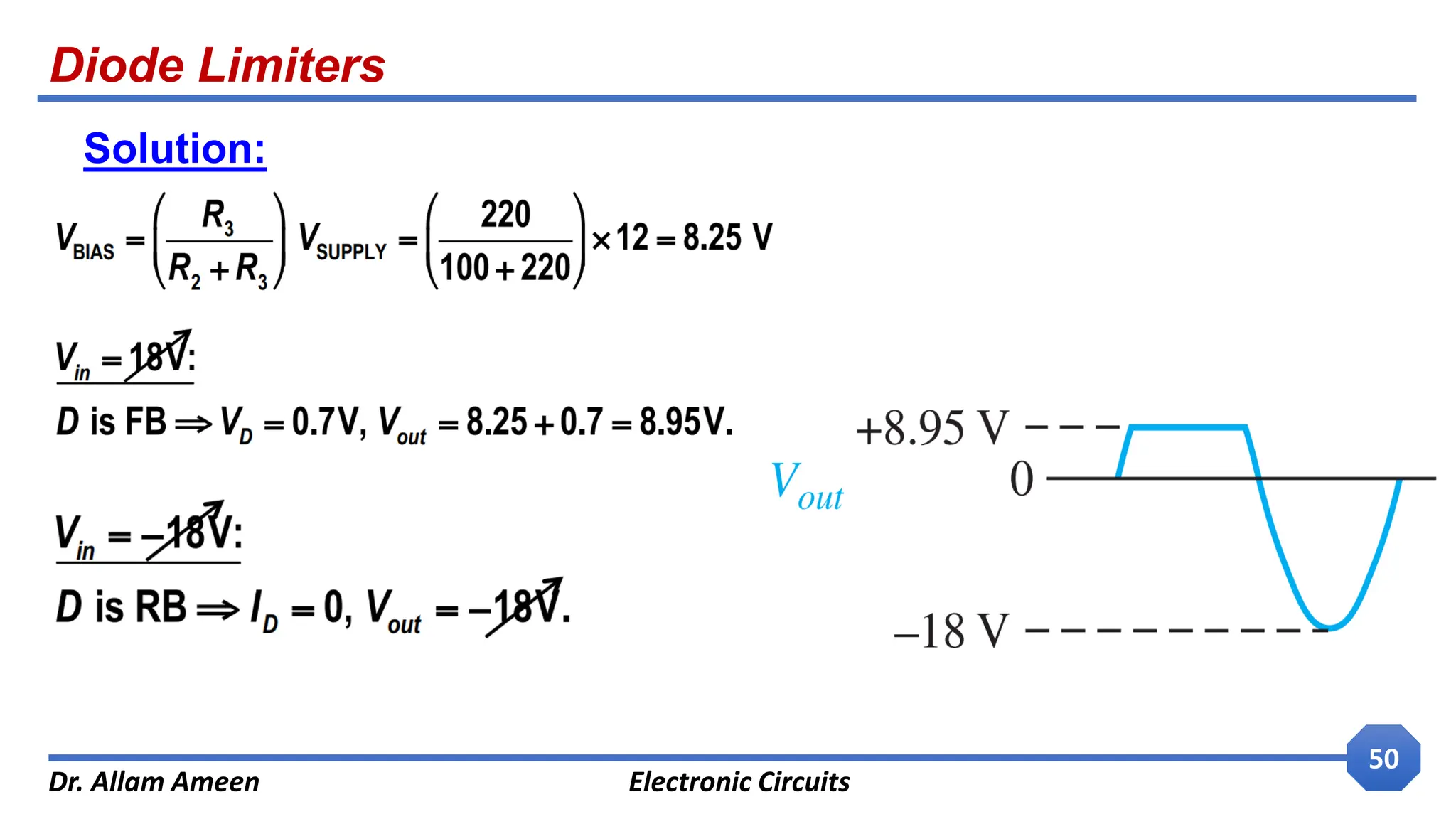
Example 6: Describe the output voltage waveform for the diode
limiter shown besides.
Diode Limiters
Dr. Allam Ameen Electronic Circuits
50
Solution:
Diode Clampers
Dr. Allam Ameen Electronic Circuits
51
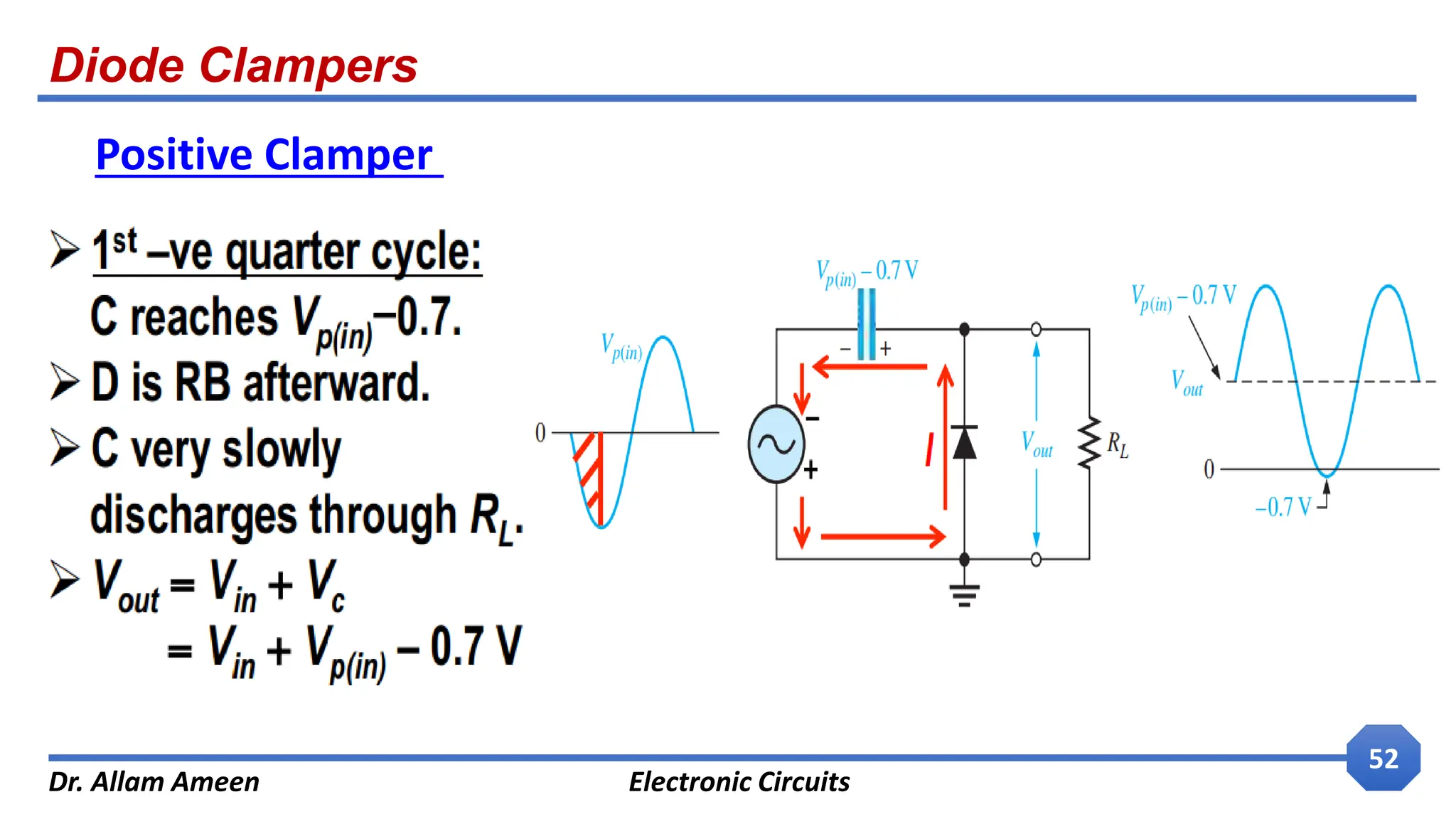
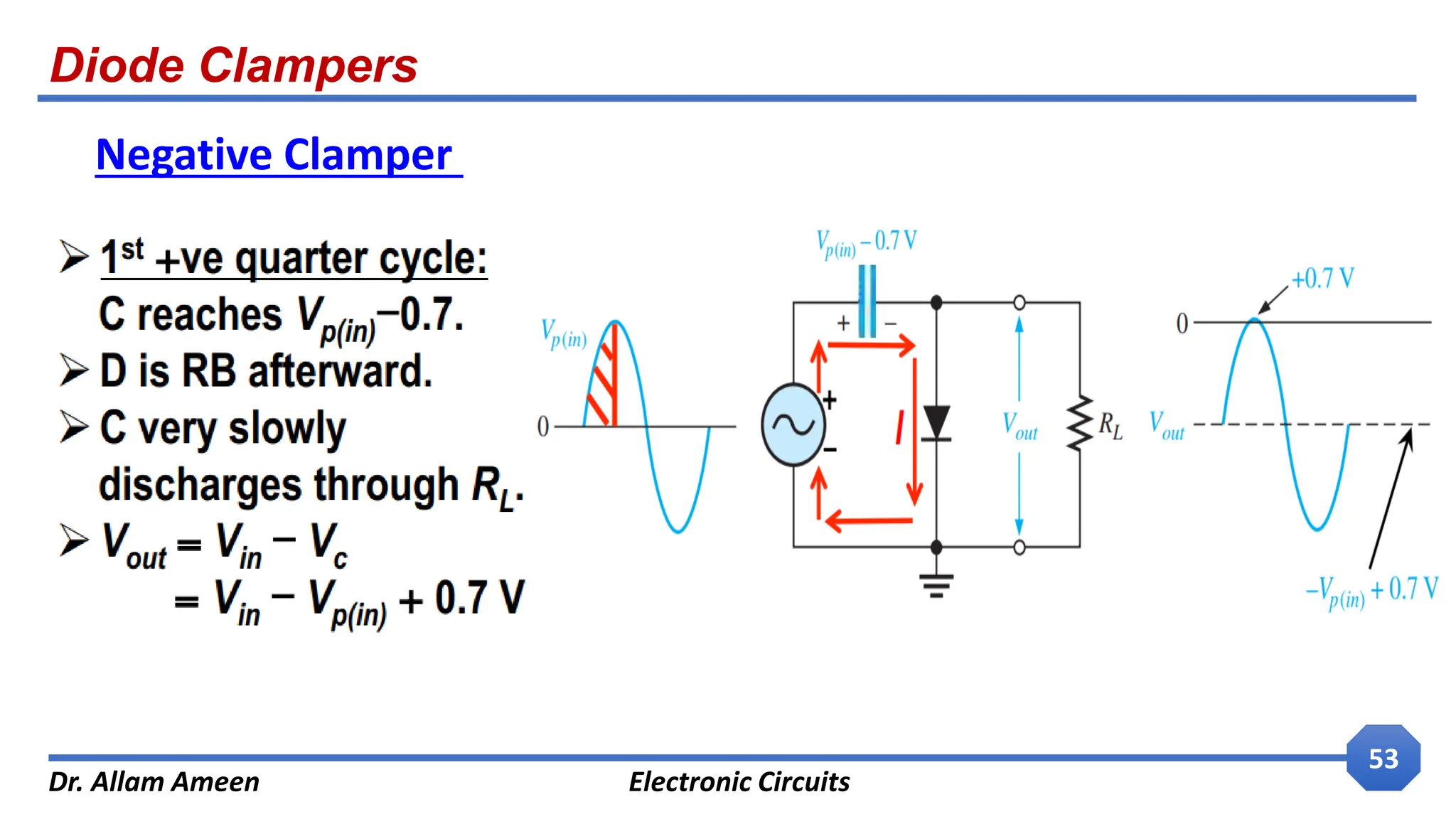
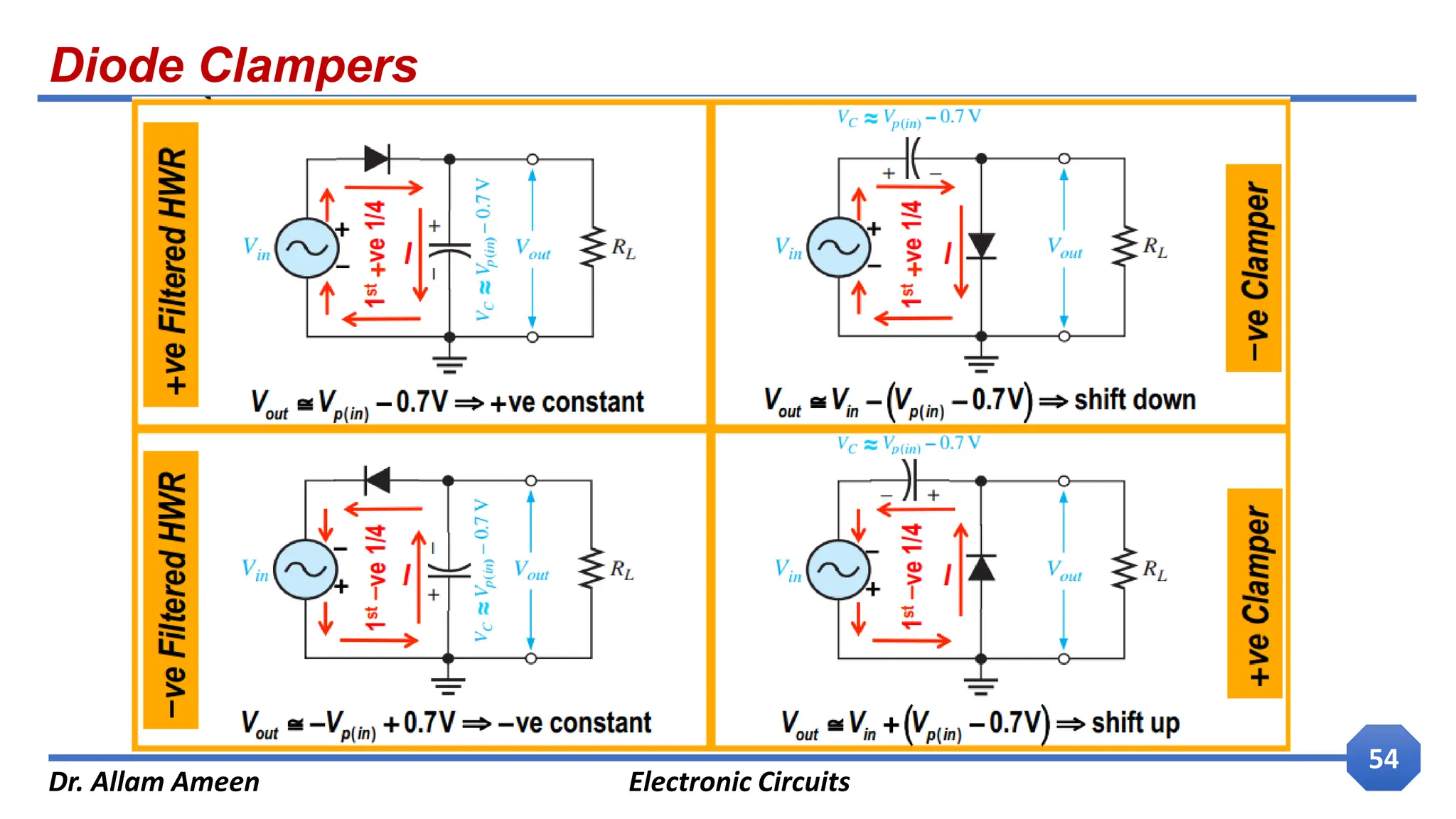
 The diode clamper is a simple biasing circuit that adds DC level
(positive or negative) to an AC voltage waveform. Its circuit analysis is
very similar to the filtered Half-Wave Rectifier (HWR), as the diode and
capacitor are just swapped.
 There are two types of clampers: the positive clamper and the
negative clamper.
1. A positive clamper shifts its input waveform so that the negative
peak of the waveform is equal to the clamper dc reference voltage.
2. A negative clamper shifts its input waveform so that the positive
peak of the waveform is equal to the clamper dc reference voltage.
Diode Clampers
Dr. Allam Ameen Electronic Circuits
52
Positive Clamper
Diode Clampers
Dr. Allam Ameen Electronic Circuits
53
Negative Clamper
Diode Clampers
Dr. Allam Ameen Electronic Circuits
54
Diode Clampers
Dr. Allam Ameen Electronic Circuits
55
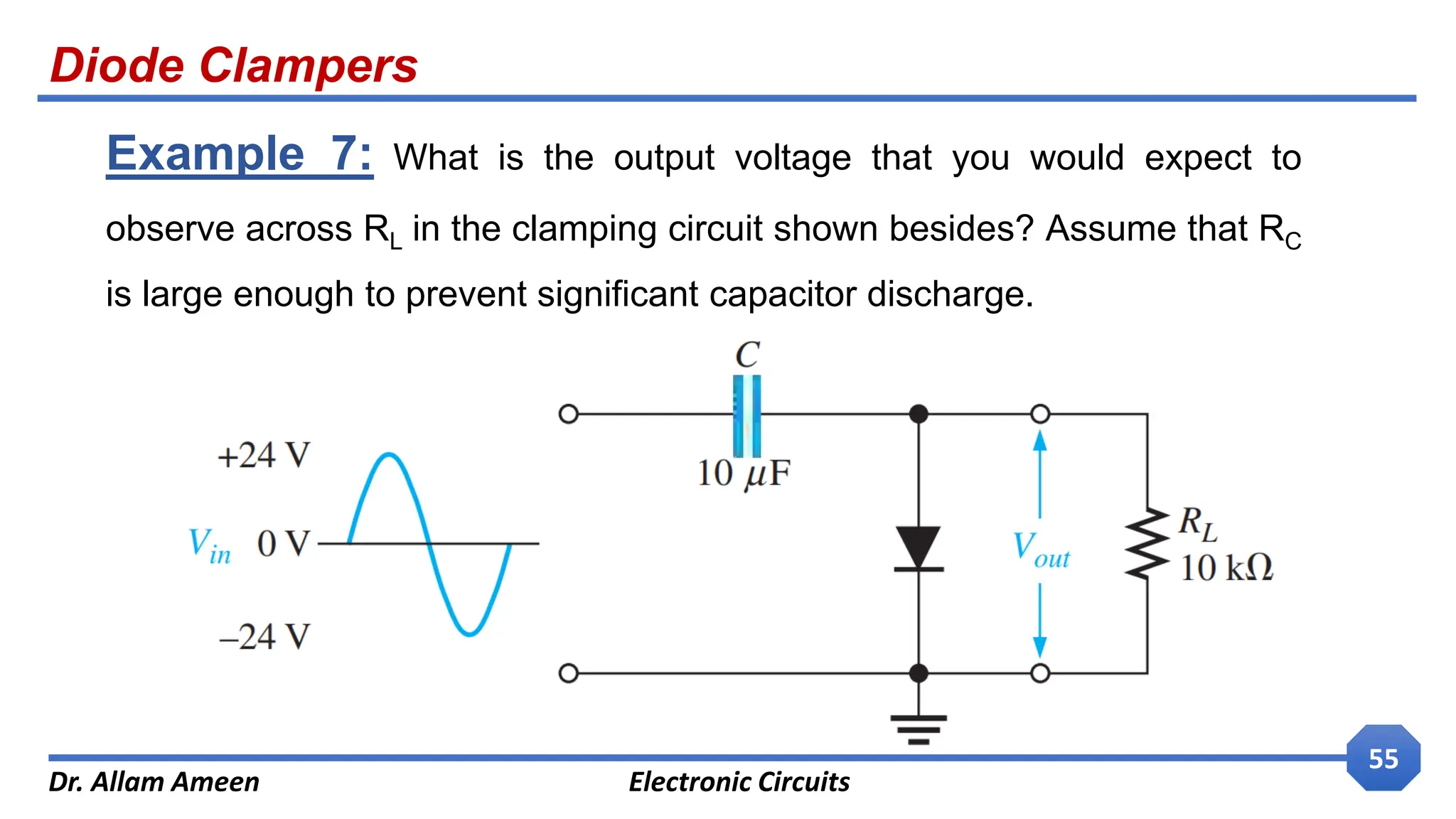
Example 7: What is the output voltage that you would expect to
observe across RL in the clamping circuit shown besides? Assume that RC
is large enough to prevent significant capacitor discharge.
Diode Clampers
Dr. Allam Ameen Electronic Circuits
56
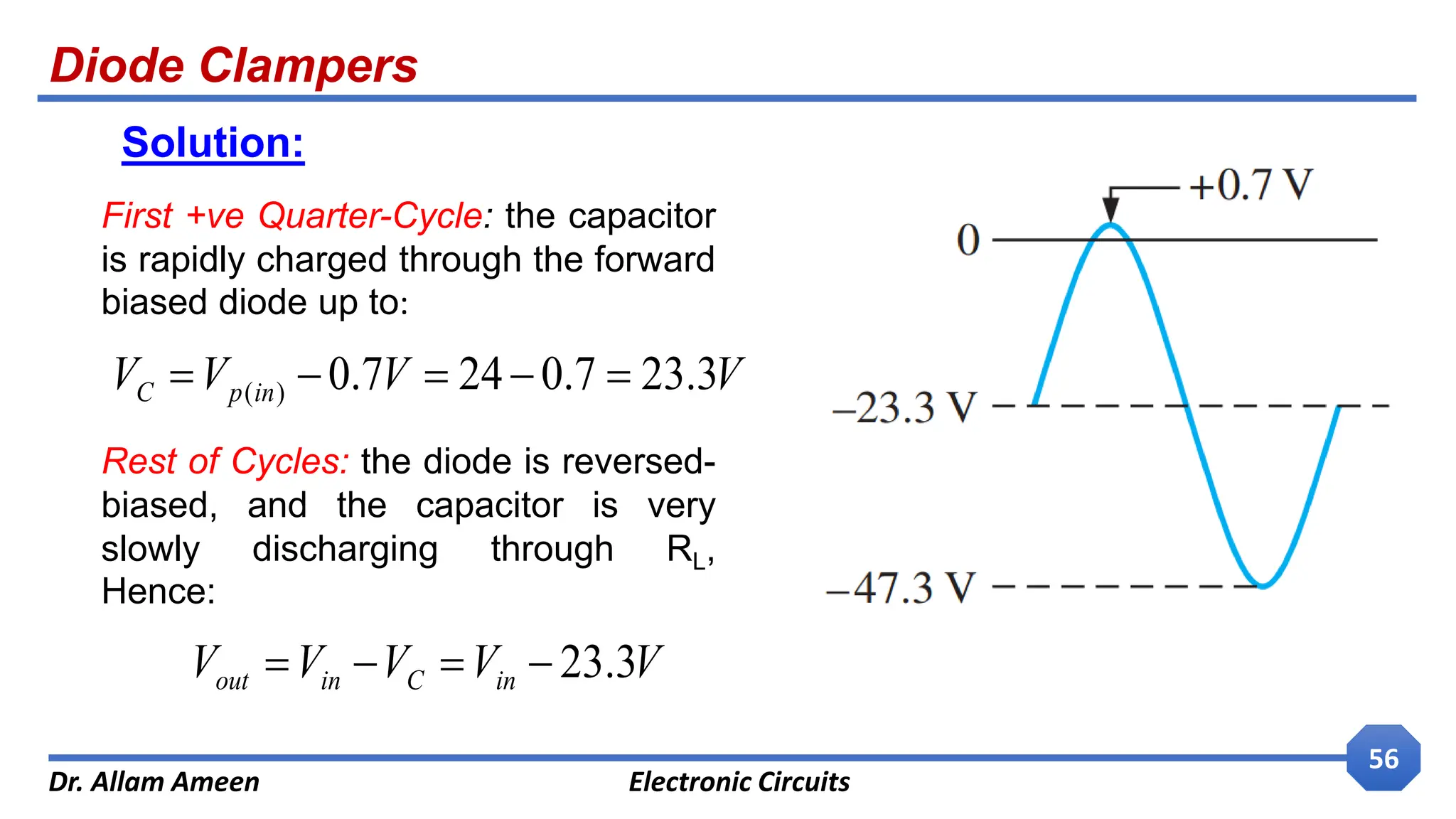
Solution:
First +ve Quarter-Cycle: the capacitor
is rapidly charged through the forward
biased diode up to:
Rest of Cycles: the diode is reversed-
biased, and the capacitor is very
slowly discharging through RL,
Hence:
V
V
V
V in
p
C 3
.
23
7
.
0
24
7
.
0
)
( 




V
V
V
V
V in
C
in
out 3
.
23




Zener Diodes
Dr. Allam Ameen Electronic Circuits
57
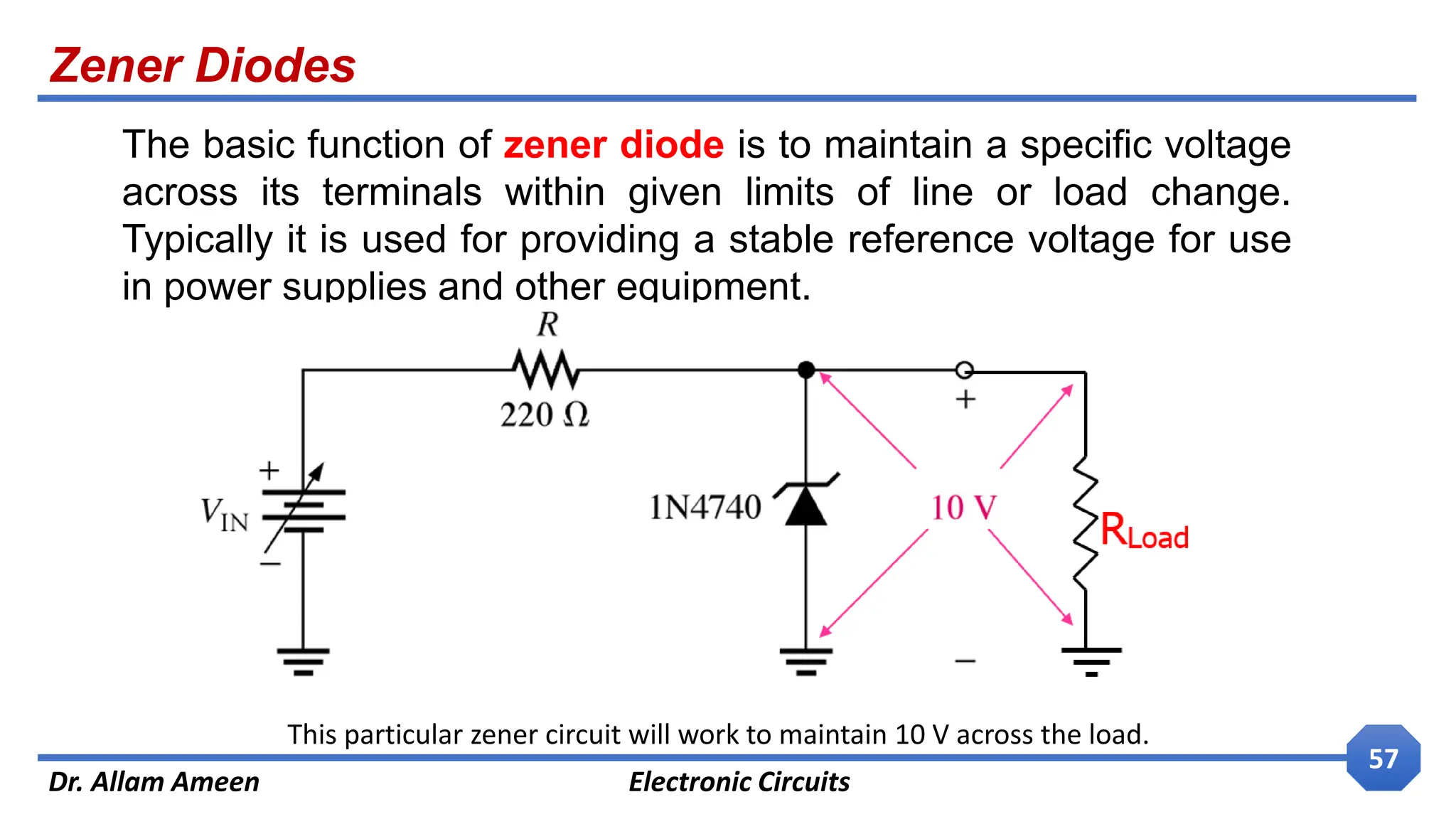
The basic function of zener diode is to maintain a specific voltage
across its terminals within given limits of line or load change.
Typically it is used for providing a stable reference voltage for use
in power supplies and other equipment.
This particular zener circuit will work to maintain 10 V across the load.
Zener Diodes
Dr. Allam Ameen Electronic Circuits
58
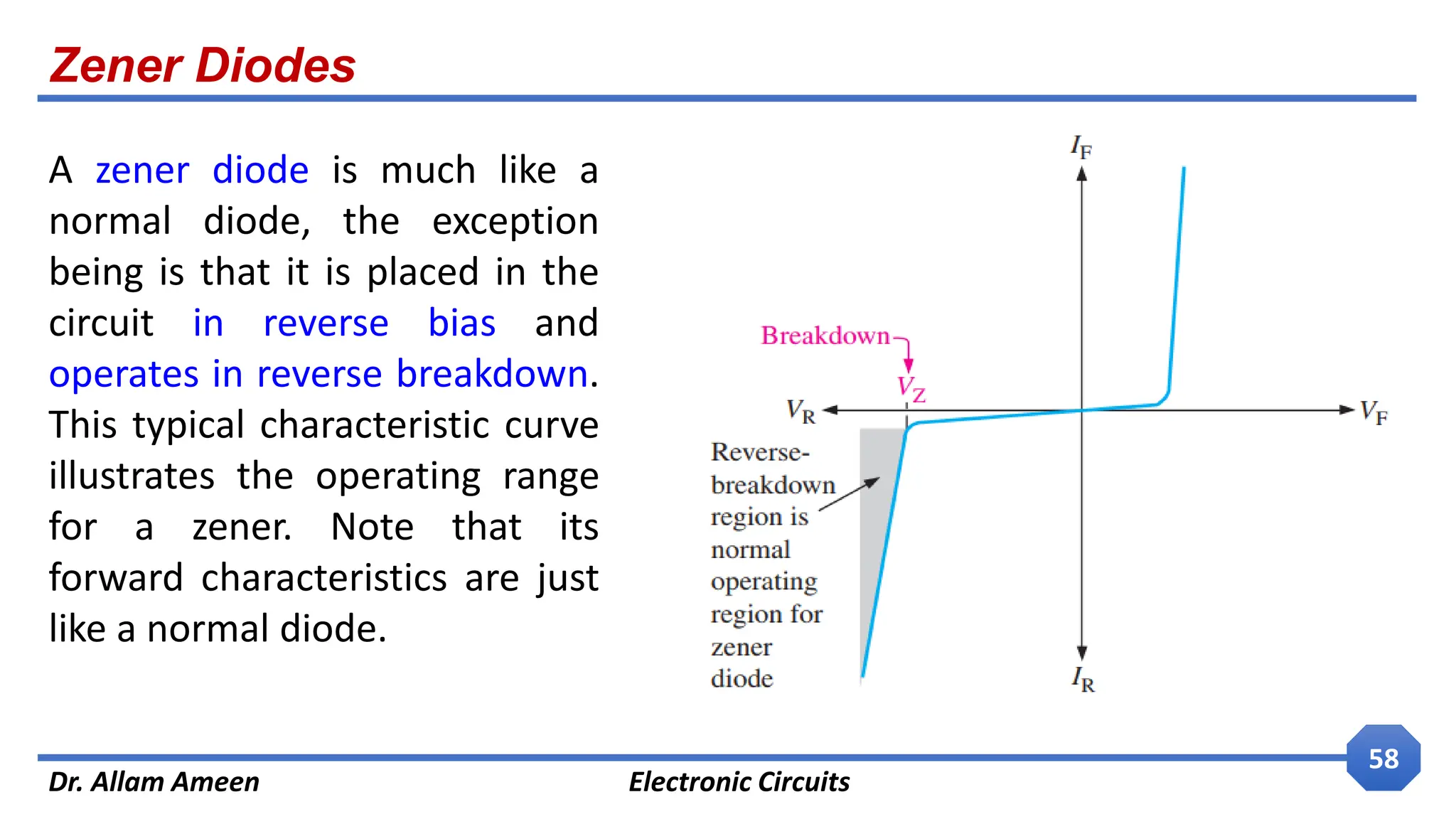
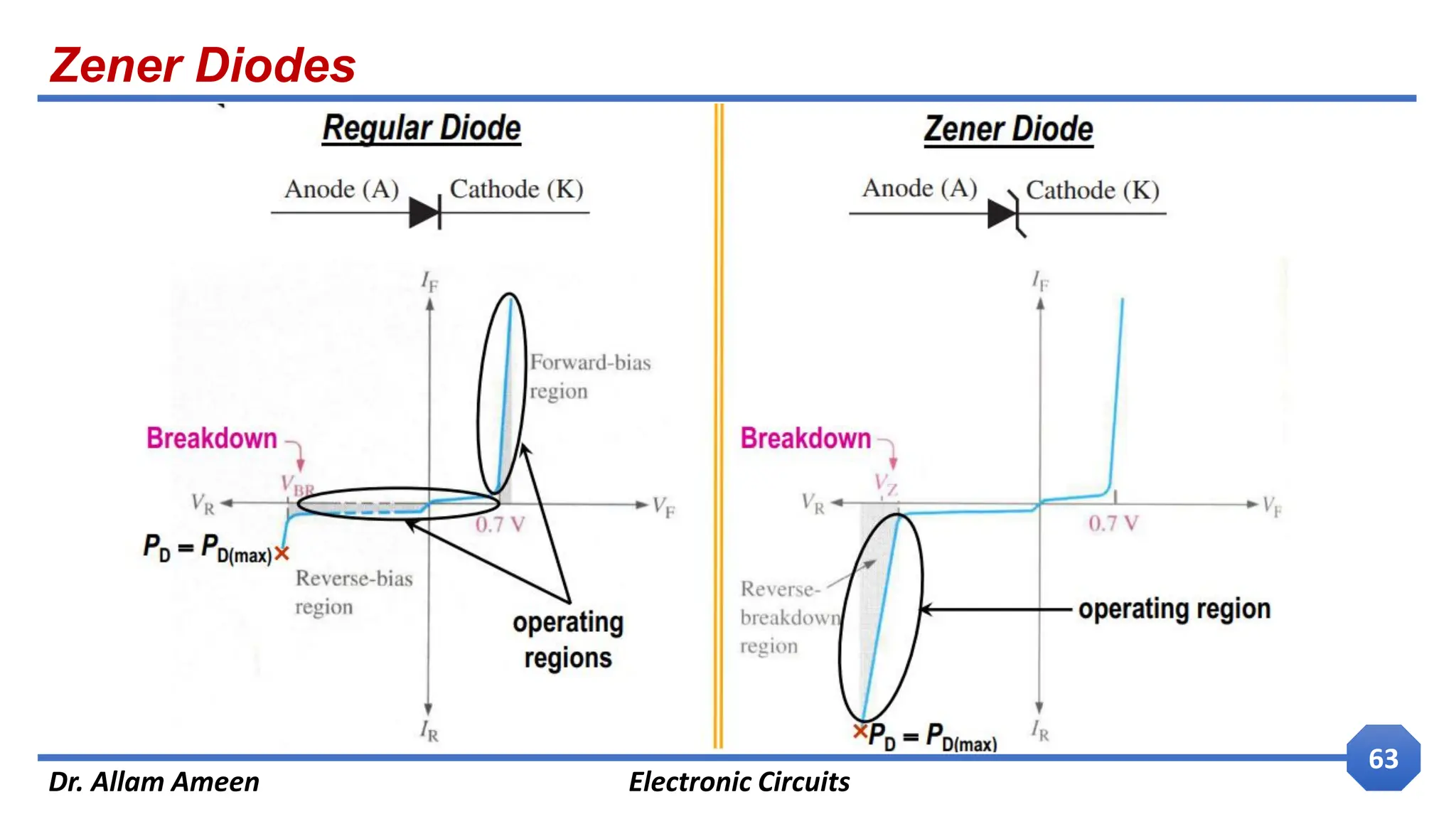
A zener diode is much like a
normal diode, the exception
being is that it is placed in the
circuit in reverse bias and
operates in reverse breakdown.
This typical characteristic curve
illustrates the operating range
for a zener. Note that its
forward characteristics are just
like a normal diode.
Zener Diodes
Dr. Allam Ameen Electronic Circuits
59
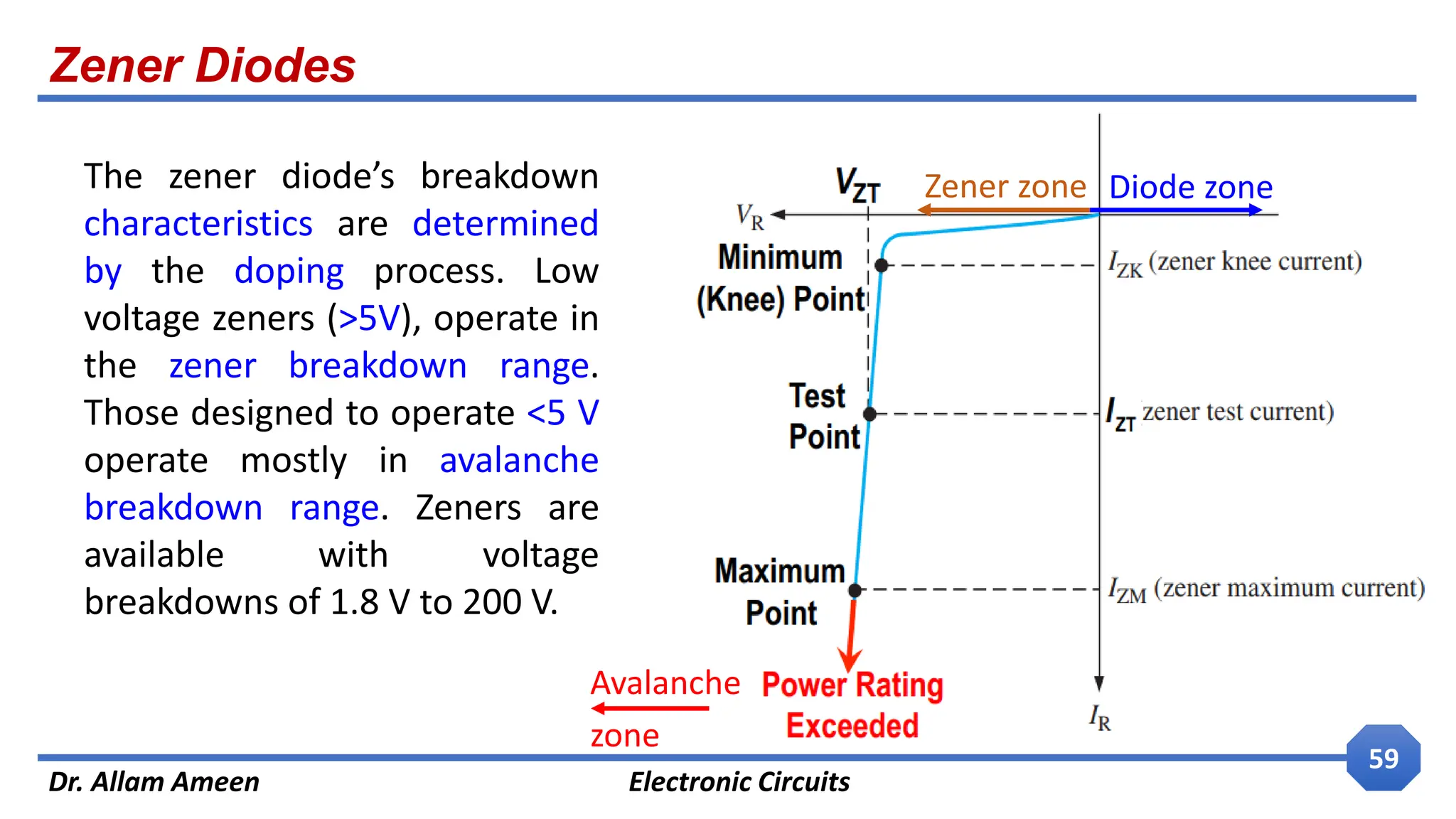
The zener diode’s breakdown
characteristics are determined
by the doping process. Low
voltage zeners (>5V), operate in
the zener breakdown range.
Those designed to operate <5 V
operate mostly in avalanche
breakdown range. Zeners are
available with voltage
breakdowns of 1.8 V to 200 V.
Zener zone Diode zone
Avalanche
zone
Zener Diodes
Dr. Allam Ameen Electronic Circuits
60
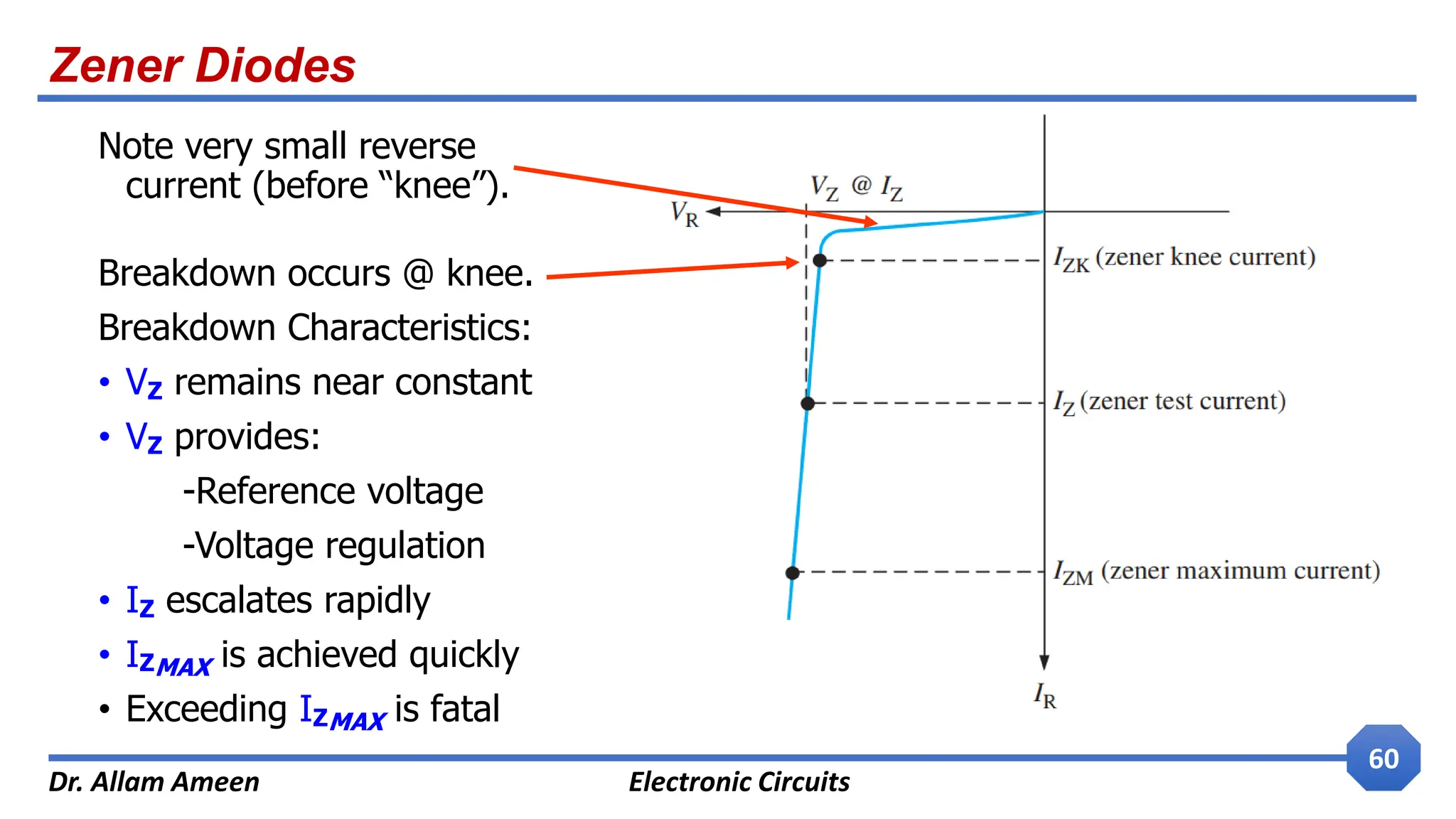
Note very small reverse
current (before “knee”).
Breakdown occurs @ knee.
Breakdown Characteristics:
• VZ remains near constant
• VZ provides:
-Reference voltage
-Voltage regulation
• IZ escalates rapidly
• IZMAX is achieved quickly
• Exceeding IZMAX is fatal
Zener Diodes
Dr. Allam Ameen Electronic Circuits
61
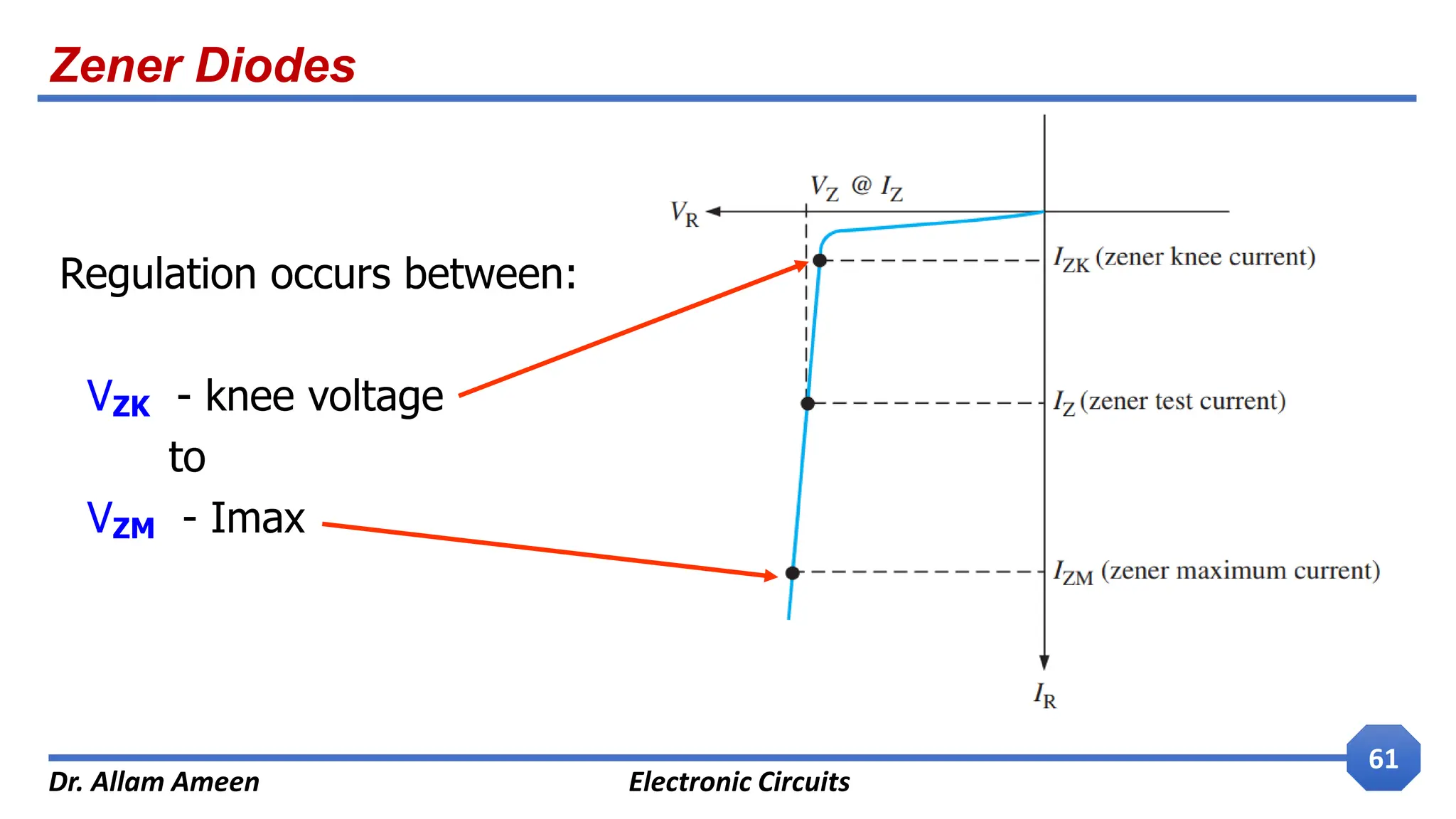
Regulation occurs between:
VZK - knee voltage
to
VZM - Imax
Zener Diodes
Dr. Allam Ameen Electronic Circuits
62
Zener Diodes
Dr. Allam Ameen Electronic Circuits
63
Zener Diodes
Dr. Allam Ameen Electronic Circuits
64
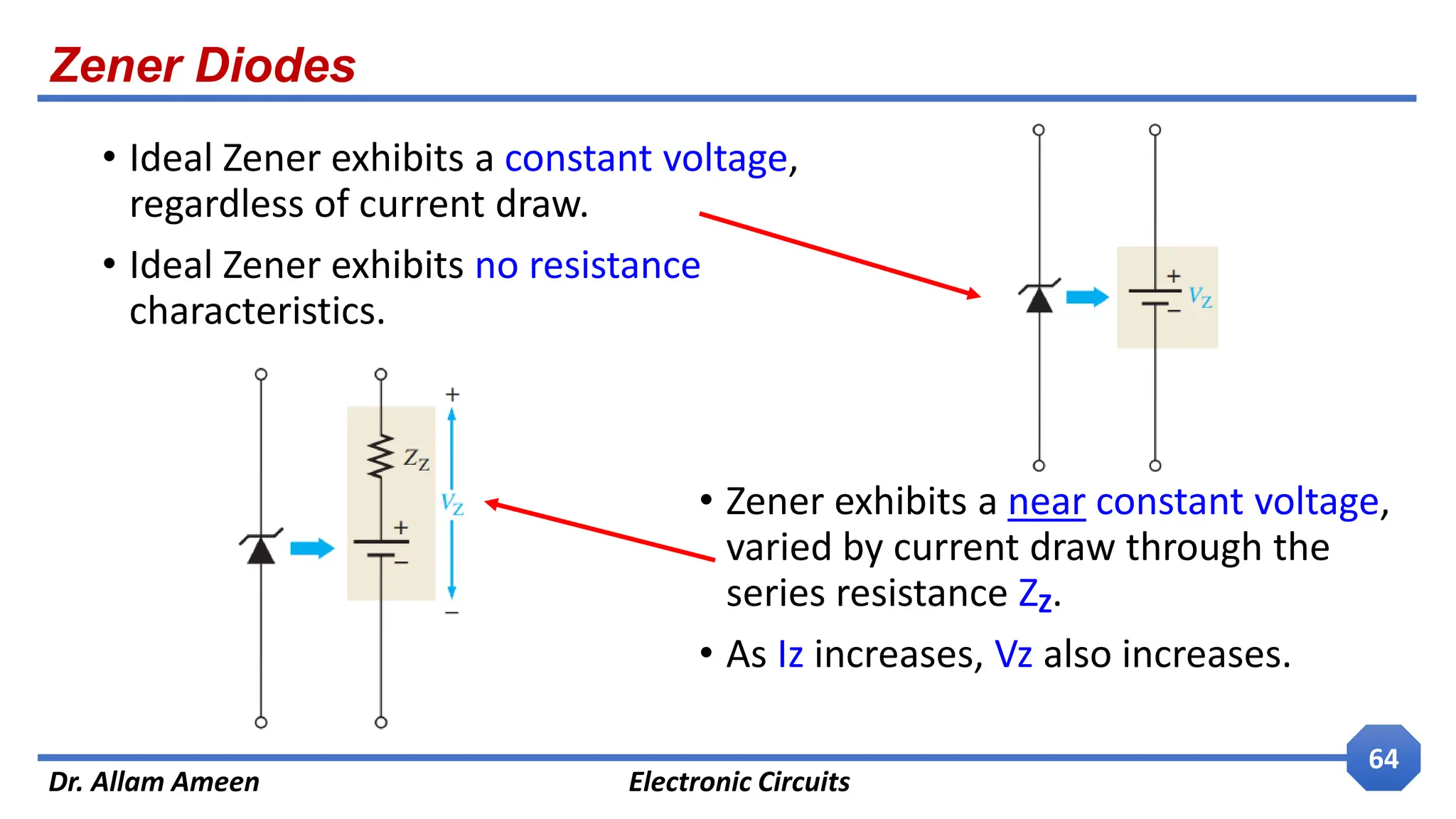
• Ideal Zener exhibits a constant voltage,
regardless of current draw.
• Ideal Zener exhibits no resistance
characteristics.
• Zener exhibits a near constant voltage,
varied by current draw through the
series resistance ZZ.
• As Iz increases, Vz also increases.
Zener Diodes
Dr. Allam Ameen Electronic Circuits
65
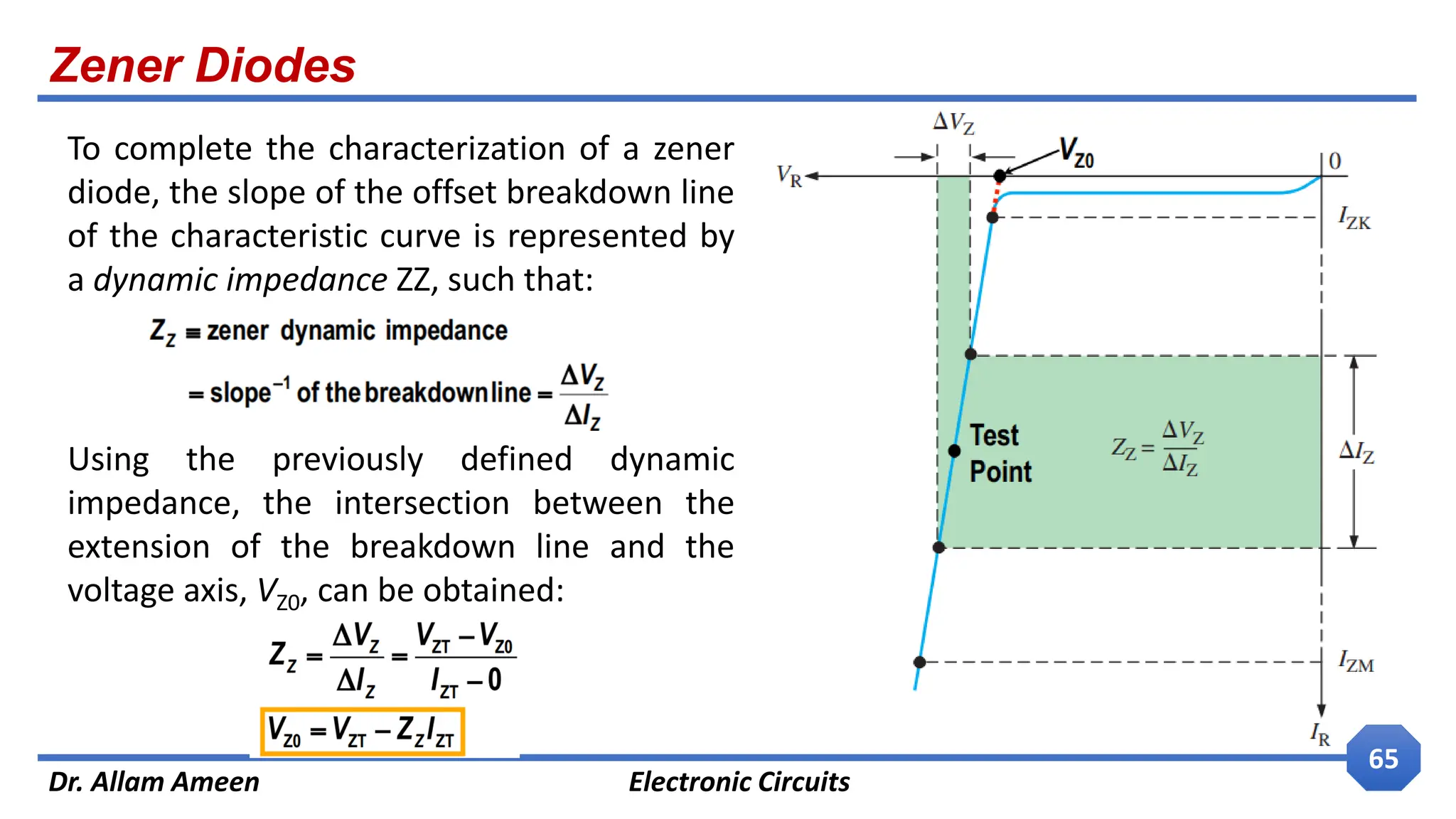
To complete the characterization of a zener
diode, the slope of the offset breakdown line
of the characteristic curve is represented by
a dynamic impedance ZZ, such that:
Using the previously defined dynamic
impedance, the intersection between the
extension of the breakdown line and the
voltage axis, VZ0, can be obtained:
Zener Diodes
Dr. Allam Ameen Electronic Circuits
66
Zener Diodes
Dr. Allam Ameen Electronic Circuits
67
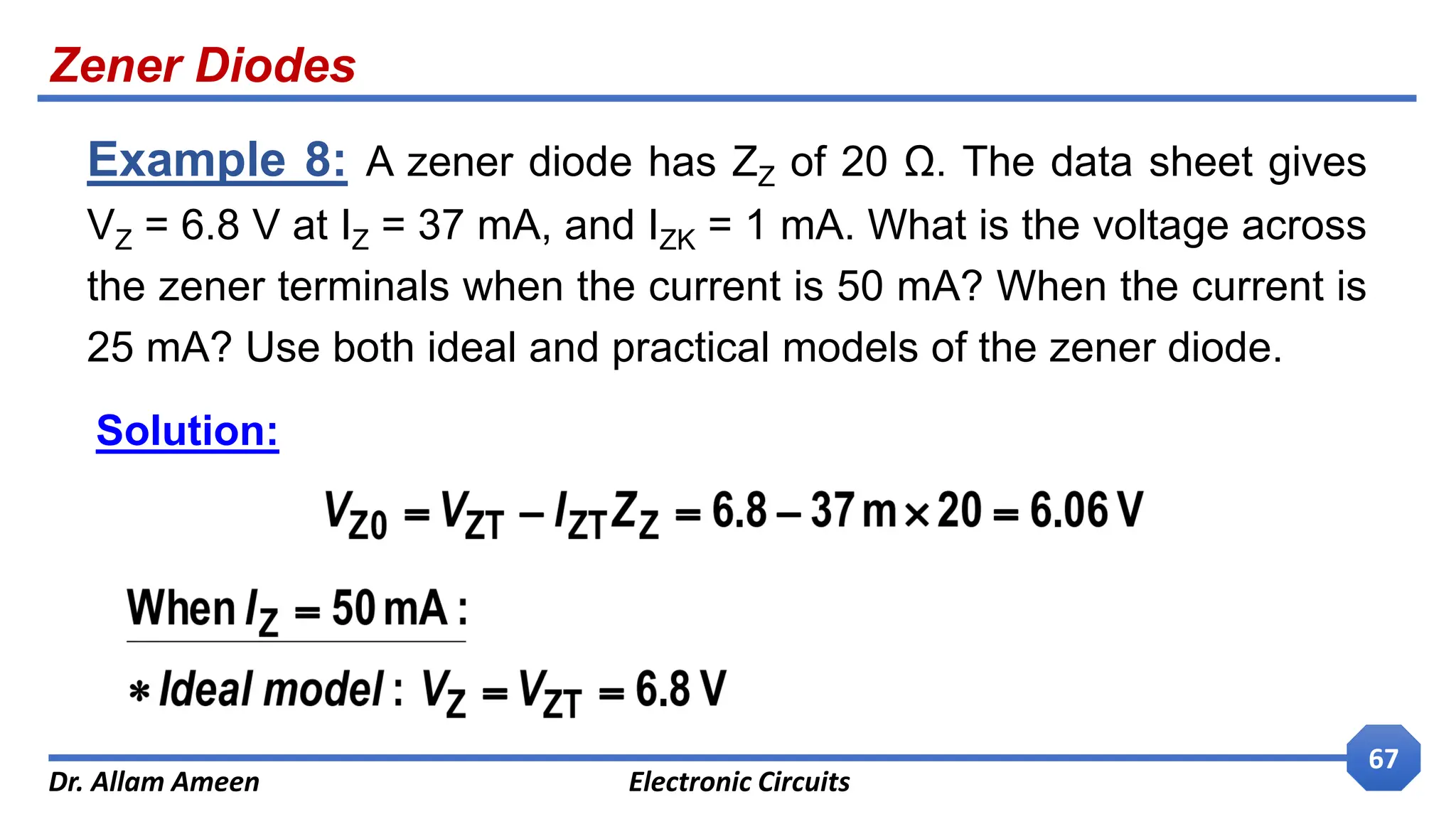
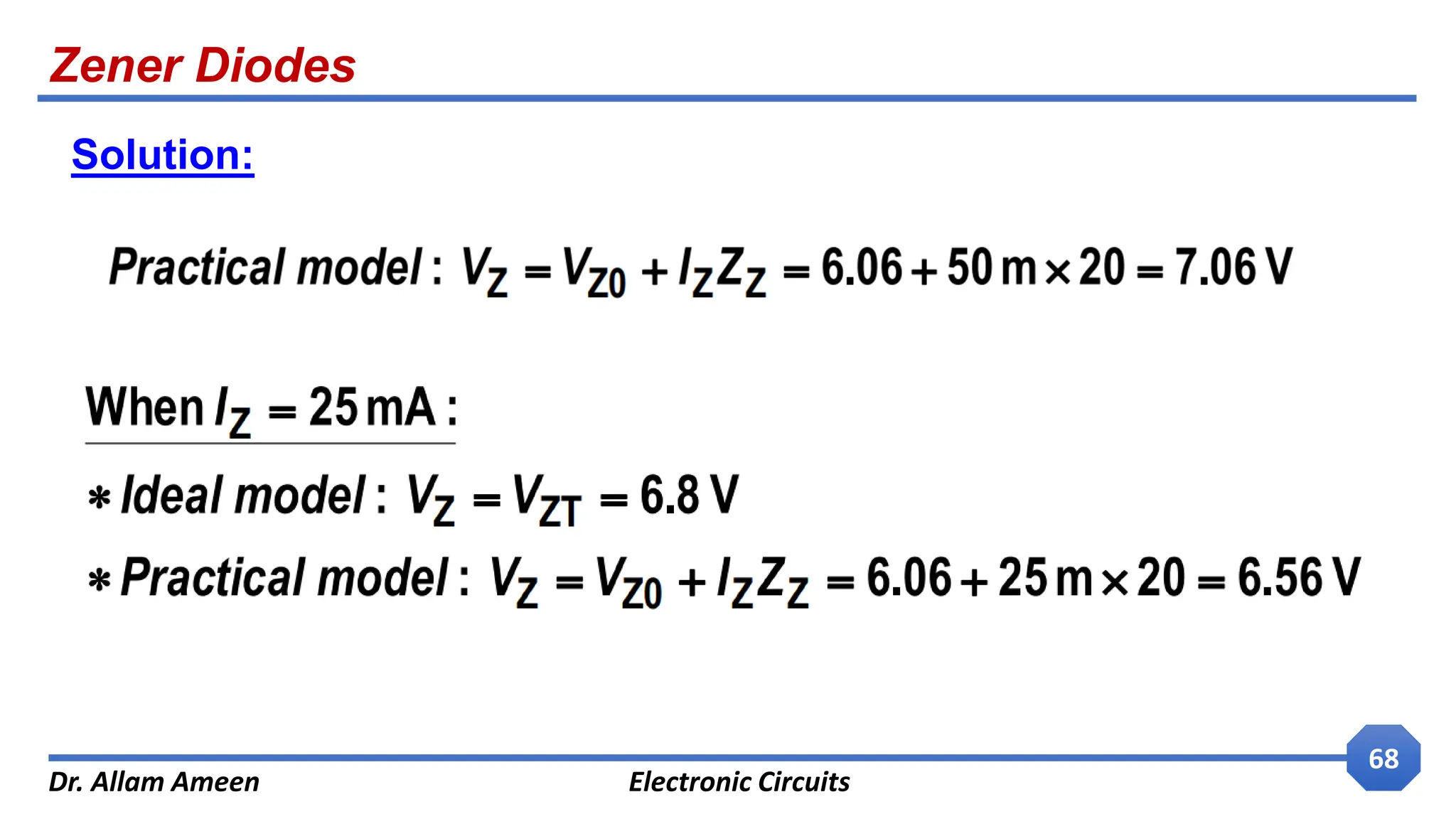
Example 8: A zener diode has ZZ of 20 Ω. The data sheet gives
VZ = 6.8 V at IZ = 37 mA, and IZK = 1 mA. What is the voltage across
the zener terminals when the current is 50 mA? When the current is
25 mA? Use both ideal and practical models of the zener diode.
Solution:
Zener Diodes
Dr. Allam Ameen Electronic Circuits
68
Solution:
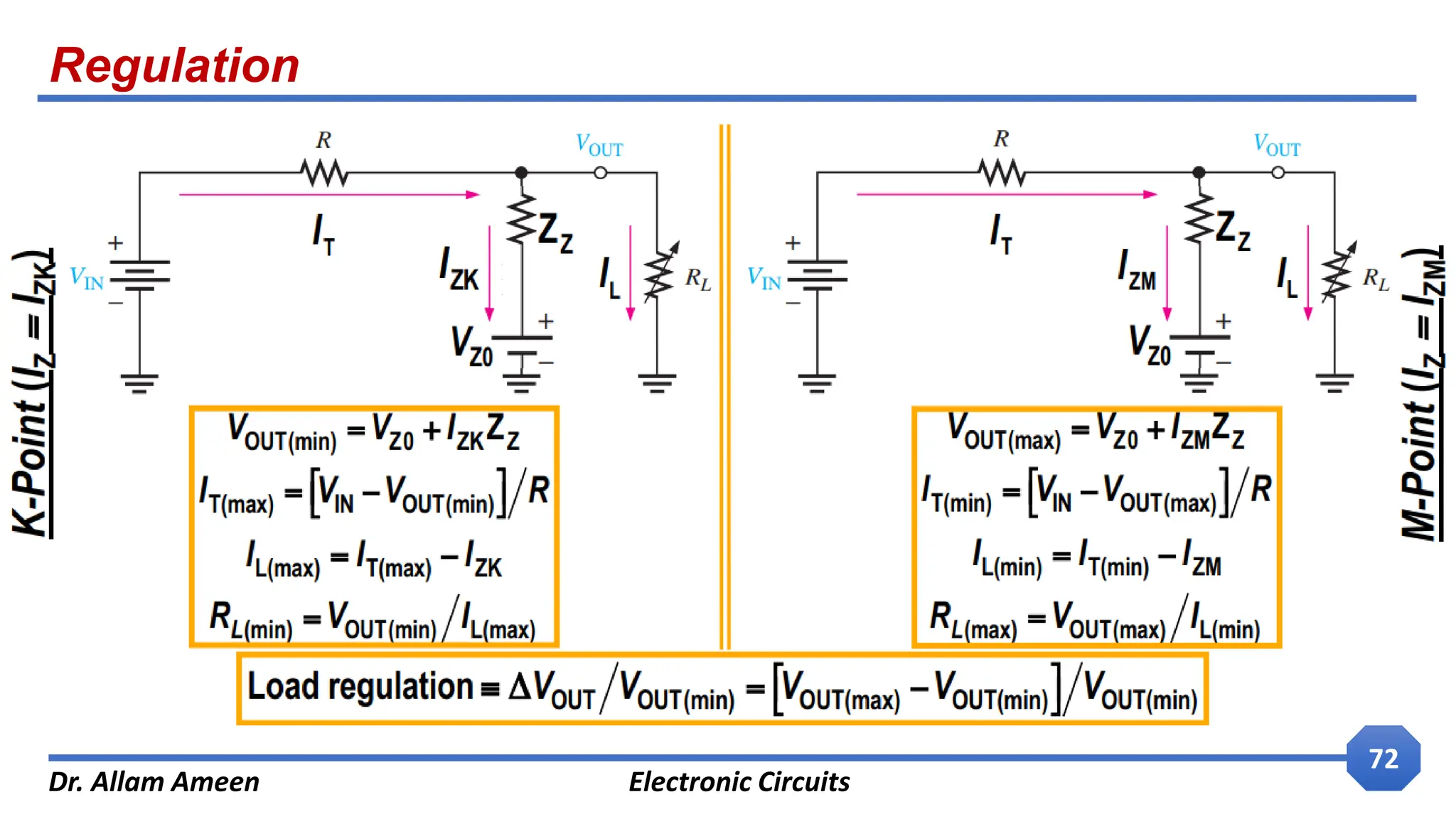
Regulation
Dr. Allam Ameen Electronic Circuits
69
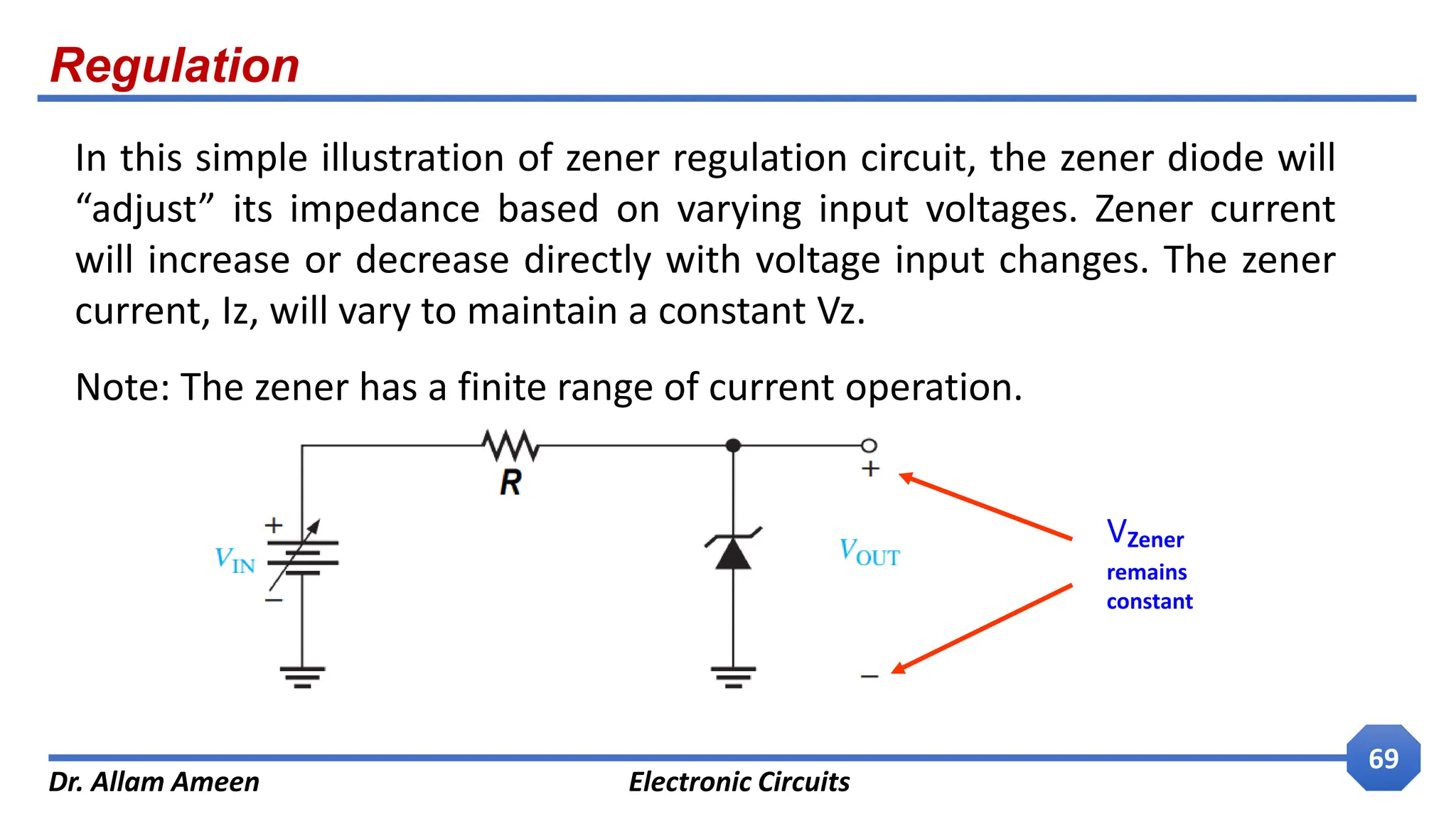
In this simple illustration of zener regulation circuit, the zener diode will
“adjust” its impedance based on varying input voltages. Zener current
will increase or decrease directly with voltage input changes. The zener
current, Iz, will vary to maintain a constant Vz.
Note: The zener has a finite range of current operation.
VZener
remains
constant
Regulation
Dr. Allam Ameen Electronic Circuits
70
Regulation
Dr. Allam Ameen Electronic Circuits
71
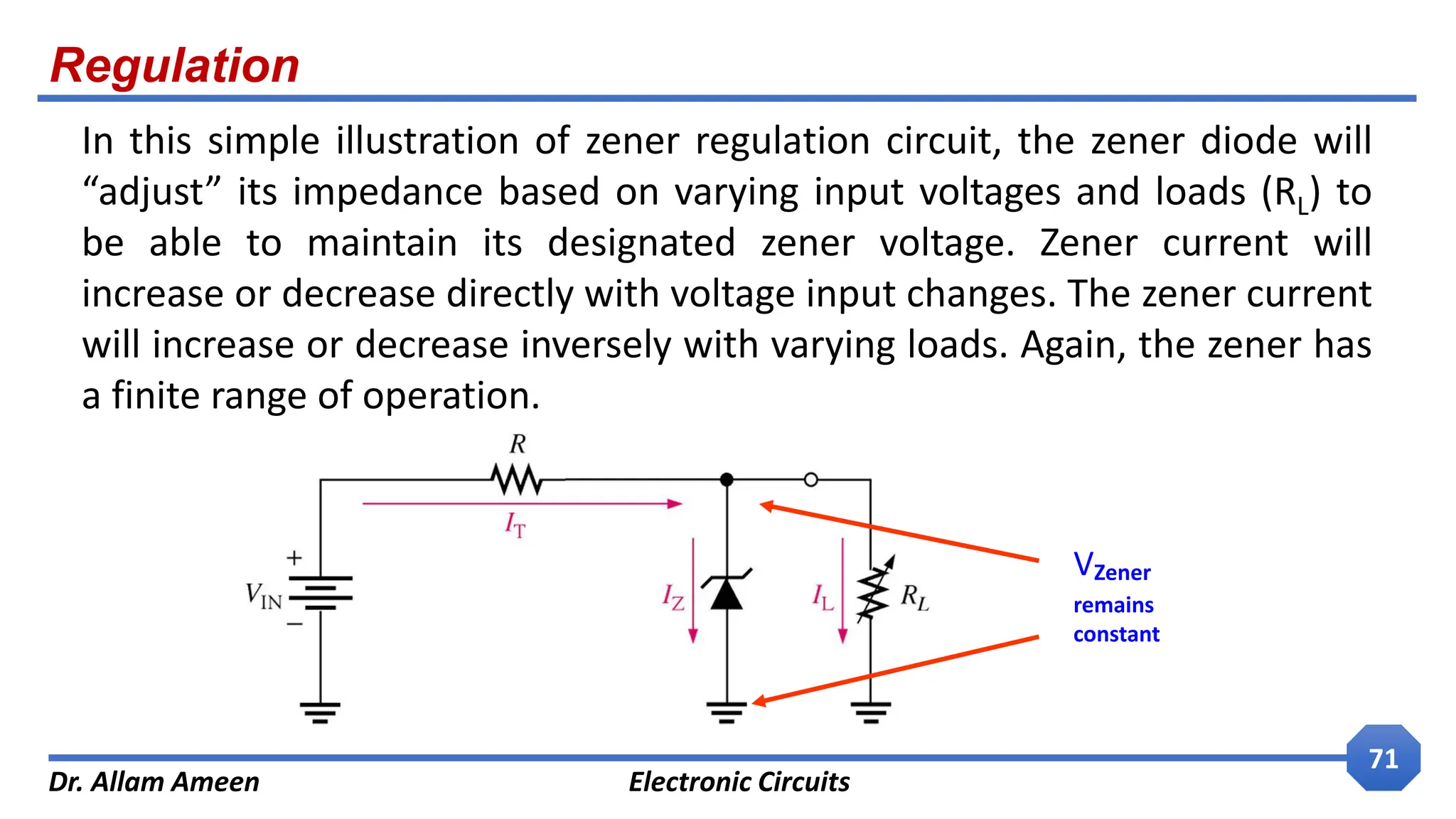
In this simple illustration of zener regulation circuit, the zener diode will
“adjust” its impedance based on varying input voltages and loads (RL) to
be able to maintain its designated zener voltage. Zener current will
increase or decrease directly with voltage input changes. The zener current
will increase or decrease inversely with varying loads. Again, the zener has
a finite range of operation.
VZener
remains
constant
Regulation
Dr. Allam Ameen Electronic Circuits
72
Regulation
Dr. Allam Ameen Electronic Circuits
73
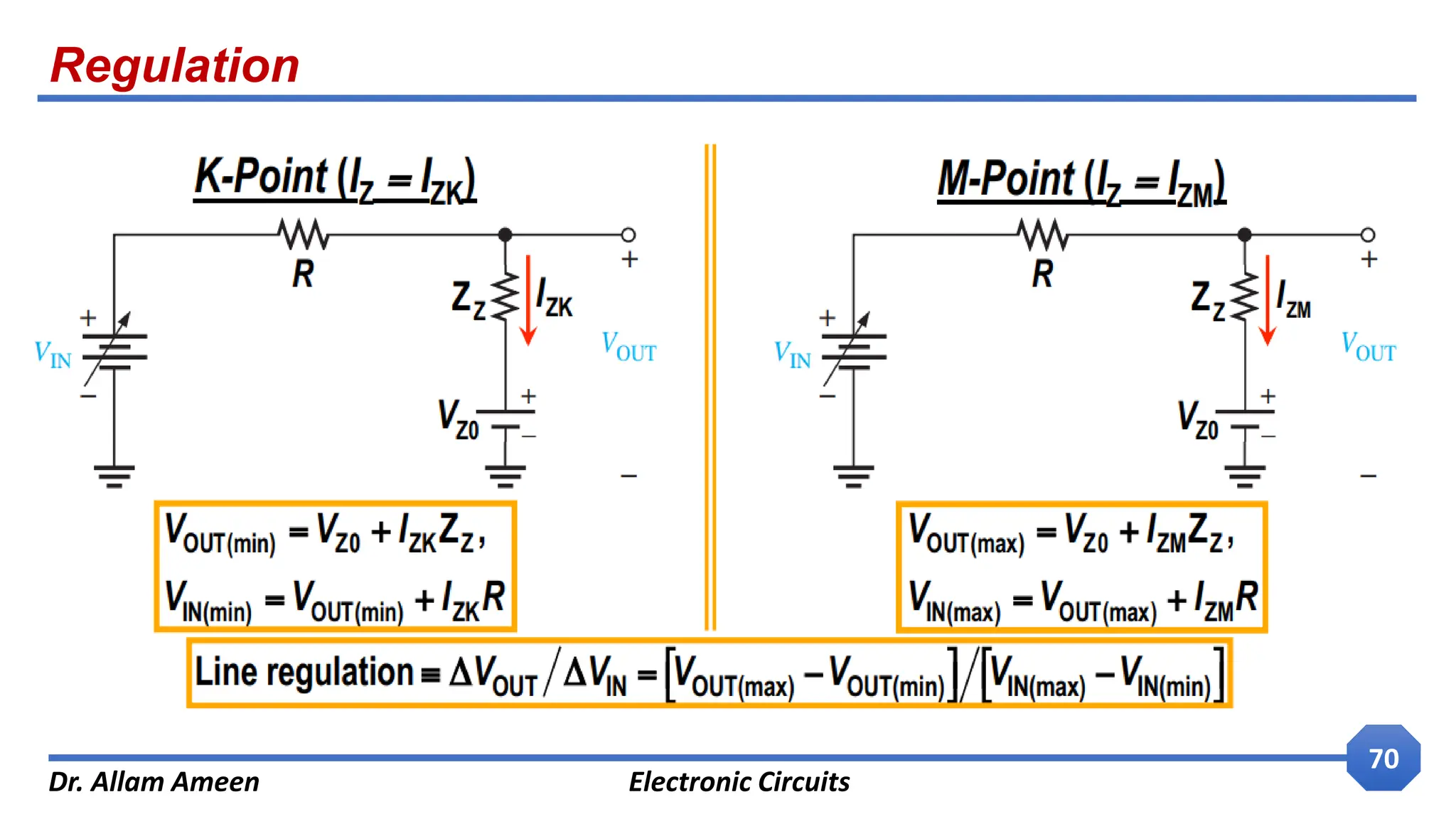
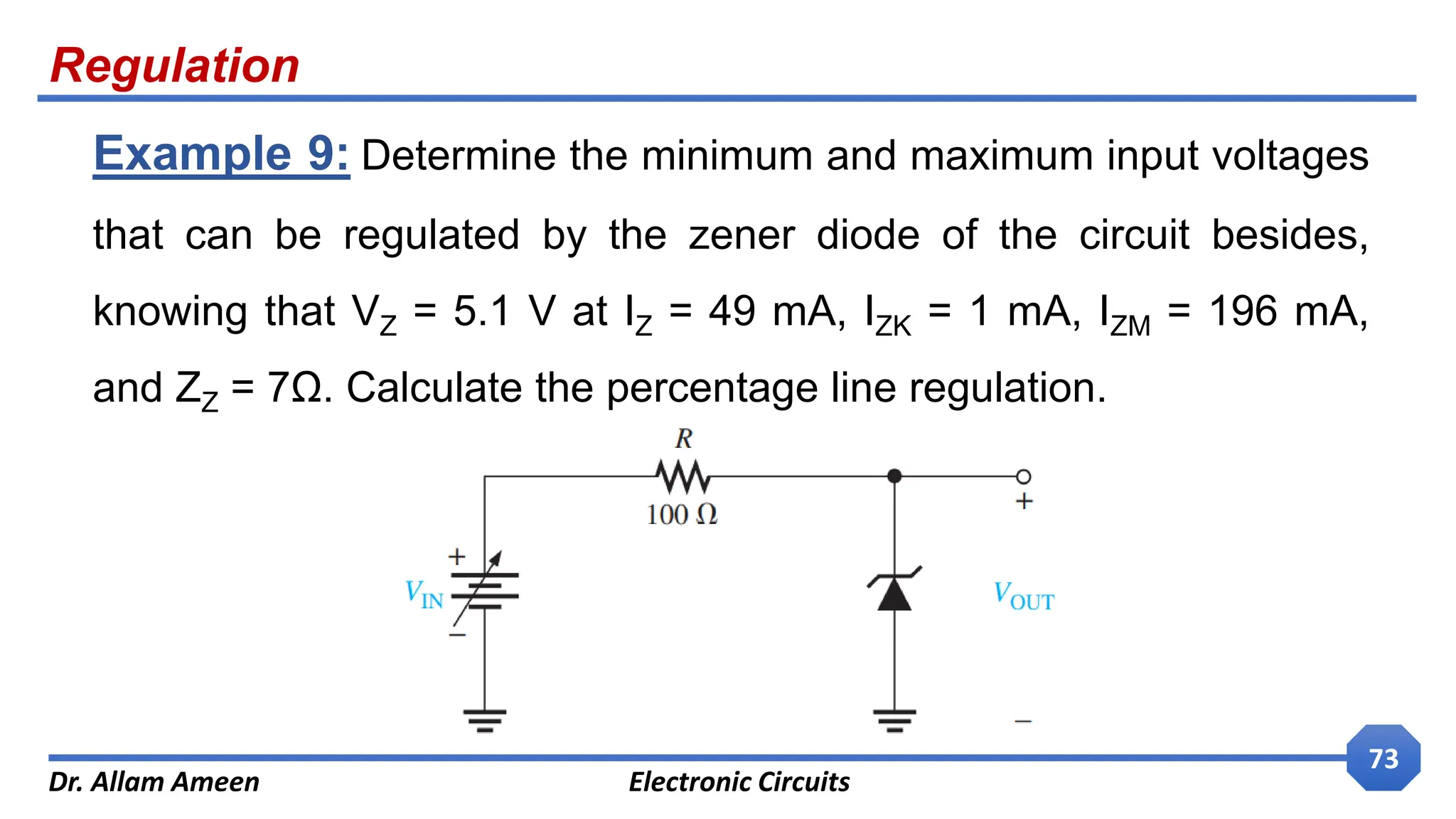
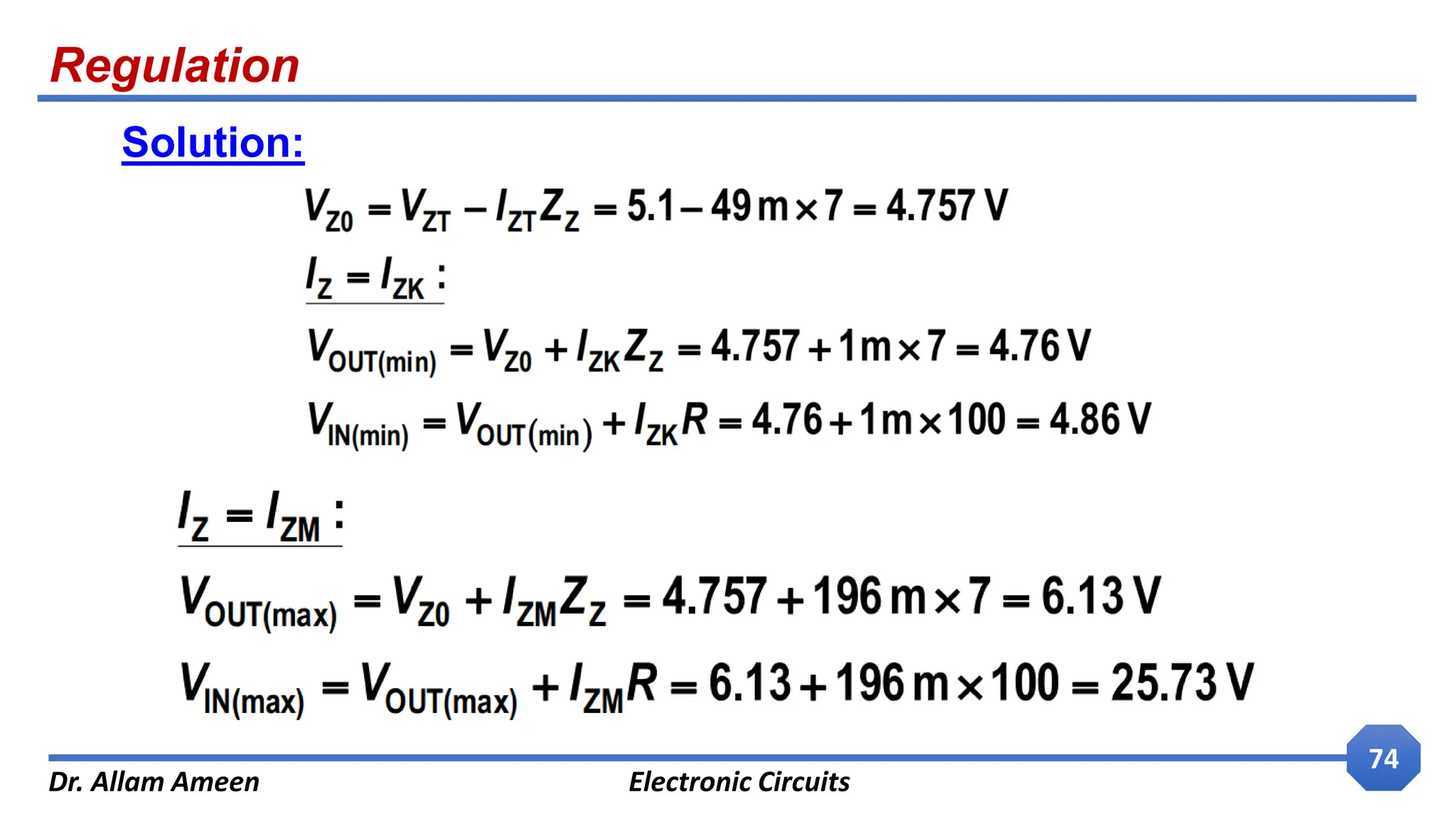
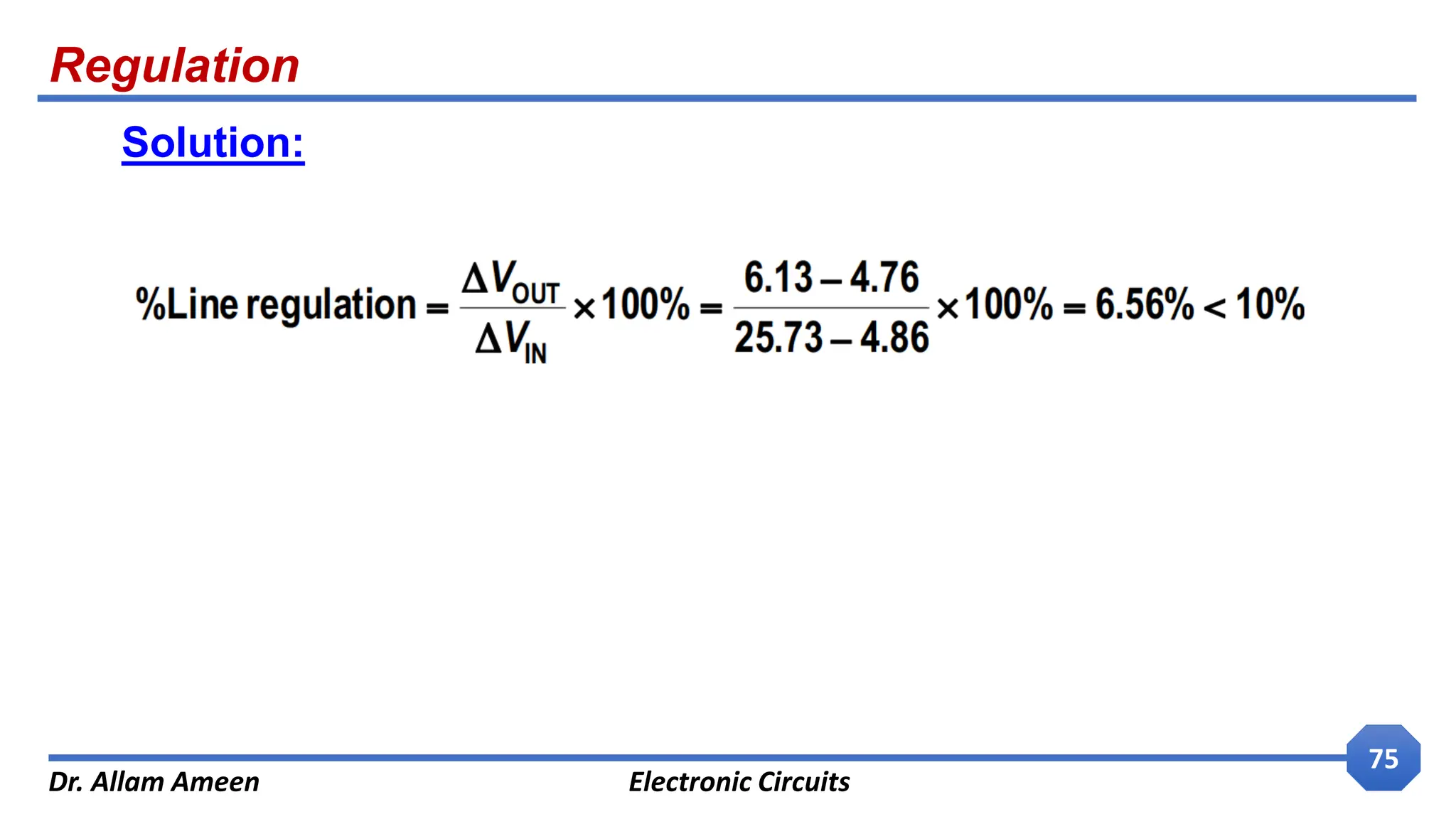
Example 9: Determine the minimum and maximum input voltages
that can be regulated by the zener diode of the circuit besides,
knowing that VZ = 5.1 V at IZ = 49 mA, IZK = 1 mA, IZM = 196 mA,
and ZZ = 7Ω. Calculate the percentage line regulation.
Regulation
Dr. Allam Ameen Electronic Circuits
74
Solution:
Regulation
Dr. Allam Ameen Electronic Circuits
75
Solution:
Regulation
Dr. Allam Ameen Electronic Circuits
76
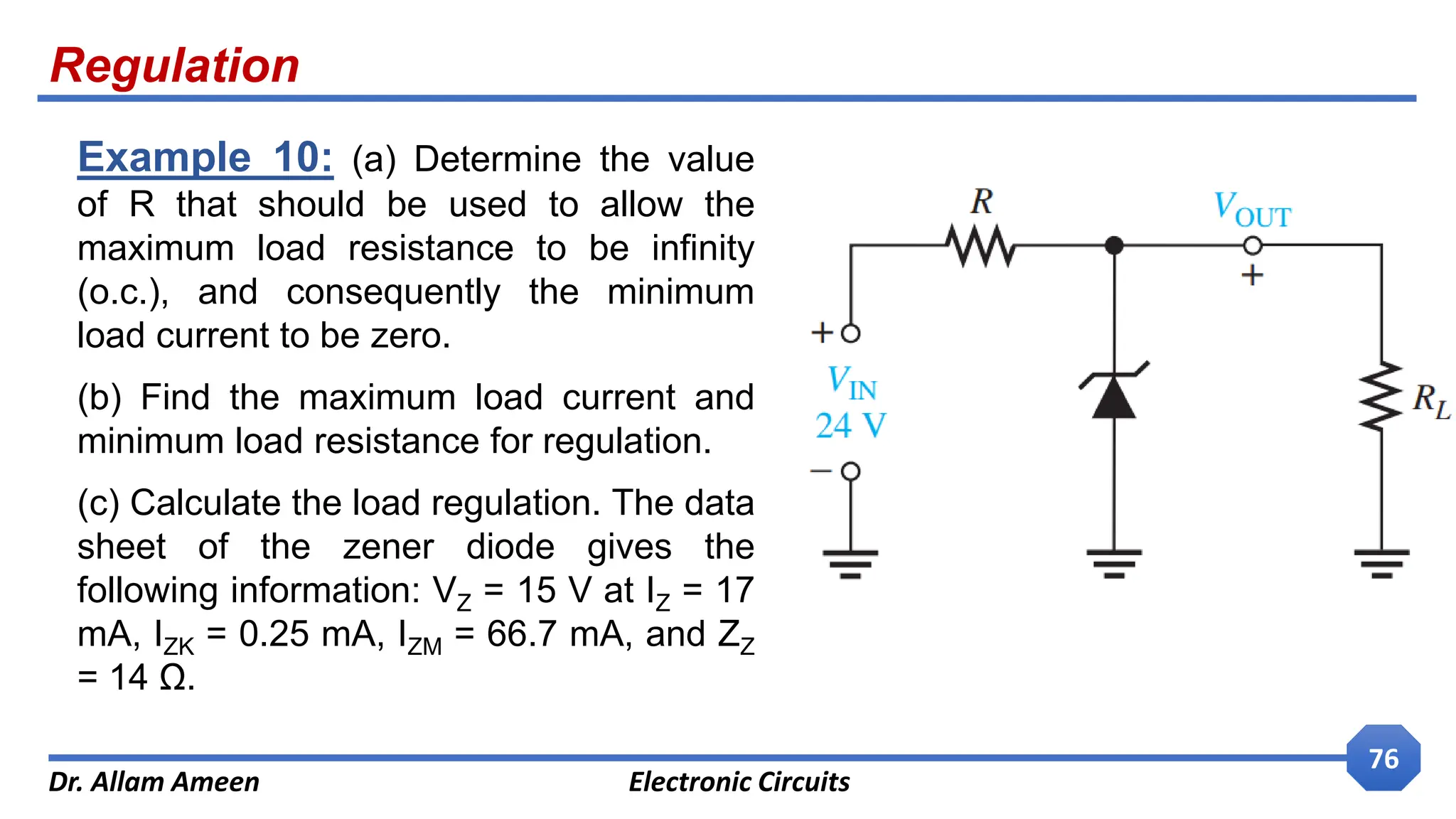
Example 10: (a) Determine the value
of R that should be used to allow the
maximum load resistance to be infinity
(o.c.), and consequently the minimum
load current to be zero.
(b) Find the maximum load current and
minimum load resistance for regulation.
(c) Calculate the load regulation. The data
sheet of the zener diode gives the
following information: VZ = 15 V at IZ = 17
mA, IZK = 0.25 mA, IZM = 66.7 mA, and ZZ
= 14 Ω.
Regulation
Dr. Allam Ameen Electronic Circuits
77
Solution:
Regulation
Dr. Allam Ameen Electronic Circuits
78
Solution:
Power Supply Regulators
Dr. Allam Ameen Electronic Circuits
79
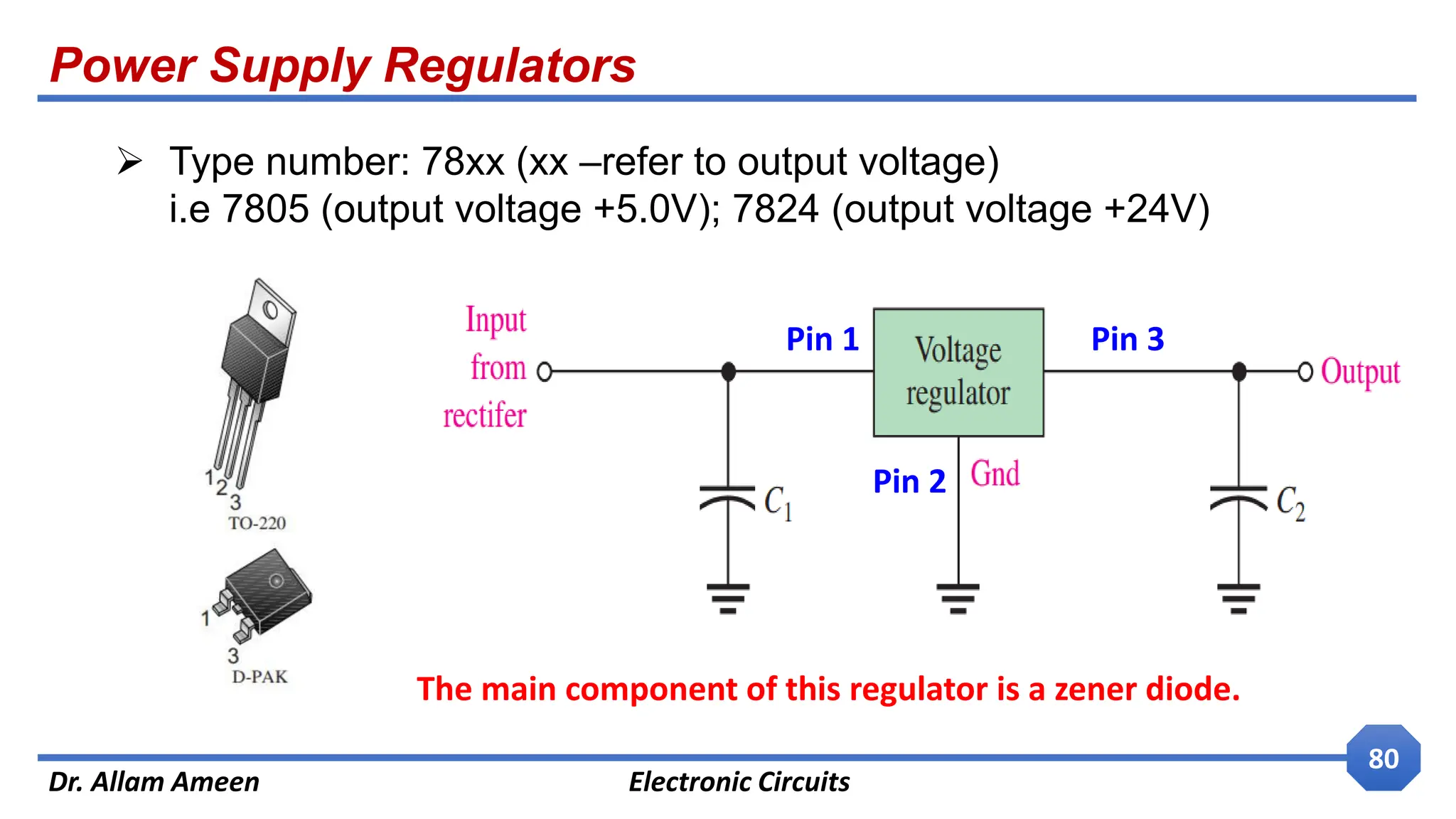
 Connected to the output of a filtered & maintains a constant output
voltage (or current) despite changes in the input, load current or
temperature.
 Combination of a large capacitor & an IC regulator – inexpensive &
produce excellent small power supply.
 Popular IC regulators have 3 terminals:
(i) input terminal
(ii) output terminal
(iii) reference (or adjust) terminal
Power Supply Regulators
Dr. Allam Ameen Electronic Circuits
80
 Type number: 78xx (xx –refer to output voltage)
i.e 7805 (output voltage +5.0V); 7824 (output voltage +24V)
Pin 1
Pin 2
Pin 3
The main component of this regulator is a zener diode.
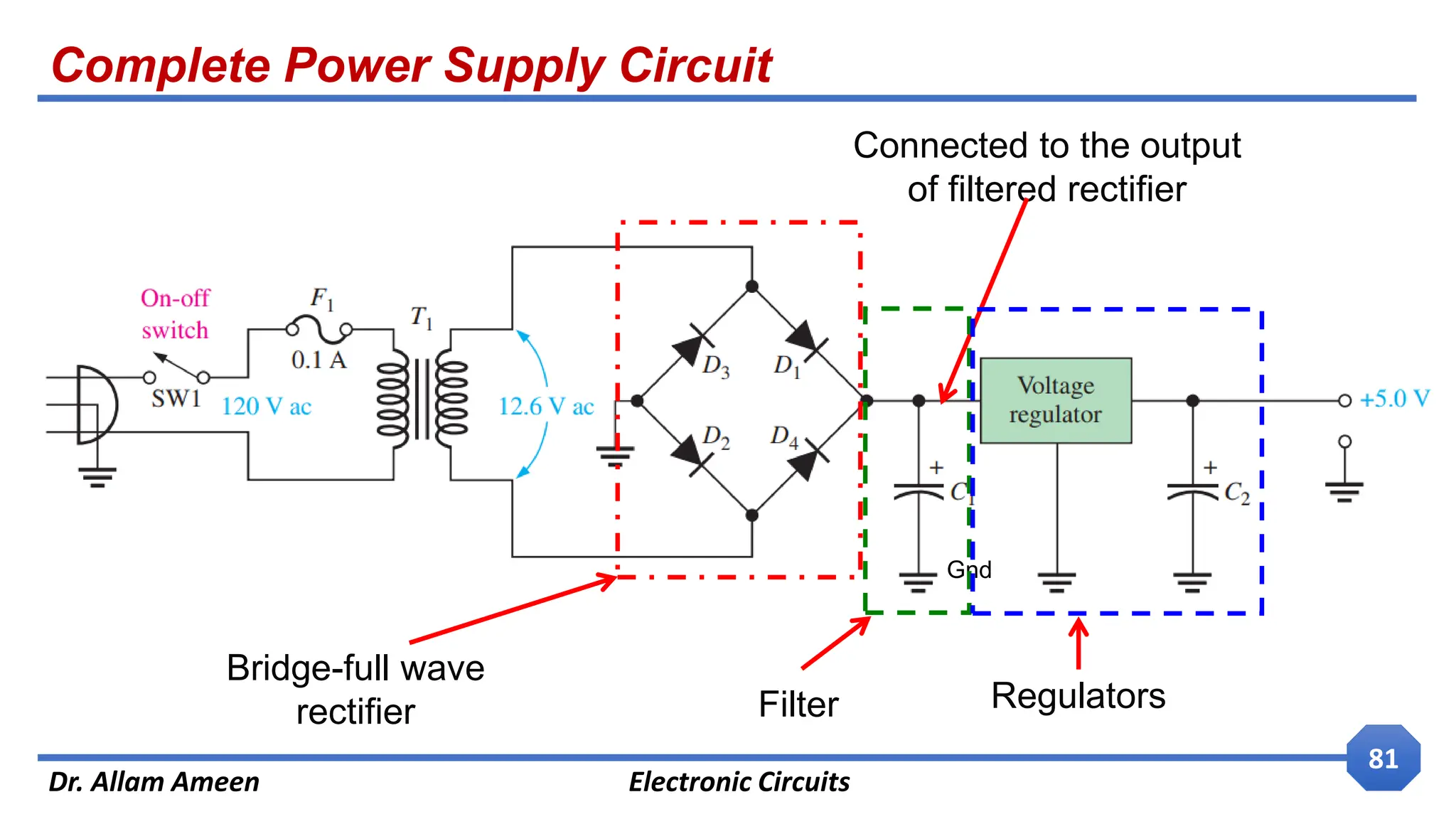
Complete Power Supply Circuit
Dr. Allam Ameen Electronic Circuits
81
Gnd
Connected to the output
of filtered rectifier
Bridge-full wave
rectifier Filter Regulators

Dr. Allam Ameen Electronic Circuits
82

Lectures in electronic circiuts on diode

  • 1.
    Dr. Allam Ameen AssistantProfessor Egyptian Chinese University, Faculty of Engineering and Technology Electronics Research Institute, Microstrip Department Lecture 3 Spring 2025 Electronic Circuits (MCT 123)
  • 2.
    Last Lecture Topics Dr.Allam Ameen Electronic Circuits 2  PN Junction.  Applications of PN Junction.  Diode.  Biasing of the Diode.  Diode Models.  V-I Characteristic of a Diode.
  • 3.
    Today’s Topics Dr. AllamAmeen Electronic Circuits 3  Half-Wave Rectifiers.  Full-Wave Rectifiers.  Power Supply Filters.  Diode Limiters.  Diode Clippers.  Diode Clampers.  Completed Power Supply.
  • 4.
    Full-Wave Rectifiers Dr. AllamAmeen Electronic Circuits 4  A full-wave rectifier allows current to flow during both the positive and negative half cycles or the full 360º whereas half-wave rectifier allows only during one-half of the cycle.  The no. of +ve alternations is twice the half wave for the same time interval  The output frequency is twice the input frequency.  The average value – the value measured on a dc voltmeter  p AVG V V 2 
  • 5.
    Full-Wave Rectifiers Dr. AllamAmeen Electronic Circuits 5 Twice output  p AVG V V 2  63.7% of Vp
  • 6.
    Full-Wave Rectifiers Dr. AllamAmeen Electronic Circuits 6 The Center-Tapped Full-Wave Rectifier  This method of rectification employs two diodes connected to a secondary center-tapped transformer.  The i/p voltage is coupled through the transformer to the center-tapped secondary. Coupled input voltage Center-tap
  • 7.
    Full-Wave Rectifiers Dr. AllamAmeen Electronic Circuits 7 The Center-Tapped Full-Wave Rectifier  +ve half-cycle input voltage (forward-bias D1 & reverse-bias D2)-the current pass through the D1 and RL  -ve half-cycle input voltage (reverse-bias D1 & forward-bias D2)-the current pass through D2 and RL  The output current on both portions of the input cycle is passing in the same direction through the load.  The o/p voltage across the load resistors – full-wave rectifiers
  • 8.
    Full-Wave Rectifiers Dr. AllamAmeen Electronic Circuits 8 During positive half-cycles, D1 is forward-biased and D2 is reverse-biased. During negative half-cycles, D2 is forward-biased and D1 is reverse-biased.
  • 9.
    Full-Wave Rectifiers Dr. AllamAmeen Electronic Circuits 9 Effect of the Turns Ratio on the Output Voltage If n=1, Vp(sec)=Vp(pri) If n=2, 7 . 0 ) ( ) (   pri p out p V V pri V V 2 sec  7 . 0 2 ) ( ) (   pri p out p V V
  • 10.
    Full-Wave Rectifiers Dr. AllamAmeen Electronic Circuits 10 Peak Inverse Voltage (PIV)  Maximum anode voltage: 2 (sec) 1 p V D   2 (sec) 2 p V D    D1: forward-bias – its cathode is at the same voltage of its anode minus diode drop; This is also the voltage on the cathode of D2.
  • 11.
    Full-Wave Rectifiers Dr. AllamAmeen Electronic Circuits 11 PIV across D2 : V V V V V PIV p p p 7 . 0 2 7 . 0 2 (sec) (sec) (sec)                       V V V V V V out p p p out p 4 . 1 2 7 . 0 2 ) ( (sec) (sec) ) (       We know that  Thus; V V PIV out p 7 . 0 2 ) (  
  • 12.
    Full-Wave Rectifiers Dr. AllamAmeen Electronic Circuits 12  It employs four diodes arranged such that current flows in the direction through the load during each half of the cycle.  When Vin +ve, D1 and D2 FB and conduct current. A voltage across RL looks like +ve half of the input cycle. During this time, D3 and D4 are RB.  When Vin –ve, D3 and D4 are FB and conduct current. D1 and D2 are RB. The Bridge Full-Wave Rectifier
  • 13.
    Full-Wave Rectifiers Dr. AllamAmeen Electronic Circuits 13 Used 4 diode: 2 diode in forward 2 diode in reverse Without diode drop (ideal diode): (sec) ) ( p out p V V  2 diode always in series with load resistor during +ve and –ve half cycle . With diode drop (practical diode): V V V p out p 4 . 1 (sec) ) (  
  • 14.
    Full-Wave Rectifiers Dr. AllamAmeen Electronic Circuits 14  p AVG V V 2  
  • 15.
    Full-Wave Rectifiers Dr. AllamAmeen Electronic Circuits 15 For ideal diode, PIV = Vp(out) V V PIV out p 7 . 0 ) (   For each diode, To protect the diodes:
  • 16.
    Full-Wave Rectifiers Dr. AllamAmeen Electronic Circuits 16 Example 1: Draw the output voltage waveform for each circuit in Figure below and include the voltage values.
  • 17.
    Solved Problems Dr. AllamAmeen Electronic Circuits 17 Solution: 𝑉𝑝(𝑜𝑢𝑡) = 𝑉𝑝(𝑖𝑛) − 0.7 = 5 − 0.7 = 4.3𝑉
  • 18.
    Solved Problems Dr. AllamAmeen Electronic Circuits 18 Solution: 𝑉𝑝(𝑜𝑢𝑡) = 𝑉𝑝(𝑖𝑛) − 0.7 = −50 − −0.7 = −49.3𝑉
  • 19.
    Solved Problems Dr. AllamAmeen Electronic Circuits 19 Example 2: Determine the peak output voltage for the bridge rectifier shown besides. Assuming the practical model, what PIV rating is required for the diodes? The transformer is specified to have a 12 V rms secondary voltage for 120 V rms across the primary.
  • 20.
    Solved Problems Dr. AllamAmeen Electronic Circuits 20 Solution:
  • 21.
    Power Supply Filters Dr.Allam Ameen Electronic Circuits 21  To reduce the fluctuations in the output voltage of half / full- wave rectifier – produces constant-level dc voltage.  It is necessary – electronic circuits require a constant source to provide power & biasing for proper operation.  Filters are implemented with capacitors.  In most power supply – 50/60 Hz ac power line voltage is converted to constant dc voltage.  50/60Hz pulsating dc output must be filtered to reduce the large voltage variation.
  • 22.
    Power Supply Filters Dr.Allam Ameen Electronic Circuits 22  The small amount of fluctuation in the filter output voltage is called ripple. The simplest power supply filter is formed by connecting a large capacitor between the rectifier output and the ground. It is referred to as capacitor- input filter.
  • 23.
    Power Supply Filters Dr.Allam Ameen Electronic Circuits 23 Capacitive Filter  Capacitive filter is simply a capacitor connected in parallel with the load resistance or connected from the rectifier output to ground.  During the positive first quarter-cycle of the input, the diode is forward- biased, allowing the capacitor charges rapidly, as illustrated in Figure.
  • 24.
    Power Supply Filters Dr.Allam Ameen Electronic Circuits 24 Capacitive Filter  When the input begins to decrease from maximum, the diode is reverse- biased, and the capacitor slowly discharges through the load resistance. As the output from the rectifier drops below the charged voltage of the capacitor, the capacitor acts as the voltage source for the load.
  • 25.
    Power Supply Filters Dr.Allam Ameen Electronic Circuits 25 Capacitive Filter  During first quarter of the next cycle, the diode will again become forward- biased when the input voltage exceeds the capacitor voltage. The capacitor is fastly charging through the diode.
  • 26.
    Power Supply Filters Dr.Allam Ameen Electronic Circuits 26  The capacitor discharge rate is related to the time constant of the discharge circuit (τ), which equals RLC.  The larger the time constant the smaller the ripple and the more effective filtering we get.  Hence, a capacitor with relatively large capacitance is always used in power supply filters.
  • 27.
    Power Supply Filters Dr.Allam Ameen Electronic Circuits 27  If connected to the same capacitor, full-wave rectifier produces smaller ripple than half-wave rectifier.  This is because the full-wave rectifier allows a smaller discharge interval.
  • 28.
    Power Supply Filters Dr.Allam Ameen Electronic Circuits 28  The performance of the filter is measured using the ripple factor (r). The less the ripple factor, the better the filter: DC pp r V V factor ripple r ) ( _   where : = peak - to -peak ripple voltage ) ( pp r V
  • 29.
    Power Supply Filters Dr.Allam Ameen Electronic Circuits 29  Lower ripple factor  better filter [can be lowered by increasing the value of filter capacitor or increasing the load resistance]
  • 30.
    Power Supply Filters Dr.Allam Ameen Electronic Circuits 30 VDC = VAVG = average value of filter’s output voltage. 5 . 0 1 2 1 1 1 ) ( ) ( ) ( ) (                           C fR V V r V C fR V V V C fR V L DC pp r rect p L AVG DC rect p L pp r
  • 31.
    Solved Problems Dr. AllamAmeen Electronic Circuits 31 Example 3: Determine Vp(rect), Vr(pp), VDC, and the ripple factor for the filtered bridge rectifier with a load as shown below.
  • 32.
    Solved Problems Dr. AllamAmeen Electronic Circuits 32 Solution:
  • 33.
    Solved Problems Dr. AllamAmeen Electronic Circuits 33 Solution:
  • 34.
    Diode Limiters Dr. AllamAmeen Electronic Circuits 34  The diode limiter (clipper) is a circuit that clips the portion from the input waveform that falls either above or below certain reference level.  Limiting circuits limit the positive or negative amount of an input voltage to a specific value. It is very useful for protection.  2 basic clipper configuration:  Positive clipper.  Negative clipper.
  • 35.
    Diode Limiters Dr. AllamAmeen Electronic Circuits 35 Positive clipper • Forward-biased diode when i/p is +ve cycle. • Reverse-biased diode when i/p is in –ve cycle. • o/p signal is limit/clip to +0.7V during +ve cycle of i/p signal.
  • 36.
    Diode Limiters Dr. AllamAmeen Electronic Circuits 36 Negative clipper • Reverse-biased diode act as open circuit during +ve cycle. • Forward-biased diode act as short circuit during –ve cycle. • o/p signal is limit/clip to -0.7V during –ve cycle of i/p signal.
  • 37.
    Diode Limiters Dr. AllamAmeen Electronic Circuits 37 Example 4: What would you expect to see displayed on an oscilloscope connected across RL in the limiter shown below.
  • 38.
    Diode Limiters Dr. AllamAmeen Electronic Circuits 38 Solution: • The diode is forward biased and conducts when input voltage goes below -0.7V. So, for –ve limiter, the peak output voltage across RL is: • The waveform is shown below: V V k k V R R R V in p L L out p 09 . 9 10 1 . 1 0 . 1 ) ( 1 ) (                    
  • 39.
    Diode Limiters Dr. AllamAmeen Electronic Circuits 39 Biased Limiters :  Use dc biasing source, VBIAS to set limit on the circuit output voltage.  This allow the circuit to clip input waveform at values other than diode forward voltage, 0.7V.  In each circuit, bias voltage is in series with shunt diode. As a result, the diode conducts and clips the i/p waveform when signal voltage equals sum of VF and VBIAS.  2 type of biased limiter: • Positive-biased limiter • Negative-biased limiter
  • 40.
    Diode Limiters Dr. AllamAmeen Electronic Circuits 40 Positive limiter • The voltage at point A must equal VBIAS+0.7V before diode become FB and conduct. • Once diode begin to conduct, voltage at point A is limited to VBIAS+0.7V, so all i/p voltage above this level is clipped off.
  • 41.
    Diode Limiters Dr. AllamAmeen Electronic Circuits 41 Negative limiter • Voltage at point A must go below –VBIAS - 0.7V to forward-bias the diode and initiate limiting action. • o/p signal is limit/clip to -0.7V during –ve cycle of i/p signal.
  • 42.
    Diode Limiters Dr. AllamAmeen Electronic Circuits 42 Opposite Biased Limiters :  Use dc biasing source, VBIAS to set limit on the circuit output voltage.  If VBIAS is connected is series with the diode, such that their polarities are opposite to each other, the limiter circuit passes a small portion from the input waveform and rejects the rest.  2 type of biased limiter: • Positive-opposite biased limiter • Negative-opposite biased limiter
  • 43.
    Diode Limiters Dr. AllamAmeen Electronic Circuits 43 Positive-opposite biased limiter
  • 44.
    Diode Limiters Dr. AllamAmeen Electronic Circuits 44 Negative-opposite biased limiter
  • 45.
    Diode Limiters Dr. AllamAmeen Electronic Circuits 45  A voltage divider can be used to provide the required bias voltage (VBIAS) as portion of a supply voltage (VSUPPLY), according to the well- known voltage-divider formula:  The resistors of the divider (R2 and R3) should be very small compared to R1 in order to have a stiff voltage divider, and to minimize the AC voltage drop on (R2 || R3) which may affect VBIAS. SUPPLY BIAS V R R R V           3 2 3
  • 46.
    Diode Limiters Dr. AllamAmeen Electronic Circuits 46  The three commonly used voltage-dividers are shown below:
  • 47.
    Diode Limiters Dr. AllamAmeen Electronic Circuits 47 Example 5: The circuit besides combines a biased positive limiter with a biased negative limiter. Determine the output voltage waveform.
  • 48.
    Diode Limiters Dr. AllamAmeen Electronic Circuits 48 Solution:
  • 49.
    Diode Limiters Dr. AllamAmeen Electronic Circuits 49 Example 6: Describe the output voltage waveform for the diode limiter shown besides.
  • 50.
    Diode Limiters Dr. AllamAmeen Electronic Circuits 50 Solution:
  • 51.
    Diode Clampers Dr. AllamAmeen Electronic Circuits 51  The diode clamper is a simple biasing circuit that adds DC level (positive or negative) to an AC voltage waveform. Its circuit analysis is very similar to the filtered Half-Wave Rectifier (HWR), as the diode and capacitor are just swapped.  There are two types of clampers: the positive clamper and the negative clamper. 1. A positive clamper shifts its input waveform so that the negative peak of the waveform is equal to the clamper dc reference voltage. 2. A negative clamper shifts its input waveform so that the positive peak of the waveform is equal to the clamper dc reference voltage.
  • 52.
    Diode Clampers Dr. AllamAmeen Electronic Circuits 52 Positive Clamper
  • 53.
    Diode Clampers Dr. AllamAmeen Electronic Circuits 53 Negative Clamper
  • 54.
    Diode Clampers Dr. AllamAmeen Electronic Circuits 54
  • 55.
    Diode Clampers Dr. AllamAmeen Electronic Circuits 55 Example 7: What is the output voltage that you would expect to observe across RL in the clamping circuit shown besides? Assume that RC is large enough to prevent significant capacitor discharge.
  • 56.
    Diode Clampers Dr. AllamAmeen Electronic Circuits 56 Solution: First +ve Quarter-Cycle: the capacitor is rapidly charged through the forward biased diode up to: Rest of Cycles: the diode is reversed- biased, and the capacitor is very slowly discharging through RL, Hence: V V V V in p C 3 . 23 7 . 0 24 7 . 0 ) (      V V V V V in C in out 3 . 23    
  • 57.
    Zener Diodes Dr. AllamAmeen Electronic Circuits 57 The basic function of zener diode is to maintain a specific voltage across its terminals within given limits of line or load change. Typically it is used for providing a stable reference voltage for use in power supplies and other equipment. This particular zener circuit will work to maintain 10 V across the load.
  • 58.
    Zener Diodes Dr. AllamAmeen Electronic Circuits 58 A zener diode is much like a normal diode, the exception being is that it is placed in the circuit in reverse bias and operates in reverse breakdown. This typical characteristic curve illustrates the operating range for a zener. Note that its forward characteristics are just like a normal diode.
  • 59.
    Zener Diodes Dr. AllamAmeen Electronic Circuits 59 The zener diode’s breakdown characteristics are determined by the doping process. Low voltage zeners (>5V), operate in the zener breakdown range. Those designed to operate <5 V operate mostly in avalanche breakdown range. Zeners are available with voltage breakdowns of 1.8 V to 200 V. Zener zone Diode zone Avalanche zone
  • 60.
    Zener Diodes Dr. AllamAmeen Electronic Circuits 60 Note very small reverse current (before “knee”). Breakdown occurs @ knee. Breakdown Characteristics: • VZ remains near constant • VZ provides: -Reference voltage -Voltage regulation • IZ escalates rapidly • IZMAX is achieved quickly • Exceeding IZMAX is fatal
  • 61.
    Zener Diodes Dr. AllamAmeen Electronic Circuits 61 Regulation occurs between: VZK - knee voltage to VZM - Imax
  • 62.
    Zener Diodes Dr. AllamAmeen Electronic Circuits 62
  • 63.
    Zener Diodes Dr. AllamAmeen Electronic Circuits 63
  • 64.
    Zener Diodes Dr. AllamAmeen Electronic Circuits 64 • Ideal Zener exhibits a constant voltage, regardless of current draw. • Ideal Zener exhibits no resistance characteristics. • Zener exhibits a near constant voltage, varied by current draw through the series resistance ZZ. • As Iz increases, Vz also increases.
  • 65.
    Zener Diodes Dr. AllamAmeen Electronic Circuits 65 To complete the characterization of a zener diode, the slope of the offset breakdown line of the characteristic curve is represented by a dynamic impedance ZZ, such that: Using the previously defined dynamic impedance, the intersection between the extension of the breakdown line and the voltage axis, VZ0, can be obtained:
  • 66.
    Zener Diodes Dr. AllamAmeen Electronic Circuits 66
  • 67.
    Zener Diodes Dr. AllamAmeen Electronic Circuits 67 Example 8: A zener diode has ZZ of 20 Ω. The data sheet gives VZ = 6.8 V at IZ = 37 mA, and IZK = 1 mA. What is the voltage across the zener terminals when the current is 50 mA? When the current is 25 mA? Use both ideal and practical models of the zener diode. Solution:
  • 68.
    Zener Diodes Dr. AllamAmeen Electronic Circuits 68 Solution:
  • 69.
    Regulation Dr. Allam AmeenElectronic Circuits 69 In this simple illustration of zener regulation circuit, the zener diode will “adjust” its impedance based on varying input voltages. Zener current will increase or decrease directly with voltage input changes. The zener current, Iz, will vary to maintain a constant Vz. Note: The zener has a finite range of current operation. VZener remains constant
  • 70.
    Regulation Dr. Allam AmeenElectronic Circuits 70
  • 71.
    Regulation Dr. Allam AmeenElectronic Circuits 71 In this simple illustration of zener regulation circuit, the zener diode will “adjust” its impedance based on varying input voltages and loads (RL) to be able to maintain its designated zener voltage. Zener current will increase or decrease directly with voltage input changes. The zener current will increase or decrease inversely with varying loads. Again, the zener has a finite range of operation. VZener remains constant
  • 72.
    Regulation Dr. Allam AmeenElectronic Circuits 72
  • 73.
    Regulation Dr. Allam AmeenElectronic Circuits 73 Example 9: Determine the minimum and maximum input voltages that can be regulated by the zener diode of the circuit besides, knowing that VZ = 5.1 V at IZ = 49 mA, IZK = 1 mA, IZM = 196 mA, and ZZ = 7Ω. Calculate the percentage line regulation.
  • 74.
    Regulation Dr. Allam AmeenElectronic Circuits 74 Solution:
  • 75.
    Regulation Dr. Allam AmeenElectronic Circuits 75 Solution:
  • 76.
    Regulation Dr. Allam AmeenElectronic Circuits 76 Example 10: (a) Determine the value of R that should be used to allow the maximum load resistance to be infinity (o.c.), and consequently the minimum load current to be zero. (b) Find the maximum load current and minimum load resistance for regulation. (c) Calculate the load regulation. The data sheet of the zener diode gives the following information: VZ = 15 V at IZ = 17 mA, IZK = 0.25 mA, IZM = 66.7 mA, and ZZ = 14 Ω.
  • 77.
    Regulation Dr. Allam AmeenElectronic Circuits 77 Solution:
  • 78.
    Regulation Dr. Allam AmeenElectronic Circuits 78 Solution:
  • 79.
    Power Supply Regulators Dr.Allam Ameen Electronic Circuits 79  Connected to the output of a filtered & maintains a constant output voltage (or current) despite changes in the input, load current or temperature.  Combination of a large capacitor & an IC regulator – inexpensive & produce excellent small power supply.  Popular IC regulators have 3 terminals: (i) input terminal (ii) output terminal (iii) reference (or adjust) terminal
  • 80.
    Power Supply Regulators Dr.Allam Ameen Electronic Circuits 80  Type number: 78xx (xx –refer to output voltage) i.e 7805 (output voltage +5.0V); 7824 (output voltage +24V) Pin 1 Pin 2 Pin 3 The main component of this regulator is a zener diode.
  • 81.
    Complete Power SupplyCircuit Dr. Allam Ameen Electronic Circuits 81 Gnd Connected to the output of filtered rectifier Bridge-full wave rectifier Filter Regulators
  • 82.
    Dr. Allam AmeenElectronic Circuits 82