Lecture 12
Heat transfer.
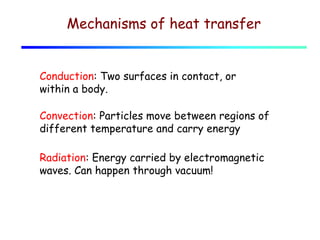
Mechanisms of heat transfer
Conduction: Two surfaces in contact, or
within a body.
Convection: Particles move between regions of
different temperature and carry energy
Radiation: Energy carried by electromagnetic
waves. Can happen through vacuum!
Conduction
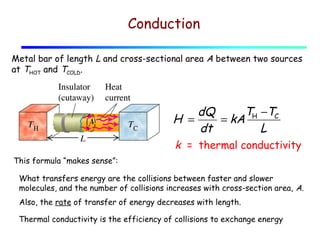
Metal bar of length L and cross-sectional area A between two sources
at THOT and TCOLD.

TH −TC
dQ
H =
= kA
dt
L
k = thermal conductivity
This formula “makes sense”:
What transfers energy are the collisions between faster and slower
molecules, and the number of collisions increases with cross-section area, A.
Also, the rate of transfer of energy decreases with length.
Thermal conductivity is the efficiency of collisions to exchange energy
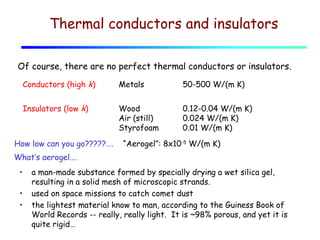
Thermal conductors and insulators
Of course, there are no perfect thermal conductors or insulators.
Conductors (high k)

Metals

50-500 W/(m K)

Insulators (low k)

Wood
Air (still)
Styrofoam

0.12-0.04 W/(m K)
0.024 W/(m K)
0.01 W/(m K)

How low can you go?????….

“Aerogel”: 8x10⁻⁵ W/(m K)

What’s aerogel….
•
•
•

a man-made substance formed by specially drying a wet silica gel,
resulting in a solid mesh of microscopic strands.
used on space missions to catch comet dust
the lightest material know to man, according to the Guiness Book of
World Records -- really, really light. It is ~98% porous, and yet it is
quite rigid…
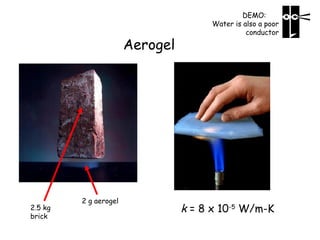
Aerogel

2.5 kg
brick

2 g aerogel

DEMO:
Water is also a poor
conductor

k = 8 x 10⁻⁵ W/m-K
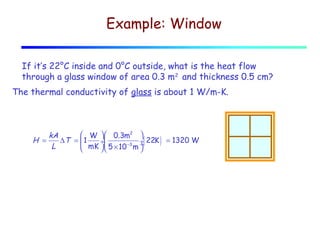
Example: Window
If it’s 22°C inside and 0°C outside, what is the heat flow
through a glass window of area 0.3 m2 and thickness 0.5 cm?
The thermal conductivity of glass is about 1 W/m-K.

 W   0.3m2 
kA
H =
∆T =  1
÷( 22K ) = 1320 W
÷
L
mK   5 × 10 −3 m ÷



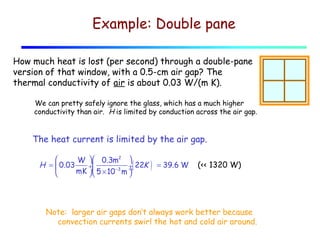
Example: Double pane
How much heat is lost (per second) through a double-pane
version of that window, with a 0.5-cm air gap? The
thermal conductivity of air is about 0.03 W/(m K).
We can pretty safely ignore the glass, which has a much higher
conductivity than air. H is limited by conduction across the air gap.

The heat current is limited by the air gap.

W   0.3m2 
H =  0.03
÷( 22K
÷

mK  5 × 10 −3 m ÷



)

= 39.6 W

(<< 1320 W)

Note: larger air gaps don’t always work better because
convection currents swirl the hot and cold air around.
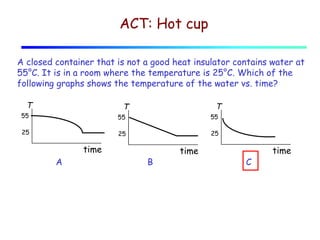
ACT: Hot cup
A closed container that is not a good heat insulator contains water at
55°C. It is in a room where the temperature is 25°C. Which of the
following graphs shows the temperature of the water vs. time?
T

T

T

55

55

55

25

25

25

time
A

B

time

C

time
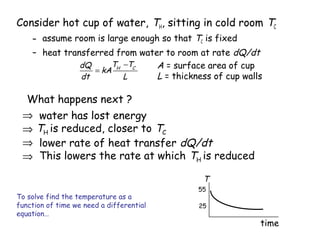
Consider hot cup of water, TH, sitting in cold room TC
– assume room is large enough so that TC is fixed
– heat transferred from water to room at rate dQ/dt
TH −TC
dQ
A = surface area of cup
= kA
L = thickness of cup walls
dt
L

What happens next ?
⇒ water has lost energy
⇒ TH is reduced, closer to TC
⇒ lower rate of heat transfer dQ/dt
⇒ This lowers the rate at which TH is reduced
T
To solve find the temperature as a
function of time we need a differential
equation…

55
25

time
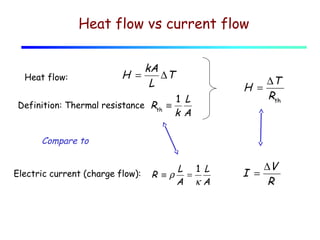
Heat flow vs current flow

Heat flow:

kA
H =
∆T
L

Definition: Thermal resistance Rth ≡

1 L
kA

∆T
H =
Rth

Compare to
Electric current (charge flow):

L 1 L
R ≡ρ =
A κA

∆V
I =
R
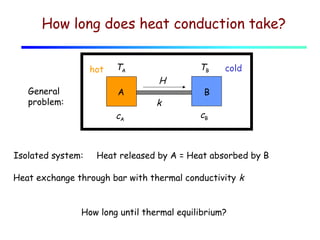
How long does heat conduction take?
hot
General
problem:

TA
A

cA

Isolated system:

H
k

TB

cold

B

cB

Heat released by A = Heat absorbed by B

Heat exchange through bar with thermal conductivity k
How long until thermal equilibrium?
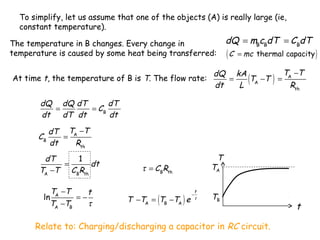
To simplify, let us assume that one of the objects (A) is really large (ie,
constant temperature).

dQ = mBcBdT = C BdT

The temperature in B changes. Every change in
temperature is caused by some heat being transferred:
At time t, the temperature of B is T. The flow rate:

(C

= mc thermal capacity )

T −T
dQ kA
=
TA −T ) = A
(
dt
L
Rth

dQ dQ dT
dT
=
= CB
dt
dT dt
dt
CB

dT TA −T
=
dt
Rth

dT
1
=
dt
TA −T C BRth

T −T
t
ln A
=−
TA −TB
τ

T

TA

τ = C BRth
T −TA = (TB −TA ) e

t
−
τ

TB

Relate to: Charging/discharging a capacitor in RC circuit.

t
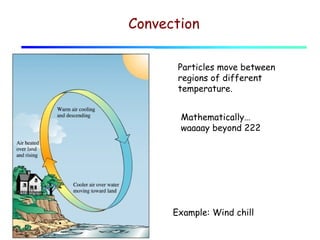
Convection
Particles move between
regions of different
temperature.
Mathematically…
waaaay beyond 222

Example: Wind chill
DEMO:
Lighting a
match

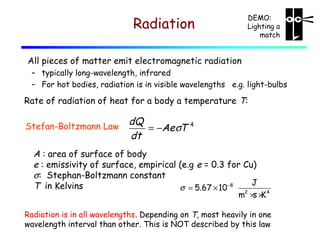
Radiation
All pieces of matter emit electromagnetic radiation

– typically long-wavelength, infrared
– For hot bodies, radiation is in visible wavelengths e.g. light-bulbs

Rate of radiation of heat for a body a temperature T:
Stefan-Boltzmann Law

dQ
= −Ae σT
dt

4

A : area of surface of body
e : emissivity of surface, empirical (e.g e = 0.3 for Cu)
σ: Stephan-Boltzmann constant
J
T in Kelvins
σ = 5.67 × 10 −8

m2 ×s × 4
K

Radiation is in all wavelengths. Depending on T, most heavily in one
wavelength interval than other. This is NOT described by this law
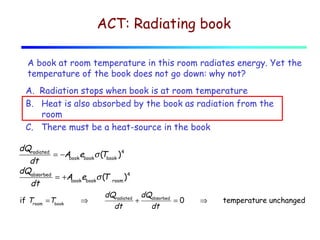
ACT: Radiating book
A book at room temperature in this room radiates energy. Yet the
temperature of the book does not go down: why not?
A. Radiation stops when book is at room temperature
B. Heat is also absorbed by the book as radiation from the
room
C. There must be a heat-source in the book
dQradiated
= −Abookebookσ ( book ) 4
T
dt
dQabsorbed
= +Abookebookσ ( room ) 4
T
dt
if Troom =Tbook

⇒

dQradiated dQabsorbed
+
=0
dt
dt

⇒

temperature unchanged
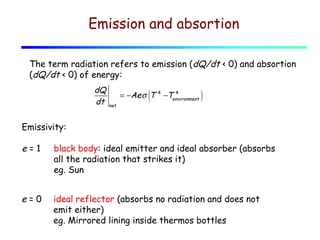
Emission and absortion
The term radiation refers to emission (dQ/dt < 0) and absortion
(dQ/dt < 0) of energy:
dQ
dt

(

= −Ae σ T
net

4

4
−Tenvironment

)

Emissivity:

e=1

black body: ideal emitter and ideal absorber (absorbs
all the radiation that strikes it)
eg. Sun

e=0

ideal reflector (absorbs no radiation and does not
emit either)
eg. Mirrored lining inside thermos bottles
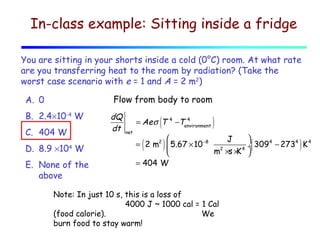
In-class example: Sitting inside a fridge
You are sitting in your shorts inside a cold (0°C) room. At what rate
are you transferring heat to the room by radiation? (Take the
worst case scenario with e = 1 and A = 2 m2)
Flow from body to room

A. 0
B. 2.4×10⁻⁴ W
C. 404 W
D. 8.9 ×10⁴ W
E. None of the
above

dQ
dt

(

= Ae σ T
net

4

4
−Tenvironment

)



J
4
4
4
= 2 m2  5.67 × 10 −8 2
÷ 309 − 273 K
m ×s × 4 
K

= 404 W

(

)

Note: In just 10 s, this is a loss of
4000 J ~ 1000 cal = 1 Cal
(food calorie).
We
burn food to stay warm!

(

)

Lecture 12 heat transfer.

  • 1.
  • 2.
    Mechanisms of heattransfer Conduction: Two surfaces in contact, or within a body. Convection: Particles move between regions of different temperature and carry energy Radiation: Energy carried by electromagnetic waves. Can happen through vacuum!
  • 3.
    Conduction Metal bar oflength L and cross-sectional area A between two sources at THOT and TCOLD. TH −TC dQ H = = kA dt L k = thermal conductivity This formula “makes sense”: What transfers energy are the collisions between faster and slower molecules, and the number of collisions increases with cross-section area, A. Also, the rate of transfer of energy decreases with length. Thermal conductivity is the efficiency of collisions to exchange energy
  • 4.
    Thermal conductors andinsulators Of course, there are no perfect thermal conductors or insulators. Conductors (high k) Metals 50-500 W/(m K) Insulators (low k) Wood Air (still) Styrofoam 0.12-0.04 W/(m K) 0.024 W/(m K) 0.01 W/(m K) How low can you go?????…. “Aerogel”: 8x10⁻⁵ W/(m K) What’s aerogel…. • • • a man-made substance formed by specially drying a wet silica gel, resulting in a solid mesh of microscopic strands. used on space missions to catch comet dust the lightest material know to man, according to the Guiness Book of World Records -- really, really light. It is ~98% porous, and yet it is quite rigid…
  • 5.
    Aerogel 2.5 kg brick 2 gaerogel DEMO: Water is also a poor conductor k = 8 x 10⁻⁵ W/m-K
  • 6.
    Example: Window If it’s22°C inside and 0°C outside, what is the heat flow through a glass window of area 0.3 m2 and thickness 0.5 cm? The thermal conductivity of glass is about 1 W/m-K.  W   0.3m2  kA H = ∆T =  1 ÷( 22K ) = 1320 W ÷ L mK   5 × 10 −3 m ÷   
  • 7.
    Example: Double pane Howmuch heat is lost (per second) through a double-pane version of that window, with a 0.5-cm air gap? The thermal conductivity of air is about 0.03 W/(m K). We can pretty safely ignore the glass, which has a much higher conductivity than air. H is limited by conduction across the air gap. The heat current is limited by the air gap.  W   0.3m2  H =  0.03 ÷( 22K ÷  mK  5 × 10 −3 m ÷   ) = 39.6 W (<< 1320 W) Note: larger air gaps don’t always work better because convection currents swirl the hot and cold air around.
  • 8.
    ACT: Hot cup Aclosed container that is not a good heat insulator contains water at 55°C. It is in a room where the temperature is 25°C. Which of the following graphs shows the temperature of the water vs. time? T T T 55 55 55 25 25 25 time A B time C time
  • 9.
    Consider hot cupof water, TH, sitting in cold room TC – assume room is large enough so that TC is fixed – heat transferred from water to room at rate dQ/dt TH −TC dQ A = surface area of cup = kA L = thickness of cup walls dt L What happens next ? ⇒ water has lost energy ⇒ TH is reduced, closer to TC ⇒ lower rate of heat transfer dQ/dt ⇒ This lowers the rate at which TH is reduced T To solve find the temperature as a function of time we need a differential equation… 55 25 time
  • 10.
    Heat flow vscurrent flow Heat flow: kA H = ∆T L Definition: Thermal resistance Rth ≡ 1 L kA ∆T H = Rth Compare to Electric current (charge flow): L 1 L R ≡ρ = A κA ∆V I = R
  • 11.
    How long doesheat conduction take? hot General problem: TA A cA Isolated system: H k TB cold B cB Heat released by A = Heat absorbed by B Heat exchange through bar with thermal conductivity k How long until thermal equilibrium?
  • 12.
    To simplify, letus assume that one of the objects (A) is really large (ie, constant temperature). dQ = mBcBdT = C BdT The temperature in B changes. Every change in temperature is caused by some heat being transferred: At time t, the temperature of B is T. The flow rate: (C = mc thermal capacity ) T −T dQ kA = TA −T ) = A ( dt L Rth dQ dQ dT dT = = CB dt dT dt dt CB dT TA −T = dt Rth dT 1 = dt TA −T C BRth T −T t ln A =− TA −TB τ T TA τ = C BRth T −TA = (TB −TA ) e t − τ TB Relate to: Charging/discharging a capacitor in RC circuit. t
  • 13.
    Convection Particles move between regionsof different temperature. Mathematically… waaaay beyond 222 Example: Wind chill
  • 14.
    DEMO: Lighting a match Radiation All piecesof matter emit electromagnetic radiation – typically long-wavelength, infrared – For hot bodies, radiation is in visible wavelengths e.g. light-bulbs Rate of radiation of heat for a body a temperature T: Stefan-Boltzmann Law dQ = −Ae σT dt 4 A : area of surface of body e : emissivity of surface, empirical (e.g e = 0.3 for Cu) σ: Stephan-Boltzmann constant J T in Kelvins σ = 5.67 × 10 −8 m2 ×s × 4 K Radiation is in all wavelengths. Depending on T, most heavily in one wavelength interval than other. This is NOT described by this law
  • 15.
    ACT: Radiating book Abook at room temperature in this room radiates energy. Yet the temperature of the book does not go down: why not? A. Radiation stops when book is at room temperature B. Heat is also absorbed by the book as radiation from the room C. There must be a heat-source in the book dQradiated = −Abookebookσ ( book ) 4 T dt dQabsorbed = +Abookebookσ ( room ) 4 T dt if Troom =Tbook ⇒ dQradiated dQabsorbed + =0 dt dt ⇒ temperature unchanged
  • 16.
    Emission and absortion Theterm radiation refers to emission (dQ/dt < 0) and absortion (dQ/dt < 0) of energy: dQ dt ( = −Ae σ T net 4 4 −Tenvironment ) Emissivity: e=1 black body: ideal emitter and ideal absorber (absorbs all the radiation that strikes it) eg. Sun e=0 ideal reflector (absorbs no radiation and does not emit either) eg. Mirrored lining inside thermos bottles
  • 17.
    In-class example: Sittinginside a fridge You are sitting in your shorts inside a cold (0°C) room. At what rate are you transferring heat to the room by radiation? (Take the worst case scenario with e = 1 and A = 2 m2) Flow from body to room A. 0 B. 2.4×10⁻⁴ W C. 404 W D. 8.9 ×10⁴ W E. None of the above dQ dt ( = Ae σ T net 4 4 −Tenvironment )   J 4 4 4 = 2 m2  5.67 × 10 −8 2 ÷ 309 − 273 K m ×s × 4  K  = 404 W ( ) Note: In just 10 s, this is a loss of 4000 J ~ 1000 cal = 1 Cal (food calorie). We burn food to stay warm! ( )