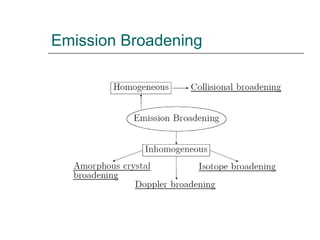
Emission Broadening
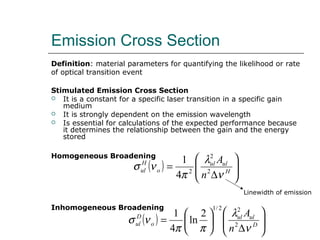
Emission Cross Section 
Definition: material parameters for quantifying the likelihood or rate 
of optical transition event 
Stimulated Emission Cross Section 
 It is a constant for a specific laser transition in a specific gain 
medium 
 It is strongly dependent on the emission wavelength 
 Is essential for calculations of the expected performance because 
it determines the relationship between the gain and the energy 
stored 
Homogeneous Broadening 
æ 
1 
( ) ÷ ÷ø 
H 
ul n 
s n 2 
Inhomogeneous Broadening 
ö 
ç çè 
= ul ul 
H 
D 
o 
A 
n 
l 
p 
2 
4 2 
ö 
1/ 2 2 ln 2 
æ 
1 
= æ D 
ö çè 
( ) ÷ ÷ø 
ç çè 
D 
D 
ul n 
s n 2 
÷ø 
ul ul 
o 
A 
n 
l 
p p 
4 
Linewidth of emission
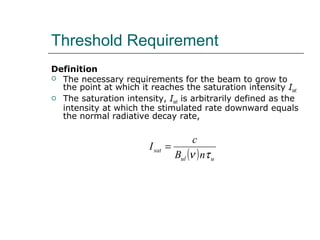
Threshold Requirement 
Definition 
 The necessary requirements for the beam to grow to 
the point at which it reaches the saturation intensity Isat 
 The saturation intensity, Isat is arbitrarily defined as the 
intensity at which the stimulated rate downward equals 
the normal radiative decay rate, 
I c 
ul ( ) u 
sat B n 
n t 
=
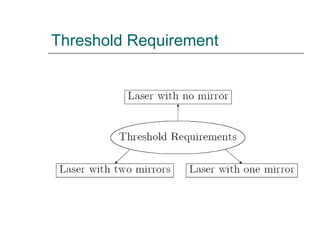
Threshold Requirement
Threshold Requirement 
Laser With No Mirror 
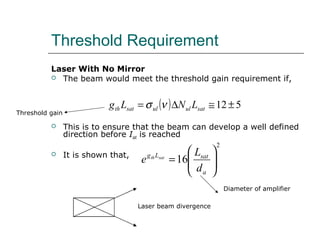
 The beam would meet the threshold gain requirement if, 
= ( )D @ 12 ± 5 th sat ul ul sat g L s n N L 
 This is to ensure that the beam can develop a well defined 
direction before Isat is reached 
 It is shown that, 
2 
ö 
æ 
e th sat L 
16 ÷ ÷ø 
ç çè 
g L sat 
= 
a 
d 
Diameter of amplifier 
Threshold gain 
Laser beam divergence
Threshold Requirement 
Laser With One Mirror 
 Adding a mirror can be thought of as adding a second 
amplifier 
 Assuming that the beam just reaches Isat after two passes 
through the amplifier, the gain medium would meet the 
threshold gain requirement if, 
g L = g (2L) = g L = ( )DN (2L) @ 12 ± 5 th sat th th eff ul ul s n 
oThe beam is narrower, as it emerges from the end of the 
amplifier
Threshold Requirement 
Laser With Two Mirrors 
 Placing a mirror at each end of the amplifier effectively 
adds an infinite series of amplifiers behind the original 
amplifier 
 A slight amount of light is allowed to leak out the end 
by using a mirror with 99.9% reflectivity 
 Two factors determine if a two-mirror laser can reach Isat 
1. Net gain per trip 
2. Sufficient gain duration 
 The beam emerges with a very narrow angular 
divergence
Threshold Requirement 
Net Gain per Round Trip 
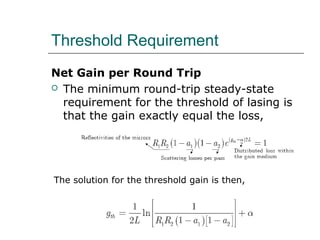
 The minimum round-trip steady-state 
requirement for the threshold of lasing is 
that the gain exactly equal the loss, 
The solution for the threshold gain is then,
Resonator Stability
Resonator Stability 
Stable Resonators 
 The curvatures of the mirrors keep the light 
concentrated near the axis of the resonator 
 The only way light can escape from the resonator 
is to go through one of the mirrors
Resonator Stability 
Unstable Resonators 
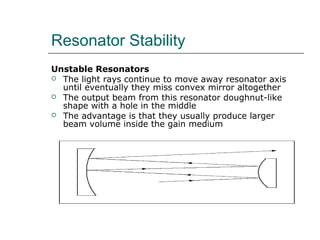
 The light rays continue to move away resonator axis 
until eventually they miss convex mirror altogether 
 The output beam from this resonator doughnut-like 
shape with a hole in the middle 
 The advantage is that they usually produce larger 
beam volume inside the gain medium
Pumping Techniques
Pumping Techniques 
Direct Pumping 
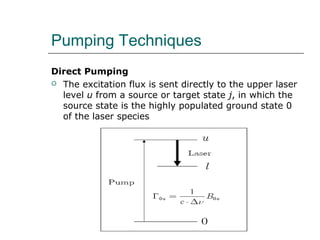
 The excitation flux is sent directly to the upper laser 
level u from a source or target state j, in which the 
source state is the highly populated ground state 0 
of the laser species
Pumping Techniques 
Optical Pumping 
 Often used for solid-state and 
organic dye lasers 
Particle Pumping 
 Generally used for gas lasers and 
also semiconductor lasers
Pumping Techniques 
Direct Pumping 
Disadvantages 
 Several effects can prevent direct pumping from being an effective 
excitation process for many potential lasers. These effects are listed 
as follows. 
 1. There may be no efficient direct route from the ground state 0 to 
the laser state u. For optical pumping, that would mean that the B0u 
associated with pump absorption is too small to produce enough gain; 
for particle pumping, it would mean that the electron collisional 
excitation cross section σ0u is too small. 
 2. There may be a good direct route from 0 to u, but there may also 
be a better route from 0 to l (the lower laser level) by the same 
process. In this case Γ0l/Γ0u may be too large to allow an inversion. 
 3. Even though there may be a good probability for excitation - via 
absorption either of the pump light associated with B0u for optical 
excitation or of σ0u 
e for electron excitation - there may not be a good 
source of pumping flux available. That is, there may be insufficient 
intensity, I for optical pumping, or insufficient density Np (or electron 
density ne) for particle pumping, at the specific energies necessary for 
pumping population from level 0 to level u.
Pumping Techniques 
Indirect Pumping 
 Indirect pumping processes all involve an intermediate level 
q and can be considered in three general categories as 
diagrammed in the figure below: transfer from below, 
transfer across, and transfer from above.
Cavity Modes 
Longitudinal Laser Cavity Modes 
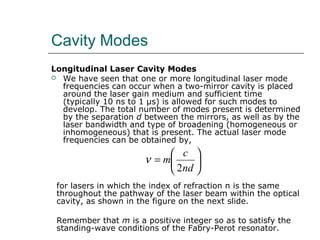
 We have seen that one or more longitudinal laser mode 
frequencies can occur when a two-mirror cavity is placed 
around the laser gain medium and sufficient time 
(typically 10 ns to 1 μs) is allowed for such modes to 
develop. The total number of modes present is determined 
by the separation d between the mirrors, as well as by the 
laser bandwidth and type of broadening (homogeneous or 
inhomogeneous) that is present. The actual laser mode 
frequencies can be obtained by, 
m c 
2 
ö çè 
÷ø 
= æ 
nd 
n 
for lasers in which the index of refraction n is the same 
throughout the pathway of the laser beam within the optical 
cavity, as shown in the figure on the next slide. 
Remember that m is a positive integer so as to satisfy the 
standing-wave conditions of the Fabry-Perot resonator.
Cavity Modes 
Longitudinal Laser Cavity Modes 
 This expression is valid for almost all gas lasers, as well as 
for solid-state and dye lasers in which the mirrors are 
placed immediately at the ends of the gain medium. If a 
laser has a space of length d - L between the gain medium 
and the mirrors, and if that cavity space has a different 
value for the index of refraction nc than the index nL of the 
laser gain medium, then a specific laser mode frequency 
associated with a mode number m can be expressed as, 
ö 
ù 
1 
[ ] ÷ ÷ø 
æ 
ç çè 
úû 
é 
êë 
- + 
= 
n d L n L 
m c 
c L 
2 
n

Lecture 12 2013_

  • 1.
  • 2.
    Emission Cross Section Definition: material parameters for quantifying the likelihood or rate of optical transition event Stimulated Emission Cross Section  It is a constant for a specific laser transition in a specific gain medium  It is strongly dependent on the emission wavelength  Is essential for calculations of the expected performance because it determines the relationship between the gain and the energy stored Homogeneous Broadening æ 1 ( ) ÷ ÷ø H ul n s n 2 Inhomogeneous Broadening ö ç çè = ul ul H D o A n l p 2 4 2 ö 1/ 2 2 ln 2 æ 1 = æ D ö çè ( ) ÷ ÷ø ç çè D D ul n s n 2 ÷ø ul ul o A n l p p 4 Linewidth of emission
  • 3.
    Threshold Requirement Definition  The necessary requirements for the beam to grow to the point at which it reaches the saturation intensity Isat  The saturation intensity, Isat is arbitrarily defined as the intensity at which the stimulated rate downward equals the normal radiative decay rate, I c ul ( ) u sat B n n t =
  • 4.
  • 5.
    Threshold Requirement LaserWith No Mirror  The beam would meet the threshold gain requirement if, = ( )D @ 12 ± 5 th sat ul ul sat g L s n N L  This is to ensure that the beam can develop a well defined direction before Isat is reached  It is shown that, 2 ö æ e th sat L 16 ÷ ÷ø ç çè g L sat = a d Diameter of amplifier Threshold gain Laser beam divergence
  • 6.
    Threshold Requirement LaserWith One Mirror  Adding a mirror can be thought of as adding a second amplifier  Assuming that the beam just reaches Isat after two passes through the amplifier, the gain medium would meet the threshold gain requirement if, g L = g (2L) = g L = ( )DN (2L) @ 12 ± 5 th sat th th eff ul ul s n oThe beam is narrower, as it emerges from the end of the amplifier
  • 7.
    Threshold Requirement LaserWith Two Mirrors  Placing a mirror at each end of the amplifier effectively adds an infinite series of amplifiers behind the original amplifier  A slight amount of light is allowed to leak out the end by using a mirror with 99.9% reflectivity  Two factors determine if a two-mirror laser can reach Isat 1. Net gain per trip 2. Sufficient gain duration  The beam emerges with a very narrow angular divergence
  • 8.
    Threshold Requirement NetGain per Round Trip  The minimum round-trip steady-state requirement for the threshold of lasing is that the gain exactly equal the loss, The solution for the threshold gain is then,
  • 9.
  • 10.
    Resonator Stability StableResonators  The curvatures of the mirrors keep the light concentrated near the axis of the resonator  The only way light can escape from the resonator is to go through one of the mirrors
  • 11.
    Resonator Stability UnstableResonators  The light rays continue to move away resonator axis until eventually they miss convex mirror altogether  The output beam from this resonator doughnut-like shape with a hole in the middle  The advantage is that they usually produce larger beam volume inside the gain medium
  • 12.
  • 13.
    Pumping Techniques DirectPumping  The excitation flux is sent directly to the upper laser level u from a source or target state j, in which the source state is the highly populated ground state 0 of the laser species
  • 14.
    Pumping Techniques OpticalPumping  Often used for solid-state and organic dye lasers Particle Pumping  Generally used for gas lasers and also semiconductor lasers
  • 15.
    Pumping Techniques DirectPumping Disadvantages  Several effects can prevent direct pumping from being an effective excitation process for many potential lasers. These effects are listed as follows.  1. There may be no efficient direct route from the ground state 0 to the laser state u. For optical pumping, that would mean that the B0u associated with pump absorption is too small to produce enough gain; for particle pumping, it would mean that the electron collisional excitation cross section σ0u is too small.  2. There may be a good direct route from 0 to u, but there may also be a better route from 0 to l (the lower laser level) by the same process. In this case Γ0l/Γ0u may be too large to allow an inversion.  3. Even though there may be a good probability for excitation - via absorption either of the pump light associated with B0u for optical excitation or of σ0u e for electron excitation - there may not be a good source of pumping flux available. That is, there may be insufficient intensity, I for optical pumping, or insufficient density Np (or electron density ne) for particle pumping, at the specific energies necessary for pumping population from level 0 to level u.
  • 16.
    Pumping Techniques IndirectPumping  Indirect pumping processes all involve an intermediate level q and can be considered in three general categories as diagrammed in the figure below: transfer from below, transfer across, and transfer from above.
  • 17.
    Cavity Modes LongitudinalLaser Cavity Modes  We have seen that one or more longitudinal laser mode frequencies can occur when a two-mirror cavity is placed around the laser gain medium and sufficient time (typically 10 ns to 1 μs) is allowed for such modes to develop. The total number of modes present is determined by the separation d between the mirrors, as well as by the laser bandwidth and type of broadening (homogeneous or inhomogeneous) that is present. The actual laser mode frequencies can be obtained by, m c 2 ö çè ÷ø = æ nd n for lasers in which the index of refraction n is the same throughout the pathway of the laser beam within the optical cavity, as shown in the figure on the next slide. Remember that m is a positive integer so as to satisfy the standing-wave conditions of the Fabry-Perot resonator.
  • 18.
    Cavity Modes LongitudinalLaser Cavity Modes  This expression is valid for almost all gas lasers, as well as for solid-state and dye lasers in which the mirrors are placed immediately at the ends of the gain medium. If a laser has a space of length d - L between the gain medium and the mirrors, and if that cavity space has a different value for the index of refraction nc than the index nL of the laser gain medium, then a specific laser mode frequency associated with a mode number m can be expressed as, ö ù 1 [ ] ÷ ÷ø æ ç çè úû é êë - + = n d L n L m c c L 2 n