Laser Safety
For
Clinical Staff
• LASER is an acronym that stands for "Light
  Amplification by Stimulated Emission of Radiation".
• Laser light is a form of non-ionizing radiation.
• Laser equipment produces and amplifies light that has
  unique properties that cannot be produced any other way.
• The light that it produces is monochromatic - it is
  composed of one single color at a specific wavelength.


What is LASER?
• The classifications categorize lasers according to their ability to
  produce damage in exposed people, from class 1 (no hazard
  during normal use) to class 4 (severe hazard for eyes and
  skin)
• Necessary control measures are determined by these
  classifications
• In the U.S., laser classifications are based on American
  National Standards Institute’s (ANSI) Z136.1 Safe Use of
  Lasers


Laser Classifications
The Stone Center Lasers are all Class 4
  • The highest and most dangerous class of lasers
  • Equipped with a key switch and a safety interlock
  • Can burn the skin, or cause devastating and permanent eye
    damage as a result of direct, diffuse or indirect beam
    viewing
  • May ignite combustible materials, and thus may represent a
    fire risk


LASER Class
• Laser beam hazards include eye and skin burns which are due
  to laser beam shining on a person's body.
• Non-beam hazards are associated with the laser equipment or
  the hazardous substances released from the laser equipment,
  and fumes emitted from materials exposed to laser beams,
  including laser-plumes produced during surgical procedures.

Sources of laser hazards include:
• Accidental eye exposure during alignment
• Misaligned laser beam
• Lack of eye protection
• Equipment malfunction
• Improper handling of high voltage systems
• Use of unfamiliar equipment
• Improper restoration of equipment following service


LASER Hazards
• Eye : Acute exposure of the eye to lasers of certain
  wavelengths and power can cause corneal or retinal burns
  (or both). Chronic exposure to excessive levels may cause
  corneal or lenticular opacities (cataracts) or retinal injury.
• Skin : Acute exposure to high levels of optical radiation
  may cause skin burns; while carcinogenesis may occur
  for ultraviolet wavelengths (290-320 nm).
• Chemical : Some lasers require hazardous or toxic
  substances to operate (i.e., chemical dye, Excimer lasers).
• Electrical : Most lasers utilize high voltages that can be
  lethal.
• Fire : The solvents used in dye lasers are flammable. High
  voltage pulse or flash lamps may cause ignition.
  Flammable materials may be ignited by direct beams or
  specular reflections from high power continuous wave
  (CW) infrared lasers.


Type of Hazards
• During all laser procedure you will see a warning sign
  posted on the door with extra goggles/glasses for anyone
  who needs to enter


Signage
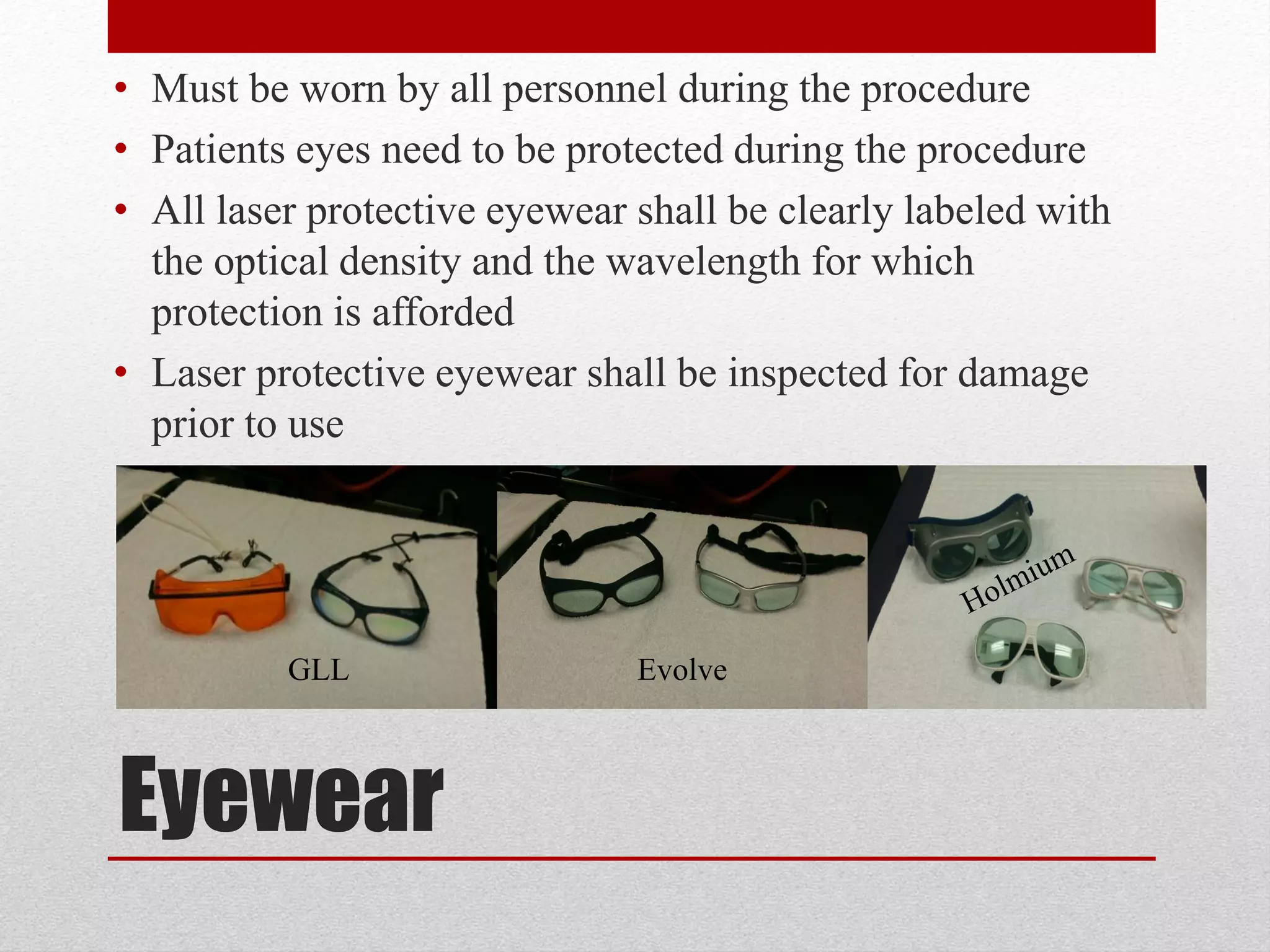
• Must be worn by all personnel during the procedure
• Patients eyes need to be protected during the procedure
• All laser protective eyewear shall be clearly labeled with
  the optical density and the wavelength for which
  protection is afforded
• Laser protective eyewear shall be inspected for damage
  prior to use


          GLL                  Evolve


Eyewear
GreenLight Laser   Evolve Laser   Holmium Laser


Lasers used at the Center
• Key must not be left in the switch when the laser system
  is unattended
• Key kept in the specified area


Laser key
• The most common reason for a damaged blast shield is,
  without a doubt, contamination on the proximal (connector)
  end of the fiber. If there is enough debris on the face of the
  fiber when the laser is fired, the debris will absorb the energy
  and flash or burn.


• If you have a damaged blast shield you need to change both
  the fiber and shield.


Blast Shields
Blast    Evolve Fiber
     Shield


Evolve Laser Blast Shield
Blast Shield Insertion Site   Holmium Fiber with Blast Shield


Holmium Laser Blast Shield
•   BPH
•   Bladder Biopsies
•   Condyloma
•   Fulguration of bladder tumors
•   Lithotripsy
•   Strictures


Urological Laser Procedures
LASER CHECKLIST

Date__________________Time:________ RN/RT__________________________

HOLMIUM LASER _______ GLL _______ EVOLVE _______ OTHER_______
Check as completed:
All doors closed                           _______
COVER THE WINDOW (on the door)             _______
LASER Warning signs posted on all entrances_______
Protective eye wear for:                   _______
Staff                                      _______
Patient                                    _______
Urologist                                  _______
Anesthesiologist                           _______
Other                                      _______
Extra pair hung on outside the door        _______
Electrical cord checked for damage         _______
LASER Unit                                 _______
Self check done                            _______
Verify aiming beam                         _______
Cleave fiber if applicable                 _______
Foot switch checked for damage             _______
Fire Extinguisher                          ________
Comments_______________________________________________________________________________________________
_________________________________________________________________________________
_____________________________________________________________________

Laser Checklist
• Laser foot pedal
  • Pedal is to be activated only by physician performing
    procedure – no other foot operated device can be used by
    the physician!
  • Laser used correctly
     • Laser in “Standby” when not in direct use
     • Physician must communicate “laser on” and “laser standby”
       with nurse/technician
     • Laser nurse or technician at control panel for emergency shut
       down


Procedural Practices
• Smoke evacuator used when lasing produces particulates
  •   Check filter unit before use for capacity
  •   Check alignment of laser prior to use
  •   Set energy setting
  •   Verify “kill” switch works
  •   Complete Medical Record for laser use


Procedural Practices, cont’d
Holmium Laser Fibers
                              -200
                              -365 (Most Commonly Used)
                              -550
                              -1000


               Evolve Fiber


 GLL Fiber
 -Fiber Card


Fibers
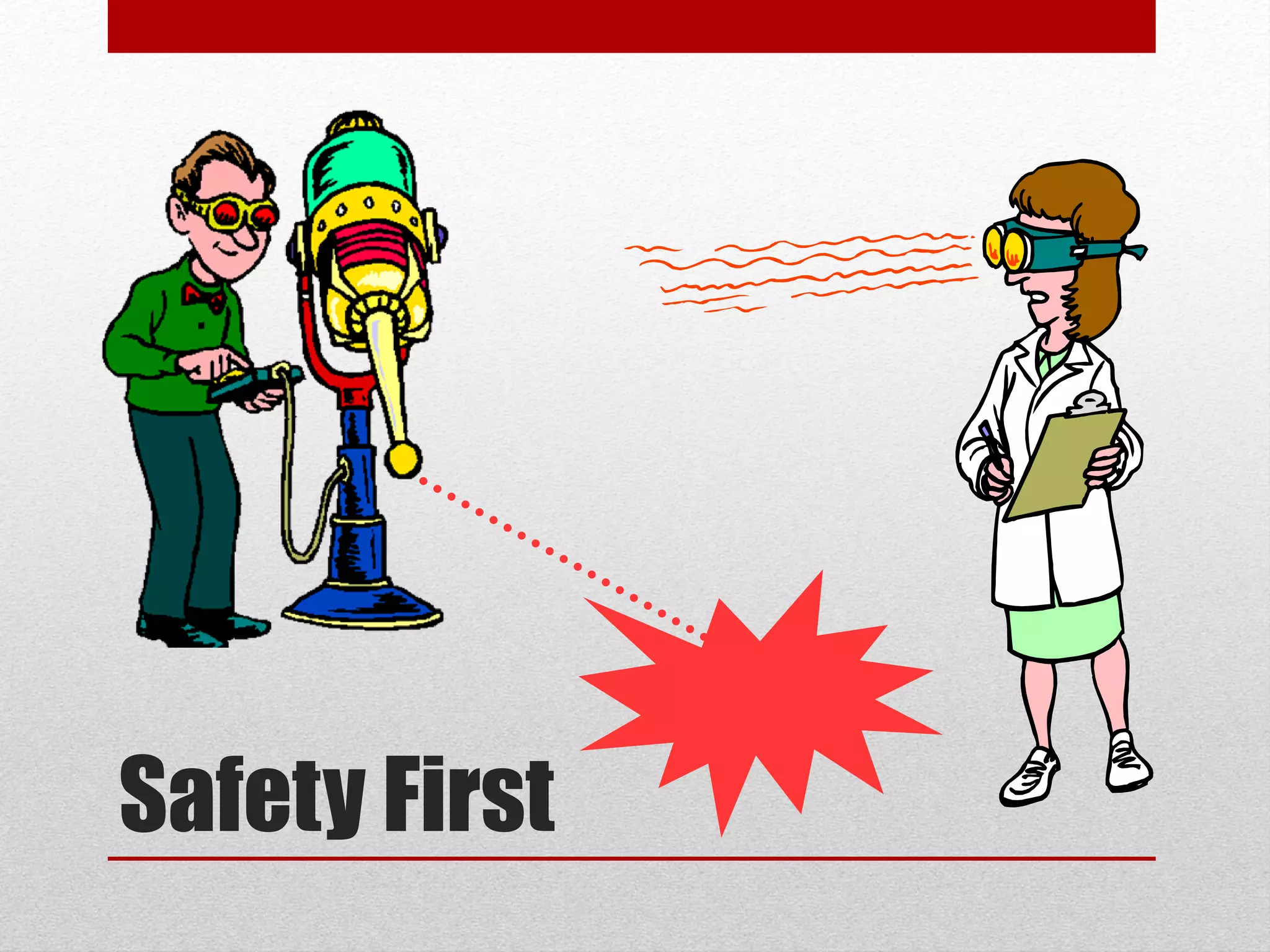
Safety First

Laser safety

  • 1.
  • 2.
    • LASER isan acronym that stands for "Light Amplification by Stimulated Emission of Radiation". • Laser light is a form of non-ionizing radiation. • Laser equipment produces and amplifies light that has unique properties that cannot be produced any other way. • The light that it produces is monochromatic - it is composed of one single color at a specific wavelength. What is LASER?
  • 3.
    • The classificationscategorize lasers according to their ability to produce damage in exposed people, from class 1 (no hazard during normal use) to class 4 (severe hazard for eyes and skin) • Necessary control measures are determined by these classifications • In the U.S., laser classifications are based on American National Standards Institute’s (ANSI) Z136.1 Safe Use of Lasers Laser Classifications
  • 4.
    The Stone CenterLasers are all Class 4 • The highest and most dangerous class of lasers • Equipped with a key switch and a safety interlock • Can burn the skin, or cause devastating and permanent eye damage as a result of direct, diffuse or indirect beam viewing • May ignite combustible materials, and thus may represent a fire risk LASER Class
  • 5.
    • Laser beamhazards include eye and skin burns which are due to laser beam shining on a person's body. • Non-beam hazards are associated with the laser equipment or the hazardous substances released from the laser equipment, and fumes emitted from materials exposed to laser beams, including laser-plumes produced during surgical procedures. Sources of laser hazards include: • Accidental eye exposure during alignment • Misaligned laser beam • Lack of eye protection • Equipment malfunction • Improper handling of high voltage systems • Use of unfamiliar equipment • Improper restoration of equipment following service LASER Hazards
  • 6.
    • Eye :Acute exposure of the eye to lasers of certain wavelengths and power can cause corneal or retinal burns (or both). Chronic exposure to excessive levels may cause corneal or lenticular opacities (cataracts) or retinal injury. • Skin : Acute exposure to high levels of optical radiation may cause skin burns; while carcinogenesis may occur for ultraviolet wavelengths (290-320 nm). • Chemical : Some lasers require hazardous or toxic substances to operate (i.e., chemical dye, Excimer lasers). • Electrical : Most lasers utilize high voltages that can be lethal. • Fire : The solvents used in dye lasers are flammable. High voltage pulse or flash lamps may cause ignition. Flammable materials may be ignited by direct beams or specular reflections from high power continuous wave (CW) infrared lasers. Type of Hazards
  • 7.
    • During alllaser procedure you will see a warning sign posted on the door with extra goggles/glasses for anyone who needs to enter Signage
  • 8.
    • Must beworn by all personnel during the procedure • Patients eyes need to be protected during the procedure • All laser protective eyewear shall be clearly labeled with the optical density and the wavelength for which protection is afforded • Laser protective eyewear shall be inspected for damage prior to use GLL Evolve Eyewear
  • 9.
    GreenLight Laser Evolve Laser Holmium Laser Lasers used at the Center
  • 10.
    • Key mustnot be left in the switch when the laser system is unattended • Key kept in the specified area Laser key
  • 11.
    • The mostcommon reason for a damaged blast shield is, without a doubt, contamination on the proximal (connector) end of the fiber. If there is enough debris on the face of the fiber when the laser is fired, the debris will absorb the energy and flash or burn. • If you have a damaged blast shield you need to change both the fiber and shield. Blast Shields
  • 12.
    Blast Evolve Fiber Shield Evolve Laser Blast Shield
  • 13.
    Blast Shield InsertionSite Holmium Fiber with Blast Shield Holmium Laser Blast Shield
  • 14.
    BPH • Bladder Biopsies • Condyloma • Fulguration of bladder tumors • Lithotripsy • Strictures Urological Laser Procedures
  • 15.
    LASER CHECKLIST Date__________________Time:________ RN/RT__________________________ HOLMIUMLASER _______ GLL _______ EVOLVE _______ OTHER_______ Check as completed: All doors closed _______ COVER THE WINDOW (on the door) _______ LASER Warning signs posted on all entrances_______ Protective eye wear for: _______ Staff _______ Patient _______ Urologist _______ Anesthesiologist _______ Other _______ Extra pair hung on outside the door _______ Electrical cord checked for damage _______ LASER Unit _______ Self check done _______ Verify aiming beam _______ Cleave fiber if applicable _______ Foot switch checked for damage _______ Fire Extinguisher ________ Comments_______________________________________________________________________________________________ _________________________________________________________________________________ _____________________________________________________________________ Laser Checklist
  • 16.
    • Laser footpedal • Pedal is to be activated only by physician performing procedure – no other foot operated device can be used by the physician! • Laser used correctly • Laser in “Standby” when not in direct use • Physician must communicate “laser on” and “laser standby” with nurse/technician • Laser nurse or technician at control panel for emergency shut down Procedural Practices
  • 17.
    • Smoke evacuatorused when lasing produces particulates • Check filter unit before use for capacity • Check alignment of laser prior to use • Set energy setting • Verify “kill” switch works • Complete Medical Record for laser use Procedural Practices, cont’d
  • 18.
    Holmium Laser Fibers -200 -365 (Most Commonly Used) -550 -1000 Evolve Fiber GLL Fiber -Fiber Card Fibers
  • 19.