Download to read offline
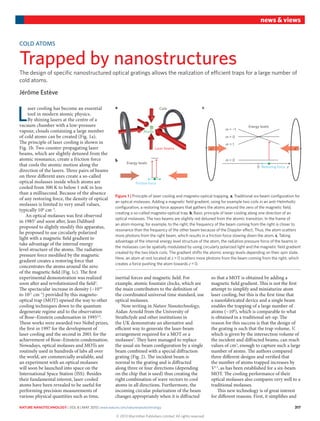
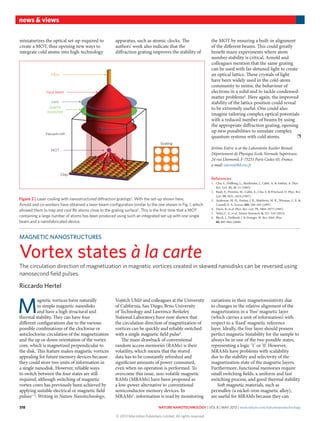

1) Laser cooling uses lasers to cool atoms to very low temperatures, creating clouds of cold atoms. It involves using counter-propagating laser beams slightly detuned from the atomic resonance to create friction and cool atomic motion. 2) In 1985, an optical molasses was first observed, cooling atoms to below 1 mK. However, optical molasses have low density due to the lack of a restoring force. Jean Dalibard then proposed using polarized light and a magnetic field gradient to create a restoring force in a magneto-optical trap (MOT), greatly increasing atom density. 3) Now, researchers have demonstrated an efficient way to generate the laser beam configuration for a MOT or molasses using a


![Abortion in AL AIN*%UAE^*[☎️+971523788684**]]@ @# Abortion pills for sale in ...](https://cdn.slidesharecdn.com/ss_thumbnails/eth-2021-02-240504032152-560dd769-thumbnail.jpg?width=640&height=640&fit=bounds)
![𝐂𝐲𝐭𝐨𝐭𝐞𝐜 𝐩𝐢𝐥𝐥𝐬 𝐈𝐧 𝐊𝐮𝐰𝐚𝐢𝐭 “+*%UAE^*[☎️+971523788684**]]@ @#”𝐀𝐛𝐨𝐫𝐭𝐢𝐨𝐧 𝐩𝐢𝐥𝐥𝐬 𝐢𝐧 𝐊...](https://cdn.slidesharecdn.com/ss_thumbnails/eth-2021-02-240504035716-2109b3a1-thumbnail.jpg?width=640&height=640&fit=bounds)


