DYE LASERS
BY-ABHISHEK RANAN
BATCH 11
ISP, CUSAT
GENERAL DSCRIPTION
A dye laser is a laser which uses an organic dye as the lasing medium,
usually as a liquid solution. It is also known as organic dye lasers
which are produced in liquid gain media.
There are over 200 dye lasers which produce tuneable laser operating
from wavelength ranging from 320 nm to 1200 nm.
It is because of broad emission and gain spectrum of dyes which
leads to tuneability and short pulses.
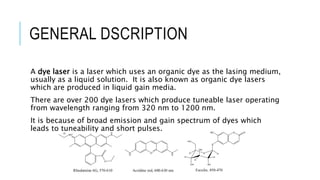
ONH+
H
N
O
O
Cl-
Rhodamine 6G, 570-610
N
H
O+
N
H
Acridine red, 600-630 nm
O
O
H
OH
H
OH
OH
H
H
H
O
HO
HO O
Esculin, 450-470
Typical dye concentration 1024 to 1025 dye molecules/m3
Organic polyatomic molecules withlong chain with conjugated double bonds
Rhodamine, polymemine (700-1500nm), coumarine (320-400nm), xanthene (500-700nm)
and more.
Solvent
Methanol, ethanol, water or ethylene glycol
Additional chemicals added to prevent intersystem crossing and prohibit degration of
the dye.The laser gain medium consists of strongly emitting and absorbing organic
dyes dissolved in solvent.
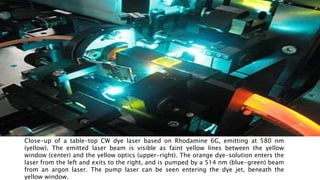
Close-up of a table-top CW dye laser based on Rhodamine 6G, emitting at 580 nm
(yellow). The emitted laser beam is visible as faint yellow lines between the yellow
window (center) and the yellow optics (upper-right). The orange dye-solution enters the
laser from the left and exits to the right, and is pumped by a 514 nm (blue-green) beam
from an argon laser. The pump laser can be seen entering the dye jet, beneath the
yellow window.
EXCITATION MECHANISM
EXCITATION MECHANISM CONT..
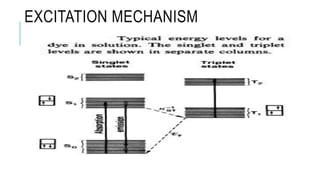
Selection rule: ∆S = 0
 S0 → S1 allowed also T2 → T1
Fluorescence emission
 S1 → S0
Losses:
 Intersystem crossing mostly due to collision
 S1 → T1
 Accumulates atT1 (T1 → S0 very weak 10-100us)
 Phosphoresence
 T1 → S0
 Absorption
 S1 → S2
 T1 → T2 (almost equal to S1 → S0 emission)
LASER PUMPED PULSED
TUNEABLE LASERSThis class of lasers produce a tuneable ultranarrow frequency pulsed
laser output over wavelength ranging from 190 um to 4.5 um.
The output energies range from tens to hundreds of milijoules.
The pump beam is split into several separate beams, with one beam
used to pump a narrow frequency output tuneable oscillator.
The other beams are used to side pump or end pump a series of dye
amplifiers.
FLASHLAMP PULSED DYE LASER
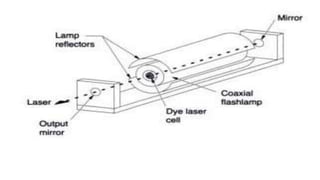
The dye laser is surrounded by a coaxial cylindrically shaped flash
lamp.
Provision for water cooling is made between flash lamp and dye cell.
This laser produces 5J per second in 1.5 us pulse duration or a peak
power of over 3 MW per pulse.
The laser has an input power of 1000J and capable of operating at a
0.5 Hz repetition rate.
Uses RH6G dye and is tuned to operate at 585-nm wavelength for
medical applications.
MODE LOCKED LASERS
This type of configuration gives femtosecond dye laser pulses, and
must be designed with odd number of beam waists within the cavity.
The optical path length between the two dye jets is one fourth of the
optical path around the entire ring.
There are tow counter propagating pulses within the cavity , this
ensures that both the pulses will have equal properties by allowing
the gain recovery time to be same for each.
Also, Maintaining the critical dimension or geometry of such a cavity
is important.
ADVANTAGES
Broad Emission spectrum
Tuneable
Very short pulses Achievable
Wide selection of dyes for different emission wavelength ranges and
absorbance
 Tunable in a wide range of wavelengths
 Research oriented program in Astronomy
 Pollution monitoring
 Studies of atomic physics, photochemistry, spectroscopy in solids
 Isotopes separation(uranium)
 Medical –shatter kidney stones or gall bladder,remove birthmarks.
Application
REFERENCES
BOOK BY WILLIAM SILVAST
BOOK BY K.R NAMBIAR
WIKIPEDIA.COM
THANK YOU FOR YOUR
ATTENTION

Dye lasers PPT

  • 1.
  • 2.
    GENERAL DSCRIPTION A dyelaser is a laser which uses an organic dye as the lasing medium, usually as a liquid solution. It is also known as organic dye lasers which are produced in liquid gain media. There are over 200 dye lasers which produce tuneable laser operating from wavelength ranging from 320 nm to 1200 nm. It is because of broad emission and gain spectrum of dyes which leads to tuneability and short pulses. ONH+ H N O O Cl- Rhodamine 6G, 570-610 N H O+ N H Acridine red, 600-630 nm O O H OH H OH OH H H H O HO HO O Esculin, 450-470
  • 3.
    Typical dye concentration1024 to 1025 dye molecules/m3 Organic polyatomic molecules withlong chain with conjugated double bonds Rhodamine, polymemine (700-1500nm), coumarine (320-400nm), xanthene (500-700nm) and more. Solvent Methanol, ethanol, water or ethylene glycol Additional chemicals added to prevent intersystem crossing and prohibit degration of the dye.The laser gain medium consists of strongly emitting and absorbing organic dyes dissolved in solvent.
  • 4.
    Close-up of atable-top CW dye laser based on Rhodamine 6G, emitting at 580 nm (yellow). The emitted laser beam is visible as faint yellow lines between the yellow window (center) and the yellow optics (upper-right). The orange dye-solution enters the laser from the left and exits to the right, and is pumped by a 514 nm (blue-green) beam from an argon laser. The pump laser can be seen entering the dye jet, beneath the yellow window.
  • 5.
  • 6.
    EXCITATION MECHANISM CONT.. Selectionrule: ∆S = 0  S0 → S1 allowed also T2 → T1 Fluorescence emission  S1 → S0 Losses:  Intersystem crossing mostly due to collision  S1 → T1  Accumulates atT1 (T1 → S0 very weak 10-100us)  Phosphoresence  T1 → S0  Absorption  S1 → S2  T1 → T2 (almost equal to S1 → S0 emission)
  • 7.
    LASER PUMPED PULSED TUNEABLELASERSThis class of lasers produce a tuneable ultranarrow frequency pulsed laser output over wavelength ranging from 190 um to 4.5 um. The output energies range from tens to hundreds of milijoules. The pump beam is split into several separate beams, with one beam used to pump a narrow frequency output tuneable oscillator. The other beams are used to side pump or end pump a series of dye amplifiers.
  • 8.
    FLASHLAMP PULSED DYELASER The dye laser is surrounded by a coaxial cylindrically shaped flash lamp. Provision for water cooling is made between flash lamp and dye cell. This laser produces 5J per second in 1.5 us pulse duration or a peak power of over 3 MW per pulse. The laser has an input power of 1000J and capable of operating at a 0.5 Hz repetition rate. Uses RH6G dye and is tuned to operate at 585-nm wavelength for medical applications.
  • 10.
    MODE LOCKED LASERS Thistype of configuration gives femtosecond dye laser pulses, and must be designed with odd number of beam waists within the cavity. The optical path length between the two dye jets is one fourth of the optical path around the entire ring. There are tow counter propagating pulses within the cavity , this ensures that both the pulses will have equal properties by allowing the gain recovery time to be same for each. Also, Maintaining the critical dimension or geometry of such a cavity is important.
  • 11.
    ADVANTAGES Broad Emission spectrum Tuneable Veryshort pulses Achievable Wide selection of dyes for different emission wavelength ranges and absorbance
  • 12.
     Tunable ina wide range of wavelengths  Research oriented program in Astronomy  Pollution monitoring  Studies of atomic physics, photochemistry, spectroscopy in solids  Isotopes separation(uranium)  Medical –shatter kidney stones or gall bladder,remove birthmarks. Application
  • 13.
    REFERENCES BOOK BY WILLIAMSILVAST BOOK BY K.R NAMBIAR WIKIPEDIA.COM
  • 14.
    THANK YOU FORYOUR ATTENTION