Crustal Deformation & Mountain Building
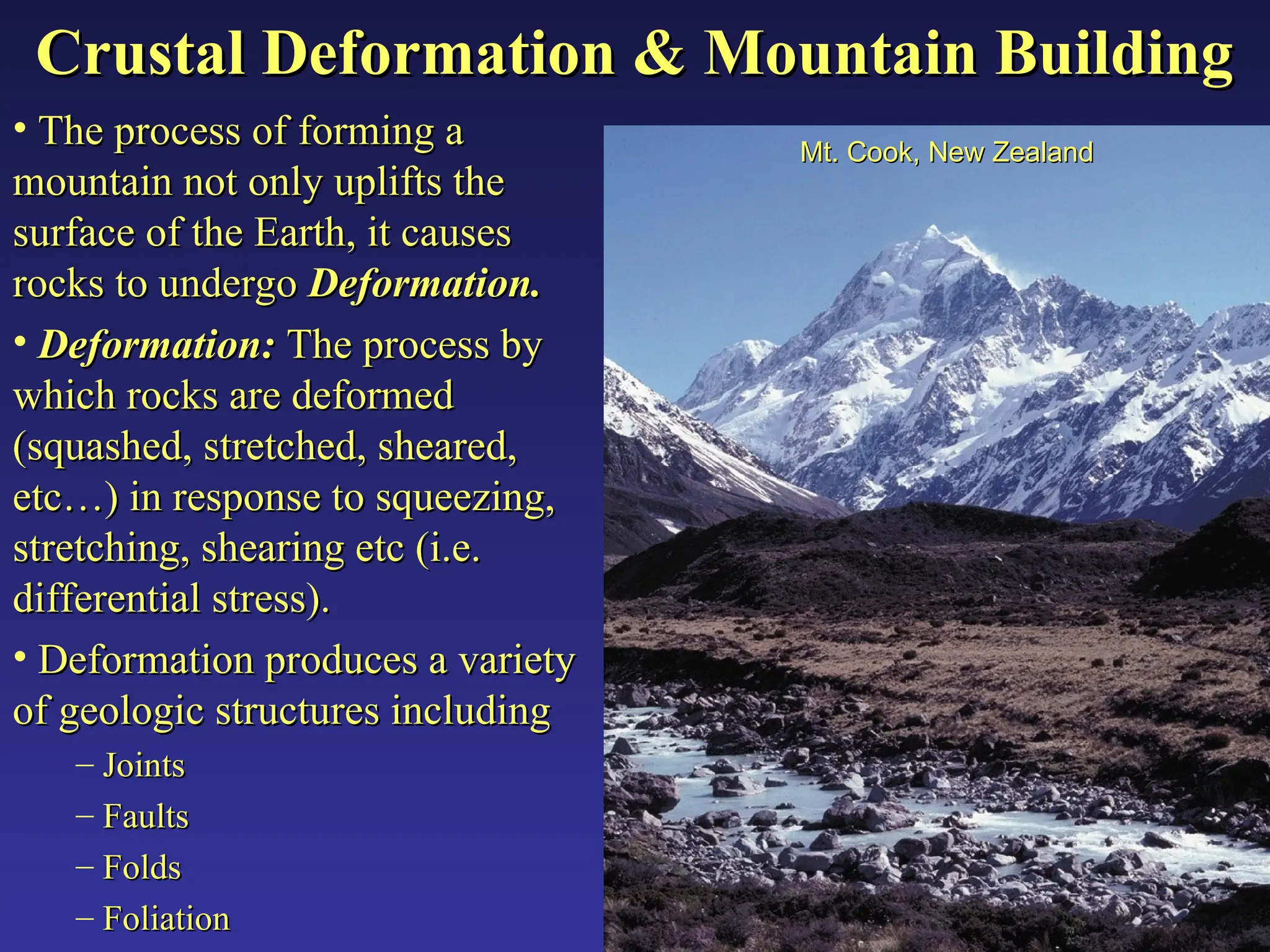
• The process of forming a
The process of forming a
mountain not only uplifts the
surface of the Earth, it causes
rocks to undergo
rocks to undergo Deformation.
Deformation.
• Deformation:
Deformation: The process by
The process by
which rocks are deformed
(squashed, stretched, sheared,
etc…) in response to squeezing,
stretching, shearing etc (i.e.
differential stress).
• Deformation produces a variety
Deformation produces a variety
of geologic structures including
– Joints
Joints
– Faults
Faults
– Folds
Folds
– Foliation
Foliation
Mt. Cook, New Zealand
Mountain Belts and Orogens
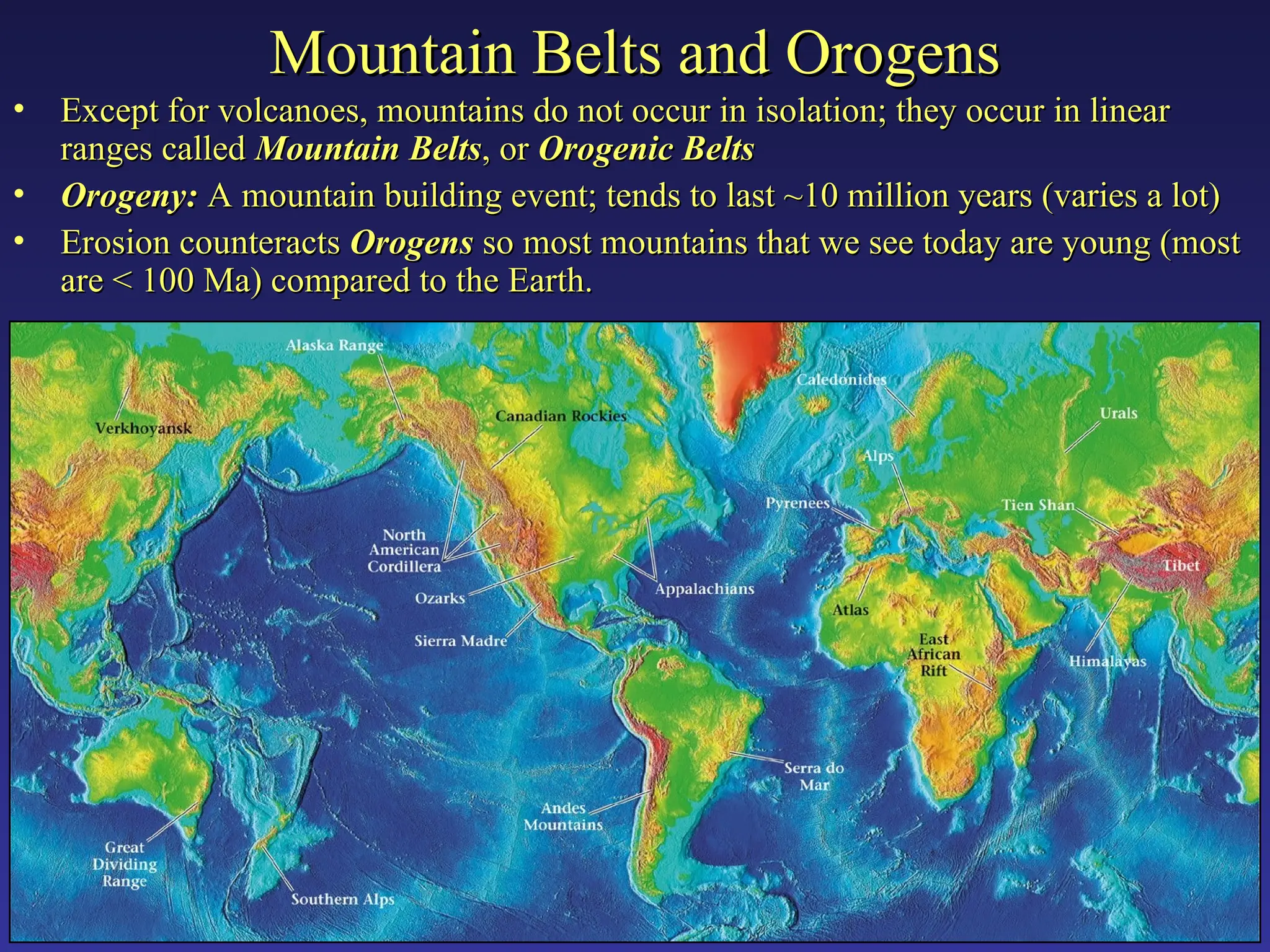
• Except for volcanoes, mountains do not occur in isolation; they occur in linear
Except for volcanoes, mountains do not occur in isolation; they occur in linear
ranges called
ranges called Mountain Belts
Mountain Belts, or
, or Orogenic Belts
Orogenic Belts
• Orogeny:
Orogeny: A mountain building event; tends to last ~10 million years (varies a lot)
A mountain building event; tends to last ~10 million years (varies a lot)
• Erosion counteracts
Erosion counteracts Orogens
Orogens so most mountains that we see today are young (most
so most mountains that we see today are young (most
are < 100 Ma) compared to the Earth.
Deformed vs. Undeformed
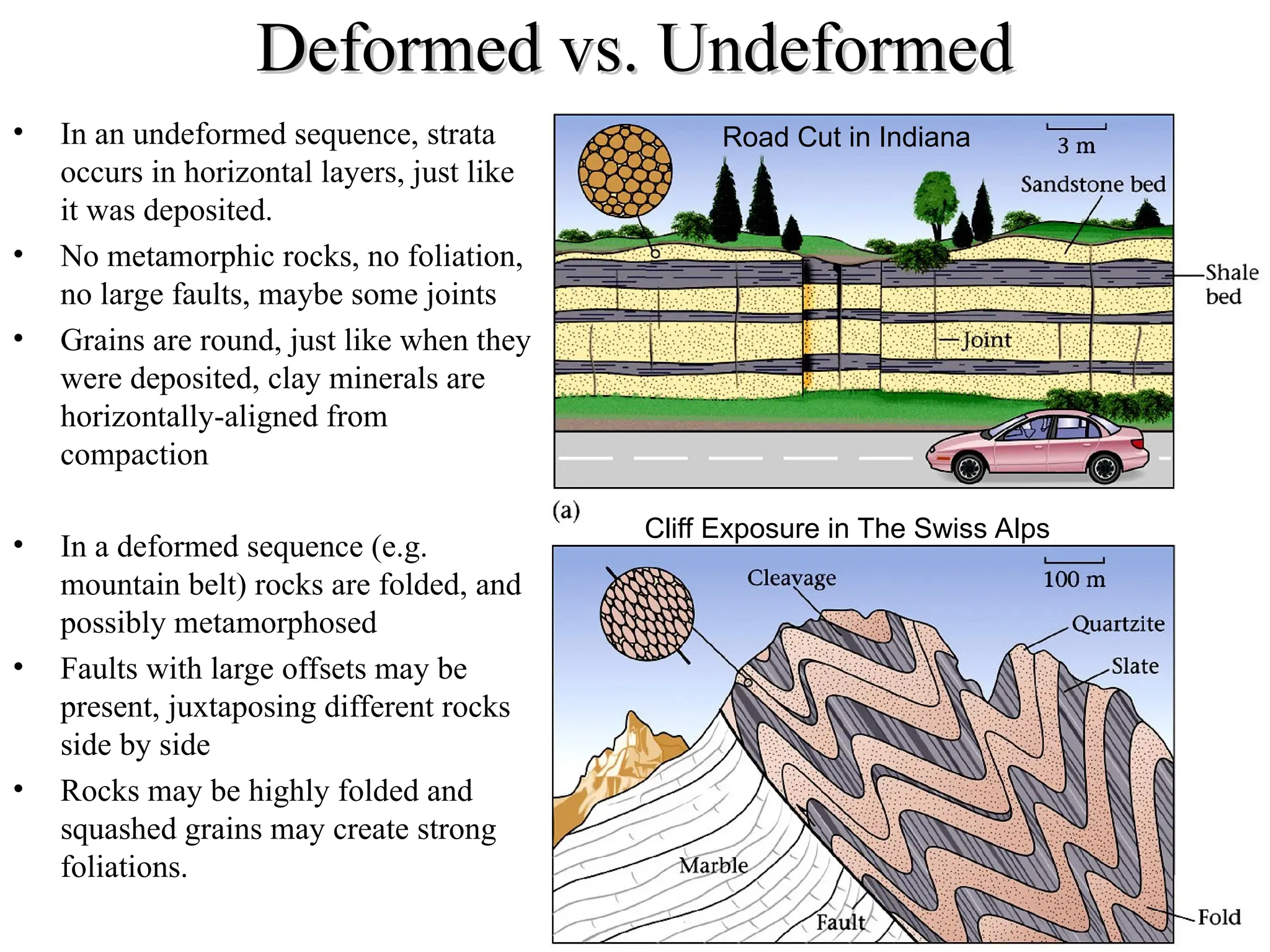
• In an undeformed sequence, strata
occurs in horizontal layers, just like
it was deposited.
• No metamorphic rocks, no foliation,
no large faults, maybe some joints
• Grains are round, just like when they
were deposited, clay minerals are
horizontally-aligned from
compaction
• In a deformed sequence (e.g.
mountain belt) rocks are folded, and
possibly metamorphosed
• Faults with large offsets may be
present, juxtaposing different rocks
side by side
• Rocks may be highly folded and
squashed grains may create strong
foliations.
Road Cut in Indiana
Cliff Exposure in The Swiss Alps
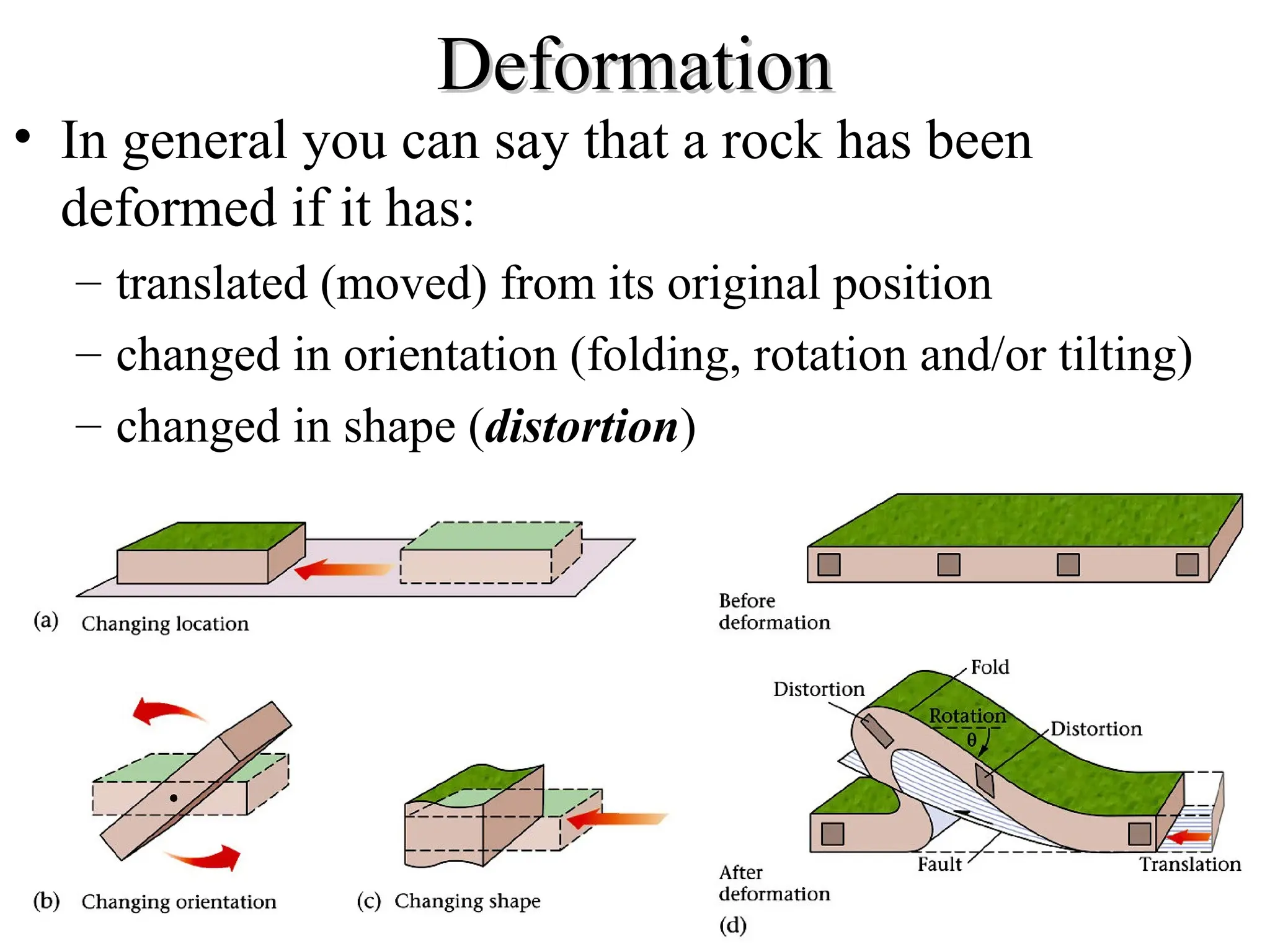
Deformation
Deformation
• In general you can say that a rock has been
deformed if it has:
– translated (moved) from its original position
– changed in orientation (folding, rotation and/or tilting)
– changed in shape (distortion)
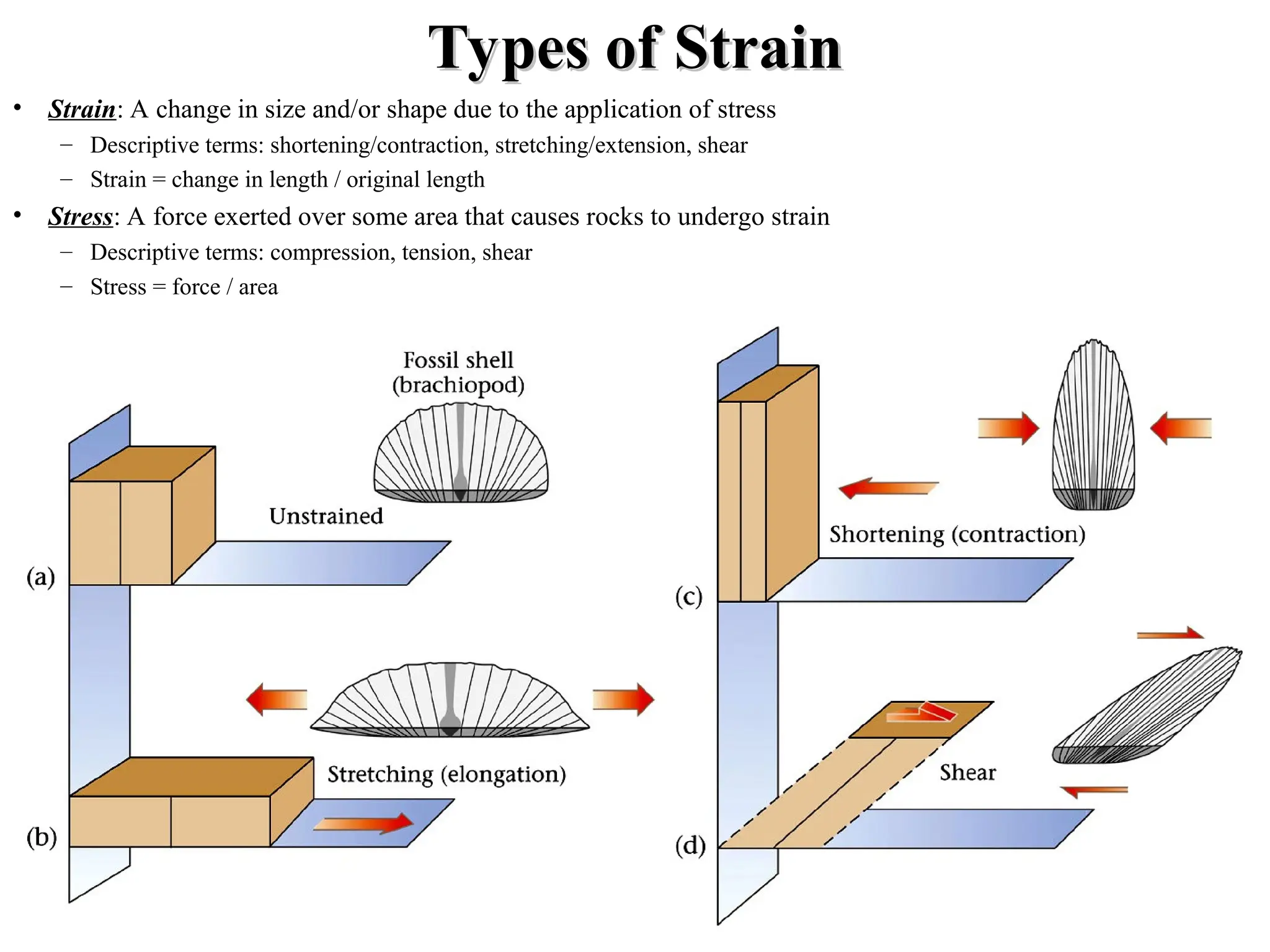
Types of Strain
Types of Strain
• Strain: A change in size and/or shape due to the application of stress
– Descriptive terms: shortening/contraction, stretching/extension, shear
– Strain = change in length / original length
• Stress: A force exerted over some area that causes rocks to undergo strain
– Descriptive terms: compression, tension, shear
– Stress = force / area
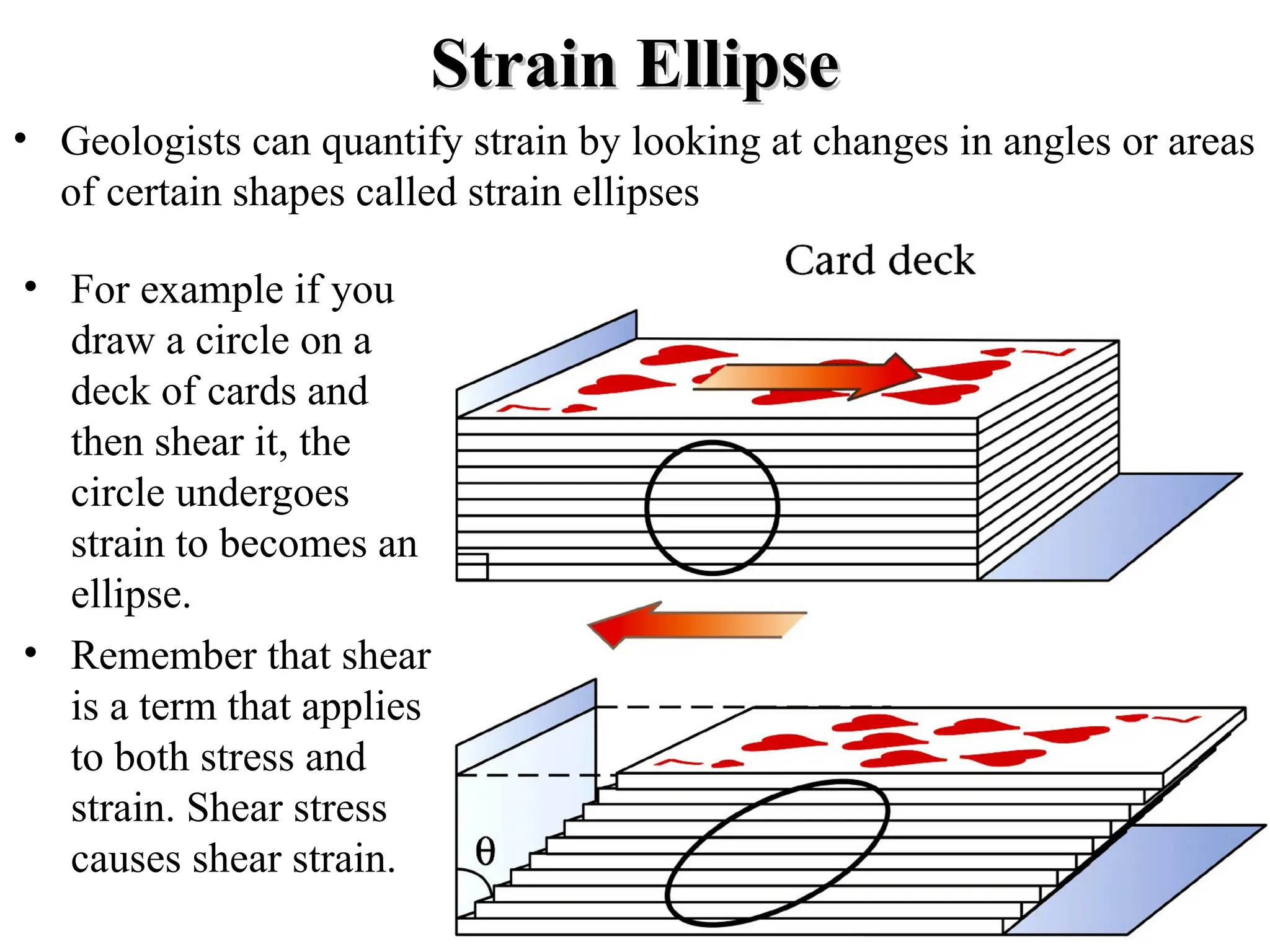
Strain Ellipse
Strain Ellipse
• Geologists can quantify strain by looking at changes in angles or areas
of certain shapes called strain ellipses
• For example if you
draw a circle on a
deck of cards and
then shear it, the
circle undergoes
strain to becomes an
ellipse.
• Remember that shear
is a term that applies
to both stress and
strain. Shear stress
causes shear strain.
Brittle and Ductile Deformation
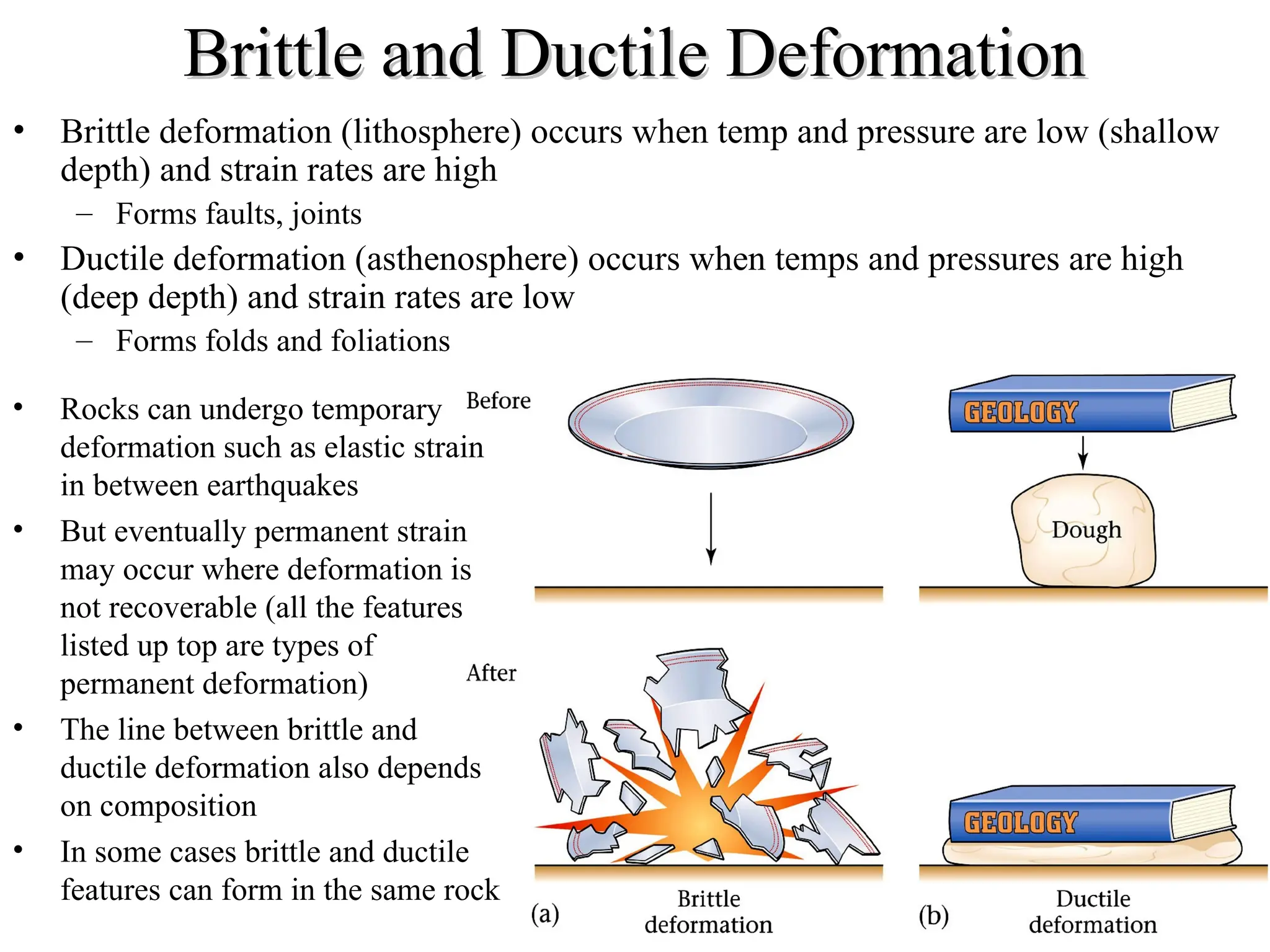
• Brittle deformation (lithosphere) occurs when temp and pressure are low (shallow
depth) and strain rates are high
– Forms faults, joints
• Ductile deformation (asthenosphere) occurs when temps and pressures are high
(deep depth) and strain rates are low
– Forms folds and foliations
• Rocks can undergo temporary
deformation such as elastic strain
in between earthquakes
• But eventually permanent strain
may occur where deformation is
not recoverable (all the features
listed up top are types of
permanent deformation)
• The line between brittle and
ductile deformation also depends
on composition
• In some cases brittle and ductile
features can form in the same rock
Stress
Stress ≠ Force
≠ Force
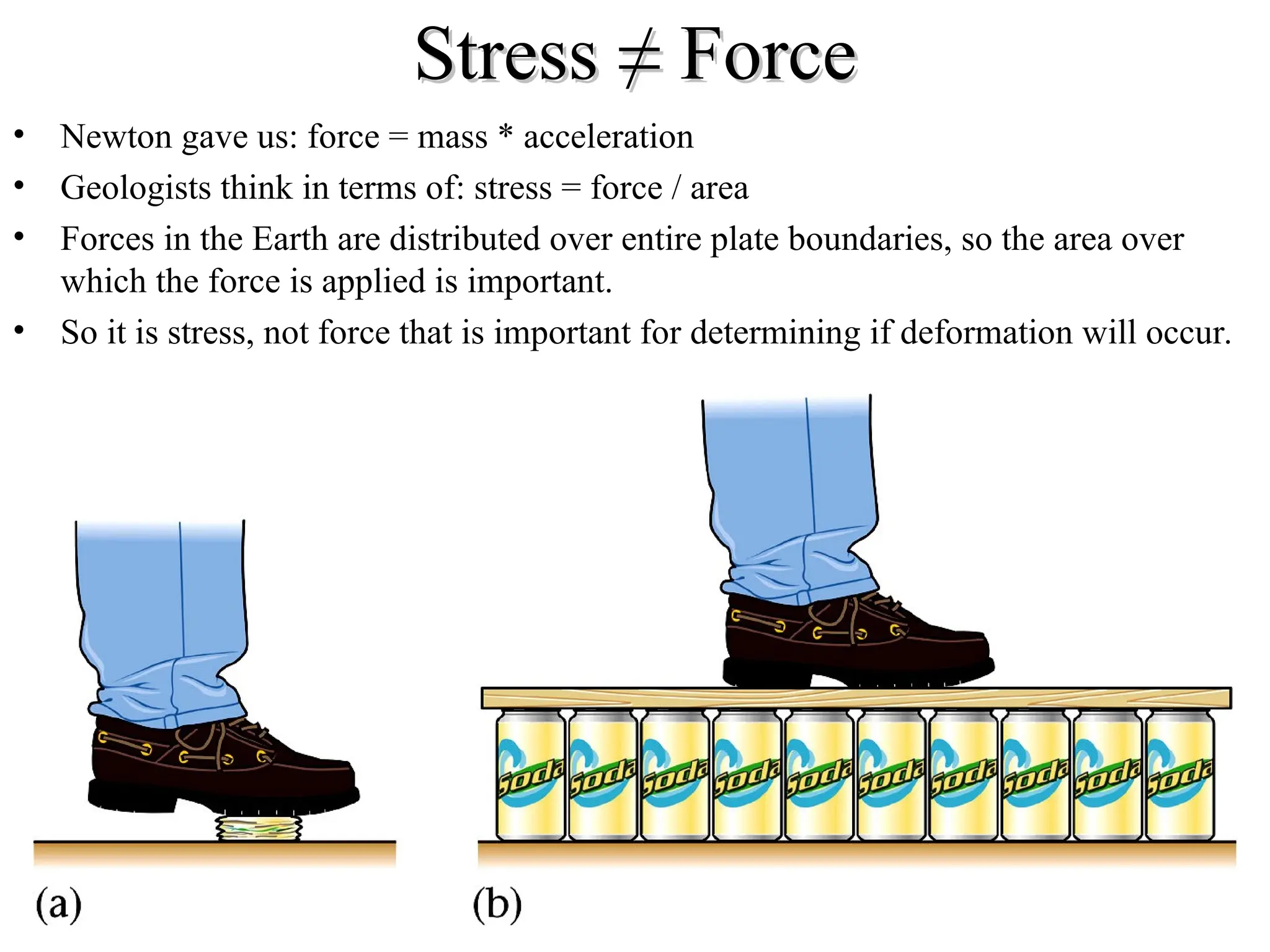
• Newton gave us: force = mass * acceleration
• Geologists think in terms of: stress = force / area
• Forces in the Earth are distributed over entire plate boundaries, so the area over
which the force is applied is important.
• So it is stress, not force that is important for determining if deformation will occur.
Types of Stress
Types of Stress
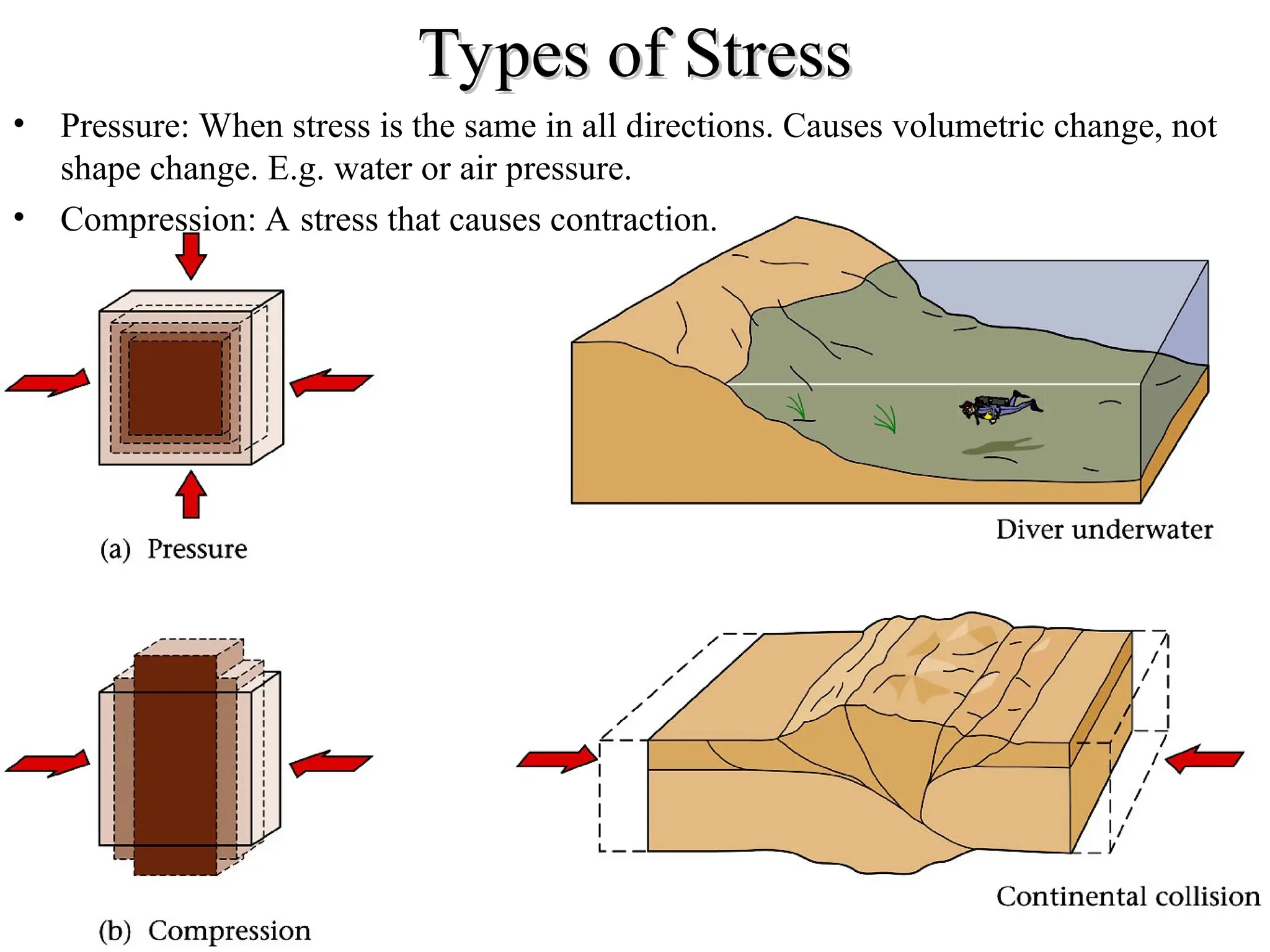
• Pressure: When stress is the same in all directions. Causes volumetric change, not
shape change. E.g. water or air pressure.
• Compression: A stress that causes contraction.
Types of Stress
Types of Stress
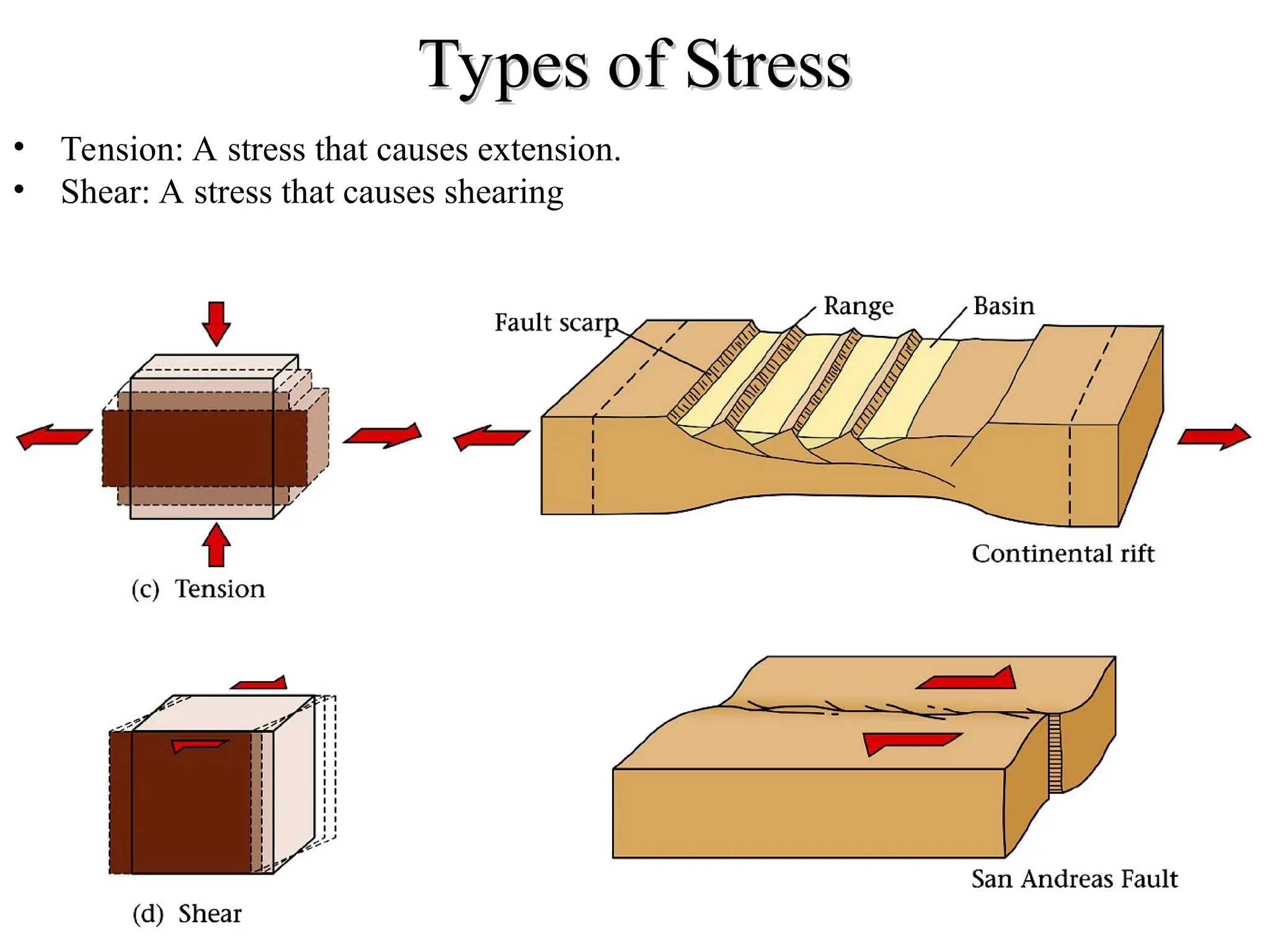
• Tension: A stress that causes extension.
• Shear: A stress that causes shearing
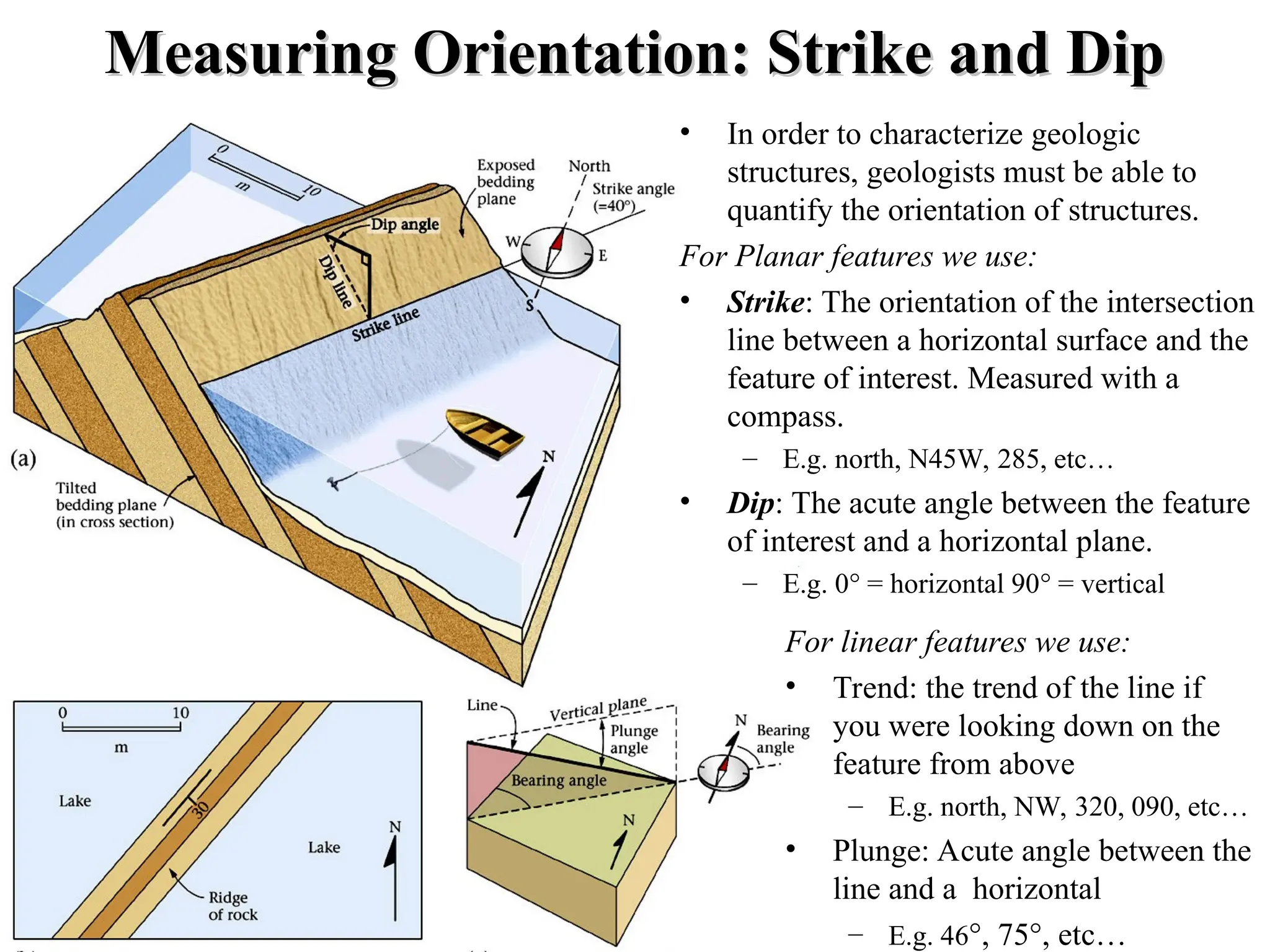
Measuring Orientation: Strike and Dip
• In order to characterize geologic
structures, geologists must be able to
quantify the orientation of structures.
For Planar features we use:
• Strike: The orientation of the intersection
line between a horizontal surface and the
feature of interest. Measured with a
compass.
– E.g. north, N45W, 285, etc…
• Dip: The acute angle between the feature
of interest and a horizontal plane.
– E.g. 0° = horizontal 90° = vertical
For linear features we use:
• Trend: the trend of the line if
you were looking down on the
feature from above
– E.g. north, NW, 320, 090, etc…
• Plunge: Acute angle between the
line and a horizontal
– E.g. 46°, 75°, etc…
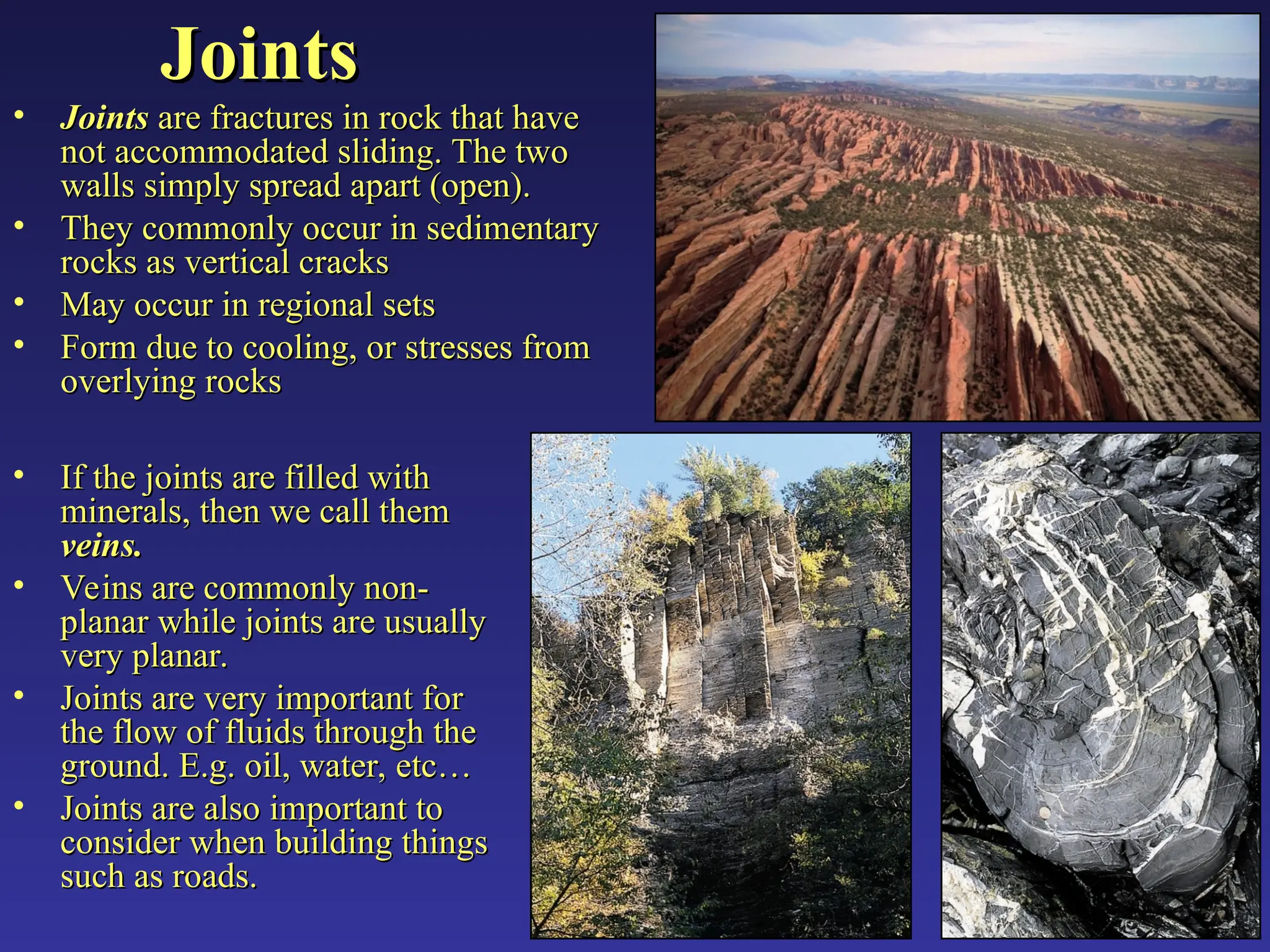
Joints
Joints
• Joints
Joints are fractures in rock that have
are fractures in rock that have
not accommodated sliding. The two
walls simply spread apart (open).
• They commonly occur in sedimentary
They commonly occur in sedimentary
rocks as vertical cracks
• May occur in regional sets
May occur in regional sets
• Form due to cooling, or stresses from
Form due to cooling, or stresses from
overlying rocks
overlying rocks
• If the joints are filled with
If the joints are filled with
minerals, then we call them
veins.
veins.
• Veins are commonly non-
Veins are commonly non-
planar while joints are usually
very planar.
very planar.
• Joints are very important for
Joints are very important for
the flow of fluids through the
ground. E.g. oil, water, etc…
• Joints are also important to
Joints are also important to
consider when building things
such as roads.
such as roads.
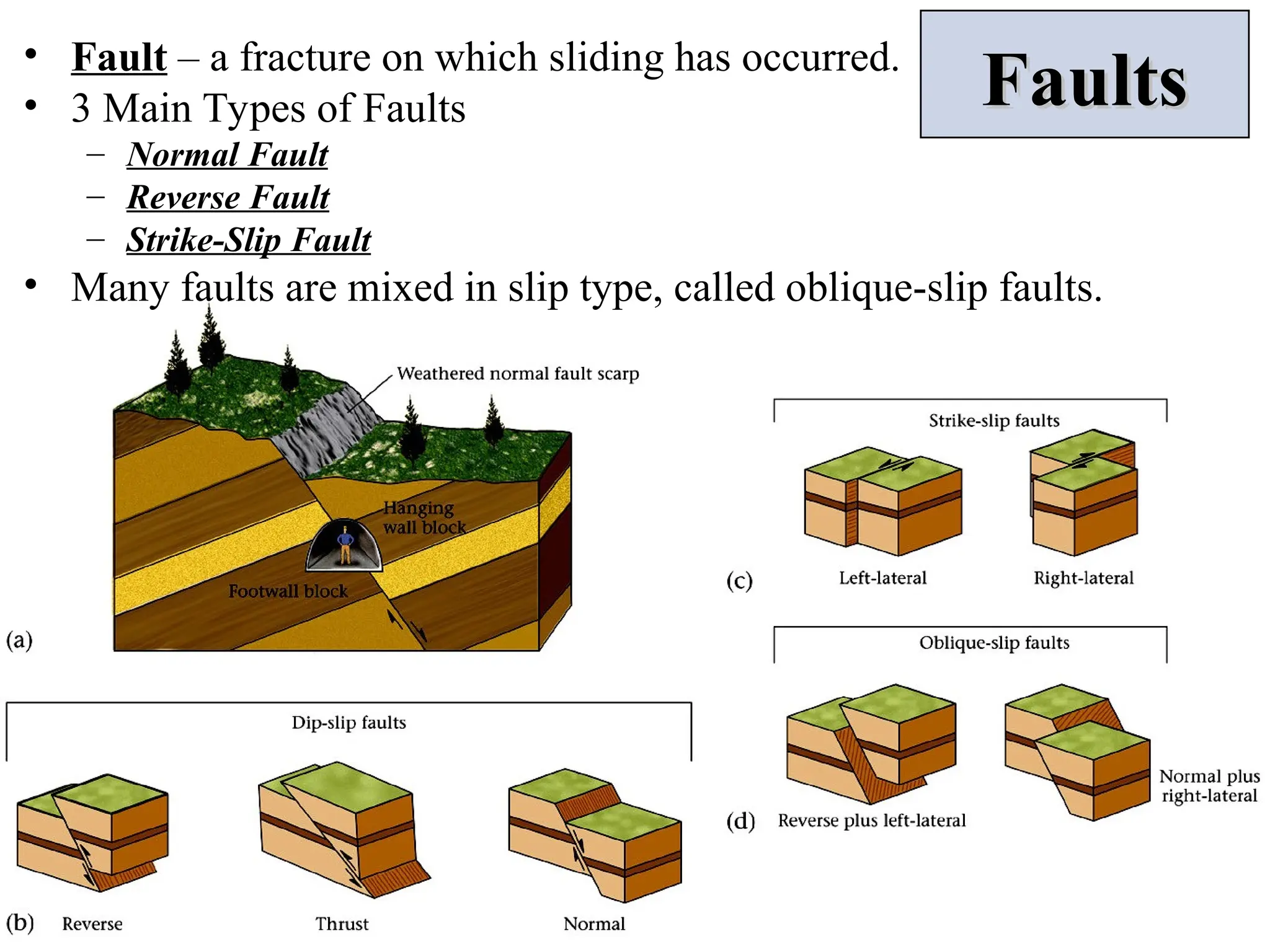
Faults
Faults
• Fault – a fracture on which sliding has occurred.
• 3 Main Types of Faults
– Normal Fault
– Reverse Fault
– Strike-Slip Fault
• Many faults are mixed in slip type, called oblique-slip faults.
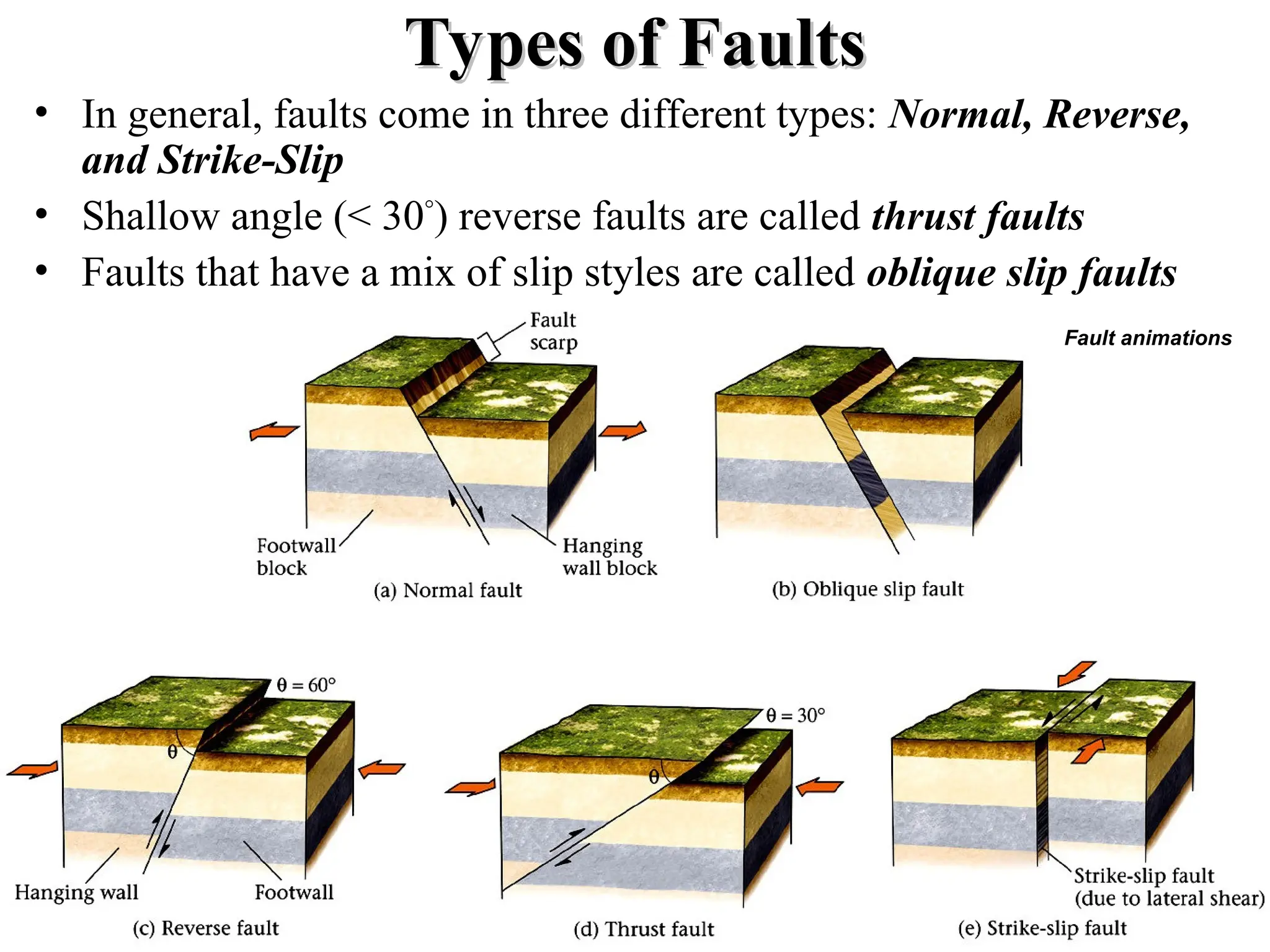
Types of Faults
Types of Faults
• In general, faults come in three different types: Normal, Reverse,
and Strike-Slip
• Shallow angle (< 30°
) reverse faults are called thrust faults
• Faults that have a mix of slip styles are called oblique slip faults
Fault animations
• Normal Faults: from stretching of or extending rock; points on
Normal Faults: from stretching of or extending rock; points on
opposite sides of a fault are father apart after an earthquake
• Reverse Faults: from contraction or squishing rock; points on
Reverse Faults: from contraction or squishing rock; points on
opposite sides of the fault are closer together after an earthquake
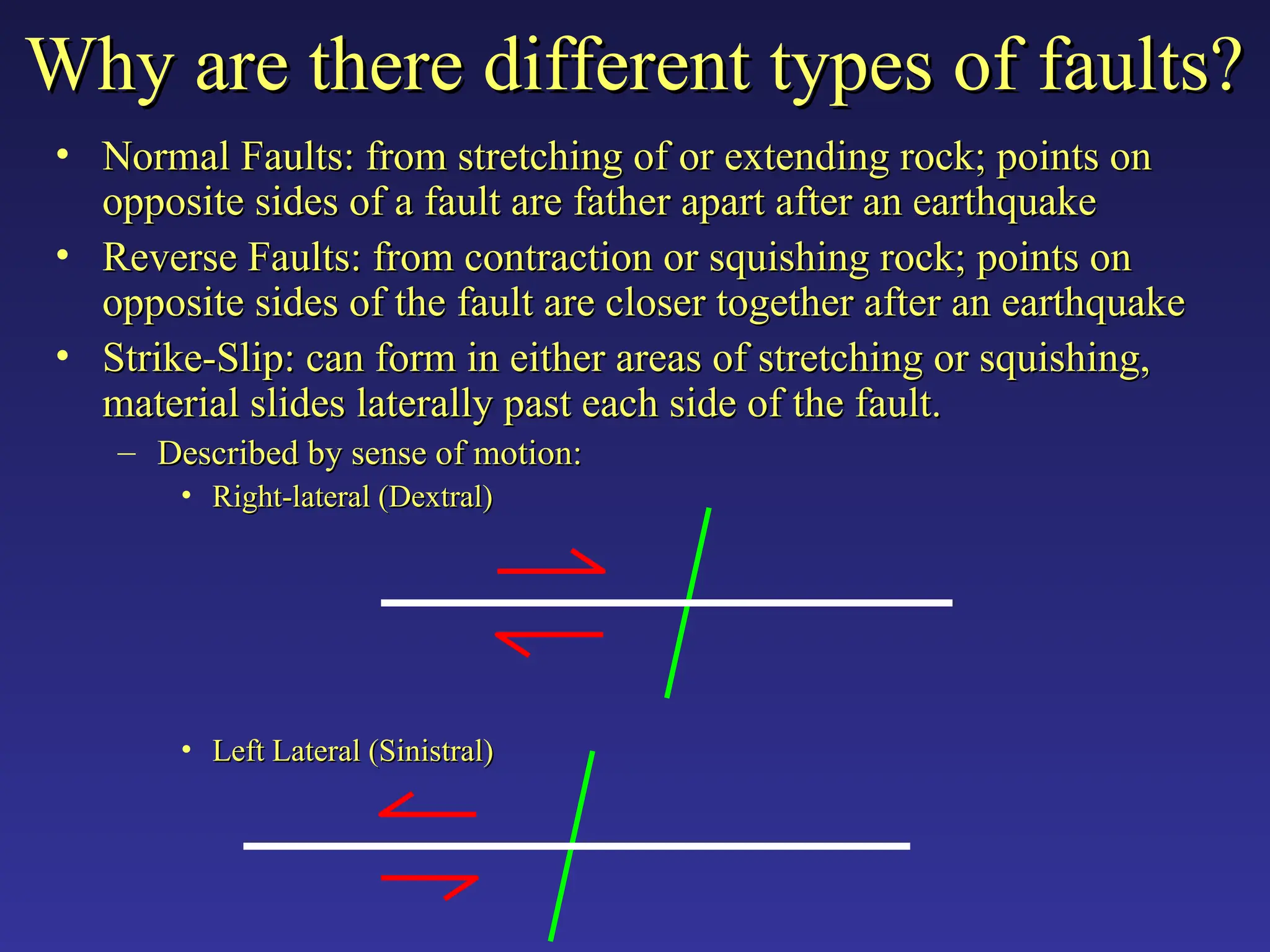
• Strike-Slip: can form in either areas of stretching or squishing,
Strike-Slip: can form in either areas of stretching or squishing,
material slides laterally past each side of the fault.
– Described by sense of motion:
Described by sense of motion:
• Right-lateral (Dextral)
Right-lateral (Dextral)
• Left Lateral (Sinistral)
Left Lateral (Sinistral)
Why are there different types of faults?
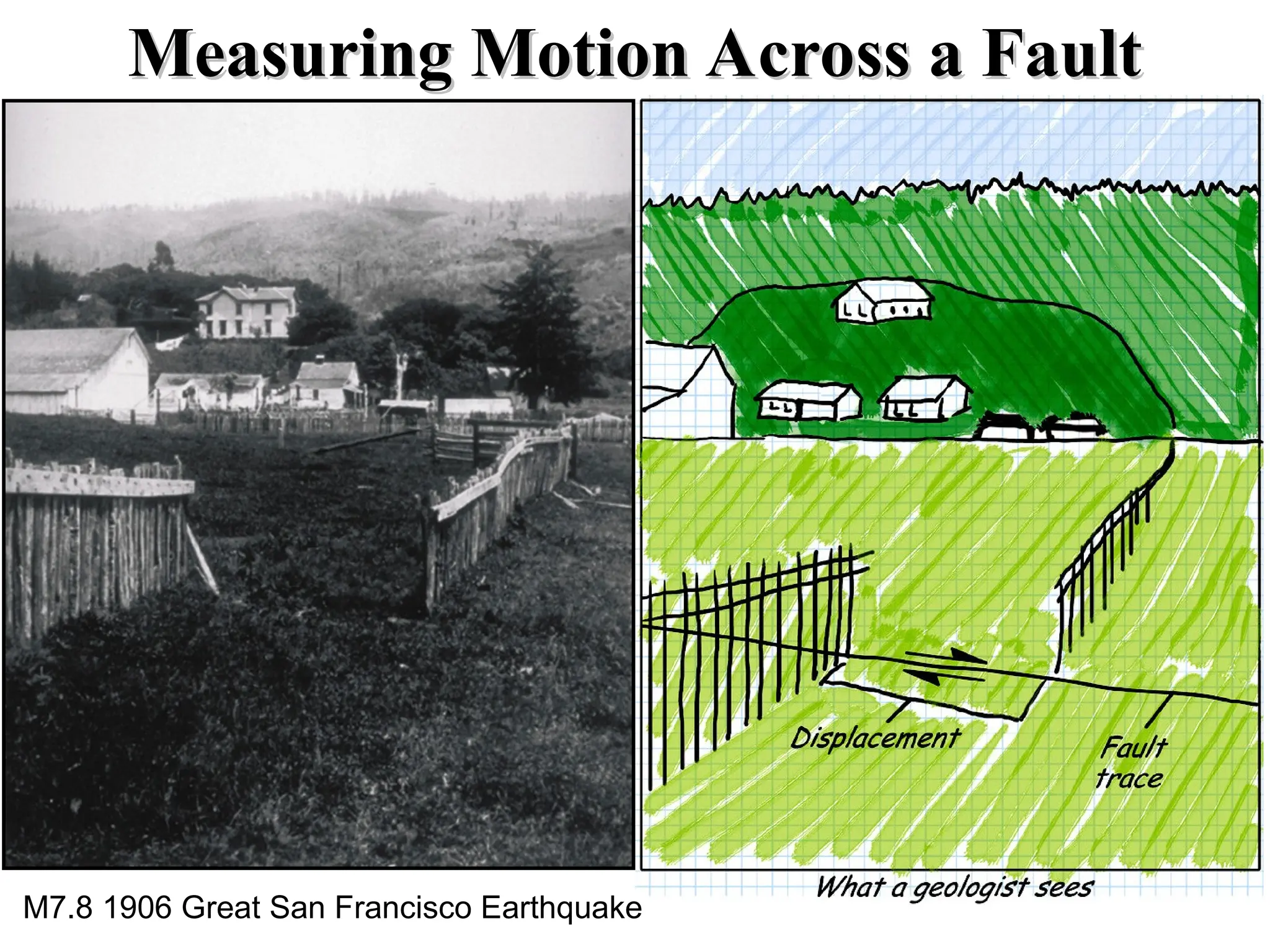
Measuring Motion Across a Fault
M7.8 1906 Great San Francisco Earthquake
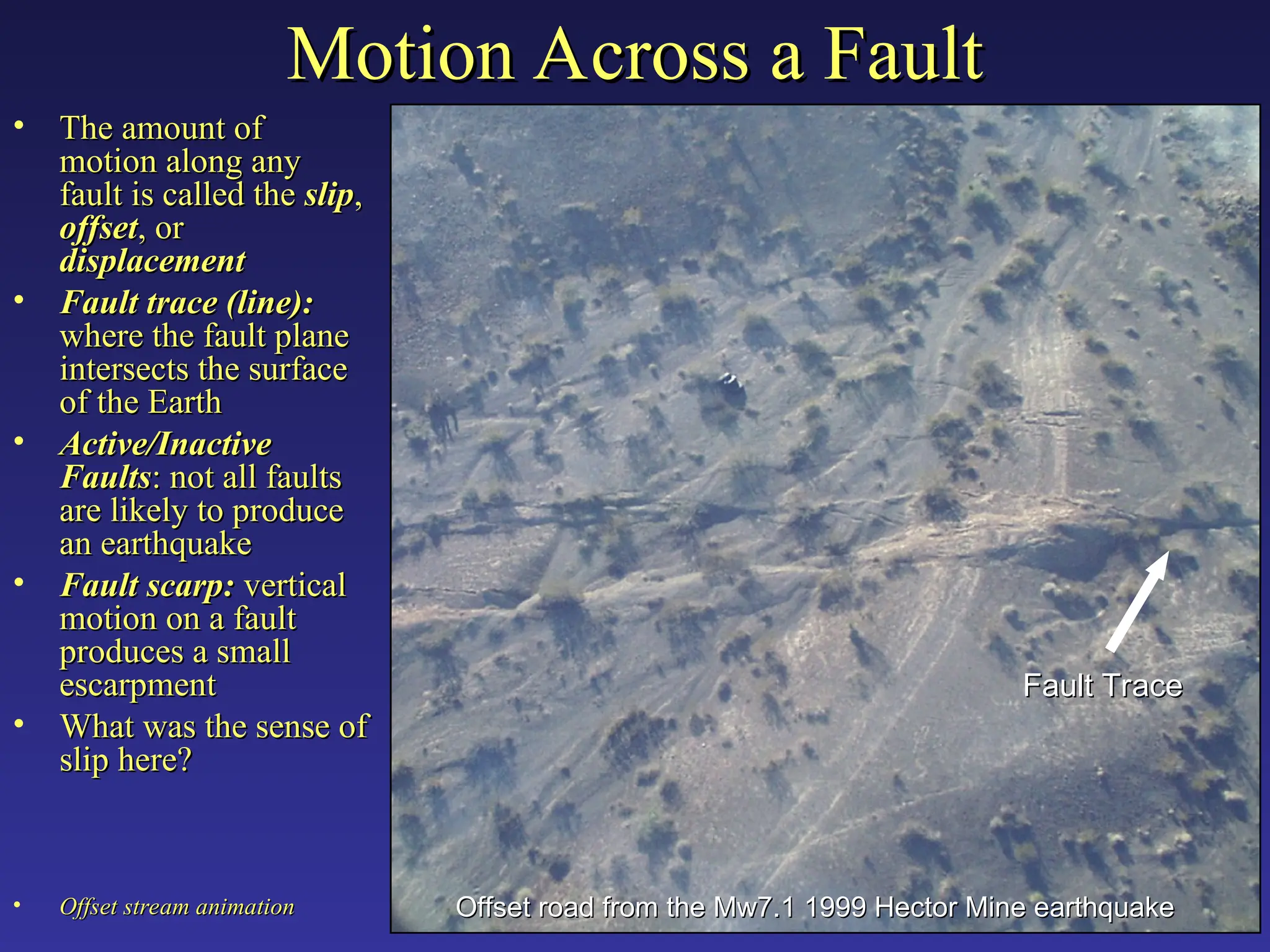
Motion Across a Fault
• The amount of
The amount of
motion along any
motion along any
fault is called the
fault is called the slip
slip,
,
offset
offset, or
, or
displacement
displacement
• Fault trace (line):
Fault trace (line):
where the fault plane
intersects the surface
of the Earth
of the Earth
• Active/Inactive
Active/Inactive
Faults
Faults: not all faults
: not all faults
are likely to produce
an earthquake
an earthquake
• Fault scarp:
Fault scarp: vertical
vertical
motion on a fault
motion on a fault
produces a small
produces a small
escarpment
escarpment
• What was the sense of
What was the sense of
slip here?
slip here?
• Offset stream animation
Offset stream animation
Fault Trace
Fault Trace
Offset road from the Mw7.1 1999 Hector Mine earthquake
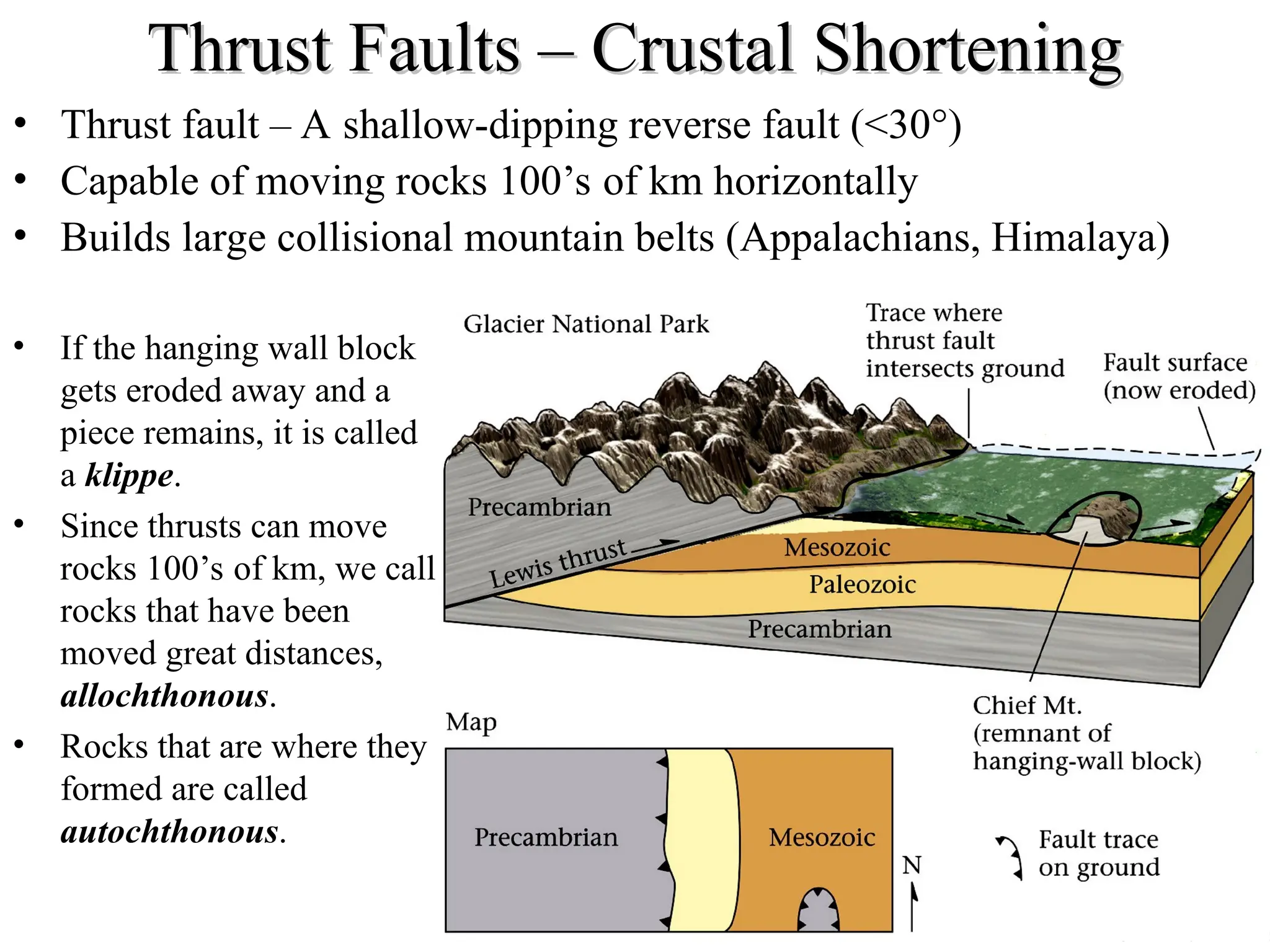
Thrust Faults – Crustal Shortening
• Thrust fault – A shallow-dipping reverse fault (<30°)
• Capable of moving rocks 100’s of km horizontally
• Builds large collisional mountain belts (Appalachians, Himalaya)
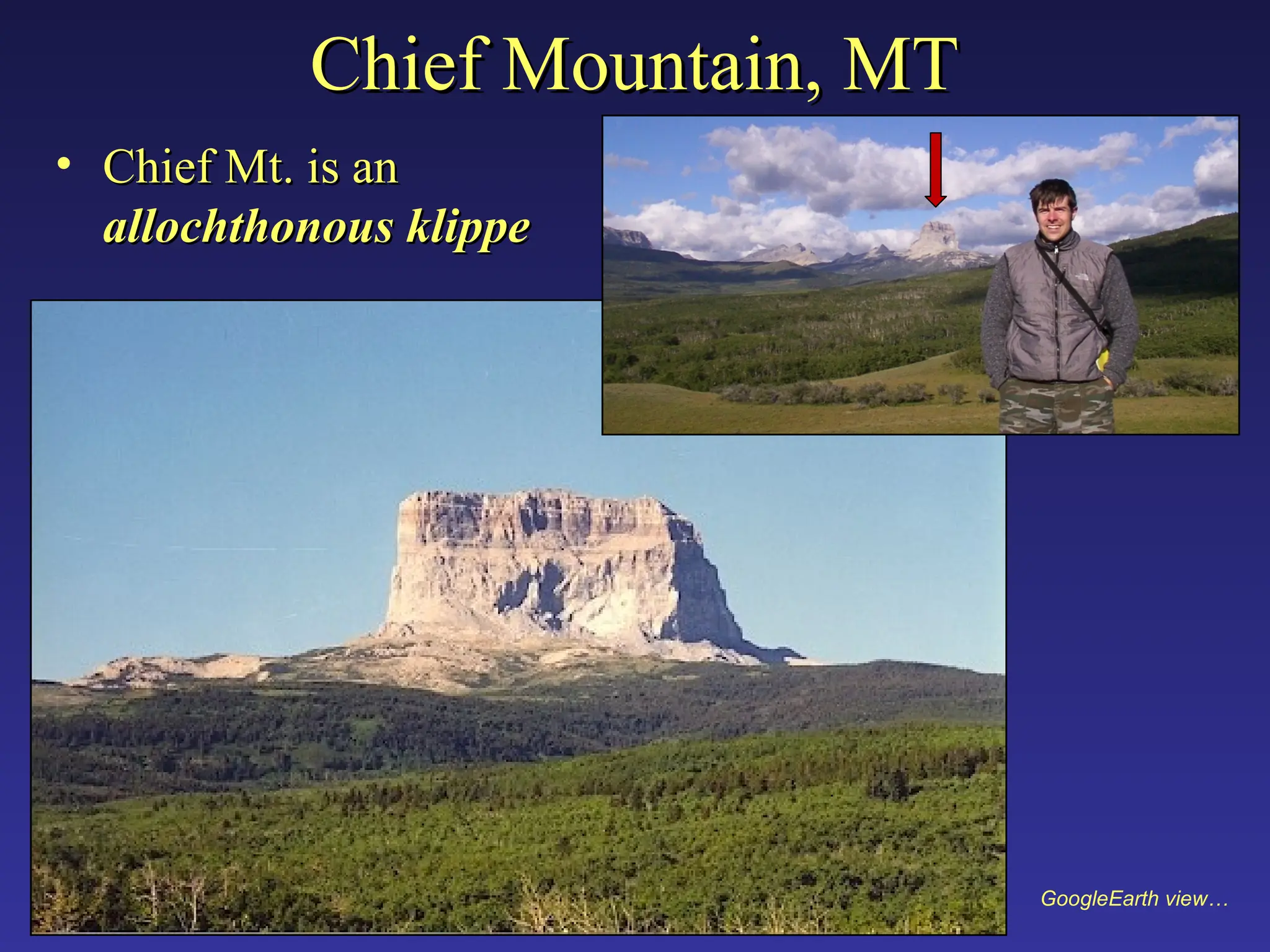
• If the hanging wall block
gets eroded away and a
piece remains, it is called
a klippe.
• Since thrusts can move
rocks 100’s of km, we call
rocks that have been
moved great distances,
allochthonous.
• Rocks that are where they
formed are called
autochthonous.
Chief Mountain, MT
Chief Mountain, MT
• Chief Mt. is an
Chief Mt. is an
allochthonous klippe
GoogleEarth view…
Normal Faults – Crustal Extension
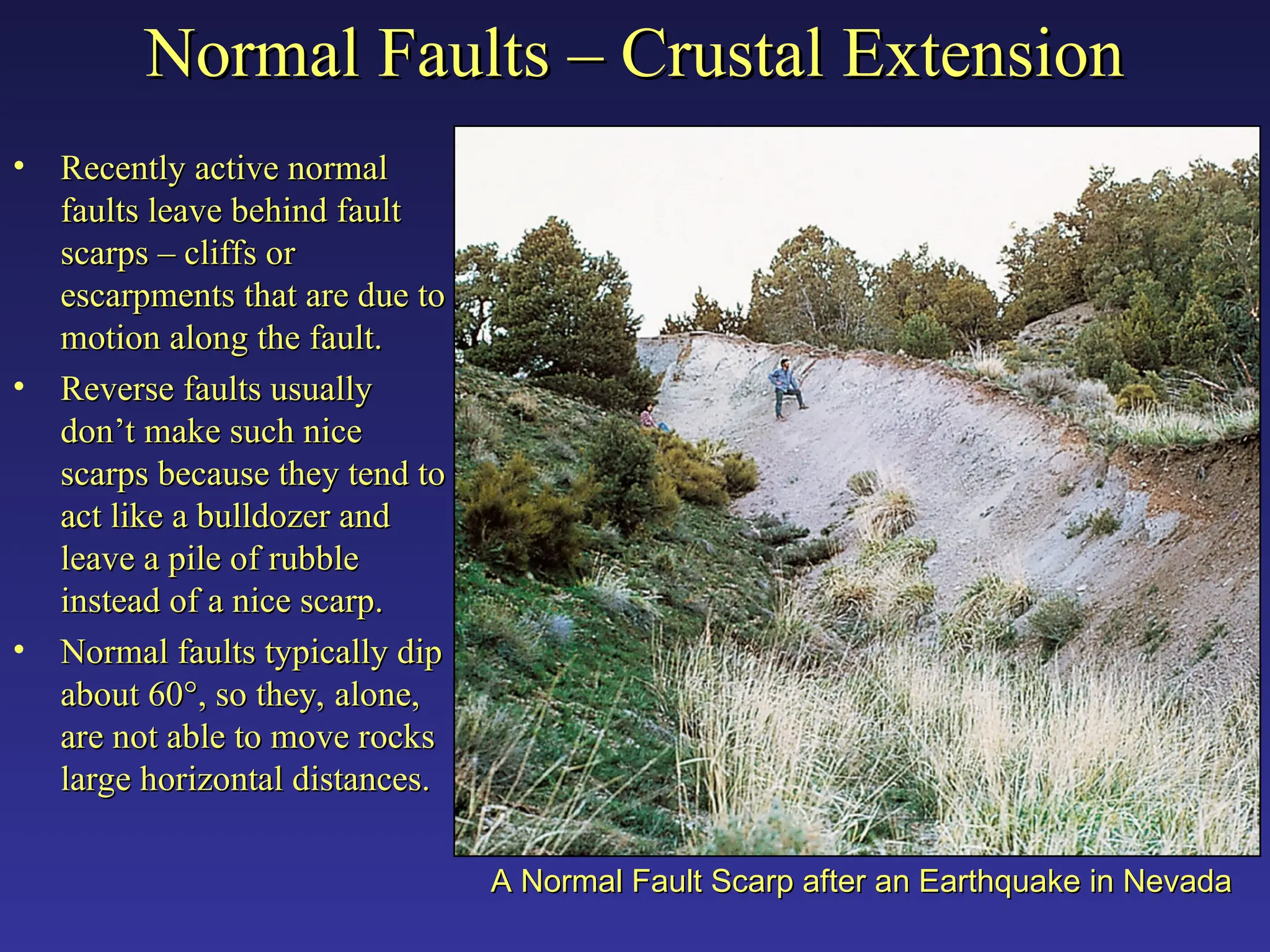
• Recently active normal
Recently active normal
faults leave behind fault
scarps – cliffs or
scarps – cliffs or
escarpments that are due to
motion along the fault.
• Reverse faults usually
Reverse faults usually
don’t make such nice
scarps because they tend to
act like a bulldozer and
leave a pile of rubble
instead of a nice scarp.
• Normal faults typically dip
Normal faults typically dip
about 60
about 60°
°, so they, alone,
, so they, alone,
are not able to move rocks
large horizontal distances.
A Normal Fault Scarp after an Earthquake in Nevada
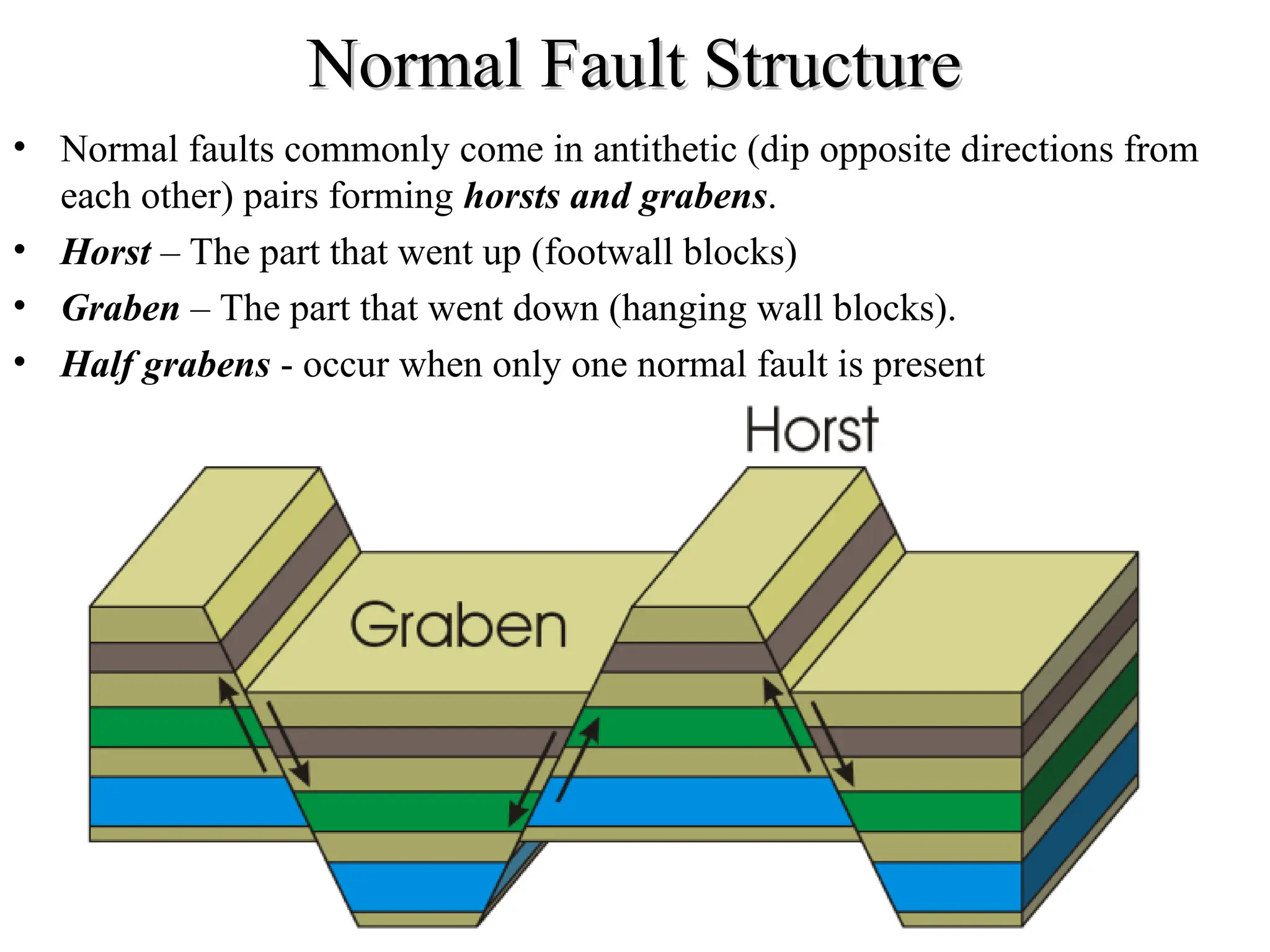
Normal Fault Structure
• Normal faults commonly come in antithetic (dip opposite directions from
each other) pairs forming horsts and grabens.
• Horst – The part that went up (footwall blocks)
• Graben – The part that went down (hanging wall blocks).
• Half grabens - occur when only one normal fault is present
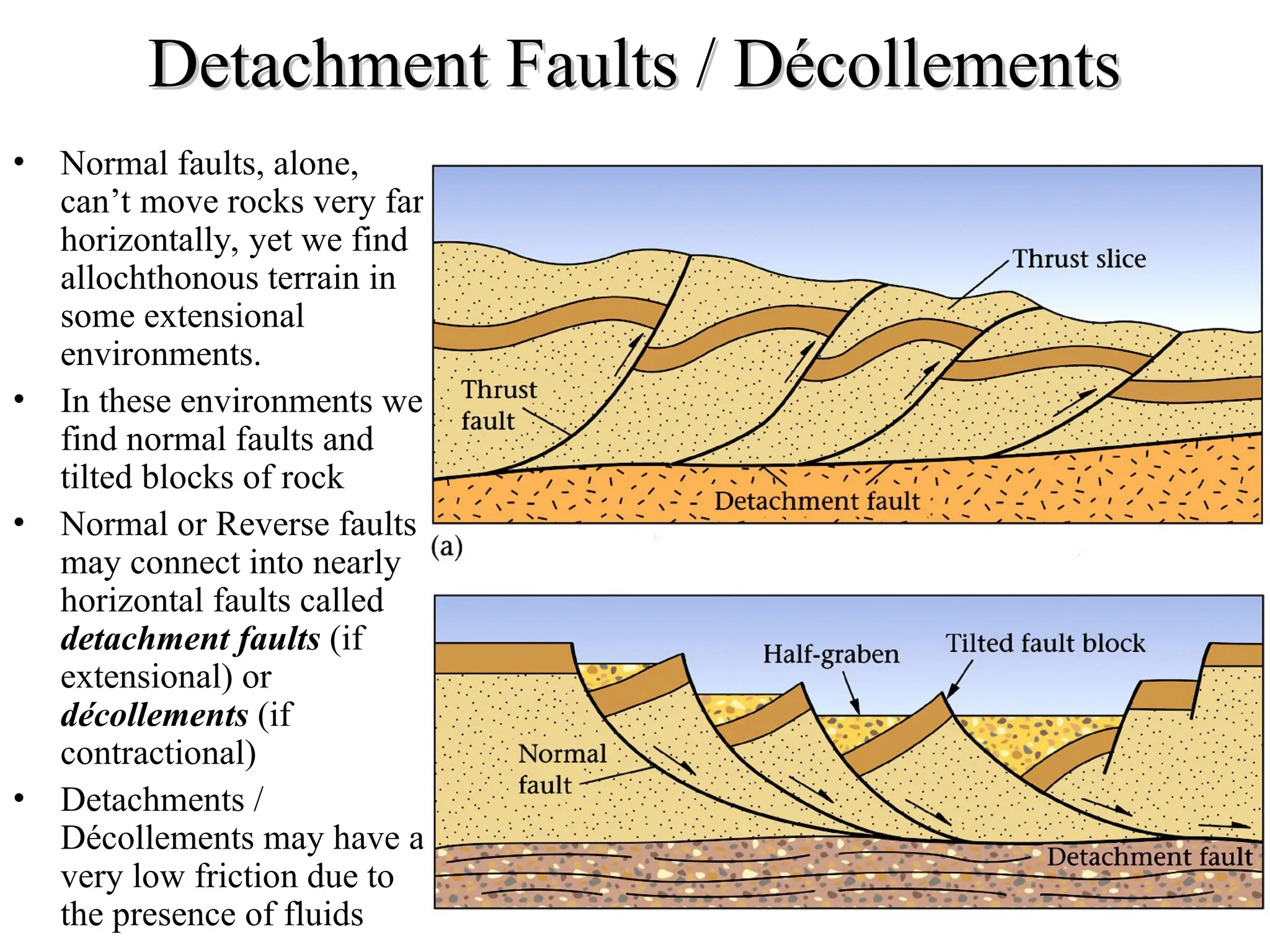
Detachment Faults / Décollements
• Normal faults, alone,
can’t move rocks very far
horizontally, yet we find
allochthonous terrain in
some extensional
environments.
• In these environments we
find normal faults and
tilted blocks of rock
• Normal or Reverse faults
may connect into nearly
horizontal faults called
detachment faults (if
extensional) or
décollements (if
contractional)
• Detachments /
Décollements may have a
very low friction due to
the presence of fluids
Recognizing Faults
Recognizing Faults
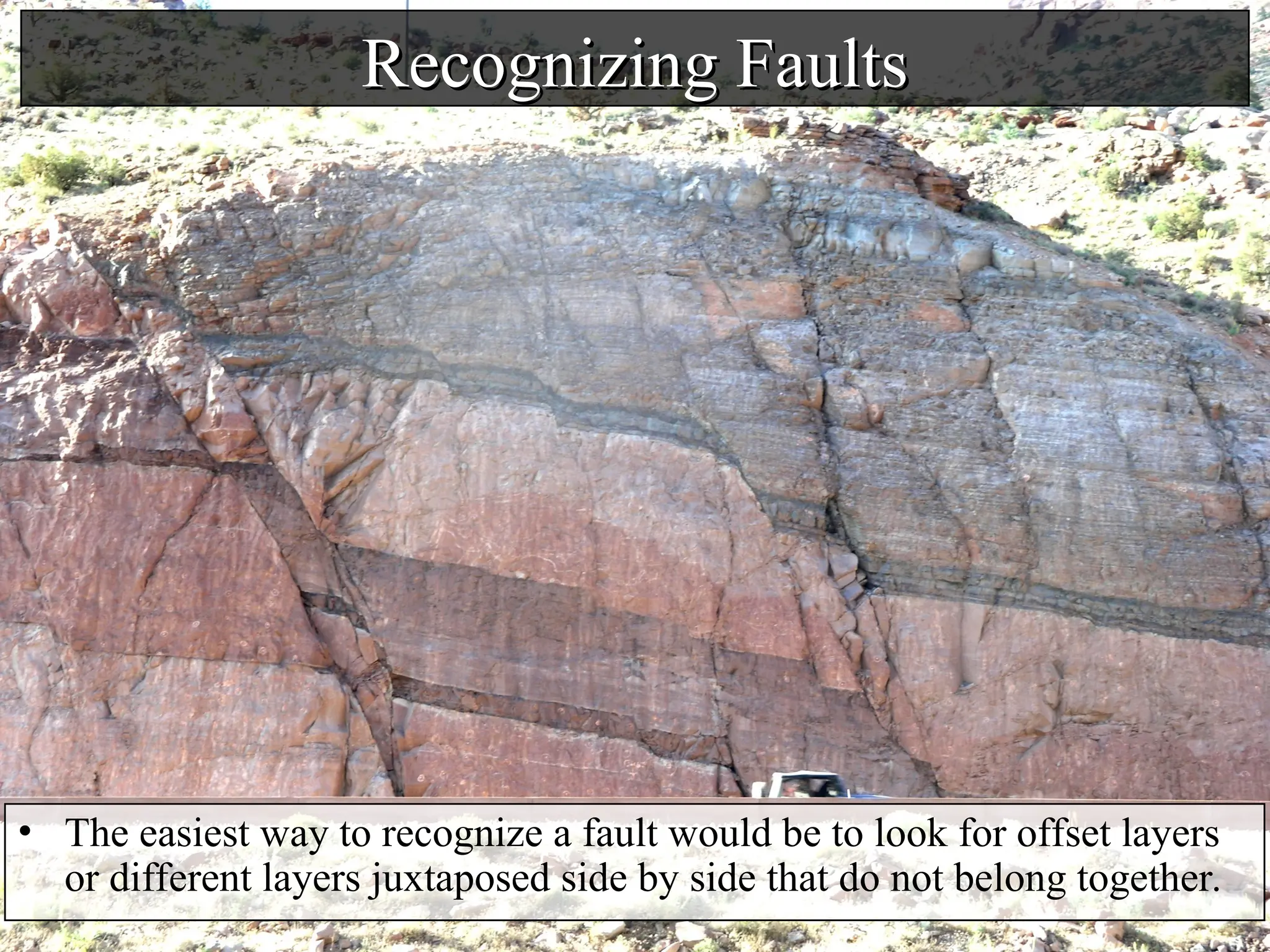
• The easiest way to recognize a fault would be to look for offset layers
or different layers juxtaposed side by side that do not belong together.
Moab Fault, UT
Moab Fault, UT
Different
Different
color
color
Different
Different
color
color
Fault
Fault
Fault
Fault
Youngest
Youngest
Rocks
Rocks
Young
Young
Rocks
Rocks
Oldest
Oldest
Rocks
Rocks
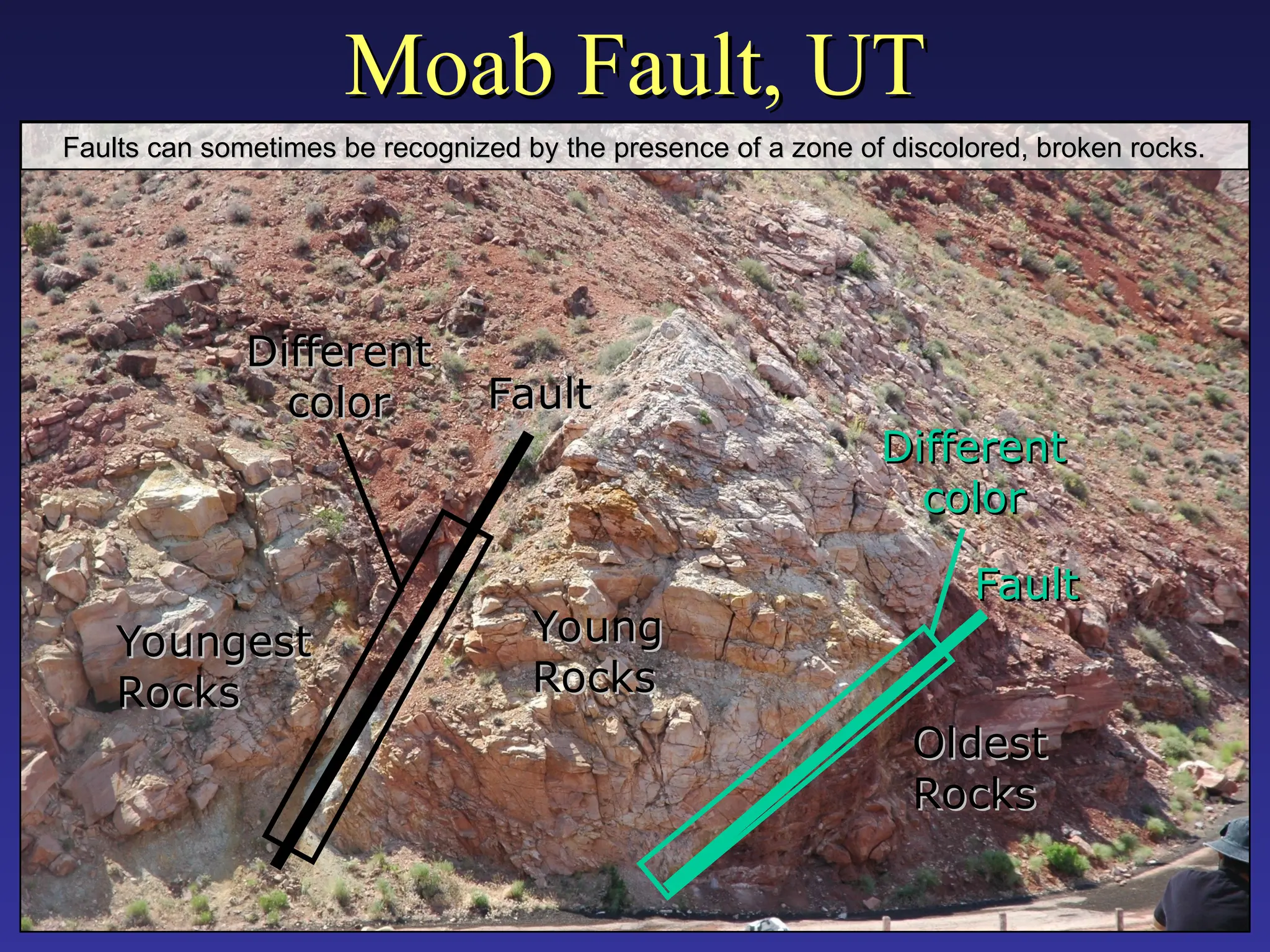
Faults can sometimes be recognized by the presence of a zone of discolored, broken rocks.
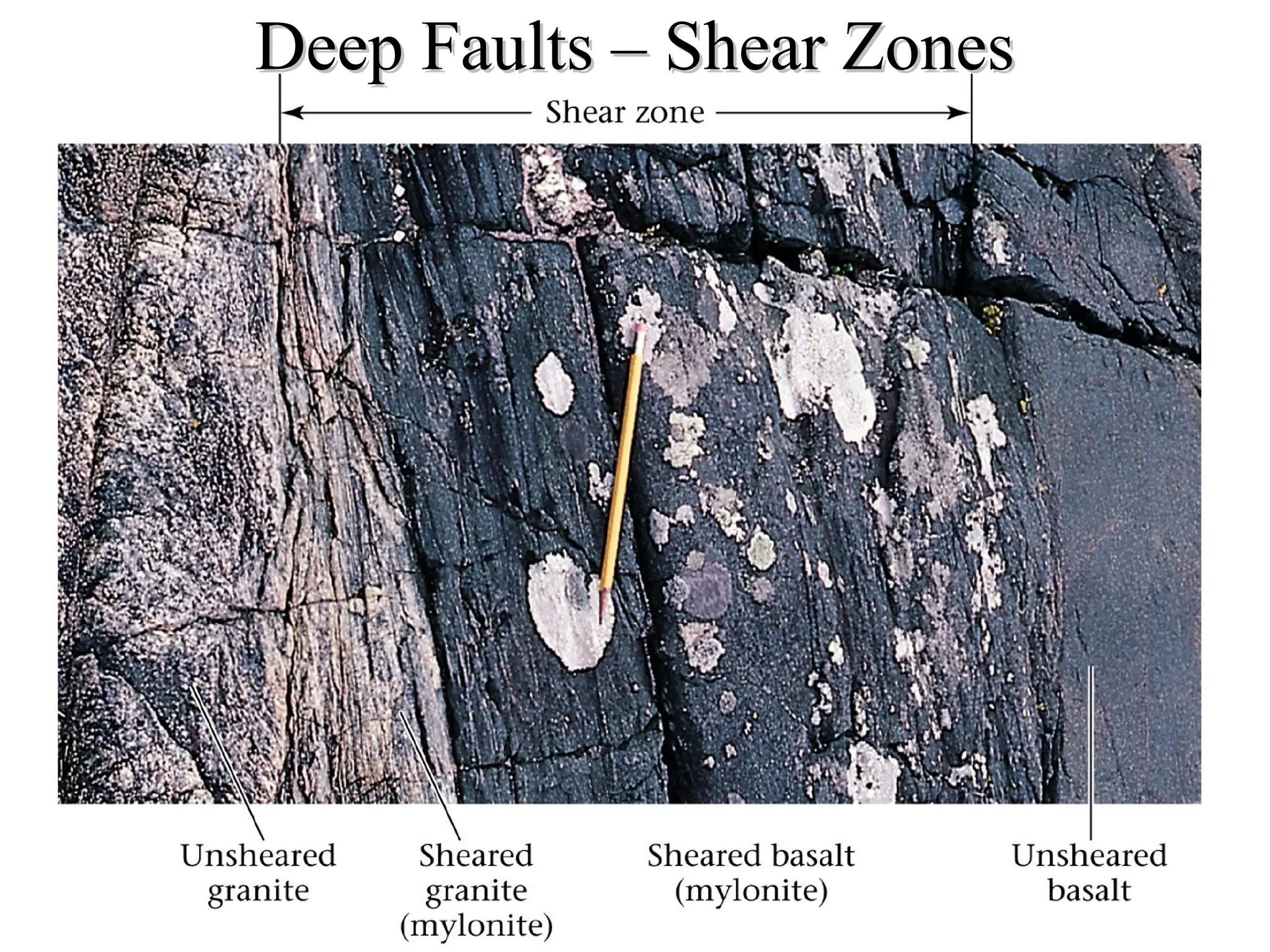
Deep Faults – Shear Zones
Fault Surface Fabric - Slickensides
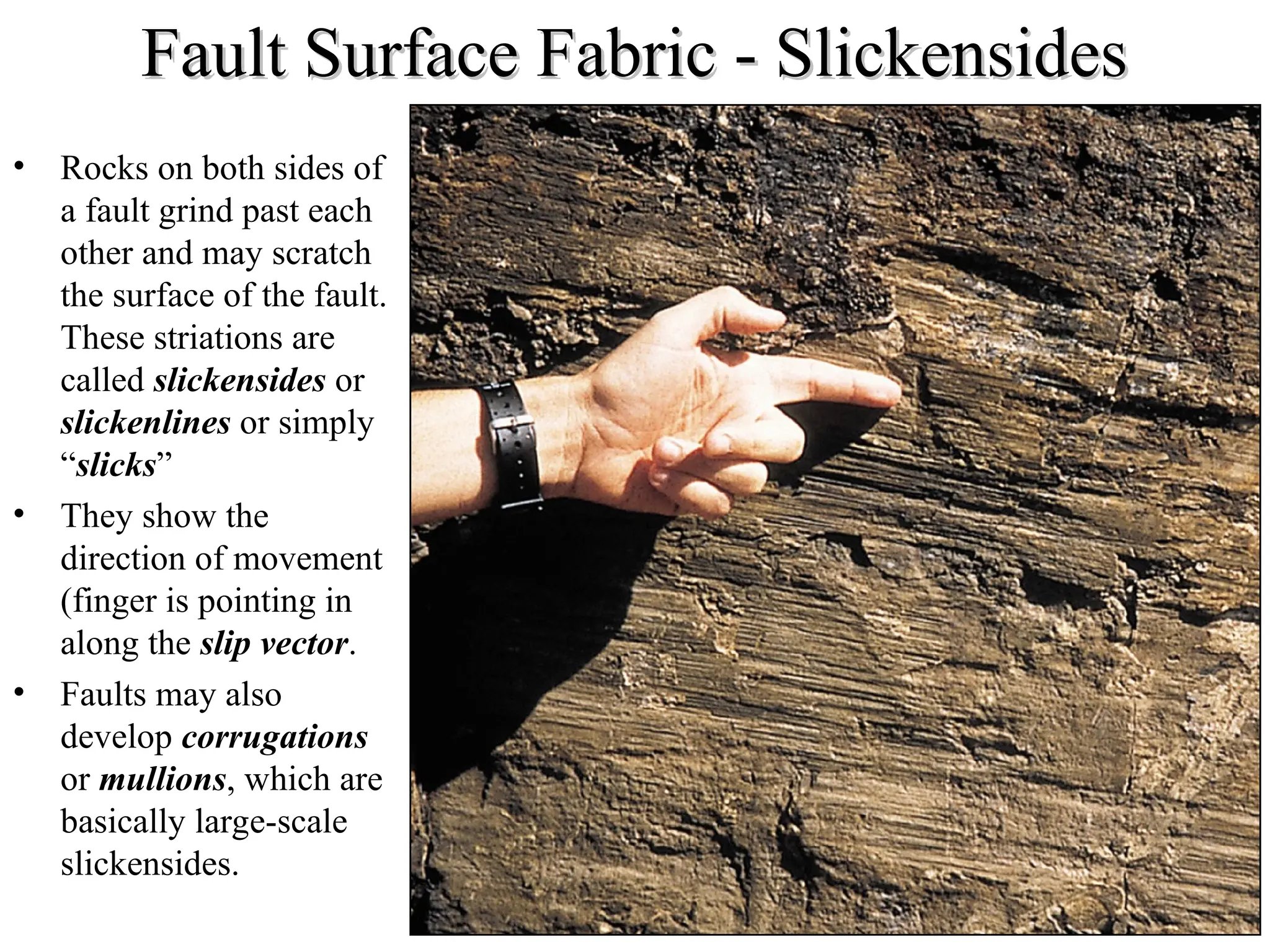
• Rocks on both sides of
a fault grind past each
other and may scratch
the surface of the fault.
These striations are
called slickensides or
slickenlines or simply
“slicks”
• They show the
direction of movement
(finger is pointing in
along the slip vector.
• Faults may also
develop corrugations
or mullions, which are
basically large-scale
slickensides.
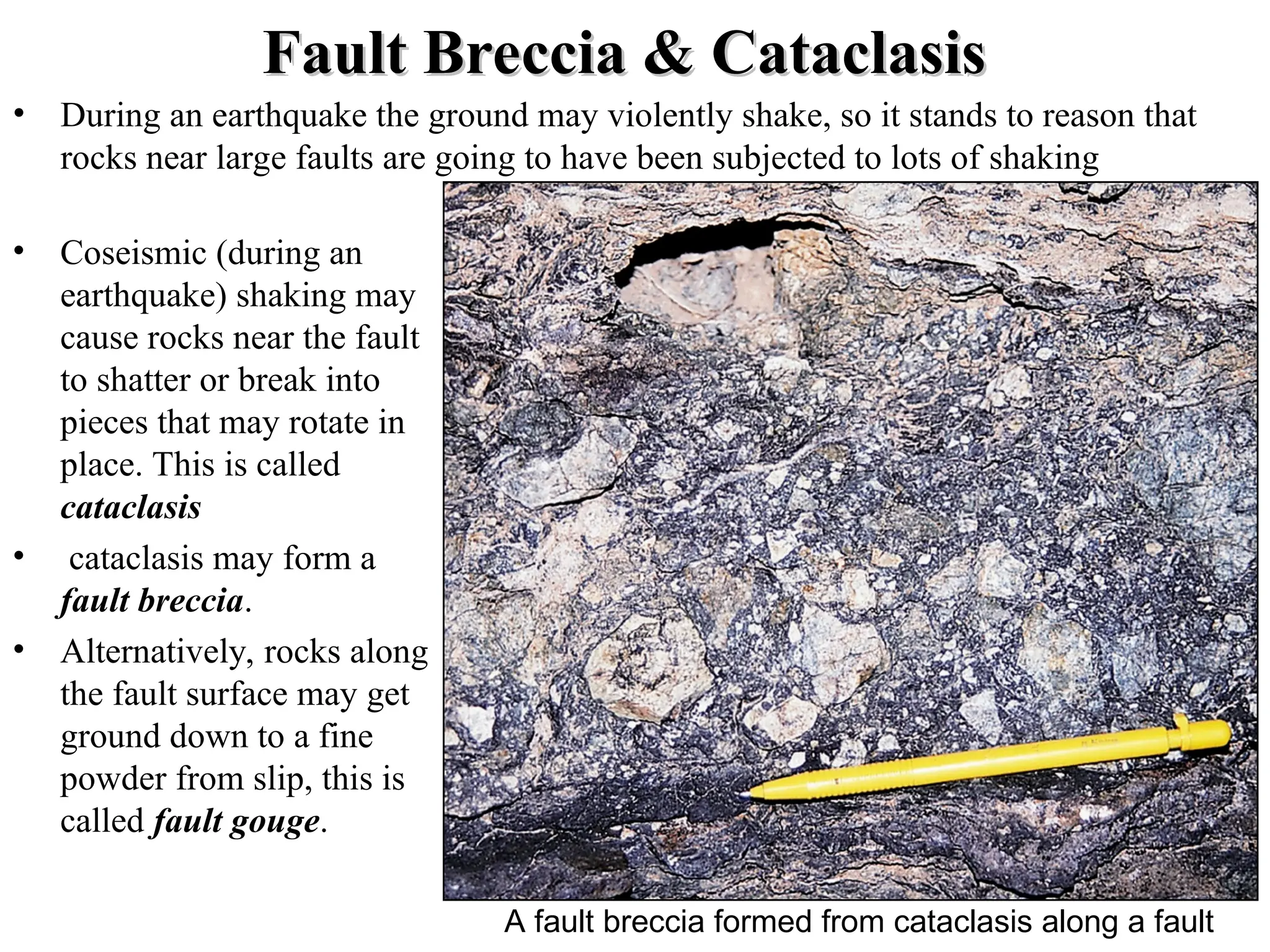
Fault Breccia & Cataclasis
• During an earthquake the ground may violently shake, so it stands to reason that
rocks near large faults are going to have been subjected to lots of shaking
• Coseismic (during an
earthquake) shaking may
cause rocks near the fault
to shatter or break into
pieces that may rotate in
place. This is called
cataclasis
• cataclasis may form a
fault breccia.
• Alternatively, rocks along
the fault surface may get
ground down to a fine
powder from slip, this is
called fault gouge.
A fault breccia formed from cataclasis along a fault
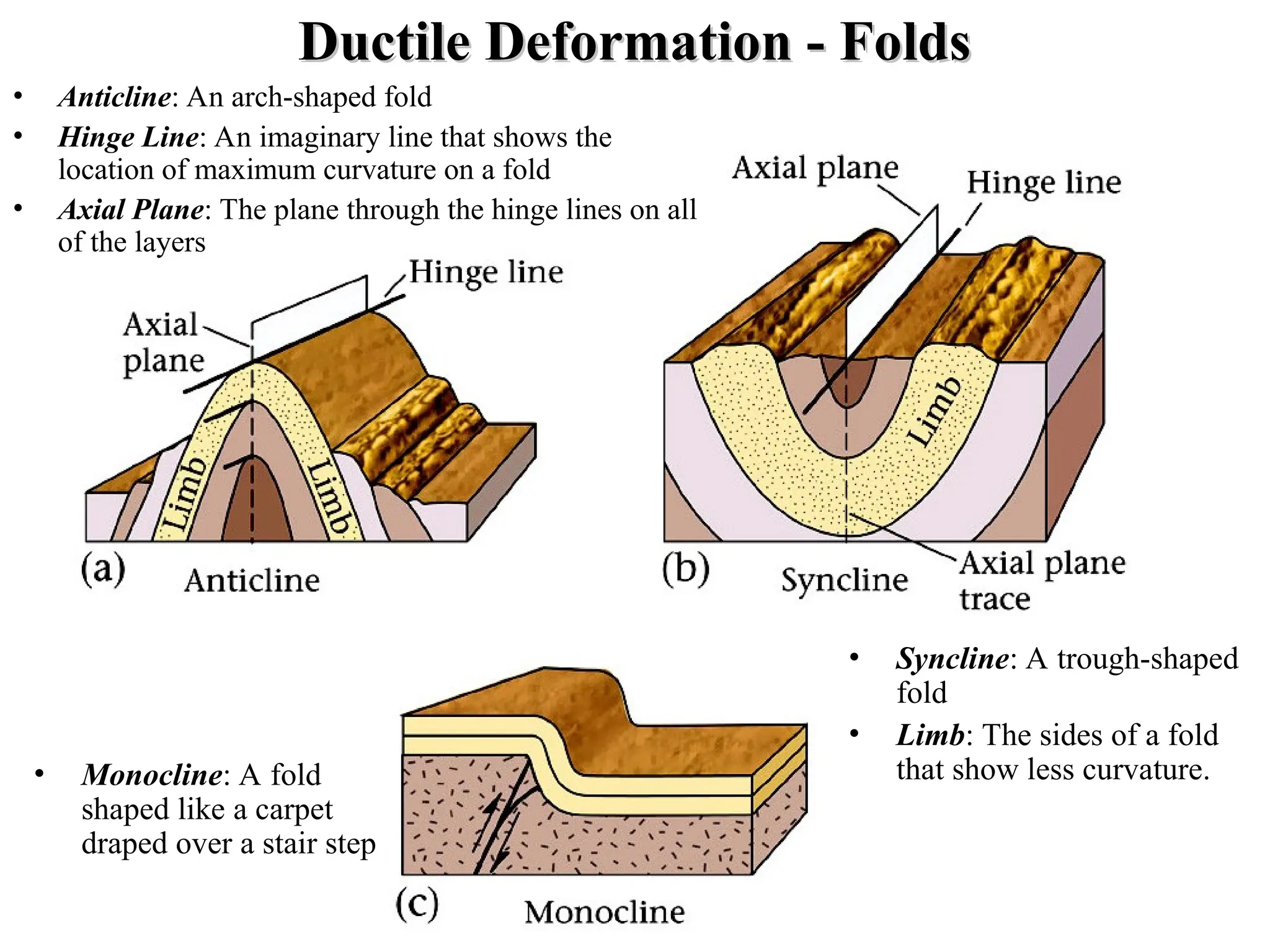
Ductile Deformation - Folds
• Anticline: An arch-shaped fold
• Hinge Line: An imaginary line that shows the
location of maximum curvature on a fold
• Axial Plane: The plane through the hinge lines on all
of the layers
• Monocline: A fold
shaped like a carpet
draped over a stair step
• Syncline: A trough-shaped
fold
• Limb: The sides of a fold
that show less curvature.
Descriptive Fold Terms
In order for geologists to describe folds we
need to have terms to describe them
• Open Fold: A fold that is broad, i.e.
the angle between the limbs is large
• Tight Fold: A fold that is narrow,
i.e. the angle between limbs is small
• Plunging Fold: The hinge
line is non-horizontal
• Non-plunging Fold: The
hinge line is horizontal
Doubly Plunging Folds form
domes and basins
• Dome: An upside-down
bowl-shaped fold
• Basin: A right-side-up
bowl-shaped fold
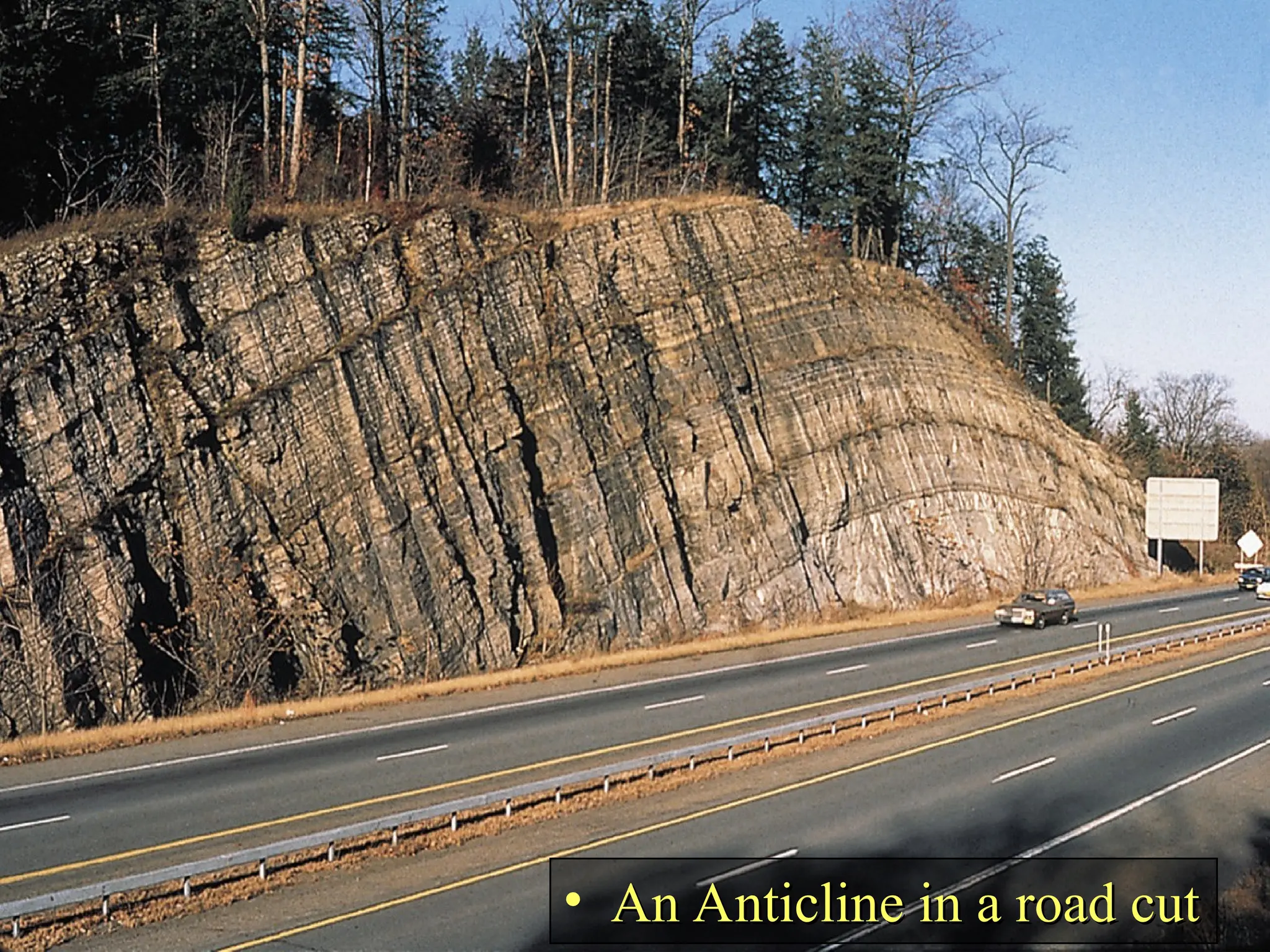
• An Anticline in a road cut
An Anticline in a road cut
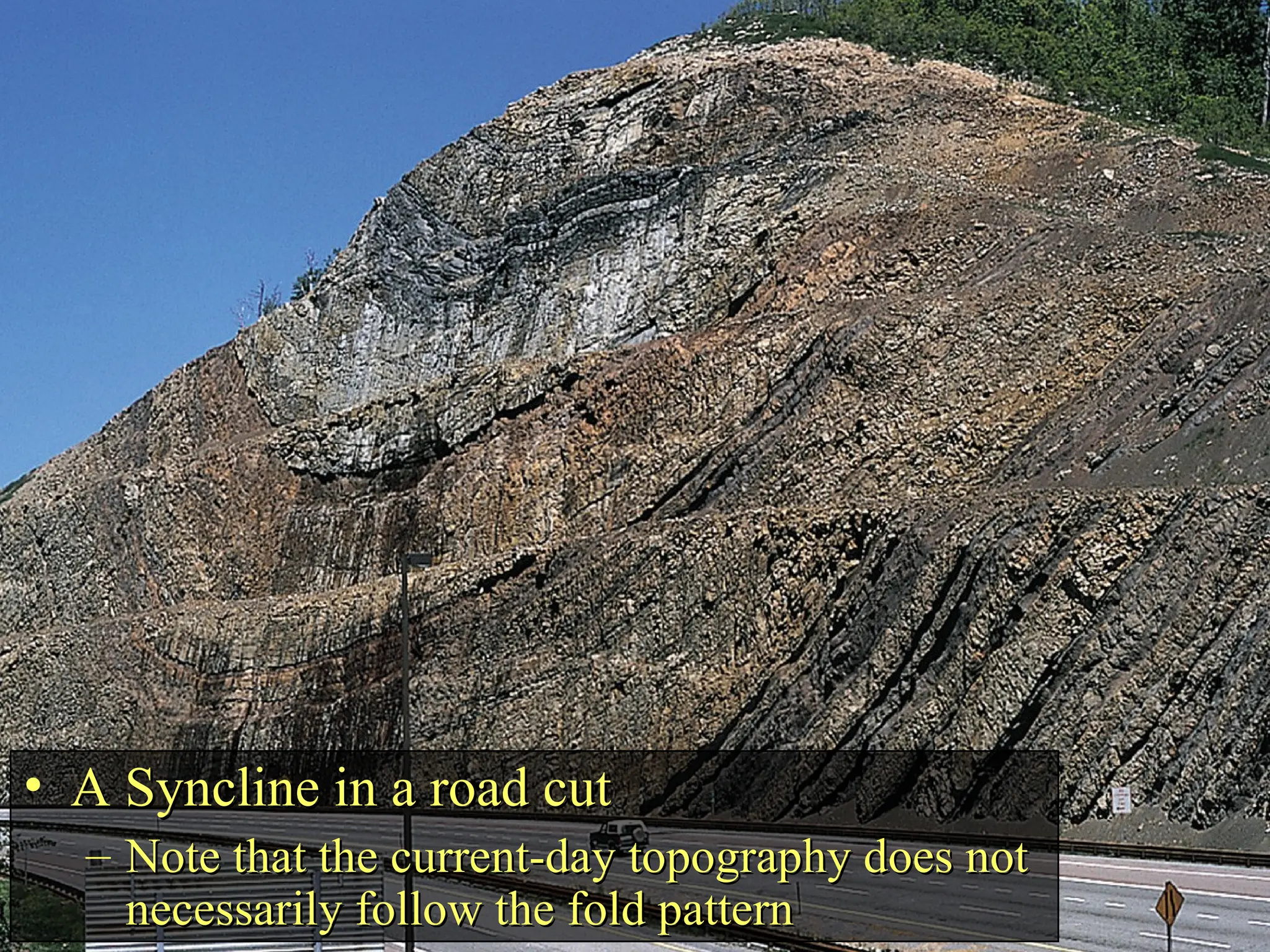
• A Syncline in a road cut
A Syncline in a road cut
– Note that the current-day topography does not
Note that the current-day topography does not
necessarily follow the fold pattern
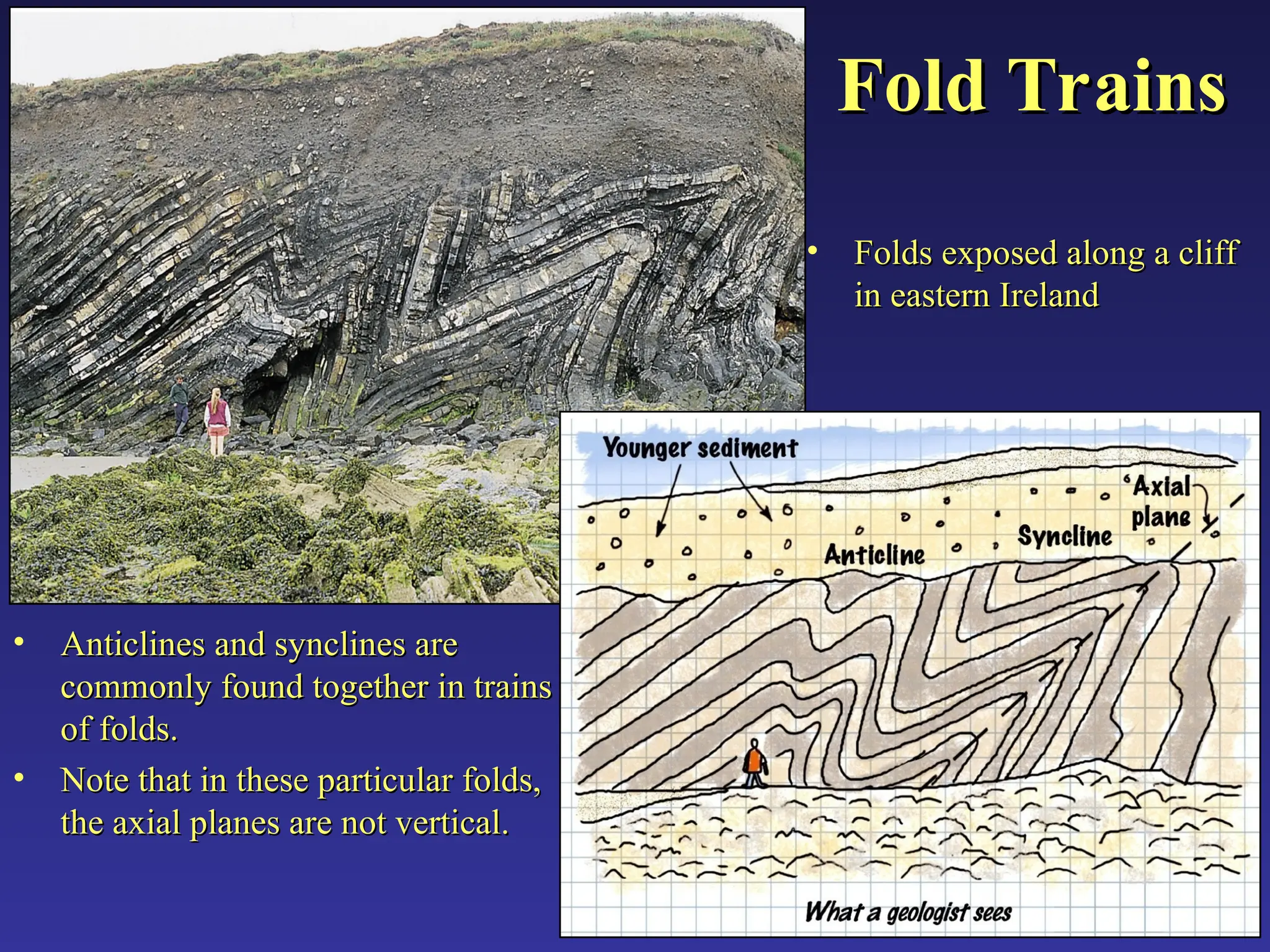
Fold Trains
Fold Trains
• Anticlines and synclines are
Anticlines and synclines are
commonly found together in trains
of folds.
of folds.
• Note that in these particular folds,
Note that in these particular folds,
the axial planes are not vertical.
• Folds exposed along a cliff
Folds exposed along a cliff
in eastern Ireland
in eastern Ireland
Fold Formation
Fold Formation
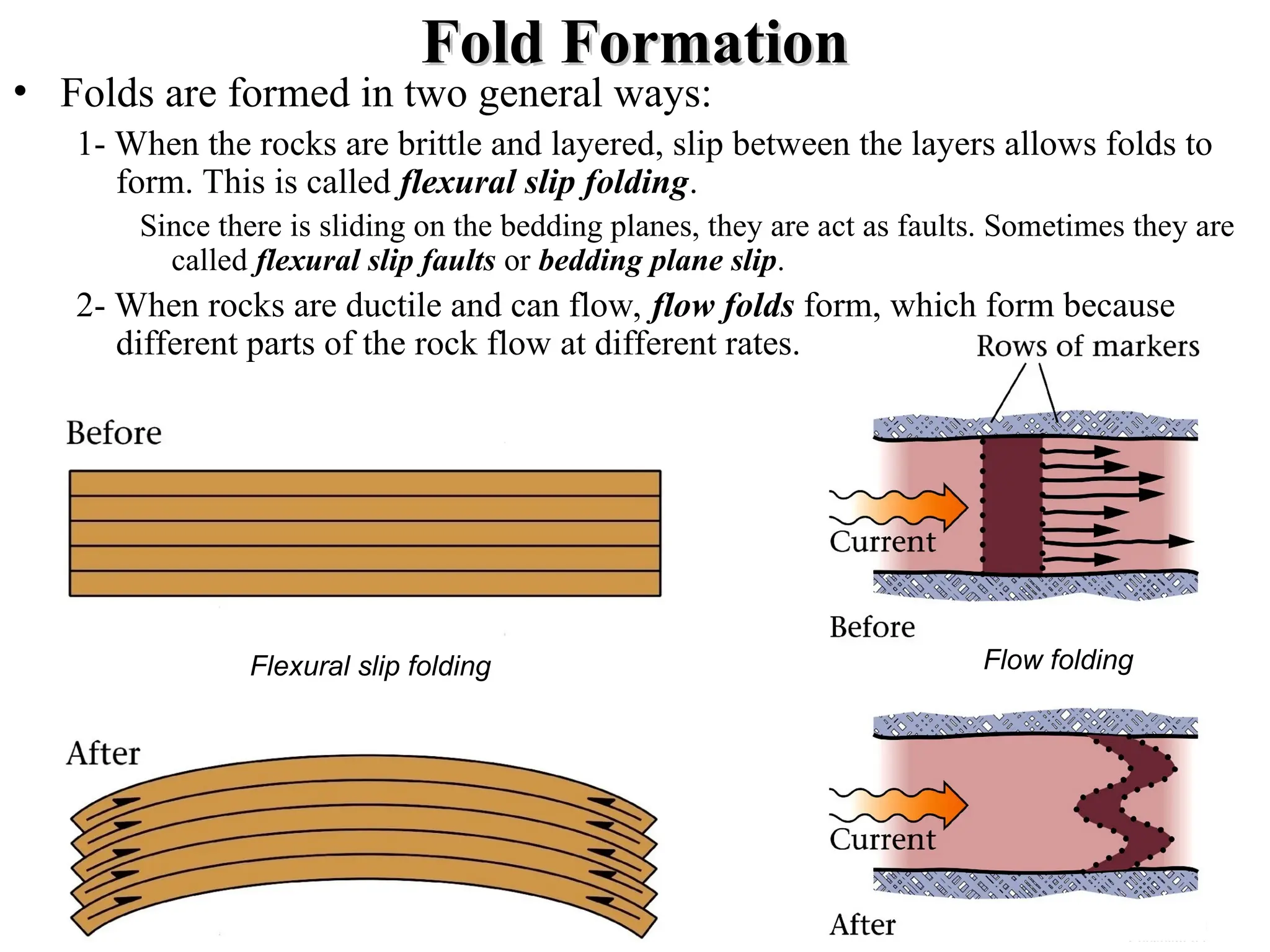
• Folds are formed in two general ways:
1- When the rocks are brittle and layered, slip between the layers allows folds to
form. This is called flexural slip folding.
Since there is sliding on the bedding planes, they are act as faults. Sometimes they are
called flexural slip faults or bedding plane slip.
2- When rocks are ductile and can flow, flow folds form, which form because
different parts of the rock flow at different rates.
Flexural slip folding Flow folding
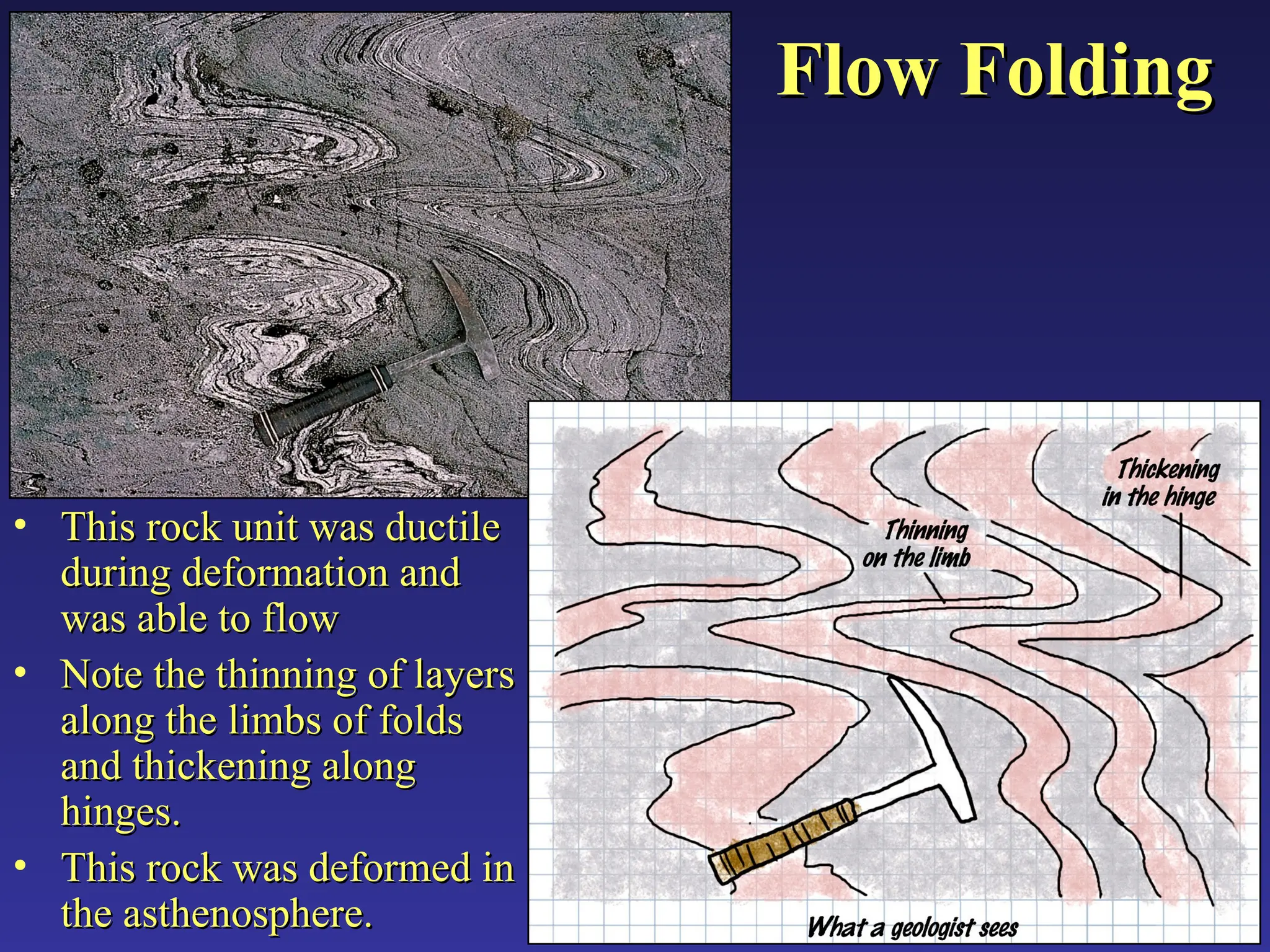
Flow Folding
Flow Folding
• This rock unit was ductile
This rock unit was ductile
during deformation and
was able to flow
was able to flow
• Note the thinning of layers
Note the thinning of layers
along the limbs of folds
and thickening along
hinges.
hinges.
• This rock was deformed in
This rock was deformed in
the asthenosphere.
the asthenosphere.
Flexural Slip
Flexural Slip
Folding
Folding
• Layers are folded with
Layers are folded with
significant slip on the
bedding planes.
bedding planes.
• Layer thickness stays
Layer thickness stays
constant throughout.
• May see slickensides on
May see slickensides on
bedding planes
bedding planes
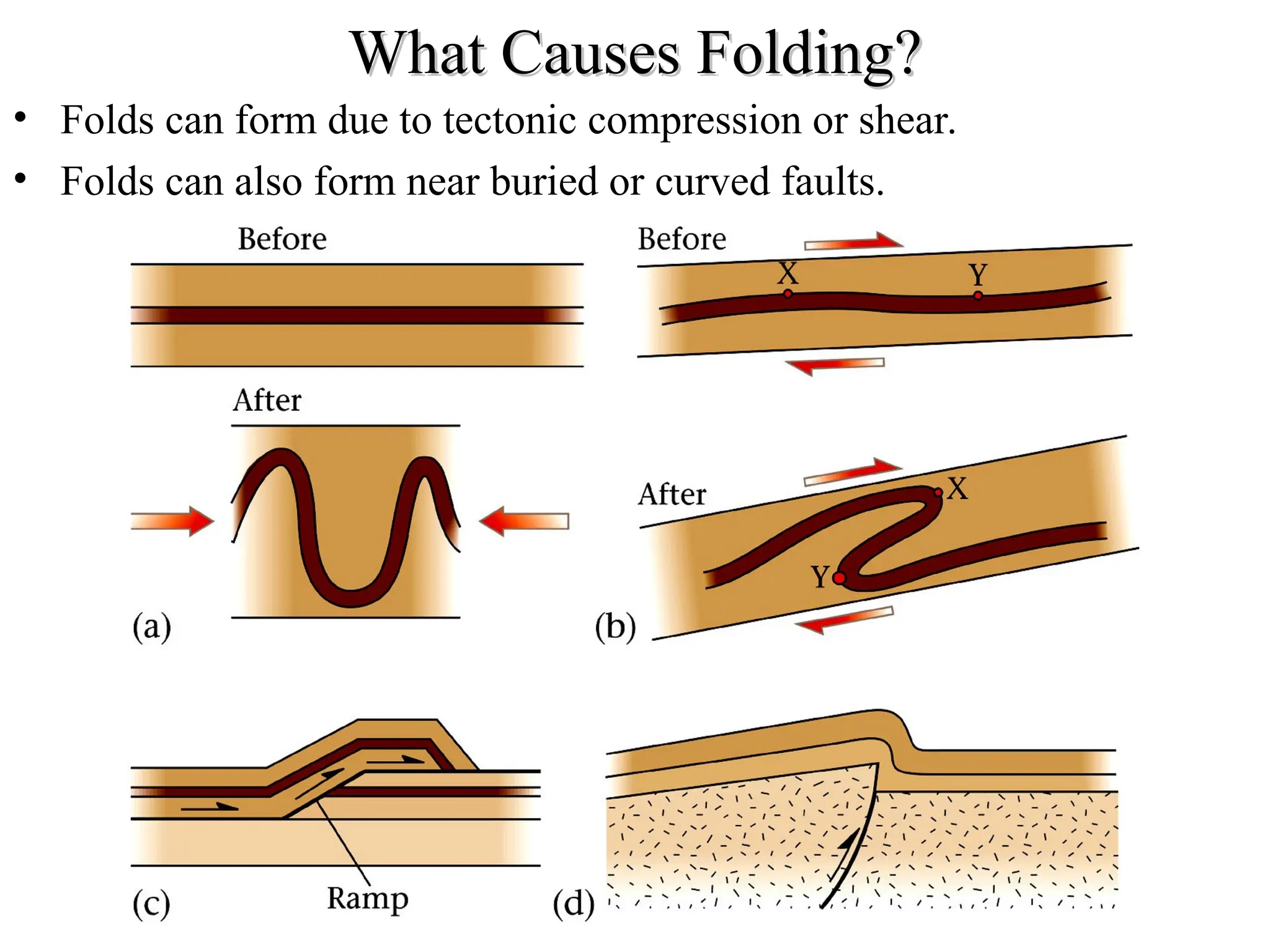
What Causes Folding?
• Folds can form due to tectonic compression or shear.
• Folds can also form near buried or curved faults.
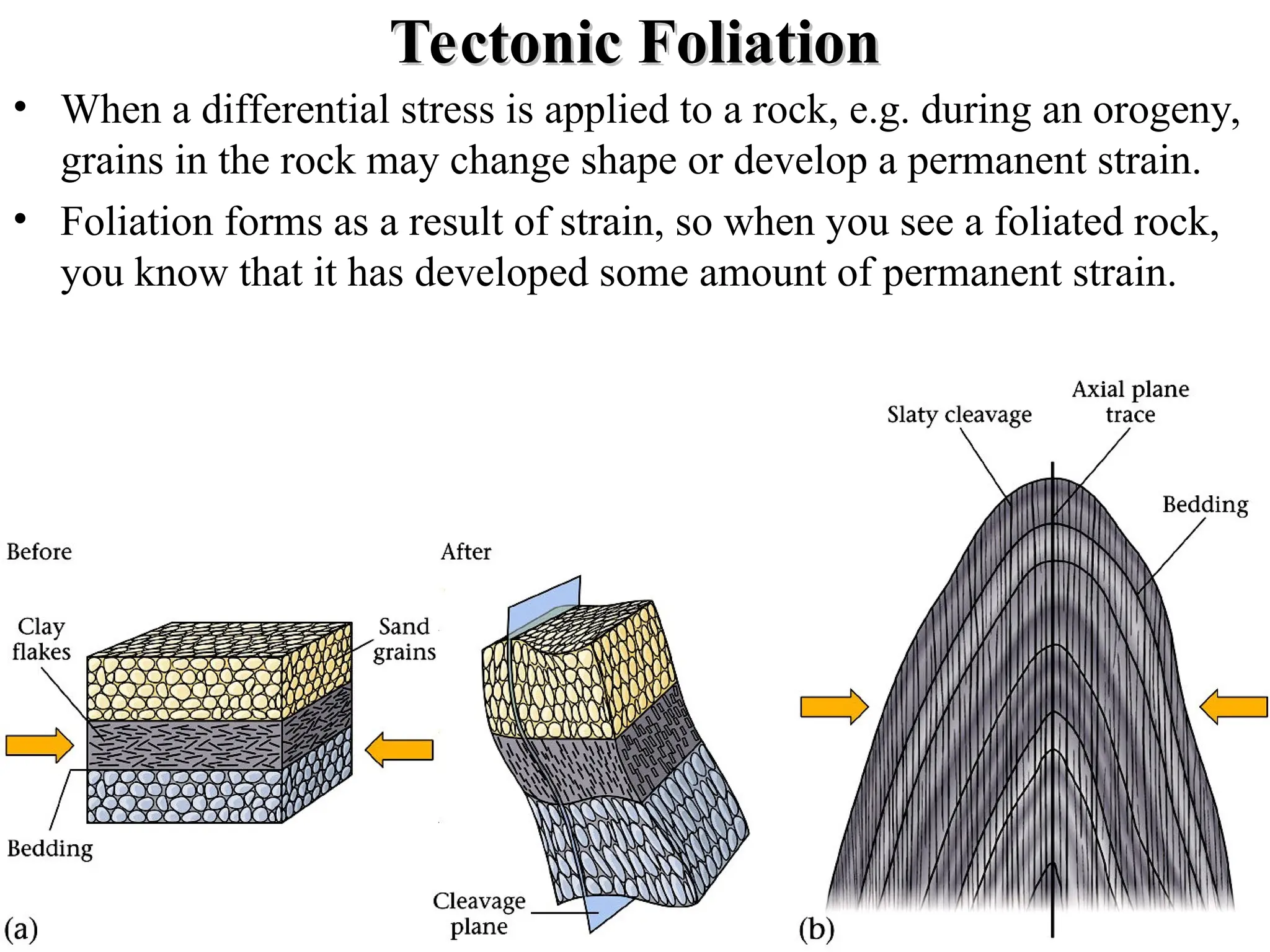
Tectonic Foliation
Tectonic Foliation
• When a differential stress is applied to a rock, e.g. during an orogeny,
grains in the rock may change shape or develop a permanent strain.
• Foliation forms as a result of strain, so when you see a foliated rock,
you know that it has developed some amount of permanent strain.
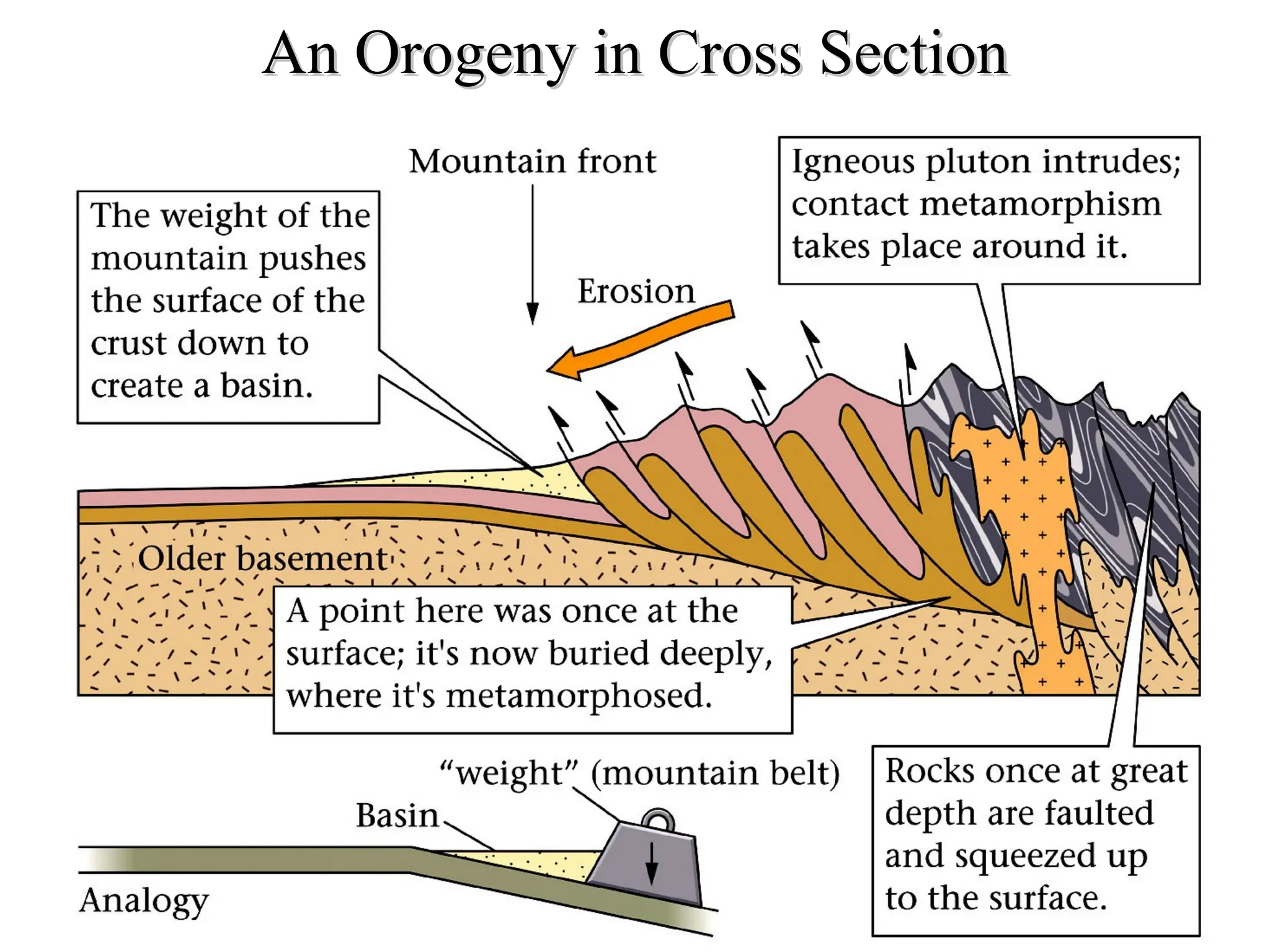
An Orogeny in Cross Section
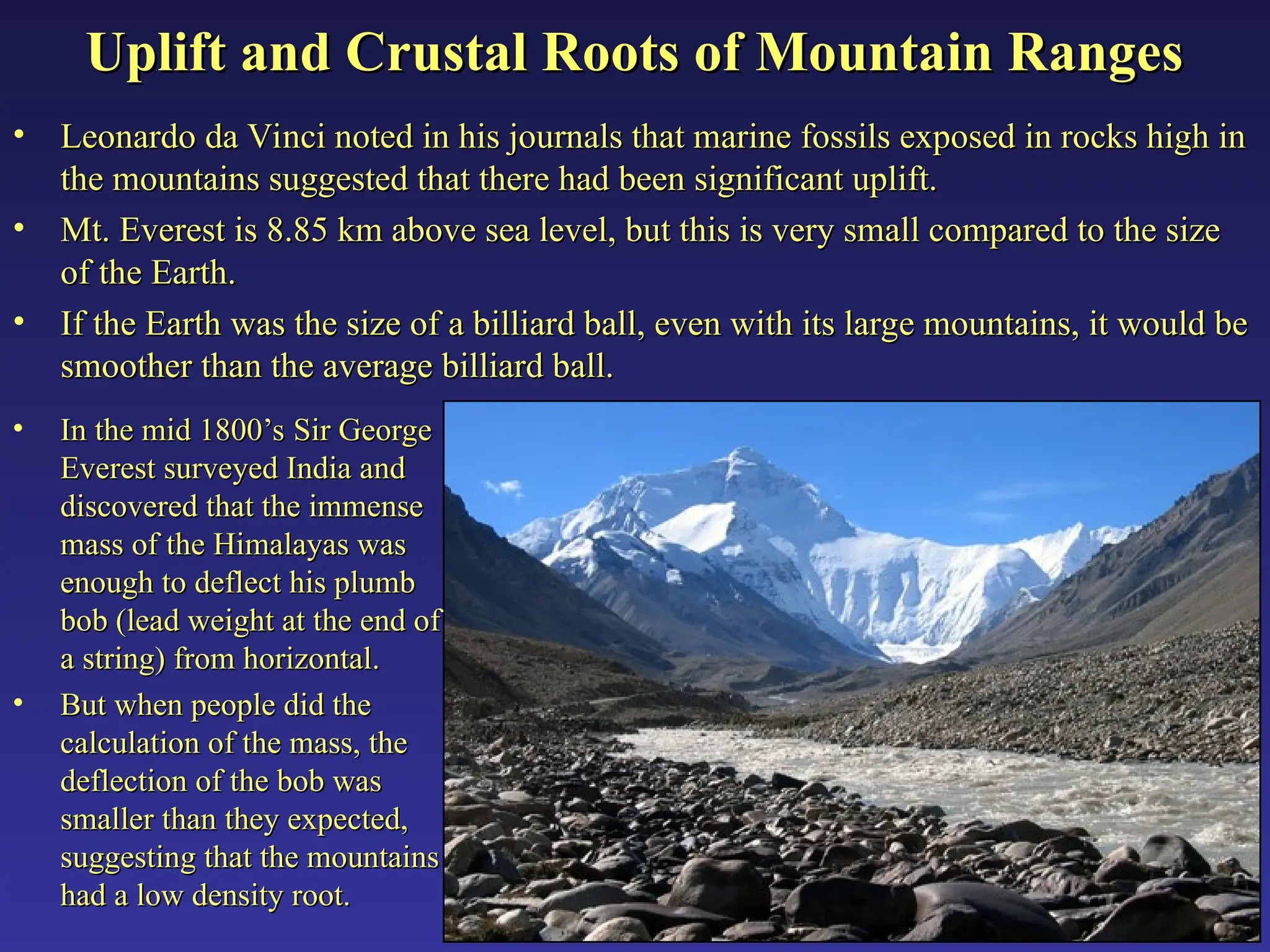
Uplift and Crustal Roots of Mountain Ranges
• Leonardo da Vinci noted in his journals that marine fossils exposed in rocks high in
Leonardo da Vinci noted in his journals that marine fossils exposed in rocks high in
the mountains suggested that there had been significant uplift.
• Mt. Everest is 8.85 km above sea level, but this is very small compared to the size
Mt. Everest is 8.85 km above sea level, but this is very small compared to the size
of the Earth.
of the Earth.
• If the Earth was the size of a billiard ball, even with its large mountains, it would be
If the Earth was the size of a billiard ball, even with its large mountains, it would be
smoother than the average billiard ball.
• In the mid 1800’s Sir George
In the mid 1800’s Sir George
Everest surveyed India and
discovered that the immense
mass of the Himalayas was
enough to deflect his plumb
bob (lead weight at the end of
a string) from horizontal.
• But when people did the
But when people did the
calculation of the mass, the
deflection of the bob was
smaller than they expected,
suggesting that the mountains
had a low density root.
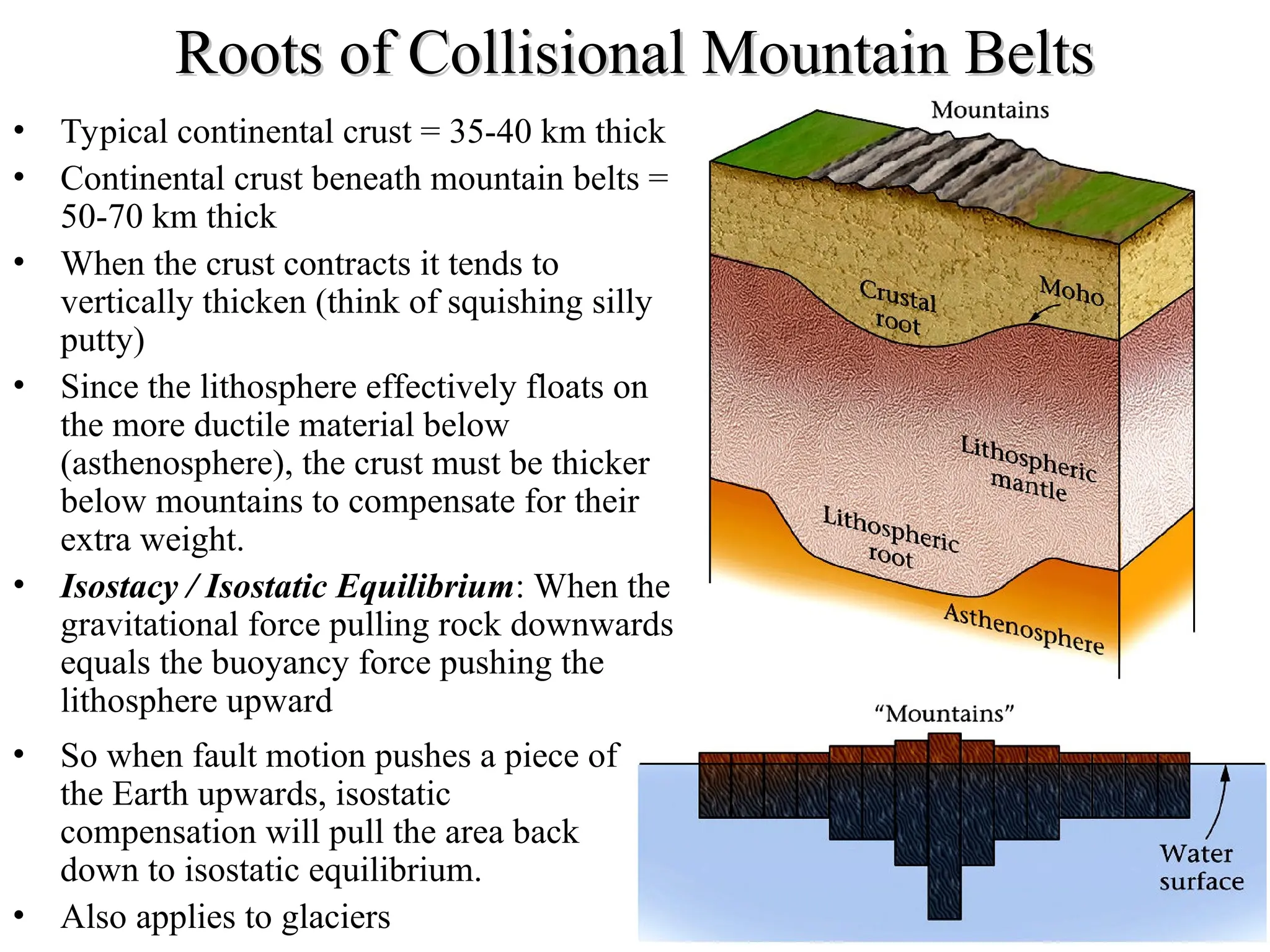
Roots of Collisional Mountain Belts
• Typical continental crust = 35-40 km thick
• Continental crust beneath mountain belts =
50-70 km thick
• When the crust contracts it tends to
vertically thicken (think of squishing silly
putty)
• Since the lithosphere effectively floats on
the more ductile material below
(asthenosphere), the crust must be thicker
below mountains to compensate for their
extra weight.
• Isostacy / Isostatic Equilibrium: When the
gravitational force pulling rock downwards
equals the buoyancy force pushing the
lithosphere upward
• So when fault motion pushes a piece of
the Earth upwards, isostatic
compensation will pull the area back
down to isostatic equilibrium.
• Also applies to glaciers
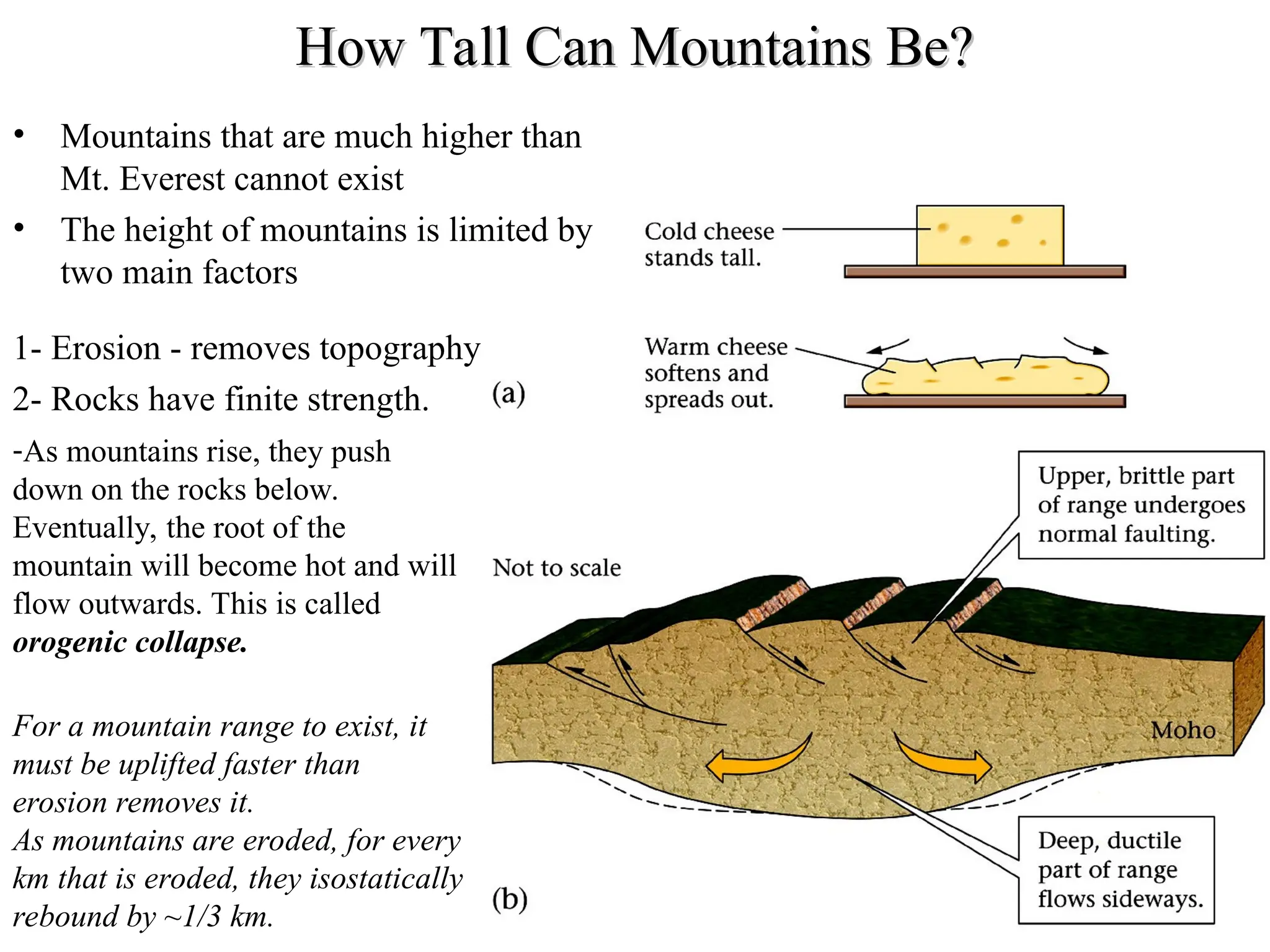
How Tall Can Mountains Be?
• Mountains that are much higher than
Mt. Everest cannot exist
• The height of mountains is limited by
two main factors
1- Erosion - removes topography
2- Rocks have finite strength.
-As mountains rise, they push
down on the rocks below.
Eventually, the root of the
mountain will become hot and will
flow outwards. This is called
orogenic collapse.
For a mountain range to exist, it
must be uplifted faster than
erosion removes it.
As mountains are eroded, for every
km that is eroded, they isostatically
rebound by ~1/3 km.
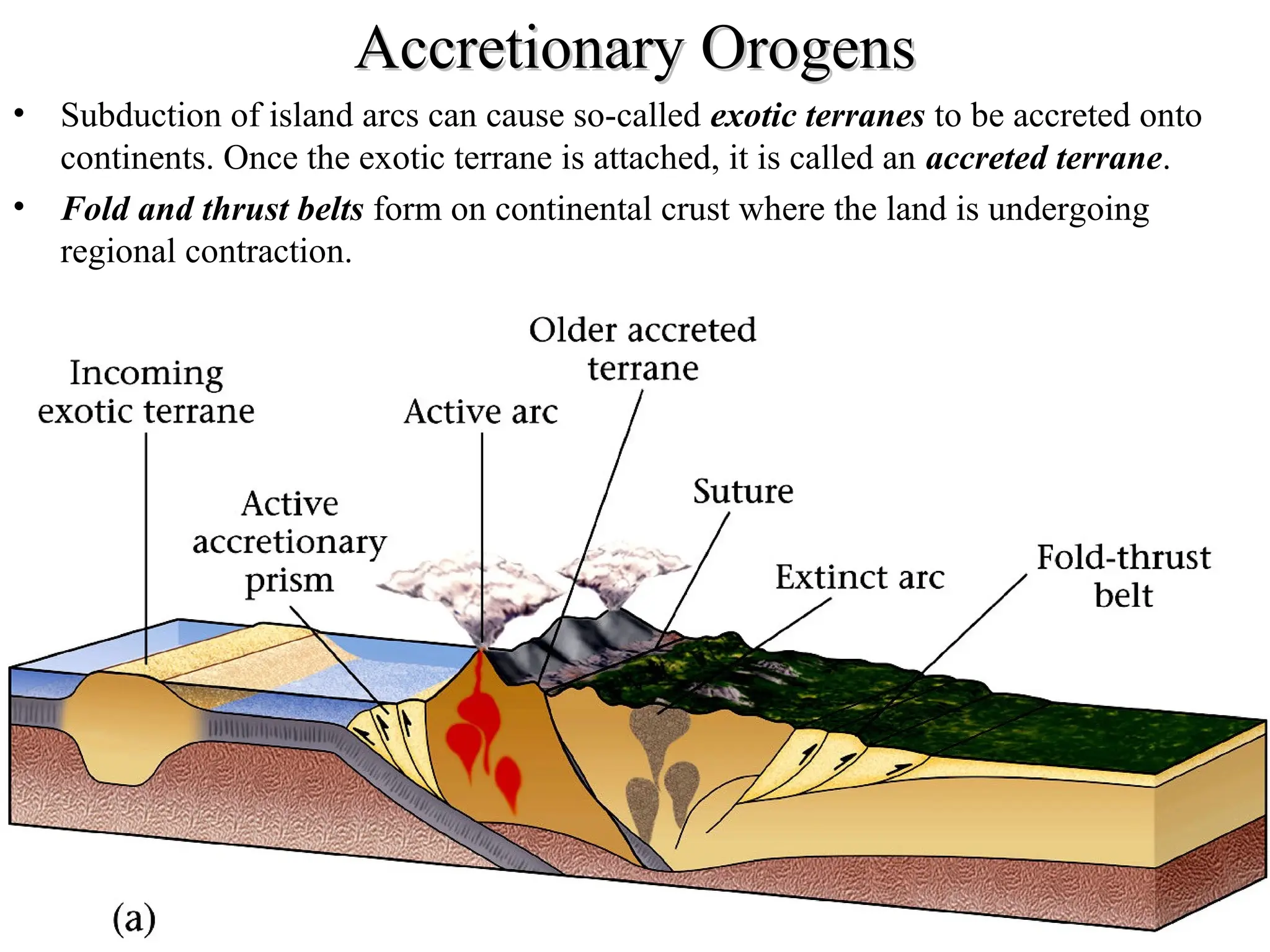
Accretionary Orogens
• Subduction of island arcs can cause so-called exotic terranes to be accreted onto
continents. Once the exotic terrane is attached, it is called an accreted terrane.
• Fold and thrust belts form on continental crust where the land is undergoing
regional contraction.
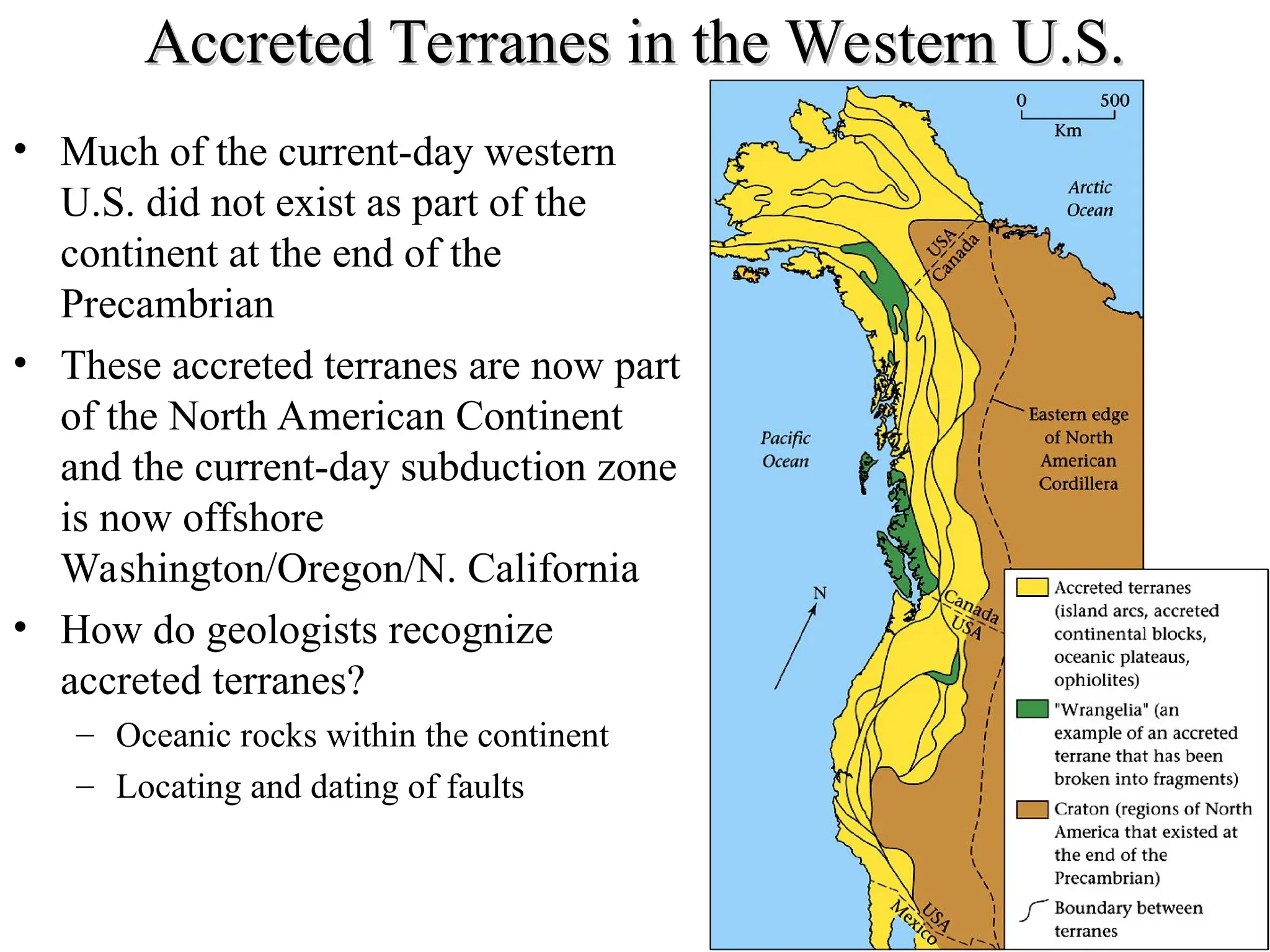
Accreted Terranes in the Western U.S.
• Much of the current-day western
U.S. did not exist as part of the
continent at the end of the
Precambrian
• These accreted terranes are now part
of the North American Continent
and the current-day subduction zone
is now offshore
Washington/Oregon/N. California
• How do geologists recognize
accreted terranes?
– Oceanic rocks within the continent
– Locating and dating of faults
Other Ways to Form
Other Ways to Form
Mountain Belts
Mountain Belts
• Mountain belts
can also form
due to
continent-
continent
collisions
• Continental rifts
can also form
fault block
mountain belts
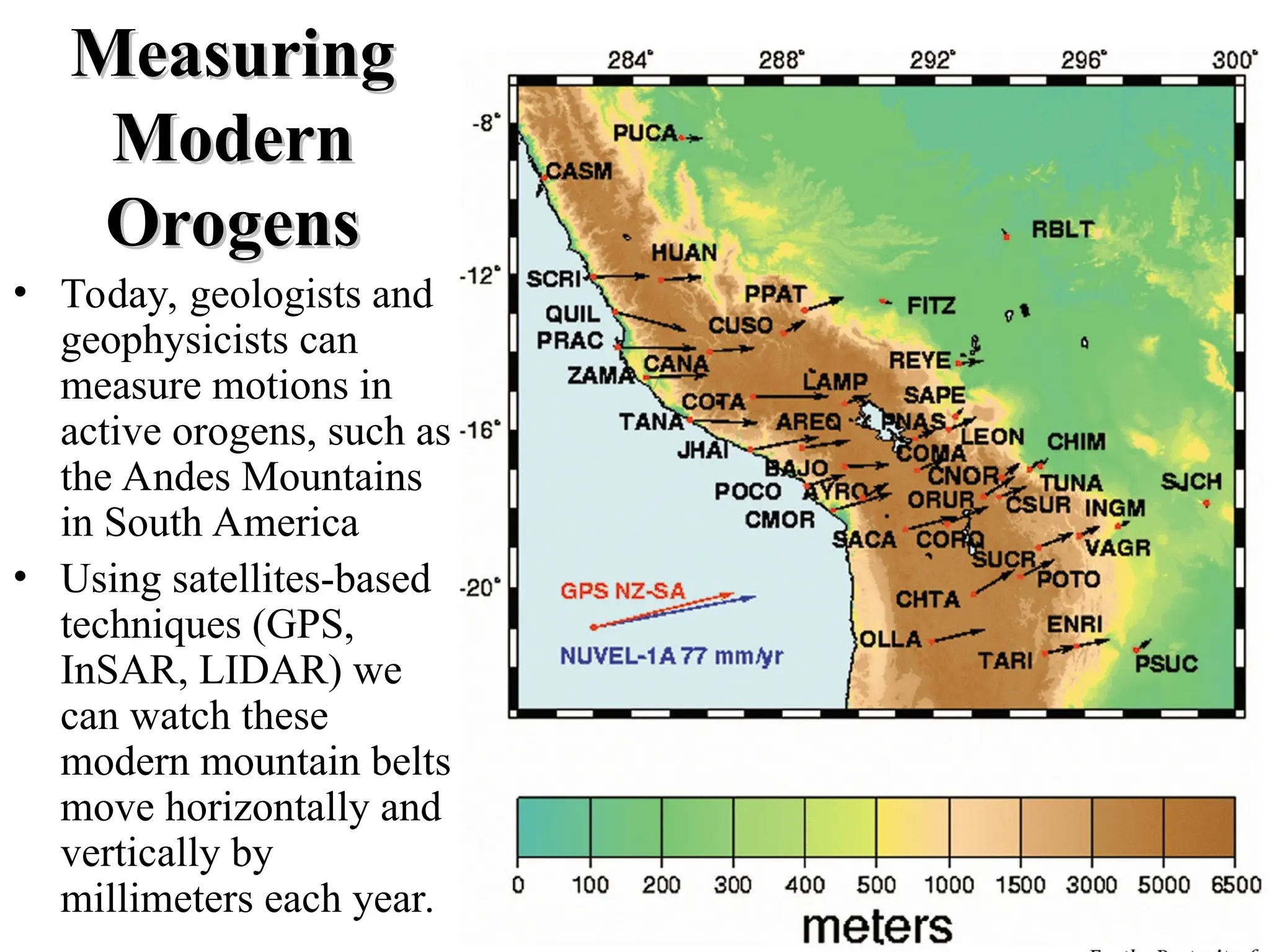
Measuring
Measuring
Modern
Modern
Orogens
Orogens
• Today, geologists and
geophysicists can
measure motions in
active orogens, such as
the Andes Mountains
in South America
• Using satellites-based
techniques (GPS,
InSAR, LIDAR) we
can watch these
modern mountain belts
move horizontally and
vertically by
millimeters each year.
11-Deformation criteria in earthquake study

  • 1.
    Crustal Deformation &Mountain Building Crustal Deformation & Mountain Building • The process of forming a The process of forming a mountain not only uplifts the mountain not only uplifts the surface of the Earth, it causes surface of the Earth, it causes rocks to undergo rocks to undergo Deformation. Deformation. • Deformation: Deformation: The process by The process by which rocks are deformed which rocks are deformed (squashed, stretched, sheared, (squashed, stretched, sheared, etc…) in response to squeezing, etc…) in response to squeezing, stretching, shearing etc (i.e. stretching, shearing etc (i.e. differential stress). differential stress). • Deformation produces a variety Deformation produces a variety of geologic structures including of geologic structures including – Joints Joints – Faults Faults – Folds Folds – Foliation Foliation Mt. Cook, New Zealand Mt. Cook, New Zealand
  • 2.
    Mountain Belts andOrogens Mountain Belts and Orogens • Except for volcanoes, mountains do not occur in isolation; they occur in linear Except for volcanoes, mountains do not occur in isolation; they occur in linear ranges called ranges called Mountain Belts Mountain Belts, or , or Orogenic Belts Orogenic Belts • Orogeny: Orogeny: A mountain building event; tends to last ~10 million years (varies a lot) A mountain building event; tends to last ~10 million years (varies a lot) • Erosion counteracts Erosion counteracts Orogens Orogens so most mountains that we see today are young (most so most mountains that we see today are young (most are < 100 Ma) compared to the Earth. are < 100 Ma) compared to the Earth.
  • 3.
    Deformed vs. Undeformed Deformedvs. Undeformed • In an undeformed sequence, strata occurs in horizontal layers, just like it was deposited. • No metamorphic rocks, no foliation, no large faults, maybe some joints • Grains are round, just like when they were deposited, clay minerals are horizontally-aligned from compaction • In a deformed sequence (e.g. mountain belt) rocks are folded, and possibly metamorphosed • Faults with large offsets may be present, juxtaposing different rocks side by side • Rocks may be highly folded and squashed grains may create strong foliations. Road Cut in Indiana Cliff Exposure in The Swiss Alps
  • 4.
    Deformation Deformation • In generalyou can say that a rock has been deformed if it has: – translated (moved) from its original position – changed in orientation (folding, rotation and/or tilting) – changed in shape (distortion)
  • 5.
    Types of Strain Typesof Strain • Strain: A change in size and/or shape due to the application of stress – Descriptive terms: shortening/contraction, stretching/extension, shear – Strain = change in length / original length • Stress: A force exerted over some area that causes rocks to undergo strain – Descriptive terms: compression, tension, shear – Stress = force / area
  • 6.
    Strain Ellipse Strain Ellipse •Geologists can quantify strain by looking at changes in angles or areas of certain shapes called strain ellipses • For example if you draw a circle on a deck of cards and then shear it, the circle undergoes strain to becomes an ellipse. • Remember that shear is a term that applies to both stress and strain. Shear stress causes shear strain.
  • 7.
    Brittle and DuctileDeformation Brittle and Ductile Deformation • Brittle deformation (lithosphere) occurs when temp and pressure are low (shallow depth) and strain rates are high – Forms faults, joints • Ductile deformation (asthenosphere) occurs when temps and pressures are high (deep depth) and strain rates are low – Forms folds and foliations • Rocks can undergo temporary deformation such as elastic strain in between earthquakes • But eventually permanent strain may occur where deformation is not recoverable (all the features listed up top are types of permanent deformation) • The line between brittle and ductile deformation also depends on composition • In some cases brittle and ductile features can form in the same rock
  • 8.
    Stress Stress ≠ Force ≠Force • Newton gave us: force = mass * acceleration • Geologists think in terms of: stress = force / area • Forces in the Earth are distributed over entire plate boundaries, so the area over which the force is applied is important. • So it is stress, not force that is important for determining if deformation will occur.
  • 9.
    Types of Stress Typesof Stress • Pressure: When stress is the same in all directions. Causes volumetric change, not shape change. E.g. water or air pressure. • Compression: A stress that causes contraction.
  • 10.
    Types of Stress Typesof Stress • Tension: A stress that causes extension. • Shear: A stress that causes shearing
  • 11.
    Measuring Orientation: Strikeand Dip Measuring Orientation: Strike and Dip • In order to characterize geologic structures, geologists must be able to quantify the orientation of structures. For Planar features we use: • Strike: The orientation of the intersection line between a horizontal surface and the feature of interest. Measured with a compass. – E.g. north, N45W, 285, etc… • Dip: The acute angle between the feature of interest and a horizontal plane. – E.g. 0° = horizontal 90° = vertical For linear features we use: • Trend: the trend of the line if you were looking down on the feature from above – E.g. north, NW, 320, 090, etc… • Plunge: Acute angle between the line and a horizontal – E.g. 46°, 75°, etc…
  • 12.
    Joints Joints • Joints Joints arefractures in rock that have are fractures in rock that have not accommodated sliding. The two not accommodated sliding. The two walls simply spread apart (open). walls simply spread apart (open). • They commonly occur in sedimentary They commonly occur in sedimentary rocks as vertical cracks rocks as vertical cracks • May occur in regional sets May occur in regional sets • Form due to cooling, or stresses from Form due to cooling, or stresses from overlying rocks overlying rocks • If the joints are filled with If the joints are filled with minerals, then we call them minerals, then we call them veins. veins. • Veins are commonly non- Veins are commonly non- planar while joints are usually planar while joints are usually very planar. very planar. • Joints are very important for Joints are very important for the flow of fluids through the the flow of fluids through the ground. E.g. oil, water, etc… ground. E.g. oil, water, etc… • Joints are also important to Joints are also important to consider when building things consider when building things such as roads. such as roads.
  • 13.
    Faults Faults • Fault –a fracture on which sliding has occurred. • 3 Main Types of Faults – Normal Fault – Reverse Fault – Strike-Slip Fault • Many faults are mixed in slip type, called oblique-slip faults.
  • 14.
    Types of Faults Typesof Faults • In general, faults come in three different types: Normal, Reverse, and Strike-Slip • Shallow angle (< 30° ) reverse faults are called thrust faults • Faults that have a mix of slip styles are called oblique slip faults Fault animations
  • 15.
    • Normal Faults:from stretching of or extending rock; points on Normal Faults: from stretching of or extending rock; points on opposite sides of a fault are father apart after an earthquake opposite sides of a fault are father apart after an earthquake • Reverse Faults: from contraction or squishing rock; points on Reverse Faults: from contraction or squishing rock; points on opposite sides of the fault are closer together after an earthquake opposite sides of the fault are closer together after an earthquake • Strike-Slip: can form in either areas of stretching or squishing, Strike-Slip: can form in either areas of stretching or squishing, material slides laterally past each side of the fault. material slides laterally past each side of the fault. – Described by sense of motion: Described by sense of motion: • Right-lateral (Dextral) Right-lateral (Dextral) • Left Lateral (Sinistral) Left Lateral (Sinistral) Why are there different types of faults? Why are there different types of faults?
  • 16.
    Measuring Motion Acrossa Fault Measuring Motion Across a Fault M7.8 1906 Great San Francisco Earthquake
  • 17.
    Motion Across aFault Motion Across a Fault • The amount of The amount of motion along any motion along any fault is called the fault is called the slip slip, , offset offset, or , or displacement displacement • Fault trace (line): Fault trace (line): where the fault plane where the fault plane intersects the surface intersects the surface of the Earth of the Earth • Active/Inactive Active/Inactive Faults Faults: not all faults : not all faults are likely to produce are likely to produce an earthquake an earthquake • Fault scarp: Fault scarp: vertical vertical motion on a fault motion on a fault produces a small produces a small escarpment escarpment • What was the sense of What was the sense of slip here? slip here? • Offset stream animation Offset stream animation Fault Trace Fault Trace Offset road from the Mw7.1 1999 Hector Mine earthquake Offset road from the Mw7.1 1999 Hector Mine earthquake
  • 18.
    Thrust Faults –Crustal Shortening Thrust Faults – Crustal Shortening • Thrust fault – A shallow-dipping reverse fault (<30°) • Capable of moving rocks 100’s of km horizontally • Builds large collisional mountain belts (Appalachians, Himalaya) • If the hanging wall block gets eroded away and a piece remains, it is called a klippe. • Since thrusts can move rocks 100’s of km, we call rocks that have been moved great distances, allochthonous. • Rocks that are where they formed are called autochthonous.
  • 19.
    Chief Mountain, MT ChiefMountain, MT • Chief Mt. is an Chief Mt. is an allochthonous klippe allochthonous klippe GoogleEarth view…
  • 20.
    Normal Faults –Crustal Extension Normal Faults – Crustal Extension • Recently active normal Recently active normal faults leave behind fault faults leave behind fault scarps – cliffs or scarps – cliffs or escarpments that are due to escarpments that are due to motion along the fault. motion along the fault. • Reverse faults usually Reverse faults usually don’t make such nice don’t make such nice scarps because they tend to scarps because they tend to act like a bulldozer and act like a bulldozer and leave a pile of rubble leave a pile of rubble instead of a nice scarp. instead of a nice scarp. • Normal faults typically dip Normal faults typically dip about 60 about 60° °, so they, alone, , so they, alone, are not able to move rocks are not able to move rocks large horizontal distances. large horizontal distances. A Normal Fault Scarp after an Earthquake in Nevada A Normal Fault Scarp after an Earthquake in Nevada
  • 21.
    Normal Fault Structure NormalFault Structure • Normal faults commonly come in antithetic (dip opposite directions from each other) pairs forming horsts and grabens. • Horst – The part that went up (footwall blocks) • Graben – The part that went down (hanging wall blocks). • Half grabens - occur when only one normal fault is present
  • 22.
    Detachment Faults /Décollements Detachment Faults / Décollements • Normal faults, alone, can’t move rocks very far horizontally, yet we find allochthonous terrain in some extensional environments. • In these environments we find normal faults and tilted blocks of rock • Normal or Reverse faults may connect into nearly horizontal faults called detachment faults (if extensional) or décollements (if contractional) • Detachments / Décollements may have a very low friction due to the presence of fluids
  • 23.
    Recognizing Faults Recognizing Faults •The easiest way to recognize a fault would be to look for offset layers or different layers juxtaposed side by side that do not belong together.
  • 24.
    Moab Fault, UT MoabFault, UT Different Different color color Different Different color color Fault Fault Fault Fault Youngest Youngest Rocks Rocks Young Young Rocks Rocks Oldest Oldest Rocks Rocks Faults can sometimes be recognized by the presence of a zone of discolored, broken rocks. Faults can sometimes be recognized by the presence of a zone of discolored, broken rocks.
  • 25.
    Deep Faults –Shear Zones Deep Faults – Shear Zones
  • 26.
    Fault Surface Fabric- Slickensides Fault Surface Fabric - Slickensides • Rocks on both sides of a fault grind past each other and may scratch the surface of the fault. These striations are called slickensides or slickenlines or simply “slicks” • They show the direction of movement (finger is pointing in along the slip vector. • Faults may also develop corrugations or mullions, which are basically large-scale slickensides.
  • 27.
    Fault Breccia &Cataclasis Fault Breccia & Cataclasis • During an earthquake the ground may violently shake, so it stands to reason that rocks near large faults are going to have been subjected to lots of shaking • Coseismic (during an earthquake) shaking may cause rocks near the fault to shatter or break into pieces that may rotate in place. This is called cataclasis • cataclasis may form a fault breccia. • Alternatively, rocks along the fault surface may get ground down to a fine powder from slip, this is called fault gouge. A fault breccia formed from cataclasis along a fault
  • 28.
    Ductile Deformation -Folds Ductile Deformation - Folds • Anticline: An arch-shaped fold • Hinge Line: An imaginary line that shows the location of maximum curvature on a fold • Axial Plane: The plane through the hinge lines on all of the layers • Monocline: A fold shaped like a carpet draped over a stair step • Syncline: A trough-shaped fold • Limb: The sides of a fold that show less curvature.
  • 29.
    Descriptive Fold Terms DescriptiveFold Terms In order for geologists to describe folds we need to have terms to describe them • Open Fold: A fold that is broad, i.e. the angle between the limbs is large • Tight Fold: A fold that is narrow, i.e. the angle between limbs is small • Plunging Fold: The hinge line is non-horizontal • Non-plunging Fold: The hinge line is horizontal Doubly Plunging Folds form domes and basins • Dome: An upside-down bowl-shaped fold • Basin: A right-side-up bowl-shaped fold
  • 30.
    • An Anticlinein a road cut An Anticline in a road cut
  • 31.
    • A Synclinein a road cut A Syncline in a road cut – Note that the current-day topography does not Note that the current-day topography does not necessarily follow the fold pattern necessarily follow the fold pattern
  • 32.
    Fold Trains Fold Trains •Anticlines and synclines are Anticlines and synclines are commonly found together in trains commonly found together in trains of folds. of folds. • Note that in these particular folds, Note that in these particular folds, the axial planes are not vertical. the axial planes are not vertical. • Folds exposed along a cliff Folds exposed along a cliff in eastern Ireland in eastern Ireland
  • 33.
    Fold Formation Fold Formation •Folds are formed in two general ways: 1- When the rocks are brittle and layered, slip between the layers allows folds to form. This is called flexural slip folding. Since there is sliding on the bedding planes, they are act as faults. Sometimes they are called flexural slip faults or bedding plane slip. 2- When rocks are ductile and can flow, flow folds form, which form because different parts of the rock flow at different rates. Flexural slip folding Flow folding
  • 34.
    Flow Folding Flow Folding •This rock unit was ductile This rock unit was ductile during deformation and during deformation and was able to flow was able to flow • Note the thinning of layers Note the thinning of layers along the limbs of folds along the limbs of folds and thickening along and thickening along hinges. hinges. • This rock was deformed in This rock was deformed in the asthenosphere. the asthenosphere.
  • 35.
    Flexural Slip Flexural Slip Folding Folding •Layers are folded with Layers are folded with significant slip on the significant slip on the bedding planes. bedding planes. • Layer thickness stays Layer thickness stays constant throughout. constant throughout. • May see slickensides on May see slickensides on bedding planes bedding planes
  • 36.
    What Causes Folding? WhatCauses Folding? • Folds can form due to tectonic compression or shear. • Folds can also form near buried or curved faults.
  • 37.
    Tectonic Foliation Tectonic Foliation •When a differential stress is applied to a rock, e.g. during an orogeny, grains in the rock may change shape or develop a permanent strain. • Foliation forms as a result of strain, so when you see a foliated rock, you know that it has developed some amount of permanent strain.
  • 38.
    An Orogeny inCross Section An Orogeny in Cross Section
  • 39.
    Uplift and CrustalRoots of Mountain Ranges Uplift and Crustal Roots of Mountain Ranges • Leonardo da Vinci noted in his journals that marine fossils exposed in rocks high in Leonardo da Vinci noted in his journals that marine fossils exposed in rocks high in the mountains suggested that there had been significant uplift. the mountains suggested that there had been significant uplift. • Mt. Everest is 8.85 km above sea level, but this is very small compared to the size Mt. Everest is 8.85 km above sea level, but this is very small compared to the size of the Earth. of the Earth. • If the Earth was the size of a billiard ball, even with its large mountains, it would be If the Earth was the size of a billiard ball, even with its large mountains, it would be smoother than the average billiard ball. smoother than the average billiard ball. • In the mid 1800’s Sir George In the mid 1800’s Sir George Everest surveyed India and Everest surveyed India and discovered that the immense discovered that the immense mass of the Himalayas was mass of the Himalayas was enough to deflect his plumb enough to deflect his plumb bob (lead weight at the end of bob (lead weight at the end of a string) from horizontal. a string) from horizontal. • But when people did the But when people did the calculation of the mass, the calculation of the mass, the deflection of the bob was deflection of the bob was smaller than they expected, smaller than they expected, suggesting that the mountains suggesting that the mountains had a low density root. had a low density root.
  • 40.
    Roots of CollisionalMountain Belts Roots of Collisional Mountain Belts • Typical continental crust = 35-40 km thick • Continental crust beneath mountain belts = 50-70 km thick • When the crust contracts it tends to vertically thicken (think of squishing silly putty) • Since the lithosphere effectively floats on the more ductile material below (asthenosphere), the crust must be thicker below mountains to compensate for their extra weight. • Isostacy / Isostatic Equilibrium: When the gravitational force pulling rock downwards equals the buoyancy force pushing the lithosphere upward • So when fault motion pushes a piece of the Earth upwards, isostatic compensation will pull the area back down to isostatic equilibrium. • Also applies to glaciers
  • 41.
    How Tall CanMountains Be? How Tall Can Mountains Be? • Mountains that are much higher than Mt. Everest cannot exist • The height of mountains is limited by two main factors 1- Erosion - removes topography 2- Rocks have finite strength. -As mountains rise, they push down on the rocks below. Eventually, the root of the mountain will become hot and will flow outwards. This is called orogenic collapse. For a mountain range to exist, it must be uplifted faster than erosion removes it. As mountains are eroded, for every km that is eroded, they isostatically rebound by ~1/3 km.
  • 42.
    Accretionary Orogens Accretionary Orogens •Subduction of island arcs can cause so-called exotic terranes to be accreted onto continents. Once the exotic terrane is attached, it is called an accreted terrane. • Fold and thrust belts form on continental crust where the land is undergoing regional contraction.
  • 43.
    Accreted Terranes inthe Western U.S. Accreted Terranes in the Western U.S. • Much of the current-day western U.S. did not exist as part of the continent at the end of the Precambrian • These accreted terranes are now part of the North American Continent and the current-day subduction zone is now offshore Washington/Oregon/N. California • How do geologists recognize accreted terranes? – Oceanic rocks within the continent – Locating and dating of faults
  • 44.
    Other Ways toForm Other Ways to Form Mountain Belts Mountain Belts • Mountain belts can also form due to continent- continent collisions • Continental rifts can also form fault block mountain belts
  • 45.
    Measuring Measuring Modern Modern Orogens Orogens • Today, geologistsand geophysicists can measure motions in active orogens, such as the Andes Mountains in South America • Using satellites-based techniques (GPS, InSAR, LIDAR) we can watch these modern mountain belts move horizontally and vertically by millimeters each year.