1
Chapter-1
3G MOBILE COMMUNICATION NETWORKS
1.1 Back Ground
Third generation (3G) is the generic term used for the next generation of mobile
communications systems. These have been created to support the effective delivery of a
range of multimedia services. In addition, they provide more efficient systems for the
over-the-air transmission of existing services, such as voice, text and data that are
available today.
1.2 Early Stages:1G to 3G
Electromagnetic waves were first discovered as a communications medium at the end of
the 19th century. The first systems offering mobile telephone service (car phone) were
introduced in the late 1940s in the United States and in the early 1950s in Europe. Those
early single cell systems were severely constrained by restricted mobility, low capacity,
limited service, and poor speech quality. The equipment was heavy, bulky, expensive,
and susceptible to interference. Because of those limitations, less than one million
subscribers were registered worldwide by the early 1980s.
1.3 First Generation(1G): Analog Cellular
The introduction of cellular systems in the late 1970s and early 1980s represented a
quantum leap in mobile communication (especially in capacity and mobility).
Semiconductor technology and microprocessors made smaller, lighter weight and more
sophisticated mobile systems a practical reality for many more users. These 1G cellular
systems still transmit only analog voice information. The most prominent 1G systems are
Advanced Mobile Phone System (AMPS), Nordic Mobile Telephone (NMT), and Total
Access Communication System (TACS). With the 1G introduction, the mobile market
showed annual growth rates of 30 to 50 percent, rising to nearly 20 million subscribers by
1990.
1.4 SecondGeneration(2G): Multiple Digital Systems
The development of 2G cellular systems was driven by the need to improve transmission
quality, system capacity, and coverage. Further advances in semiconductor technology and
microwave devices brought digital transmission to mobile communications. Speech
transmission still dominates the airways, but the demands for fax, short message, and data
transmissions are growing rapidly. Supplementary services such as fraud prevention and
encrypting of user data have become standard features that are comparable to those in fixed
networks. 2G cellular systems include GSM, Digital AMPS (D-AMPS), code division
multiple access (CDMA), and Personal Digital Communication (PDC). Today, multiple
1G and 2G standards are used in worldwide mobile communications. Different standards
serve different applications with different levels of mobility, capability, and service area
(paging systems, cordless telephone, wireless local loop, private mobile radio, cellular
systems, and mobile satellite systems). Many standards are used only in one country or
region, and most are incompatible. GSM is the most successful family of cellular standards
2
(GSM900, GSM–railway [GSM–R], GSM1800, GSM1900, and
GSM400), supporting some 250 million of the world’s 450 million cellular subscribers
with international roaming in approximately 140 countries and 400 networks.
2G to 3G: GSM Evolution
Phase 1 of the standardization of GSM900 was completed by the European
Telecommunications Standards Institute (ETSI) in 1990 and included all necessary
definitions for the GSM network operations. Several tele -services and bearer services have
been defined (including data transmission up to 9.6 kbps), but only some very basic
supplementary services were offered. As a result, GSM standards were enhanced in Phase
2 (1995) to incorporate a large variety of supplementary services that were comparable to
digital fixed network integrated services digital network (ISDN) standards. In 1996, ETSI
decided to further enhance GSM in annual Phase 2+ releases that incorporate 3G
capabilities.
GSM Phase 2+ releases have introduced important 3G features such as intelligent network
(IN) services with customized application for mobile enhanced logic (CAMEL), enhanced
speech compression/decompression (CODEC), enhanced full rate (EFR), and adaptive multi-
rate (AMR), high–data rate services and new transmission principles with high-speed circuit-
switched data (HSCSD), general packet radio service (GPRS), and enhanced data rates for
GSM evolution (EDGE). UMTS is a 3G GSM successor standard that is downward-
compatible with GSM, using the GSM Phase 2+ enhanced core network.
1.4.1 IMT–2000
The main characteristics of 3G systems, known collectively as IMT–2000, are a
single family of compatible standards that have the following characteristics:
1. Used worldwide
2. Used for all mobile applications
3. Support both packet-switched (PS) and circuit-switched (CS) data transmission
4. Offer high data rates up to 2 Mbps (depending on mobility/velocity)
5. Offer high spectrum efficiency
3
Figure 1: Multiple Standards for Different
Applications and Countries
IMT–2000 is a set of requirements defined by the International
Telecommunications Union (ITU). As previously mentioned,
IMT stands for International Mobile
Telecommunications, and “2000” represents both the
scheduled year for initial trial systems and the frequency range
of 2000 MHz (WARC’92: 1885–2025 MHz and 2110– 2200
MHz). All 3G standards have been developed by regional
standards developing organizations (SDOs). In total,
proposals for 17 different IMT–2000 standards were
submitted by regional SDOs to ITU in 1998—11 proposals for
terrestrial systems and 6 for mobile satellite systems (MSSs).
Evaluation of the proposals was completed at the end of 1998,
and negotiations to build a consensus among differing views
were completed in mid 1999. All 17 proposals have been
accepted by ITU as IMT–2000 standards. The specification
for the Radio Transmission Technology (RTT) was released
at the end of 1999.
The most important IMT–2000 proposals are the UMTS (W-
CDMA) as the successor to GSM, CDMA2000 as the interim
standard ’95 (IS–95) successor, and time division–
synchronous CDMA (TD–SCDMA) (universal wireless
4
communication–136 [UWC– 136]/EDGE) as TDMA–based
enhancements to D–AMPS/GSM—all of which are leading
previous standards toward the ultimate goal of IMT–2000.
The figure 2 show the shift from 1G to 3G
igure 2: Evolution from 1G to 3G
5
1.5 CDMA2000
1.5.1 An Overview
Cdma2000 specification was developed by the Third Generation Partnership Project
2 (3GPP2), a partnership consisting of five telecommunications standards bodies:
ARIB and TTC in Japan, CWTS in China, TTA in Korea and TIA in North America.
Cdma2000 has already been implemented to several networks as an evolutionary step
from CDMAOne as cdma2000 provides full backward compatibility with IS-95B.
Cdma2000 is not constrained to only the IMT-2000 band, but operators can also overlay
acdma2000 1x system, which supports 144 kbps now and data rates up to 307 kbps in
the future, on top of their existing CDMAOne network.
The evolution of cdma2000 1x is labeled cdma2000 1xEV. 1xEV will be implemented
in steps: 1xEV-DO and 1xEV-DV. 1xEV-DO stands for "1x Evolution Data Only".
1xEV-DV stands for "1x Evolution Data and Voice". Both 1xEV cdma2000 evolution
steps will use a standard 1.25 MHz carrier. 1xEV-DO probably will be available for
cdma2000 operators during 2002 and 1xEV-DV solutions will be available
approximately late 2003 or early 2004.
Cdma2000 1x EV-DO and cdma2000 3x are an ITU-approved, IMT-2000 (3G) standards.
Cdma2000 3x is part of what the ITU has termed IMT-2000 CDMA MC (Multi Carrier).
It uses less that 5 MHz spectrum (3x 1.25 MHz channels) to give speeds of over 2 Mbps.
Cdma2000 1x with lower data speed is considered to be a 2.5G technology.
Table 01: Technical Summary for CDMA2000
Frequency band Any existing band.
Minimum frequency band required 1x: 2x1.25MHz, 3x: 2x3.75
Chip rate 1x: 1.2288, 3x: 3.6864 Mcps
Maximum user data rate: 1x: 144 kbps now, 307 kbps in the future
1xEV-DO: max 384 kbps - 2.4 Mbps,
1xEV-DV: 4.8 Mbps.
Frame length 5ms, 10ms or 20ms
Power control rate 800 Hz
Spreading factors 4 ... 256 UL
6
1.6 Basic Terminologies
Some of the Concepts which should e considered in order to understand the further
details of the of CDMA2000 and WCDMA are discussed in the following section
1.6.1 Forwardand Reverse Link
The transmission from a base station to a mobile phone is considered as the forward link.
The reverse link is from the mobile phone to the base station. Reverse and forward links
are shown in figure 3.
Base Station
Forward link
Reverse link
MobileFigureStation3:Forward and Reverse Links
1.6.1 Channel Access Duplex Methods
Channel access methods are used in point to multipoint networks such as cellular networks
for dividing forward and reverse communication channels on the same physical
communications medium, they are known as duplexing methods, such as:
1.6.1.1Time Division Duplex
Time division duplex (TDD) is the application of time-division multiple access to separate
outward and return signals. Time division duplex has a strong advantage in the case where
the asymmetry of the uplink and downlink data speed is variable. As the amount of uplink
data increases, more bandwidth can be allocated to that and as it shrinks it can be taken
away. Another advantage is that the uplink and downlink radio paths are likely to be very
similar in the case of a slow moving system. This means that techniques such as beam
forming work well with TDD systems.
7
Forward link (F1)
Reverse link (F2)
Base Station
Mobile Station
(a)
Mobile Station Base Station
Transmitter BPF BPF Transmitter
F1 F2
Receiver BPF BPF Receiver
F2 F1
BPF: Band Pass Filter
(b)
Figure 4: (a) Frequency Division Duplex (b) Rough Sketch of FDD System
1.6.1.2FrequencyDivision Duplex
Frequency division duplex (FDD) is the application of frequency -division multiple access
to separate outward and return signals. The uplink and downlink sub-bands are said to be
separated by the "frequency offset". Frequency division duplex is much more efficient in
the case of symmetric traffic. In this case TDD tends to waste bandwidth during switchover
from transmit to receive, has greater inherent latency, and may require more complex, more
power-hungry circuitry.
Another advantage of FDD is that it makes radio planning easier and more efficient since
8
base stations do not "hear" each other (as they transmit and receive in different sub-
bands) and therefore will normally not interfere each other. With TDD systems, care
must be taken to keep guard bands between neighboring base stations (which decreases
spectral efficiency) or to synchronize base stations so they will transmit and receive at the
same time (which increases network complexity and therefore cost, and reduces
bandwidth allocation flexibility as all base stations and sectors will be forced to use the
same uplink/downlink ratio)
Forward link (F1)
Reverse link (F1)
Base Station
Mobile Station
(a)
Mobile Station Base Station
Transmitter
Transmitter
BPF BPF
F1 Receiver
Receiver
Synchronous Switches
(b)
Figure 5: (a) Time Division Duplex (b) Rough Sketch of TDD System
9
1.6.2 Spread Spectrum Techniques
There are major two type of spread spectrum techniques. Direct Sequence Spread spectrum
and Frequency hoping spread Spectrum. CDMA is a multiple-access scheme based on spread-
spectrum communication techniques. It spreads the message signal to a relatively wide
bandwidth by using a unique code that reduces interference, enhances system processing, and
differentiates users. CDMA does not require frequency or time-division for multiple access;
thus, it improves the capacity of the communication system.
Spread-spectrum communications is a secondary modulation technique. In a typical spread-
spectrum communication system, the message signal is first modulated by traditiona l
amplitude, frequency, or phase techniques. A pseudorandom noise (PN) signal is then applie d
to spread the modulated waveform over a relatively wide bandwidth. The PN signal can
amplitude modulate the message waveform to generate direct-sequence spreading, or it can
shift the carrier frequency of the message signal to produce frequency-hopped spreading, as
shown in Figure 3. The direct-sequence spread-spectrum signal is generated by multiplying
the message signal d(t) by a pseudorandom noise signal pn (t):
g(t) = pn(t)d(t)
Figure 6: (a) Message Signal, (b) Direct Spread Sequence, (c) Frequency Spread Sequence
10
1.7 Summary of Channel Access
Methods
Powe
r
tim
e
FDM
A
y
c
n
E
u
q
e
r
f
power
time
TDM
A
y
c
n
e
u
q
e
r
f
power
tim
e
CDMA
cy
n
e
u
q
fre
Figure 7: (From Right to Left) CDMA, TDMA, and FDMA
11
1.8 Channelization in CDMA2000
1.8.1 Introduction
CDMA is a scheme by which multiple users are assigned radio resources using DS-SS
techniques. Although all users are transmitting in the same RF band, individual users are
separated from each other via the use of orthogonal codes.
The North American CDMA standard, or IS-95, specifies that each user conveys base band
information at 9.6 Kbps (Rate Set 1), which is the rate of the vocoder output. The rate of the
final spread signal is 1.2288 Mcps, resulting in an RF bandwidth of approximately 1.25 MHz.
There can be many 1.25-MHz signals present in the same RF band. To a large degree, the
performance of a CDMA system is interference-limited. This means that the capacity and
quality of the system are limited by the amount of interference power present in the band.
Capacity is defined as the total number of simultaneous users the system can support, and
quality is defined as the perceived condition of a radio link assigned to a particular user; this
perceived link quality is directly related to the probability of bit error, or bit error rate (BER).
This chapter presents those characteristics of a CDMA system that need to be optimized in
order to reduce interference and increase quality.
The IS-95 CDMA and CDMA2000 system is unique in that its forward and reverse links
have different link structures. This is necessary to accommodate the requirements of a land-
mobile communication system. The forward link consists of four types of logical channels:
pilot, sync, paging, and traffic channels. There is one pilot channel, one sync channel, up
to seven paging channels, and several traffic channels. Each of these forward-link channels
is first spread orthogonally by its Walsh function, and then it is spread by a quadrature pair
of short PN sequences. All channels are added together to form the composite SS signal to
be transmitted on the forward link.
The reverse link consists of two types of logical channels: access and traffic channels. Each
of these reverse-link channels is spread orthogonally by a unique long PN sequence; hence,
each channel is identified using the distinct long PN code. The reason that a pilot channel
is not used on the reverse link is that it is impractical for each mobile to broadcast its own
pilot sequence.
1.8.2 WalshCodes
In order to avoid mutual interference on the forward link, Walsh codes are used to separate
individual users while they simultaneously occupy the same RF band. Walsh codes as used
in IS-95 are a set of 64 binary orthogonal sequences. These sequences are orthogonal to
each other, and they are generated by using the Hadamard matrix. Recursion is used to
generate higher order matrices from lower order ones; that is,
12
HN HN
H 2 N =
HN HN Where
HN contains the same but inverted elements of HN .
Rule of Thumb: For generating the matrix is for a given seed repeat it over right once and
below once and invert diagonally as shown in the above example. For the given seed
Therefore, to derive a set of four orthogonal Walsh sequences w0, w1, w2, and
w3, we only need to generate a Hadamard matrix of order 4, or
The four orthogonal sequences in this Walsh code set are taken from the rows of the
matrix H4; that is,
W
0 = [0 0 0 0]
W 1 = [01 0 1]
W
2 = [0 0 1 1]
W
3 = [0 1 1 0]
For DS-SS multiple access, three conditions that must be met by a set of orthogonal
sequences. The three conditions are as follows:
1. The cross-correlation should be zero or very small.
2. Each sequence in the set has an equal number of 1s and -1s, or the number of 1s
differs from the number of -1s by at most one.
3. The scaled dot product of each code should equal to 1.
By changing the 0s to -1s and keeping the 1s as it is in each of the four sequences above,
that is,
W 0 = [−1−1 −1 −1]
W 1 = [+ 1 +1 −1 −1]
W 2 = [− 1−1 +1 +1]
W 3 = [− 1+1 +1 −1]
13
14
In general, the 0th Walsh sequence consists of all -1s and thus cannot be used for
channelization. In the IS-95 CDMA system, w0 is not used to transmit any Base band
information.
1.8.3 Forward Link
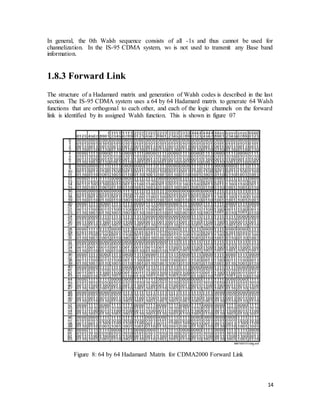
The structure of a Hadamard matrix and generation of Walsh codes is described in the last
section. The IS-95 CDMA system uses a 64 by 64 Hadamard matrix to generate 64 Walsh
functions that are orthogonal to each other, and each of the logic channels on the forward
link is identified by its assigned Walsh function. This is shown in figure 07
Figure 8: 64 by 64 Hadamard Matrix for CDMA2000 Forward Link
15
16
1.8.4 Channelization
Channelization is done in following steps
• Generate Walsh Codes
• Generate Codes for each message
• Transmitted Signal
• Retrieval of message
Suppose that there are three different users, and each user wishes to send a separate
message. The separate messages are:
M 0 = [+1 −1 +1]
M 1 = [+ 1 +1 −1]
M 2 = [− 1 +1 +1]
There respective codes are as follows:
W 0 = [−1 −1 −1 −1]
W 1 = [+ 1 +1 −1 −1]
W 2 = [− 1 −1 +1 +1]
W 3 = [− 1 +1 +1 −1]
The signal to be transmitted is calculated to be m (t) * w (t). This is shown below:
M1 (t) = +1 -1 +1
M1 (t) = +1 +1 +1 +1 -1 -1 -1 -1 +1 +1 +1 +1
M1 (t) = -1 +1 -1 +1 -1 +1 -1 +1 -1 +1 -1 +1
M
1 (t) * W1 (t) = -1 +1 -1 +1 +1 -1 +1 -1 -1 +1 -1 +1
Similarly for the M2 (t) and M3 (t)
M2 (t) * W2 (t) = -1 -1 +1 +1 -1 -1 +1 +1 +1 +1 -1 -1
M3 (t) * W3 (t) = +1 -1 -1 +1 -1 +1 +1 -1 -1 +1 +1 -1
The spread-spectrum signals for all three messages, m1(t)w1(t), m2(t)w2(t), and
m3(t)w3(t), are combined to form a composite signal C(t); that is,
C (t) = M1 (t) * W1 (t) + M2 (t) * W2 (t) + M3 (t) * W3 (t)
The resulting C (t) is
C (t) = -1 -1 -1 +3 -1 -1 +3 -1 -1 +3 -1 -1
17
18
C(t) is the composite signal that is transmitted in the single RF band. If there are negligible
errors during the transmission process, the receiver intercepts C (t). In order to separate out
the original messages M1 (t), M2 (t), and M3 (t) from the composite signal C(t), the receiver
multiplies C (t) by the assigned Walsh code for each message:
19
20
1.8.4.1 Pilot Channel
The pilot channel is identified by the Walsh function 0 (w0). The channel itself contains
no base band information. The base band sequence is a stream of 0s that are spread by
Walsh function 0, which is also a sequence of all 0s. The resulting sequence (still all 0s) is
then spread, or multiplied, by a pair of quadrature PN sequences. Therefore, the pilot
channel is effectively the PN sequence itself (see Figure 8). The PN sequence with a
specified offset uniquely identifies the particular sector that is transmitting the pilot signal.
Note that both Walsh function 0 and the PN sequence are running at a rate of 1.2288 Mcps
(Mega-Chips per second). After PN spreading, base band filters are used to shape the
digital pulses. These filters effectively low pass filter the digital pulse stream and control
the base band spectrum of the signal. This way, the signal bandwidth may have a sharper
roll-off near the band edge.
The pilot channel is transmitted continuously by the base station sector. The pilot channel
provides the mobile with timing and phase reference. The mobile’s measurement of the
signal-to-noise ratio (i.e., Ec /I0) of the pilot channel also gives an indication of which is
the strongest serving sector of that mobile.
Figure 9: Pilot Channel
1.8.4.2 Sync Channel
Unlike the pilot channel, the sync channel carries base band information. The information
is contained in the sync channel message that notifies the mobile of important information
about system synchronization and parameters. Figure 9 show that the baseband information
is error protected and interleaved. It is then spread by Walsh function 32 and further spread
by the PN sequence that is identified with the serving sector. The baseband information is
at a rate of 1.2 Kbps.
21
At the bit level, the sync channel is transmitted in groups of sync channel superframes; each
superframe contains 96 bits and lasts 90 ms, yielding a data rate of (96 bits/90 ms) = 1,200 bps.
Each superframe contains three sync channel frames of equal length and duration (see Figure
10). Each sync channel frame is aligned with the short PN sequence associated with the
transmitting sector. Note that the short PN sequence repeats every 26.67 ms, and each period
of the short PN sequence is synchronized with each sync channel frame. Therefore, once the
mobile acquires synchronization with the pilot channel, the alignment for the sync channel is
immediately known. This is because the sync channel is spread with the same pilot PN
sequence, and because the frame timing of the sync channel is aligned with that of the pilot PN
sequence [1] – see figure 9. Once the mobile achieves alignment with the sync channel, the
mobile can start reading the sync channel message.
Figure 10: Sync Channel
Figure 11: Sync Channel Frame
22
The sync channel message itself is long and may occupy more than one sync channel frame.
Therefore, the sync channel message is organized in a structure called the sync channel
message capsule. A sync channel message capsule consists of the sync channel message and
padding. The sync channel message resides in more than one sync channel frame, and padding
(of bits) is used to fill up the bit positions all the way up to the beginning of the next sync
channel super-frame, where the next sync channel message starts.
Each sync channel frame begins with the start-of-message (SOM) bit. The SOM bit is the
first bit of the sync channel frame; an SOM of 1 indicates the start of the sync channel
message, and an SOM of 0 indicates that the current sync channel frame has the contents
of a running sync channel message that started in some previous frame. This way, the base
station can transmit the sync channel message in consecutive sync channel frames. Note
that an SOMof 1 also coincides with the start of a sync channel superframe. In other words,
a sync channel message always starts at the beginning of a sync channel superframe. Note
that, each sync channel frame starts with the SOM bit, and the rest of the frame is referred
to as the sync channel frame body. Figure 12 shows the structure of a hypothetical sync
channel message that occupies two consecutive superframes.
Figure 12: Sync channel message structure for a hypothetical message that occupies two
consecutive superframes.
23
The sync channel message itself contains different fields; the message contains information
such as the offset of the pilot PN sequence used by the transmitting sector (i.e., the
PILOT_PN field). The message also contains information to enable the mobile to
synchronize with the long PN sequence. This is done by reading the LC_STATE and
SYS_TIME fields of the sync channel message. The base station sets the LC_STATE field
to the long-code state at some future time given by the SYS_TIME field. And at the precise
time given
1.8.5 Paging Channel
Similar to the sync channel, the paging channel also carries baseband information. But
unlike the sync channel, the paging channel transmits at higher rates; it can transmit at
either 4.8 or 9.6 Kbps. The PRAT field in the sync channel message informs the mobile of
the data rate of the paging channel. Once the mobile acquires timing and synchronization
using the sync channel, the mobile begins to monitor the paging channel. Although there
can be up to seven paging channels per sector, each mobile only monitors one paging
channel. Details of this topic are not included
1.8.6 Traffic Channel
The forward traffic channel is used to transmit user data and voice; signaling messages
are also sent over the traffic channel. The structure of the forward traffic channel is
similar to that of the paging channel. The only difference is that the forward traffic
channel contains multiplexed PCBs. Details of this topic are not included
1.9 Reverse Link
The reverse link supports two types of logical channels: access channels and traffic
channels. Because of the non coherent nature of the reverse link, Walsh functions are not
used for channelization. Instead, long PN sequences are used to distinguish the users from
one another.
1.9.1 AccessChannel
The access channel is used by the mobile to communicate with the base station when the
mobile doesn’t have a traffic channel assigned. The mobile uses this channel to make call
originations and respond to pages and orders. The baseband data rate of the access channel
is fixed at 4.8 Kbps.
As shown in Figure 13, the baseband information is first error protected by an R = 1/3
convolutional encoder. The lower encoding rate makes error protection more robust on
the reverse link, which is often the weaker of the two links. The symbol repetition
function repeats the symbol once, yielding a code symbol rate of 28.8 Ksps (Kilo-
Samples per Second). The data is then interleaved to combat fading.
24
25
Figure 13: Access Channel
1.9.2 ReverseTraffic channel
The reverse traffic channel is used to transmit user data and voice; signaling messages are
also sent over the traffic channel. The structure of the reverse traffic channel is similar to
that of the access channel. The major difference is that the reverse traffic channel contains
a data burst randomizer.
The orthogonally modulated data is fed into the data burst randomizer. The function of the
data burst randomizer is to take advantage of the voice activity factor on the reverse link.
Recall that the forward link uses a different scheme to take advantage of the voice activity
factor — when the vocoder is operating at a lower rate, the forward link transmits the
repeated symbols at a reduced energy per symbol and thereby reduces the forward-link
power during any given period. At a reduced rate, the receiver takes longer to detect each
symbol. This scheme is fine for a forward link where the speed requirement of forward-
link power control is not stringent. After all, the mobile measures FER over a relatively
longer period of time and reports this FER back to the base station. Then, the base station
would act upon the information and adjust its forward power.
26
CHAPTER-2
Special Interest Areas
2.1 Interested Areas
CDMA2000 being a new member in the science and technology is in a premature state.
Research is still being carried out in this field. The major areas includes enhancements in
the data rate, less computations, backward compatibility of the systems of previous
generations, Better Spectral Efficiency, Easy Upgrade Path, O-CDMA and many more.
Some of the areas of interest are discussed below:
• Optical Fiber Communication using CDMA Technologies
• Downlink Admission/Congestion Control and Maximal Load in CDMA Networks
• Load Balancing in WCDMA by Adjusting Pilot Power
• Capacity Reduction of WCDMA Downlink in the Presence of Interference From
Adjacent Narrow-Band System
27
CHAPTER-3
RESEARCH UNDERGOING IN SPECIFIED AREA
3.1 Optical Fiber Communication using CDMA
This is related to the use of CMDA concepts in optical fiber communications. A non-
coherent synchronous optical fiber code-division multiple-access (CDMA) network is
proposed. In this network, sequence-inversion keying (SIK) of intensity modulated
unipolar balanced Walsh code sequences is employed, whereby a code sequence is
transmitted for each data ‘1’ bit while the logical complement of that sequence is
transmitted for each data ‘0’ bit. At the receiver the received optical signal is correlated
with the bipolar form of the reference sequence. Since the code sequences are balanced and
the unipolar-bipolar correlation is implemented the same correlation functions as a bipolar
system can be obtained. Hence, in the proposed synchronous optical fiber CDMA network,
the cross-correlation of the address sequence and the undesired sequences is zero, that is,
the interference is completely eliminated. Therefore, a very large number of users can
transmit at the same time and very high throughput can be achieved. The novel design of
programmable transmitter and receiver for non -coherent synchronous optical fiber CDMA
networks using balanced Walsh codes is also presented. The transmitter and receiver are
designed based on the use of electro-optical switches and optical delay-lines. This idea is
discussed in [1]
3.2 Difference between WCDMA with CDMA2000
With the introduction of the third generation systems (IMT-2000), second generation
capabilities (voice and low/medium rate data) are extended adding multimedia capabilities
to second-generation platforms such as support for high bit rates and introduction of
packet data/IP access. In this paper the technical features of the two IMT-2000 radio
interface proposals, ARIB/ETSI’s WCDMA and TIA’s cdma2000, are discussed and a
comparison is being made regarding their performances.
After the similarities are given briefly, the study is more focused on the differences that
are affecting the performance. Main issues of the differences are examined in detail to
find out the benefits or the drawbacks that those issues bring to each proposal. This is
discussed in details in [2].
Some other research papers are also read during the ES2006 discussed in [3], [4], [5]
28
References
Reference ResearchPapers
[1] “Synchronous Optical Fiber Code Division Multiple Access Networks Using
Walsh Code” by Pham Manh Lam and Keattisak Sripimanwatt – IEEE 7th Int.
Symp. on Spread Spectrum Tech & Appl., Prague, Czech Republic, Sept 2-5,
2002
[2] “Downlink Admission/Congestion Control and Maximal Load in CDMA
Networks” By Fran¸cois Baccelli, Bartłomiej Błaszczyszyn & Florent Tournois -
0018-9545/02$17.00 © 2002 IEEE
[3] “Capacity Reduction of WCDMA Downlink in the Presence of Interference
from Adjacent Narrow-Band System” by Kari Heiska, Harri Posti, Peter
Muszynski, Pauli Aikio, Jussi Numminen, and Miikka Hämäläinen – 0018-
9545/02$17.00 © 2002 IEEE
[4] “A Comparison Study of 3G System Protocols: CDMA2000 VS. WCDMA” by
Emre A. Yavuz and Dr. Victor Leung
[5] “Load Balancing in WCDMA Systems by Adjusting Pilot Power” by Nagaike,
R. Harmen, S. Nokia Res
Reference URLs
1. http://www.radio-
electronics.com/info/cellulartelecomms/cellular_concepts/cellular_concept.php
2. http://www.umtsworld.com/technology/cdma2000.htm
3. http://www.radio-
electronics.com/info/cellulartelecomms/cdma-
sys/cdmaintro/cdmaintro.php
4. http://www.mobiledia.com/glossary/17.html
5. http://www.sss-mag.com/ss.html#tutorial
6. http://www.umtsworld.com/technology/cdma2000.htm
7. http://www.umtsworld.com/technology/wcdma.htm
Reference Books
13. “CDMA RF System Engineering” by Samuel C. Yang
14. “CDMA System Engineering Hand Book” by Jhong Sam Lee and Leonard E.
Miller
15. “Digital Communication over Fading Channels” by Marvin K. Simon and
Mohamed-Slim Alouini
16. “TDD-CDMA for Wireless Communications” by Riaz Esmailzadeh and Masao
Naka- gawa
29
17. “Principle of WCDMA” by M.R. Karim
18. “CDMA Mobile Radio Design” by John B. Groe Lawrence E. Larson
19. “Digital and Analog Communication Systems” by Couch,II
20. “Modern Digital and Analog Communication Systems” by B.P.Lathi
21. “CDMA Principle of Spread Spectrum” by Viterbi
22. “Introduction to 3G Mobile Communication” by Juha Korhonen

3G report file

  • 1.
    1 Chapter-1 3G MOBILE COMMUNICATIONNETWORKS 1.1 Back Ground Third generation (3G) is the generic term used for the next generation of mobile communications systems. These have been created to support the effective delivery of a range of multimedia services. In addition, they provide more efficient systems for the over-the-air transmission of existing services, such as voice, text and data that are available today. 1.2 Early Stages:1G to 3G Electromagnetic waves were first discovered as a communications medium at the end of the 19th century. The first systems offering mobile telephone service (car phone) were introduced in the late 1940s in the United States and in the early 1950s in Europe. Those early single cell systems were severely constrained by restricted mobility, low capacity, limited service, and poor speech quality. The equipment was heavy, bulky, expensive, and susceptible to interference. Because of those limitations, less than one million subscribers were registered worldwide by the early 1980s. 1.3 First Generation(1G): Analog Cellular The introduction of cellular systems in the late 1970s and early 1980s represented a quantum leap in mobile communication (especially in capacity and mobility). Semiconductor technology and microprocessors made smaller, lighter weight and more sophisticated mobile systems a practical reality for many more users. These 1G cellular systems still transmit only analog voice information. The most prominent 1G systems are Advanced Mobile Phone System (AMPS), Nordic Mobile Telephone (NMT), and Total Access Communication System (TACS). With the 1G introduction, the mobile market showed annual growth rates of 30 to 50 percent, rising to nearly 20 million subscribers by 1990. 1.4 SecondGeneration(2G): Multiple Digital Systems The development of 2G cellular systems was driven by the need to improve transmission quality, system capacity, and coverage. Further advances in semiconductor technology and microwave devices brought digital transmission to mobile communications. Speech transmission still dominates the airways, but the demands for fax, short message, and data transmissions are growing rapidly. Supplementary services such as fraud prevention and encrypting of user data have become standard features that are comparable to those in fixed networks. 2G cellular systems include GSM, Digital AMPS (D-AMPS), code division multiple access (CDMA), and Personal Digital Communication (PDC). Today, multiple 1G and 2G standards are used in worldwide mobile communications. Different standards serve different applications with different levels of mobility, capability, and service area (paging systems, cordless telephone, wireless local loop, private mobile radio, cellular systems, and mobile satellite systems). Many standards are used only in one country or region, and most are incompatible. GSM is the most successful family of cellular standards
  • 2.
    2 (GSM900, GSM–railway [GSM–R],GSM1800, GSM1900, and GSM400), supporting some 250 million of the world’s 450 million cellular subscribers with international roaming in approximately 140 countries and 400 networks. 2G to 3G: GSM Evolution Phase 1 of the standardization of GSM900 was completed by the European Telecommunications Standards Institute (ETSI) in 1990 and included all necessary definitions for the GSM network operations. Several tele -services and bearer services have been defined (including data transmission up to 9.6 kbps), but only some very basic supplementary services were offered. As a result, GSM standards were enhanced in Phase 2 (1995) to incorporate a large variety of supplementary services that were comparable to digital fixed network integrated services digital network (ISDN) standards. In 1996, ETSI decided to further enhance GSM in annual Phase 2+ releases that incorporate 3G capabilities. GSM Phase 2+ releases have introduced important 3G features such as intelligent network (IN) services with customized application for mobile enhanced logic (CAMEL), enhanced speech compression/decompression (CODEC), enhanced full rate (EFR), and adaptive multi- rate (AMR), high–data rate services and new transmission principles with high-speed circuit- switched data (HSCSD), general packet radio service (GPRS), and enhanced data rates for GSM evolution (EDGE). UMTS is a 3G GSM successor standard that is downward- compatible with GSM, using the GSM Phase 2+ enhanced core network. 1.4.1 IMT–2000 The main characteristics of 3G systems, known collectively as IMT–2000, are a single family of compatible standards that have the following characteristics: 1. Used worldwide 2. Used for all mobile applications 3. Support both packet-switched (PS) and circuit-switched (CS) data transmission 4. Offer high data rates up to 2 Mbps (depending on mobility/velocity) 5. Offer high spectrum efficiency
  • 3.
    3 Figure 1: MultipleStandards for Different Applications and Countries IMT–2000 is a set of requirements defined by the International Telecommunications Union (ITU). As previously mentioned, IMT stands for International Mobile Telecommunications, and “2000” represents both the scheduled year for initial trial systems and the frequency range of 2000 MHz (WARC’92: 1885–2025 MHz and 2110– 2200 MHz). All 3G standards have been developed by regional standards developing organizations (SDOs). In total, proposals for 17 different IMT–2000 standards were submitted by regional SDOs to ITU in 1998—11 proposals for terrestrial systems and 6 for mobile satellite systems (MSSs). Evaluation of the proposals was completed at the end of 1998, and negotiations to build a consensus among differing views were completed in mid 1999. All 17 proposals have been accepted by ITU as IMT–2000 standards. The specification for the Radio Transmission Technology (RTT) was released at the end of 1999. The most important IMT–2000 proposals are the UMTS (W- CDMA) as the successor to GSM, CDMA2000 as the interim standard ’95 (IS–95) successor, and time division– synchronous CDMA (TD–SCDMA) (universal wireless
  • 4.
    4 communication–136 [UWC– 136]/EDGE)as TDMA–based enhancements to D–AMPS/GSM—all of which are leading previous standards toward the ultimate goal of IMT–2000. The figure 2 show the shift from 1G to 3G igure 2: Evolution from 1G to 3G
  • 5.
    5 1.5 CDMA2000 1.5.1 AnOverview Cdma2000 specification was developed by the Third Generation Partnership Project 2 (3GPP2), a partnership consisting of five telecommunications standards bodies: ARIB and TTC in Japan, CWTS in China, TTA in Korea and TIA in North America. Cdma2000 has already been implemented to several networks as an evolutionary step from CDMAOne as cdma2000 provides full backward compatibility with IS-95B. Cdma2000 is not constrained to only the IMT-2000 band, but operators can also overlay acdma2000 1x system, which supports 144 kbps now and data rates up to 307 kbps in the future, on top of their existing CDMAOne network. The evolution of cdma2000 1x is labeled cdma2000 1xEV. 1xEV will be implemented in steps: 1xEV-DO and 1xEV-DV. 1xEV-DO stands for "1x Evolution Data Only". 1xEV-DV stands for "1x Evolution Data and Voice". Both 1xEV cdma2000 evolution steps will use a standard 1.25 MHz carrier. 1xEV-DO probably will be available for cdma2000 operators during 2002 and 1xEV-DV solutions will be available approximately late 2003 or early 2004. Cdma2000 1x EV-DO and cdma2000 3x are an ITU-approved, IMT-2000 (3G) standards. Cdma2000 3x is part of what the ITU has termed IMT-2000 CDMA MC (Multi Carrier). It uses less that 5 MHz spectrum (3x 1.25 MHz channels) to give speeds of over 2 Mbps. Cdma2000 1x with lower data speed is considered to be a 2.5G technology. Table 01: Technical Summary for CDMA2000 Frequency band Any existing band. Minimum frequency band required 1x: 2x1.25MHz, 3x: 2x3.75 Chip rate 1x: 1.2288, 3x: 3.6864 Mcps Maximum user data rate: 1x: 144 kbps now, 307 kbps in the future 1xEV-DO: max 384 kbps - 2.4 Mbps, 1xEV-DV: 4.8 Mbps. Frame length 5ms, 10ms or 20ms Power control rate 800 Hz Spreading factors 4 ... 256 UL
  • 6.
    6 1.6 Basic Terminologies Someof the Concepts which should e considered in order to understand the further details of the of CDMA2000 and WCDMA are discussed in the following section 1.6.1 Forwardand Reverse Link The transmission from a base station to a mobile phone is considered as the forward link. The reverse link is from the mobile phone to the base station. Reverse and forward links are shown in figure 3. Base Station Forward link Reverse link MobileFigureStation3:Forward and Reverse Links 1.6.1 Channel Access Duplex Methods Channel access methods are used in point to multipoint networks such as cellular networks for dividing forward and reverse communication channels on the same physical communications medium, they are known as duplexing methods, such as: 1.6.1.1Time Division Duplex Time division duplex (TDD) is the application of time-division multiple access to separate outward and return signals. Time division duplex has a strong advantage in the case where the asymmetry of the uplink and downlink data speed is variable. As the amount of uplink data increases, more bandwidth can be allocated to that and as it shrinks it can be taken away. Another advantage is that the uplink and downlink radio paths are likely to be very similar in the case of a slow moving system. This means that techniques such as beam forming work well with TDD systems.
  • 7.
    7 Forward link (F1) Reverselink (F2) Base Station Mobile Station (a) Mobile Station Base Station Transmitter BPF BPF Transmitter F1 F2 Receiver BPF BPF Receiver F2 F1 BPF: Band Pass Filter (b) Figure 4: (a) Frequency Division Duplex (b) Rough Sketch of FDD System 1.6.1.2FrequencyDivision Duplex Frequency division duplex (FDD) is the application of frequency -division multiple access to separate outward and return signals. The uplink and downlink sub-bands are said to be separated by the "frequency offset". Frequency division duplex is much more efficient in the case of symmetric traffic. In this case TDD tends to waste bandwidth during switchover from transmit to receive, has greater inherent latency, and may require more complex, more power-hungry circuitry. Another advantage of FDD is that it makes radio planning easier and more efficient since
  • 8.
    8 base stations donot "hear" each other (as they transmit and receive in different sub- bands) and therefore will normally not interfere each other. With TDD systems, care must be taken to keep guard bands between neighboring base stations (which decreases spectral efficiency) or to synchronize base stations so they will transmit and receive at the same time (which increases network complexity and therefore cost, and reduces bandwidth allocation flexibility as all base stations and sectors will be forced to use the same uplink/downlink ratio) Forward link (F1) Reverse link (F1) Base Station Mobile Station (a) Mobile Station Base Station Transmitter Transmitter BPF BPF F1 Receiver Receiver Synchronous Switches (b) Figure 5: (a) Time Division Duplex (b) Rough Sketch of TDD System
  • 9.
    9 1.6.2 Spread SpectrumTechniques There are major two type of spread spectrum techniques. Direct Sequence Spread spectrum and Frequency hoping spread Spectrum. CDMA is a multiple-access scheme based on spread- spectrum communication techniques. It spreads the message signal to a relatively wide bandwidth by using a unique code that reduces interference, enhances system processing, and differentiates users. CDMA does not require frequency or time-division for multiple access; thus, it improves the capacity of the communication system. Spread-spectrum communications is a secondary modulation technique. In a typical spread- spectrum communication system, the message signal is first modulated by traditiona l amplitude, frequency, or phase techniques. A pseudorandom noise (PN) signal is then applie d to spread the modulated waveform over a relatively wide bandwidth. The PN signal can amplitude modulate the message waveform to generate direct-sequence spreading, or it can shift the carrier frequency of the message signal to produce frequency-hopped spreading, as shown in Figure 3. The direct-sequence spread-spectrum signal is generated by multiplying the message signal d(t) by a pseudorandom noise signal pn (t): g(t) = pn(t)d(t) Figure 6: (a) Message Signal, (b) Direct Spread Sequence, (c) Frequency Spread Sequence
  • 10.
    10 1.7 Summary ofChannel Access Methods Powe r tim e FDM A y c n E u q e r f power time TDM A y c n e u q e r f power tim e CDMA cy n e u q fre Figure 7: (From Right to Left) CDMA, TDMA, and FDMA
  • 11.
    11 1.8 Channelization inCDMA2000 1.8.1 Introduction CDMA is a scheme by which multiple users are assigned radio resources using DS-SS techniques. Although all users are transmitting in the same RF band, individual users are separated from each other via the use of orthogonal codes. The North American CDMA standard, or IS-95, specifies that each user conveys base band information at 9.6 Kbps (Rate Set 1), which is the rate of the vocoder output. The rate of the final spread signal is 1.2288 Mcps, resulting in an RF bandwidth of approximately 1.25 MHz. There can be many 1.25-MHz signals present in the same RF band. To a large degree, the performance of a CDMA system is interference-limited. This means that the capacity and quality of the system are limited by the amount of interference power present in the band. Capacity is defined as the total number of simultaneous users the system can support, and quality is defined as the perceived condition of a radio link assigned to a particular user; this perceived link quality is directly related to the probability of bit error, or bit error rate (BER). This chapter presents those characteristics of a CDMA system that need to be optimized in order to reduce interference and increase quality. The IS-95 CDMA and CDMA2000 system is unique in that its forward and reverse links have different link structures. This is necessary to accommodate the requirements of a land- mobile communication system. The forward link consists of four types of logical channels: pilot, sync, paging, and traffic channels. There is one pilot channel, one sync channel, up to seven paging channels, and several traffic channels. Each of these forward-link channels is first spread orthogonally by its Walsh function, and then it is spread by a quadrature pair of short PN sequences. All channels are added together to form the composite SS signal to be transmitted on the forward link. The reverse link consists of two types of logical channels: access and traffic channels. Each of these reverse-link channels is spread orthogonally by a unique long PN sequence; hence, each channel is identified using the distinct long PN code. The reason that a pilot channel is not used on the reverse link is that it is impractical for each mobile to broadcast its own pilot sequence. 1.8.2 WalshCodes In order to avoid mutual interference on the forward link, Walsh codes are used to separate individual users while they simultaneously occupy the same RF band. Walsh codes as used in IS-95 are a set of 64 binary orthogonal sequences. These sequences are orthogonal to each other, and they are generated by using the Hadamard matrix. Recursion is used to generate higher order matrices from lower order ones; that is,
  • 12.
    12 HN HN H 2N = HN HN Where HN contains the same but inverted elements of HN . Rule of Thumb: For generating the matrix is for a given seed repeat it over right once and below once and invert diagonally as shown in the above example. For the given seed Therefore, to derive a set of four orthogonal Walsh sequences w0, w1, w2, and w3, we only need to generate a Hadamard matrix of order 4, or The four orthogonal sequences in this Walsh code set are taken from the rows of the matrix H4; that is, W 0 = [0 0 0 0] W 1 = [01 0 1] W 2 = [0 0 1 1] W 3 = [0 1 1 0] For DS-SS multiple access, three conditions that must be met by a set of orthogonal sequences. The three conditions are as follows: 1. The cross-correlation should be zero or very small. 2. Each sequence in the set has an equal number of 1s and -1s, or the number of 1s differs from the number of -1s by at most one. 3. The scaled dot product of each code should equal to 1. By changing the 0s to -1s and keeping the 1s as it is in each of the four sequences above, that is, W 0 = [−1−1 −1 −1] W 1 = [+ 1 +1 −1 −1] W 2 = [− 1−1 +1 +1] W 3 = [− 1+1 +1 −1]
  • 13.
  • 14.
    14 In general, the0th Walsh sequence consists of all -1s and thus cannot be used for channelization. In the IS-95 CDMA system, w0 is not used to transmit any Base band information. 1.8.3 Forward Link The structure of a Hadamard matrix and generation of Walsh codes is described in the last section. The IS-95 CDMA system uses a 64 by 64 Hadamard matrix to generate 64 Walsh functions that are orthogonal to each other, and each of the logic channels on the forward link is identified by its assigned Walsh function. This is shown in figure 07 Figure 8: 64 by 64 Hadamard Matrix for CDMA2000 Forward Link
  • 15.
  • 16.
    16 1.8.4 Channelization Channelization isdone in following steps • Generate Walsh Codes • Generate Codes for each message • Transmitted Signal • Retrieval of message Suppose that there are three different users, and each user wishes to send a separate message. The separate messages are: M 0 = [+1 −1 +1] M 1 = [+ 1 +1 −1] M 2 = [− 1 +1 +1] There respective codes are as follows: W 0 = [−1 −1 −1 −1] W 1 = [+ 1 +1 −1 −1] W 2 = [− 1 −1 +1 +1] W 3 = [− 1 +1 +1 −1] The signal to be transmitted is calculated to be m (t) * w (t). This is shown below: M1 (t) = +1 -1 +1 M1 (t) = +1 +1 +1 +1 -1 -1 -1 -1 +1 +1 +1 +1 M1 (t) = -1 +1 -1 +1 -1 +1 -1 +1 -1 +1 -1 +1 M 1 (t) * W1 (t) = -1 +1 -1 +1 +1 -1 +1 -1 -1 +1 -1 +1 Similarly for the M2 (t) and M3 (t) M2 (t) * W2 (t) = -1 -1 +1 +1 -1 -1 +1 +1 +1 +1 -1 -1 M3 (t) * W3 (t) = +1 -1 -1 +1 -1 +1 +1 -1 -1 +1 +1 -1 The spread-spectrum signals for all three messages, m1(t)w1(t), m2(t)w2(t), and m3(t)w3(t), are combined to form a composite signal C(t); that is, C (t) = M1 (t) * W1 (t) + M2 (t) * W2 (t) + M3 (t) * W3 (t) The resulting C (t) is C (t) = -1 -1 -1 +3 -1 -1 +3 -1 -1 +3 -1 -1
  • 17.
  • 18.
    18 C(t) is thecomposite signal that is transmitted in the single RF band. If there are negligible errors during the transmission process, the receiver intercepts C (t). In order to separate out the original messages M1 (t), M2 (t), and M3 (t) from the composite signal C(t), the receiver multiplies C (t) by the assigned Walsh code for each message:
  • 19.
  • 20.
    20 1.8.4.1 Pilot Channel Thepilot channel is identified by the Walsh function 0 (w0). The channel itself contains no base band information. The base band sequence is a stream of 0s that are spread by Walsh function 0, which is also a sequence of all 0s. The resulting sequence (still all 0s) is then spread, or multiplied, by a pair of quadrature PN sequences. Therefore, the pilot channel is effectively the PN sequence itself (see Figure 8). The PN sequence with a specified offset uniquely identifies the particular sector that is transmitting the pilot signal. Note that both Walsh function 0 and the PN sequence are running at a rate of 1.2288 Mcps (Mega-Chips per second). After PN spreading, base band filters are used to shape the digital pulses. These filters effectively low pass filter the digital pulse stream and control the base band spectrum of the signal. This way, the signal bandwidth may have a sharper roll-off near the band edge. The pilot channel is transmitted continuously by the base station sector. The pilot channel provides the mobile with timing and phase reference. The mobile’s measurement of the signal-to-noise ratio (i.e., Ec /I0) of the pilot channel also gives an indication of which is the strongest serving sector of that mobile. Figure 9: Pilot Channel 1.8.4.2 Sync Channel Unlike the pilot channel, the sync channel carries base band information. The information is contained in the sync channel message that notifies the mobile of important information about system synchronization and parameters. Figure 9 show that the baseband information is error protected and interleaved. It is then spread by Walsh function 32 and further spread by the PN sequence that is identified with the serving sector. The baseband information is at a rate of 1.2 Kbps.
  • 21.
    21 At the bitlevel, the sync channel is transmitted in groups of sync channel superframes; each superframe contains 96 bits and lasts 90 ms, yielding a data rate of (96 bits/90 ms) = 1,200 bps. Each superframe contains three sync channel frames of equal length and duration (see Figure 10). Each sync channel frame is aligned with the short PN sequence associated with the transmitting sector. Note that the short PN sequence repeats every 26.67 ms, and each period of the short PN sequence is synchronized with each sync channel frame. Therefore, once the mobile acquires synchronization with the pilot channel, the alignment for the sync channel is immediately known. This is because the sync channel is spread with the same pilot PN sequence, and because the frame timing of the sync channel is aligned with that of the pilot PN sequence [1] – see figure 9. Once the mobile achieves alignment with the sync channel, the mobile can start reading the sync channel message. Figure 10: Sync Channel Figure 11: Sync Channel Frame
  • 22.
    22 The sync channelmessage itself is long and may occupy more than one sync channel frame. Therefore, the sync channel message is organized in a structure called the sync channel message capsule. A sync channel message capsule consists of the sync channel message and padding. The sync channel message resides in more than one sync channel frame, and padding (of bits) is used to fill up the bit positions all the way up to the beginning of the next sync channel super-frame, where the next sync channel message starts. Each sync channel frame begins with the start-of-message (SOM) bit. The SOM bit is the first bit of the sync channel frame; an SOM of 1 indicates the start of the sync channel message, and an SOM of 0 indicates that the current sync channel frame has the contents of a running sync channel message that started in some previous frame. This way, the base station can transmit the sync channel message in consecutive sync channel frames. Note that an SOMof 1 also coincides with the start of a sync channel superframe. In other words, a sync channel message always starts at the beginning of a sync channel superframe. Note that, each sync channel frame starts with the SOM bit, and the rest of the frame is referred to as the sync channel frame body. Figure 12 shows the structure of a hypothetical sync channel message that occupies two consecutive superframes. Figure 12: Sync channel message structure for a hypothetical message that occupies two consecutive superframes.
  • 23.
    23 The sync channelmessage itself contains different fields; the message contains information such as the offset of the pilot PN sequence used by the transmitting sector (i.e., the PILOT_PN field). The message also contains information to enable the mobile to synchronize with the long PN sequence. This is done by reading the LC_STATE and SYS_TIME fields of the sync channel message. The base station sets the LC_STATE field to the long-code state at some future time given by the SYS_TIME field. And at the precise time given 1.8.5 Paging Channel Similar to the sync channel, the paging channel also carries baseband information. But unlike the sync channel, the paging channel transmits at higher rates; it can transmit at either 4.8 or 9.6 Kbps. The PRAT field in the sync channel message informs the mobile of the data rate of the paging channel. Once the mobile acquires timing and synchronization using the sync channel, the mobile begins to monitor the paging channel. Although there can be up to seven paging channels per sector, each mobile only monitors one paging channel. Details of this topic are not included 1.8.6 Traffic Channel The forward traffic channel is used to transmit user data and voice; signaling messages are also sent over the traffic channel. The structure of the forward traffic channel is similar to that of the paging channel. The only difference is that the forward traffic channel contains multiplexed PCBs. Details of this topic are not included 1.9 Reverse Link The reverse link supports two types of logical channels: access channels and traffic channels. Because of the non coherent nature of the reverse link, Walsh functions are not used for channelization. Instead, long PN sequences are used to distinguish the users from one another. 1.9.1 AccessChannel The access channel is used by the mobile to communicate with the base station when the mobile doesn’t have a traffic channel assigned. The mobile uses this channel to make call originations and respond to pages and orders. The baseband data rate of the access channel is fixed at 4.8 Kbps. As shown in Figure 13, the baseband information is first error protected by an R = 1/3 convolutional encoder. The lower encoding rate makes error protection more robust on the reverse link, which is often the weaker of the two links. The symbol repetition function repeats the symbol once, yielding a code symbol rate of 28.8 Ksps (Kilo- Samples per Second). The data is then interleaved to combat fading.
  • 24.
  • 25.
    25 Figure 13: AccessChannel 1.9.2 ReverseTraffic channel The reverse traffic channel is used to transmit user data and voice; signaling messages are also sent over the traffic channel. The structure of the reverse traffic channel is similar to that of the access channel. The major difference is that the reverse traffic channel contains a data burst randomizer. The orthogonally modulated data is fed into the data burst randomizer. The function of the data burst randomizer is to take advantage of the voice activity factor on the reverse link. Recall that the forward link uses a different scheme to take advantage of the voice activity factor — when the vocoder is operating at a lower rate, the forward link transmits the repeated symbols at a reduced energy per symbol and thereby reduces the forward-link power during any given period. At a reduced rate, the receiver takes longer to detect each symbol. This scheme is fine for a forward link where the speed requirement of forward- link power control is not stringent. After all, the mobile measures FER over a relatively longer period of time and reports this FER back to the base station. Then, the base station would act upon the information and adjust its forward power.
  • 26.
    26 CHAPTER-2 Special Interest Areas 2.1Interested Areas CDMA2000 being a new member in the science and technology is in a premature state. Research is still being carried out in this field. The major areas includes enhancements in the data rate, less computations, backward compatibility of the systems of previous generations, Better Spectral Efficiency, Easy Upgrade Path, O-CDMA and many more. Some of the areas of interest are discussed below: • Optical Fiber Communication using CDMA Technologies • Downlink Admission/Congestion Control and Maximal Load in CDMA Networks • Load Balancing in WCDMA by Adjusting Pilot Power • Capacity Reduction of WCDMA Downlink in the Presence of Interference From Adjacent Narrow-Band System
  • 27.
    27 CHAPTER-3 RESEARCH UNDERGOING INSPECIFIED AREA 3.1 Optical Fiber Communication using CDMA This is related to the use of CMDA concepts in optical fiber communications. A non- coherent synchronous optical fiber code-division multiple-access (CDMA) network is proposed. In this network, sequence-inversion keying (SIK) of intensity modulated unipolar balanced Walsh code sequences is employed, whereby a code sequence is transmitted for each data ‘1’ bit while the logical complement of that sequence is transmitted for each data ‘0’ bit. At the receiver the received optical signal is correlated with the bipolar form of the reference sequence. Since the code sequences are balanced and the unipolar-bipolar correlation is implemented the same correlation functions as a bipolar system can be obtained. Hence, in the proposed synchronous optical fiber CDMA network, the cross-correlation of the address sequence and the undesired sequences is zero, that is, the interference is completely eliminated. Therefore, a very large number of users can transmit at the same time and very high throughput can be achieved. The novel design of programmable transmitter and receiver for non -coherent synchronous optical fiber CDMA networks using balanced Walsh codes is also presented. The transmitter and receiver are designed based on the use of electro-optical switches and optical delay-lines. This idea is discussed in [1] 3.2 Difference between WCDMA with CDMA2000 With the introduction of the third generation systems (IMT-2000), second generation capabilities (voice and low/medium rate data) are extended adding multimedia capabilities to second-generation platforms such as support for high bit rates and introduction of packet data/IP access. In this paper the technical features of the two IMT-2000 radio interface proposals, ARIB/ETSI’s WCDMA and TIA’s cdma2000, are discussed and a comparison is being made regarding their performances. After the similarities are given briefly, the study is more focused on the differences that are affecting the performance. Main issues of the differences are examined in detail to find out the benefits or the drawbacks that those issues bring to each proposal. This is discussed in details in [2]. Some other research papers are also read during the ES2006 discussed in [3], [4], [5]
  • 28.
    28 References Reference ResearchPapers [1] “SynchronousOptical Fiber Code Division Multiple Access Networks Using Walsh Code” by Pham Manh Lam and Keattisak Sripimanwatt – IEEE 7th Int. Symp. on Spread Spectrum Tech & Appl., Prague, Czech Republic, Sept 2-5, 2002 [2] “Downlink Admission/Congestion Control and Maximal Load in CDMA Networks” By Fran¸cois Baccelli, Bartłomiej Błaszczyszyn & Florent Tournois - 0018-9545/02$17.00 © 2002 IEEE [3] “Capacity Reduction of WCDMA Downlink in the Presence of Interference from Adjacent Narrow-Band System” by Kari Heiska, Harri Posti, Peter Muszynski, Pauli Aikio, Jussi Numminen, and Miikka Hämäläinen – 0018- 9545/02$17.00 © 2002 IEEE [4] “A Comparison Study of 3G System Protocols: CDMA2000 VS. WCDMA” by Emre A. Yavuz and Dr. Victor Leung [5] “Load Balancing in WCDMA Systems by Adjusting Pilot Power” by Nagaike, R. Harmen, S. Nokia Res Reference URLs 1. http://www.radio- electronics.com/info/cellulartelecomms/cellular_concepts/cellular_concept.php 2. http://www.umtsworld.com/technology/cdma2000.htm 3. http://www.radio- electronics.com/info/cellulartelecomms/cdma- sys/cdmaintro/cdmaintro.php 4. http://www.mobiledia.com/glossary/17.html 5. http://www.sss-mag.com/ss.html#tutorial 6. http://www.umtsworld.com/technology/cdma2000.htm 7. http://www.umtsworld.com/technology/wcdma.htm Reference Books 13. “CDMA RF System Engineering” by Samuel C. Yang 14. “CDMA System Engineering Hand Book” by Jhong Sam Lee and Leonard E. Miller 15. “Digital Communication over Fading Channels” by Marvin K. Simon and Mohamed-Slim Alouini 16. “TDD-CDMA for Wireless Communications” by Riaz Esmailzadeh and Masao Naka- gawa
  • 29.
    29 17. “Principle ofWCDMA” by M.R. Karim 18. “CDMA Mobile Radio Design” by John B. Groe Lawrence E. Larson 19. “Digital and Analog Communication Systems” by Couch,II 20. “Modern Digital and Analog Communication Systems” by B.P.Lathi 21. “CDMA Principle of Spread Spectrum” by Viterbi 22. “Introduction to 3G Mobile Communication” by Juha Korhonen