WAVELENGTH-DIVISION MULTIPLEXING
WELCOME
WHAT IS WDM ??
Wavelength division multiplexing (WDM) is a technique of
multiplexing multiple optical carrier signals through a single
optical fiber channel by varying the wavelengths of laser lights.
WDM allows communication in both the directions in the fiber
cable.
CONCEPT AND PROCESS
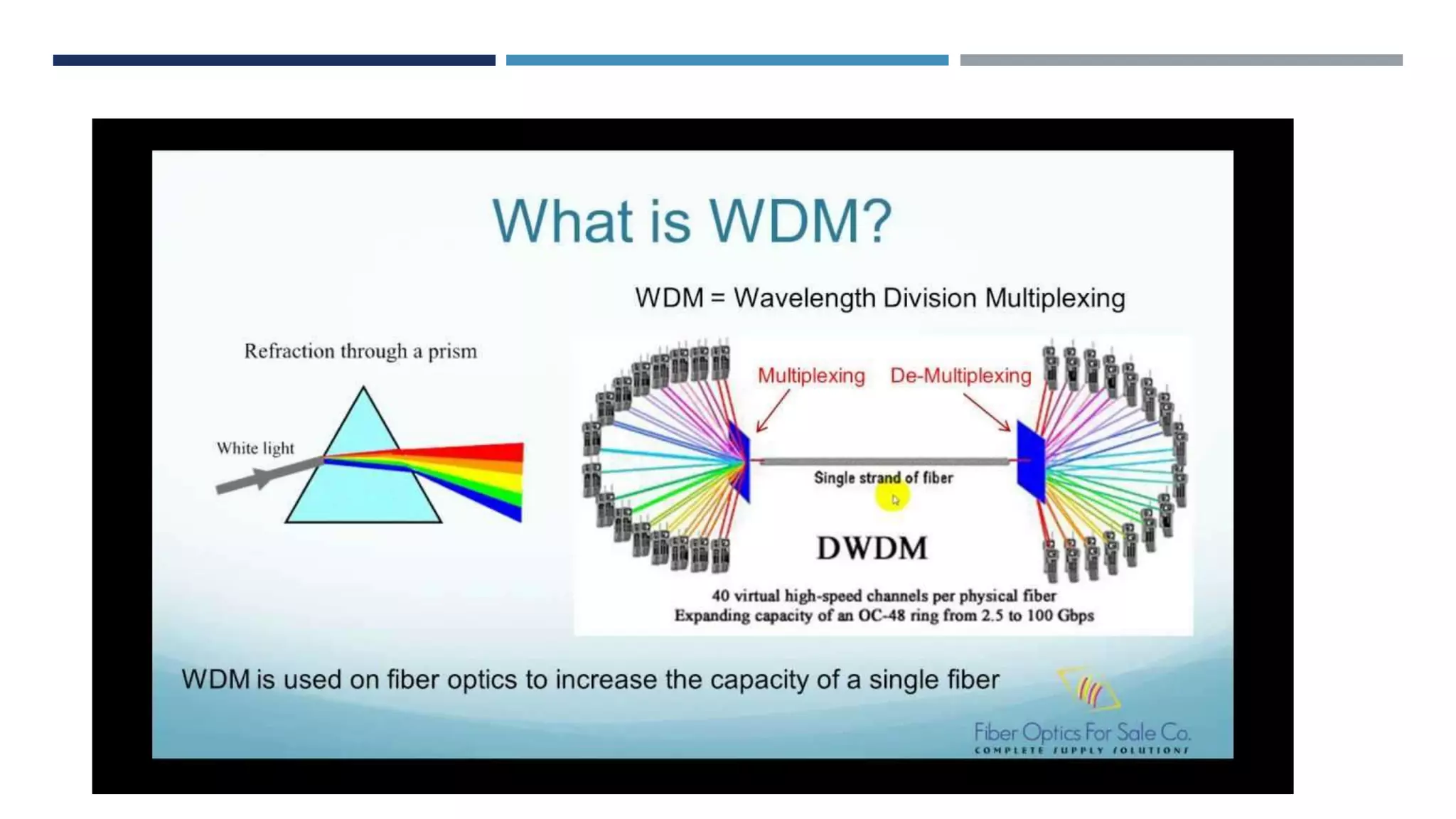
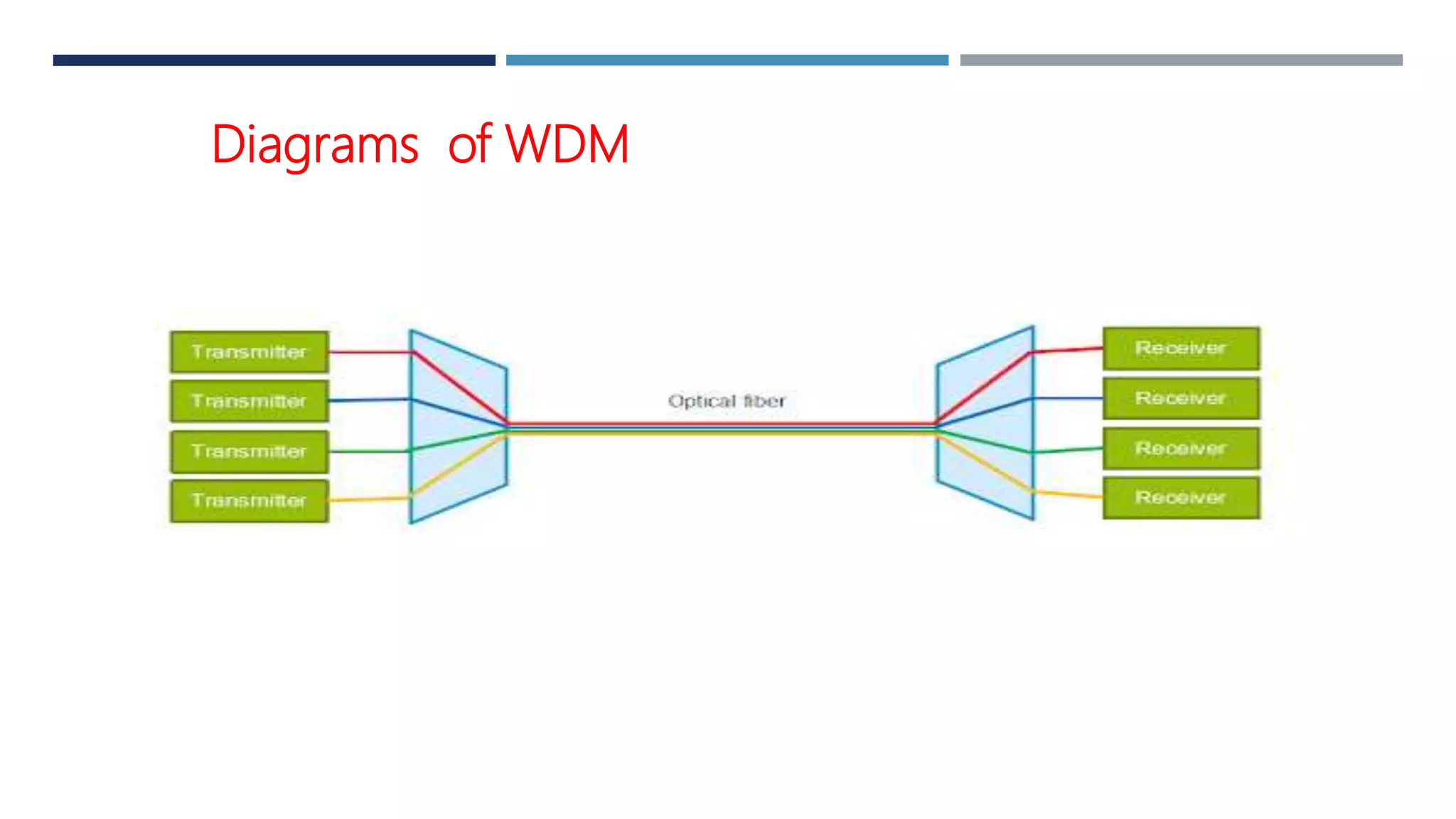
In WDM, the optical signals from different sources or
(transponders) are combined by a multiplexer, which is
essentially an optical combiner. They are combined so that
their wavelengths are different.
The combined signal is transmitted via a single optical fiber
strand. At the receiving end, a demultiplexer splits the
incoming beam into its components and each of the beams
is send to the corresponding receivers.
CATEGORIES OF WDM
Course WDM (CWDM)
Dense WDM (DWDM)
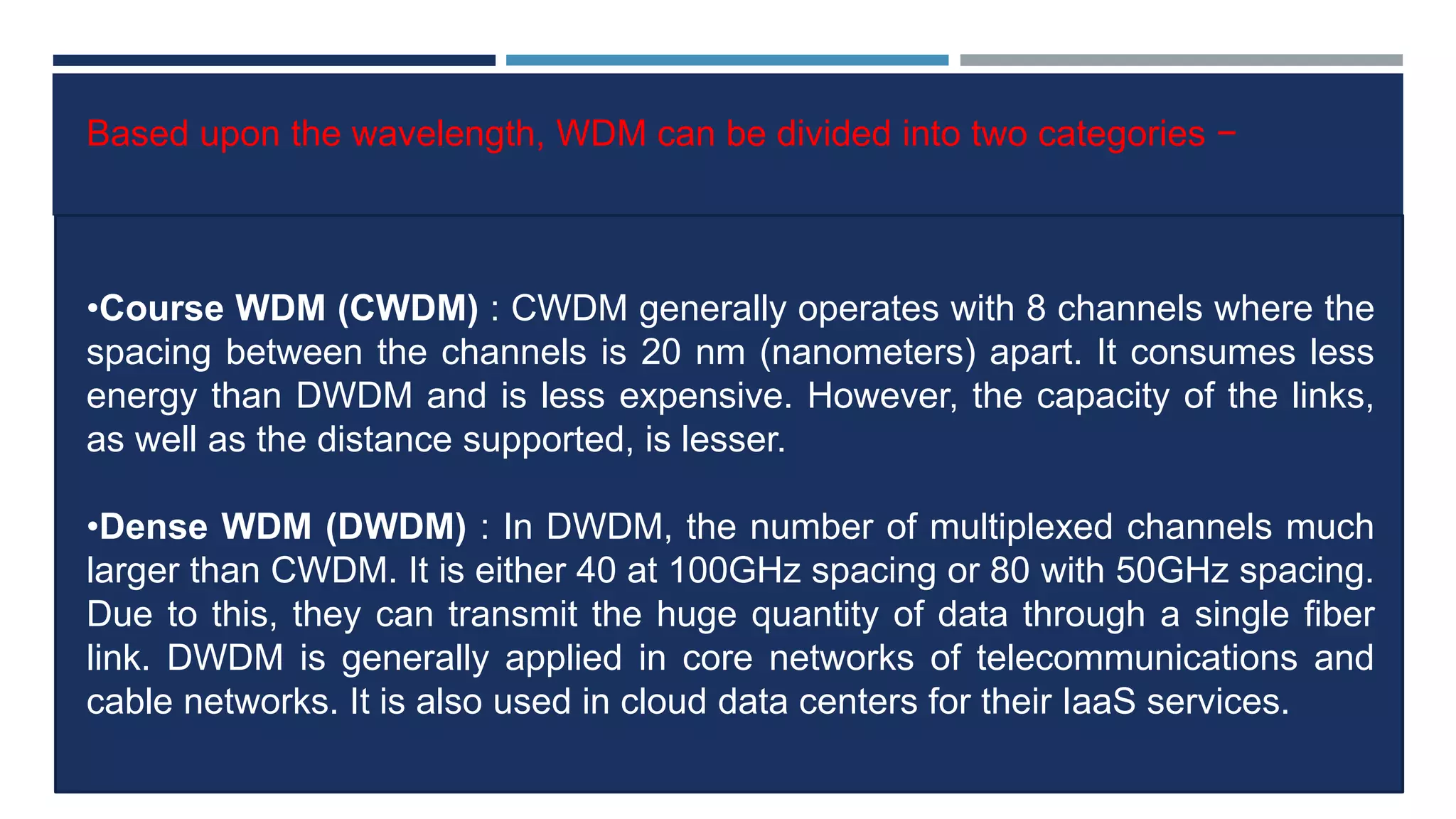
Based upon the wavelength, WDM can be divided into two categories −
•Course WDM (CWDM) : CWDM generally operates with 8 channels where the
spacing between the channels is 20 nm (nanometers) apart. It consumes less
energy than DWDM and is less expensive. However, the capacity of the links,
as well as the distance supported, is lesser.
•Dense WDM (DWDM) : In DWDM, the number of multiplexed channels much
larger than CWDM. It is either 40 at 100GHz spacing or 80 with 50GHz spacing.
Due to this, they can transmit the huge quantity of data through a single fiber
link. DWDM is generally applied in core networks of telecommunications and
cable networks. It is also used in cloud data centers for their IaaS services.
DIFFERENCES BETWEEN CWDM & DWDM
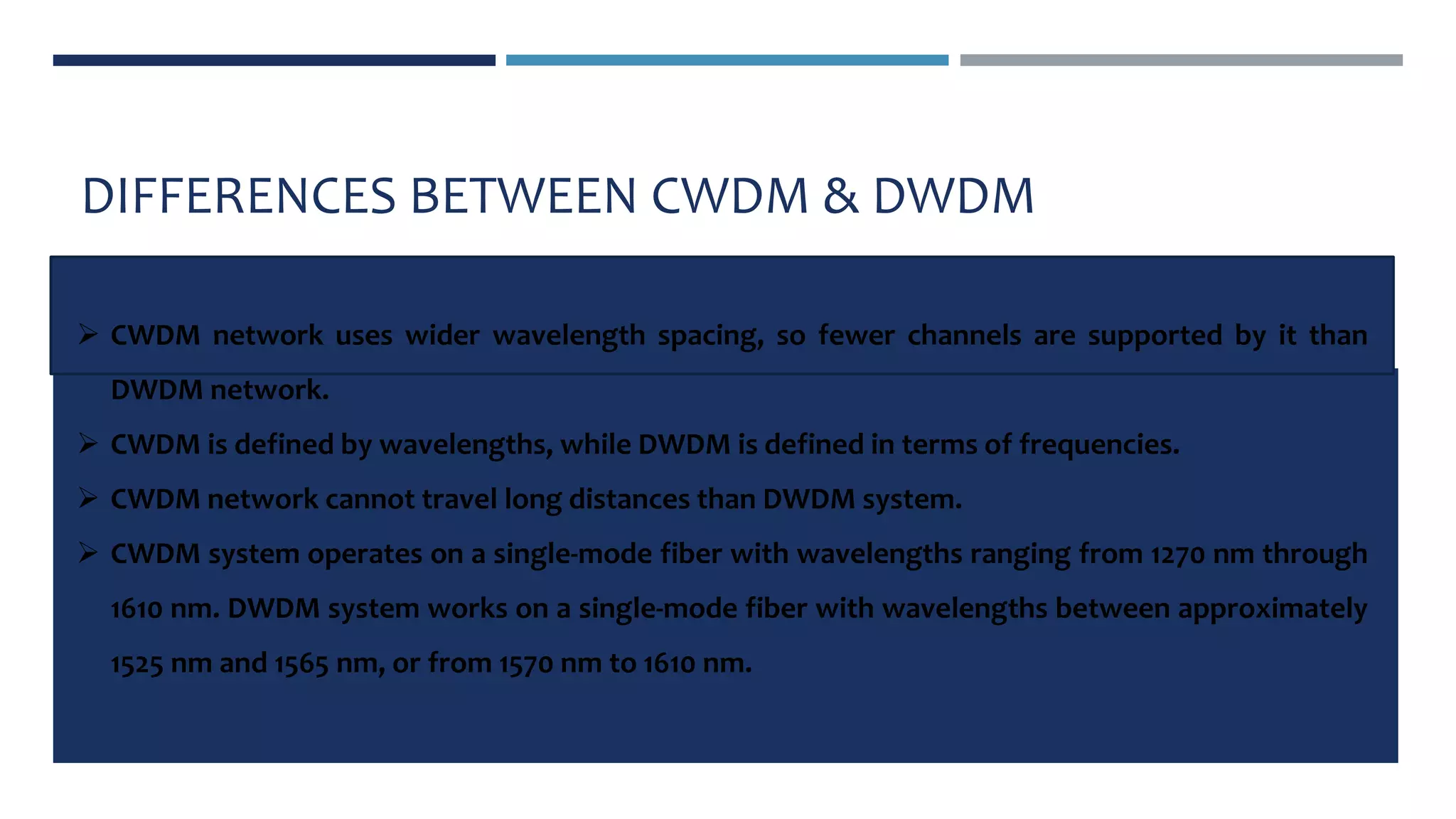
 CWDM network uses wider wavelength spacing, so fewer channels are supported by it than
DWDM network.
 CWDM is defined by wavelengths, while DWDM is defined in terms of frequencies.
 CWDM network cannot travel long distances than DWDM system.
 CWDM system operates on a single-mode fiber with wavelengths ranging from 1270 nm through
1610 nm. DWDM system works on a single-mode fiber with wavelengths between approximately
1525 nm and 1565 nm, or from 1570 nm to 1610 nm.
USES OF WAVELENGTH DIVISION MULTIPLEXING
 WDM multiply the effective bandwidth of a fiber optic communications system.
 A fiber optic repeater device called the erbium amplifier can make WDM a cost-effective and it is the long-term
solution.
 This reduces the cost and increases the capacity of the cable to carry data.
 Wavelength Division Multiplexing (WDM) uses multiple wavelengths (colors of light) to transport signals over a
single fiber.
 It uses light of different colour’s to create a number of signal paths.
 It uses Optical prisms to separate the different colour’s at the receiving end and optical prisms
does not require power source.
 These systems used temperature stabilized lasers to provide the needed channels count.
 The basic concept the in WDM is that uses different optical carriers or colours to transmit
different signals in a optic fibre here is analogous to multilane highway. WDM is irrelevant to
type of traffic to be carried and hence any type of traffic can travel over fibre optic cable.
Example:- (Optical fibre Communications use the WDM technique, to merge
different wavelengths into a single light for the communication.)
ATM packets
SDH and IP data
Devices use in WDM
Diagrams of WDM
ADVANTAGES
AND
DISADVANTAGES
1. Large capacity
2. Ultra-long Distance Transmission
3. Transparent transmission of data
4. Flexible for Smooth Expansion:
Advantages of wavelength division multiplexing
5. High Networking Reliability
6. Compatible with All Optical Switching
7. The sharing of active optical equipment reduces the cost of transmitting
multiple signals or increasing new services.
 Signals can’t be very close
 Light Wave carrying WDM are limited to 2 point circuit
 Complex transmitters and receivers
 Cost of the system increases with addition of optical components.
 Scalability is a concern.
 OLT has to have transmitter array with one transmitter for each ONU.
 Difficulty in Wavelength tuning.
 Inefficiency in BW utilization.
 Difficulty in a cascaded topology.
Disadvantages
Thank You
Team Members
Charith
Kanchana
Piyumi
Dilshani
LUX
Gayangi

Wavelength division multiplexing

  • 1.
  • 2.
    WHAT IS WDM?? Wavelength division multiplexing (WDM) is a technique of multiplexing multiple optical carrier signals through a single optical fiber channel by varying the wavelengths of laser lights. WDM allows communication in both the directions in the fiber cable.
  • 4.
    CONCEPT AND PROCESS InWDM, the optical signals from different sources or (transponders) are combined by a multiplexer, which is essentially an optical combiner. They are combined so that their wavelengths are different. The combined signal is transmitted via a single optical fiber strand. At the receiving end, a demultiplexer splits the incoming beam into its components and each of the beams is send to the corresponding receivers.
  • 5.
    CATEGORIES OF WDM CourseWDM (CWDM) Dense WDM (DWDM)
  • 6.
    Based upon thewavelength, WDM can be divided into two categories − •Course WDM (CWDM) : CWDM generally operates with 8 channels where the spacing between the channels is 20 nm (nanometers) apart. It consumes less energy than DWDM and is less expensive. However, the capacity of the links, as well as the distance supported, is lesser. •Dense WDM (DWDM) : In DWDM, the number of multiplexed channels much larger than CWDM. It is either 40 at 100GHz spacing or 80 with 50GHz spacing. Due to this, they can transmit the huge quantity of data through a single fiber link. DWDM is generally applied in core networks of telecommunications and cable networks. It is also used in cloud data centers for their IaaS services.
  • 7.
    DIFFERENCES BETWEEN CWDM& DWDM  CWDM network uses wider wavelength spacing, so fewer channels are supported by it than DWDM network.  CWDM is defined by wavelengths, while DWDM is defined in terms of frequencies.  CWDM network cannot travel long distances than DWDM system.  CWDM system operates on a single-mode fiber with wavelengths ranging from 1270 nm through 1610 nm. DWDM system works on a single-mode fiber with wavelengths between approximately 1525 nm and 1565 nm, or from 1570 nm to 1610 nm.
  • 8.
    USES OF WAVELENGTHDIVISION MULTIPLEXING  WDM multiply the effective bandwidth of a fiber optic communications system.  A fiber optic repeater device called the erbium amplifier can make WDM a cost-effective and it is the long-term solution.  This reduces the cost and increases the capacity of the cable to carry data.  Wavelength Division Multiplexing (WDM) uses multiple wavelengths (colors of light) to transport signals over a single fiber.
  • 9.
     It useslight of different colour’s to create a number of signal paths.  It uses Optical prisms to separate the different colour’s at the receiving end and optical prisms does not require power source.  These systems used temperature stabilized lasers to provide the needed channels count.  The basic concept the in WDM is that uses different optical carriers or colours to transmit different signals in a optic fibre here is analogous to multilane highway. WDM is irrelevant to type of traffic to be carried and hence any type of traffic can travel over fibre optic cable. Example:- (Optical fibre Communications use the WDM technique, to merge different wavelengths into a single light for the communication.) ATM packets SDH and IP data
  • 10.
  • 11.
  • 13.
  • 14.
    1. Large capacity 2.Ultra-long Distance Transmission 3. Transparent transmission of data 4. Flexible for Smooth Expansion: Advantages of wavelength division multiplexing
  • 15.
    5. High NetworkingReliability 6. Compatible with All Optical Switching 7. The sharing of active optical equipment reduces the cost of transmitting multiple signals or increasing new services.
  • 16.
     Signals can’tbe very close  Light Wave carrying WDM are limited to 2 point circuit  Complex transmitters and receivers  Cost of the system increases with addition of optical components.  Scalability is a concern.  OLT has to have transmitter array with one transmitter for each ONU.  Difficulty in Wavelength tuning.  Inefficiency in BW utilization.  Difficulty in a cascaded topology. Disadvantages
  • 17.