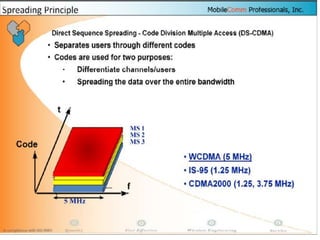
• The transmission medium is a resource that can be subdivided into 
individual 
• channels according to different criteria that depend on the 
technology used. 
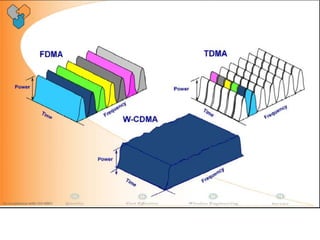
• Here’s how the three most popular radio technologies establish 
channels: 
• • FDMA (Frequency Division Multiple Access) 
• - Each user is on a different frequency 
• - A channel is a frequency. 
• • TDMA (Time Division Multiple Access) 
• - Each user is on a different window in time (“time slot”) 
• - A channel is a specific time-slot on a specific frequency. 
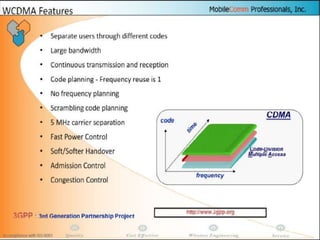
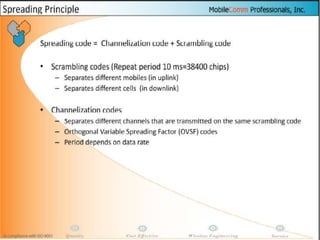
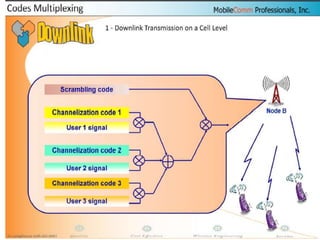
• • W-CDMA (Wide-band Code Division Multiple Access) 
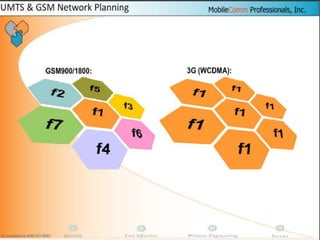
• - Each user uses the same frequency all the time, but it is mixed 
with different 
• distinguishing code patterns. A channel is a unique (set of) code 
pattern(s).
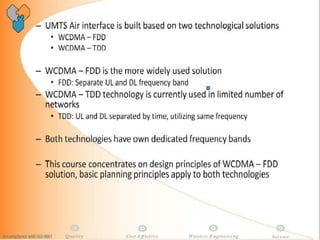
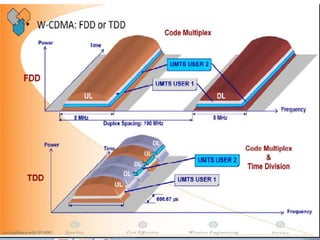
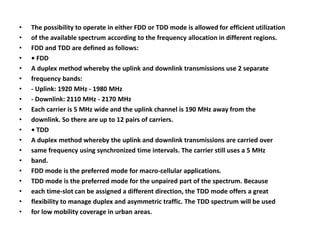
• The possibility to operate in either FDD or TDD mode is allowed for efficient utilization 
• of the available spectrum according to the frequency allocation in different regions. 
• FDD and TDD are defined as follows: 
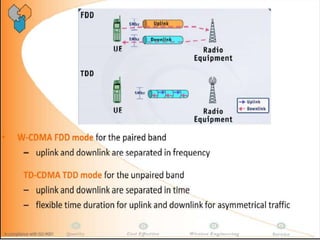
• • FDD 
• A duplex method whereby the uplink and downlink transmissions use 2 separate 
• frequency bands: 
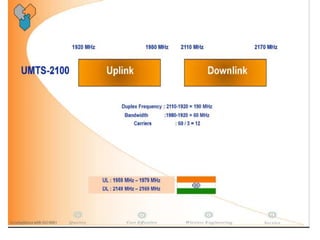
• - Uplink: 1920 MHz - 1980 MHz 
• - Downlink: 2110 MHz - 2170 MHz 
• Each carrier is 5 MHz wide and the uplink channel is 190 MHz away from the 
• downlink. So there are up to 12 pairs of carriers. 
• • TDD 
• A duplex method whereby the uplink and downlink transmissions are carried over 
• same frequency using synchronized time intervals. The carrier still uses a 5 MHz 
• band. 
• FDD mode is the preferred mode for macro-cellular applications. 
• TDD mode is the preferred mode for the unpaired part of the spectrum. Because 
• each time-slot can be assigned a different direction, the TDD mode offers a great 
• flexibility to manage duplex and asymmetric traffic. The TDD spectrum will be used 
• for low mobility coverage in urban areas.
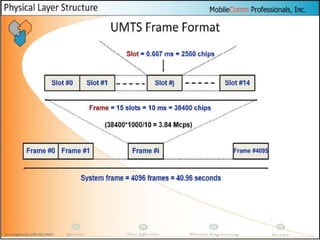
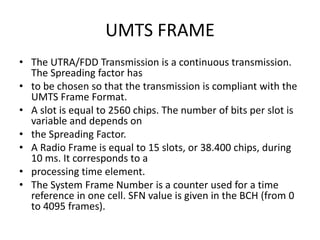
UMTS FRAME 
• The UTRA/FDD Transmission is a continuous transmission. 
The Spreading factor has 
• to be chosen so that the transmission is compliant with the 
UMTS Frame Format. 
• A slot is equal to 2560 chips. The number of bits per slot is 
variable and depends on 
• the Spreading Factor. 
• A Radio Frame is equal to 15 slots, or 38.400 chips, during 
10 ms. It corresponds to a 
• processing time element. 
• The System Frame Number is a counter used for a time 
reference in one cell. SFN value is given in the BCH (from 0 
to 4095 frames).
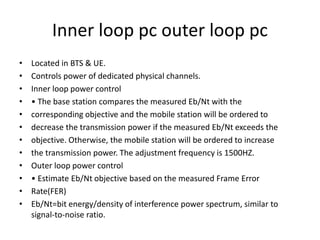
Inner loop pc outer loop pc 
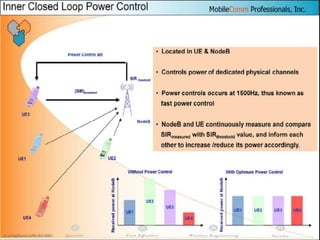
• Located in BTS & UE. 
• Controls power of dedicated physical channels. 
• Inner loop power control 
• • The base station compares the measured Eb/Nt with the 
• corresponding objective and the mobile station will be ordered to 
• decrease the transmission power if the measured Eb/Nt exceeds the 
• objective. Otherwise, the mobile station will be ordered to increase 
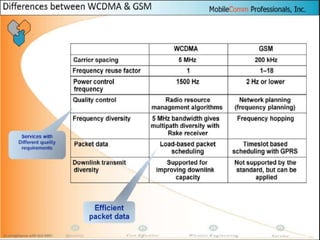
• the transmission power. The adjustment frequency is 1500HZ. 
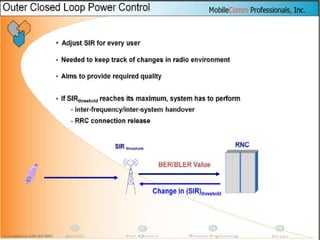
• Outer loop power control 
• • Estimate Eb/Nt objective based on the measured Frame Error 
• Rate(FER) 
• Eb/Nt=bit energy/density of interference power spectrum, similar to 
signal-to-noise ratio.
Wcdma presentation4
Wcdma presentation4
Wcdma presentation4
Wcdma presentation4

Wcdma presentation4

  • 3.
    • The transmissionmedium is a resource that can be subdivided into individual • channels according to different criteria that depend on the technology used. • Here’s how the three most popular radio technologies establish channels: • • FDMA (Frequency Division Multiple Access) • - Each user is on a different frequency • - A channel is a frequency. • • TDMA (Time Division Multiple Access) • - Each user is on a different window in time (“time slot”) • - A channel is a specific time-slot on a specific frequency. • • W-CDMA (Wide-band Code Division Multiple Access) • - Each user uses the same frequency all the time, but it is mixed with different • distinguishing code patterns. A channel is a unique (set of) code pattern(s).
  • 6.
    • The possibilityto operate in either FDD or TDD mode is allowed for efficient utilization • of the available spectrum according to the frequency allocation in different regions. • FDD and TDD are defined as follows: • • FDD • A duplex method whereby the uplink and downlink transmissions use 2 separate • frequency bands: • - Uplink: 1920 MHz - 1980 MHz • - Downlink: 2110 MHz - 2170 MHz • Each carrier is 5 MHz wide and the uplink channel is 190 MHz away from the • downlink. So there are up to 12 pairs of carriers. • • TDD • A duplex method whereby the uplink and downlink transmissions are carried over • same frequency using synchronized time intervals. The carrier still uses a 5 MHz • band. • FDD mode is the preferred mode for macro-cellular applications. • TDD mode is the preferred mode for the unpaired part of the spectrum. Because • each time-slot can be assigned a different direction, the TDD mode offers a great • flexibility to manage duplex and asymmetric traffic. The TDD spectrum will be used • for low mobility coverage in urban areas.
  • 17.
    UMTS FRAME •The UTRA/FDD Transmission is a continuous transmission. The Spreading factor has • to be chosen so that the transmission is compliant with the UMTS Frame Format. • A slot is equal to 2560 chips. The number of bits per slot is variable and depends on • the Spreading Factor. • A Radio Frame is equal to 15 slots, or 38.400 chips, during 10 ms. It corresponds to a • processing time element. • The System Frame Number is a counter used for a time reference in one cell. SFN value is given in the BCH (from 0 to 4095 frames).
  • 21.
    Inner loop pcouter loop pc • Located in BTS & UE. • Controls power of dedicated physical channels. • Inner loop power control • • The base station compares the measured Eb/Nt with the • corresponding objective and the mobile station will be ordered to • decrease the transmission power if the measured Eb/Nt exceeds the • objective. Otherwise, the mobile station will be ordered to increase • the transmission power. The adjustment frequency is 1500HZ. • Outer loop power control • • Estimate Eb/Nt objective based on the measured Frame Error • Rate(FER) • Eb/Nt=bit energy/density of interference power spectrum, similar to signal-to-noise ratio.

Editor's Notes

  • #5 FDD: Frquency Division Duplexing TDD: Time Division Duplexing
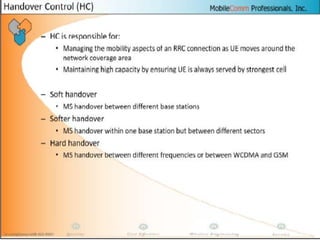
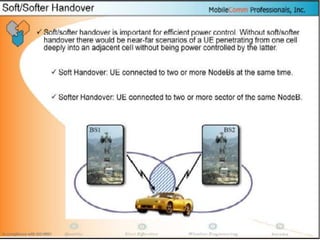
  • #12 Soft Handover: Inter site handover Softer Handover: Intra site handover