Financial management is an integrated decision
making process, concerned with acquiring,
managing and financing assets to accomplish
overall goals within a business entity.

Speaking differently, it is concerned with making
decisions relating to investments in long term
assets, working capital, financing of assets and so
on.
What is Financial Management?

 Financial management capacity is a cornerstone of
 organizational excellence.

 Financial management pervades the whole organization as
 management decisions almost always have financial
 implications.
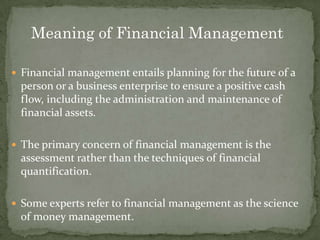
Meaning of Financial Management

 Financial management entails planning for the future of a
 person or a business enterprise to ensure a positive cash
 flow, including the administration and maintenance of
 financial assets.

 The primary concern of financial management is the
 assessment rather than the techniques of financial
 quantification.

 Some experts refer to financial management as the science
 of money management.
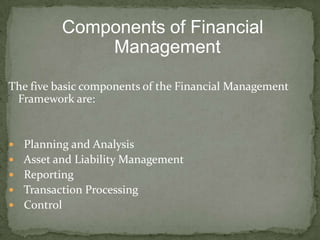
Components of Financial
               Management

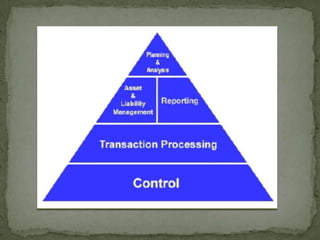
The five basic components of the Financial Management
 Framework are:


   Planning and Analysis
   Asset and Liability Management
   Reporting
   Transaction Processing
   Control
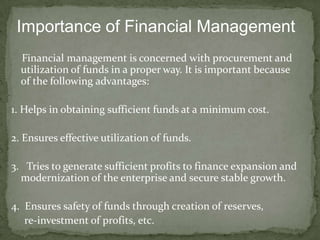
Importance of Financial Management
  Financial management is concerned with procurement and
  utilization of funds in a proper way. It is important because
  of the following advantages:

1. Helps in obtaining sufficient funds at a minimum cost.

2. Ensures effective utilization of funds.

3. Tries to generate sufficient profits to finance expansion and
  modernization of the enterprise and secure stable growth.

4. Ensures safety of funds through creation of reserves,
   re-investment of profits, etc.
Finance function
   The finance function relates to three major decisions which
  the finance manager has to take:

 Investment decisions


 Finance decisions


 Dividend decisions
Investment decision:

  This decision relates to the careful selection of assets
 in which funds will be invested by the firm. It
 Involves buying, holding, reducing, replacing, selling
 & managing assets.

  Common questions involving Investments include:
 In what lines of business should the firm engage?
 Should the firm acquire other companies?
 What sort of property, plant, equipment should the
  firm hold?
 Should the firm modernise or sell an old production
  facility?
Financing decisions involve the acquisition of funds needed to
  support long-term investments.

 While taking this decision, financial management weighs the
  advantages and disadvantages of the different sources of finance.

 The business can either finance from its shareholder funds which
  can be subdivided into equity share capital, preference share
  capital and the accumulated profits.

 Borrowings from outsiders include borrowed funds like
  debentures and loans from financial institutions.
 This decision relates to the appropriation of profits earned.
  The two major alternatives are to retain the profits earned
  or to distribute these profits to shareholders.

   While declaring dividend, a large number of
  considerations are kept in mind such as:

 Trend of earnings
 Stability in dividends
 The trend of share market prices
 The requirement of funds for future growth
 The cash flow situation
 Restrictions under the Companies Act
 The tax impact on shareholders etc.
Investment decision


Three Legged Tool Analogy: Broad Classification of Decision Activities
Objectives of Financial Management

  The objectives or goals of financial management are-

(a) Profit maximization,

(b) Return maximization, and

(c) Wealth maximization.
Objectives of Financial Management

(1)Profit maximization: Maximization of profits is generally regarded
   as the main objective of a business enterprise.

(2)Return Maximization: Another goal of financial management is to
  safeguard the economic interest of the persons who are directly or
  indirectly connected with the company, i.e., shareholders,
  creditors and employees.

(3)Wealth Maximization: Maximization of profits is regarded as the
  proper objective of the firm but it is not as inclusive a goal as that
  of maximizing its value to its shareholders.
Financial Management levels

  Broadly speaking, the process of financial management takes
  place at two levels:
 At the individual level, financial management involves tailoring
  expenses according to the financial resources of an individual. From
  an organizational point of view, the process of financial
  management is associated with financial planning and financial
  control.

 At the corporate level, the main aim of the process of managing
  finances is to achieve the various goals a company sets at a given
  point of time.
Financial Planning
  Financial planning means deciding in advance how much to spend,
  on what to spend, according to the funds at your disposal.
  Thus, there are two aspects of financial planning:

 How much funds are required to finance current and fixed assets
  and future expansion project?
 From where will these funds come?


   Financial planning takes into consideration the growth,
  performance, investments and requirement of funds for the
  business for a given period of time.
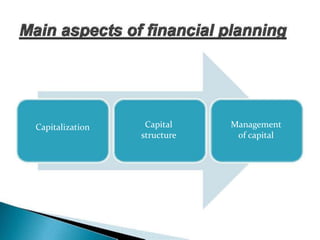
Capitalization    Capital    Management
                 structure    of capital
Capitalisation

     Capital is the basis of all financial decisions and
     the term capitalization has been derived from it .

 Capital means the total funds invested in the business and
  includes owners’ funds , long term loans and other reserves
  which are represented by assets.

 Capitalization is the valuation of this capital and will include
  owners funds, borrowed funds, long term loans, reserves and
  any surplus earnings.
Three possible situations of Capitalisation


Fair capitalization   Over                Under
                      capitalization      capitalization
‡Business employs
correct amount of     Business employs     Business employs
capital               more capital than
                                          less capital than
                      warranted
                                          warranted
Over Capitalisation

There are three main indicators of over capitalization:

i. When the amount of capital invested in the business exceeds
   the real value of its assets.

ii. When the earnings are not justified by the amount of
    capitalization i.e. a fair return is not realized on capital
    employed.

iii. When a business has more net assets than it requires
Under Capitalisation

  Under capitalization is the reverse of over
  capitalization. A company becomes under capitalized
  when :

 The future earnings are under estimated at the time of
  promotion.

 Unforeseen increase in earnings
Functions of Financial Management

  Functions of financial management can be divided into two
  groups:

 Executive (or managerial)functions


 Incidental or routine functions
Executive functions:

  These functions involve financial, investment and dividend decision
  making.

  Executive functions involve the following decisions:

 Financial Forecasting
 Investment decisions
 Managing corporate asset structure
 The management of income
 Management of cash
 Deciding about new sources of finance
 To contact and carry negotiations for new financing
 Analysis and appraisal of financial performance
 Advising the top management
Incidental functions:

 They are performed by low level assistants like
 accountants, account assistants etc. They include:

 Record keeping and reporting
 Preparation of various financial statements
 Cash planning and its supervision
 Credit management
 Custody and safeguarding different financial securities
  etc.
 Providing top management with information on current
  and prospective financial conditions of the business.
 Understanding financial management: a practical
  guide By Harold Kent Baker, Gary E. Powell
 http://www.economywatch.com/finance/financial-
  management.html
 http://managementhelp.org/finance/fp_fnce/fp_fnce.
  htm
 Various other sources on the internet
Financial management

Financial management

  • 2.
    Financial management isan integrated decision making process, concerned with acquiring, managing and financing assets to accomplish overall goals within a business entity. Speaking differently, it is concerned with making decisions relating to investments in long term assets, working capital, financing of assets and so on.
  • 3.
    What is FinancialManagement?  Financial management capacity is a cornerstone of organizational excellence.  Financial management pervades the whole organization as management decisions almost always have financial implications.
  • 4.
    Meaning of FinancialManagement  Financial management entails planning for the future of a person or a business enterprise to ensure a positive cash flow, including the administration and maintenance of financial assets.  The primary concern of financial management is the assessment rather than the techniques of financial quantification.  Some experts refer to financial management as the science of money management.
  • 5.
    Components of Financial Management The five basic components of the Financial Management Framework are:  Planning and Analysis  Asset and Liability Management  Reporting  Transaction Processing  Control
  • 7.
    Importance of FinancialManagement Financial management is concerned with procurement and utilization of funds in a proper way. It is important because of the following advantages: 1. Helps in obtaining sufficient funds at a minimum cost. 2. Ensures effective utilization of funds. 3. Tries to generate sufficient profits to finance expansion and modernization of the enterprise and secure stable growth. 4. Ensures safety of funds through creation of reserves, re-investment of profits, etc.
  • 8.
    Finance function The finance function relates to three major decisions which the finance manager has to take:  Investment decisions  Finance decisions  Dividend decisions
  • 9.
    Investment decision: This decision relates to the careful selection of assets in which funds will be invested by the firm. It Involves buying, holding, reducing, replacing, selling & managing assets. Common questions involving Investments include:  In what lines of business should the firm engage?  Should the firm acquire other companies?  What sort of property, plant, equipment should the firm hold?  Should the firm modernise or sell an old production facility?
  • 10.
    Financing decisions involvethe acquisition of funds needed to support long-term investments.  While taking this decision, financial management weighs the advantages and disadvantages of the different sources of finance.  The business can either finance from its shareholder funds which can be subdivided into equity share capital, preference share capital and the accumulated profits.  Borrowings from outsiders include borrowed funds like debentures and loans from financial institutions.
  • 11.
     This decisionrelates to the appropriation of profits earned. The two major alternatives are to retain the profits earned or to distribute these profits to shareholders. While declaring dividend, a large number of considerations are kept in mind such as:  Trend of earnings  Stability in dividends  The trend of share market prices  The requirement of funds for future growth  The cash flow situation  Restrictions under the Companies Act  The tax impact on shareholders etc.
  • 12.
    Investment decision Three LeggedTool Analogy: Broad Classification of Decision Activities
  • 13.
    Objectives of FinancialManagement The objectives or goals of financial management are- (a) Profit maximization, (b) Return maximization, and (c) Wealth maximization.
  • 14.
    Objectives of FinancialManagement (1)Profit maximization: Maximization of profits is generally regarded as the main objective of a business enterprise. (2)Return Maximization: Another goal of financial management is to safeguard the economic interest of the persons who are directly or indirectly connected with the company, i.e., shareholders, creditors and employees. (3)Wealth Maximization: Maximization of profits is regarded as the proper objective of the firm but it is not as inclusive a goal as that of maximizing its value to its shareholders.
  • 15.
    Financial Management levels Broadly speaking, the process of financial management takes place at two levels:  At the individual level, financial management involves tailoring expenses according to the financial resources of an individual. From an organizational point of view, the process of financial management is associated with financial planning and financial control.  At the corporate level, the main aim of the process of managing finances is to achieve the various goals a company sets at a given point of time.
  • 16.
    Financial Planning Financial planning means deciding in advance how much to spend, on what to spend, according to the funds at your disposal. Thus, there are two aspects of financial planning:  How much funds are required to finance current and fixed assets and future expansion project?  From where will these funds come? Financial planning takes into consideration the growth, performance, investments and requirement of funds for the business for a given period of time.
  • 18.
    Capitalization Capital Management structure of capital
  • 19.
    Capitalisation Capital is the basis of all financial decisions and the term capitalization has been derived from it .  Capital means the total funds invested in the business and includes owners’ funds , long term loans and other reserves which are represented by assets.  Capitalization is the valuation of this capital and will include owners funds, borrowed funds, long term loans, reserves and any surplus earnings.
  • 20.
    Three possible situationsof Capitalisation Fair capitalization Over Under capitalization capitalization ‡Business employs correct amount of Business employs Business employs capital more capital than less capital than warranted warranted
  • 21.
    Over Capitalisation There arethree main indicators of over capitalization: i. When the amount of capital invested in the business exceeds the real value of its assets. ii. When the earnings are not justified by the amount of capitalization i.e. a fair return is not realized on capital employed. iii. When a business has more net assets than it requires
  • 22.
    Under Capitalisation Under capitalization is the reverse of over capitalization. A company becomes under capitalized when :  The future earnings are under estimated at the time of promotion.  Unforeseen increase in earnings
  • 23.
    Functions of FinancialManagement Functions of financial management can be divided into two groups:  Executive (or managerial)functions  Incidental or routine functions
  • 24.
    Executive functions: These functions involve financial, investment and dividend decision making. Executive functions involve the following decisions:  Financial Forecasting  Investment decisions  Managing corporate asset structure  The management of income  Management of cash  Deciding about new sources of finance  To contact and carry negotiations for new financing  Analysis and appraisal of financial performance  Advising the top management
  • 25.
    Incidental functions: Theyare performed by low level assistants like accountants, account assistants etc. They include:  Record keeping and reporting  Preparation of various financial statements  Cash planning and its supervision  Credit management  Custody and safeguarding different financial securities etc.  Providing top management with information on current and prospective financial conditions of the business.
  • 26.
     Understanding financialmanagement: a practical guide By Harold Kent Baker, Gary E. Powell  http://www.economywatch.com/finance/financial- management.html  http://managementhelp.org/finance/fp_fnce/fp_fnce. htm  Various other sources on the internet