Baiju Kunnathur Thomas
Business Finance
 Money required for carrying out business activities is
called business finance.
 Finance is needed to establish a business, to run it, to
modernise it, to expand, or diversify it.
 It is required for buying a variety of assets, which
may be tangible like machinery, factories, buildings,
offices; or intangible such as trademarks, patents,
technical expertise, etc.
 Also, finance is central to running the day-to-day
operations of business, like buying material, paying
bills, salaries, collecting cash from customers, etc.
needed at every stage in the life of a business entity.
Concept of Financial Management
 Financial Management is concerned with optimal
procurement as well as the usage of finance.
For optimal procurement, different available sources of
finance are identified and compared in terms of their
costs and associated risks.
 Similarly, the finance so procured needs to be invested
in a manner that the returns from the investment
exceed the cost at which procurement has taken place.
Aims of Financial Management
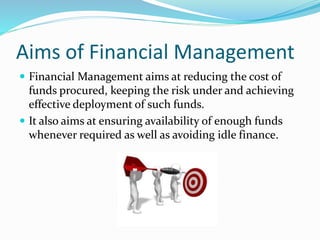
 Financial Management aims at reducing the cost of
funds procured, keeping the risk under and achieving
effective deployment of such funds.
 It also aims at ensuring availability of enough funds
whenever required as well as avoiding idle finance.
Importance of Financial Management
FINANCIAL MANAGEMENT AFFECTS:
 The size and the composition of fixed assets of the
business
 The quantum of current assets and its break-up into
cash, inventory and receivables
 The amount of long-term and short term funds to be
used
 Break-up of long-term financing into debt, equity etc
 All items in the Profit and Loss Account, e.g., Interest,
Expense, Depreciation, etc
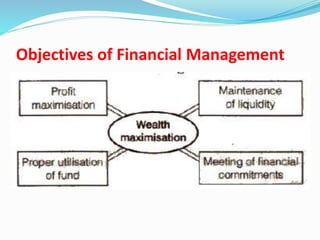
Objectives of Financial Management
 To maximise shareholders’ wealth
 To ensure that each decision is efficient and adds some
value to increase the market price of shares.
 To maximise the current price of equity shares of the
company
 To ensure that benefits from the investment exceed
the cost so that some value addition takes place.
 To reduce the cost of procuring finance so that the
value addition is even higher.
Objectives of Financial Management
Financial Decisions
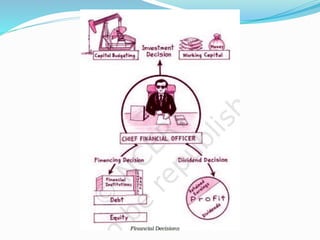
 Investment decisions
 Financing decisions
 Dividend decisions
Investment
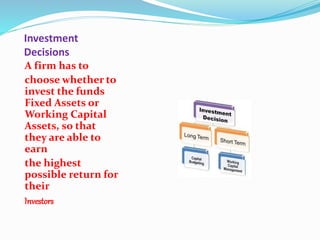
Decisions
A firm has to
choose whether to
invest the funds
Fixed Assets or
Working Capital
Assets, so that
they are able to
earn
the highest
possible return for
their
Investors
Investment Decisions
Capital Budgeting decision working capital decisions
 Long term decisions
 They are regarding acquiring
fixed assets
 They affect its earning capacity
in the long run.
 they involve huge amounts of
investment and are irreversible
except at a huge cost
 They affect size of assets,
profitability and
competitiveness
 Eg: Making investment in a new
machine
 Short term decisions
 They are regarding the levels
of cash, inventory and
receivables.
 They affect the day-to-day
working of a business.
 They involve lesser amounts
 They affect profitability and
liquidity
 Eg: Making investment in
increasing inventory
Factors affecting capital budgeting decisions
 Cash flow of the project: Cash flows in the form of a
series of cash receipts and payments over the life of an
investment are to be generated
 Rate of Return on Investment: The proposals with
less risk and higher rate of return are accepted
 Investment criteria: Capital budgeting techniques
to calculate the amount of investment, interest rate,
cash flows and rate of return etc. and evaluate
investment decisions are applied before selecting a
particular project
Financing Decision
This decision is about the quantum of finance to be
raised from various long-term sources - shareholders’
funds and borrowed funds.
 The shareholders’ funds refer to the equity capital
and the retained earnings.
Borrowed funds refer to the finance raised through
debentures or other forms of debt.
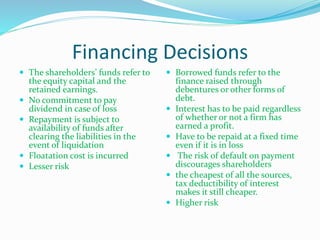
Financing Decisions
 The shareholders’ funds refer to
the equity capital and the
retained earnings.
 No commitment to pay
dividend in case of loss
 Repayment is subject to
availability of funds after
clearing the liabilities in the
event of liquidation
 Floatation cost is incurred
 Lesser risk
 Borrowed funds refer to the
finance raised through
debentures or other forms of
debt.
 Interest has to be paid regardless
of whether or not a firm has
earned a profit.
 Have to be repaid at a fixed time
even if it is in loss
 The risk of default on payment
discourages shareholders
 the cheapest of all the sources,
tax deductibility of interest
makes it still cheaper.
 Higher risk
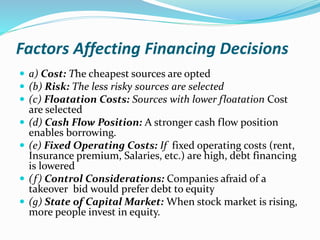
Factors Affecting Financing Decisions
 a) Cost: The cheapest sources are opted
 (b) Risk: The less risky sources are selected
 (c) Floatation Costs: Sources with lower floatation Cost
are selected
 (d) Cash Flow Position: A stronger cash flow position
enables borrowing.
 (e) Fixed Operating Costs: If fixed operating costs (rent,
Insurance premium, Salaries, etc.) are high, debt financing
is lowered
 (f) Control Considerations: Companies afraid of a
takeover bid would prefer debt to equity
 (g) State of Capital Market: When stock market is rising,
more people invest in equity.
Dividend Decisions
 The Dividend Decisions refer to the
decisions regarding how much of the profit
earned by company (after paying tax) is to
be distributed to the shareholders and how
much of it should be retained in the
business.
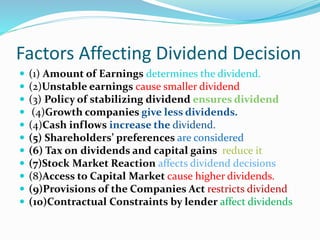
Factors Affecting Dividend Decision
 (1) Amount of Earnings determines the dividend.
 (2)Unstable earnings cause smaller dividend
 (3) Policy of stabilizing dividend ensures dividend
 (4)Growth companies give less dividends.
 (4)Cash inflows increase the dividend.
 (5) Shareholders’ preferences are considered
 (6) Tax on dividends and capital gains reduce it
 (7)Stock Market Reaction affects dividend decisions
 (8)Access to Capital Market cause higher dividends.
 (9)Provisions of the Companies Act restricts dividend
 (10)Contractual Constraints by lender affect dividends
Financial Planning
Financial planning is the preparation of a
financial blueprint of an organisation’s
future operations focusing on fund
requirements and their availability in the
light of financial decisions. Long-term
planning relates to capital expenditure
programmes for three to five years.
Detailed planning called budget is made for
a short term of one year or less.
Objectives of Financial Planning
(a) To ensure availability of funds whenever
required: The funds required for different purposes
such as for the purchase of long term assets or to meet
day-to-day expenses of business are to be estimated.
There is a need to estimate the time at which these
funds are to be made available.
 (b) To see that the firm does not raise resources
unnecessarily: Financial planning aims to put even
the surplus fund to the best possible use so that the
financial resources are not left idle and don’t
unnecessarily add to the cost.
Importance of Financial Planning
It helps in forecasting what may happen in future
under different business situations and prepare
alternative plans.
It helps in avoiding business shocks and surprises
If helps in co-ordinating various business functions,
by providing clear policies and procedures.
Detailed plans of action prepared under financial
planning reduce waste, duplication of efforts, and
gaps in planning.
It tries to link the present with the future.
It provides a link between investment and financing
decisions on a continuous basis.
It makes the evaluation of actual performance easier
by spelling out detailed objectives
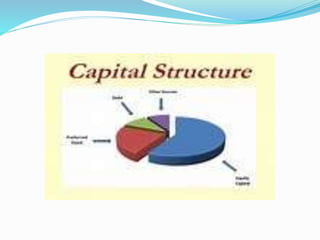
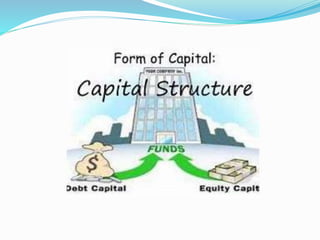
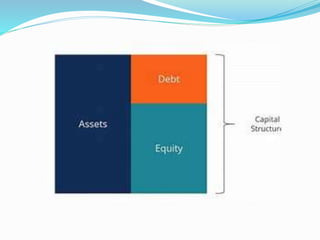
Capital Structure
Capital structure refers to the mix between owners and
borrowed funds. These shall be referred as equity and
debt. If it is greater than one, interest expenses will be
high and if it is less than one, shareholders can be
hopeful of getting something in case of liquidation.
It can be calculated as debt-equity ratio
𝑑𝑒𝑏𝑡
𝑒𝑞𝑢𝑖𝑡𝑦
It can also be calculated as the proportion of debt out
of the total capital i.e.,
𝑑𝑒𝑏𝑡
𝑑𝑒𝑏𝑡 + 𝑒𝑞𝑢𝑖𝑡𝑦
 The cost of debt is lower than the cost of equity for a
firm because the lender’s risk is lower than the equity
shareholder’s risk, since the lender earns an assured
return and repayment of capital and, therefore, they
should require a lower rate of return. Additionally,
interest paid on debt is a deductible expense for
computation of tax liability whereas dividends are paid
out of after-tax profit
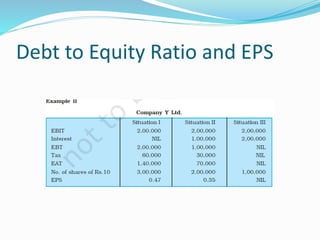
EBIT-EPS
The proportion of debt in the overall capital is
also called financial leverage. As the financial
leverage increases, the cost of funds declines
because of increased use of cheaper debt but
the financial risk increases. The impact of
financial leverage on the profitability of a
business can be seen through EBIT-EPS
(Earning before Interest and Taxes-Earning per
Share) analysis.
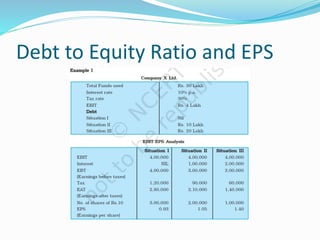
Debt to Equity Ratio and EPS
Factors affecting the Choice of
Capital Structure
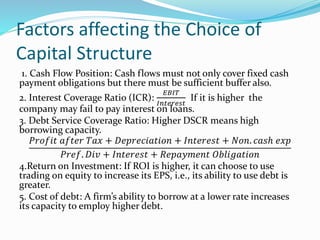
1. Cash Flow Position: Cash flows must not only cover fixed cash
payment obligations but there must be sufficient buffer also.
2. Interest Coverage Ratio (ICR):
𝐸𝐵𝐼𝑇
𝐼𝑛𝑡𝑒𝑟𝑒𝑠𝑡
If it is higher the
company may fail to pay interest on loans.
3. Debt Service Coverage Ratio: Higher DSCR means high
borrowing capacity.
𝑃𝑟𝑜𝑓𝑖𝑡 𝑎𝑓𝑡𝑒𝑟 𝑇𝑎𝑥 + 𝐷𝑒𝑝𝑟𝑒𝑐𝑖𝑎𝑡𝑖𝑜𝑛 + 𝐼𝑛𝑡𝑒𝑟𝑒𝑠𝑡 + 𝑁𝑜𝑛. 𝑐𝑎𝑠ℎ 𝑒𝑥𝑝
𝑃𝑟𝑒𝑓. 𝐷𝑖𝑣 + 𝐼𝑛𝑡𝑒𝑟𝑒𝑠𝑡 + 𝑅𝑒𝑝𝑎𝑦𝑚𝑒𝑛𝑡 𝑂𝑏𝑙𝑖𝑔𝑎𝑡𝑖𝑜𝑛
4.Return on Investment: If ROI is higher, it can choose to use
trading on equity to increase its EPS, i.e., its ability to use debt is
greater.
5. Cost of debt: A firm’s ability to borrow at a lower rate increases
its capacity to employ higher debt.
Factors affecting the Choice of
Capital Structure
 6. Tax Rate: Since interest is tax deductible, a higher tax
rate makes debt relatively cheaper.
 7. Cost of Equity: If debt increases, cost of equity may go up
sharply and share price may decrease inspite of increased
EPS.
 8. Floatation Costs: If public issue of shares and debentures
costs more, a loan may be cheaper.
 9. Risk Consideration: If a firm’s business risk is lower, its
capacity to use debt is higher and vice-versa.
 10. Flexibility: To maintain flexibility, it must maintain
some borrowing power to take care of unforeseen
circumstances.
Factors affecting the Choice of
Capital Structure
 11. Control: A public issue of equity make it vulnerable
to takeover.
 12. Regulatory Framework: The relative ease of SEBI
guidelines for issue of shares and bank norms for loans
has a bearing upon the choice of the source of finance.
 13. Stock Market Conditions: Shares are better if its
bullish whereas debt is better if its bearish.
 14. Capital Structure of other Companies: Justification
must be there if the company follows or deviates from
debt-equity ratios of other companies in the same
industry.
FIXED AND WORKING CAPITAL
Fixed Capital Working Capital
 Fixed assets are those which
remains in the business for
more than one year, usually
for much longer, e.g., plant
and machinery, furniture and
fixture, land and building,
vehicles, etc.
 Current assets are those
assets which, in the normal
routine of the business, get
converted into cash or cash
equivalents within one year,
e.g., inventories, debtors, bills
receivables, etc.
Importance of Management of
Investment Decisions
 (i) Long-term growth: The funds invested will affect the
future prospects of the business.
 (ii) Large amount of funds involved: These need a
detailed analysis as a substantial portion of funds are
blocked in long-term projects.
 (iii) Risk involved: Fixed capital involves business risk of
the firm.
 (iv) Irreversible decisions: Abandoning a project after
heavy investment is made is quite costly in terms of waste
of funds.
Therefore, these decisions should be taken only after
carefully evaluating each detail or else the company may face
serious problems.
Factors affecting the Requirement
of Fixed Capital
 1. Nature of Business: The type of business has a
bearing upon the fixed capital requirements.
 2. Scale of Operations: A large scale firm requires
higher investment in fixed assets.
 3. Choice of Technique: A capital-intensive firm
requires high fixed capital and labour intensive
organisations require less fixed assets.
 4. Technology Upgradation: Obsolete assets need
replacements.
 5. Growth Prospects: Higher growth of a firm requires
higher investment in fixed assets.
Factors affecting the Requirement
of Fixed Capital
 6. Diversification: With diversification, fixed capital
requirements increase.
 7. Financing Alternatives: Availability of leasing
facilities may reduce fixed assets.
 8. Level of Collaboration: If business organisations
share each other’s facilities, level of investment in
fixed assets is reduced.
Working Capital
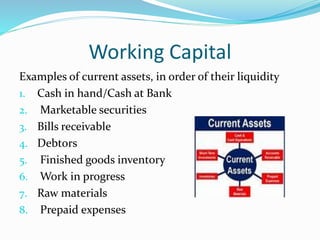
Examples of current assets, in order of their liquidity
1. Cash in hand/Cash at Bank
2. Marketable securities
3. Bills receivable
4. Debtors
5. Finished goods inventory
6. Work in progress
7. Raw materials
8. Prepaid expenses
Current Liabilities
Current liabilities are those payment obligations which
are due for payment within one year
1. bills payable,
2. creditors,
3. outstanding expenses
4. advances received from customers, etc.
Net Working Capital
Some part of current assets is usually financed
through short-term sources, i.e., current liabilities. The
rest is financed through long-term sources and is called
net working capital.
NWC = CA – CL
(i.e. Current Assets - Current Liabilities.)
FACTORS AFFECTING THE WORKING CAPITAL
REQUIREMENTS
 1. Nature of Business: The basic nature of a business influences the
amount of working capital required.
 2. Scale of Operations: For organisations which operate on a higher
scale of operation, the quantum of inventory and debtors required is
generally high.
 3. Business Cycle: In case of a boom larger amount of working capital
is required. As against this, the requirement for working capital will be
lower during trough
 4. Seasonal Factors: In peak season, larger amount of working capital
is required.
 5. Production Cycle: Duration and the length of production cycle,
affects the amount of funds required for raw materials and expenses.
 6. Credit Allowed: A liberal credit policy results in higher amount of
debtors, increasing the requirement of working capital.
FACTORS AFFECTING THE WORKING
CAPITAL REQUIREMENTS
 7. Credit Availed: To the extent it avails the credit on purchases,
the working capital requirement is reduced.
 8. Operating Efficiency: Higher inventory turnover ratio, better
debtors turnover ratio may reduce the requirement of working
capital.
 9. Availability of Raw Material: If the raw materials and other
required materials are available freely and continuously, lower
stock levels may suffice.
 10. Growth Prospects: Growth companies will require larger
amount of working capital.
 11. Level of Competition: Higher level of competitiveness may
necessitate larger stocks of finished goods
 12. Inflation: With rising prices, larger amounts are required
even to maintain a constant volume of production and sales.

Financial management

  • 2.
  • 3.
    Business Finance  Moneyrequired for carrying out business activities is called business finance.  Finance is needed to establish a business, to run it, to modernise it, to expand, or diversify it.  It is required for buying a variety of assets, which may be tangible like machinery, factories, buildings, offices; or intangible such as trademarks, patents, technical expertise, etc.  Also, finance is central to running the day-to-day operations of business, like buying material, paying bills, salaries, collecting cash from customers, etc. needed at every stage in the life of a business entity.
  • 4.
    Concept of FinancialManagement  Financial Management is concerned with optimal procurement as well as the usage of finance. For optimal procurement, different available sources of finance are identified and compared in terms of their costs and associated risks.  Similarly, the finance so procured needs to be invested in a manner that the returns from the investment exceed the cost at which procurement has taken place.
  • 5.
    Aims of FinancialManagement  Financial Management aims at reducing the cost of funds procured, keeping the risk under and achieving effective deployment of such funds.  It also aims at ensuring availability of enough funds whenever required as well as avoiding idle finance.
  • 6.
    Importance of FinancialManagement FINANCIAL MANAGEMENT AFFECTS:  The size and the composition of fixed assets of the business  The quantum of current assets and its break-up into cash, inventory and receivables  The amount of long-term and short term funds to be used  Break-up of long-term financing into debt, equity etc  All items in the Profit and Loss Account, e.g., Interest, Expense, Depreciation, etc
  • 7.
    Objectives of FinancialManagement  To maximise shareholders’ wealth  To ensure that each decision is efficient and adds some value to increase the market price of shares.  To maximise the current price of equity shares of the company  To ensure that benefits from the investment exceed the cost so that some value addition takes place.  To reduce the cost of procuring finance so that the value addition is even higher.
  • 8.
  • 9.
    Financial Decisions  Investmentdecisions  Financing decisions  Dividend decisions
  • 11.
    Investment Decisions A firm hasto choose whether to invest the funds Fixed Assets or Working Capital Assets, so that they are able to earn the highest possible return for their Investors
  • 12.
    Investment Decisions Capital Budgetingdecision working capital decisions  Long term decisions  They are regarding acquiring fixed assets  They affect its earning capacity in the long run.  they involve huge amounts of investment and are irreversible except at a huge cost  They affect size of assets, profitability and competitiveness  Eg: Making investment in a new machine  Short term decisions  They are regarding the levels of cash, inventory and receivables.  They affect the day-to-day working of a business.  They involve lesser amounts  They affect profitability and liquidity  Eg: Making investment in increasing inventory
  • 13.
    Factors affecting capitalbudgeting decisions  Cash flow of the project: Cash flows in the form of a series of cash receipts and payments over the life of an investment are to be generated  Rate of Return on Investment: The proposals with less risk and higher rate of return are accepted  Investment criteria: Capital budgeting techniques to calculate the amount of investment, interest rate, cash flows and rate of return etc. and evaluate investment decisions are applied before selecting a particular project
  • 14.
    Financing Decision This decisionis about the quantum of finance to be raised from various long-term sources - shareholders’ funds and borrowed funds.  The shareholders’ funds refer to the equity capital and the retained earnings. Borrowed funds refer to the finance raised through debentures or other forms of debt.
  • 15.
    Financing Decisions  Theshareholders’ funds refer to the equity capital and the retained earnings.  No commitment to pay dividend in case of loss  Repayment is subject to availability of funds after clearing the liabilities in the event of liquidation  Floatation cost is incurred  Lesser risk  Borrowed funds refer to the finance raised through debentures or other forms of debt.  Interest has to be paid regardless of whether or not a firm has earned a profit.  Have to be repaid at a fixed time even if it is in loss  The risk of default on payment discourages shareholders  the cheapest of all the sources, tax deductibility of interest makes it still cheaper.  Higher risk
  • 16.
    Factors Affecting FinancingDecisions  a) Cost: The cheapest sources are opted  (b) Risk: The less risky sources are selected  (c) Floatation Costs: Sources with lower floatation Cost are selected  (d) Cash Flow Position: A stronger cash flow position enables borrowing.  (e) Fixed Operating Costs: If fixed operating costs (rent, Insurance premium, Salaries, etc.) are high, debt financing is lowered  (f) Control Considerations: Companies afraid of a takeover bid would prefer debt to equity  (g) State of Capital Market: When stock market is rising, more people invest in equity.
  • 17.
    Dividend Decisions  TheDividend Decisions refer to the decisions regarding how much of the profit earned by company (after paying tax) is to be distributed to the shareholders and how much of it should be retained in the business.
  • 18.
    Factors Affecting DividendDecision  (1) Amount of Earnings determines the dividend.  (2)Unstable earnings cause smaller dividend  (3) Policy of stabilizing dividend ensures dividend  (4)Growth companies give less dividends.  (4)Cash inflows increase the dividend.  (5) Shareholders’ preferences are considered  (6) Tax on dividends and capital gains reduce it  (7)Stock Market Reaction affects dividend decisions  (8)Access to Capital Market cause higher dividends.  (9)Provisions of the Companies Act restricts dividend  (10)Contractual Constraints by lender affect dividends
  • 21.
    Financial Planning Financial planningis the preparation of a financial blueprint of an organisation’s future operations focusing on fund requirements and their availability in the light of financial decisions. Long-term planning relates to capital expenditure programmes for three to five years. Detailed planning called budget is made for a short term of one year or less.
  • 23.
    Objectives of FinancialPlanning (a) To ensure availability of funds whenever required: The funds required for different purposes such as for the purchase of long term assets or to meet day-to-day expenses of business are to be estimated. There is a need to estimate the time at which these funds are to be made available.  (b) To see that the firm does not raise resources unnecessarily: Financial planning aims to put even the surplus fund to the best possible use so that the financial resources are not left idle and don’t unnecessarily add to the cost.
  • 24.
    Importance of FinancialPlanning It helps in forecasting what may happen in future under different business situations and prepare alternative plans. It helps in avoiding business shocks and surprises If helps in co-ordinating various business functions, by providing clear policies and procedures. Detailed plans of action prepared under financial planning reduce waste, duplication of efforts, and gaps in planning. It tries to link the present with the future. It provides a link between investment and financing decisions on a continuous basis. It makes the evaluation of actual performance easier by spelling out detailed objectives
  • 26.
    Capital Structure Capital structurerefers to the mix between owners and borrowed funds. These shall be referred as equity and debt. If it is greater than one, interest expenses will be high and if it is less than one, shareholders can be hopeful of getting something in case of liquidation. It can be calculated as debt-equity ratio 𝑑𝑒𝑏𝑡 𝑒𝑞𝑢𝑖𝑡𝑦 It can also be calculated as the proportion of debt out of the total capital i.e., 𝑑𝑒𝑏𝑡 𝑑𝑒𝑏𝑡 + 𝑒𝑞𝑢𝑖𝑡𝑦
  • 27.
     The costof debt is lower than the cost of equity for a firm because the lender’s risk is lower than the equity shareholder’s risk, since the lender earns an assured return and repayment of capital and, therefore, they should require a lower rate of return. Additionally, interest paid on debt is a deductible expense for computation of tax liability whereas dividends are paid out of after-tax profit
  • 28.
    EBIT-EPS The proportion ofdebt in the overall capital is also called financial leverage. As the financial leverage increases, the cost of funds declines because of increased use of cheaper debt but the financial risk increases. The impact of financial leverage on the profitability of a business can be seen through EBIT-EPS (Earning before Interest and Taxes-Earning per Share) analysis.
  • 29.
    Debt to EquityRatio and EPS
  • 30.
    Debt to EquityRatio and EPS
  • 32.
    Factors affecting theChoice of Capital Structure 1. Cash Flow Position: Cash flows must not only cover fixed cash payment obligations but there must be sufficient buffer also. 2. Interest Coverage Ratio (ICR): 𝐸𝐵𝐼𝑇 𝐼𝑛𝑡𝑒𝑟𝑒𝑠𝑡 If it is higher the company may fail to pay interest on loans. 3. Debt Service Coverage Ratio: Higher DSCR means high borrowing capacity. 𝑃𝑟𝑜𝑓𝑖𝑡 𝑎𝑓𝑡𝑒𝑟 𝑇𝑎𝑥 + 𝐷𝑒𝑝𝑟𝑒𝑐𝑖𝑎𝑡𝑖𝑜𝑛 + 𝐼𝑛𝑡𝑒𝑟𝑒𝑠𝑡 + 𝑁𝑜𝑛. 𝑐𝑎𝑠ℎ 𝑒𝑥𝑝 𝑃𝑟𝑒𝑓. 𝐷𝑖𝑣 + 𝐼𝑛𝑡𝑒𝑟𝑒𝑠𝑡 + 𝑅𝑒𝑝𝑎𝑦𝑚𝑒𝑛𝑡 𝑂𝑏𝑙𝑖𝑔𝑎𝑡𝑖𝑜𝑛 4.Return on Investment: If ROI is higher, it can choose to use trading on equity to increase its EPS, i.e., its ability to use debt is greater. 5. Cost of debt: A firm’s ability to borrow at a lower rate increases its capacity to employ higher debt.
  • 34.
    Factors affecting theChoice of Capital Structure  6. Tax Rate: Since interest is tax deductible, a higher tax rate makes debt relatively cheaper.  7. Cost of Equity: If debt increases, cost of equity may go up sharply and share price may decrease inspite of increased EPS.  8. Floatation Costs: If public issue of shares and debentures costs more, a loan may be cheaper.  9. Risk Consideration: If a firm’s business risk is lower, its capacity to use debt is higher and vice-versa.  10. Flexibility: To maintain flexibility, it must maintain some borrowing power to take care of unforeseen circumstances.
  • 36.
    Factors affecting theChoice of Capital Structure  11. Control: A public issue of equity make it vulnerable to takeover.  12. Regulatory Framework: The relative ease of SEBI guidelines for issue of shares and bank norms for loans has a bearing upon the choice of the source of finance.  13. Stock Market Conditions: Shares are better if its bullish whereas debt is better if its bearish.  14. Capital Structure of other Companies: Justification must be there if the company follows or deviates from debt-equity ratios of other companies in the same industry.
  • 37.
    FIXED AND WORKINGCAPITAL Fixed Capital Working Capital  Fixed assets are those which remains in the business for more than one year, usually for much longer, e.g., plant and machinery, furniture and fixture, land and building, vehicles, etc.  Current assets are those assets which, in the normal routine of the business, get converted into cash or cash equivalents within one year, e.g., inventories, debtors, bills receivables, etc.
  • 38.
    Importance of Managementof Investment Decisions  (i) Long-term growth: The funds invested will affect the future prospects of the business.  (ii) Large amount of funds involved: These need a detailed analysis as a substantial portion of funds are blocked in long-term projects.  (iii) Risk involved: Fixed capital involves business risk of the firm.  (iv) Irreversible decisions: Abandoning a project after heavy investment is made is quite costly in terms of waste of funds. Therefore, these decisions should be taken only after carefully evaluating each detail or else the company may face serious problems.
  • 39.
    Factors affecting theRequirement of Fixed Capital  1. Nature of Business: The type of business has a bearing upon the fixed capital requirements.  2. Scale of Operations: A large scale firm requires higher investment in fixed assets.  3. Choice of Technique: A capital-intensive firm requires high fixed capital and labour intensive organisations require less fixed assets.  4. Technology Upgradation: Obsolete assets need replacements.  5. Growth Prospects: Higher growth of a firm requires higher investment in fixed assets.
  • 40.
    Factors affecting theRequirement of Fixed Capital  6. Diversification: With diversification, fixed capital requirements increase.  7. Financing Alternatives: Availability of leasing facilities may reduce fixed assets.  8. Level of Collaboration: If business organisations share each other’s facilities, level of investment in fixed assets is reduced.
  • 41.
    Working Capital Examples ofcurrent assets, in order of their liquidity 1. Cash in hand/Cash at Bank 2. Marketable securities 3. Bills receivable 4. Debtors 5. Finished goods inventory 6. Work in progress 7. Raw materials 8. Prepaid expenses
  • 42.
    Current Liabilities Current liabilitiesare those payment obligations which are due for payment within one year 1. bills payable, 2. creditors, 3. outstanding expenses 4. advances received from customers, etc.
  • 43.
    Net Working Capital Somepart of current assets is usually financed through short-term sources, i.e., current liabilities. The rest is financed through long-term sources and is called net working capital. NWC = CA – CL (i.e. Current Assets - Current Liabilities.)
  • 44.
    FACTORS AFFECTING THEWORKING CAPITAL REQUIREMENTS  1. Nature of Business: The basic nature of a business influences the amount of working capital required.  2. Scale of Operations: For organisations which operate on a higher scale of operation, the quantum of inventory and debtors required is generally high.  3. Business Cycle: In case of a boom larger amount of working capital is required. As against this, the requirement for working capital will be lower during trough  4. Seasonal Factors: In peak season, larger amount of working capital is required.  5. Production Cycle: Duration and the length of production cycle, affects the amount of funds required for raw materials and expenses.  6. Credit Allowed: A liberal credit policy results in higher amount of debtors, increasing the requirement of working capital.
  • 45.
    FACTORS AFFECTING THEWORKING CAPITAL REQUIREMENTS  7. Credit Availed: To the extent it avails the credit on purchases, the working capital requirement is reduced.  8. Operating Efficiency: Higher inventory turnover ratio, better debtors turnover ratio may reduce the requirement of working capital.  9. Availability of Raw Material: If the raw materials and other required materials are available freely and continuously, lower stock levels may suffice.  10. Growth Prospects: Growth companies will require larger amount of working capital.  11. Level of Competition: Higher level of competitiveness may necessitate larger stocks of finished goods  12. Inflation: With rising prices, larger amounts are required even to maintain a constant volume of production and sales.