Ptesented by
Subhasish champatisingh
               Roll no-03
                 Ibs,bbsr
   Working Capital refers to that part of the firm’s capital, which
    is required for financing short-term or current assets such a
    cash marketable securities, debtors and inventories.
   Funds thus, invested in current assets keep revolving fast and
    are constantly converted into cash and this cash flow out again
    in exchange for other current assets.
   Working Capital is also known as revolving or circulating
    capital or short-term capital.
circulating capital means current assets of a company
that are changed in the ordinary course of business from
one form to another, as for example, from cash to
inventories, inventories to receivables, receivable to
cash”
4
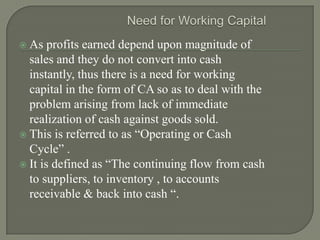
 As   profits earned depend upon magnitude of
  sales and they do not convert into cash
  instantly, thus there is a need for working
  capital in the form of CA so as to deal with the
  problem arising from lack of immediate
  realization of cash against goods sold.
 This is referred to as “Operating or Cash
  Cycle” .
 It is defined as “The continuing flow from cash
  to suppliers, to inventory , to accounts
  receivable & back into cash “.
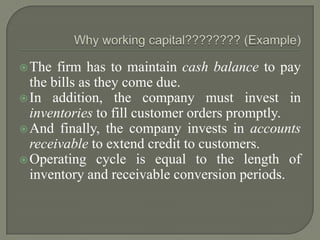
 The  firm has to maintain cash balance to pay
  the bills as they come due.
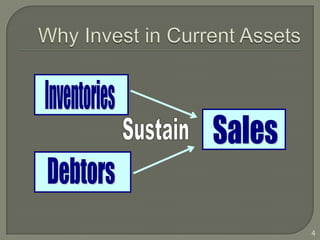
 In addition, the company must invest in
  inventories to fill customer orders promptly.
 And finally, the company invests in accounts
  receivable to extend credit to customers.
 Operating cycle is equal to the length of
  inventory and receivable conversion periods.
 Gross Working Capital
 Net working Capital
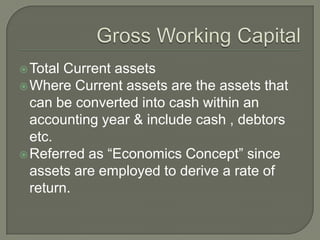
 Total Current assets
 Where Current assets are the assets that
  can be converted into cash within an
  accounting year & include cash , debtors
  etc.
 Referred as “Economics Concept” since
  assets are employed to derive a rate of
  return.
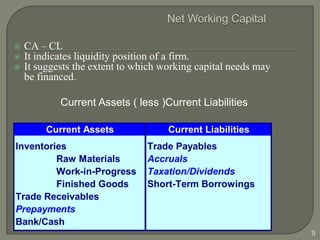
   CA – CL
   It indicates liquidity position of a firm.
   It suggests the extent to which working capital needs may
    be financed.

            Current Assets ( less )Current Liabilities

         Current Assets              Current Liabilities
Inventories                     Trade Payables
         Raw Materials          Accruals
         Work-in-Progress       Taxation/Dividends
         Finished Goods         Short-Term Borrowings
Trade Receivables
Prepayments
Bank/Cash
                                                                9
Having sufficient funds available to meet all
 foreseen and unforeseen obligations


                                                10
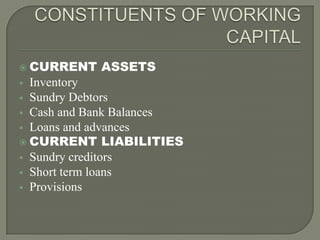
 CURRENT   ASSETS
 Inventory
 Sundry Debtors
 Cash and Bank Balances
 Loans and advances
 CURRENT LIABILITIES
 Sundry creditors
 Short term loans
 Provisions
1. Nature of Business-
 Different Industries have different Working
  Capital requirements.

   Manufacturing and Trading Companies will have
    a high proportion of Current Assets in the form
    of inventory of Raw Materials, Work-in-
    Progress, accounts Receivable, Cash and
    Accounts Payable as Current Liability.

   But in case of public utilities may have limited
    need for working capital because they only have
    cash sales, & supply services, not products and
    no funds will be tied up in debtors & stock.
2. Growth and Expansion
 As the company grows, it is logical to expect that
  a larger amount of working capital is required.
3. Degree of Competition in the Market
   When the degree of competition in the market
   for finished goods in an industry is high, then
   companies belonging to the industry may have to
   resort to an increased credit period to its
   customers to push their products. These practices
   are likely to result in a high proportion of
   accounts receivable.
4. Technology & manufacturing process

 Longer  the manufacturing cycle, larger will be the
  firm’s working capital requirements.
 Exa- Manufacturing cycle in case of boiler- More
  working capital needed depending on its size,
  (may range between Six to Twenty-four months.
 Exa- Manufacturing cycle in case of detergent
  powder, soaps, chocolate etc- less working capital.
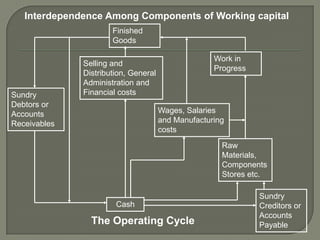
Interdependence Among Components of Working capital
                      Finished
                      Goods

                                                    Work in
              Selling and
                                                    Progress
              Distribution, General
              Administration and
Sundry        Financial costs
Debtors or
Accounts                              Wages, Salaries
Receivables                           and Manufacturing
                                      costs
                                                      Raw
                                                      Materials,
                                                      Components
                                                      Stores etc.

                                                               Sundry
                       Cash                                    Creditors or
                                                               Accounts
                The Operating Cycle                            Payable
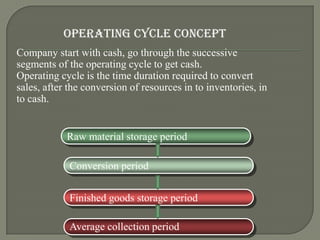
Operating Cycle Concept
Company start with cash, go through the successive
segments of the operating cycle to get cash.
Operating cycle is the time duration required to convert
sales, after the conversion of resources in to inventories, in
to cash.


            Raw material storage period

             Conversion period


             Finished goods storage period

             Average collection period
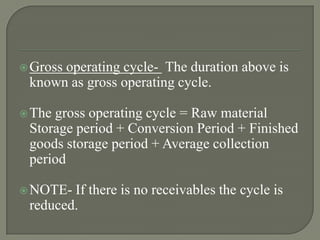
 Gross
      operating cycle- The duration above is
 known as gross operating cycle.

 Thegross operating cycle = Raw material
 Storage period + Conversion Period + Finished
 goods storage period + Average collection
 period

 NOTE- If there is no receivables the cycle is
 reduced.
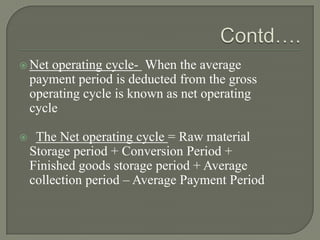
 Net   operating cycle- When the average
    payment period is deducted from the gross
    operating cycle is known as net operating
    cycle

    The Net operating cycle = Raw material
    Storage period + Conversion Period +
    Finished goods storage period + Average
    collection period – Average Payment Period
   Time
    • Permanent
    • Temporary or Variable
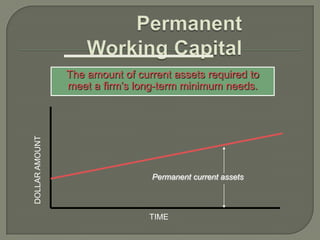
The amount of current assets required to
                meet a firm’s long-term minimum needs.
DOLLAR AMOUNT


                                 Permanent current assets


                                 TIME
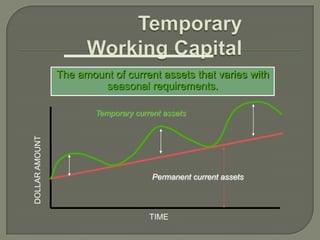
The amount of current assets that varies with
                         seasonal requirements.

                        Temporary current assets
DOLLAR AMOUNT


                                       Permanent current assets


                                      TIME
 We  need working capital for the smooth
  functioning.
 Magnitude of current assets varies with the
  changes in the operating cycle
 There will always be a minimum level of
  current assets (i.e. permanent or fixed current
  assets)
 Depending upon the production and sales the
  need for the working capital over and above
  the fixed level will fluctuate.
A larger investment in current assets would
 mean a low rate of return on investment for
 the firm, as excess investment in current
 assets will not earn enough return.

 On the other hand a smaller investment in
 current assets would mean interrupted
 production & sales.
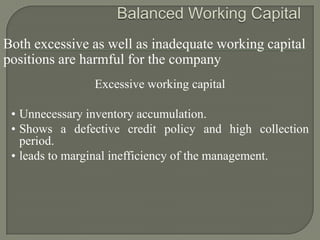
Both excessive as well as inadequate working capital
positions are harmful for the company
               Excessive working capital

 • Unnecessary inventory accumulation.
 • Shows a defective credit policy and high collection
   period.
 • leads to marginal inefficiency of the management.
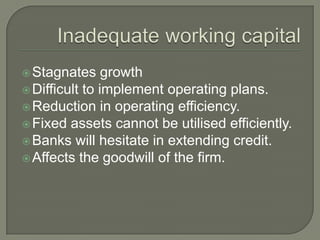
 Stagnates     growth
 Difficult to implement operating plans.
 Reduction in operating efficiency.
 Fixed assets cannot be utilised efficiently.
 Banks will hesitate in extending credit.
 Affects the goodwill of the firm.
 For   more information Log on to


THANK                U

 subhasish.champatisingh@gmail.com

Working capital management

  • 1.
  • 2.
    Working Capital refers to that part of the firm’s capital, which is required for financing short-term or current assets such a cash marketable securities, debtors and inventories.  Funds thus, invested in current assets keep revolving fast and are constantly converted into cash and this cash flow out again in exchange for other current assets.  Working Capital is also known as revolving or circulating capital or short-term capital.
  • 3.
    circulating capital meanscurrent assets of a company that are changed in the ordinary course of business from one form to another, as for example, from cash to inventories, inventories to receivables, receivable to cash”
  • 4.
  • 5.
     As profits earned depend upon magnitude of sales and they do not convert into cash instantly, thus there is a need for working capital in the form of CA so as to deal with the problem arising from lack of immediate realization of cash against goods sold.  This is referred to as “Operating or Cash Cycle” .  It is defined as “The continuing flow from cash to suppliers, to inventory , to accounts receivable & back into cash “.
  • 6.
     The firm has to maintain cash balance to pay the bills as they come due.  In addition, the company must invest in inventories to fill customer orders promptly.  And finally, the company invests in accounts receivable to extend credit to customers.  Operating cycle is equal to the length of inventory and receivable conversion periods.
  • 7.
     Gross WorkingCapital  Net working Capital
  • 8.
     Total Currentassets  Where Current assets are the assets that can be converted into cash within an accounting year & include cash , debtors etc.  Referred as “Economics Concept” since assets are employed to derive a rate of return.
  • 9.
    CA – CL  It indicates liquidity position of a firm.  It suggests the extent to which working capital needs may be financed. Current Assets ( less )Current Liabilities Current Assets Current Liabilities Inventories Trade Payables Raw Materials Accruals Work-in-Progress Taxation/Dividends Finished Goods Short-Term Borrowings Trade Receivables Prepayments Bank/Cash 9
  • 10.
    Having sufficient fundsavailable to meet all foreseen and unforeseen obligations 10
  • 11.
     CURRENT ASSETS  Inventory  Sundry Debtors  Cash and Bank Balances  Loans and advances  CURRENT LIABILITIES  Sundry creditors  Short term loans  Provisions
  • 12.
    1. Nature ofBusiness-  Different Industries have different Working Capital requirements.  Manufacturing and Trading Companies will have a high proportion of Current Assets in the form of inventory of Raw Materials, Work-in- Progress, accounts Receivable, Cash and Accounts Payable as Current Liability.  But in case of public utilities may have limited need for working capital because they only have cash sales, & supply services, not products and no funds will be tied up in debtors & stock.
  • 13.
    2. Growth andExpansion  As the company grows, it is logical to expect that a larger amount of working capital is required. 3. Degree of Competition in the Market When the degree of competition in the market for finished goods in an industry is high, then companies belonging to the industry may have to resort to an increased credit period to its customers to push their products. These practices are likely to result in a high proportion of accounts receivable.
  • 14.
    4. Technology &manufacturing process  Longer the manufacturing cycle, larger will be the firm’s working capital requirements.  Exa- Manufacturing cycle in case of boiler- More working capital needed depending on its size, (may range between Six to Twenty-four months.  Exa- Manufacturing cycle in case of detergent powder, soaps, chocolate etc- less working capital.
  • 15.
    Interdependence Among Componentsof Working capital Finished Goods Work in Selling and Progress Distribution, General Administration and Sundry Financial costs Debtors or Accounts Wages, Salaries Receivables and Manufacturing costs Raw Materials, Components Stores etc. Sundry Cash Creditors or Accounts The Operating Cycle Payable
  • 16.
    Operating Cycle Concept Companystart with cash, go through the successive segments of the operating cycle to get cash. Operating cycle is the time duration required to convert sales, after the conversion of resources in to inventories, in to cash. Raw material storage period Conversion period Finished goods storage period Average collection period
  • 17.
     Gross operating cycle- The duration above is known as gross operating cycle.  Thegross operating cycle = Raw material Storage period + Conversion Period + Finished goods storage period + Average collection period  NOTE- If there is no receivables the cycle is reduced.
  • 18.
     Net operating cycle- When the average payment period is deducted from the gross operating cycle is known as net operating cycle  The Net operating cycle = Raw material Storage period + Conversion Period + Finished goods storage period + Average collection period – Average Payment Period
  • 19.
    Time • Permanent • Temporary or Variable
  • 20.
    The amount ofcurrent assets required to meet a firm’s long-term minimum needs. DOLLAR AMOUNT Permanent current assets TIME
  • 21.
    The amount ofcurrent assets that varies with seasonal requirements. Temporary current assets DOLLAR AMOUNT Permanent current assets TIME
  • 22.
     We need working capital for the smooth functioning.  Magnitude of current assets varies with the changes in the operating cycle  There will always be a minimum level of current assets (i.e. permanent or fixed current assets)  Depending upon the production and sales the need for the working capital over and above the fixed level will fluctuate.
  • 23.
    A larger investmentin current assets would mean a low rate of return on investment for the firm, as excess investment in current assets will not earn enough return.  On the other hand a smaller investment in current assets would mean interrupted production & sales.
  • 24.
    Both excessive aswell as inadequate working capital positions are harmful for the company Excessive working capital • Unnecessary inventory accumulation. • Shows a defective credit policy and high collection period. • leads to marginal inefficiency of the management.
  • 25.
     Stagnates growth  Difficult to implement operating plans.  Reduction in operating efficiency.  Fixed assets cannot be utilised efficiently.  Banks will hesitate in extending credit.  Affects the goodwill of the firm.
  • 26.
     For more information Log on to THANK U  subhasish.champatisingh@gmail.com