PRESENTATION ON :
             INVESTOR LIFE CYCLE
            Presented by:
                      Vinay Kenkere
MEANING
 Investor:
An investor is a party that makes an investment into
  one or more categories of assets --- equity, debt
  securities, real estate, currency, commodity,
  derivatives such as put and call options
with the objective of making a profit.
Someone who provides a business with capital and
  someone who buys a stock are both investors.
  Since those in the secondary market are
  considered investor.
Speculators are also investors.
MEANING
   Investment:
               any vehicle into
    which funds can be placed
    with the expectation that it
    will generate positive income
    and/or that its value will be
    preserved or increased.
Return:
       Current income(Dividends
        /Interest)
       Increase in value(Capital
        Appreciation)
MEANING
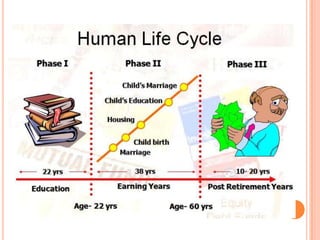
   Investor Life Cycle:

Investors life cycles contains different stages, which
  shows the different phases of individual investor in
  his/her investment life, It also include both short
  term and long term investments
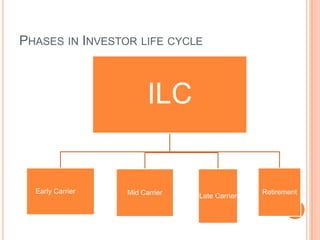
PHASES IN INVESTOR LIFE CYCLE


                        ILC


  Early Carrier   Mid Carrier                  Retirement
                                Late Carrier
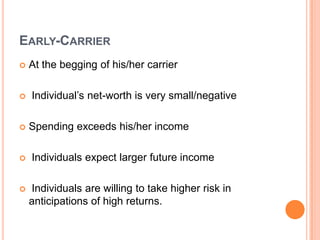
EARLY-CARRIER
   At the begging of his/her carrier

   Individual’s net-worth is very small/negative

   Spending exceeds his/her income

   Individuals expect larger future income

   Individuals are willing to take higher risk in
    anticipations of high returns.
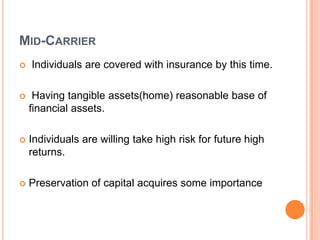
MID-CARRIER
   Individuals are covered with insurance by this time.

    Having tangible assets(home) reasonable base of
    financial assets.

   Individuals are willing take high risk for future high
    returns.

   Preservation of capital acquires some importance
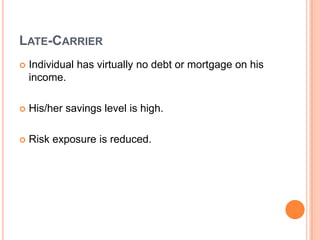
LATE-CARRIER
   Individual has virtually no debt or mortgage on his
    income.

   His/her savings level is high.

   Risk exposure is reduced.
RETIREMENT
   Investments become principal source of income in
    this step.

   Chances of unexpected expenditures (Medical
    expenses)

   Preservation of capital may become the over-riding
    concern.
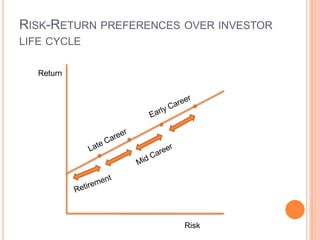
RISK-RETURN PREFERENCES OVER INVESTOR
LIFE CYCLE

   Return


                        Risk
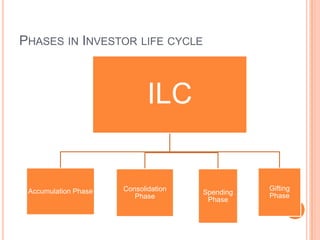
PHASES IN INVESTOR LIFE CYCLE


                             ILC


 Accumulation Phase   Consolidation              Gifting
                                      Spending   Phase
                         Phase         Phase
ACCUMULATION PHASE
   Early to middle years of careers

   Attempting to satisfy intermediate and long-term
    goals

   Net worth is usually small, debt may be heavy

   Long-term investment horizon means usually willing
    to take moderately high risks in order to make
    above-average returns
CONSOLIDATION PHASE
   Past career midpoint

   Have paid off much of their accumulated debt

   Earnings now exceed living expenses, so the
    balance can be invested

   Time horizon is still long-term, so moderately high
    risk investments are still attractive
SPENDING PHASE
   Usually begins at retirement

   Saving before, prudent spending now

   Living expenses covered by Social Security and
    retirement plans

   Changing emphasis toward preservation of
    capital, but still want investment values to keep
    pace with inflation
GIFTING PHASE
   Can be concurrent with spending phase

   If resources allow, individuals can now use excess
    assets to provide gifts to other individuals or
    organizations

   Estate planning becomes important, especially tax
    considerations
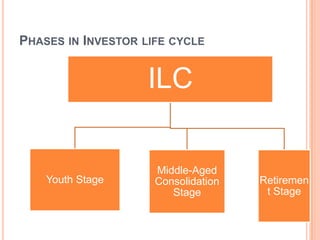
PHASES IN INVESTOR LIFE CYCLE


                    ILC

                     Middle-Aged
    Youth Stage      Consolidation   Retiremen
                        Stage         t Stage
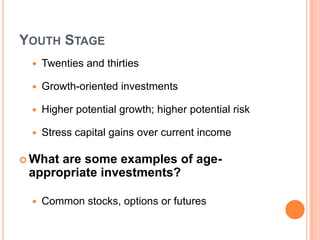
YOUTH STAGE
    Twenties and thirties

    Growth-oriented investments

    Higher potential growth; higher potential risk

    Stress capital gains over current income

 Whatare some examples of age-
 appropriate investments?

    Common stocks, options or futures
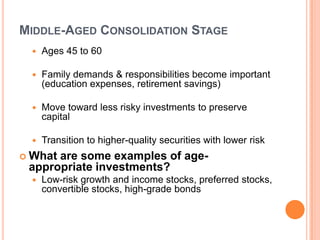
MIDDLE-AGED CONSOLIDATION STAGE
     Ages 45 to 60

     Family demands & responsibilities become important
      (education expenses, retirement savings)

     Move toward less risky investments to preserve
      capital

     Transition to higher-quality securities with lower risk
 Whatare some examples of age-
 appropriate investments?
     Low-risk growth and income stocks, preferred stocks,
      convertible stocks, high-grade bonds
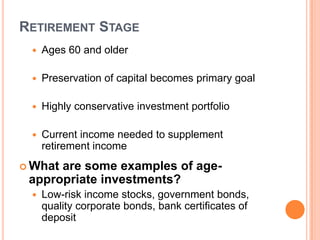
RETIREMENT STAGE
    Ages 60 and older

    Preservation of capital becomes primary goal

    Highly conservative investment portfolio

    Current income needed to supplement
     retirement income
 Whatare some examples of age-
 appropriate investments?
    Low-risk income stocks, government bonds,
     quality corporate bonds, bank certificates of
     deposit
Investors life cycle

Investors life cycle

  • 1.
    PRESENTATION ON : INVESTOR LIFE CYCLE Presented by: Vinay Kenkere
  • 3.
    MEANING  Investor: An investoris a party that makes an investment into one or more categories of assets --- equity, debt securities, real estate, currency, commodity, derivatives such as put and call options with the objective of making a profit. Someone who provides a business with capital and someone who buys a stock are both investors. Since those in the secondary market are considered investor. Speculators are also investors.
  • 4.
    MEANING  Investment: any vehicle into which funds can be placed with the expectation that it will generate positive income and/or that its value will be preserved or increased. Return:  Current income(Dividends /Interest)  Increase in value(Capital Appreciation)
  • 5.
    MEANING  Investor Life Cycle: Investors life cycles contains different stages, which shows the different phases of individual investor in his/her investment life, It also include both short term and long term investments
  • 6.
    PHASES IN INVESTORLIFE CYCLE ILC Early Carrier Mid Carrier Retirement Late Carrier
  • 7.
    EARLY-CARRIER  At the begging of his/her carrier  Individual’s net-worth is very small/negative  Spending exceeds his/her income  Individuals expect larger future income  Individuals are willing to take higher risk in anticipations of high returns.
  • 8.
    MID-CARRIER  Individuals are covered with insurance by this time.  Having tangible assets(home) reasonable base of financial assets.  Individuals are willing take high risk for future high returns.  Preservation of capital acquires some importance
  • 9.
    LATE-CARRIER  Individual has virtually no debt or mortgage on his income.  His/her savings level is high.  Risk exposure is reduced.
  • 10.
    RETIREMENT  Investments become principal source of income in this step.  Chances of unexpected expenditures (Medical expenses)  Preservation of capital may become the over-riding concern.
  • 11.
    RISK-RETURN PREFERENCES OVERINVESTOR LIFE CYCLE Return Risk
  • 12.
    PHASES IN INVESTORLIFE CYCLE ILC Accumulation Phase Consolidation Gifting Spending Phase Phase Phase
  • 13.
    ACCUMULATION PHASE  Early to middle years of careers  Attempting to satisfy intermediate and long-term goals  Net worth is usually small, debt may be heavy  Long-term investment horizon means usually willing to take moderately high risks in order to make above-average returns
  • 14.
    CONSOLIDATION PHASE  Past career midpoint  Have paid off much of their accumulated debt  Earnings now exceed living expenses, so the balance can be invested  Time horizon is still long-term, so moderately high risk investments are still attractive
  • 15.
    SPENDING PHASE  Usually begins at retirement  Saving before, prudent spending now  Living expenses covered by Social Security and retirement plans  Changing emphasis toward preservation of capital, but still want investment values to keep pace with inflation
  • 16.
    GIFTING PHASE  Can be concurrent with spending phase  If resources allow, individuals can now use excess assets to provide gifts to other individuals or organizations  Estate planning becomes important, especially tax considerations
  • 18.
    PHASES IN INVESTORLIFE CYCLE ILC Middle-Aged Youth Stage Consolidation Retiremen Stage t Stage
  • 19.
    YOUTH STAGE  Twenties and thirties  Growth-oriented investments  Higher potential growth; higher potential risk  Stress capital gains over current income  Whatare some examples of age- appropriate investments?  Common stocks, options or futures
  • 20.
    MIDDLE-AGED CONSOLIDATION STAGE  Ages 45 to 60  Family demands & responsibilities become important (education expenses, retirement savings)  Move toward less risky investments to preserve capital  Transition to higher-quality securities with lower risk  Whatare some examples of age- appropriate investments?  Low-risk growth and income stocks, preferred stocks, convertible stocks, high-grade bonds
  • 21.
    RETIREMENT STAGE  Ages 60 and older  Preservation of capital becomes primary goal  Highly conservative investment portfolio  Current income needed to supplement retirement income  Whatare some examples of age- appropriate investments?  Low-risk income stocks, government bonds, quality corporate bonds, bank certificates of deposit