Chapter - 9
Forecasting Exchange Rates
• MNCs need exchange rate forecasts for their:
– Hedging Decisions
– Short-term Financing Decisions
– Short-term Investment Decisions
– Capital Budgeting Decisions
– Long-term Financing Decisions
– Earnings Assessment
Why Firms Forecast Exchange Rates
• Hedging Decision
– MNCs constantly face the decision of whether to hedge future
payables and receivables in foreign currencies.
– Whether a firm hedges may be determined by its forecasts of
foreign currency values.
• Short-term Financing Decision
– When large corporations borrow, they have access to several
different currencies.
– The currency they borrow will ideally exhibit:
1) a low interest rate and
2) weaken in value over the financing period.
Why Firms Forecast Exchange Rates
• Short-term Investment Decision
– Corporations sometimes have a substantial amount of excess
cash available for a short time period.
– The ideal currency they deposits ideally exhibit:
1) a high interest rate and
2) strengthen in value over the investment period.
• Capital Budgeting Decision
– When an MNC’s parent assesses whether to invest funds in a
foreign project, the firm takes into account that:
– The project may periodically require the exchange of
currencies.
– Analysis can be completed only when all estimated cash flows
are measured in the parent’s local currency.
Why Firms Forecast Exchange Rates
• Earnings Assessment
– The parent’s decision about whether a foreign subsidiary:
 Reinvest earnings in a foreign country or
 Remit earnings back to the parent.
– Decision may be influenced by exchange rate forecasts.
 If a strong foreign currency is expected to weaken
substantially, the parent may prefer to expedite the
remittance earnings before the foreign currency weakens.
– When earnings of an MNC are reported, subsidiary earnings
are consolidated and translated into the currency
representing the parent firm’s home country.
Why Firms Forecast Exchange Rates
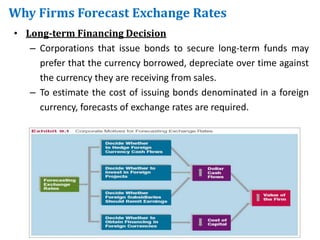
• Long-term Financing Decision
– Corporations that issue bonds to secure long-term funds may
prefer that the currency borrowed, depreciate over time against
the currency they are receiving from sales.
– To estimate the cost of issuing bonds denominated in a foreign
currency, forecasts of exchange rates are required.
Forecasting Techniques
• Numerous methods available for forecasting
exchange rates can be categorized into four general
groups:
1. Technical Forecasting
2. Fundamental Forecasting
3. Market Based Forecasting
• Technical Forecasting
– Technical forecasting involves the use of historical
exchange rate data to predict future values.
– There may be a trend of successive exchange rate
adjustments in the same direction.
– It includes statistical analysis and time series models.
– Speculators may find the models useful for predicting
day-to-day movements.
Forecasting Techniques
• Fundamental Forecasting
– Fundamental forecasting is based on fundamental
relationships between economic variables &
exchange rates.
– A forecast may arise simply from a subjective
assessment of the factors that affect exchange rates.
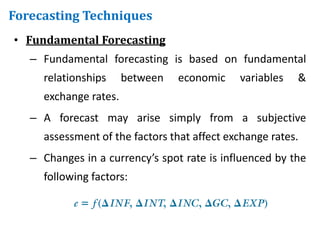
– Changes in a currency’s spot rate is influenced by the
following factors:
Forecasting Techniques
• Market-Based Forecasting
– The process of developing forecasts from market
indicators, is usually based on either;
1. Spot rate or
2. Forward rate.
– Speculation should push the rates to the level that
reflect the market expectation of the future exchange
rate.
– Corporations can use the spot rate to forecast since it
represents the market’s expectation of the spot rate in
the near future.
Forecasting Techniques

Forecasting Exchange Rates

  • 1.
  • 2.
    • MNCs needexchange rate forecasts for their: – Hedging Decisions – Short-term Financing Decisions – Short-term Investment Decisions – Capital Budgeting Decisions – Long-term Financing Decisions – Earnings Assessment Why Firms Forecast Exchange Rates
  • 3.
    Why Firms ForecastExchange Rates • Hedging Decision – MNCs constantly face the decision of whether to hedge future payables and receivables in foreign currencies. – Whether a firm hedges may be determined by its forecasts of foreign currency values. • Short-term Financing Decision – When large corporations borrow, they have access to several different currencies. – The currency they borrow will ideally exhibit: 1) a low interest rate and 2) weaken in value over the financing period.
  • 4.
    Why Firms ForecastExchange Rates • Short-term Investment Decision – Corporations sometimes have a substantial amount of excess cash available for a short time period. – The ideal currency they deposits ideally exhibit: 1) a high interest rate and 2) strengthen in value over the investment period. • Capital Budgeting Decision – When an MNC’s parent assesses whether to invest funds in a foreign project, the firm takes into account that: – The project may periodically require the exchange of currencies. – Analysis can be completed only when all estimated cash flows are measured in the parent’s local currency.
  • 5.
    Why Firms ForecastExchange Rates • Earnings Assessment – The parent’s decision about whether a foreign subsidiary:  Reinvest earnings in a foreign country or  Remit earnings back to the parent. – Decision may be influenced by exchange rate forecasts.  If a strong foreign currency is expected to weaken substantially, the parent may prefer to expedite the remittance earnings before the foreign currency weakens. – When earnings of an MNC are reported, subsidiary earnings are consolidated and translated into the currency representing the parent firm’s home country.
  • 6.
    Why Firms ForecastExchange Rates • Long-term Financing Decision – Corporations that issue bonds to secure long-term funds may prefer that the currency borrowed, depreciate over time against the currency they are receiving from sales. – To estimate the cost of issuing bonds denominated in a foreign currency, forecasts of exchange rates are required.
  • 7.
    Forecasting Techniques • Numerousmethods available for forecasting exchange rates can be categorized into four general groups: 1. Technical Forecasting 2. Fundamental Forecasting 3. Market Based Forecasting
  • 8.
    • Technical Forecasting –Technical forecasting involves the use of historical exchange rate data to predict future values. – There may be a trend of successive exchange rate adjustments in the same direction. – It includes statistical analysis and time series models. – Speculators may find the models useful for predicting day-to-day movements. Forecasting Techniques
  • 9.
    • Fundamental Forecasting –Fundamental forecasting is based on fundamental relationships between economic variables & exchange rates. – A forecast may arise simply from a subjective assessment of the factors that affect exchange rates. – Changes in a currency’s spot rate is influenced by the following factors: Forecasting Techniques
  • 10.
    • Market-Based Forecasting –The process of developing forecasts from market indicators, is usually based on either; 1. Spot rate or 2. Forward rate. – Speculation should push the rates to the level that reflect the market expectation of the future exchange rate. – Corporations can use the spot rate to forecast since it represents the market’s expectation of the spot rate in the near future. Forecasting Techniques