Investment Meaning, Nature and
Scope: Decision Process
Investment
   In finance, the purchase of a financial product or
    other item of value with an expectation of
    favorable future returns. In general terms,
    investment means the use money in the hope of
    making more money.
Objective of SAPM
   To improve decision-making skills in management
    of investment through better understanding of
    modern theories on portfolio management and
    functioning of capital market.
   To get better return on portfolio with lesser risk
Nature and Scope of Investment
Decision
   To understand various investment decision rules.
   To know what are the good investments decisions
    rules.
   To know the category of investment decision
    rules.
   You can take investment decision only after
    analyzing entire process of investment that starts
    with funds contribution and ends with getting
    expectations fulfilled.
Continue…
   The investment decision rules allow you to
    formalize the process and specify what condition
    or conditions need to be met to accept the project.
   You will take decision only after ensuring that the
    required expectations in terms of returns are
    ensured at any cost.
Decision Process
   Understand characteristics of good investment
    decision rules.
   Decide basis of calculation of return based on
    required condition.
   Use constrain to eliminate investment alternatives.
   Follow decision rules to accept or reject
    investment opportunity.
Characteristics of Good Investment
Decision Rules
   It should maintain a fair balance between allowing
    manager to analyze the project and bring-in
    subjective assessment into the decision and
    ensuring that different projects are judged
    consistently.
   It must maximize the value of the firm and
    minimize risk.
   It should work across a variety of investments.
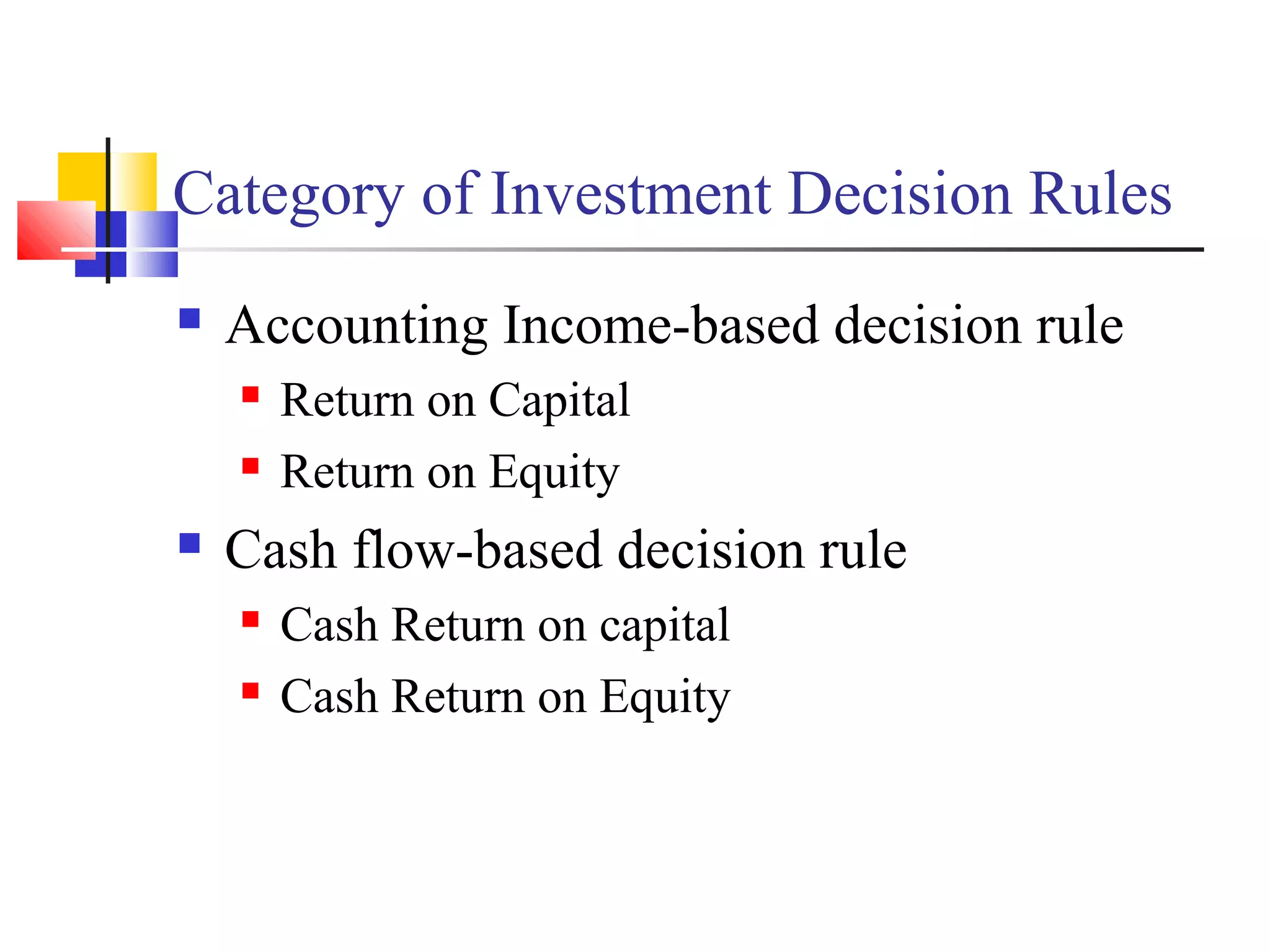
Category of Investment Decision Rules
   Accounting Income-based decision rule
       Return on Capital
       Return on Equity
   Cash flow-based decision rule
       Cash Return on capital
       Cash Return on Equity

01 Investment meaning, nature and scope

  • 1.
    Investment Meaning, Natureand Scope: Decision Process
  • 2.
    Investment  In finance, the purchase of a financial product or other item of value with an expectation of favorable future returns. In general terms, investment means the use money in the hope of making more money.
  • 3.
    Objective of SAPM  To improve decision-making skills in management of investment through better understanding of modern theories on portfolio management and functioning of capital market.  To get better return on portfolio with lesser risk
  • 4.
    Nature and Scopeof Investment Decision  To understand various investment decision rules.  To know what are the good investments decisions rules.  To know the category of investment decision rules.  You can take investment decision only after analyzing entire process of investment that starts with funds contribution and ends with getting expectations fulfilled.
  • 5.
    Continue…  The investment decision rules allow you to formalize the process and specify what condition or conditions need to be met to accept the project.  You will take decision only after ensuring that the required expectations in terms of returns are ensured at any cost.
  • 6.
    Decision Process  Understand characteristics of good investment decision rules.  Decide basis of calculation of return based on required condition.  Use constrain to eliminate investment alternatives.  Follow decision rules to accept or reject investment opportunity.
  • 7.
    Characteristics of GoodInvestment Decision Rules  It should maintain a fair balance between allowing manager to analyze the project and bring-in subjective assessment into the decision and ensuring that different projects are judged consistently.  It must maximize the value of the firm and minimize risk.  It should work across a variety of investments.
  • 8.
    Category of InvestmentDecision Rules  Accounting Income-based decision rule  Return on Capital  Return on Equity  Cash flow-based decision rule  Cash Return on capital  Cash Return on Equity