Topic on: traffic volume study 
Presented by :- 
Kalpataru Das 
120101cel062
OUTLINE 
1. Objectives 
2. Scope 
3. Definition 
4. Methodology 
5. Data presentation 
6. Purpose 
7. Conclusion
OBJECTIVE 
 Counting is the most fundamental measurement in 
traffic engineering: vehicles, passenger etc. 
 Counting technique to produce estimates of volume, 
rate flow, demand and capacity. 
 The purposes of carrying out traffic volume count are 
designing, improving traffic system, planning, 
management etc. 
 Traffic volume study is used in plan.
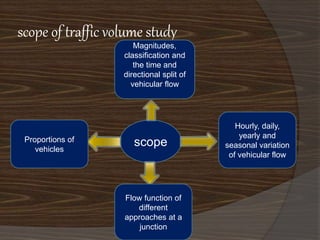
scope of traffic volume study 
Magnitudes, 
classification and 
the time and 
directional split of 
vehicular flow 
Proportions of scope 
vehicles 
Flow function of 
different 
approaches at a 
junction 
Hourly, daily, 
yearly and 
seasonal variation 
of vehicular flow
DEFINATION 
 Traffic volume study is producer to determine 
mainly the volume of traffic moving on roads on a 
particular section during a particular time. 
 AADT: Average annual daily traffic obtain by adding 
daily traffic count in one year divided by 365. 
 ADT: Average daily traffic is the volume of traffic 
total counted on the roadway(two way) over a given 
time period(greater than one day but less than one 
year) divided by the number of days in that time 
period.
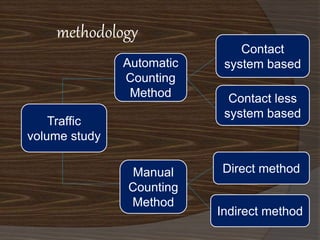
methodology 
Traffic 
volume study 
Automatic 
Counting 
Method 
Manual 
Counting 
Method 
Contact 
system based 
Contact less 
system based 
Direct method 
Indirect method
Automatic counting method 
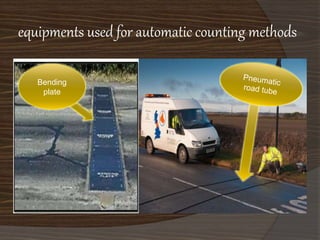
 In this method, vehicles are counted automatically 
without any human involvement. 
 There are two techniques of automatic counting 
 Contact system based:- 
 It is based on pneumatic, mechanical, magnetic or 
piezo-electric method. 
 Contactless system based:- 
 It is based on electrical/optical, ultrasound/infrared 
radar, micro wave, CCTV/video image processing 
method.
equipments used for automatic counting methods 
Bending 
plate
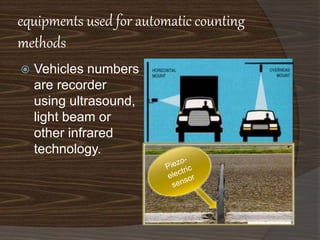
equipments used for automatic counting 
methods 
 Vehicles numbers 
are recorder 
using ultrasound, 
light beam or 
other infrared 
technology.
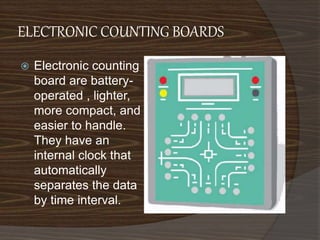
ELECTRONIC COUNTING BOARDS 
 Electronic counting 
board are battery-operated 
, lighter, 
more compact, and 
easier to handle. 
They have an 
internal clock that 
automatically 
separates the data 
by time interval.
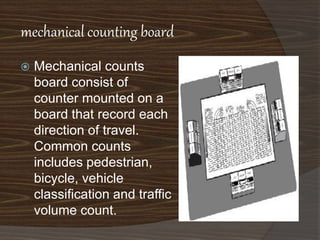
mechanical counting board 
 Mechanical counts 
board consist of 
counter mounted on a 
board that record each 
direction of travel. 
Common counts 
includes pedestrian, 
bicycle, vehicle 
classification and traffic 
volume count.
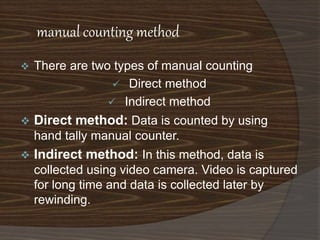
manual counting method 
 There are two types of manual counting 
 Direct method 
 Indirect method 
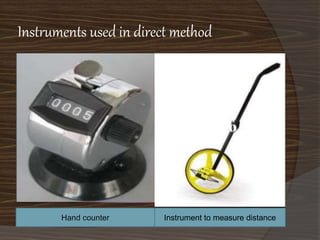
 Direct method: Data is counted by using 
hand tally manual counter. 
 Indirect method: In this method, data is 
collected using video camera. Video is captured 
for long time and data is collected later by 
rewinding.
Instruments used in direct method 
Hand counter Instrument to measure distance
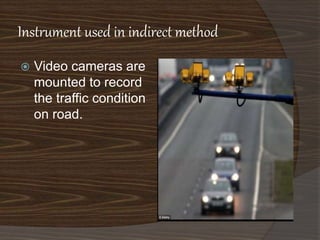
Instrument used in indirect method 
 Video cameras are 
mounted to record 
the traffic condition 
on road.
Data presentation 
The collect from traffic volume counts 
may be presented in the several ways 
depending on the type of count 
conducted and primary use of the data.
continue… 
 Trend chart showing volume trends over 
period of years are prepared. These data 
useful for planning future expansion, 
design and regulation. 
 Variation chart showing hourly,daily and 
seasonal variations are also prepared. 
these help in deciding the facilities and 
regulation needed during peak traffic 
periods. 
 Traffic flow maps along the routes are 
drawn.These helps to find the traffic 
volume distribution at glance.
continue… 
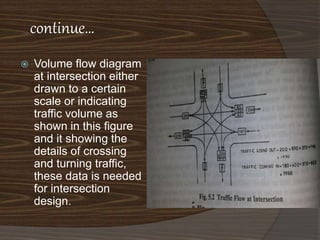
 Volume flow diagram 
at intersection either 
drawn to a certain 
scale or indicating 
traffic volume as 
shown in this figure 
and it showing the 
details of crossing 
and turning traffic, 
these data is needed 
for intersection 
design.
purposes 
 Estimating of highway usage 
 Measurement of current demand of 
facility 
 Economic feasibility evaluation 
 Computation of accident rates 
 Improvement purpose 
 Planning purpose 
 Traffic management purpose
conclusion 
 Light vehicles(car,jeep,etc) occupied 
64% of total vehicle 
 Percentage of auto rickshaw is relatively 
high 
 Percentage of public transport is very 
low
Traffic volume study

Traffic volume study

  • 1.
    Topic on: trafficvolume study Presented by :- Kalpataru Das 120101cel062
  • 2.
    OUTLINE 1. Objectives 2. Scope 3. Definition 4. Methodology 5. Data presentation 6. Purpose 7. Conclusion
  • 3.
    OBJECTIVE  Countingis the most fundamental measurement in traffic engineering: vehicles, passenger etc.  Counting technique to produce estimates of volume, rate flow, demand and capacity.  The purposes of carrying out traffic volume count are designing, improving traffic system, planning, management etc.  Traffic volume study is used in plan.
  • 4.
    scope of trafficvolume study Magnitudes, classification and the time and directional split of vehicular flow Proportions of scope vehicles Flow function of different approaches at a junction Hourly, daily, yearly and seasonal variation of vehicular flow
  • 5.
    DEFINATION  Trafficvolume study is producer to determine mainly the volume of traffic moving on roads on a particular section during a particular time.  AADT: Average annual daily traffic obtain by adding daily traffic count in one year divided by 365.  ADT: Average daily traffic is the volume of traffic total counted on the roadway(two way) over a given time period(greater than one day but less than one year) divided by the number of days in that time period.
  • 6.
    methodology Traffic volumestudy Automatic Counting Method Manual Counting Method Contact system based Contact less system based Direct method Indirect method
  • 7.
    Automatic counting method  In this method, vehicles are counted automatically without any human involvement.  There are two techniques of automatic counting  Contact system based:-  It is based on pneumatic, mechanical, magnetic or piezo-electric method.  Contactless system based:-  It is based on electrical/optical, ultrasound/infrared radar, micro wave, CCTV/video image processing method.
  • 8.
    equipments used forautomatic counting methods Bending plate
  • 9.
    equipments used forautomatic counting methods  Vehicles numbers are recorder using ultrasound, light beam or other infrared technology.
  • 10.
    ELECTRONIC COUNTING BOARDS  Electronic counting board are battery-operated , lighter, more compact, and easier to handle. They have an internal clock that automatically separates the data by time interval.
  • 11.
    mechanical counting board  Mechanical counts board consist of counter mounted on a board that record each direction of travel. Common counts includes pedestrian, bicycle, vehicle classification and traffic volume count.
  • 12.
    manual counting method  There are two types of manual counting  Direct method  Indirect method  Direct method: Data is counted by using hand tally manual counter.  Indirect method: In this method, data is collected using video camera. Video is captured for long time and data is collected later by rewinding.
  • 13.
    Instruments used indirect method Hand counter Instrument to measure distance
  • 14.
    Instrument used inindirect method  Video cameras are mounted to record the traffic condition on road.
  • 16.
    Data presentation Thecollect from traffic volume counts may be presented in the several ways depending on the type of count conducted and primary use of the data.
  • 17.
    continue…  Trendchart showing volume trends over period of years are prepared. These data useful for planning future expansion, design and regulation.  Variation chart showing hourly,daily and seasonal variations are also prepared. these help in deciding the facilities and regulation needed during peak traffic periods.  Traffic flow maps along the routes are drawn.These helps to find the traffic volume distribution at glance.
  • 18.
    continue…  Volumeflow diagram at intersection either drawn to a certain scale or indicating traffic volume as shown in this figure and it showing the details of crossing and turning traffic, these data is needed for intersection design.
  • 19.
    purposes  Estimatingof highway usage  Measurement of current demand of facility  Economic feasibility evaluation  Computation of accident rates  Improvement purpose  Planning purpose  Traffic management purpose
  • 20.
    conclusion  Lightvehicles(car,jeep,etc) occupied 64% of total vehicle  Percentage of auto rickshaw is relatively high  Percentage of public transport is very low