Lecture02(C Expressions & Operators)
June 20, 2010
      Today's Outline
         C operators
         Operator Precedence & Associativity
         C Expression Evaluation
         Type Conversion in Expressions


 Md. Mahbub Alam   Structured Programming Language   1
                              (CSE-1121)
C Operators
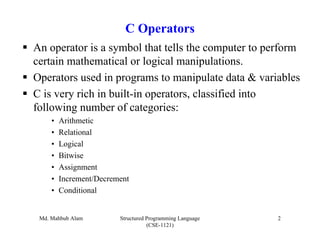
An operator is a symbol that tells the computer to perform
certain mathematical or logical manipulations.
Operators used in programs to manipulate data & variables
C is very rich in built-in operators, classified into
following number of categories:
     •   Arithmetic
     •   Relational
     •   Logical
     •   Bitwise
     •   Assignment
     •   Increment/Decrement
     •   Conditional


 Md. Mahbub Alam         Structured Programming Language   2
                                    (CSE-1121)
C Operators - Arithmetic Operators
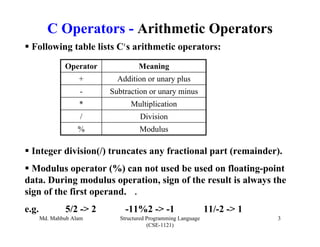
 Following table lists C’s arithmetic operators:
               Operator             Meaning
                    +       Addition or unary plus
                    -     Subtraction or unary minus
                    *            Multiplication
                     /              Division
                    %               Modulus

 Integer division(/) truncates any fractional part (remainder).
  Modulus operator (%) can not used be used on floating-point
data. During modulus operation, sign of the result is always the
sign of the first operand. .
e.g.           5/2 -> 2        -11%2 -> -1                     11/-2 -> 1
       Md. Mahbub Alam       Structured Programming Language                3
                                        (CSE-1121)
C Operators – Relational Operators
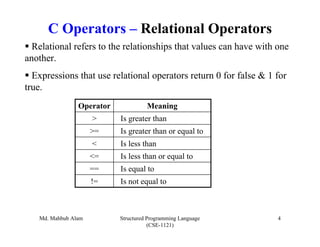
  Relational refers to the relationships that values can have with one
another.
  Expressions that use relational operators return 0 for false & 1 for
true.
                Operator             Meaning
                     >     Is greater than
                     >=    Is greater than or equal to
                     <     Is less than
                     <=    Is less than or equal to
                     ==    Is equal to
                     !=    Is not equal to


   Md. Mahbub Alam         Structured Programming Language         4
                                      (CSE-1121)
C Operators – Logical Operators
Logical refers to the ways relationships can be connected.
Expressions that use logical operators return 0 for false & 1 for true.
             Operator         Meaning
                    &&   AND
                    ||   OR
                    !    NOT

The truth table for logical operators is shown below:
                    P    Q      P && Q         P || Q      !P
                    0    0           0            0        1
                    0    1           0            1        1
                    1    1           1            1        0
                    1    0           0            1        0
  Md. Mahbub Alam        Structured Programming Language          5
                                    (CSE-1121)
C Operators – Bitwise Operators
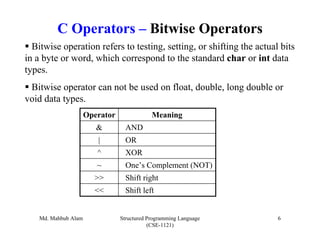
  Bitwise operation refers to testing, setting, or shifting the actual bits
in a byte or word, which correspond to the standard char or int data
types.
 Bitwise operator can not be used on float, double, long double or
void data types.
                      Operator               Meaning
                         &         AND
                         |         OR
                         ^         XOR
                         ~         One’s Complement (NOT)
                        >>         Shift right
                        <<         Shift left


    Md. Mahbub Alam              Structured Programming Language      6
                                            (CSE-1121)
C Operators – Assignment Operator
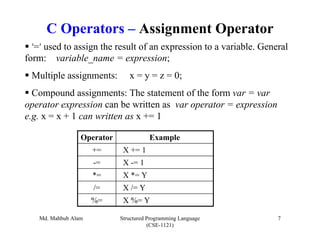
  ‘=‘ used to assign the result of an expression to a variable. General
form: variable_name = expression;
 Multiple assignments:         x = y = z = 0;
  Compound assignments: The statement of the form var = var
operator expression can be written as var operator = expression
e.g. x = x + 1 can written as x += 1

                 Operator              Example
                     +=      X += 1
                     -=      X -= 1
                     *=      X *= Y
                     /=      X /= Y
                     %=      X %= Y

   Md. Mahbub Alam          Structured Programming Language         7
                                       (CSE-1121)
C Operators – Increment/Decrement
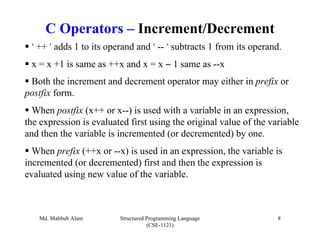
 ‘ ++ ’ adds 1 to its operand and ‘ -- ’ subtracts 1 from its operand.
 x = x +1 is same as ++x and x = x – 1 same as --x
 Both the increment and decrement operator may either in prefix or
postfix form.
  When postfix (x++ or x--) is used with a variable in an expression,
the expression is evaluated first using the original value of the variable
and then the variable is incremented (or decremented) by one.
  When prefix (++x or --x) is used in an expression, the variable is
incremented (or decremented) first and then the expression is
evaluated using new value of the variable.


   Md. Mahbub Alam       Structured Programming Language            8
                                    (CSE-1121)
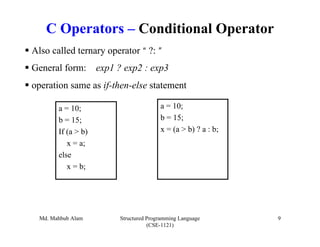
C Operators – Conditional Operator
Also called ternary operator “ ?: ”
General form: exp1 ? exp2 : exp3
operation same as if-then-else statement

        a = 10;                       a = 10;
        b = 15;                       b = 15;
        If (a > b)                    x = (a > b) ? a : b;
           x = a;
        else
           x = b;


  Md. Mahbub Alam      Structured Programming Language       9
                                  (CSE-1121)
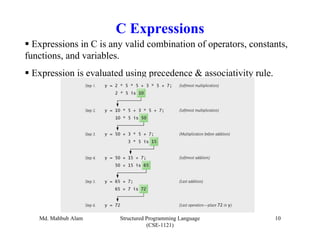
C Expressions
  Expressions in C is any valid combination of operators, constants,
functions, and variables.
 Expression is evaluated using precedence & associativity rule.


   Md. Mahbub Alam      Structured Programming Language           10
                                   (CSE-1121)
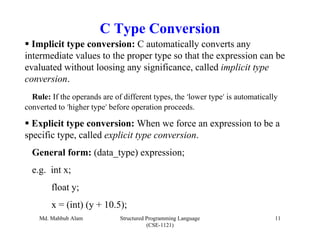
C Type Conversion
  Implicit type conversion: C automatically converts any
intermediate values to the proper type so that the expression can be
evaluated without loosing any significance, called implicit type
conversion.
  Rule: If the operands are of different types, the ‘lower type’ is automatically
converted to ‘higher type’ before operation proceeds.

  Explicit type conversion: When we force an expression to be a
specific type, called explicit type conversion.
  General form: (data_type) expression;
  e.g. int x;
        float y;
        x = (int) (y + 10.5);
    Md. Mahbub Alam           Structured Programming Language                   11
                                         (CSE-1121)
Any Question?


Md. Mahbub Alam   Structured Programming Language   12
                             (CSE-1121)
Thank You All


Md. Mahbub Alam     Structured Programming Language   13
                               (CSE-1121)

Lecture03(c expressions & operators)

  • 1.
    Lecture02(C Expressions &Operators) June 20, 2010 Today's Outline C operators Operator Precedence & Associativity C Expression Evaluation Type Conversion in Expressions Md. Mahbub Alam Structured Programming Language 1 (CSE-1121)
  • 2.
    C Operators An operatoris a symbol that tells the computer to perform certain mathematical or logical manipulations. Operators used in programs to manipulate data & variables C is very rich in built-in operators, classified into following number of categories: • Arithmetic • Relational • Logical • Bitwise • Assignment • Increment/Decrement • Conditional Md. Mahbub Alam Structured Programming Language 2 (CSE-1121)
  • 3.
    C Operators -Arithmetic Operators Following table lists C’s arithmetic operators: Operator Meaning + Addition or unary plus - Subtraction or unary minus * Multiplication / Division % Modulus Integer division(/) truncates any fractional part (remainder). Modulus operator (%) can not used be used on floating-point data. During modulus operation, sign of the result is always the sign of the first operand. . e.g. 5/2 -> 2 -11%2 -> -1 11/-2 -> 1 Md. Mahbub Alam Structured Programming Language 3 (CSE-1121)
  • 4.
    C Operators –Relational Operators Relational refers to the relationships that values can have with one another. Expressions that use relational operators return 0 for false & 1 for true. Operator Meaning > Is greater than >= Is greater than or equal to < Is less than <= Is less than or equal to == Is equal to != Is not equal to Md. Mahbub Alam Structured Programming Language 4 (CSE-1121)
  • 5.
    C Operators –Logical Operators Logical refers to the ways relationships can be connected. Expressions that use logical operators return 0 for false & 1 for true. Operator Meaning && AND || OR ! NOT The truth table for logical operators is shown below: P Q P && Q P || Q !P 0 0 0 0 1 0 1 0 1 1 1 1 1 1 0 1 0 0 1 0 Md. Mahbub Alam Structured Programming Language 5 (CSE-1121)
  • 6.
    C Operators –Bitwise Operators Bitwise operation refers to testing, setting, or shifting the actual bits in a byte or word, which correspond to the standard char or int data types. Bitwise operator can not be used on float, double, long double or void data types. Operator Meaning & AND | OR ^ XOR ~ One’s Complement (NOT) >> Shift right << Shift left Md. Mahbub Alam Structured Programming Language 6 (CSE-1121)
  • 7.
    C Operators –Assignment Operator ‘=‘ used to assign the result of an expression to a variable. General form: variable_name = expression; Multiple assignments: x = y = z = 0; Compound assignments: The statement of the form var = var operator expression can be written as var operator = expression e.g. x = x + 1 can written as x += 1 Operator Example += X += 1 -= X -= 1 *= X *= Y /= X /= Y %= X %= Y Md. Mahbub Alam Structured Programming Language 7 (CSE-1121)
  • 8.
    C Operators –Increment/Decrement ‘ ++ ’ adds 1 to its operand and ‘ -- ’ subtracts 1 from its operand. x = x +1 is same as ++x and x = x – 1 same as --x Both the increment and decrement operator may either in prefix or postfix form. When postfix (x++ or x--) is used with a variable in an expression, the expression is evaluated first using the original value of the variable and then the variable is incremented (or decremented) by one. When prefix (++x or --x) is used in an expression, the variable is incremented (or decremented) first and then the expression is evaluated using new value of the variable. Md. Mahbub Alam Structured Programming Language 8 (CSE-1121)
  • 9.
    C Operators –Conditional Operator Also called ternary operator “ ?: ” General form: exp1 ? exp2 : exp3 operation same as if-then-else statement a = 10; a = 10; b = 15; b = 15; If (a > b) x = (a > b) ? a : b; x = a; else x = b; Md. Mahbub Alam Structured Programming Language 9 (CSE-1121)
  • 10.
    C Expressions Expressions in C is any valid combination of operators, constants, functions, and variables. Expression is evaluated using precedence & associativity rule. Md. Mahbub Alam Structured Programming Language 10 (CSE-1121)
  • 11.
    C Type Conversion Implicit type conversion: C automatically converts any intermediate values to the proper type so that the expression can be evaluated without loosing any significance, called implicit type conversion. Rule: If the operands are of different types, the ‘lower type’ is automatically converted to ‘higher type’ before operation proceeds. Explicit type conversion: When we force an expression to be a specific type, called explicit type conversion. General form: (data_type) expression; e.g. int x; float y; x = (int) (y + 10.5); Md. Mahbub Alam Structured Programming Language 11 (CSE-1121)
  • 12.
    Any Question? Md. MahbubAlam Structured Programming Language 12 (CSE-1121)
  • 13.
    Thank You All Md.Mahbub Alam Structured Programming Language 13 (CSE-1121)