Transportation Engineering
Lina Shbeeb
Capacity Analysis
Traffic flow theory in practice
 Used in facility planning
 The understanding of facility capacity
 Used in design
 The sizing and geometric features of facilities
 Used in performance measure
 The level of service offered by a specific facility
 Delay
 Travel speeds
 Travel times
Applications of Traffic Flow Theory
 Determining turning lane lengths
 Average delay at intersections
 Average delay at freeway ramp merging areas
 Change in the levels of freeway performance
 Simulation (mathematical models (algorithms) to study
interrelationship among the different elements of traffic
itcdemo3d.ram
Various Types of Traffic Volumes
 DailyVolume
 AverageAnnual DailyTraffic (AADT)
 AverageAnnualWeekdayTraffic (AAWT)
 Average DailyTraffic (ADT)
 AverageWeekdayTraffic (AWT)
 HourlyVolume
 SubhourlyVolume
AADT and AAWT
 AverageAnnual DailyTraffic (AADT)
 Average 24-hour traffic volume at a location over a full 365-day
year, which is the total number of vehicles passing the location
divided by 365
 AverageAnnualWeekdayTraffic (AAWT)
 Average 24-hour traffic volume on weekdays over a full year,
which is the total weekday traffic volume divided by 260
ADT and AWT
 Average DailyTraffic (ADT)
 Average 24-hour traffic at a location for any period less than a
year (e.g. six months, a season, a month, a week or even two
days)
 AverageWeekdayTraffic (AWT)
 Average 24-hour traffic volume on weekdays for any period less
than a year
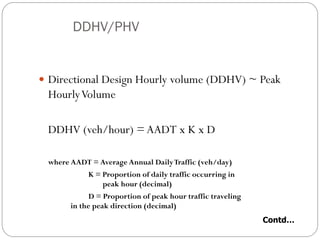
DDHV/PHV
 Directional Design Hourly volume (DDHV) ~ Peak
HourlyVolume
DDHV (veh/hour) =AADT x K x D
where AADT = Average Annual DailyTraffic (veh/day)
K = Proportion of daily traffic occurring in
peak hour (decimal)
D = Proportion of peak hour traffic traveling
in the peak direction (decimal)
Contd…
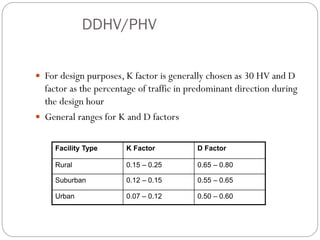
DDHV/PHV
 For design purposes, K factor is generally chosen as 30 HV and D
factor as the percentage of traffic in predominant direction during
the design hour
 General ranges for K and D factors
Facility Type K Factor D Factor
Rural 0.15 – 0.25 0.65 – 0.80
Suburban 0.12 – 0.15 0.55 – 0.65
Urban 0.07 – 0.12 0.50 – 0.60
Sub-Hourly Volume
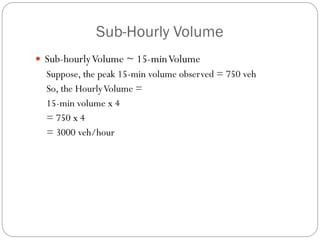
 Sub-hourlyVolume ~ 15-minVolume
Suppose, the peak 15-min volume observed = 750 veh
So, the HourlyVolume =
15-min volume x 4
= 750 x 4
= 3000 veh/hour
Peak Hour Factor
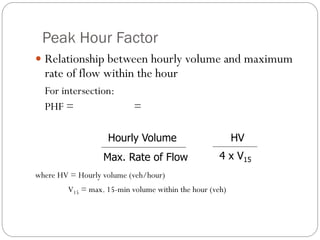
 Relationship between hourly volume and maximum
rate of flow within the hour
For intersection:
PHF = =
where HV = Hourly volume (veh/hour)
V15 = max. 15-min volume within the hour (veh)
Hourly Volume
Max. Rate of Flow
HV
4 x V15
Example of PHF Calculation
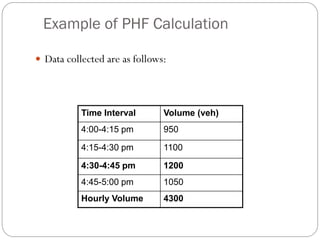
 Data collected are as follows:
Time Interval Volume (veh)
4:00-4:15 pm 950
4:15-4:30 pm 1100
4:30-4:45 pm 1200
4:45-5:00 pm 1050
Hourly Volume 4300
Example of PHF Calculation
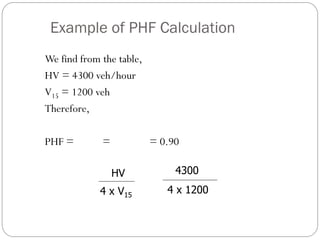
We find from the table,
HV = 4300 veh/hour
V15 = 1200 veh
Therefore,
PHF = = = 0.90
HV
4 x V15
4300
4 x 1200
Peak Hour Factor
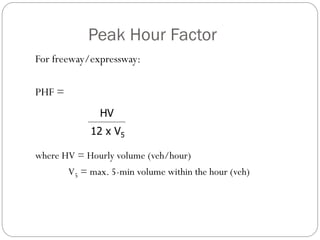
For freeway/expressway:
PHF =
where HV = Hourly volume (veh/hour)
V5 = max. 5-min volume within the hour (veh)
HV
12 x V5
Traffic Volume
 Number of vehicles passing a given point or a section of a
roadway during a specified time
 Data collected by
 Manual counting
 Electro-mechanical devices
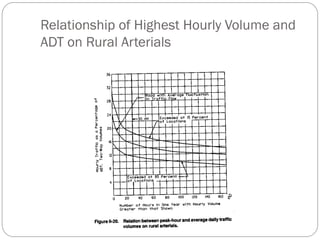
Relationship of Highest Hourly Volume and
ADT on Rural Arterials
Travel Time and Delay Surveys
 Want to determine travel time between two points or causes of
delay along a route
 Used for
Performance monitoring
Before and after evaluation of traffic management
schemes or new infrastructure
Stream measurements: the moving
observer method
 Moving Observer
 stopwatch, pen and paper
 laptop PC
 instrumented vehicle
=> Chase car versus floating car techniques
 Stationary Observer
 number plate survey
 Field staff or optical character recognition from video
 Vehicle electronic tags
 Mobile phone
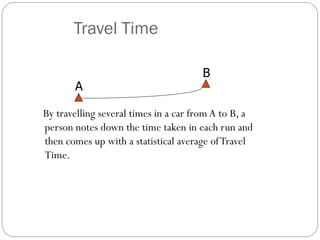
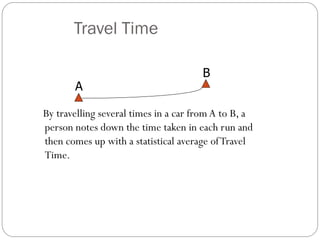
Travel Time
By travelling several times in a car fromA to B, a
person notes down the time taken in each run and
then comes up with a statistical average ofTravel
Time.
A
B
Delay
Delay =Actual travel time - Expected travel time
 Stopped time delay
 Travel time delay
Calculation of Delay
 Travel time delay
 Actual travel time data collected by traveling in a car through
the stretch of the road under study.
 Expected travel time calculated from the distance and average
speed.
 Travel time delay calculated from the difference between actual
travel time and expected travel time.
 Stopped time data for the vehicular speed of 0 to 5 mph.
Introduction
 Shock wave - a rapid change in traffic conditions (speed,
density, and flow)
 A moving boundary between two different traffic states
 Forward, backward, and stationary shock waves
Travel Time
By travelling several times in a car fromA to B, a
person notes down the time taken in each run and
then comes up with a statistical average ofTravel
Time.
A
B
Delay
Delay =Actual travel time - Expected travel time
 Stopped time delay
 Travel time delay
Calculation of Delay
 Travel time delay
 Actual travel time data collected by traveling in a car through
the stretch of the road under study.
 Expected travel time calculated from the distance and average
speed.
 Travel time delay calculated from the difference between actual
travel time and expected travel time.
 Stopped time data for the vehicular speed of 0 to 5 mph.
Level of Service (LOS)
25
 Concept – a qualitative measure describing operational
conditions within a traffic stream and their perception by
drivers and/or passengers
 Levels represent range of operating conditions defined
by measures of effectiveness (MOE)
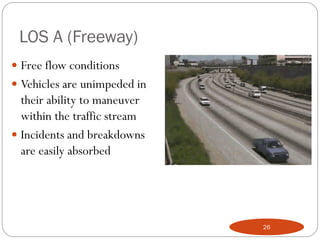
LOS A (Freeway)
 Free flow conditions
 Vehicles are unimpeded in
their ability to maneuver
within the traffic stream
 Incidents and breakdowns
are easily absorbed
26
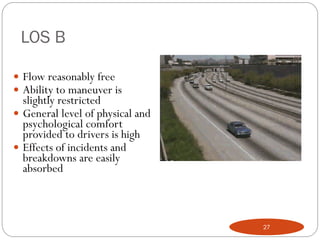
LOS B
 Flow reasonably free
 Ability to maneuver is
slightly restricted
 General level of physical and
psychological comfort
provided to drivers is high
 Effects of incidents and
breakdowns are easily
absorbed
27
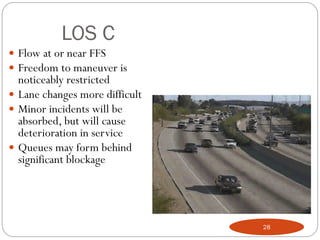
LOS C
 Flow at or near FFS
 Freedom to maneuver is
noticeably restricted
 Lane changes more difficult
 Minor incidents will be
absorbed, but will cause
deterioration in service
 Queues may form behind
significant blockage
28
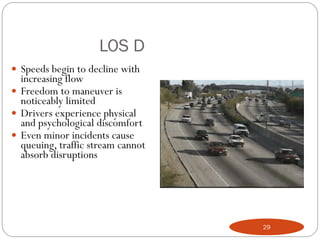
LOS D
 Speeds begin to decline with
increasing flow
 Freedom to maneuver is
noticeably limited
 Drivers experience physical
and psychological discomfort
 Even minor incidents cause
queuing, traffic stream cannot
absorb disruptions
29
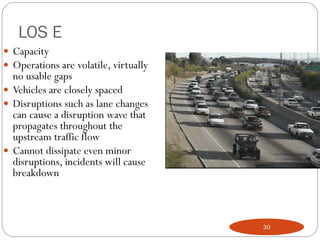
LOS E
 Capacity
 Operations are volatile, virtually
no usable gaps
 Vehicles are closely spaced
 Disruptions such as lane changes
can cause a disruption wave that
propagates throughout the
upstream traffic flow
 Cannot dissipate even minor
disruptions, incidents will cause
breakdown
30
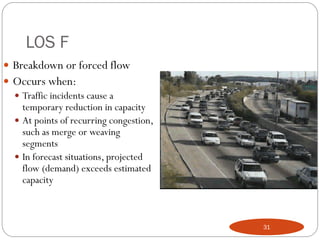
LOS F
 Breakdown or forced flow
 Occurs when:
 Traffic incidents cause a
temporary reduction in capacity
 At points of recurring congestion,
such as merge or weaving
segments
 In forecast situations, projected
flow (demand) exceeds estimated
capacity
31
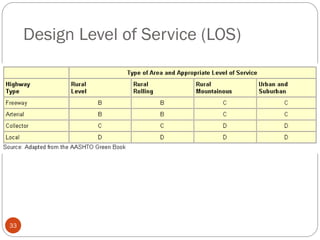
Design Level of Service
32
This is the desired quality of traffic conditions from a driver’s
perspective (used to determine number of lanes)
 Design LOS is higher for higher functional classes
 Design LOS is higher for rural areas
 LOS is higher for level/rolling than mountainous terrain
 Other factors include: adjacent land use type and development
intensity, environmental factors, and aesthetic and historic values
 Design all elements to same LOS (use HCM to analyze)
Design Level of Service (LOS)
33
Capacity – Defined
34
 Capacity: Maximum hourly rate of vehicles or
persons that can reasonably be expected to pass a point, or
traverse a uniform section of lane or roadway,
during a specified time period under prevailing conditions
(traffic and roadway)
 Different for different facilities (freeway, multilane, 2-
lane rural, signals)
 Why would it be different?
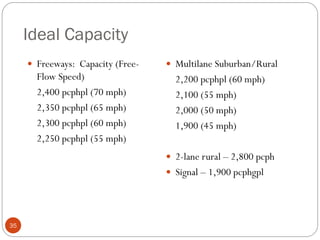
Ideal Capacity
35
 Freeways: Capacity (Free-
Flow Speed)
2,400 pcphpl (70 mph)
2,350 pcphpl (65 mph)
2,300 pcphpl (60 mph)
2,250 pcphpl (55 mph)
 Multilane Suburban/Rural
2,200 pcphpl (60 mph)
2,100 (55 mph)
2,000 (50 mph)
1,900 (45 mph)
 2-lane rural – 2,800 pcph
 Signal – 1,900 pcphgpl
Principles for Acceptable Degree of
Congestion:
36
1. Demand <= capacity, even for short time
2. 75-85% of capacity at signals
3. Dissipate from queue @ 1500-1800 vph
4. Afford some choice of speed, related to trip length
5. Freedom from tension, esp long trips, < 42 veh/mi.
6. Practical limits - users expect lower LOS in expensive
situations (urban, mountainous)
Multilane Highways
37
 Chapter 21 of the Highway Capacity Manual
 For rural and suburban multilane highways
 Assumptions (Ideal Conditions, all other conditions
reduce capacity):
 Only passenger cars
 No direct access points
 A divided highway
 FFS > 60 mph
 Represents highest level of multilane rural and suburban
highways
Multilane Highways
38
 Intended for analysis of uninterrupted-flow highway
segments
 Signal spacing > 2.0 miles
 No on-street parking
 No significant bus stops
 No significant pedestrian activities
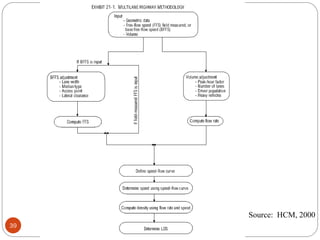
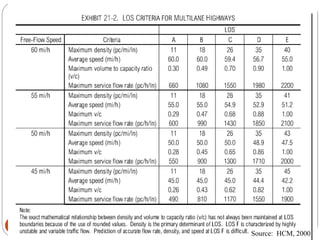
39
Source: HCM, 2000
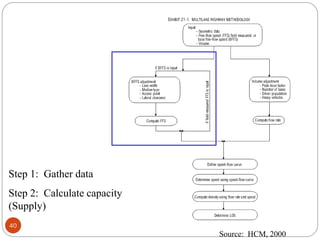
40
Source: HCM, 2000
Step 1: Gather data
Step 2: Calculate capacity
(Supply)
41
Source: HCM, 2000
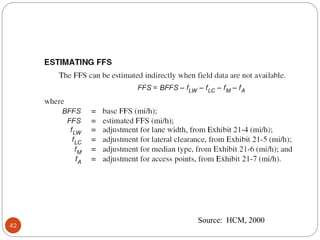
42
Source: HCM, 2000
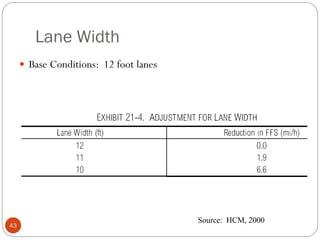
Lane Width
43
 Base Conditions: 12 foot lanes
Source: HCM, 2000
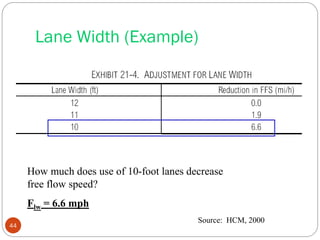
Lane Width (Example)
44
Source: HCM, 2000
How much does use of 10-foot lanes decrease
free flow speed?
Flw = 6.6 mph
Lateral Clearance
45
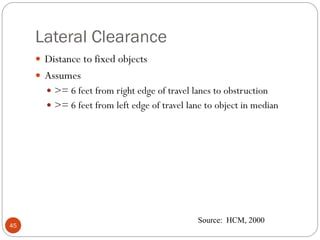
 Distance to fixed objects
 Assumes
 >= 6 feet from right edge of travel lanes to obstruction
 >= 6 feet from left edge of travel lane to object in median
Source: HCM, 2000
Lateral Clearance
46
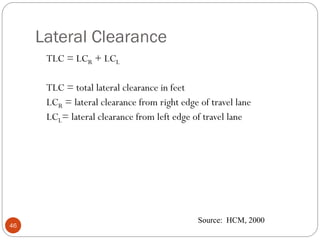
TLC = LCR + LCL
TLC = total lateral clearance in feet
LCR = lateral clearance from right edge of travel lane
LCL= lateral clearance from left edge of travel lane
Source: HCM, 2000
47
Source: HCM, 2000
48
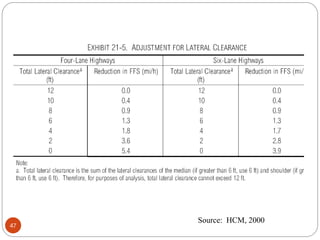
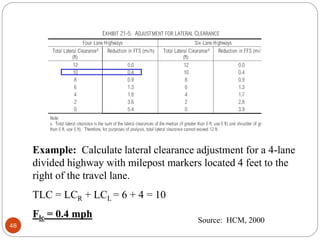
Example: Calculate lateral clearance adjustment for a 4-lane
divided highway with milepost markers located 4 feet to the
right of the travel lane.
TLC = LCR + LCL = 6 + 4 = 10
Flc = 0.4 mph
Source: HCM, 2000
49
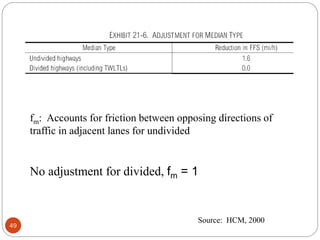
fm: Accounts for friction between opposing directions of
traffic in adjacent lanes for undivided
No adjustment for divided, fm = 1
Source: HCM, 2000
50
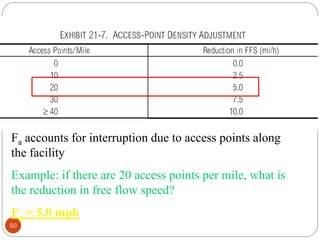
Fa accounts for interruption due to access points along
the facility
Example: if there are 20 access points per mile, what is
the reduction in free flow speed?
Fa = 5.0 mph
Estimate Free flow Speed
51
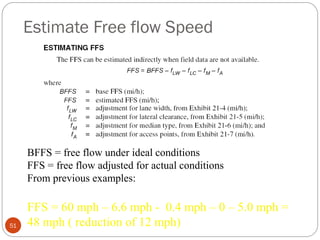
BFFS = free flow under ideal conditions
FFS = free flow adjusted for actual conditions
From previous examples:
FFS = 60 mph – 6.6 mph - 0.4 mph – 0 – 5.0 mph =
48 mph ( reduction of 12 mph)
52
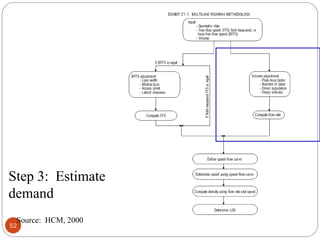
Source: HCM, 2000
Step 3: Estimate
demand
53
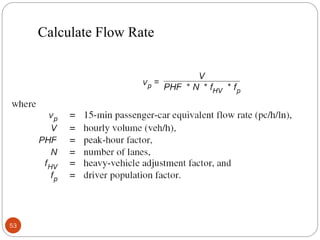
Calculate Flow Rate
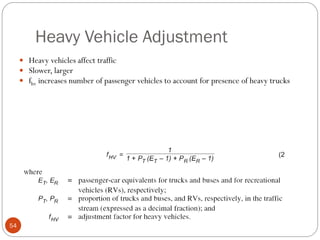
Heavy Vehicle Adjustment
54
 Heavy vehicles affect traffic
 Slower, larger
 fhv increases number of passenger vehicles to account for presence of heavy trucks
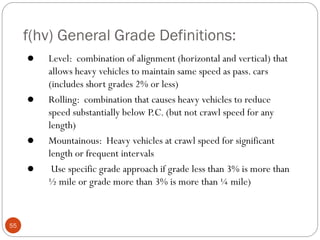
f(hv) General Grade Definitions:
55
 Level: combination of alignment (horizontal and vertical) that
allows heavy vehicles to maintain same speed as pass. cars
(includes short grades 2% or less)
 Rolling: combination that causes heavy vehicles to reduce
speed substantially below P.C. (but not crawl speed for any
length)
 Mountainous: Heavy vehicles at crawl speed for significant
length or frequent intervals
 Use specific grade approach if grade less than 3% is more than
½ mile or grade more than 3% is more than ¼ mile)
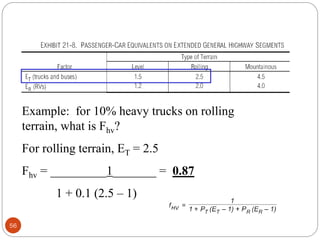
56
Example: for 10% heavy trucks on rolling
terrain, what is Fhv?
For rolling terrain, ET = 2.5
Fhv = _________1_______ = 0.87
1 + 0.1 (2.5 – 1)
Driver Population Factor (fp)
57
 Non-familiar users affect capacity
 fp = 1, familiar users
 1 > fp >=0.85, unfamiliar users
58
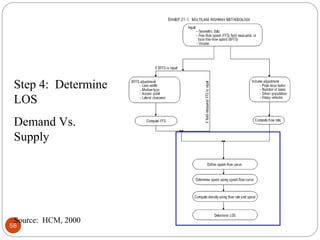
Source: HCM, 2000
Step 4: Determine
LOS
Demand Vs.
Supply
59
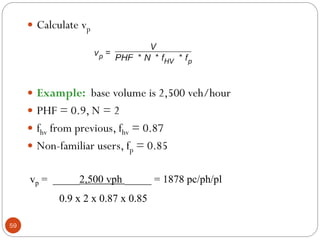
 Calculate vp
 Example: base volume is 2,500 veh/hour
 PHF = 0.9, N = 2
 fhv from previous, fhv = 0.87
 Non-familiar users, fp = 0.85
vp = _____2,500 vph _____ = 1878 pc/ph/pl
0.9 x 2 x 0.87 x 0.85
Calculate Density
60
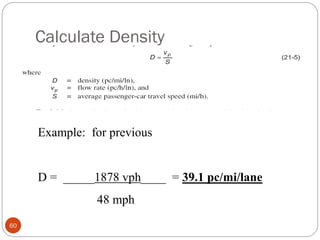
Example: for previous
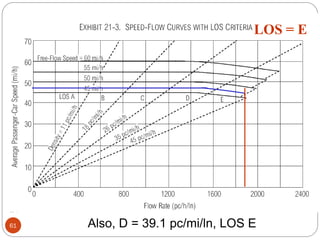
D = _____1878 vph____ = 39.1 pc/mi/lane
48 mph
61
LOS = E
Also, D = 39.1 pc/mi/ln, LOS E
Design Decision
62
 What can we change in a design to provide an acceptable
LOS?
 Lateral clearance (only 0.4 mph)
 Lane width
 Number of lanes
Lane Width (Example)
63
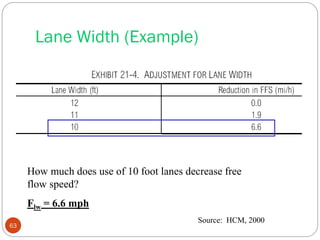
Source: HCM, 2000
How much does use of 10 foot lanes decrease free
flow speed?
Flw = 6.6 mph
Recalculate Density
64
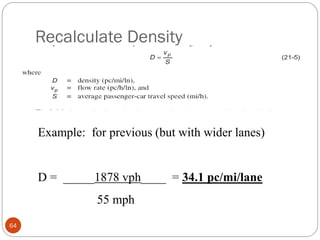
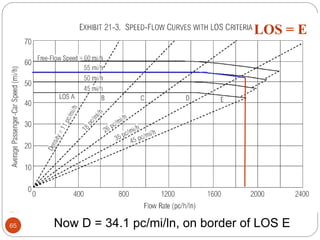
Example: for previous (but with wider lanes)
D = _____1878 vph____ = 34.1 pc/mi/lane
55 mph
65
LOS = E
Now D = 34.1 pc/mi/ln, on border of LOS E
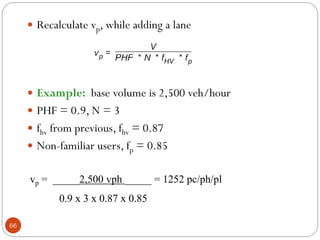
66
 Recalculate vp, while adding a lane
 Example: base volume is 2,500 veh/hour
 PHF = 0.9, N = 3
 fhv from previous, fhv = 0.87
 Non-familiar users, fp = 0.85
vp = _____2,500 vph _____ = 1252 pc/ph/pl
0.9 x 3 x 0.87 x 0.85
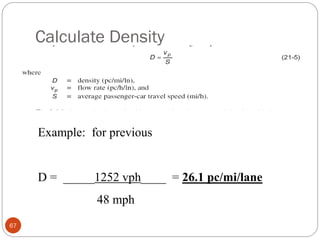
Calculate Density
67
Example: for previous
D = _____1252 vph____ = 26.1 pc/mi/lane
48 mph
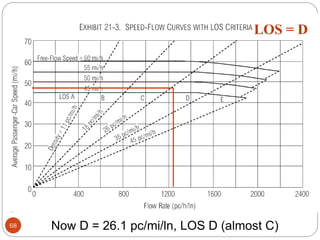
68
LOS = D
Now D = 26.1 pc/mi/ln, LOS D (almost C)

Lec 12 Capacity Analysis (Transportation Engineering Dr.Lina Shbeeb)

  • 1.
  • 2.
    Traffic flow theoryin practice  Used in facility planning  The understanding of facility capacity  Used in design  The sizing and geometric features of facilities  Used in performance measure  The level of service offered by a specific facility  Delay  Travel speeds  Travel times
  • 3.
    Applications of TrafficFlow Theory  Determining turning lane lengths  Average delay at intersections  Average delay at freeway ramp merging areas  Change in the levels of freeway performance  Simulation (mathematical models (algorithms) to study interrelationship among the different elements of traffic itcdemo3d.ram
  • 4.
    Various Types ofTraffic Volumes  DailyVolume  AverageAnnual DailyTraffic (AADT)  AverageAnnualWeekdayTraffic (AAWT)  Average DailyTraffic (ADT)  AverageWeekdayTraffic (AWT)  HourlyVolume  SubhourlyVolume
  • 5.
    AADT and AAWT AverageAnnual DailyTraffic (AADT)  Average 24-hour traffic volume at a location over a full 365-day year, which is the total number of vehicles passing the location divided by 365  AverageAnnualWeekdayTraffic (AAWT)  Average 24-hour traffic volume on weekdays over a full year, which is the total weekday traffic volume divided by 260
  • 6.
    ADT and AWT Average DailyTraffic (ADT)  Average 24-hour traffic at a location for any period less than a year (e.g. six months, a season, a month, a week or even two days)  AverageWeekdayTraffic (AWT)  Average 24-hour traffic volume on weekdays for any period less than a year
  • 7.
    DDHV/PHV  Directional DesignHourly volume (DDHV) ~ Peak HourlyVolume DDHV (veh/hour) =AADT x K x D where AADT = Average Annual DailyTraffic (veh/day) K = Proportion of daily traffic occurring in peak hour (decimal) D = Proportion of peak hour traffic traveling in the peak direction (decimal) Contd…
  • 8.
    DDHV/PHV  For designpurposes, K factor is generally chosen as 30 HV and D factor as the percentage of traffic in predominant direction during the design hour  General ranges for K and D factors Facility Type K Factor D Factor Rural 0.15 – 0.25 0.65 – 0.80 Suburban 0.12 – 0.15 0.55 – 0.65 Urban 0.07 – 0.12 0.50 – 0.60
  • 9.
    Sub-Hourly Volume  Sub-hourlyVolume~ 15-minVolume Suppose, the peak 15-min volume observed = 750 veh So, the HourlyVolume = 15-min volume x 4 = 750 x 4 = 3000 veh/hour
  • 10.
    Peak Hour Factor Relationship between hourly volume and maximum rate of flow within the hour For intersection: PHF = = where HV = Hourly volume (veh/hour) V15 = max. 15-min volume within the hour (veh) Hourly Volume Max. Rate of Flow HV 4 x V15
  • 11.
    Example of PHFCalculation  Data collected are as follows: Time Interval Volume (veh) 4:00-4:15 pm 950 4:15-4:30 pm 1100 4:30-4:45 pm 1200 4:45-5:00 pm 1050 Hourly Volume 4300
  • 12.
    Example of PHFCalculation We find from the table, HV = 4300 veh/hour V15 = 1200 veh Therefore, PHF = = = 0.90 HV 4 x V15 4300 4 x 1200
  • 13.
    Peak Hour Factor Forfreeway/expressway: PHF = where HV = Hourly volume (veh/hour) V5 = max. 5-min volume within the hour (veh) HV 12 x V5
  • 14.
    Traffic Volume  Numberof vehicles passing a given point or a section of a roadway during a specified time  Data collected by  Manual counting  Electro-mechanical devices
  • 15.
    Relationship of HighestHourly Volume and ADT on Rural Arterials
  • 16.
    Travel Time andDelay Surveys  Want to determine travel time between two points or causes of delay along a route  Used for Performance monitoring Before and after evaluation of traffic management schemes or new infrastructure
  • 17.
    Stream measurements: themoving observer method  Moving Observer  stopwatch, pen and paper  laptop PC  instrumented vehicle => Chase car versus floating car techniques  Stationary Observer  number plate survey  Field staff or optical character recognition from video  Vehicle electronic tags  Mobile phone
  • 18.
    Travel Time By travellingseveral times in a car fromA to B, a person notes down the time taken in each run and then comes up with a statistical average ofTravel Time. A B
  • 19.
    Delay Delay =Actual traveltime - Expected travel time  Stopped time delay  Travel time delay
  • 20.
    Calculation of Delay Travel time delay  Actual travel time data collected by traveling in a car through the stretch of the road under study.  Expected travel time calculated from the distance and average speed.  Travel time delay calculated from the difference between actual travel time and expected travel time.  Stopped time data for the vehicular speed of 0 to 5 mph.
  • 21.
    Introduction  Shock wave- a rapid change in traffic conditions (speed, density, and flow)  A moving boundary between two different traffic states  Forward, backward, and stationary shock waves
  • 22.
    Travel Time By travellingseveral times in a car fromA to B, a person notes down the time taken in each run and then comes up with a statistical average ofTravel Time. A B
  • 23.
    Delay Delay =Actual traveltime - Expected travel time  Stopped time delay  Travel time delay
  • 24.
    Calculation of Delay Travel time delay  Actual travel time data collected by traveling in a car through the stretch of the road under study.  Expected travel time calculated from the distance and average speed.  Travel time delay calculated from the difference between actual travel time and expected travel time.  Stopped time data for the vehicular speed of 0 to 5 mph.
  • 25.
    Level of Service(LOS) 25  Concept – a qualitative measure describing operational conditions within a traffic stream and their perception by drivers and/or passengers  Levels represent range of operating conditions defined by measures of effectiveness (MOE)
  • 26.
    LOS A (Freeway) Free flow conditions  Vehicles are unimpeded in their ability to maneuver within the traffic stream  Incidents and breakdowns are easily absorbed 26
  • 27.
    LOS B  Flowreasonably free  Ability to maneuver is slightly restricted  General level of physical and psychological comfort provided to drivers is high  Effects of incidents and breakdowns are easily absorbed 27
  • 28.
    LOS C  Flowat or near FFS  Freedom to maneuver is noticeably restricted  Lane changes more difficult  Minor incidents will be absorbed, but will cause deterioration in service  Queues may form behind significant blockage 28
  • 29.
    LOS D  Speedsbegin to decline with increasing flow  Freedom to maneuver is noticeably limited  Drivers experience physical and psychological discomfort  Even minor incidents cause queuing, traffic stream cannot absorb disruptions 29
  • 30.
    LOS E  Capacity Operations are volatile, virtually no usable gaps  Vehicles are closely spaced  Disruptions such as lane changes can cause a disruption wave that propagates throughout the upstream traffic flow  Cannot dissipate even minor disruptions, incidents will cause breakdown 30
  • 31.
    LOS F  Breakdownor forced flow  Occurs when:  Traffic incidents cause a temporary reduction in capacity  At points of recurring congestion, such as merge or weaving segments  In forecast situations, projected flow (demand) exceeds estimated capacity 31
  • 32.
    Design Level ofService 32 This is the desired quality of traffic conditions from a driver’s perspective (used to determine number of lanes)  Design LOS is higher for higher functional classes  Design LOS is higher for rural areas  LOS is higher for level/rolling than mountainous terrain  Other factors include: adjacent land use type and development intensity, environmental factors, and aesthetic and historic values  Design all elements to same LOS (use HCM to analyze)
  • 33.
    Design Level ofService (LOS) 33
  • 34.
    Capacity – Defined 34 Capacity: Maximum hourly rate of vehicles or persons that can reasonably be expected to pass a point, or traverse a uniform section of lane or roadway, during a specified time period under prevailing conditions (traffic and roadway)  Different for different facilities (freeway, multilane, 2- lane rural, signals)  Why would it be different?
  • 35.
    Ideal Capacity 35  Freeways:Capacity (Free- Flow Speed) 2,400 pcphpl (70 mph) 2,350 pcphpl (65 mph) 2,300 pcphpl (60 mph) 2,250 pcphpl (55 mph)  Multilane Suburban/Rural 2,200 pcphpl (60 mph) 2,100 (55 mph) 2,000 (50 mph) 1,900 (45 mph)  2-lane rural – 2,800 pcph  Signal – 1,900 pcphgpl
  • 36.
    Principles for AcceptableDegree of Congestion: 36 1. Demand <= capacity, even for short time 2. 75-85% of capacity at signals 3. Dissipate from queue @ 1500-1800 vph 4. Afford some choice of speed, related to trip length 5. Freedom from tension, esp long trips, < 42 veh/mi. 6. Practical limits - users expect lower LOS in expensive situations (urban, mountainous)
  • 37.
    Multilane Highways 37  Chapter21 of the Highway Capacity Manual  For rural and suburban multilane highways  Assumptions (Ideal Conditions, all other conditions reduce capacity):  Only passenger cars  No direct access points  A divided highway  FFS > 60 mph  Represents highest level of multilane rural and suburban highways
  • 38.
    Multilane Highways 38  Intendedfor analysis of uninterrupted-flow highway segments  Signal spacing > 2.0 miles  No on-street parking  No significant bus stops  No significant pedestrian activities
  • 39.
  • 40.
    40 Source: HCM, 2000 Step1: Gather data Step 2: Calculate capacity (Supply)
  • 41.
  • 42.
  • 43.
    Lane Width 43  BaseConditions: 12 foot lanes Source: HCM, 2000
  • 44.
    Lane Width (Example) 44 Source:HCM, 2000 How much does use of 10-foot lanes decrease free flow speed? Flw = 6.6 mph
  • 45.
    Lateral Clearance 45  Distanceto fixed objects  Assumes  >= 6 feet from right edge of travel lanes to obstruction  >= 6 feet from left edge of travel lane to object in median Source: HCM, 2000
  • 46.
    Lateral Clearance 46 TLC =LCR + LCL TLC = total lateral clearance in feet LCR = lateral clearance from right edge of travel lane LCL= lateral clearance from left edge of travel lane Source: HCM, 2000
  • 47.
  • 48.
    48 Example: Calculate lateralclearance adjustment for a 4-lane divided highway with milepost markers located 4 feet to the right of the travel lane. TLC = LCR + LCL = 6 + 4 = 10 Flc = 0.4 mph Source: HCM, 2000
  • 49.
    49 fm: Accounts forfriction between opposing directions of traffic in adjacent lanes for undivided No adjustment for divided, fm = 1 Source: HCM, 2000
  • 50.
    50 Fa accounts forinterruption due to access points along the facility Example: if there are 20 access points per mile, what is the reduction in free flow speed? Fa = 5.0 mph
  • 51.
    Estimate Free flowSpeed 51 BFFS = free flow under ideal conditions FFS = free flow adjusted for actual conditions From previous examples: FFS = 60 mph – 6.6 mph - 0.4 mph – 0 – 5.0 mph = 48 mph ( reduction of 12 mph)
  • 52.
    52 Source: HCM, 2000 Step3: Estimate demand
  • 53.
  • 54.
    Heavy Vehicle Adjustment 54 Heavy vehicles affect traffic  Slower, larger  fhv increases number of passenger vehicles to account for presence of heavy trucks
  • 55.
    f(hv) General GradeDefinitions: 55  Level: combination of alignment (horizontal and vertical) that allows heavy vehicles to maintain same speed as pass. cars (includes short grades 2% or less)  Rolling: combination that causes heavy vehicles to reduce speed substantially below P.C. (but not crawl speed for any length)  Mountainous: Heavy vehicles at crawl speed for significant length or frequent intervals  Use specific grade approach if grade less than 3% is more than ½ mile or grade more than 3% is more than ¼ mile)
  • 56.
    56 Example: for 10%heavy trucks on rolling terrain, what is Fhv? For rolling terrain, ET = 2.5 Fhv = _________1_______ = 0.87 1 + 0.1 (2.5 – 1)
  • 57.
    Driver Population Factor(fp) 57  Non-familiar users affect capacity  fp = 1, familiar users  1 > fp >=0.85, unfamiliar users
  • 58.
    58 Source: HCM, 2000 Step4: Determine LOS Demand Vs. Supply
  • 59.
    59  Calculate vp Example: base volume is 2,500 veh/hour  PHF = 0.9, N = 2  fhv from previous, fhv = 0.87  Non-familiar users, fp = 0.85 vp = _____2,500 vph _____ = 1878 pc/ph/pl 0.9 x 2 x 0.87 x 0.85
  • 60.
    Calculate Density 60 Example: forprevious D = _____1878 vph____ = 39.1 pc/mi/lane 48 mph
  • 61.
    61 LOS = E Also,D = 39.1 pc/mi/ln, LOS E
  • 62.
    Design Decision 62  Whatcan we change in a design to provide an acceptable LOS?  Lateral clearance (only 0.4 mph)  Lane width  Number of lanes
  • 63.
    Lane Width (Example) 63 Source:HCM, 2000 How much does use of 10 foot lanes decrease free flow speed? Flw = 6.6 mph
  • 64.
    Recalculate Density 64 Example: forprevious (but with wider lanes) D = _____1878 vph____ = 34.1 pc/mi/lane 55 mph
  • 65.
    65 LOS = E NowD = 34.1 pc/mi/ln, on border of LOS E
  • 66.
    66  Recalculate vp,while adding a lane  Example: base volume is 2,500 veh/hour  PHF = 0.9, N = 3  fhv from previous, fhv = 0.87  Non-familiar users, fp = 0.85 vp = _____2,500 vph _____ = 1252 pc/ph/pl 0.9 x 3 x 0.87 x 0.85
  • 67.
    Calculate Density 67 Example: forprevious D = _____1252 vph____ = 26.1 pc/mi/lane 48 mph
  • 68.
    68 LOS = D NowD = 26.1 pc/mi/ln, LOS D (almost C)